Gettysburg Voices Reading Worksheet
Grade 6 Social Studies & Reading
Name:
Date:
Period:
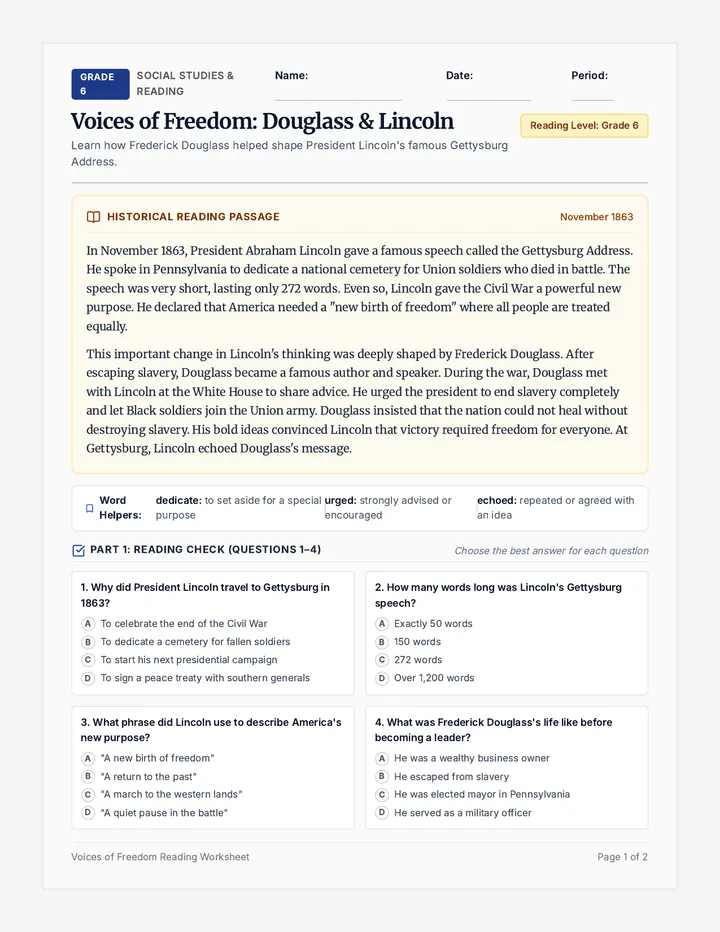
Voices of Freedom: Douglass & Lincoln
Learn how Frederick Douglass helped shape President Lincoln's famous Gettysburg Address.
Reading Level: Grade 6
Historical Reading Passage
November 1863
In November 1863, President Abraham Lincoln gave a famous speech called the Gettysburg Address. He spoke in Pennsylvania to dedicate a national cemetery for Union soldiers who died in battle. The speech was very short, lasting only 272 words. Even so, Lincoln gave the Civil War a powerful new purpose. He declared that America needed a "new birth of freedom" where all people are treated equally.
This important change in Lincoln's thinking was deeply shaped by Frederick Douglass. After escaping slavery, Douglass became a famous author and speaker. During the war, Douglass met with Lincoln at the White House to share advice. He urged the president to end slavery completely and let Black soldiers join the Union army. Douglass insisted that the nation could not heal without destroying slavery. His bold ideas convinced Lincoln that victory required freedom for everyone. At Gettysburg, Lincoln echoed Douglass's message.
Word Helpers:
dedicate: to set aside for a special purpose
urged: strongly advised or encouraged
echoed: repeated or agreed with an idea
Part 1: Reading Check (Questions 1–4)
Choose the best answer for each question
1. Why did President Lincoln travel to Gettysburg in 1863?
A To celebrate the end of the Civil War
B To dedicate a cemetery for fallen soldiers
C To start his next presidential campaign
D To sign a peace treaty with southern generals
2. How many words long was Lincoln's Gettysburg speech?
A Exactly 50 words
B 150 words
C 272 words
D Over 1,200 words
3. What phrase did Lincoln use to describe America's new purpose?
A "A new birth of freedom"
B "A return to the past"
C "A march to the western lands"
D "A quiet pause in the battle"
4. What was Frederick Douglass's life like before becoming a leader?
A He was a wealthy business owner
B He escaped from slavery
C He was elected mayor in Pennsylvania
D He served as a military officer
Voices of Freedom Reading Worksheet Page 1 of 2
Voices of Freedom: Part 2
Comprehension questions continued & written response.
Name:
Score: / 10
Part 2: Reading Check (Questions 5–8)
Choose the best answer for each question
5. How did Frederick Douglass share his ideas with Lincoln?
A By meeting him at the White House
B By writing secret messages in code
C By arguing with him in court trials
D By sending letters through battlefield scouts
6. What did Douglass ask Lincoln to allow Black Americans to do?
A Move to other countries for safety
B Join the Union army as soldiers
C Stop participating in public speeches
D Form an independent government
7. What does the passage mean when it says Lincoln echoed Douglass?
A Lincoln shouted as loudly as he could
B Lincoln repeated and agreed with Douglass's ideas
C Lincoln copied Douglass's handwriting
D Lincoln disagreed with Douglass's goals
8. What is the main idea of this reading passage?
A Lincoln gave the longest speech in American history
B Douglass's ideas helped convince Lincoln to make the war about freedom
C The battle of Gettysburg was fought entirely in the White House
D Douglass and Lincoln could not agree on cemetery dedications
Part 3: Written Response & Text Evidence
Standards: CCSS.ELA-LITERACY.RI.6.1 & RI.6.2
Question: According to the passage, why did Frederick Douglass believe the nation could not heal without destroying slavery? Use at least one detail or phrase from the passage to support your answer.
Self-Check:
Still Learning Almost Got It Confident!
Common Core Standards: RI.6.1 (Evidence), RI.6.2 (Central Idea), RI.6.4 (Vocabulary)
Page 2 of 2
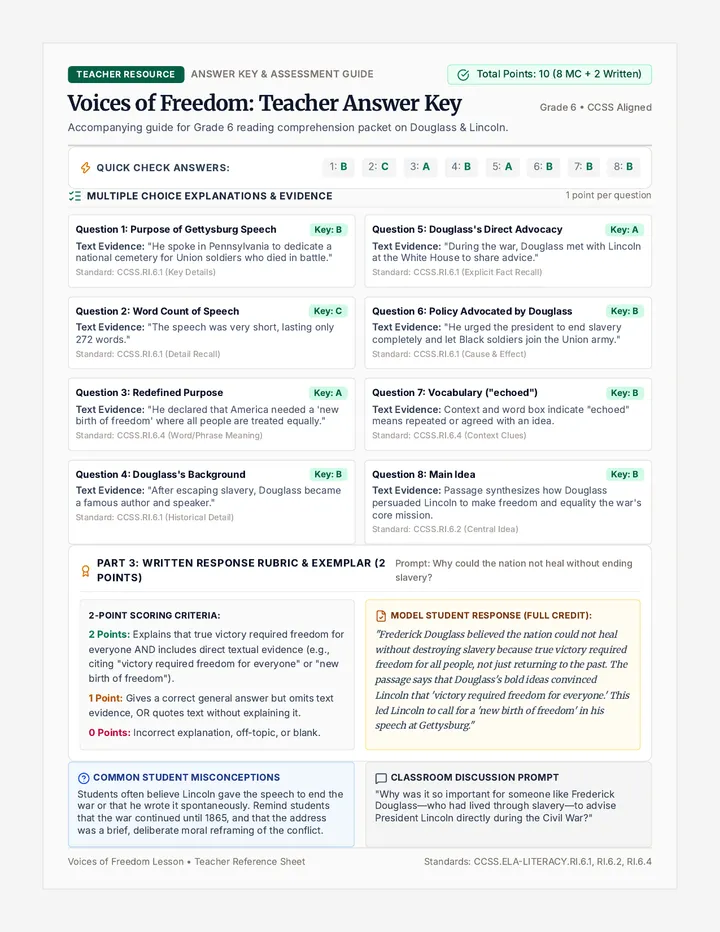
Gettysburg Voices Answer Key
Teacher Resource Answer Key & Assessment Guide
Total Points: 10 (8 MC + 2 Written)
Voices of Freedom: Teacher Answer Key
Accompanying guide for Grade 6 reading comprehension packet on Douglass & Lincoln.
Grade 6 • CCSS Aligned
Quick Check Answers:
1: B
2: C
3: A
4: B
5: A
6: B
7: B
8: B
Multiple Choice Explanations & Evidence
1 point per question
Question 1: Purpose of Gettysburg Speech Key: B
Text Evidence: "He spoke in Pennsylvania to dedicate a national cemetery for Union soldiers who died in battle."
Standard: CCSS.RI.6.1 (Key Details)
Question 5: Douglass's Direct Advocacy Key: A
Text Evidence: "During the war, Douglass met with Lincoln at the White House to share advice."
Standard: CCSS.RI.6.1 (Explicit Fact Recall)
Question 2: Word Count of Speech Key: C
Text Evidence: "The speech was very short, lasting only 272 words."
Standard: CCSS.RI.6.1 (Detail Recall)
Question 6: Policy Advocated by Douglass Key: B
Text Evidence: "He urged the president to end slavery completely and let Black soldiers join the Union army."
Standard: CCSS.RI.6.1 (Cause & Effect)
Question 3: Redefined Purpose Key: A
Text Evidence: "He declared that America needed a 'new birth of freedom' where all people are treated equally."
Standard: CCSS.RI.6.4 (Word/Phrase Meaning)
Question 7: Vocabulary ("echoed") Key: B
Text Evidence: Context and word box indicate "echoed" means repeated or agreed with an idea.
Standard: CCSS.RI.6.4 (Context Clues)
Question 4: Douglass's Background Key: B
Text Evidence: "After escaping slavery, Douglass became a famous author and speaker."
Standard: CCSS.RI.6.1 (Historical Detail)
Question 8: Main Idea Key: B
Text Evidence: Passage synthesizes how Douglass persuaded Lincoln to make freedom and equality the war's core mission.
Standard: CCSS.RI.6.2 (Central Idea)
Part 3: Written Response Rubric & Exemplar (2 Points)
Prompt: Why could the nation not heal without ending slavery?
2-Point Scoring Criteria:
2 Points: Explains that true victory required freedom for everyone AND includes direct textual evidence (e.g., citing "victory required freedom for everyone" or "new birth of freedom").
1 Point: Gives a correct general answer but omits text evidence, OR quotes text without explaining it.