Constitution Blueprint Reading Worksheet
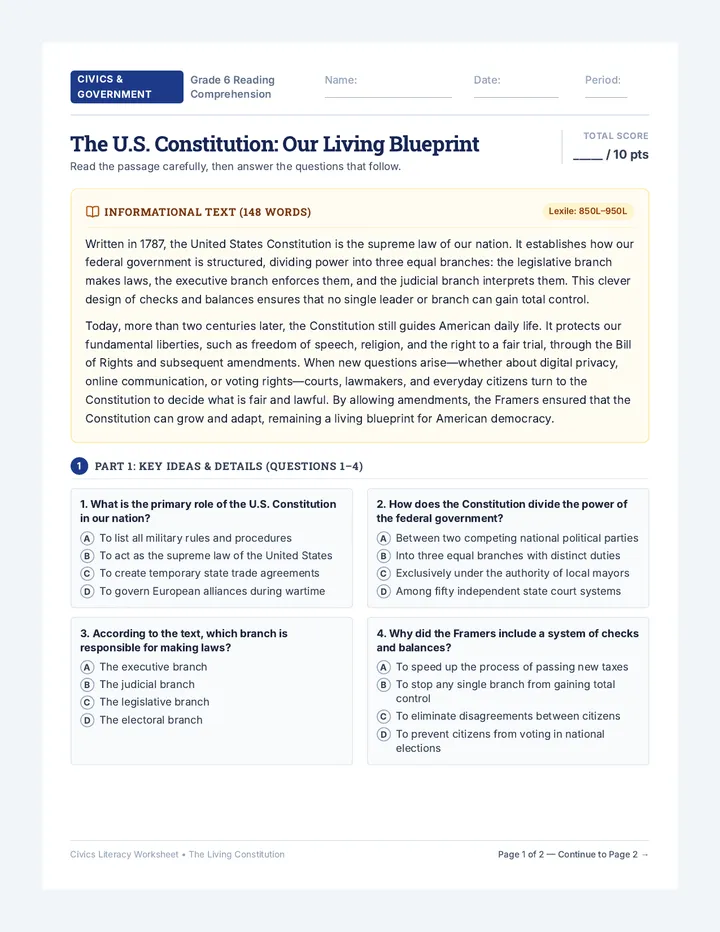
Civics & Government Grade 6 Reading Comprehension
Name:
Date:
Period:
The U.S. Constitution: Our Living Blueprint
Read the passage carefully, then answer the questions that follow.
Total Score _____ / 10 pts
Informational Text (148 Words)
Lexile: 850L–950L
Written in 1787, the United States Constitution is the supreme law of our nation. It establishes how our federal government is structured, dividing power into three equal branches: the legislative branch makes laws, the executive branch enforces them, and the judicial branch interprets them. This clever design of checks and balances ensures that no single leader or branch can gain total control.
Today, more than two centuries later, the Constitution still guides American daily life. It protects our fundamental liberties, such as freedom of speech, religion, and the right to a fair trial, through the Bill of Rights and subsequent amendments. When new questions arise—whether about digital privacy, online communication, or voting rights—courts, lawmakers, and everyday citizens turn to the Constitution to decide what is fair and lawful. By allowing amendments, the Framers ensured that the Constitution can grow and adapt, remaining a living blueprint for American democracy.
1
Part 1: Key Ideas & Details (Questions 1–4)
1. What is the primary role of the U.S. Constitution in our nation?
A To list all military rules and procedures
B To act as the supreme law of the United States
C To create temporary state trade agreements
D To govern European alliances during wartime
2. How does the Constitution divide the power of the federal government?
A Between two competing national political parties
B Into three equal branches with distinct duties
C Exclusively under the authority of local mayors
D Among fifty independent state court systems
3. According to the text, which branch is responsible for making laws?
A The executive branch
B The judicial branch
C The legislative branch
D The electoral branch
4. Why did the Framers include a system of checks and balances?
A To speed up the process of passing new taxes
B To stop any single branch from gaining total control
C To eliminate disagreements between citizens
D To prevent citizens from voting in national elections
Civics Literacy Worksheet • The Living Constitution Page 1 of 2 — Continue to Page 2 →
Part 1 Continued
Questions 5–8: Analysis & Modern Application
Student Name:
5. Which part of the Constitution specifically safeguards personal liberties?
A The Preamble's opening sentence
B The Bill of Rights and subsequent amendments
C The original list of presidential cabinet posts
D The annual congressional federal budget
6. According to the text, why do modern courts still consult the Constitution?
A To calculate historical trade tariffs
B To resolve modern issues like digital privacy
C To determine the precise borders of all fifty states
D To assign military ranks to armed forces officers
7. What important feature allows the Constitution to grow and change?
A The ability to add constitutional amendments
B The requirement to rewrite the text every decade
C The executive branch's power to cancel old laws
D The judicial branch's rule to replace the Framers' ideas
8. Why does the author describe the Constitution as a "living blueprint"?
A It contains physical drawings of government halls
B It was written by living leaders who still hold office
C It continually adapts to guide democracy over time
D It only applies to people currently voting in elections
2
Part 2: Constructed Written Response (2 Points)
Prompt:
In the passage, the author states that the Constitution remains a "living blueprint for American democracy." In a well-developed paragraph, explain what this phrase means. Use at least two specific examples from the text (such as how power is shared, how rights are protected, or how modern issues are handled) to support your explanation.
Student Response Space Write in complete sentences.
Response Checklist:
States main idea Cites 2 text details Explains modern connection Uses complete sentences
Civics Literacy Worksheet • The Living Constitution Page 2 of 2
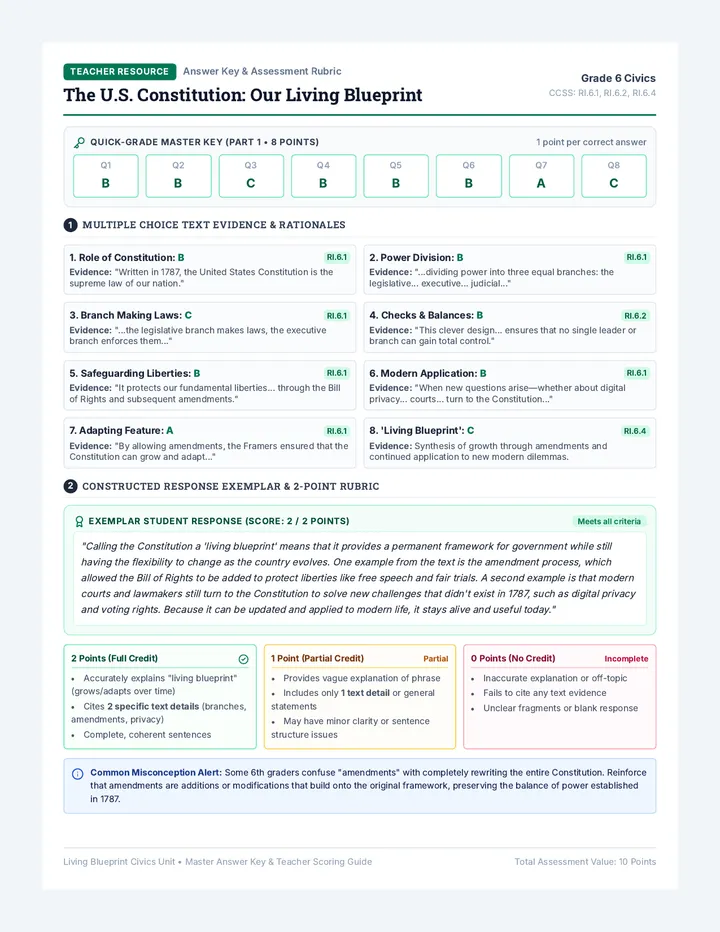
Constitution Blueprint Answer Key
Teacher Resource Answer Key & Assessment Rubric
The U.S. Constitution: Our Living Blueprint
Grade 6 Civics CCSS: RI.6.1, RI.6.2, RI.6.4
Quick-Grade Master Key (Part 1 • 8 Points)
1 point per correct answer
Q1 B
Q2 B
Q3 C
Q4 B
Q5 B
Q6 B
Q7 A
Q8 C
1
Multiple Choice Text Evidence & Rationales
1. Role of Constitution: B RI.6.1
Evidence: "Written in 1787, the United States Constitution is the supreme law of our nation."
2. Power Division: B RI.6.1
Evidence: "...dividing power into three equal branches: the legislative... executive... judicial..."
3. Branch Making Laws: C RI.6.1
Evidence: "...the legislative branch makes laws, the executive branch enforces them..."
4. Checks & Balances: B RI.6.2
Evidence: "This clever design... ensures that no single leader or branch can gain total control."
5. Safeguarding Liberties: B RI.6.1
Evidence: "It protects our fundamental liberties... through the Bill of Rights and subsequent amendments."
6. Modern Application: B RI.6.1
Evidence: "When new questions arise—whether about digital privacy... courts... turn to the Constitution..."
7. Adapting Feature: A RI.6.1
Evidence: "By allowing amendments, the Framers ensured that the Constitution can grow and adapt..."
8. 'Living Blueprint': C RI.6.4
Evidence: Synthesis of growth through amendments and continued application to new modern dilemmas.
2
Constructed Response Exemplar & 2-Point Rubric
Exemplar Student Response (Score: 2 / 2 Points) Meets all criteria
"Calling the Constitution a 'living blueprint' means that it provides a permanent framework for government while still having the flexibility to change as the country evolves. One example from the text is the amendment process, which allowed the Bill of Rights to be added to protect liberties like free speech and fair trials. A second example is that modern courts and lawmakers still turn to the Constitution to solve new challenges that didn't exist in 1787, such as digital privacy and voting rights. Because it can be updated and applied to modern life, it stays alive and useful today."
2 Points (Full Credit)
- Accurately explains "living blueprint" (grows/adapts over time)