Civil War Bridge Anchor Chart THE BIG QUESTION
How Did the English Civil War Bridge Absolutism to the Enlightenment?
1 Absolute King
Divine Right of Kings
• Monarch believed God granted unlimited authority.
• Charles I dissolved Parliament, levied illegal taxes, and jailed critics.
👑 “The King has all the power.”
2 Civil War (1642–1651)
Holding the King Accountable
• Royalists (King) clashed with Parliamentarians (Lawmakers).
• 1649 Turning Point: Charles I was tried for treason and executed!
⚔️ “The King can be stopped.”
3 Constitutional Monarchy
English Bill of Rights (1689)
• Created a Constitutional Monarchy (a king bound by laws).
• No standing armies or taxes without Parliament; protected jury trials.
⚖️ “The King must follow the law.”
4 The Enlightenment
Social Contract & Natural Rights
• John Locke: People hold natural rights to Life, Liberty, & Property .
• Power comes from the consent of the governed (inspired 1776!).
💡 “People have rights!”
THE HISTORIC BRIDGE: A Real-Life Political Experiment
Absolutism ➔ Enlightenment
Step 1: Old Way
Absolute Monarchy
King has total control by Divine Right. Citizens have duties, not rights.
THE BRIDGE
Civil War & Bill of Rights
Proved in real life that kings are not above the law !
Step 2: New Way
The Enlightenment
Government exists solely to protect citizens' natural rights.
The Big ? Answer
The Civil War was the bridge because stopping King Charles I proved rulers are not gods. It created legal limits on the king and showed that government must protect the people's rights .
Constitutional Monarchy
A system where laws and an elected Parliament restrict the king’s power (created in 1689).
Consent of the Governed
The principle that government authority is only legitimate when citizens agree to it.
Social Contract (Locke)
If rulers violate natural rights (Life, Liberty, Property), people can replace them—directly inspiring 1776 !
EASY MEMORY HOOK
👑 King Has Power ➔ ⚔️ King Is Challenged ➔ ⚖️ King Has Limits ➔ 💡 People Have Rights
Civil War Matching Quiz Name:
Date:
Class Period:
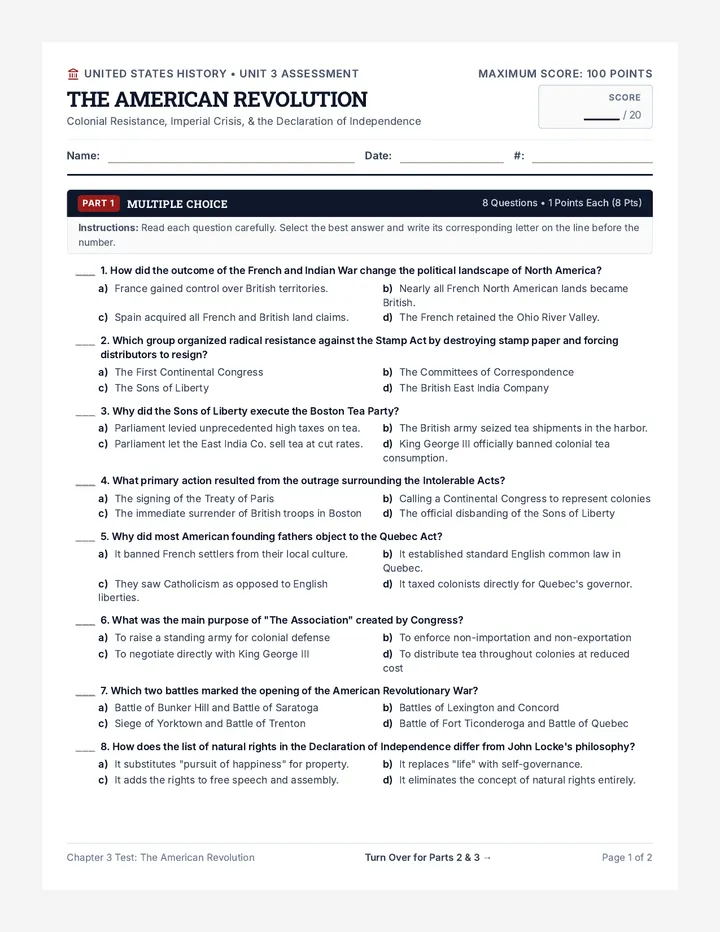
MATCHING QUIZ | English Civil War & The Bridge
Directions: Match each term or symbol with its correct definition. Write the letter in the blank.
Total Points
____ / 15
1 Part 1: The 4 Stages of Power 4 Points
👑 1. Absolute King
⚔️ 2. English Civil War
⚖️ 3. English Bill of Rights
💡 4. The Enlightenment
A. King was put on public trial and executed; proved rulers can be stopped.
B. Ideas that government exists only to protect people's natural rights.
C. Ruler claimed God gave him total power to govern without laws.
D. Laws created in 1689 placing strict legal limits on the monarch.
2 Part 2: Essential Vocabulary 5 Points
5. Divine Right
6. Parliament
7. Constitutional Monarchy
8. Natural Rights
9. John Locke
E. Rights you are born with: Life, Liberty, and Property.
F. Belief that God chose the king, so nobody on Earth can question him.
G. A king or queen whose powers are strictly limited by law.
H. England's elected group of lawmakers who challenged the king.
I. Philosopher who argued government must protect human rights.
3 Part 3: Complete "The Big ? Answer" 4 Points
Word Bank: Civil War King Law Rights
The English (10) was the bridge because stopping King Charles I proved the (11) is not above the (12) . It showed that government exists to protect the people's (13) .
4 Part 4: True or False 2 Points
14. Under the Divine Right of Kings, ordinary citizens had protected constitutional rights.
TRUE FALSE
15. England’s 1689 Bill of Rights directly inspired the American Revolution and the U.S. Constitution.
TRUE FALSE
Remember: 👑 King Has Power ➔ ⚔️ King Is Challenged ➔ ⚖️ King Has Limits ➔ 💡 People Have Rights
Civil War Bridge Flashcards CIVIL WAR FLASHCARDS | Set 1: From Monarchy to Limits
✂️ Directions: Cut along the dashed lines to create 4 large study cards.
Cards 1–4 Page 1 of 2
👑 Divine Right
Card 1
Big Question:
Where did the King claim his power came from?
Explanation:
The belief that God chose the king to rule with complete control. Because God chose him, no earthly law or Parliament could limit him.
Memory Hook
👑 “The King holds all the power.”
👑 King Charles I
Card 2
Big Question:
Why was his execution a huge historical shock?
Explanation:
He shut down Parliament and raised taxes without consent. After losing the Civil War, he was convicted of treason and executed in 1649 .
Key Takeaway
⚖️ Proved that kings can be held accountable!
⚔️ English Civil War
Card 3
Big Question:
Who fought in the Civil War (1642–1651)?
Explanation:
Two sides went to war: Royalists (supported the King) fought Parliamentarians (supported the lawmakers). Parliament won!
Memory Hook
⚔️ “The King can be stopped.”
⚖️ Bill of Rights (1689)
Card 4
Big Question:
How did this document limit the monarch?
Explanation:
New rulers William & Mary agreed that monarchs cannot ignore laws or raise taxes alone. Citizens were granted fair trials and speech rights.
Memory Hook
⚖️ “The King has legal limits.”
Unit: Bridge to Rights 👑 King Has Power ➔ ⚔️ King Is Challenged ➔ ⚖️ King Has Limits ➔ 💡 People Have Rights Page 1 of 2
CIVIL WAR FLASHCARDS | Set 2: The Ideas & The Bridge
✂️ Directions: Cut along the dashed lines to create 4 large study cards.
Cards 5–8 Page 2 of 2
🏛️ Constitutional Monarchy
Card 5
Big Question:
What is a Constitutional Monarchy?
Explanation:
A system of government where a monarch remains on the throne, but their power is strictly controlled by written laws and an elected legislature.
Core Contrast
Laws rule over the ruler!
💡 Natural Rights
Card 6
Civil War Quiz Answer Key TEACHER RESOURCE Grading & Scoring Guide
CIVIL WAR MATCHING QUIZ | Answer Key
Scoring Scale 15 Total Points
1 Part 1: The 4 Stages 4 Pts (1 pt each)
1. 👑 Absolute King [ C ]
2. ⚔️ English Civil War [ A ]
3. ⚖️ English Bill of Rights [ D ]
4. 💡 The Enlightenment [ B ]
Tip: Have students verify by reciting the 4-step memory hook aloud.
2 Part 2: Essential Vocabulary 5 Pts (1 pt each)
5. Divine Right [ F ]
6. Parliament [ H ]
7. Constitutional Monarchy [ G ]
8. Natural Rights [ E ]
9. John Locke [ I ]
Key Check: Ensure students do not mix up Divine Right (F) and Natural Rights (E).
3 Part 3: "The Big ? Answer" Solutions 4 Pts (1 pt each blank)
The English (10) Civil War was the bridge because stopping King Charles I proved the (11) King is not above the (12) Law. It showed that government exists to protect the people's (13) Rights.
4 Part 4: True / False Solutions 2 Pts (1 pt each)
14. Under Divine Right, ordinary citizens had protected constitutional rights.
Why: Under Absolutism, the king held total authority and citizens had no protected rights.
FALSE
15. England’s 1689 Bill of Rights directly inspired the American Revolution and U.S. Constitution.
Why: Ideas of trial by jury, no taxation without consent, and natural rights traveled straight to 1776 and 1791.
TRUE
SPED Accommodations & Quick-Grading Guide
Grade Breakdown: 14–15 pts = Mastery (A)
SPED Modifications: • Allow use of Anchor Chart
Core Takeaway: Ensure students understand: The King is the one who was limited, while The People gained protected rights.
Lesson: Bridge to Rights Confidential Teacher Grading Resource Print Ready
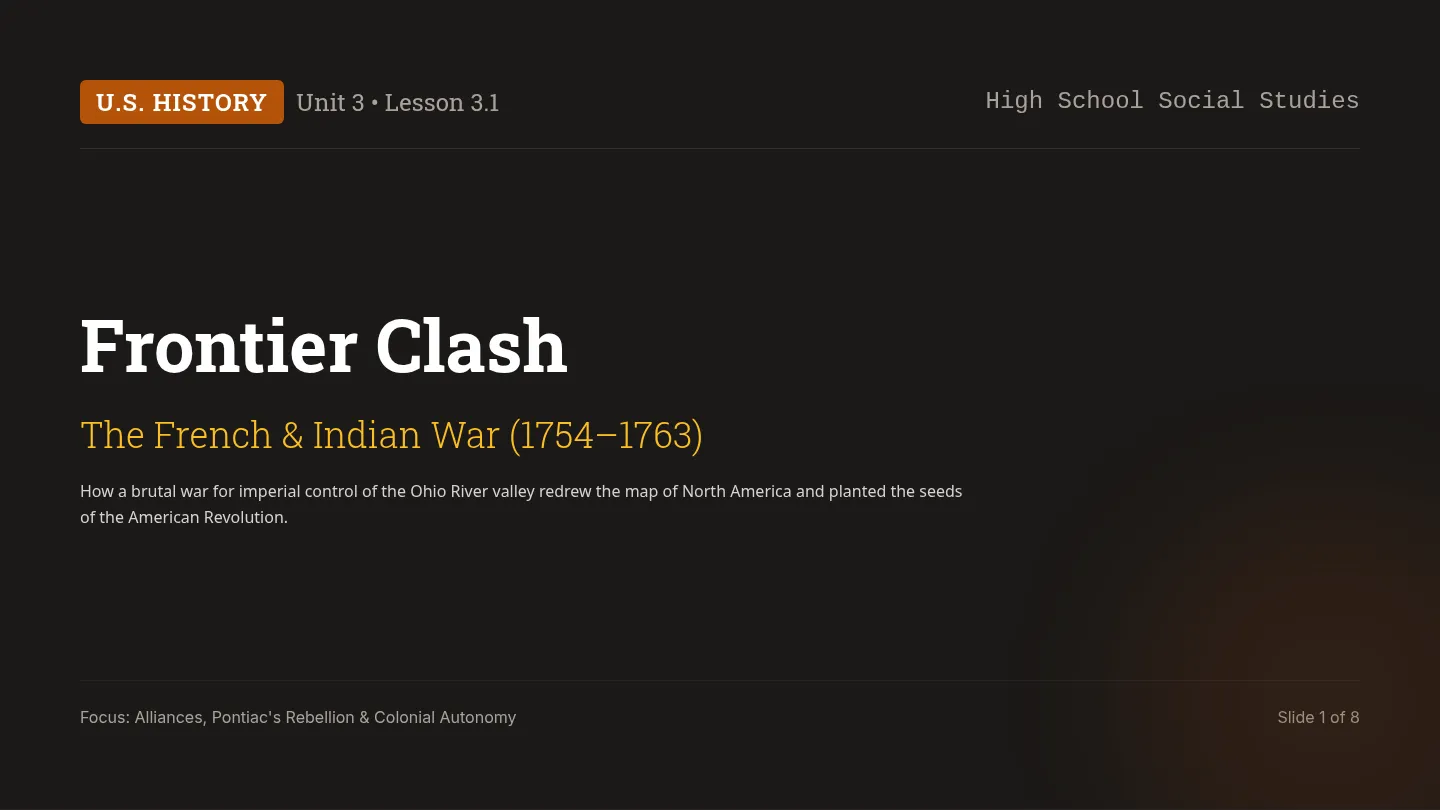
Civil War Bridge Slides THE BIG QUESTION History & Civics Review
How Did the English Civil War Bridge Absolutism to the Enlightenment?
From the Divine Right of Kings to Human Rights
👑 King Has Power ➔ ⚔️ King Challenged ➔ ⚖️ King Has Limits ➔ 💡 People Have Rights
👑 STAGE 1: AGE OF ABSOLUTISM 1600s
The Divine Right of Kings
Divine Right:
Monarchs claimed God gave them total power . Questioning the king was considered a direct sin against God.
King Charles I:
Ruled without Parliament, made illegal taxes, and arrested critics who dared to speak out.
👑 “The King holds all the power.”
⚔️ STAGE 2: CIVIL WAR (1642–1651) 1649 Execution
The King Can Be Stopped
👑 Royalists (Cavaliers)
Fought to defend the King's total rule and the Divine Right tradition.
🏛️ Parliamentarians (Roundheads)
Fought to stop royal abuse and protect the power of elected lawmakers.
⚡ 1649 Turning Point: Charles I was put on public trial for treason and executed. Proved monarchs are not untouchable!
⚔️ “The King can be challenged and held accountable.”
⚖️ STAGE 3: CONSTITUTIONAL MONARCHY 1689
The English Bill of Rights (1689)
Constitutional Monarchy:
New rulers William & Mary were forced to sign written limits into law.
The monarch cannot suspend laws or create taxes alone.
Citizen Protections:
• Guaranteed fair trials by jury.
• Protected free elections in Parliament.
• Banned cruel and unusual fines.
⚖️ “The King must follow the law.”
💡 STAGE 4: THE ENLIGHTENMENT 1700s ➔ 1776
John Locke & Natural Rights
🌱 LIFE Right to live safely
🕊️ LIBERTY Right to freedom
🏡 PROPERTY Right to own goods
Consent of the Governed: Government exists only to protect human rights. If a ruler steals rights, people can replace them—inspiring 1776 & the U.S. Constitution !
💡 “People have natural rights; government serves the people.”
THE BIG ? ANSWER Core Takeaway
Why Was the Civil War "The Bridge"?