Architects of Power Teacher GuideArchitects of Power Nation-State Building Teacher Guide Duration 90 Minutes Grade Level 7th Grade Scope England, France, Spain, Russia Learning Objectives ✦ Identify key monarchs (Henry II, Louis XIV, Ferdinand/Isabella, Peter the Great) and their contributions to nation-building. ✦ Analyze the policies used to centralize power, including judicial reform, religious unification, and modernization. ✦ Compare and contrast the strategies of four major European nation-states. Essential Vocabulary Nation-State Centralization Absolutism Common Law Westernization Essential Question "How do leaders transform a collection of local territories into a unified, powerful nation?" Instructional Sequence 1 Hook: The Power Paradox (10 mins) Ask students: "If you were king/queen, but your local lords owned the land, collected the taxes, and had their own armies, do you really have power?" Discuss the shift from fragmented feudalism to centralized power. Introduce the concept of a "Nation-State" as a unified group under one government. 2 Direct Instruction: The Four Foundations (25 mins) Use the Architects of Power Slides to introduce the four case studies: England: Henry II & common law / justice systems. France: Louis XIV & the "Sun King" absolutism. Spain: Ferdinand & Isabella's religious/territorial unification. Russia: Peter the Great's modernization and "Window to the West." 3 Guided Practice: Mapping the Monarchs (25 mins) Distribute the Royal Records Graphic Organizer. Students work in pairs to categorize policies into categories: Law, Religion, Military, or Culture. Circulate and ask: "Which leader used the most 'soft power' (culture/religion) vs 'hard power' (law/army)?" 4 Assessment: Royal Decrees (20 mins) Students complete the Decrees of the State Analysis Worksheet, interpreting primary source snippets from each ruler to identify their core building strategy. 5 Exit Ticket: The Best Architect (10 mins) Prompt: "Which of the four nations we studied today created the strongest foundation for a modern country? Defend your choice with one specific policy."
Royal Records Graphic OrganizerRoyal Records Nation-State Comparison Ledger Subject: Date: As we examine the rise of powerful monarchs, record the specific strategies and policies used by each "architect" to unify their territory and centralize their power. Nation Architect (Leader) Centralizing Policy (Law/Gov) Cultural / Religious Strategy Outcome / Impact ENGLAND FRANCE SPAIN RUSSIA Synthesis Prompt Which of these four countries achieved the highest degree of centralization by the end of the 17th century? Justify your answer using evidence from the chart above.
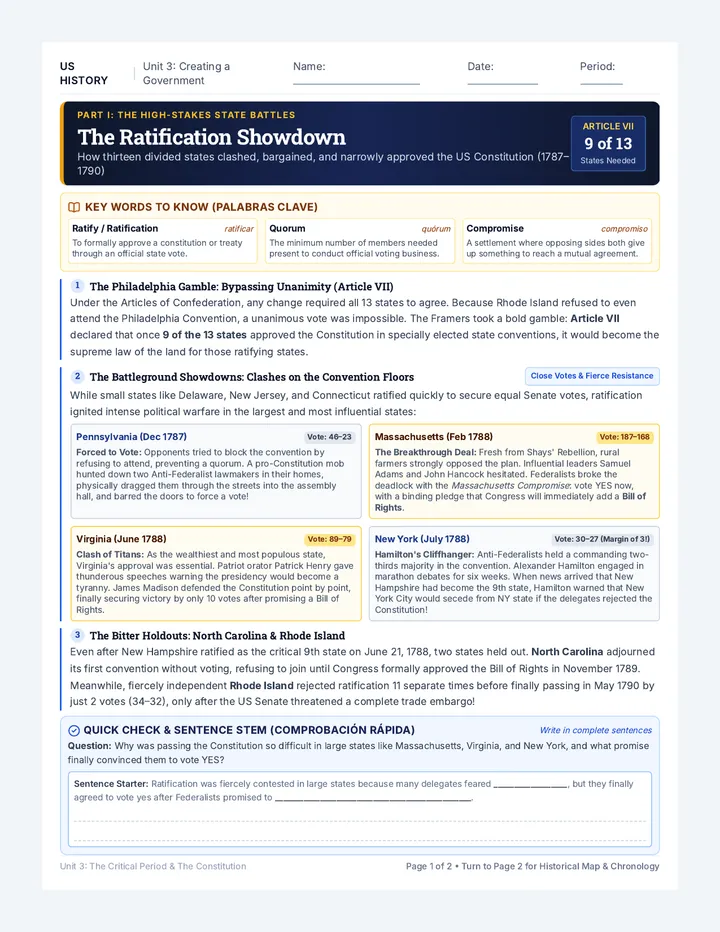
Decrees of the State WorksheetDecrees of the State Primary Source Analysis: The Architect's Vision Name: Date: "To build a nation, a monarch must speak with authority. Below are excerpts from four famous decrees. Your task is to decode the architect's plan for power." DOCUMENT A The King's Justice "For the preservation of peace and the execution of justice... let twelve of the more lawful men of every hundred... swear that they will speak the truth, whether in their hundred there be any man who is accused or notoriously suspected of being a robber, murderer, or thief." — Assize of Clarendon, 1166 1. Identify the Architect (Monarch/Nation): 2. How does this centralize power? DOCUMENT B The Sun Rises "The head alone must deliberate and resolve, and the functions of all the other members consist only in the execution of the commands given to them... All power, all authority, resides in the hands of the King." — Memoirs for the Instruction of the Dauphin 1. Identify the Architect (Monarch/Nation): 2. How does this centralize power? DOCUMENT C The Holy Crown "It is decided that all Jews and Jewesses of whatever age... shall depart from all our kingdoms and lordships... and that they shall not dare to return... under penalty of death and confiscation of all their belongings." — Alhambra Decree, 1492 1. Identify the Architect (Monarch/Nation): 2. How does this centralize power? DOCUMENT D The Window to the West "Whatever beards there are shall be shaved... and for those who wish to keep their beards, a tax shall be imposed: for noblemen, 100 rubles; for citizens, 60 rubles... that they may look like the people of the Western world." — Decree on the Shaving of Beards, 1698 1. Identify the Architect (Monarch/Nation): 2. How does this centralize power? The Architect's Ledger Looking at all four documents, what is the most common tool these monarchs used to take power away from local lords or individuals and give it to the central government?
Architects of Power SlidesArchitects of Power The Rise of European Nation-States The Power Shift Feudalism (Before) • Fragmented local power • Lords had their own armies • Weak central government • Identity tied to local village Nation-State (After) • Centralized authority (Monarch) • Professional national armies • Unified laws and taxes • National identity and language A "Nation-State" is a country where a unified group of people lives under one government. England: The Rule of Law Henry II (Reigned 1154–1189) The Architect's Plan: Common Law ▶ Replaced local feudal courts with Royal Courts that traveled the country. ▶ Created Common Law—laws that applied to everyone in the kingdom. ▶ Introduced the use of a Jury System to resolve disputes. "By standardizing justice, Henry made the King's law more important than the Lord's word." France: The Sun King Louis XIV (Reigned 1643–1715) The Architect's Plan: Absolutism ▶ Absolute Monarchy: The belief that the king has total power over the state. ▶ Versailles: Built a massive palace to control the nobles (keep them close and busy). ▶ "L'État, c'est moi" (I am the State). "Louis centralized all political, social, and cultural life around himself—the 'Sun' of France." Spain: Religious Unity Ferdinand & Isabella (Married 1469) The Architect's Plan: Unification ▶ Territorial Union: Combined their kingdoms (Aragon & Castile) to create modern Spain. ▶ Reconquista: Expelled non-Christians to ensure religious unity. ▶ Exploration: Funded Columbus to expand Spanish power globally. "They believed a nation was strongest when it shared one faith and one crown." Russia: Modernization Peter the Great (Reigned 1682–1725) The Architect's Plan: Westernization ▶ Westernization: Forced Russia to adopt European technology, clothing, and customs.
Architects of Power Answer KeyTeacher Answer Key Architects of Power: Primary Source & Organizer Guide Decrees of the State Worksheet Document A: The King's Justice Architect: Henry II / England Centralization Strategy: Creation of "Common Law" and the Jury System. By making royal courts the standard for justice, he took power away from local lords who previously ran their own private courts. Document B: The Sun Rises Architect: Louis XIV / France Centralization Strategy: Absolutism. He eliminated the role of advisors or representative bodies in decision-making, concentrating all legislative and executive authority in his own person. Document C: The Holy Crown Architect: Ferdinand & Isabella / Spain Centralization Strategy: Religious Unification. By expelling Jews (and later Muslims), they ensured the entire population was Catholic, making them easier to control under a single "divine" authority. Document D: Window to the West Architect: Peter the Great / Russia Centralization Strategy: Cultural Modernization (Westernization). By forcing nobles to shave beards and dress in European styles, he broke traditional power structures and forced them to obey his modern, central vision. Final Analysis Prompt Sample High-Quality Answer: "The most common tool was the standardization of life. Whether it was standardizing the law (England), the religion (Spain), the appearance (Russia), or the source of authority (France), each monarch took diverse, local customs and replaced them with a single national standard that only the King/Queen could control." Comparison Ledger Key NationPolicy FocusImpactEnglandLaw & CourtsUnified national identity through shared rules.FranceAbsolutism & LuxuryNobles became dependent on the King at Versailles.SpainReligion & EmpireA "pure" Catholic state focused on exploration.RussiaWesternizationRapid leap from medieval to modern power.