Cooperation or Conflict Worksheet
7th Grade Social Studies • Unit 2: Colonial America Guided & Independent Practice
Cooperation or Conflict?
Relationships Between English Colonists and Native Nations (1607–1754)
Name:
Date:
Class:
We Do
Quick Class Model: Jamestown Cause-and-Effect Chain
Think: What changed? Who benefited first? What triggered war?
Choice Box:
A. Tobacco becomes profitable B. Colonists seize more land C. Full-scale war erupts
1. Arrival English arrive in Jamestown (1607)
2. Trade Powhatan trade corn & aid survival
3. Cash Crop
Fill from choice box
4. Expansion
Fill from choice box
5. Retaliation Powhatan attack settlements (1622)
6. Outcome
Fill from choice box
Word Bank • Herramientas de Vocabulario
Treaty / Tratado
A written agreement between nations to make peace or trade.
Ally / Aliado
A partner who works with you for defense or mutual help.
Graze / Pastar
When cows, pigs, or horses eat grass and crops in open fields.
Smallpox / Viruela
A deadly European virus that spread rapidly among Native nations.
You Do
Historical Reading: From Cooperation to Conflict
Reading Level: 5th–6th Grade • Reference paragraphs [¶1]–[¶4]
[¶1] Early Cooperation: When English settlers first arrived in North America, they relied heavily on Native Americans to survive. Native peoples taught colonists which crops grew best, such as corn and beans, and traded fresh food for European goods like metal cooking pots, iron knives, and woven cloth. Some leaders, such as Chief Massasoit of the Wampanoag, signed peace treaties because they hoped the English would be strong trade partners and useful allies against rival tribes.
[¶2] Disease & Population Shift: Over time, the relationship changed. Europeans brought deadly diseases like smallpox. Because Native nations had never been exposed to these germs, epidemics spread quickly and killed many people. At the same time, thousands of new colonists arrived each year needing farmland. The balance of power shifted toward the colonists as European populations grew and Native numbers declined.
[¶3] Clashing Views on Land: Land ownership caused the greatest tension. Most Native nations believed land was a gift from nature to be shared and cared for by the whole community. In contrast, the English believed land could be bought, divided, fenced, and owned by one person. Conflict erupted when colonists cleared forests and let their livestock graze in Native cornfields, destroying precious food supplies.
[¶4] War and Peaceful Exceptions: By 1675, Metacom (Massasoit's son, known as King Philip) believed his people would lose everything if they did not fight back. The brutal war that followed—King Philip's War—destroyed many towns on both sides. Yet not every relationship ended in war. In Pennsylvania, William Penn signed fair treaties with the Lenape and maintained peace for decades. In New York, the Haudenosaunee remained powerful partners through trade and diplomacy.
Active Reading Check: Underline two ways Native peoples helped settlers, and circle two causes of conflict in the text.
7th Grade Social Studies • Early America: Cooperation or Conflict? Turn page over to answer questions → Page 1 of 2
Part 3: Text Evidence & Critical Thinking Independent Work
Analyzing Colonial & Native Relationships
Answer in complete sentences using the reading on Page 1. Use the provided sentence starters.
Use the Sentence Starters to write your answers.
1. List two ways Native Americans helped early colonists survive. [Evidence from ¶1] Text Evidence
Sentence Starter: Two ways Native Americans helped early colonists were...
2. Why did Chief Massasoit agree to sign a peace treaty with the English? [Evidence from ¶1] Motivation
Sentence Starter: Chief Massasoit agreed to sign a peace treaty because he hoped the English would...
3. How did Native Americans and the English view land ownership differently, and how did this cause conflict? [Evidence from ¶3] Compare Perspectives
Sentence Starter: Native nations believed land was..., while English colonists believed land should be... This caused conflict when...
4. How did European disease change the balance of power between colonists and Native Americans? [Evidence from ¶2] Cause & Effect
Sentence Starter: European diseases like smallpox changed the balance of power because...
5. Why did relations stay peaceful longer in Pennsylvania than in New England? [Evidence from ¶4] Comparison
Sentence Starter: Relations stayed peaceful longer in Pennsylvania because William Penn...
Extension
Challenge Thinking Task
Historical Decision: If you were Metacom in 1675, would you have chosen war or another option? Explain your reasoning.
Starter: If I were Metacom, I would have chosen... because...
Exit Ticket
Daily Formative Check
Ticket de Salida
What was the most important cause of conflict between colonists and Native Americans? Support with 1 lesson example.
Starter: The most important cause of conflict was... For example,...
Grade 7 Social Studies • Accommodations & Sentence Starters Included Page 2 of 2
Cooperation or Conflict Answer Key
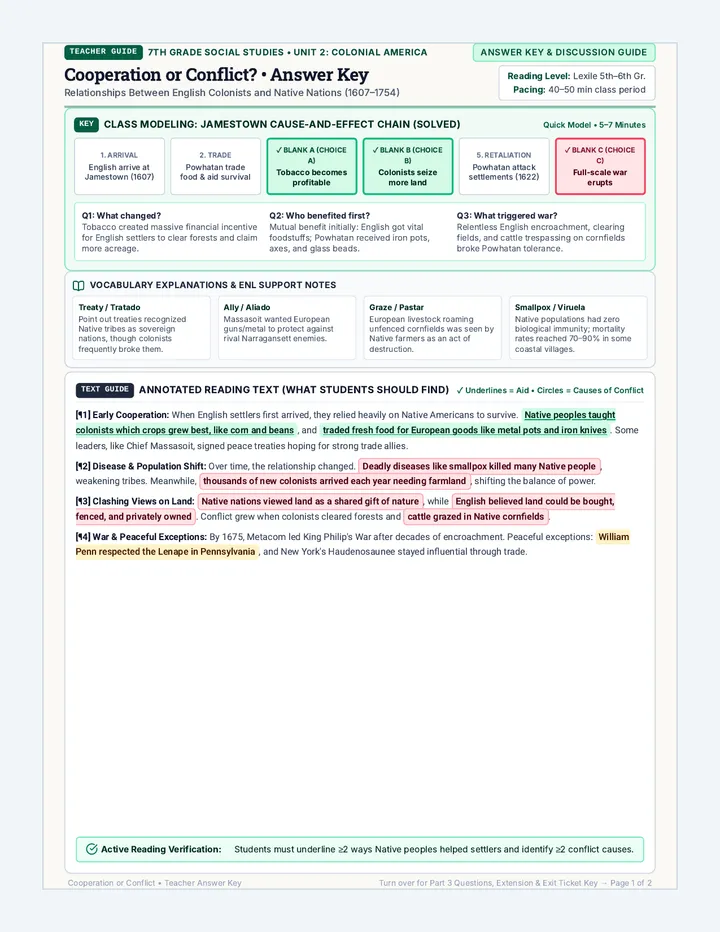
TEACHER GUIDE 7th Grade Social Studies • Unit 2: Colonial America Answer Key & Discussion Guide
Cooperation or Conflict? • Answer Key
Relationships Between English Colonists and Native Nations (1607–1754)
Reading Level: Lexile 5th–6th Gr.
Pacing: 40–50 min class period
KEY
Class Modeling: Jamestown Cause-and-Effect Chain (Solved)
Quick Model • 5–7 Minutes
1. Arrival English arrive at Jamestown (1607)
2. Trade Powhatan trade food & aid survival
✓ Blank A (Choice A) Tobacco becomes profitable
✓ Blank B (Choice B) Colonists seize more land
5. Retaliation Powhatan attack settlements (1622)
✓ Blank C (Choice C) Full-scale war erupts
Q1: What changed?
Tobacco created massive financial incentive for English settlers to clear forests and claim more acreage.
Q2: Who benefited first?
Mutual benefit initially: English got vital foodstuffs; Powhatan received iron pots, axes, and glass beads.
Q3: What triggered war?
Relentless English encroachment, clearing fields, and cattle trespassing on cornfields broke Powhatan tolerance.
Vocabulary Explanations & ENL Support Notes
Treaty / Tratado
Point out treaties recognized Native tribes as sovereign nations, though colonists frequently broke them.
Ally / Aliado
Massasoit wanted European guns/metal to protect against rival Narragansett enemies.
Graze / Pastar
European livestock roaming unfenced cornfields was seen by Native farmers as an act of destruction.
Smallpox / Viruela
Native populations had zero biological immunity; mortality rates reached 70–90% in some coastal villages.
TEXT GUIDE
Annotated Reading Text (What Students Should Find)
✓ Underlines = Aid • Circles = Causes of Conflict
[¶1] Early Cooperation: When English settlers first arrived, they relied heavily on Native Americans to survive. Native peoples taught colonists which crops grew best, like corn and beans, and traded fresh food for European goods like metal pots and iron knives. Some leaders, like Chief Massasoit, signed peace treaties hoping for strong trade allies.
[¶2] Disease & Population Shift: Over time, the relationship changed. Deadly diseases like smallpox killed many Native people, weakening tribes. Meanwhile, thousands of new colonists arrived each year needing farmland, shifting the balance of power.
[¶3] Clashing Views on Land: Native nations viewed land as a shared gift of nature, while English believed land could be bought, fenced, and privately owned. Conflict grew when colonists cleared forests and cattle grazed in Native cornfields.