Sighet Stories Slides Sighet Stories
A Prelude to Elie Wiesel's Night
Today's Mission
Explore
Discover the town of Sighet and the people who lived there.
Investigate
Move through the room to collect "field notes" on characters.
Reflect
Think about how memory keeps a community alive.
Sighet, Transylvania
"The small town where I was born... was my whole universe."
Located in the mountains of modern-day Romania.
A close-knit Jewish community of 15,000 people.
Religion, family, and tradition were the heartbeat of the town.
Sighet, 1944
Eliezer Wiesel
The Protagonist
At age 12, Eliezer is deeply religious and spends his time studying the Torah. He is observant, sensitive, and deeply connected to his faith and family.
The People Around Him
Schlomo Wiesel
Elie's father. Respected leader. Realistic and calm.
Moshe the Beadle
The teacher. Poor and quiet. Tells a warning no one believes.
Madame Schächter
The woman on the train. Screams of "Fire!" when none see it.
Tzipora
Elie’s youngest sister. Representing innocence and family bond.
The Gallery Walk
1
Grab your Field Notes sheet and a pen.
2
Move to any station in the room with your group.
3
Read the card and record 3 facts about the person or place.
4
Rotate when the signal sounds (every 6 minutes).
Walking Rules
DO:
• Whisper with your group.
• Stay at your assigned station.
• Keep moving until you finish!
DON'T:
• Block other stations.
• Rush through the reading.
• Use your phone.
Sighet Gallery Cards Station 1
Sighet: The Small Universe
Sighet was a small town in the Carpathian Mountains of Transylvania (modern-day Romania). It was a quiet place where everybody knew everyone else. For the 15,000 Jewish residents, life revolved around the synagogue, the marketplace, and family dinners.
"We were the center of the world. Or so we thought. We lived our lives, we loved our children, we worked our trades, and we prayed to God."
Key Detail
Life was predictable. People felt safe in their routines and their faith.
Community
The Jewish community was vibrant, with schools, shops, and many religious leaders.
Station 2
Eliezer: The Seeker
Twelve-year-old Eliezer is the narrator of our story. Unlike many other boys his age, he doesn't care much for games. He is deeply religious and wants to study the Kabbalah (Jewish mysticism) — a subject usually reserved for older, wiser men.
He is sensitive, thoughtful, and spends hours in the synagogue weeping over the destruction of the Temple, even though he doesn't fully understand why he cries.
His Goal
To grow closer to God through intense study and prayer.
His Personality
Highly emotional, intellectual, and traditional.
Station 3
Schlomo: The Father
Schlomo Wiesel, Eliezer's father, is a cultured man who is highly respected in Sighet. He is a shopkeeper, but he is also a community leader that people go to for advice and help with legal matters.
He is described as "unsentimental." He rarely shows his emotions and is more concerned with the welfare of the community than his own family's private feelings. He initially discourages Eliezer's desire to study mysticism.
Role
The rock of the community; a voice of reason and logic.
Challenge
Balancing his public duties with his relationship with his son.
Station 4
Moshe the Beadle
Moshe is a poor, foreign Jew who works in the synagogue. He is awkward and quiet, making himself "invisible" to most people. However, he becomes Eliezer's teacher, guiding him through complex religious texts.
Moshe is deported by the Hungarian police early in the book. He miraculously escapes and returns to Sighet to tell the town about the mass killings he witnessed. The tragedy is that no one believes him; they think he has gone mad.
Symbol
The ignored warning; the loss of innocence.
Fate
He survives a massacre to warn others, but is treated as a lunatic.
Station 5
Madame Schächter
Madame Schächter is a middle-aged woman from Sighet who is deported in the same cattle car as Eliezer. She has been separated from her husband and two older sons, which has shattered her mind.
Throughout the nightmarish journey, she screams about seeing "fire" and "flames" in the distance. The other prisoners eventually beat her to keep her quiet. When they finally arrive at Auschwitz, they see the crematorium chimneys — and realize she was right.
Theme
The psychological toll of separation and fear.
Irony
Her "madness" was actually the most accurate vision of reality.
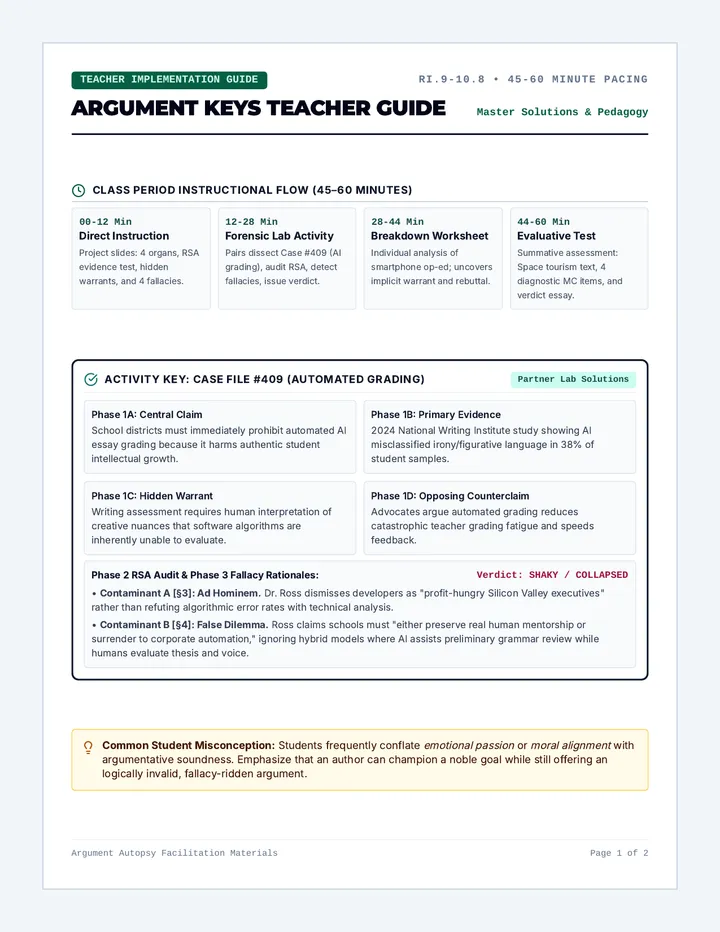
Prelude Facilitation Guide Teacher Resource
Night Prelude Guide
Facilitation strategies and student examples for the introductory unit of Elie Wiesel's Night .
Target Audience
Designed specifically for students with ADHD and Specific Learning Disabilities (SLD), focusing on kinesthetic learning and high-contrast visuals.
Unit Structure
Two 90-minute blocks (or four 45-minute periods) focusing on setting, character, and the psychological impact of deportation.
1
Sighet Stories: Gallery Walk
Setup Instructions
Print the Sighet Gallery Cards and place them at five distinct "stations" around the room.
Provide each student with the Sighet Field Notes Worksheet and a clipboard.
ADHD Strategy: Use a timer (3-4 minutes per station) to maintain momentum and provide clear transitions.
Discussion Prompts
After the walk, gather students to discuss:
"Why did no one believe Moshe the Beadle?"
"How does Eliezer's father, Schlomo, differ from Eliezer?"
"What does the quote 'We were the center of the world' tell us about the residents' mindset?"
Example Student Notes
Station 4: Moshe the Beadle
Key Insight:
"He tries to warn people about what he saw, but they think he is crazy. He's like a ghost in the town."
Station 5: Madame Schächter
Key Insight:
"She sees fire when everyone else sees darkness. It's scary because her visions actually come true at the end."
Character Connection
Eliezer & Schlomo:
"Eliezer wants to be a mystic; his dad wants him to be a shopkeeper. They don't really understand each other yet."
2
Vanishing Identities: Simulation
The "Suitcase" Activity
Ask students to imagine they have 10 minutes to pack one small bag. Limit is 10kg (approx. 22 lbs).
Students fill out the Suitcase Manifest .
The Twist: Halfway through, tell students they must leave the bag behind and can only keep what fits in their pockets.Emotional Safety: Monitor students closely. This simulation is intended to build empathy, not distress.
Dehumanization Concept
Explain how taking possessions was the first step in stripping people of their humanity. POSSESSIONS → NAMES → IDENTITY.
Prelude Answer Key Answer Key & Examples
Night Prelude Unit Resources
Teacher Use Only
1
Sighet Field Notes Examples
These are suggested facts students might record. Accept any accurate details from the gallery cards.
Station 1: Sighet
Small town in the Carpathian Mountains.
Home to 15,000 Jewish residents.
Life revolved around synagogue and family.
Station 2: Eliezer
Twelve years old and very religious.
Wants to study the Kabbalah .
More interested in study than games.
Station 3: Schlomo
Highly respected shopkeeper and leader.
Described as "unsentimental."
Discouraged Eliezer's mysticism studies.
Station 4: Moshe the Beadle
Eliezer's religious teacher/mentor.
Survived a massacre and returned to warn Sighet.
The town thought he had gone mad.
Station 5: Madame Schächter
Screamed about "fire" and "flames" on the train.
Separated from her husband and two older sons.
Her "mad" visions turned out to be the crematoriums.
2
Suitcase Manifest Rubric & Examples
Grading Focus
This activity is about empathy and critical thinking, not "right" answers. Look for:
Selection: Did they justify why they chose practical vs. sentimental items?Weight Awareness: Did they respect the 10kg limit? (Force them to prioritize).Reflection: Can they articulate the psychological difficulty of leaving home?
Example Selection 1 (Practical)
Item: Heavy Winter Boots (1.5kg)
Rationale: "I don't know how far I'll have to walk or if there will be snow."
Item: Dried Fruit & Bread (2.0kg)
Rationale: "Survival is #1. I don't trust that they will feed us."
Example Selection 2 (Sentimental)
Item: Small Locket/Photo (0.1kg)
Rationale: "To remember my family's faces if we get separated."
Item: Hand-written Journal (0.5kg)
Rationale: "To record what is happening so the world knows the truth."
Sighet Field Notes Worksheet Field Notes: Sighet
Case Study: Community and Character
Name:
Date:
Instructions: Visit each station in the room. Read the cards carefully and record three specific facts or observations about the person or place.
Station 1: Sighet
Setting the Scene
Station 2: Eliezer
The Student
Station 3: Schlomo
The Father
Station 4: Moshe
The Messenger
Station 5: Madame Schächter
The Visionary
"The small town where I was born... was my whole universe." — Night
Vanishing Identities Slides Vanishing Identities
From Sighet to the Unknown
1944: The End of Life as They Knew It
German troops enter Sighet.
New laws: No more traveling, no more jewelry.
The Yellow Star must be worn by all Jews.
"The yellow star? Oh well, what of it? You don't die of it..."
— Schlomo Wiesel
Eliezer’s father tries to keep everyone calm, but the identity of "citizen" is already beginning to vanish.
The Ghetto
The Jewish community is forced into two small "ghettos" — fenced-in areas of the town.
The Reality
Families are packed into single rooms.
The Illusion
"We are among ourselves," some thought. "It will be okay."
The Command
"Every person is allowed one suitcase. Maximum 10kg (22 lbs). Everything else must stay."
Your Task:
1 Get into your family groups.
2 You have 8 minutes to pack your list.
3 Decide: Survival or Sentimental? What defines YOU?
Stripping the Soul
HOME
POSSESSIONS
FAMILY
NUMBER
"I became A-7713. After that, I had no other name."
The Transport
80 people per cattle car.
A few loaves of bread. A little water.
One window with bars.
Identity is now reduced to the space you take up on the floor.
Suitcase Manifest Worksheet The 10kg Suitcase
Simulation: Packing for the Unknown
Name:
Group:
The Challenge
You have been ordered to leave your home in 20 minutes. You may take one suitcase weighing no more than 10kg (22 lbs) . Everything else — your house, your bed, your photos, your toys — must be left behind forever.
Packing List
Item Description Estimated Weight Category Survival / Personal Survival / Personal Survival / Personal Survival / Personal Survival / Personal Survival / Personal
What was the hardest item to leave?
How does this bag define who you are?
TOTAL WEIGHT MUST NOT EXCEED 10.0 KG