Lenny.com
Explore
Create
ActivitiesNewMathEnglish Language ArtsScience & EngineeringSocial StudiesGlobal LanguagesHealth & Physical EducationSpecial EducationCounseling & Life SkillsArts & CreativityESL
Lenny.com
Lenny.com
Explore
Create
ActivitiesNewMathEnglish Language ArtsScience & EngineeringSocial StudiesGlobal LanguagesHealth & Physical EducationSpecial EducationCounseling & Life SkillsArts & CreativityESL
Lenny.com
Lenny.com

Solutions

Lenny for EducatorsLenny for SchoolsLenny for Districts

Product

ExploreSign inCreateSupportAbout

Resources

Getting startedMTSS Acceleration Program

© 2026 Lenny Learning Inc.

TermsPrivacyAccessibility
LinkedInInstagramX
Lenny
English Language ArtsPhonics & Reading FoundationsLetter IdentificationLearn Letters A-ZLowercase and Uppercase LettersConsonants and VowelsLetter-Sound AssociationsLetter-Sound Associations: LowercaseLetter-Sound Associations: UppercaseBeginning and Ending SoundsRhymingBlending And SegmentingShort VowelsShort Vowel SoundsConsonant BlendsConsonant DigraphsBlends, Digraphs, and TrigraphsDigraphs, Blends, and Silent LettersLong Vowel SoundsLong Vowel PatternsShort and Long VowelsShort and Long Vowel PatternsSilent EVowel SoundsVowel TeamsR-Controlled VowelsDiphthongs: Oi, Oy, Ou, OwVariant VowelsVariant, Diphthong, And R Vowel PatternsSoft G And CSight WordsIrregular WordsWord RecognitionSyllablesSyllable TypesTwo-Syllable WordsMultisyllabic WordsPhoneme ManipulationDecodable TextsVocabularyAction WordsQuestion WordsNouns and AdjectivesClassify WordsCompound WordsSynonyms and AntonymsHomophonesHomophones and HomonymsShades of MeaningContext CluesPrefixes and SuffixesGreek and Latin RootsAnalogiesIdioms and AdagesForeign Words and ExpressionsWord Choice and UsageReference SkillsReading ComprehensionRead-Along Literary TextsRead-Along Informational TextsReality vs. FictionStory ElementsCharacterSequenceMain IdeaCause And EffectCompare And ContrastReading StrategiesText StructureAuthor's PurposeAuthor's Purpose And ToneAuthor's PerspectivePoint Of ViewThemeInference And ThemeInference And AnalysisPoetry ElementsLiterary DevicesAnalyzing LiteratureAnalyzing Informational TextsComparing TextsAudience, Purpose, And ToneBusiness DocumentsNovel StudyNonfiction Book StudyGrammar & MechanicsSentencesNounsVerbsAdjectivesPronounsCapitalizationPunctuationContractionsConjunctionsPrepositionsArticlesAdjectives And AdverbsVerb TypesVerb TensePronouns And AntecedentsPronoun TypesSubject-Verb AgreementDirect And Indirect ObjectsSentences, Fragments, And Run-OnsPhrases And ClausesCommasSemicolons, Colons, And CommasDashes, Hyphens, And EllipsesSpellingAbbreviationsFormattingVerb Tense And MoodMisplaced ModifiersWritingDescriptive DetailsCreative WritingOpinion WritingTopic SentencesOrganizing WritingLinking WordsSentence VarietyIntroductions And ConclusionsPersuasive And Opinion WritingExpository WritingPersuasive StrategiesDeveloping And Supporting ArgumentsTopic Sentences And Thesis StatementsSummarizingResearch SkillsEditing And RevisingActive And Passive Voice=Writing Clearly And ConciselyDebate & Public SpeakingPublic Speaking BasicsPersuasive TechniquesClaims and EvidenceTypes of ArgumentsReasoning TypesLogical FallaciesTopic ResearchOrganizing EvidenceDebate Speech OrganizationAttacking and Defending ArgumentsClash and EngagementImpact CalculusQuestioning and Cross-ExaminationCritical ThinkingInformal LogicFormal LogicInductive Reasoning

Argument Autopsy

A high-impact 9th-grade ELA lesson on dissecting and evaluating full arguments. Students examine how authors construct claims, weigh evidence validity and relevance, identify warrants, and detect fallacies to judge argumentative soundness.

ACAmazyn Carter

Argument Autopsy

A high-impact 9th-grade ELA lesson on dissecting and evaluating full arguments. Students examine how authors construct claims, weigh evidence validity and relevance, identify warrants, and detect fallacies to judge argumentative soundness.

ACAmazyn Carter
Investigative Evidence & Reasoning
Relevance[ ] High [ ] Mid [ ] LowDoes the 2024 National Writing Institute study directly substantiate the harm claimed in [§1]? Explain:
Sufficiency[ ] High [ ] Mid [ ] LowDoes one study regarding satirical essays sufficiently justify a total district-wide ban? Explain:

| | Accuracy & Source | [ ] High [ ] Mid [ ] Low | Is the National Writing Institute a credible authority on essay evaluation? Explain why or why not:

|

3

Phase 3: Fallacy Interrogation

Contaminant A: Paragraph [§3]

"These developers are nothing more than profit-hungry Silicon Valley executives..."

Identified Fallacy:

[ ] Ad Hominem [ ] Straw Man [ ] Slippery Slope

Why this weakens the argument:

Contaminant B: Paragraph [§4]

"We can either preserve real human mentorship... or surrender to mindless corporate automation."

Identified Fallacy:

[ ] False Dilemma [ ] Hasty Generalization [ ] Red Herring

Why this weakens the argument:

Phase 4: Official Forensic Verdict

SOUND SHAKY COLLAPSED

Forensic Defense Statement: Synthesize your analysis. Is Dr. Ross's overall argument sound, shaky, or collapsed? Cite specific strengths, evidence quality, and logical defects to justify your verdict.

Investigation verified by Rhetorical Forensics Division Standards: RI.9-10.8 • W.9-10.9

Critical Warrants & Evaluative Verdict

Name: __________________________

3

Part 3: Interrogating Implicit Warrants (Assumptions)

The Toulmin Bridge: In [§2], Cho argues that because phones reduce test performance in struggling students, schools have an obligation to confiscate or ban them entirely.

What unstated assumption (warrant) must Cho believe about the primary role of high school?

A) School should teach self-regulation through temptation.

B) Academic test performance outweighs personal autonomy during the school day.

C) Technology has no valid pedagogical utility in modern learning.

Challenge this warrant: In what scenario might this assumption fail or be considered flawed?

4

Part 4: Evaluating the Rebuttal

A. The Opposing Concern Cho Addresses:

B. Cho's Rebuttal Strategy:

Critique Cho's Rebuttal: Does comparing modern campus emergencies to historical front-office protocols hold up, or is it an outdated comparison? Explain:

Part 5: Evaluative Soundness Synthesis (RI.9-10.8)

Verdict: [ ] SOUND [ ] SHAKY [ ] COLLAPSED

Write an evaluative paragraph (4-5 sentences): Did David Cho successfully prove his case for a bell-to-bell phone ban? Assess the strength of his evidence, the validity of his warrants, and what additional data he would need to provide to make his argument airtight.

English Language Arts • Critical Rhetoric & Logic Unit Rubric Score: _____ / 20 pts

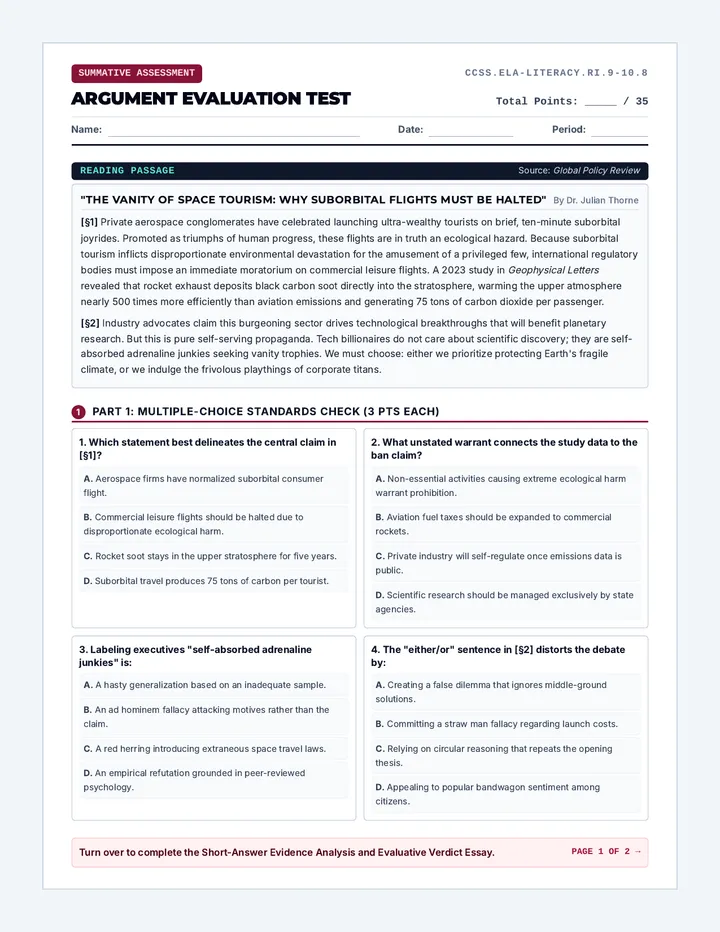
B. An ad hominem fallacy attacking motives rather than the claim.

C. A red herring introducing extraneous space travel laws.

D. An empirical refutation grounded in peer-reviewed psychology.

4. The "either/or" sentence in [§2] distorts the debate by:

A. Creating a false dilemma that ignores middle-ground solutions.

B. Committing a straw man fallacy regarding launch costs.

C. Relying on circular reasoning that repeats the opening thesis.

D. Appealing to popular bandwagon sentiment among citizens.

Turn over to complete the Short-Answer Evidence Analysis and Evaluative Verdict Essay. PAGE 1 OF 2 →

Assessment Section 2

Evidence Analysis & Evaluative Defense

Student Name: _______________________

2

Part 2: Short-Answer Evidence Evaluation (6 pts each)

5. Evidence Sufficiency: Examine the data in [§1] (Geophysical Letters study on soot). Does this single study provide sufficient justification to demand an immediate worldwide legal ban on all commercial flights? Explain why or why not using the RSA criteria:

6. Rebuttal Evaluation: How does Dr. Thorne respond to the counterargument that space tourism drives technological innovation? Evaluate whether his response is logically sound or flawed, citing specific evidence from [§2]:

Part 3: Final Forensic Verdict Essay (11 pts)

Verdict: [ ] SOUND [ ] SHAKY [ ] COLLAPSED

Synthesize your full evaluation of Dr. Thorne's argument (5-6 sentences). Deliver a definitive verdict on its overall soundness. You must analyze: (1) the strength and relevance of his empirical evidence, (2) the validity of his underlying assumptions, and (3) the impact of logical fallacies on his credibility.

Rubric: Claim & Verdict (3 pts) • Evidence & Warrant Analysis (4 pts) • Fallacy Critique (2 pts) • Clarity & Text Evidence (2 pts)

Grade 9 English Language Arts • Assessment RI.9-10.8 Final Exam Score: _____ / 35

Standard RI.9-10.8

W

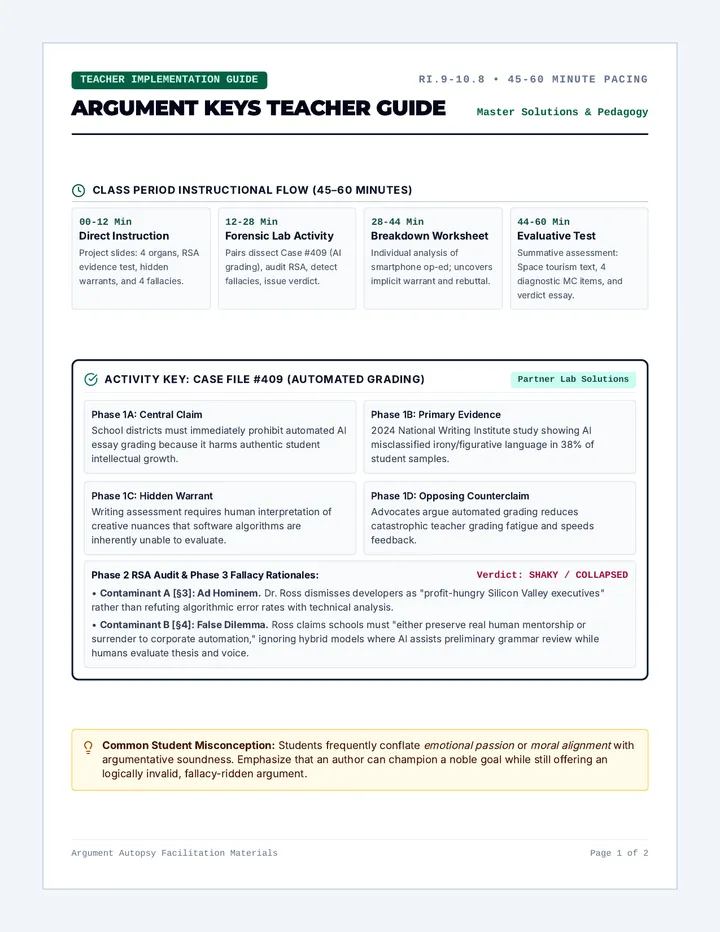
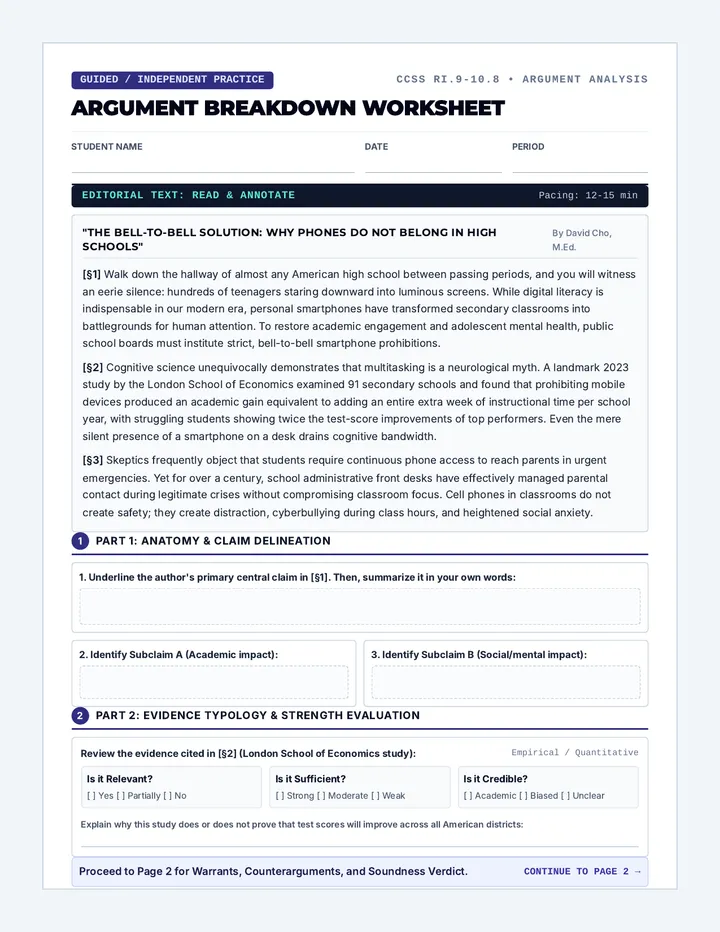
Argument Breakdown Worksheet Key (Smartphone Editorial)

1. Central Claim: School boards must enact strict bell-to-bell smartphone bans to protect learning and mental health.

2. Subclaims: (A) Phones destroy attention span and reduce cognitive bandwidth. (B) Phones fuel cyberbullying and anxiety.

3. Evidence Quality [§2]: London School of Economics empirical study is highly credible and relevant, but insufficient alone to prove universal effects across diverse cultural settings.

4. Part 3 Warrant: Correct option is B (Academic performance takes priority over student device autonomy).

5. Rebuttal Evaluation [§3]: Cho argues front offices handled crises for a century. Flaw: Ignores modern safety concerns (e.g., active campus lockdowns) where direct immediate contact is sought by families.

Exemplar Evaluative Paragraph: "David Cho constructs a moderately sound argument, anchoring his academic claims in rigorous empirical data from the London School of Economics. However, his argument becomes shaky when addressing counterarguments. By asserting that historical front-desk office procedures suffice for modern emergencies, he fails to address genuine parental safety anxieties during real-time lockdowns. To achieve complete soundness, Cho must corroborate his mental health claims with peer-reviewed psychological data and propose an actionable emergency communication protocol."

Test Solutions: Space Tourism Editorial

Summative Solutions

Q1: Central Claim Key: B Ban justified by ecological harm.

Q2: Implicit Warrant Key: A High-damage non-essentials merit bans.

Q3: Fallacy Type Key: B Ad Hominem personal insult.

Q4: Distortion Key: A False Dilemma either/or trap.

Q5 Evidence Sufficiency (6 pts): Full credit requires noting that while Geophysical Letters is a credible source, one single atmospheric study cannot conclusively prove the systemic global climate impact of a nascent industry without cross-disciplinary validation.

Q6 Rebuttal Evaluation (6 pts): Full credit requires identifying that Thorne completely ignores the substance of technological spillover (e.g., satellite solar technology) and instead relies on an Ad Hominem attack on executive character.

CriteriaProficient (Advanced)Developing
Verdict & Claim (3 pts)Declares argument SHAKY or COLLAPSED with clear thesis delineating why.Declares verdict without connecting it to author's core thesis.
Evidence Audit (4 pts)Accurately evaluates relevance vs. sufficiency of black soot data citing [§1].Mentions evidence exists without evaluating validity or sufficiency.
Fallacy Critique (2 pts)Cites both Ad Hominem and False Dilemma and explains how they damage credibility.Names a fallacy without explaining why it invalidates logic.
Conventions (2 pts)Formal academic tone, cohesive paragraph structure, precise critical rhetoric terms.Informal tone, sentence fragments, or imprecise terminology.

Rhetorical Forensics Unit • Teacher Resource Guide CCSS Alignment: RI.9-10.8 • W.9-10.9
You might also like

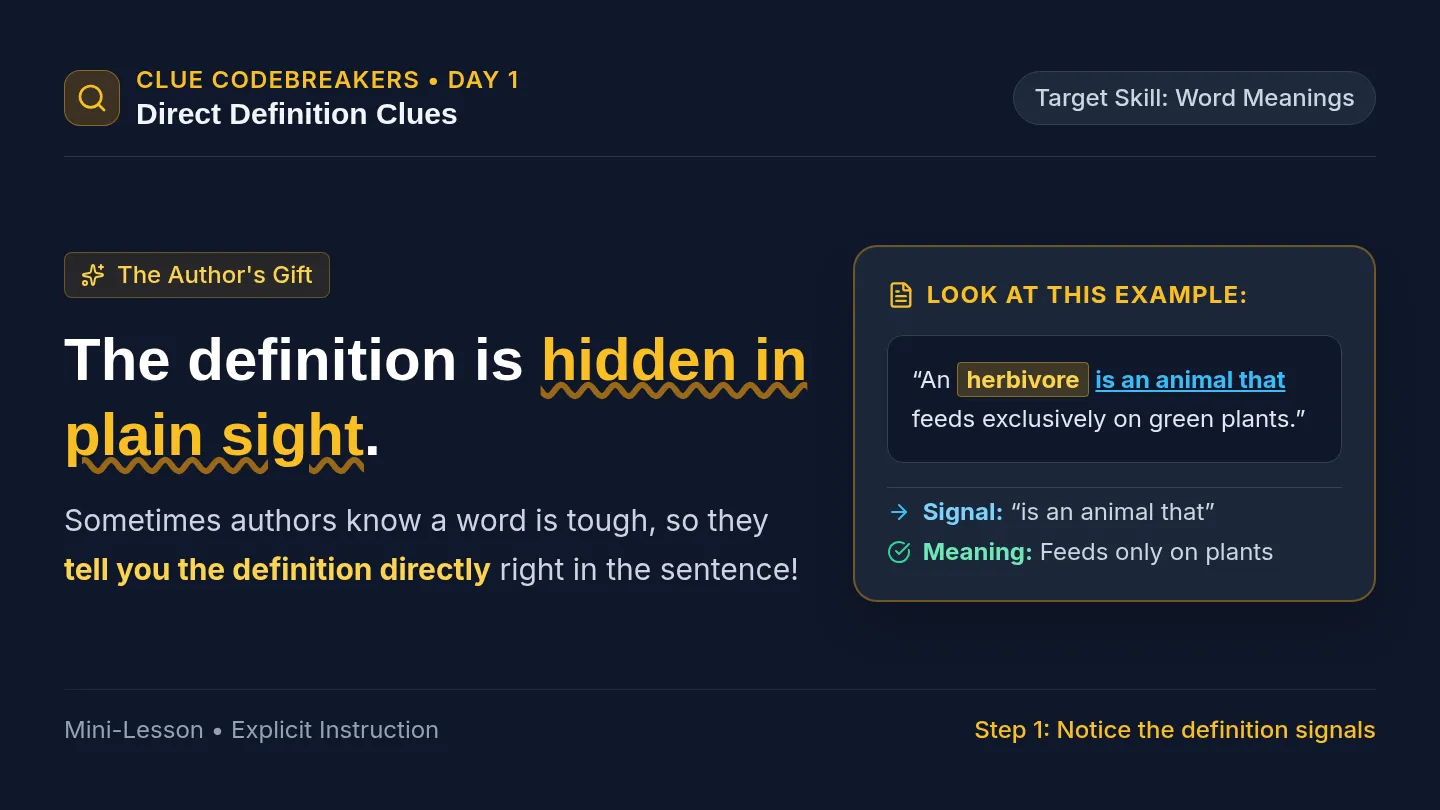
Signal Seekers Slides

Clue Codebreakers

A 3-session targeted remediation sequence designed to help struggling readers master definition context clues, progressing from explicit signal words to punctuation appositives and independent reading transfer.

E

ewestbrook

6
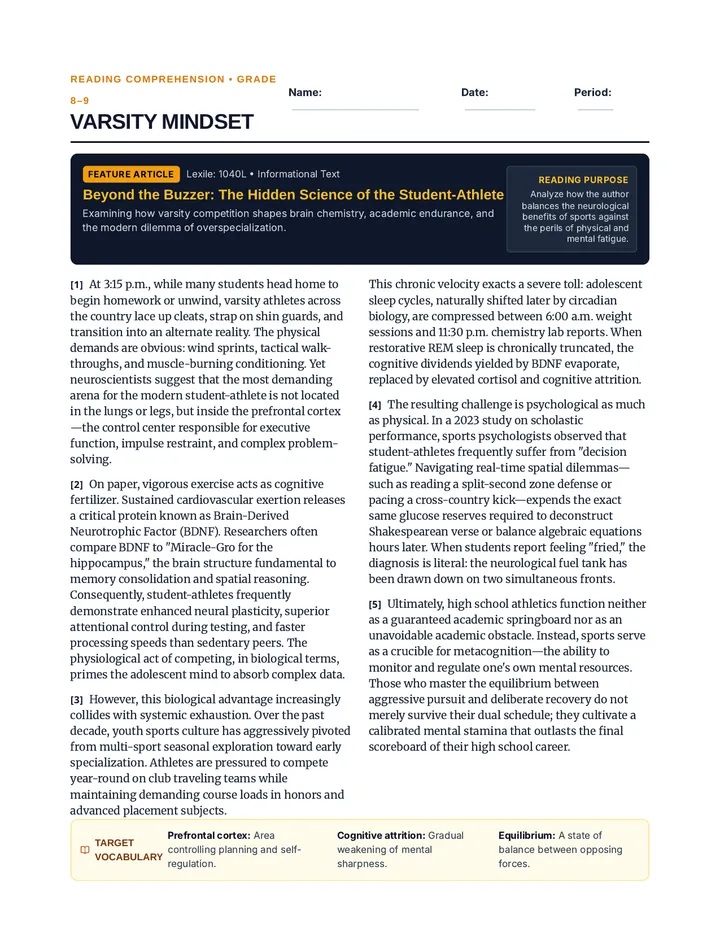
Varsity Mindset Worksheet

Varsity Mindset

An 8th-9th grade reading comprehension lesson exploring the physiological, academic, and psychological dynamics of the modern student-athlete.

AR

Alexander Rhea

2
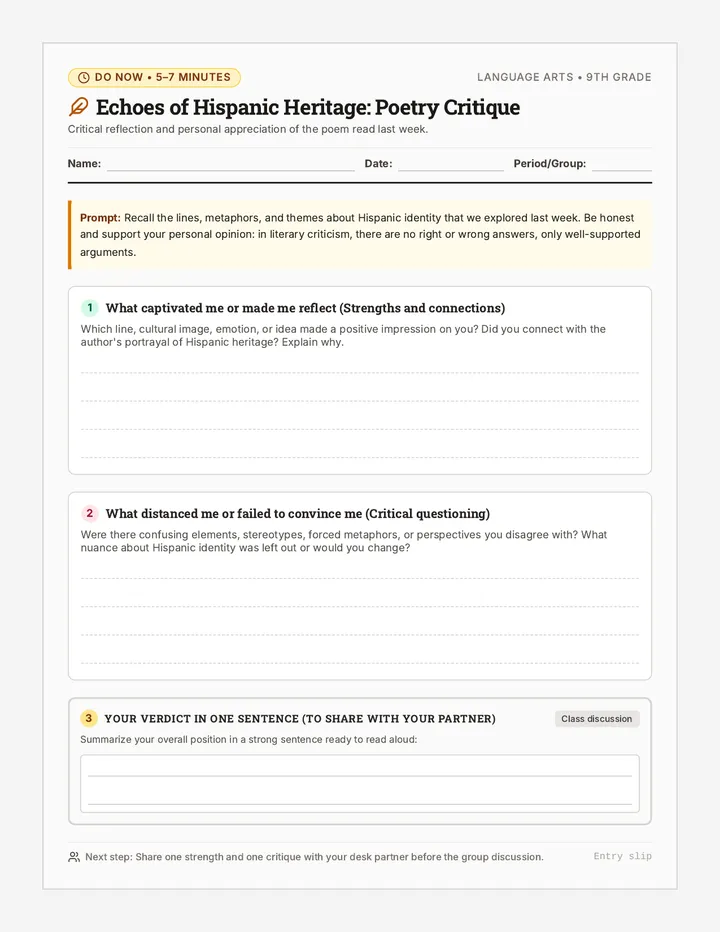
Ecos Hispanos Hazlo Ahora

Ecos Hispanos Hazlo Ahora

Una actividad de entrada o "hazlo ahora" para estudiantes de 9.º grado, diseñada para fomentar el pensamiento crítico sobre el poema de la Hispanidad estudiado recientemente. Contiene espacios estructurados para que los alumnos expresen lo que les cautivó, lo que no les convenció y preparen una frase clave para el debate en clase.

BR

BERKYS RAMIREZ

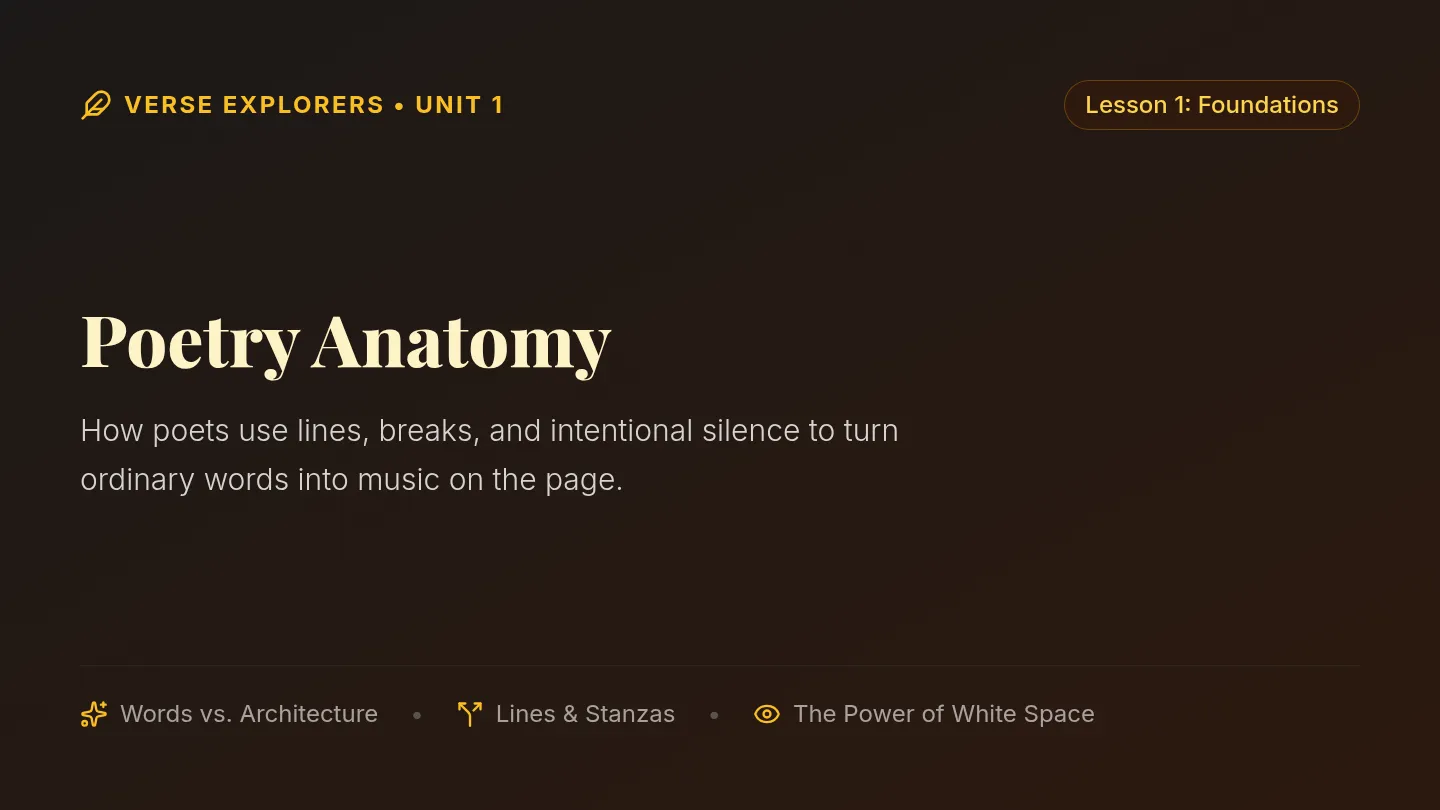
Poetry Anatomy Slides

Verse Explorers

A three-part introductory poetry sequence that guides students through the structural, rhythmic, and musical building blocks of verse. Students contrast poetry with prose, master line breaks and stanzas, tap out meter and poetic beats, and craft original structured stanzas.

NJ

Natalie Johnson

6
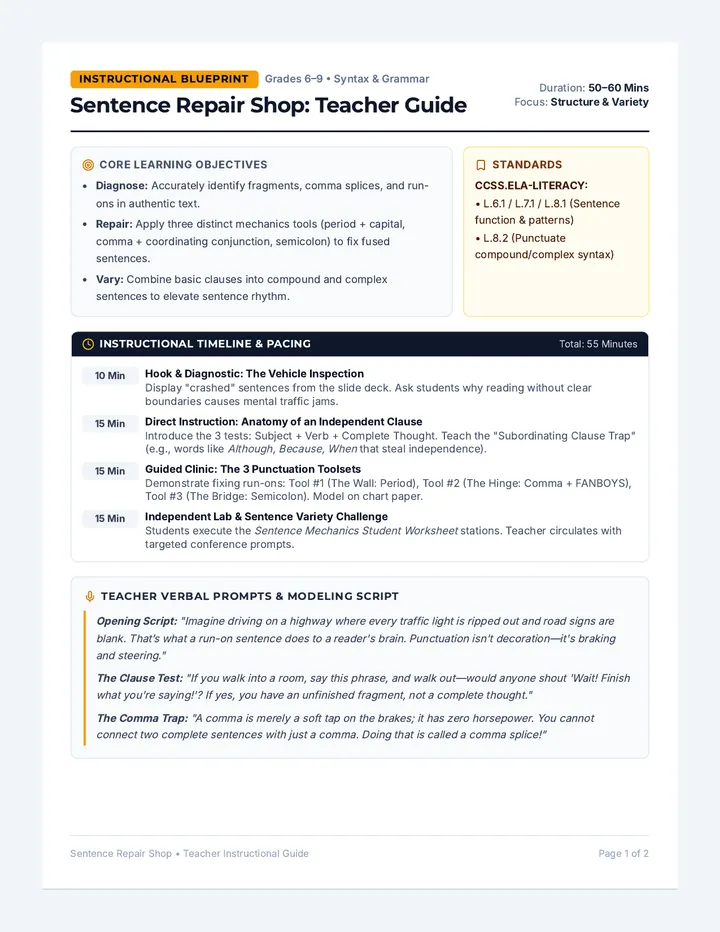
Sentence Repair Teacher Guide

Sentence Repair Shop

A comprehensive middle school grammar lesson focused on sentence anatomy, diagnosing and repairing fragments and run-on sentences, and crafting sentence variety. Students analyze clauses, apply punctuation formulas, and rebuild weak syntax into dynamic writing.

T

timothy.nixon

4
Argument Keys Teacher Guide

Argument Keys Teacher Guide

Comprehensive teacher facilitation guide and complete answer keys for the Argument Autopsy lesson. Features a 45-60 minute instructional pacing blueprint, full solutions and rationales for the activity and worksheet, and a diagnostic test key with an analytic essay rubric.

AC

Amazyn Carter

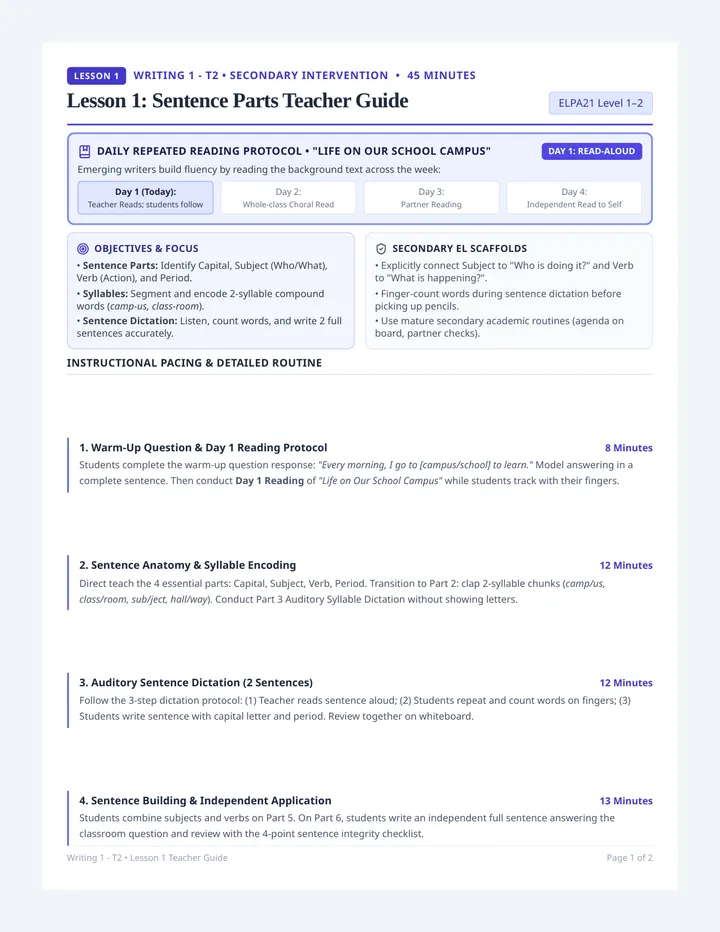
Sentence Parts Teacher Guide

Writing 1 - T2

A 5-week foundational writing intervention for secondary emerging English learners focused on school and community themes, featuring syllable and affix encoding, 2 sentence dictations per lesson, sentence parts and building, and culminating in two-sentence question responses with reasoning.

KJ

Katie Jordan

17
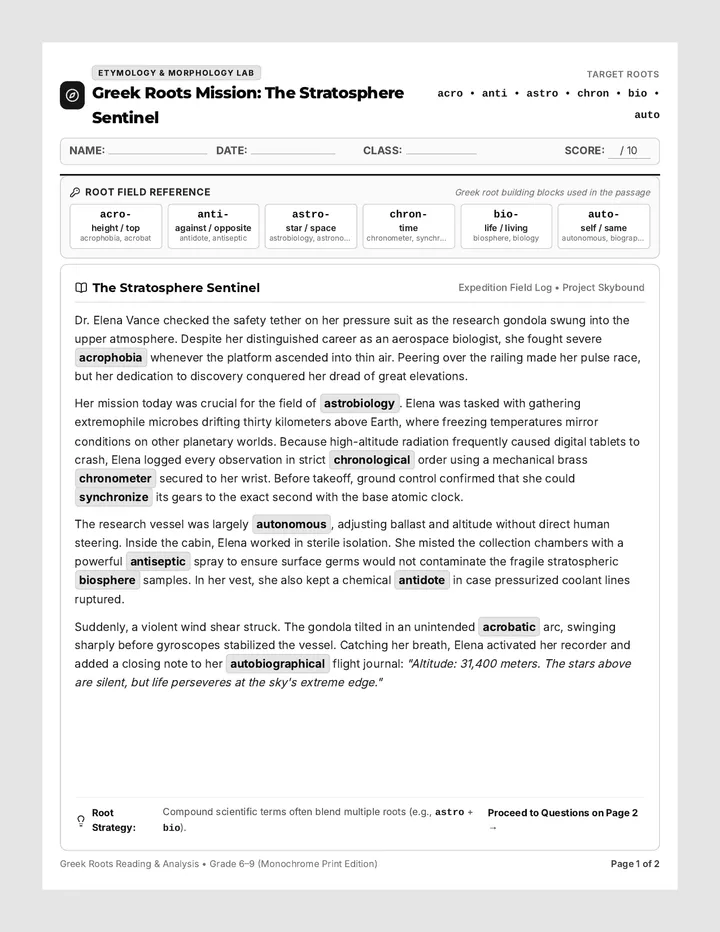
Greek Roots Reading Worksheet

Skybound Roots

A vocabulary and morphology lesson exploring six Greek roots (acro, anti, astro, chron, bio, and auto) through high-altitude science and reading comprehension.

LF

Lindsey Foulks

2
Argument Evaluation Test

Argument Evaluation Test

Summative 2-page test assessing standard RI.9-10.8 (evaluating arguments). Features an editorial text on commercial space tourism, standards-based multiple-choice diagnostic items, short-answer evidence analyses, and an evaluative verdict essay with a 4-point rubric.

AC

Amazyn Carter

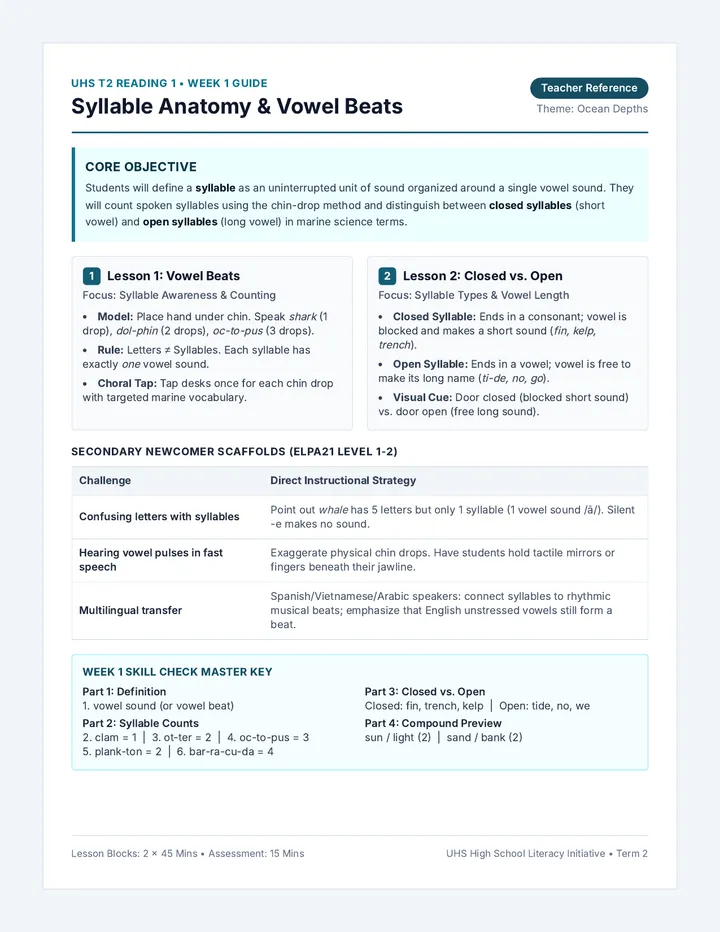
Syllable Anatomy Teacher Guide

Academic Word Lab

A 5-week, 10-lesson intensive reading intervention sequence for high school English Learners (ELPA21 Levels 1-2), systematically progressing from syllables and VCCV decoding to roots, affixes, context clues, and academic vocabulary with 30-minute structured lessons.

KJ

Katie Jordan

16
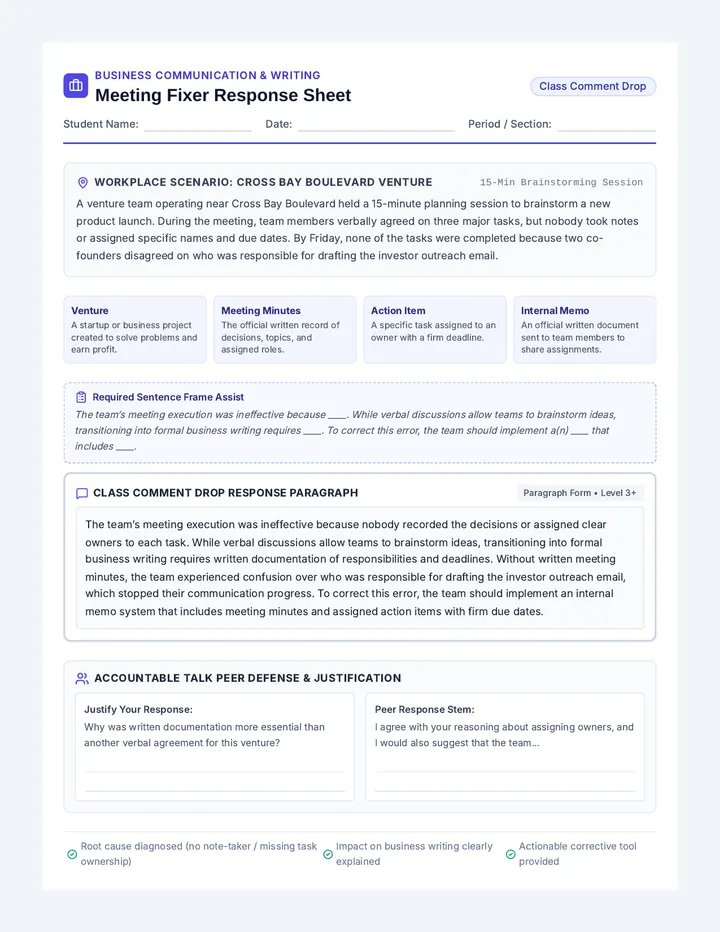
Meeting Fixer Response Sheet

Venture Writing Fundamentals

A foundational business communication lesson guiding students through workplace meeting analysis and document prioritization. Students learn internal accountability and team alignment before drafting external communications to investors and store partners.

Lenny Avatar
Lenny
2
Argument Breakdown Worksheet

Argument Breakdown Worksheet

Individual analysis worksheet guiding 9th graders through a complete editorial on high school smartphone bans. Students dissect claims, evaluate empirical versus anecdotal evidence, expose unstated warrants, critique counterarguments, and judge argumentative soundness.

AC

Amazyn Carter