A comprehensive lesson covering the presidencies of Nixon, Ford, Carter, and Reagan, focusing on key events, scandals, economic shifts, and the rise of conservatism. Students engage with primary sources and data to analyze the changing landscape of late 20th-century America.
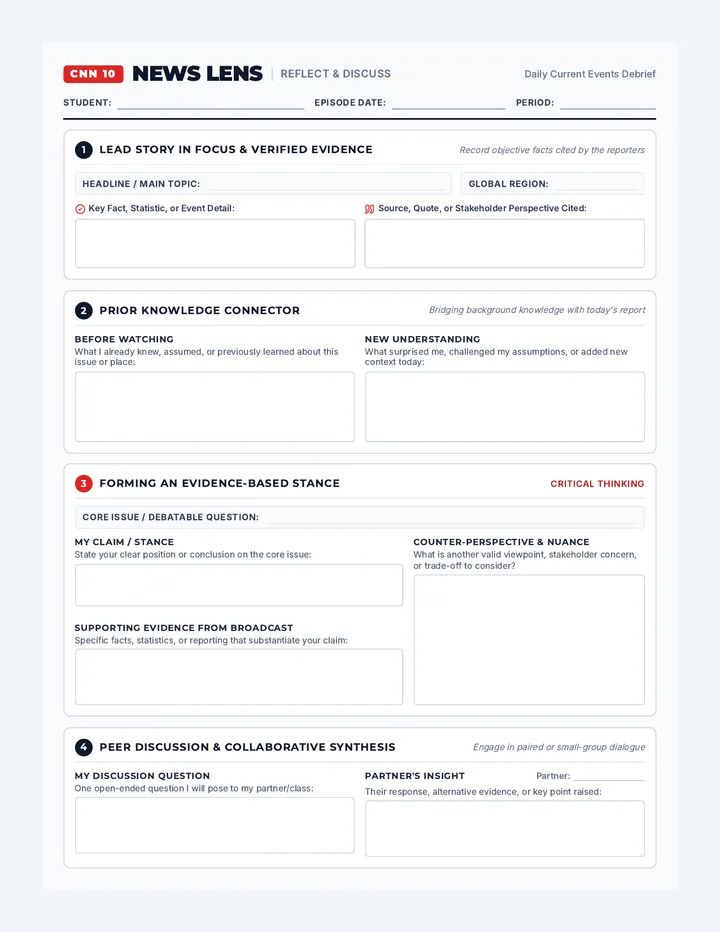
How did the hostage crisis impact the public's perception of the U.S. globally?
NOTES VOLUME 1: CARTER BRIEFING PAGE 03
Mission Briefing: Reagan
Student Evidence Log | File No: RR-1981
Agent Name
Field Notes: Guided Summary
Ronald Reagan promoted an economic theory called -side economics, which involved cutting taxes for the wealthy. His foreign policy was known as "Peace Through ," which included a massive military buildup like the Defense Initiative (SDI).
Reagan was supported by groups like the Heritage Foundation. His presidency also saw the -Contra Affair scandal and a population shift from the Rust Belt to the .
Intelligence Keywords
Reaganomics:
Deregulation:
Trickle-Down
What was the primary goal of cutting taxes for businesses?
Cold War Defense
How did the SDI program pressure the Soviet Union to end the war?
NOTES VOLUME 1: REAGAN BRIEFING PAGE 04
Mission Briefing: Era Summary
Student Evidence Log | File No: SUM-1970-1989
Agent Name
Field Notes: The Trust Gap
During the 1970s, public trust in the government began to because of the Watergate Scandal. This feeling of doubt is often called public . Under Carter, the nation faced a "crisis of ," as many felt the country was failing to solve its economic and global problems.
This led to the Conservative Revolution in 1980. Americans began to believe that the federal government should be and that business should be removed to help the economy grow.
Comparative Analysis: 70s vs. 80s
The 1970s: Outlook
Based on the reading, what was the general "mood" or "feeling" of the country during the mid-70s?
The 1980s: Outlook
How did Ronald Reagan's approach to the presidency change the national "mood"?
Synthesis Question
How did the events of the 1970s (Watergate, Energy Crisis, Iran Hostage Crisis) pave the way for the Conservative Revolution of the 1980s?
NOTES VOLUME 1: SUMMARY BRIEFING PAGE 05
Teacher Answer Key - For Instructional Use Only
Field Notes: Guided Summary
Jimmy Carter's presidency focused on human rights. His greatest diplomatic success was the Camp David Accords, a peace agreement between Israel and Egypt. However, the U.S. faced an Energy Crisis caused by OPEC embargoes (trade bans).
The final year of his term was dominated by the Iran Hostage Crisis, where 52 Americans were held for 444 days. Carter also signed the Community Reinvestment Act (CRA) to stop banks from discriminating against low-income neighborhoods.
Intelligence Keywords
OPEC:
Organization of Petroleum Exporting Countries; group that controls oil production and pricing.
Embargo:
An official ban on trade or other commercial activity with a particular country.
Camp David
It ended years of war between Israel and Egypt, providing a framework for peace and showing the US could be a neutral mediator in global conflicts.
Hostage Crisis
The US looked weak and unable to protect its own citizens or embassy. It damaged Carter’s popularity and showed that the nation was struggling to project power abroad.
Briefing Key: Reagan
Teacher Answer Key - For Instructional Use Only
Field Notes: Guided Summary
Ronald Reagan promoted an economic theory called supply-side economics, which involved cutting taxes for the wealthy. His foreign policy was known as "Peace Through Strength," which included a massive military buildup like the Strategic Defense Initiative (SDI).
Reagan was supported by conservative groups like the Heritage Foundation. His presidency also saw the Iran-Contra Affair scandal and a population shift from the Rust Belt to the Sunbelt.
Intelligence Keywords
Reaganomics:
Economic policies featuring tax cuts, deregulation, and reduced government spending.
Deregulation:
The removal of government regulations on industry/business to encourage growth.
Trickle-Down
To encourage them to invest in new businesses, factories, and technology, which would theoretically create jobs and wealth for the middle and lower classes.
Cold War Defense
It forced the Soviets to spend massive amounts of money to keep up, which their struggling economy couldn't handle, ultimately forcing them to reform or fail.
Briefing Key: Era Summary
Teacher Answer Key - For Instructional Use Only
Field Notes: The Trust Gap
During the 1970s, public trust in the government began to drop/fall because of the Watergate Scandal. This feeling of doubt is often called public cynicism. Under Carter, the nation faced a "crisis of confidence," as many felt the country was failing to solve its problems.
This led to the Conservative Revolution in 1980. Americans began to believe that the federal government should be smaller and that business regulations should be removed to help the economy grow.
Synthesis Question Key
How did the events of the 1970s pave the way for the Conservative Revolution of the 1980s?
The 1970s (Watergate, stagflation, Hostage Crisis) made Americans feel that the federal government was either dishonest or incompetent. This failure of "big government" led voters to seek the opposite: a leader who promised smaller government, lower taxes, and traditional values. Reagan’s optimism was a direct response to the "malaise" and doubt of the 1970s, making his conservative platform very attractive to a frustrated public.
Focus Area: Carter's Global Perspective
The Key Realization:
Students should distinguish between Carter's success (Camp David) and his perceived failures (Hostage Crisis). The Rigor: Connect the Energy Crisis to the Hostage Crisis—both showed a nation dependent on Middle Eastern stability and vulnerable to foreign regimes.
Focus Area: The Conservative Shift
The Key Realization:
Students must understand that the "Reagan Revolution" wasn't just about Reagan; it was a reaction to the 70s. The Rigor: Help students link the distrust of the 70s to the desire for small government in the 80s. If people don't trust the government to be honest or effective, they naturally want it to have less power.
Implementation Guide: Vol 1 Page 02
C
many citizens felt that it prevented the truth from being fully investigated in a trial
D
it was seen as a way for Ford to gain support from the Democratic Party
6. The primary success of the 1978 Camp David Accords was the —
F
negotiation of a peace treaty between Israel and Egypt
G
creation of an international trade embargo against Iran
H
establishment of the Environmental Protection Agency
J
formal recognition of Communist China by the United Nations
7. Which event most directly contributed to President Jimmy Carter's loss in the 1980 election?
A
The signing of the Community Reinvestment Act
B
The inability to resolve the Iran Hostage Crisis for over a year
C
The military success of the Strategic Defense Initiative
D
The economic boom created by the "Whip Inflation Now" program
Supply-Side Economics (Reaganomics)
Lower taxes on businesses and the wealthy
Increased investment and job creation
Prosperity "trickles down" to all citizens
8. Supporters of the economic policy described in the diagram above argued that it would —
F
reduce the national deficit through increased government spending
G
provide immediate financial relief directly to low-income families
H
stimulate economic growth by encouraging private sector investment
J
increase the number of federal regulations on the banking industry
UNIT ASSESSMENT: OVAL OFFICE PAGE 02
9. President Ronald Reagan’s "Peace Through Strength" policy included the development of the Strategic Defense Initiative (SDI). What was the primary goal of this policy?
A
To build a space-based system to intercept nuclear missiles and pressure the USSR
B
To provide humanitarian aid to Eastern European countries under Soviet control
C
To negotiate a complete nuclear disarmament treaty with the Soviet Union in 1981
D
To reduce military spending and focus on domestic social programs
The Rust Belt
Northern industrial states
Declining manufacturing jobs
Colder climate
The Sunbelt
Southern and Western states
Defense and tech jobs
Warm climate
10. During the 1970s and 1980s, the population shift illustrated in the diagram led to —
F
a decrease in the number of congressional representatives for Southern states
G
a shift in political power and a rise in support for conservative policies
H
an increase in federal funding for industrial factories in the North
J
the total elimination of the "Rust Belt" industrial economy
CRITICAL ANALYSIS: Describe how the Watergate scandal changed the relationship between American citizens and their government. Provide ONE specific reason for your answer.
UNIT ASSESSMENT: OVAL OFFICE PAGE 03
Camp David Accords
Peace treaty between Israel and Egypt. Historic victory for diplomacy.
Iran Hostage Crisis
52 Americans held for 444 days. Made the U.S. and Carter look weak.
The Energy Crisis
OPEC used oil embargoes as a weapon. Gas prices soared and supplies were scarce.
"Turn down your thermostats and wear a sweater." — Jimmy Carter
Ronald Reagan
The Conservative Revolution (1981–1989)
Reaganomics
Tax Cuts & Deregulation
Peace Through Strength
Military Build-up & Cold War End
Reaganomics: Supply-Side
Focus on "trickle-down" effects by cutting taxes for the wealthy and businesses.
Tax Cuts
Deregulation (fewer rules)
High Military Spending
Sunbelt Shift
People moved from the cold Rust Belt (North) to the warm Sunbelt (South/West) for defense and tech jobs.
End of the Cold War
Peace Through Strength
Reagan spent billions on defense. This forced the USSR to overspend until they went broke and had to reform.
SDI ("Star Wars")
A proposed satellite shield to shoot down missiles. It was a major bluff that the Soviets took seriously.
"Mr. Gorbachev, tear down this wall!"
— 1987 Speech in Berlin
The Big Picture
1970s Theme: Crisis
Crisis of Confidence
Watergate, Stagflation, Hostages.
1980s Theme: Shift
Conservative Revolution
Small Government, Traditional Values, Optimism.
The Trust Legacy
The Watergate Scandal permanently changed how Americans view the honesty and power of the Presidency.
G
creation of an trade embargo against Iran
H
establishment of the EPA
J
formal recognition of Communist China by the UN
Question 07
Which event most directly contributed to President Jimmy Carter's loss in the 1980 election?
A
The signing of the Community Reinvestment Act
B
The inability to resolve the Iran Hostage Crisis
C
The success of the Strategic Defense Initiative
D
The economic boom of "Whip Inflation Now"
Question 08
Supply-Side Economics
Lower taxes for wealthy
Investment & Job Growth
Prosperity for everyone
Supporters of this policy argued that it would —
F
reduce the national deficit through spending
G
provide immediate relief to low-income families
H
stimulate growth by encouraging investment
J
increase federal regulations on banking
Question 09
Ronald Reagan’s "Peace Through Strength" policy included the Strategic Defense Initiative (SDI). What was the primary goal?
A
To build a space-based shield and pressure the USSR
B
To provide humanitarian aid to Eastern Europe
C
To negotiate a disarmament treaty in 1981
D
To reduce military spending and focus on domestic programs
Question 10
The Rust Belt
Northern industrial states
Declining jobs
The Sunbelt
Southern/Western states
Defense/Tech jobs
During the 1970s and 1980s, the population shift illustrated above led to —
F
a decrease in congressional reps for the South
G
a shift in power and rise in support for conservatism
H
an increase in federal funding for Northern factories
J
the total elimination of the Rust Belt economy
Debrief
Review your scores and discuss how the 1970s "Crisis of Confidence" led directly to the "Conservative Shift" of the 1980s.