Economics Essentials Facilitation Guide Economics Essentials
Lesson Facilitation Guide
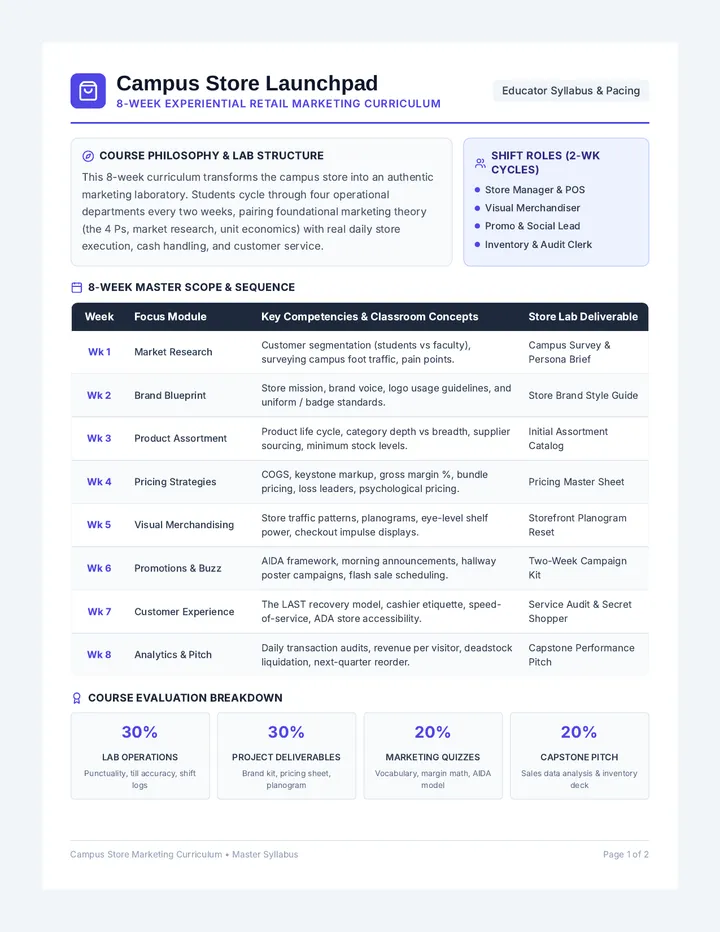
Target Audience: 12th Grade Remediation
Total Duration: 7 Sessions (90m each)
The "Why"
Understanding fundamental economic principles helps students make informed decisions as consumers, producers, and citizens, enabling them to analyze real-world economic issues and participate effectively in society.
Teacher Prep
Review slides and reading materials for all 7 days.
Make photocopies of student packets (Reading, GO, Activity, Cool Down).
Ensure whiteboard or projector is ready for daily intros.
Gather basic writing supplies.
Learning Objectives
Students will be able to define key economic terms, explain supply and demand, differentiate between economic systems, describe government's role, identify factors of production, and understand growth/trade principles using scaffolded sentence frames.
Unit Pacing & Instructions
Day 1: Intro & Scarcity 90 Minutes
Focus: Understanding choices and scarcity.
Warm-Up: Slides 1-2. Prompt: "What does economy mean to you?"
Reading & GO: Independent reading on scarcity and term definitions.
Activity: Scarcity Scenarios using provided sentence frames.
Cool Down: Reflect on scarcity in personal life.
Day 2: Supply and Demand 90 Minutes
Focus: Market mechanics and price determination.
Warm-Up: Slides 3-4. Price change reflection.
Reading & GO: Laws of supply/demand and factors affecting markets.
Activity: Market Scenarios predicting price/quantity changes.
Cool Down: Reflection on personal purchasing habits.
Day 3: Economic Systems 90 Minutes
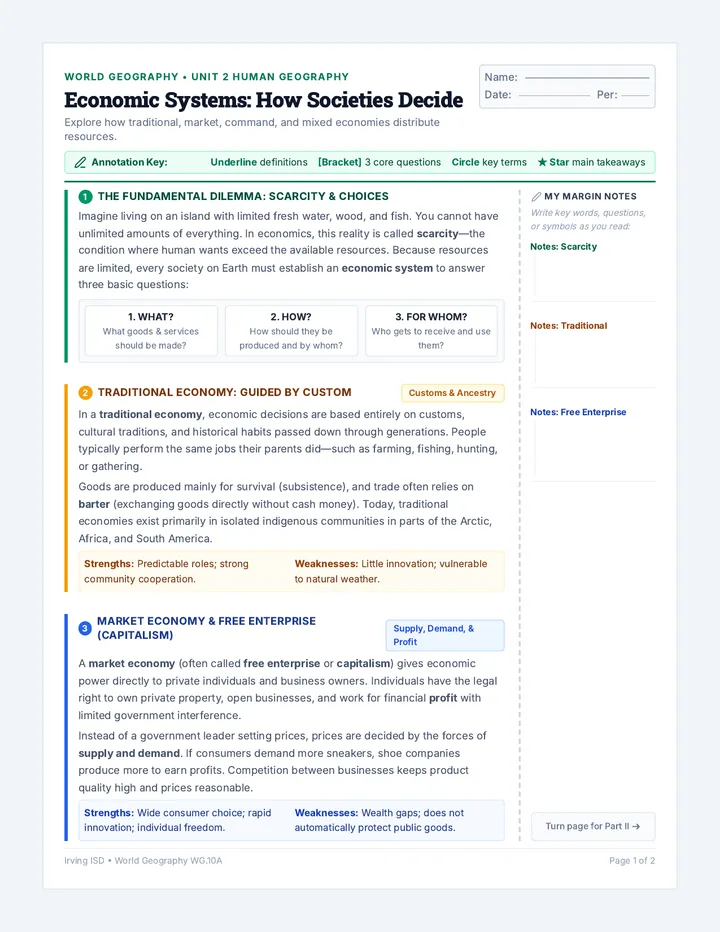
Focus: Comparing Traditional, Command, Market, and Mixed.
Warm-Up: Slides 5-6. "Who decides?" discussion.
Reading & GO: System comparison chart (What, How, For Whom).
Activity: "Design Your Own Economy" island project.
Cool Down: Preferred system reflection.
Follow similar structure for Days 4-6 focusing on Government Role, Factors of Production, and Global Trade. Day 7 is dedicated to a 45m Review Activity and a 40m Final Quiz.
Economics Essentials Slides Economics Essentials
Your 7-Day Knowledge Boost!
What is Economics?
Supply and Demand
Economic Systems
Government's Role
Factors of Production
Global Trade
What is Economics?
The study of how people, businesses, and governments make choices because resources are limited.
Think About It:
Limited money: What do you buy?
Limited workers: What does a company make?
Limited land: How does a country use it?
Scarcity: The Big Challenge
BASIC ECONOMIC PROBLEM
Time
Only 24 hours in a day.
Money
Allowances or paychecks have limits.
Resources
Limited oil, water, and space.
"Because of scarcity, we ALWAYS have to make choices!"
Supply: What's Available?
How much of a good or service producers are willing to sell at different prices.
Higher Price = Higher Supply
Lower Price = Lower Supply
🧁
The Baker Example
High prices for cupcakes? Bake more! Low prices? Bake fewer.
Demand: What Do People Want?
🎮
The Gamer Example
Expensive games? Wait to buy. Sale price? Rush to buy!
How much of a good or service consumers are willing to buy at different prices.
Higher Price = Lower Demand
Lower Price = Higher Demand
Equilibrium: The Sweet Spot!
SUPPLY
=
DEMAND
Too much supply?
Prices drop to clear the shelves.
Too much demand?
Prices rise because items are rare.
Four Main Economic Systems
Traditional
Based on customs and ancestors. "The way it's always been."
Command
The government makes all decisions. Central planning.
Market
Individuals & businesses decide. Driven by profit/choice.
Mixed
A blend of market and command. Most countries today!
Why Does Gov't Get Involved?
Public Goods (Roads, Schools)
Protect Consumers & Workers
Prevent Monopolies
Provide a Social Safety Net
Stabilize the Economy
Manage Inflation
The Economic Building Blocks
🌍
Land
Natural resources (Oil, water, trees)
👷
Labor
Human effort (Workers, skills)
🏗️
Capital
Human-made tools (Factories, tech)
💡
Entrepren...
Skills to combine resources & take risks
Economic Growth
"Making the pie bigger so everyone gets a larger slice!"
Resources
More workers or new natural resources.
Productivity
Working smarter using new technology.
Innovation
New ideas that create entire industries.
International Trade
Specialization
Countries focus on what they are best at. (e.g., Brazil & Coffee)
Comparative Advantage
Making something at a lower opportunity cost than others.
Congratulations!
You're becoming an economic expert.
Keep observing the world around you—economics is everywhere!
What is Economics Reading Day 1: Economics Basics
What is Economics?
Have you ever had to choose between buying a new video game or saving up for concert tickets? Or maybe your family had to decide if they should buy a new car or fix the old one? These are all economic choices !
Official Definition:
Economics is the study of how people, groups, and countries make choices about how to use their limited resources to satisfy their unlimited wants and needs .
Limited Resources
This means there isn't an endless supply of everything. Think about money, time, natural resources (like oil or water), or even the number of teachers in a school.
Unlimited Wants
People always want more! We need food, shelter, and clothes. But we also want new phones, cool clothes, and fun trips. There's no end to what we desire.
Because resources are limited but our wants are not, we have to make choices. Every choice has a cost , even if it's not money. This cost is what you give up when you choose one thing over another.
The Big Problem: Scarcity
Scarcity means that there are not enough resources to produce all the goods and services that people want and need. It's the basic economic problem that everyone faces.
Pizza Example: 10 slices, 20 students. The pizza is scarce!
Town Example: Not enough money for both a hospital and road repairs.
Trade-offs
Because of scarcity, we are forced to make trade-offs . A trade-off is what you give up when you make a choice. If you choose to study for a test, you are trading off watching TV.
Sentence Frames for Practice
Economics is important because it helps us understand .
A resource is limited when .
Scarcity means that .
When I make a choice, the trade-off is .
Key Economic Terms Graphic Organizer Key Economic Terms
Vocabulary Graphic Organizer
Name: __________________________
Date: ___________________________
Directions: After reading "What is Economics?", fill in the definitions and provide a personal example for each term. Use the sentence starters at the bottom if you need help!
1. Economics
The study of choices and resources.
My Definition
An Example
2. Limited Resources
Resources that are not endless.
My Definition
An Example
3. Scarcity
Not enough of something for everyone.
My Definition
An Example
4. Trade-off
What you give up to get something else.
My Definition
An Example
Scaffolding & Sentence Starters
Economics: "Economics is like studying how people _________ because _________."
Limited Resources: "Something is a limited resource if there is only _________ of it."
Scarcity: "Scarcity means that _________, so we have to _________."
Trade-off: "When I choose one thing, the trade-off is _________."
Scarcity Scenarios Activity Scarcity Scenarios
Making Tough Choices Independently
Name: __________________________
Date: ___________________________
Directions: Read each scenario. Identify the scarce resource and describe the trade-off being made. Use the sentence frames to help structure your answers.
1
The School Dance
Your school is planning its annual dance. The principal has given the student council a budget of $500 to spend on decorations, a DJ, and snacks. A fancy DJ costs $400, leaving only $100 for everything else. A cheaper DJ costs $200, leaving more for food and decor.
What is the scarce resource?
Frame: The scarce resource is _________ because there is only a set amount of it.
What is the trade-off the student council faces?
Frame: If they choose the expensive DJ, the trade-off is _________.
2
Weekend Plans
You have a big history project due Monday (5 hours). Your friend invites you to the movies Saturday (3 hours). You also promised to help with chores Sunday (2 hours). You only have 8 free hours total this weekend.
What is the scarce resource?
Frame: The scarce resource is _________ because I only have a certain amount of it.
What is the trade-off you face?
Frame: If I go to the movies, I will trade off _________.
3
Community Garden
A small community has a vacant lot. It could be a playground or a community garden. They only have enough space and money for one project.
What is the scarce resource?
What is the trade-off the community faces?
Economics in My Life Cool Down Economics in My Life
Day 1 Cool Down
Name: __________________________
Date: ___________________________
1. In your own words, what is the most important idea you learned about economics today?
Sentence Frame: The most important idea I learned about economics today is _________ because _________.
2. Describe one example of scarcity you faced today or this week.
Sentence Frame: One example of scarcity I faced today/this week was _________ because there was not enough _________.
3. What was a trade-off you made recently? What did you choose, and what did you give up?
Sentence Frame: Recently, I chose to _________ and the trade-off was _________.
Great job finishing Day 1! Turn this in to your teacher.
Understanding Supply and Demand Reading Day 2: Market Forces
The Market Dance
Have you ever wondered why the price of your favorite snack changes, or why sometimes a new video game is hard to find? The answers often lie in supply and demand .
What is Supply?
How much of a good or service producers (companies) are willing to sell at different prices.
Law of Supply: As price goes UP, quantity supplied goes UP. As price goes DOWN, quantity supplied goes DOWN.
What is Demand?
How much of a good or service consumers (buyers) are willing to buy at different prices.
Law of Demand: As price goes UP, quantity demanded goes DOWN. As price goes DOWN, quantity demanded goes UP.
Equilibrium
Equilibrium is the price where the amount producers want to sell is exactly equal to the amount consumers want to buy. It's the "just right" price.
SURPLUS
Price too high. Supply > Demand. Prices usually drop.
SHORTAGE
Price too low. Demand > Supply. Prices usually rise.
Sentence Frames for Discussion
Supply means are willing to sell .
If the price of a product goes up, the supply will because .
If the price of a product goes down, the demand will .
Equilibrium is the point where .
Supply and Demand Factors Graphic Organizer Supply and Demand Factors
What Makes Prices Change?
Name: __________________________
Date: ___________________________
Directions: Use the reading to fill in definitions and examples for things that change supply or demand.
Factors Affecting Supply
Factor Definition (My Words) Example Cost of Resources Technology Number of Sellers
Factors Affecting Demand
Factor Definition (My Words) Example Consumer Income Tastes & Preferences Number of Buyers
Sentence Starters:
"If it costs more to make something, then producers will supply _________."
"If people have more money, they will demand _________."
Market Scenarios Activity Market Scenarios
Predicting Price and Quantity
Name: __________________________
Date: ___________________________
1
New Phone Release
A popular tech company releases a new smartphone with advanced features. Consumers have been waiting months to buy it.
Effect
Does this affect Supply or Demand ?
Will it Increase or Decrease ?
Prediction
What happens to Price ?
What happens to Quantity ?
Frame: "If demand increases, the price will _________ and the quantity will _________."
2
Coffee Harvest Disaster
Severe weather destroys much of the coffee bean crop in a major producing region.
Affects Supply or Demand ?
Increase or Decrease ?
What happens to Price ?
What happens to Quantity ?
3
New Car Factory
A large company opens several new, efficient factories to produce more cars quickly.
Affects Supply or Demand ?
Increase or Decrease ?
What happens to Price ?
What happens to Quantity ?
Price Change Reflection Cool Down Price Change Reflection
Day 2 Cool Down
Name: __________________________
Date: ___________________________
1. Explain in your own words how an increase in supply might affect the price of a product.
Sentence Frame: If the supply of a product increases, the price might _________ because _________.
2. Describe a time you wanted something, but the price was too high, so you waited. What does this tell you about demand?
Sentence Frame: When the price of _________ was high, my demand _________ because _________.
3. Why is it important for businesses to understand both supply and demand?
Sentence Frame: It is important for businesses to understand supply and demand so they can _________.
The Four Economic Systems Reading Day 3: Economic Organization
The Four Economic Systems
Every society must answer three basic economic questions:
1. WHAT
to produce?
2. HOW
to produce it?
3. FOR WHOM
to produce it?
1. Traditional Economy
Based on customs, traditions, and beliefs passed down through generations. People do what their ancestors did.
Example: An isolated village where families farm the same way for hundreds of years.
2. Command Economy
The government makes all important decisions. The government owns resources and tells businesses what to make.
Example: Some communist countries where the state controls all factories and distribution.
3. Market Economy
Individuals and private businesses make decisions based on supply, demand, and profit. Freedom and competition are key.
Example: Capitalism, where people choose what to buy and sell in competitive stores.
4. Mixed Economy
Combines market and command systems. Individuals make choices, but the government regulates and provides services.
Example: Most modern countries, including the U.S. and European nations.
Sentence Frames for Writing
The three basic economic questions are , , and .
In a command economy, the decides everything.
Most countries have a mixed economy because .
Comparing Economic Systems Graphic Organizer Comparing Economic Systems
How Societies Decide
Name: __________________________
Date: ___________________________
Directions: After reading, fill in the chart below to compare how each system answers the basic economic questions. Use your own words.
Question Traditional Command Market Mixed Who decides WHAT to produce? Who decides HOW to produce it? Who decides FOR WHOM?
Need help?
Traditional: "In this system, decisions are based on _________, like ancestors."
Command: "The _________ makes choices about what is made."
Mixed: "A mixed economy combines ideas from _________ and _________."
Design Your Own Economy Activity Design Your Own Economy
Island Civilization Simulation
Name: __________________________
Date: ___________________________
Imagine you are starting a small community on a deserted island. You must decide how your economy will work. Answer the questions below to design your society.
1. What is the name of your island?
2. What are 3 things your community will produce first?
3. Which economic system will you use? Why?
Frame: We chose a _________ economy because _________.
How will you answer the 3 Questions?
WHAT TO PRODUCE?
HOW TO PRODUCE IT?
FOR WHOM TO PRODUCE?
Advantages (Good things)
Challenges (Difficulties)
My Preferred Economy Cool Down My Preferred Economy
Day 3 Cool Down
Name: __________________________
Date: ___________________________
1. If you had to live in one of the four systems, which would you choose? Why?
Sentence Frame: I would choose to live in a _________ economy because _________.
2. What is one major difference between a command economy and a market economy?
Sentence Frame: One major difference is that in a command economy, _________, but in a market economy, _________.
3. Which system is closest to the one we have in our country today? Why?
Sentence Frame: The country I live in is closest to a _________ economy because _________.
Government's Role in the Economy Reading Day 4: Public Sector Economics
Government's Role in the Economy
Many people think of the government and economics as just taxes. But governments play a much bigger role in how economies work, even in market economies.
Why does the government get involved?
1. Public Goods & Services
Things everyone benefits from but private businesses wouldn't provide enough of. Examples: roads, bridges, national defense, and parks.
2. Correcting Market Failures
Fixing problems like pollution (externalities) or breaking up companies that have too much power (monopolies).
3. Promoting Stability
Preventing big "ups and downs" in the economy using Fiscal Policy (spending/taxes) and Monetary Policy (interest rates).
4. Fairness & Safety Net
Helping those in need and setting rules for minimum wage, worker safety, and consumer protection.
Key Economic Tools
Fiscal Policy
Using government spending and taxes to influence the economy.
Monetary Policy
Controlling the supply of money and credit (usually interest rates) through a central bank.
Sentence Frames
A public good is something like because everyone uses it.
Fiscal policy is when the government uses to help the economy.
The government helps ensure fairness by .
Government Economic Tools Graphic Organizer Government Economic Tools
Influencing the Market
Name: __________________________
Date: ___________________________
Directions: After reading, fill in the definitions and provide an example action for each government role.
Role of Government Definition (My Words) Example Action or Tool Providing Public Goods Correcting Market Failures Promoting Stability Ensuring Fairness
Need help?
Public Goods: "The government provides roads and schools because _________."
Stability: "The government uses fiscal policy, which means changing _________."
Fairness: "The government makes rules about _________ to protect workers."
Government Policy Impact Activity Government Policy Impact
Analyzing Real-World Actions
Name: __________________________
Date: ___________________________
1
New Highway Construction
The state government starts a major project to build a highway connecting two cities. This creates many jobs and helps businesses move goods.
What role is the government playing?
Likely impact on the economy?
Frame: "The government is providing a public good. The impact is that jobs will _________ and businesses will _________."
2
Environmental Regulations
Laws pass requiring factories to reduce pollution. Factories must buy new, cleaner, but expensive equipment.
What role/tool is this?
One positive and one negative impact?
3
Interest Rate Hike
The central bank (Federal Reserve) decides to raise interest rates across the country.
Is this Fiscal or Monetary Policy?
Impact on borrowing and spending?
Frame: "If interest rates go up, it is _________ to borrow money, so people will spend _________."
Government's Purpose Cool Down Government's Purpose
Day 4 Cool Down
Name: __________________________
Date: ___________________________
1. Name one public good you use regularly. Why does the government provide it instead of a private store?
Sentence Frame: I use _________, which the government provides because _________.
2. Think of a problem in your town (e.g. pollution or no jobs). How could the government use a tool to help?
Sentence Frame: To help with _________, the government could _________ by using _________.
3. Should the government have more or less involvement in the economy? Why?
Sentence Frame: I think the government should have _________ involvement because _________.
Factors of Production Reading Day 5: Production & Resources
Factors of Production
Every single good (like a phone) and every service (like a haircut) requires resources to be made. In economics, we group these into four main categories .
1. Land
Definition: All natural resources found on or under the earth.
Examples: Trees, water, oil, natural gas, fertile soil.
2. Labor
Definition: The mental and physical effort people put into producing things.
Examples: Factory workers, teachers, doctors, farmers.
3. Capital
Definition: Human-made resources used to produce other things (tools/machines).
Examples: Computers, trucks, factories, robots, software.
4. Entrepreneurship
Definition: The skill of bringing resources together to take risks and start businesses.
Examples: Steve Jobs, a local bakery owner, inventors.
"No country has an unlimited supply of these resources. How a society combines them determines its success!"
Sentence Frames for Practice
To make a product, we need the 4 factors: land, labor, , and entrepreneurship.
A teacher is an example of because they use effort to provide a service.
Entrepreneurship is important because it .
Categorizing Factors of Production Graphic Organizer Categorizing Factors
Identifying Production Resources
Name: __________________________
Date: ___________________________
Directions: For each item, identify which factor of production it represents (Land, Labor, Capital, or Entrepreneurship) and explain why.
Item Factor of Production Why? (Explanation) A farmer The water in a river A tractor The person who invented Facebook An oil rig A software engineer A factory building
Frames:
"This is _________ because it is a natural resource."
"This is _________ because it is a tool used to make things."
"This is _________ because it involves taking a risk to start something new."
Resource Allocation Challenge Activity Resource Allocation Challenge
Building Your Business
Name: __________________________
Date: ___________________________
Imagine you are starting a business. You have limited money and must decide how to spend it on the factors of production.
1. What will your business produce?
Land Needs
Labor Needs
Capital Needs
Entrepreneurship
3. Prioritizing Spending
You can't buy the best of everything. Which factor will you spend the most on? Why?
Frame: I would prioritize spending on _________ because _________.
4. What is one trade-off you had to make?
Frame: A trade-off I faced is _________.
Resources Around Me Cool Down Resources Around Me
Day 5 Cool Down
Name: __________________________
Date: ___________________________
1. Name an item in the room. Which factor of production was most important to make it?
Sentence Frame: For the _________, I think _________ was most important because _________.
2. Think of a local business. Name one example of Land, Labor, and Capital they use.
Sentence Frame: A business near me is _________. They use _________ (Land) and _________ (Labor).
3. Why is entrepreneurship different from just "labor"?
Sentence Frame: Entrepreneurship is separate because it involves _________ and _________.
Economic Growth and International Trade Reading Day 6: Global Economy
Growth and Trade
What is Economic Growth?
Economic growth means an increase in the production of goods and services over time. When an economy grows, there are more jobs and better standards of living.
Resources
Finding new resources or growing the workforce.
Productivity
Making more with less using better education/tech.
Innovation
New ideas (entrepreneurship) creating new industries.
Why do Nations Trade?
No country can make everything it needs efficiently. Countries trade because of specialization and comparative advantage .
Specialization: Focusing on what you are best at making (e.g., Japan makes electronics).
Comparative Advantage: Making something at a lower "opportunity cost" than other countries.
Benefits of Trade
More choices & lower prices for you.
Access to resources we don't have.
More jobs in export industries.
Challenges of Trade
Job losses in some local industries.
Dependence on other countries.
Environmental pollution from shipping.
Sentence Frames
Economic growth means .
One way an economy grows is by .
Countries trade with each other because .
A benefit of trade is that consumers get .
Benefits and Costs of Trade Graphic Organizer Benefits and Costs of Trade
Weighing the Pros and Cons
Name: __________________________
Date: ___________________________
Directions: List the benefits and challenges of international trade based on the reading. Provide a brief explanation or example for each.
Benefits of International Trade
Benefit Explanation or Example 1. 2. 3.
Costs of International Trade
Challenge Explanation or Example 1. 2.
Need help starting?
"A benefit of trade is that it gives people _________ because _________."
"A cost of trade is that some workers might _________."
Trade Simulation Activity Island Trade Simulation
Specialization and Interdependence
Name: __________________________
Date: ___________________________
The Situation
Imagine you are the leader of a small island nation. You have plenty of one resource, but you need others to survive.
1. My Island's Specialization
What do you produce a lot of? (Fish, Wood, Cloth, etc.)
2. My Island's Needs
What 3 resources do you need from others?
Round 1: Bartering
How would you try to trade your resource for what you need? What challenges would you face?
Round 2: Using Money
Now imagine a common "currency" is introduced. How does this make trading easier or harder?
Final Reflection
Frame: This activity showed me that countries trade to get _________ and to _________.
Trade in My Life Cool Down Trade in My Life
Day 6 Cool Down
Name: __________________________
Date: ___________________________
1. Think of a product you own. Where do you think its parts came from? Why?
Sentence Frame: My _________ likely has parts from _________ because _________.
2. How does international trade benefit you personally as a consumer?
Sentence Frame: International trade benefits me because I can buy _________ that are _________.
3. Name one negative impact of trade you've heard about.
Sentence Frame: A negative impact of international trade could be _________ because _________.
Economics Self-Assessment Review Activity Self-Assessment Review
Consolidating Your Knowledge
Name: __________________________
Date: ___________________________
Directions: This is your chance to show what you've learned over the past 6 days. Answer the questions below independently. If you get stuck, look back at your earlier readings and organizers.
1. Basics & Scarcity
What is economics in your own words?
What is scarcity and why does it force us to make choices?
2. Supply & Demand
Explain the difference between the Law of Supply and the Law of Demand.
Name one factor that can increase demand for a product.
3. Economic Systems
Briefly describe the four main types of economic systems.
4. Government & Production
Explain the difference between fiscal policy and monetary policy.
List the 4 Factors of Production.
Sentence Starters for Success
Supply/Demand: "The Law of Supply states _________, while Demand states _________."
Systems: "A Command economy is different because _________."
Production: "Land is _________, Labor is _________, and Capital is _________."
Trade: "A benefit of trade is _________, but a challenge is _________."
Economics Essentials Quiz Economics Essentials Quiz
Summative Assessment • Unit Review
Name: __________________________
Score: _________ / 25
Directions: Choose the best answer for the multiple-choice questions. For open-response questions, use complete sentences.
Section 1: Multiple Choice
1. Which of the following best describes scarcity?
Having enough resources for everyone's wants
When there are unlimited resources available
Not having enough resources to satisfy all wants and needs
Only affecting poor countries
2. If the price of a new video game increases, what is likely to happen to the quantity demanded?
It will increase
It will decrease
It will stay the same
It will cause a surplus
3. In which economic system does the government make all major decisions?
Traditional economy
Command economy
Market economy
Mixed economy
4. Which of the following is an example of a public good provided by the government?
A private car company
A local grocery store
A public park
A new smartphone
5. A farmer's tractor is an example of which factor of production?
Land
Labor
Capital
Entrepreneurship
Section 2: Open Response
6. Explain the difference between supply and demand. Provide an example for each.
7. Describe one benefit and one challenge of international trade for a country.
Economics Essentials Answer Key Economics Essentials Answer Key
Teacher Reference Only
1. Scarcity Definition
Correct: Not having enough resources to satisfy all wants.
Key point: Unlimited wants vs. limited resources.
2. Price vs. Demand
Correct: It will decrease.
Key point: Law of Demand (Inverse relationship).
3. Government Decisions
Correct: Command Economy.
Key point: Central planning by the state.
4. Public Good Example
Correct: A public park.
Key point: Non-excludable and non-rivalrous.
5. Tractor Categorization
Correct: Capital.
Key point: Human-made tools used in production.
6. Supply vs. Demand (Open Response)
Full Credit: Student explains that Supply is what producers sell and Demand is what consumers buy.Example: A baker making more bread when prices are high (Supply). A person buying fewer gadgets when prices rise (Demand).
7. Trade Benefit & Challenge (Open Response)
Benefit: Lower prices, more variety, specialization, economic growth.Challenge: Local job losses, dependence on others, environmental impact.