Great Change Teacher Guide The Great Change
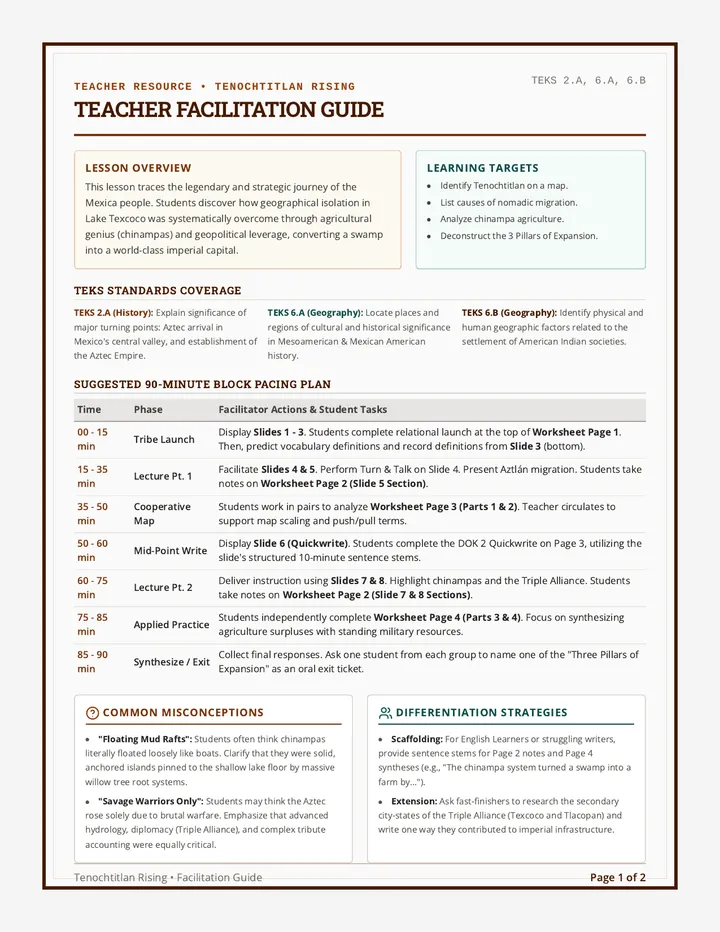
Teacher Facilitation Guide
Lesson 1
Lesson Purpose
This lesson introduces students to the Black Death not as a medical event, but as a historical turning point. By focusing on population data, students grasp the scale of the "Great Change" without being overwhelmed by graphic details. This establishes the foundation for understanding the economic shifts in Lesson 2.
Essential Question
How can a great tragedy lead to new opportunities and a different way of looking at the world?
At a Glance
45-60 Minutes
Whole Group / Small Groups
Skills: Data Analysis, Historical Empathy
The Hook: The Vanishing Town
Begin by asking the students to look around the classroom. Count the number of students (e.g., 24).
"Imagine you walk into school tomorrow, and half of the desks are empty. Half of the teachers are gone. The baker who makes the bread has vanished. The blacksmith who fixes the tools isn't there. What happens to the town? Does life stay the same, or does it have to change?"
Key Discussion Points
1
The Arrival
The plague arrived on trading ships from the East in 1347. Emphasize that trade brought people together, but it also brought the disease. Ask: Why did big trading cities get hit first?
2
The Numbers
Use the population graph from the student worksheet. Between 1347 and 1351, Europe's population dropped by roughly 30% to 50%. Ask: If there are fewer people to work the farms, what happens to the food supply?
3
The Aftermath
This wasn't just a "sad time"—it was a "restructuring time." The old rules of the Feudal System began to break because the people who were left were suddenly very important. Transition: Tell students that in the next lesson, they will see how being "important" gave peasants power.
Activity: Data Detectives
Distribute the Population Puzzle Worksheet . Guide students through the following steps:
Analyze the Graph: Help students identify the X-axis (Year) and Y-axis (Population in Millions). Point out the sharp "cliff" around 1347.
The Village Count: The worksheet asks students to calculate how many people would be left in a sample village of 100 people. This makes the math concrete.
Reflection: Encourage students to think about jobs . If the village weaver is gone, who makes the clothes? This leads into the concept of "skilled labor."
Common Misconceptions
Students might think the plague lasted for 100 years. Explain it came in "waves," but the biggest shock happened in just 4-5 years.
Students may focus on the "scary" aspect. Steer the conversation toward societal structure : How did the "rules" change when the population changed?
Great Change Slides The Great Change
The Black Death and the Shift of an Era
What if...
Imagine you walk into your town tomorrow, and half of the people are gone.
"Who fixes the roads? Who bakes the bread?"
"Does the world stop, or does it change forever?"
Where did it come from?
It arrived in 1347 on trading ships.
The plague started in Asia and traveled to Europe.
Busy trade cities were hit first because so many people met there.
Tracing the Silk Road and the Sea
A Massive Change in Numbers
Before (1347)
75 Million
People in Europe
After (1351)
50 Million
People in Europe
Roughly 1 out of every 3 people in Europe was gone in just 4 years.
The Result?
Less Food
There weren't enough farmers to plant the crops or harvest the wheat.
Worker Power
Since workers were rare, they could start asking for more pay.
The Feudal System was about to break!
Population Puzzle Worksheet Population Puzzle Worksheet
Name: _________________________________________________ Date: __________________
Lesson 1
1 Reading the Data
Look at the graph below. It shows how many millions of people lived in Europe during the Middle Ages. Use the graph to answer the questions that follow.
80M
40M
0M
1000
1300
1347
1400
Figure 1: Estimated Population of Europe (1000–1400 CE)
A. What was the population in the year 1347 (just before the plague)?
B. What was the population by the year 1351 (after the first wave)?
C. Roughly how many million people were lost in just those four years?
2 The Village Count
Imagine a small medieval village called Stonehaven . In 1347, it had 100 people. If 1/3 of the people were lost to the plague, how many people would be left?
100 People
In the Year 1347
33 People
Lost to the Plague
How many left?
D. If the village lost its only baker, blacksmith, and weaver, how would the surviving people get what they need?
E. Why do you think survivors could start asking for more money (wages) to do their work?
Final Thought
History is about more than just dates. It's about how people react to big changes. The Black Death was a tragedy, but it forced the world to build something new. In the next lesson, we'll see how these "few survivors" changed the economy forever!
Worker Power Teacher Guide Worker Power Revolution
Teacher Facilitation & Simulation Guide
Lesson 2
The Power of Choice
This lesson uses a hands-on simulation to teach the economic principle of Supply and Demand . Students will see how the labor shortage caused by the Black Death gave peasants the leverage to demand higher wages, better treatment, and eventually, their freedom from the feudal manor.
Simulation Prep
Cut out "Role Cards"
Gather "Gold Coins" (tokens)
Setup 4 "Manor" Stations
The "Lord's Bid" Simulation
Round 1: The Old World (High Supply)
Purpose: Show that when workers are many, wages are low.
Assign 4 students to be Lords . Give each a "Manor Station."
Assign the rest of the class to be Peasants .
The Rule: Peasants MUST work for a Lord. There are 20+ peasants and only 4 manors.
Lords offer 1 "Gold Coin" for a full day's work. Since there are so many peasants, they have no choice but to take it.
Round 2: After the Change (Low Supply)
Purpose: Show that when workers are few, they have power.
Ask half (or more) of the Peasants to sit out (they represent the population loss).
Now there are 4 Lords but only 6-8 Peasants left.
Lords still need their crops harvested! They must compete.
The Action: Encourage Lords to bid against each other. "I'll give you 2 coins!" "I'll give you 3 coins and a better house!"
Peasants can now choose where to work based on the best offer.
Debrief Discussion
For the Peasants:
"How did it feel when you were the only worker left? Did you feel more or less important than in Round 1?"
For the Lords:
"Was it harder to run your manor in Round 2? What did you have to do to convince people to work for you?"
The Law of Supply & Demand
When the Supply of workers went down, the Value (wages) of those workers went up. This changed the balance of power in Europe forever.
Worker Power Slides Worker Power Revolution
From Serfs to Skilled Labor
The Power of "Few"
If you were the only person in town who knew how to bake bread, what could you do?
"Charge more gold coins?"
"Ask for better working conditions?"
The Big Idea
Supply
How much of something is available? (Workers)
Demand
How much do people want it? (Labor for Farms)
THE RULE:
"When Supply is LOW, the Value goes HIGH."
Simulation: The Lord's Bid
Round 1
Too Many Workers
Lords have all the power. Wages are tiny (1 coin).
Round 2
Not Enough Workers
Peasants have the power! Lords must bid for YOU.
Wait for your Role Card!
Why This Changed Everything
Freedom
Peasants left their manors to find better work.
Wages
Workers finally earned money to spend for themselves.
Towns
People started moving to cities where they could be free.
Worker Power Simulation Cards Simulation Role Cards: The Lord's Bid
Lord / Lady
The Estate Owner
Your Goal: You need workers to harvest your wheat! Without them, you lose your wealth.
"I need workers! I will pay whatever it takes to save my farm!"
Lord / Lady
The Estate Owner
Your Goal: You need workers to harvest your wheat! Without them, you lose your wealth.
"I need workers! I will pay whatever it takes to save my farm!"
Worker
Skilled Farmer
Your Goal: You are a survivor. You know how to farm, and you are one of the few left.
"If you want me to work, you must pay me well. Who has the best offer?"
Worker
Skilled Farmer
Your Goal: You are a survivor. You know how to farm, and you are one of the few left.
"I'm not just a serf anymore. I am a valuable worker!"
Worker
Skilled Farmer
Your Goal: You are a survivor. You know how to farm, and you are one of the few left.
"Show me the gold coins! I'll work for the highest bidder."
Worker
Skilled Farmer
Your Goal: You are a survivor. You know how to farm, and you are one of the few left.
"I'll take the job with the shortest hours and the most pay!"
Print and cut these cards for the Round 2 simulation activity.
City Rise Teacher Guide City Rise and Guilds
Teacher Facilitation Guide
Lesson 3
The Urban Shift
As the Feudal system weakened, people began to leave the manors in search of freedom and opportunity in towns. This lesson explores Urbanization and the birth of the Middle Class . Students will learn how Guilds protected workers and ensured high-quality craftsmanship.
Vocabulary
Urbanization: Moving to cities.
Guild: A group of craftspeople who protect their trade.
Middle Class: People who are not lords or peasants, but earn money through trade or skill.
The Great Migration
Ask students: "Why would you stay on a farm where you are told what to do, when you could move to a town and open your own shop?"
Life on the Manor
Safety, but no freedom.
Tied to the land (serfdom).
Paid in food and housing, rarely coins.
Life in the Town
Exciting, but crowded and dirty.
"City air makes you free!"
Chance to earn gold and join a guild.
What is a Guild?
Explain that a Guild was like a "Super Club" for workers. If you wanted to be a baker, you had to join the Baker's Guild.
Protection
Guilds set fair prices so no one was cheated.
Quality
They checked every loaf of bread to ensure it was good.
Training
They taught "Apprentices" how to learn the trade.
Activity: Town Planning
Students will use the Town vs. Manor Organizer to compare these two worlds. After completing the organizer, challenge them to design their own "Guild Shield" for a trade of their choice (e.g., The Pizza Guild, The Video Game Guild, etc.).
Extension Idea
Have students simulate a "Guild Meeting." One student tries to sell a low-quality "shoe" (a crumpled paper) for a high price. The Guild members must decide if they will allow him into the guild.
City Rise Slides City Rise and Guilds
The Birth of the Middle Class
"City Air Makes You Free!"
After the plague, survivors realized they didn't have to stay on the Lord's manor. They could pack their bags and go to a Town.
The Manor
Follow rules, farm for the Lord, stay for life.
The Town
Choose your job, trade goods, earn your own money.
The Worker's Shield: Guilds
"A Guild is like a family for your job."
A New Way to Live
Before, you were either a Lord or a Peasant. Now, there was a new group:
THE MIDDLE CLASS
Merchants, Bankers, and Artisans
They had money, they had skills, and they wanted more than just survival.
What Comes Next?
With towns growing and the middle class making money, people started to look at the world differently.
They wanted beauty. They wanted realistic art. They wanted the Renaissance!
Town vs. Manor Organizer Worksheet Town vs. Manor Organizer
Name: _________________________________________________ Date: __________________
Lesson 3
1 Two Different Worlds
Fill in the chart below to compare life on a Medieval Manor with life in a Medieval Town.
Feature The Manor (Feudalism) The Town (Urbanization) Who is in charge? Main type of work? How do you get paid? Freedom to leave?
2 Join the Guild
You have moved to the town and want to start a shop! Choose a trade (Baking, Blacksmithing, Weaving, or something new) and design a Guild Shield . Use symbols that represent your skill.
Draw your guild symbols above
My Trade is:
Two rules my Guild follows:
Thinking Forward
If people in towns have more money and more freedom, how might that change the kind of art they want in their homes and churches? (Think about realism vs. flat paintings!)
New Perspective Teacher Guide A New Perspective
Art History & Humanism Teacher Guide
Lesson 4
The Visual Rebirth
As wealth and urbanization grew, the way people saw themselves changed. This lesson moves from the collective focus of the Middle Ages to the Humanism of the Renaissance. We use art as the primary evidence for this shift—moving from flat, symbolic images to 3D, realistic portrayals.
Core Concepts
Linear Perspective: Making flat surfaces look 3D.
Realism: Painting people as they actually look.
Humanism: Focusing on human potential and achievement.
The Comparison: Old vs. New
During the slide presentation, guide students to notice these specific differences:
Medieval Style
"Flat & Floating"
Figures often float in space. No shadows or depth. Backgrounds are often solid gold.
"Hierarchical Scale"
The most important person is painted the biggest, even if they are far away.
Renaissance Style
"The Window Effect"
Paintings look like you are looking through a window into a real 3D room.
"Naturalism"
Faces have emotions. Bodies have muscle and bone structure. People look like people.
Deep Inquiry Questions
Q1
"Why would artists suddenly care about making things look real? What changed about how they felt about being human?"
Q2
"In the Middle Ages, almost all art was for the Church. In the Renaissance, rich merchants started buying art. How does that change what gets painted?"
Activity: Finding the Vanishing Point
Using the Perspective Practice Worksheet , students will learn the "Math of Art."
Facilitation Tip
Show students how all parallel lines in a Renaissance painting lead to a single Vanishing Point on the Horizon Line . This was a revolutionary discovery!
Step 1: Identify the Horizon Line (the height of the viewer's eyes).
Step 2: Find the Vanishing Point (where everything disappears).
Step 3: Connect edges of objects to the point to create depth.
New Perspective Slides A New Perspective
The Visual Language of the Renaissance
The 2D Challenge
How do you make a flat piece of wood look like a deep room you could walk into?
MEDIEVAL: FLAT
RENAISSANCE: 3D
Medieval "Rules" of Art
Importance = Size
Paintings were flat and symbolic.
The most important person was painted the largest.
No real backgrounds—often just gold or solid colors.
The Renaissance Discovery: Perspective
Horizon Line
The imaginary line at the artist's eye level.
Vanishing Point
The single spot where all parallel lines seem to meet.
Why the Change? Humanism!
Artists started to believe that Human Potential was amazing.
Individual People Matter
Real faces, real emotions.
The Real World Matters
Studying nature and light.
Perspective Practice Worksheet Perspective Practice Worksheet
Name: _________________________________________________ Date: __________________
Lesson 4
1 The Vanishing Point
In a Renaissance painting, all lines that are parallel to each other appear to meet at one single spot called the Vanishing Point . Using a ruler, follow the lines of the floor tiles and the ceiling in the box below to find the secret spot where they all meet. Mark it with an X .
Draw your lines to find the X
2 Art Detective
Look at the two descriptions below. Label each one as either "Medieval" or "Renaissance".
"A painting of a king sitting on a throne. He is three times larger than his guards. The background is solid gold, and there are no shadows on his face."
Style: ____________________
"A painting of a woman standing in a garden. You can see the trees and a river far in the distance. Her face looks happy, and her dress has many realistic folds."
Style: ____________________
3 Human Potential
Renaissance artists studied the human body carefully. Try to sketch a hand or an eye as realistically as you can in the space below. Focus on details like wrinkles, shadows, or reflections.
"Art is not what you see, but what you make others see." — Edgar Degas (but felt by Renaissance masters!)
Printing Revolution Teacher Guide The Printing Revolution
Teacher Facilitation & Reflection Guide
Lesson 5
The Information Age 1.0
The sequence concludes with the technology that cemented the Renaissance: Gutenberg's printing press. By making books affordable and fast to produce, the press allowed the ideas of humanism, science, and exploration to spread across Europe, effectively ending the Medieval era.
Essential Skils
Technological Impact Analysis
Future Forecasting
Historical Cause & Effect
The Hook: The Hand-Written World
Begin by explaining what it took to make a book before the press.
"Imagine if every copy of your social studies textbook had to be written by hand by a monk in a basement. It would take a year to finish just one book. How many people in town would own a book? How much would it cost? (As much as a house!)"
How the Press Changed the World
Speed & Volume
One press could produce thousands of pages in a day. Knowledge could now travel as fast as a person could walk or sail.
Common Language
Books started being printed in the languages people actually spoke (English, French, German) instead of just Latin. This meant normal people could finally read!
Explosion of Ideas
Science and math discoveries could be shared instantly. One person's discovery became everyone's knowledge.
Activity: Spread the Word
Students will use the Spread the Word Exit Ticket to synthesize the entire sequence. They will compare the "Darkness" of the plague to the "Light" of the printing press.
The "Green Shoots" Final Discussion
Conclude the unit by revisiting the Essential Question: How can a great tragedy lead to new opportunities?
"We started with a plague that took away half the people. But because of that, workers got more power, cities grew, art became beautiful and realistic, and now, books are everywhere. If the plague had never happened, would the Renaissance have happened as quickly? Or would the world have stayed the same for hundreds more years?"
Printing Revolution Slides The Printing Revolution
The Machine That Changed History
Before the Press
Every single book had to be written by hand.
• It took months to finish one copy.
• Only the super-rich owned books.
• Most people never learned to read.
COST: $50,000+
Johannes Gutenberg's Idea
Movable Type
Small metal letters that could be rearranged and reused millions of times.
The Wine Press
He adapted a machine used to crush grapes to press ink onto paper.
H
E
L
L
O
"Like building blocks for words!"
The "Information Explosion"
Cheaper Books
The price of a book dropped 99%!
Literacy
Regular people started learning to read and write.
Fast Travel
Ideas traveled across Europe in weeks, not years.
The Transition is Complete
MEDIEVAL WORLD
Feudalism, Flat Art, Rare Books, Rural Life.
RENAISSANCE WORLD
Worker Power, 3D Art, Printed Books, Growing Cities.
The Great Shift has happened!
Plot Twists Exit Ticket Spread the Word Exit Ticket
Name: _________________________________________________ Date: __________________
Lesson 5 / Finale
1 The Invention
Johannes Gutenberg used "movable type" to print books. In the boxes below, list three things that are easier to do with a printing press than by writing with a pen.
2 Connecting the Dots
We've learned how one event leads to another. Match the "Cause" on the left to the "Effect" on the right.
The Black Death reduces the population.
A. Towns grow and a middle class is born.
Survivors demand higher wages.
B. Ideas spread quickly across Europe.
People move from manors to towns.
C. The feudal system begins to break.
The Printing Press is invented.
D. Workers gain power over the lords.
3 The Big Question
Our essential question was: How can a great tragedy lead to new opportunities? How did the tragedy of the plague eventually lead to the "rebirth" (Renaissance) of art and invention?
Congratulations! You have completed "The Great Shift" sequence.