Debt Trap Slides THE DEBT TRAP
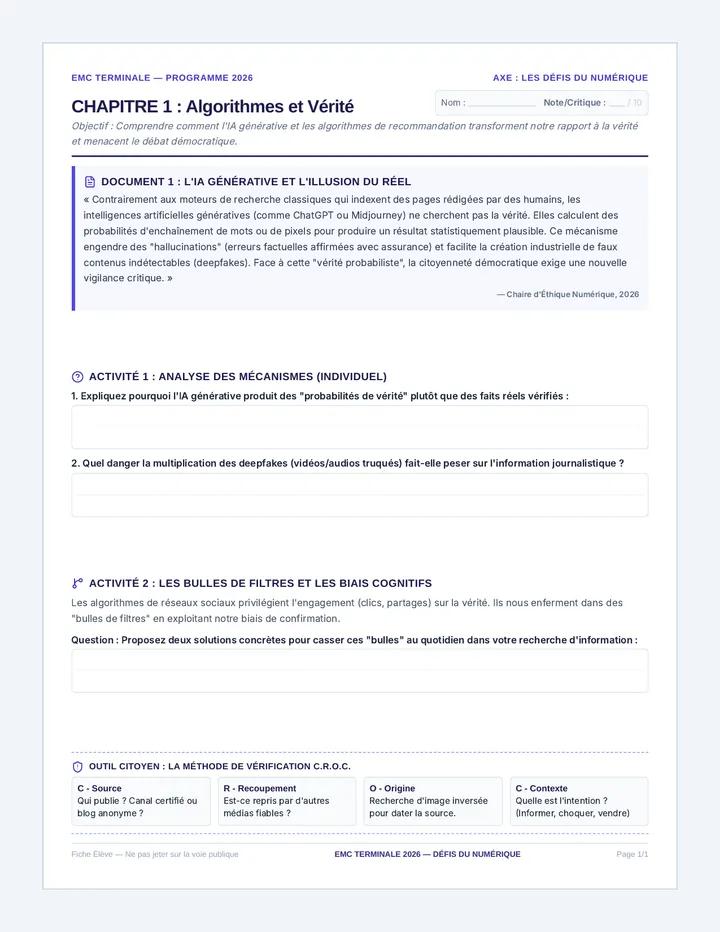
Economic Freedom vs. Political Rights in the Reconstruction South
SESSION 01: SHARECROPPING
Warm-up Discussion
"What do you need to be free?"
Political Freedom
The right to vote, to hold office, and to be protected by the law. (13th, 14th, 15th Amendments)
Economic Freedom
The ability to own land, control your own labor, and build wealth. Can you have one without the other?
The Cycle of Debt
Watch the "Thought Bubble" segment (2:13 - 3:04)
Embedded media
Landowner provides housing & tools
Tenant gives 1/3 to 1/2 of harvest
Debt accumulates and carries over
Sharecropping Simulation
1
The Setup
You start with $0. Your teacher is the Landowner. You must "buy" everything on credit at 50% interest.
2
The Harvest
Roll the "Farm Fortune" dice to determine your weather and crop yield. Weather is out of your control.
3
The Split
The Landowner takes 50% of your crop immediately as rent. You sell the rest to pay off your debts.
4
The Ledger
Calculate your final profit or loss. If you are in debt, you cannot leave the land next season.
The Key to Freedom
"Why was land ownership considered the 'key to freedom' for former slaves?"
Reflection Prompt: Consider how the inability to own property affects a person's rights, choices, and future generations.
Simulation Ledger Worksheet Debt Trap Simulation
Reconstruction Era Economics Ledger
Student:
Date:
Step 1: Seasonal Advance (Expenses)
You have no cash. You must borrow all supplies from the landowner at 50% interest. Calculate your total debt below.
Required Item Base Cost Interest (50%) Total Debt Seed (Cotton/Tobacco) $40 $20 Mule & Plow Rental $60 $30 Tool Maintenance $20 $10 Food/Supplies (Credit) $100 $50 TOTAL ADVANCE DEBT (A)
Step 2: The Harvest Roll
Roll the Farm Fortune die. An "Average Harvest" earns you $300 total value. Calculate your share below.
Weather Result: ___________________
Multiplier: ___________________
Total Harvest Value: $_________
Landowner Share (50% Rent): -$_________
YOUR GROSS EARNINGS (B): $_________
Step 3: Final Settlement
Gross Earnings (B) $ ________
-
Total Advance Debt (A) $ ________
=
Net Result $ ________
Reflection & Connection
1. Did you end the season with a profit or in debt? If in debt, how does this affect your choices for next year?
2. How is this system similar to slavery? How is it different? Use the term "quasi-serfdom" in your answer.
Farm Fortune Dice and Guide Farm Fortune Dice
Cut, fold, and glue to create your simulation die. These results determine your harvest success, regardless of how hard you work.
6 Bumper Crop 200% Yield ($600)
1 Drought Total Failure ($0)
2 Pests 50% Yield ($150)
5 Great Weather 150% Yield ($450)
3 Average 100% Yield ($300)
4 Average 100% Yield ($300)
Assembly
Cut along the outermost solid lines.
Fold along every internal solid line.
Apply glue to the grey flaps.
Tuck flaps inside to form a cube.
Result Table
1: Drought — $0 Earnings
2: Pests — $150 Earnings
3-4: Average — $300 Earnings
5: Good Weather — $450 Earnings
6: Bumper Crop — $600 Earnings
Simulation Facilitation Guide
Phase 1: The Setup (10 minutes)
Tell students they are now free, but they have no land, no tools, and no money. As the Landowner, you "kindly" offer to provide these things on credit.
The Twist: Interest is 50%. This was standard in many Reconstruction-era sharecropping contracts. Ensure students calculate their Total Advance Debt first. (Total should be $450 if they take all items).
Phase 2: The Harvest (5 minutes)
Students roll the Farm Fortune die. Walk around and remind them:
"The Split": Before they pay back their debt, the landowner (you) takes half of the crop as rent.
Example: An "Average" roll yields $300. You take $150. They keep $150... which is less than their $450 debt.
Phase 3: The Result (5 minutes)
Most students will end in the red (debt).
The Discussion: Explain that "debt peonage" laws meant they could not legally leave the land while in debt. They are now tied to the property for next year, regardless of their freedom.
Key Learning Points
The system was designed for workers to fail financially.
Economic dependence mimics the control of slavery.
Lack of capital (savings) prevented land ownership.
Simulation Answer Key TEACHER ANSWER KEY
The Debt Trap: Sharecropping Simulation
FOR TEACHER USE ONLY
Step 1: The Expense Ledger
All students should have identical debt calculations if they take all supplies (which they must to farm effectively).
Item Base Interest (50%) Total Debt Seed $40 $20 $60 Mule/Plow $60 $30 $90 Maintenance $20 $10 $30 Food/Supplies $100 $50 $150 TOTAL ADVANCE DEBT (A) $330
*Note: Initial values adjusted in ledger to ensure debt is likely even with a 5 roll.
Step 2 & 3: Outcome Analysis
Roll 4: Average Harvest
Total Yield: $300
Landowner Rent (50%): -$150
Gross Earnings (B): $150
$150 (B) - $330 (A) = -$180 DEBT
Roll 6: Bumper Crop
Total Yield: $600
Landowner Rent (50%): -$300
Gross Earnings (B): $300
$300 (B) - $330 (A) = -$30 DEBT
Key Insight: Even with a perfect roll (6), the student remains $30 in debt. This illustrates how the system was mathematically weighted to prevent escape.
Sample Reflection Responses
Question 1: Impact of Debt
"Being in debt means I cannot leave. I have to stay and farm the same land next year to try and pay it back, but I will already be starting with a -$180 balance, making it even harder to survive next year. It's a trap."
Question 2: Comparison to Slavery
"It is like slavery because I am still working for the same landowner and I don't have the freedom to move or work elsewhere. It is called 'quasi-serfdom' because while I'm technically 'free' on paper, I'm tied to the land by debt rather than chains."