Towns and Trade Slides Towns and Trade Revival
From the Manor to the Market
Life on the Manor
Self-Sufficient
Everything needed was made on the manor. No need to travel.
Fixed Social Classes
Serfs were tied to the land. You were born into your role.
Isolated
Trade was rare. Coins were almost never used.
"The land provides all... but the world is small."
Why Did Towns Grow?
1. Better Farming
New plows and the 3-field system meant more food. More food = more people!
2. Trade Routes
Crusaders brought back tastes for silks, spices, and luxury from the East.
3. Safe Travel
As warfare slightly decreased, merchants felt safer traveling between regions.
More Trade = More Money = Growth of Cities
The Merchant Class
In the feudal system, you were either a Noble, a Knight, a Clergy member, or a Serf.
But merchants and craftspeople didn't fit. They became the Middle Class—wealthy people who didn't own land but held power through money.
Blacksmiths
Tailors
Bankers
Shipping Merchants
What is a Guild?
A Guild was like a business club for one trade.
They set the Price of goods.
They ensured high Quality.
They cared for the Families of sick members.
They controlled Who could practice the trade.
The Path to Mastery
1
Apprentice (Learning, age 7-14)
2
Journeyman (Paid daily worker)
3
Master (Expert & Guild Member)
Choose Your Life
The Manor
Quiet & predictable
Protection from the Lord
No freedom to leave
Hard labor for life
The Town
Opportunity to get rich
Freedom after 1 year + 1 day
Dirty, crowded, smelly
Higher risk of crime/disease
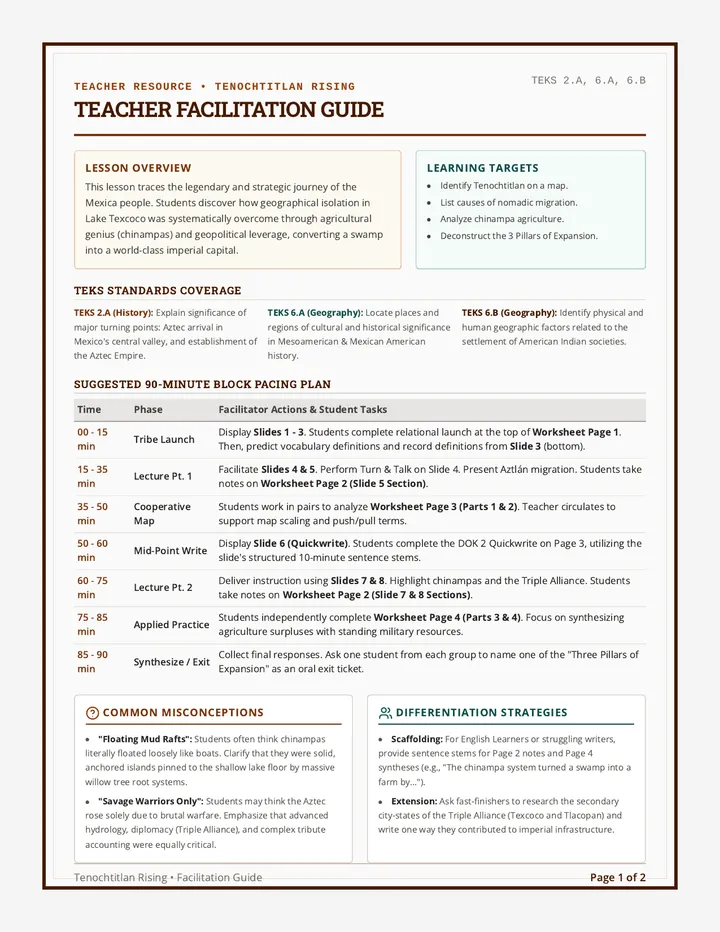
Manor vs Town Worksheet Market & Manor
Lesson 1: Towns and Trade Revival
NAME:
DATE:
As trade routes reopened across Europe, the old ways of the manor began to change. People started moving toward "burgs" (towns) for new opportunities. Use your knowledge of medieval life to compare these two worlds.
The Great Divide: Manor vs. Town
Feature The Manor (Feudalism) The Town (Trade Revival) Economy Self-sufficient farming Social Class Merchants and Craftspeople Freedom Environment Crowded, smelly, lively
Guild Application
Imagine you are an apprentice who has just finished 7 years of training. You want to become a Journeyman in your local guild. Choose a trade (Blacksmith, Weaver, Tailor, or Baker) and explain why the guild should accept you.
Selected Trade:
My Masterpiece Description:
Why I will be a valuable member of this Guild:
The Escape Clause
During the Middle Ages, there was a famous saying: "Town air makes you free." This meant that if a runaway serf lived in a town for one year and one day without being caught, they were legally free.
If you were a serf, would you take the risk to run away to a town? Explain one reason why and one reason why not.
Plague Slides The Shadow of the Plague
The Black Death Comes to Europe (1347-1351)
From East to West
The plague began in Central Asia (likely the Gobi Desert) in the 1330s.
The Silk Road
It traveled along major trade routes, carried by merchants, soldiers, and travelers.
Arrival in Europe
It arrived in 1347 via trading ships docking in Messina, Sicily.
Twelve "death ships" sailed into port. Most sailors were dead; the survivors were covered in black boils.
How Did It Spread?
The Flea
The Rat
The Human
"Bacteria lived in the fleas. The fleas lived on the rats. The rats lived with the people."
Why Couldn't They Stop It?
Miasma Theory
Doctors believed "bad air" or "poisonous vapors" caused the disease. They didn't know about germs or bacteria.
People smelled flowers or carried herbs (like lavender) to protect themselves from the "bad air."
Spoiler: It didn't work.
A Strange Costume
Protective Gear?
The Mask: Beak filled with herbs to filter "bad air."
Leather Gown: Covered head to toe to avoid contact.
The Stick: Used to touch or push away patients.
The "Bird Mask"
The Impact
1/3
of Europe's population perished.
Short-Term Chaos:
Whole villages abandoned
Farms left untended
Economy came to a halt
Loss of faith in traditional leaders
Plague Investigation Worksheet The Path of Destruction
Lesson 2: The Arrival of the Black Death
NAME:
DATE:
Part 1: Identifying the Carrier
In the boxes below, draw and label the three biological players in the spread of the Black Death. Use arrows to show the direction of the transmission.
Carrier 1
Carrier 2
Carrier 3
Part 2: Medieval vs. Modern Science
Read the statements below. Decide if they are based on Medieval Medical Knowledge (Miasma/Superstition) or Modern Medical Knowledge (Germ Theory).
Circle One:
Medieval Modern
"The disease is caused by the alignment of the planets and bad odors in the air."
Circle One:
Medieval Modern
"The illness is caused by microscopic bacteria called Yersinia pestis."
Circle One:
Medieval Modern
"We must carry sweet-smelling flowers like posies to ward off the sickness."
A Plague Doctor's Advice
"I have visited the village of Eyam. The people are dying in their beds. I advised them to wash their floors with vinegar and avoid the night air, yet the sickness remains. I am terrified my mask will not hold."
Based on what you learned today, why was the Plague Doctor's advice (vinegar and avoiding night air) ineffective?
If you could go back in time, what is ONE thing you would tell the people of Eyam to do differently to stop the spread?
Scarcity Simulation Guide The Great Labor Shift
Teacher Facilitation Guide: Market Scarcity Simulation
Objective
To demonstrate how the sudden drop in population caused by the Black Death increased the value of labor, giving serfs more bargaining power and higher wages.
Materials
• "Wages" (Candy, Stickers, or Points)
• "Noble" Hats/Badges (for 3 students)
• Student Recording Sheets
Setup & Roles
Round 1: Pre-Plague (Excess Labor)
Assign 3 students to be **Nobles**. The rest are **Serfs**. There is a huge surplus of labor. Nobles can pay very little because if a serf refuses, ten more are waiting for the job.
Noble Wage Offer: 1 Point/Sticker per task.
Round 2: Post-Plague (Scarcity)
Simulate the plague. Randomly "remove" 1/2 or 2/3 of the Serfs from the game (they can be "ghost observers"). Now, labor is scarce. Nobles still need their fields plowed.
Serf Wage Demand: Negotiable (High!).
Facilitation Steps
1
The Hiring Fair (Pre-Plague):
Nobles sit at their "Manors" (desks). Serfs must find work. Nobles are encouraged to be picky and pay the absolute minimum. Serfs should struggle to find work.
2
The Plague Event:
Stop the game. Announce the plague. Randomly hand out "Plague Cards" (X marks) to the majority of serfs. They must move to the back of the room.
3
The Bargaining (Post-Plague):
Only a few serfs remain. Nobles still need their work done. Encourage the remaining serfs to negotiate. If a noble offers 1 point, the serf should ask for 5 or 10!
Debrief Questions
To the Nobles:
"How did it feel when you realized you had no workers? Why did you agree to pay so much more in Round 2?"
To the Serfs:
"When did you have the most power? How did your relationship with the Noble change after the plague?"
Labor Market Log Labor Market Log
Lesson 3: Market Scarcity Simulation
NAME:
DATE:
My Assigned Role
NOBLE (Employer)
SERF (Worker)
The Economic Shift
Round 1: Pre-Plague
Situation: More workers than jobs
Wage Offered/Received:
How easy was it to find/fill a job?
Round 2: Post-Plague
Situation: Scarcity of labor
Wage Negotiated:
How did the power shift?
Simulation Debrief
1. Define SUPPLY and DEMAND based on what happened to the labor (the workers) in this game:
2. Why did the "Death of Millions" actually help the survivors earn more money?
3. Predict: If a serf can now earn high wages in a town, will they stay on the Manor and work for free for their Lord?
End of Serfdom Slides Breaking the Feudal Chain
How the Plague Ended Serfdom
The Domino Effect
Step 1
The Plague kills 1/3 of the people.
Step 2
There are fewer workers (labor shortage).
Step 3
Survivors demand higher wages.
The Result
The Feudal System collapses!
Demanding Freedom
When Lords tried to freeze wages or force serfs to stay, the peasants fought back.
The Peasants' Revolt (1381)
Thousands of workers in England marched on London, demanding the end of serfdom and lower taxes.
"When Adam delved and Eve span, who was then the gentleman?"
— A popular chant of the revolt
Wealth Redefined
OLD WEALTH: Land
Under feudalism, power came from owning land. If you didn't have land, you had nothing.
NEW WEALTH: Money
In the new economy, power came from money earned through trade and skilled labor.
Serfs could now buy their own freedom or move to towns to earn a living.
Looking Forward
The Black Death was a tragedy that killed millions. But by destroying the old system, it created the opportunity for a more modern, free society.
No more Serfs
Growing Towns
Rise of the Individual
Serf Resignation Letter Worksheet The Resignation
Lesson 4: Breaking the Feudal Chain
NAME:
DATE:
The Situation:
The year is 1355. You have survived the Great Mortality (The Plague). Because so many of your fellow workers have died, the Lord of the Manor is desperate for labor. However, a local Merchant from the nearby town has offered you a job as an apprentice with actual pay and freedom. It's time to tell your Lord you are leaving.
Letter to the Lord of the Manor
Anno Domini 1355
To the Most Honorable Lord:
You must include the following in your letter:
Mention the labor shortage caused by the plague.
Explain why your work is now more valuable.
State your new destination (the Town).
Demand your freedom based on your new earnings.
Signed,
Your former serf
The Lord's Reaction
How do you think the Lord will react? Will he try to stop you, or will he offer you more money to stay? Why?
Dawn Era Slides Dawn of a New Era
From the Middle Ages to the Renaissance
1,000 Years in Review
5th - 10th Century
Early Middle Ages: Fall of Rome, chaos, rise of Feudalism for protection.
11th - 13th Century
High Middle Ages: Trade revives, towns begin to grow, cathedrals are built.
14th - 15th Century
Late Middle Ages: The Black Death, end of Serfdom, the start of the Renaissance.
What Changed Forever?
Social Mobility
You weren't stuck where you were born. You could learn a trade and improve your life.
Central Power
Feudal Lords lost power. Kings became stronger, leading to modern nations.
Human Potential
Instead of just surviving, people began to focus on art, science, and education.
What is "Renaissance"?
"Rebirth"
A revival of interest in the classical learning and arts of Ancient Greece and Rome.
The wealth created by the new Merchant Class in the towns paid for the great artists like Da Vinci and Michelangelo.
Without the growth of towns and trade, the Renaissance would never have happened.
Crisis Creates Change
We often think of the Black Death as only a disaster. But in history, major crises often force society to change in ways that lead to progress.
How will you use YOUR freedom to change the world?
Legacy Plague Reflection Worksheet Legacy of the Plague
Lesson 5: Dawn of a New Era
NAME:
DATE:
The Great Transition
Compare the "Old World" of Feudalism to the "New World" of the Urban Renaissance. What stayed the same? What changed forever?
The Old World (Feudalism)
• Manors & Farming
• Serfs tied to land
• ____________________
• ____________________
The New World (Urban Growth)
Towns & Trade •
Individual Freedom •
____________________ •
____________________ •
Both
Summary Reflection
1. In your own words, how did a biological disaster (The Plague) lead to more freedom for the common people of Europe?
2. If the Black Death had never happened, do you think the feudal system would have lasted much longer? Why or why not?
3. List three things we have today that began during the "Rise of Towns" in the late Middle Ages (e.g., banks, guilds/unions, etc.):