Lenny.com
Explore
Create
ActivitiesNewMathEnglish Language ArtsScience & EngineeringSocial StudiesGlobal LanguagesHealth & Physical EducationSpecial EducationCounseling & Life SkillsArts & CreativityESL
Lenny.com
Lenny.com
Explore
Create
ActivitiesNewMathEnglish Language ArtsScience & EngineeringSocial StudiesGlobal LanguagesHealth & Physical EducationSpecial EducationCounseling & Life SkillsArts & CreativityESL
Lenny.com
Lenny.com

Solutions

Lenny for EducatorsLenny for SchoolsLenny for Districts

Product

ExploreSign inCreateSupportAbout

Resources

Getting startedMTSS Acceleration Program

© 2026 Lenny Learning Inc.

TermsPrivacyAccessibility
LinkedInInstagramX
Lenny
Special EducationSensory Processing & RegulationSensory Preferences IdentificationSensory Tool UseCommunicating Sensory NeedsSensory Overload RecognitionDeep Breathing PracticeMovement Break UtilizationIndependent Calming Strategy UsePersonalized Calming RoutinePersonal Sensory Diet CreationProactive Sensory BreaksEmotion Intensity RecognitionDysregulation RecoveryPositive Behavior SupportUnderstanding Social StoriesPersonal Social Story CreationEmotional Regulation FrameworksPersonal Trigger IdentificationSelecting Regulation StrategiesReinforcement System ResponseSelf-Monitoring & RewardsLearning Positive AlternativesCross-Setting Skill GeneralizationSocial CommunicationEye Contact & Personal SpaceContext-Appropriate GreetingsAppropriate Volume & ToneConversation Turn-TakingTopic Maintenance in DiscussionEffective Help-SeekingBody Language InterpretationFacial Expression RecognitionIdioms & Figurative LanguageSocial Problem IdentificationSocial Solution GenerationSocial Decision EvaluationTask ManagementMinimal Prompting Task StartSelf-Talk for StartingStarter Strategies for Difficult TasksAge-Appropriate Task PersistenceStrategic Break ManagementSmooth Task TransitionsAdapting to Plan ChangesObstacle Problem-SolvingMulti-Day Project CompletionPlanning & OrganizationPhysical Material OrganizationVisual Schedule & Timer UseSequential Task BreakingTime Estimation SkillsTask PrioritizationDigital & Physical Workspace ManagementPersonalized Organization StrategiesDetailed Project PlanningMultiple Commitment BalancingAcademic Support StrategiesMath Manipulative UseVisual Math Problem RepresentationComplex Math Problem BreakdownText Highlighting & AnnotationVisualization While ReadingPredictions & Inferences from TextText Structure Graphic OrganizersWriting Graphic OrganizersSentence Frames & TemplatesStudy Guide CreationSpaced Repetition for MemoryAssistive Writing TechnologyWorking Memory SupportSingle-Step Direction FocusMulti-Step Direction FollowingInformation Chunking PracticeVisual Support Memory AidsMnemonic Device ApplicationEfficient Note-Taking SystemsGraphic Organizer Note-TakingNote Review & OrganizationSustained Complex Task AttentionAssistive TechnologySymbol-Word CommunicationAAC Device NavigationSpeech Recognition DictationDictation Text EditingText-to-Speech for ReadingDigital Calendar UseKeyboard Shortcuts NavigationProductivity App ManagementSelf-Advocacy SkillsCommunicating Learning NeedsRequesting AccommodationsAdvocating for Appropriate SupportsIEP & Student RightsUnderstanding IEP ComponentsMeaningful IEP Meeting ParticipationIDEA & Section 504 RightsProgress MonitoringTracking IEP Goal ProgressReflecting on AchievementData-Informed Instructional AdjustmentTransition PlanningCareer & Vocational Goal SettingExploring Post-Secondary OptionsIndependent Living Skills Planning

Social Navigation System

A comprehensive year-long, 36-week individual social skills intervention curriculum for a 6th grade student. Structured into four 9-week modules targeting topic maintenance, social cue decoding, problem-solving, and integrated real-world application.

Cclukasik
Conversational Radar

Quarter 1 focuses on active listening, identifying the active conversational topic, filtering off-topic impulses, and making relevant comments that sustain peer interactions.

Emotion Decoder

Quarter 2 teaches students to analyze facial expressions, body posture, vocal tone, and context to accurately infer how peers and teachers feel given specific observable behaviors.

Solution Engine

Quarter 3 guides students through matching reaction intensity to problem size, identifying the core breakdown, and generating multiple constructive solutions with evaluated outcomes.

Social Synthesis

Quarter 4 integrates all three skill areas through complex middle school scenario simulations, cafeteria and group project dilemmas, self-monitoring, and IEP progress reflection.

Social Navigation System

A comprehensive year-long, 36-week individual social skills intervention curriculum for a 6th grade student. Structured into four 9-week modules targeting topic maintenance, social cue decoding, problem-solving, and integrated real-world application.

Cclukasik

"Our station is missing the graduated cylinder and timer. The teacher said we only have fifteen minutes left to record the water temperature."

Green Add-On Comment (Share a helpful on-topic idea):

Green Follow-Up Question (Ask about the next step):

Case 3: Hallway Locker Chat Topic: Video Game Update

"They added a custom map maker to the update yesterday, and you can build your own obstacle courses now."

Green Add-On Comment (Connect to gaming features):

Yellow Bridge Transition (Transition smoothly using a bridge phrase):

My 30-Minute Session Radar Score:

Total on-topic turns taken today: ______ / ______ (Target: 80%)

Needs Work On Target Super Radar

IEP Assessment Formula & Scoring Rubric

Step 1: Clue Naming

Student cites at least 2 distinct observable behaviors (e.g. slouched shoulders, flat tone).

Step 2: Emotion Label

Student states precise feeling word (e.g., overwhelmed, left out, anxious) rather than just "bad".

Step 3: Adjusted Response

Student selects supportive response behavior that matches peer's current emotional state.

IEP Target: When presented with a peer behavioral scenario, student will accurately identify the peer's emotional state and cite observable behavioral evidence in 80% of opportunities. Target: 80% Accuracy

Case File #1: Marcus in Math Class Setting: Independent Practice

The teacher hands back the chapter test. Marcus turns his paper face down instantly, rubs both hands across his forehead, slouches deep into his chair, and drops his pencil onto the floor with a loud sigh.

1. Observable Body Clues:

2. Inferred Emotion / Feeling:

3. Empathetic Next Action:

Case File #2: Chloe at the Science Lab Setting: Partner Group Work

Chloe is paired with two peers who are talking quickly and laughing. Chloe stands one step back from the lab table, holds her binder tightly against her chest with both arms, and looks down whenever they turn around.

1. Observable Body Clues:

2. Inferred Emotion / Feeling:

3. Empathetic Next Action:

Case File #3: Jordan in the Locker Bay Setting: Passing Period

Jordan tries to open his locker combination three times and it jams. He kicks the locker door, grinds his teeth, breathes rapidly with flaring nostrils, and mumbles under his breath when someone walks past.

1. Observable Body Clues:

2. Inferred Emotion / Feeling:

3. Empathetic Next Action:

Decoder Skill Check:

Did I cite visible behavioral evidence before guessing the feeling? [ Yes / No ]

Weekly Counselor Verification:

Problem Sizing

Accurately matches scenario severity to 1–5 scale without catastrophic escalation.

Multi-Solution Generation

Identifies at least 2 safe, socially viable solutions for a given interpersonal dilemma.

Constructive Action

Selects the solution that maintains positive peer relations and achieves fair resolution.

IEP Target: When faced with an interpersonal problem, student will accurately identify the problem, rate its size, and generate at least two appropriate solutions in 4 out of 5 opportunities. Target: 80% Success

Outcome: Burned out & resentful

Path B: Aggressive

Slam his laptop shut and shout: "You're lazy and ruining my grade!"

Outcome: Disciplinary referral

Path C: Assertive (Win-Win)

"Aiden, we have 4 slides left. Which 2 will you finish right now?"

Outcome: Clear tasks & progress

My Scripted Words (What will you say out loud to Aiden?):

Dilemma 2: The Recess Four-Square Gatekeeper Problem Size: Level 2

"You walk up to play four-square. Only three people are in the squares, but one player says: 'Sorry, the game is completely full today.'"

Path A: Passive

Walk away with head down, sit alone on the curb feeling angry.

Outcome: Missed recess fun

Path B: Aggressive

Grab the ball, kick it across the yard, and yell at them.

Outcome: Lose recess privileges

Path C: Assertive (Win-Win)

"There are three squares filled. I can take square 4 or wait next in line."

Outcome: Fair game entry

My Scripted Words (What will you say out loud to the group?):

My Solution Rating:

Did I choose an assertive solution that solved the problem without creating a new one? [ Yes / No ]

Student Signature:

Makes relevant comments/questions during 80% of conversation opportunities across 3 probes.

2. Cue & Emotion Reading

Accurately identifies peer feelings from behavioral cues with 80% accuracy in structured drills.

3. Problem Sizing & Action

Calibrates reaction to problem size (1–5) and selects assertive solution in 80% of trials.

Annual Progress Status: Complete weekly data sheets in counselor binder. Generalization verified across general education settings. IEP Goal Complete

Quarter 4 • Clinical Debrief Field Form 4.1

Mission Debrief & Reflection

Evaluate your performance across all three core social skills during today's simulation or real-life encounter.

Selected Mission / Encounter:

Mission 1 Mission 2 Mission 3 Mission 4

Pillar 1: Conversational Radar Analysis On-Topic Check

What was the exact anchor topic? What words did you say to stay locked on-topic?

Pillar 2: Emotion Decoder Clues Empathy Check

What 2 observable cues (face, posture, tone) did you spot, and what emotion did they signal?

Pillar 3: Solution Engine Execution Problem Size: Level 1–5

What was the problem size? What assertive win-win action or script did you execute?

My Middle School Social Mastery Goal: Looking ahead to 7th Grade

One social habit I am most proud of mastering this year:

Counselor Final Session Signature: Mastery Complete • 36 Weeks

You might also like

Task Tracker Data Sheet

Task Master

A multi-day progress-monitoring system designed to assess and track IEP goals for following multi-step functional reading instructions. It includes 10-trial combined-measure data sheets, realistic vocational and project task cards, and assessment administration protocols.

RC

Roni Coleman

4
Pause Wonder Keyring Guide

Pause And Wonder

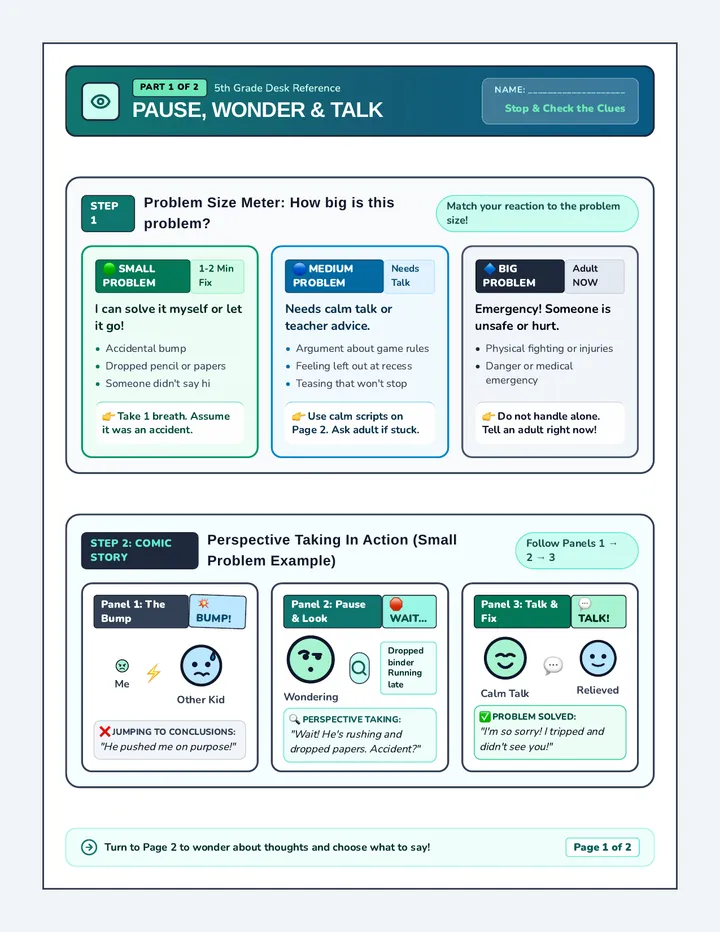
A social-emotional and perspective-taking toolkit for 5th graders with communication disabilities, featuring visual supports for problem sizing, empathy clues, communication scripts, and self-regulation.

AM

Alyssa Miller

2
Calm Action Checklist Visual

Calm Action Checklist Visual

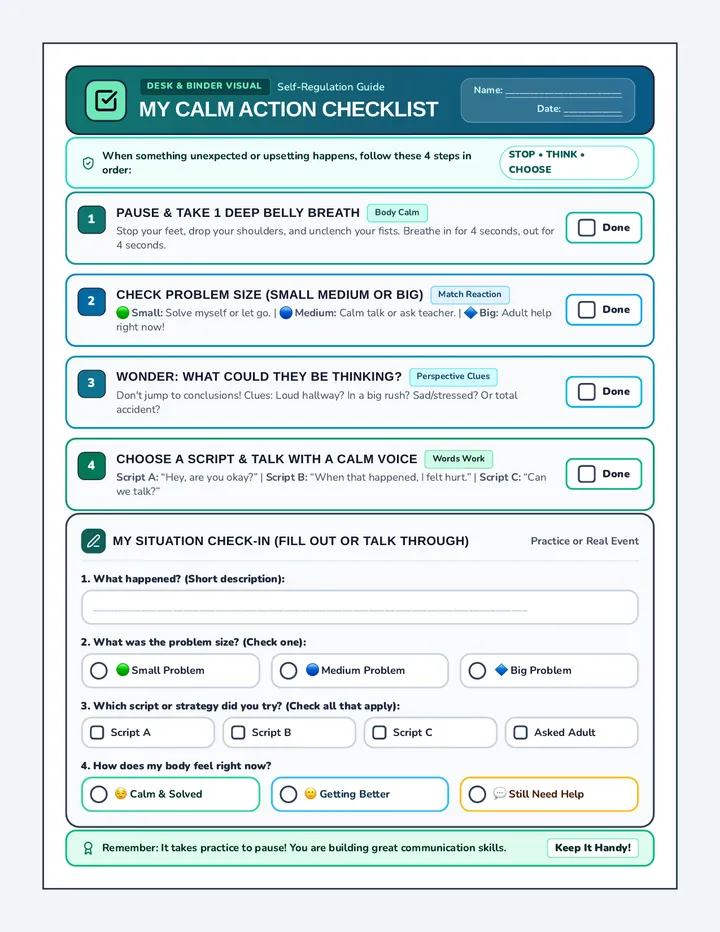
A one-page student-facing visual checklist and reflection sheet for 5th graders with communication disabilities, guiding them through four calm action steps and a self-regulation check-in.

AM

Alyssa Miller

Sixes Sevens Tiered Worksheet

Module Three Math Modifications

A comprehensive instructional sequence providing differentiated, reduced-workload, and visually scaffolded modifications for Eureka Math Grade 3 Module 3. Covers all 21 lessons organized across four focused mastery clusters with multi-tiered student practice and teacher modification guides.

ML

Michelle Low

8
Syllable Snappers Student Drill

Syllable Snappers

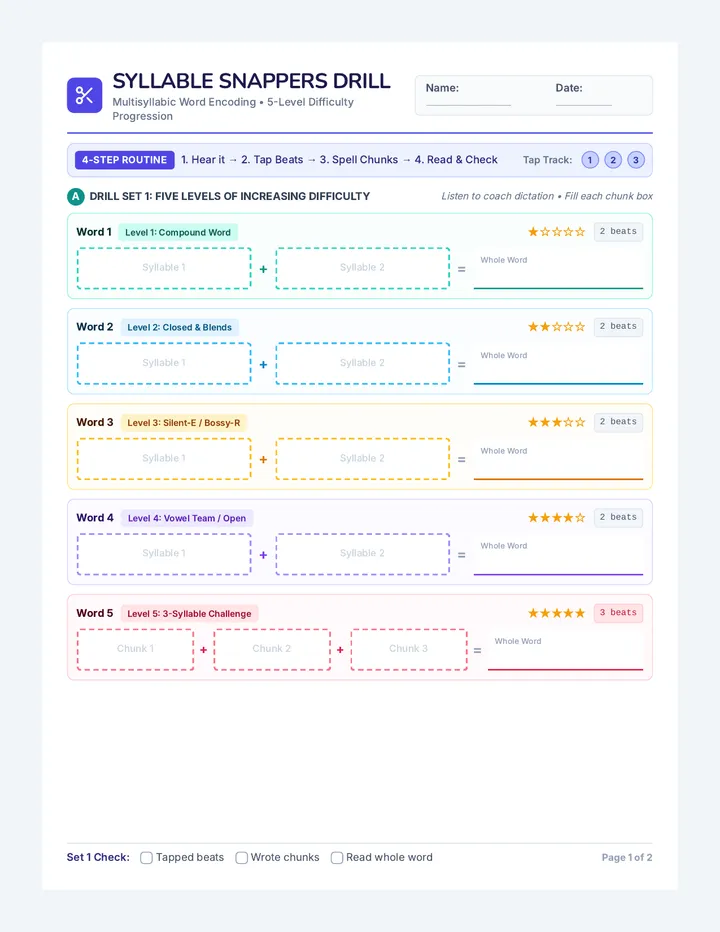
A targeted multisyllabic encoding intervention designed for third-grade learners mastering syllable division and phoneme-grapheme mapping. Features a student-facing practice drill and an explicit step-by-step facilitation script for paraprofessionals.

SW

Stephanie Wooten

14
Sound Tracker Bar Graph

Sound Tracker Bar Graph

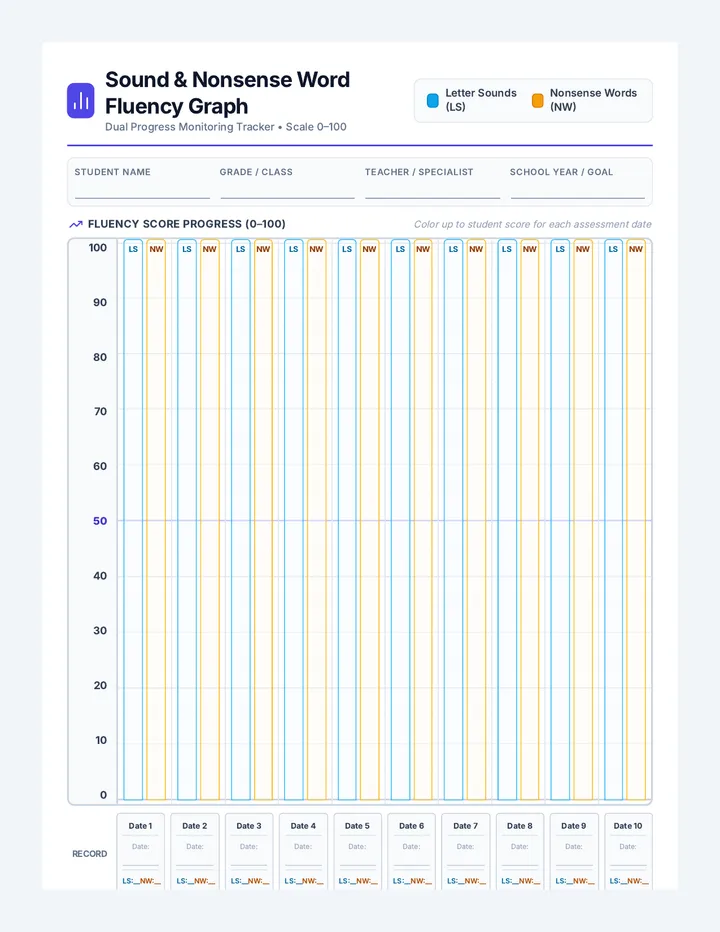
A full-page, maximized progress monitoring bar graph dedicated exclusively to tracking paired Letter Sound and Nonsense Word Fluency data up to a scale of 100 across 10 assessment recording dates.

JH

Jessica Hogan

Mighty Hands Slides

Everyday Superpowers

A comprehensive three-lesson elementary sequence introducing occupational therapy through fine motor skills, sensory processing, and daily routines. Students learn how their bodies, brains, and daily habits work together to build independence and classroom success.

Lenny Avatar
Lenny
6
Sound Match Articulation Worksheet

Speech Trio Stations

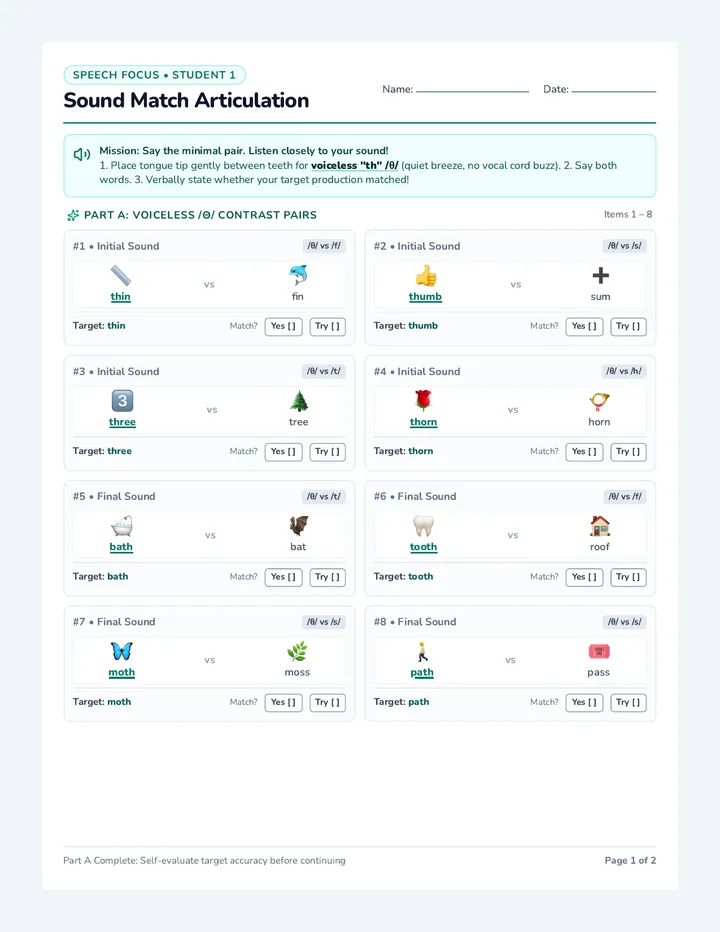
A differentiated small-group speech and language intervention lesson targeting minimal pair articulation with self-monitoring, semantic vocabulary relationships, and complex sentence formulation with subordinate clauses.

TK

T K

4
Syllable Snappers Paraprofessional Guide Two

Syllable Snappers Paraprofessional Guide Two

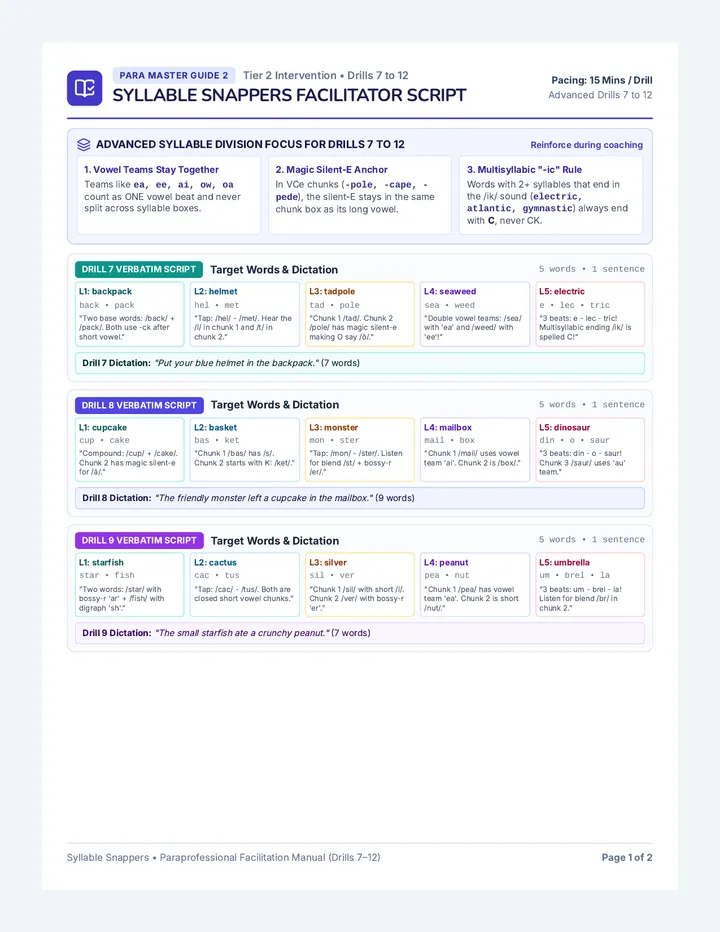
A comprehensive 2-page coaching guide and verbatim facilitation script for paraprofessionals delivering Drills 7 through 12. Features advanced syllable division rules, verbatim coaching scripts for Drills 7 to 12, error correction protocols, and a 6-session cumulative progress tracking log for Drills 7-12.

SW

Stephanie Wooten

Hit the Brakes Slides

Pause and Power Up

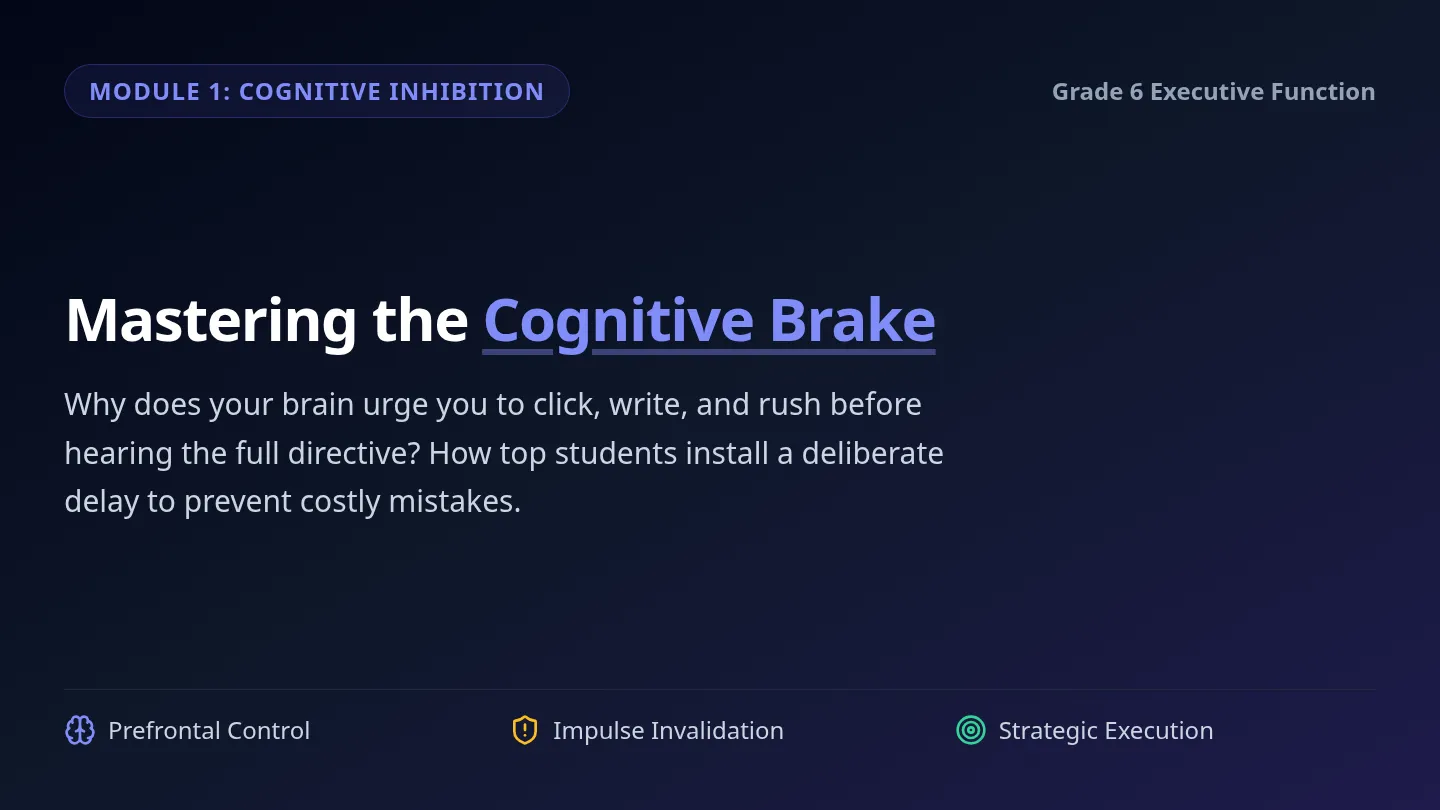
A targeted 5-part executive functioning sequence designed for 6th graders navigating the cognitive demands of middle school. Students master cognitive inhibition, auditory attention, multi-step task decomposition, and working memory strategies to achieve autonomous classroom execution.

K

kiana.james

10
Paw Print Teacher Guide

Wilson Claw and Paw

A 10-part Wilson Reading System (WRS) literacy lesson targeting the vowel team 'aw' in Double Vowel (D) syllables. Features 3-block structure, finger tapping routines, magnetic tile tracking, dictation book grids, D-syllable marking, and pencil scooping.

KW

Kellie Walsh

6
Syllable Snappers Drill Twelve

Syllable Snappers Drill Twelve

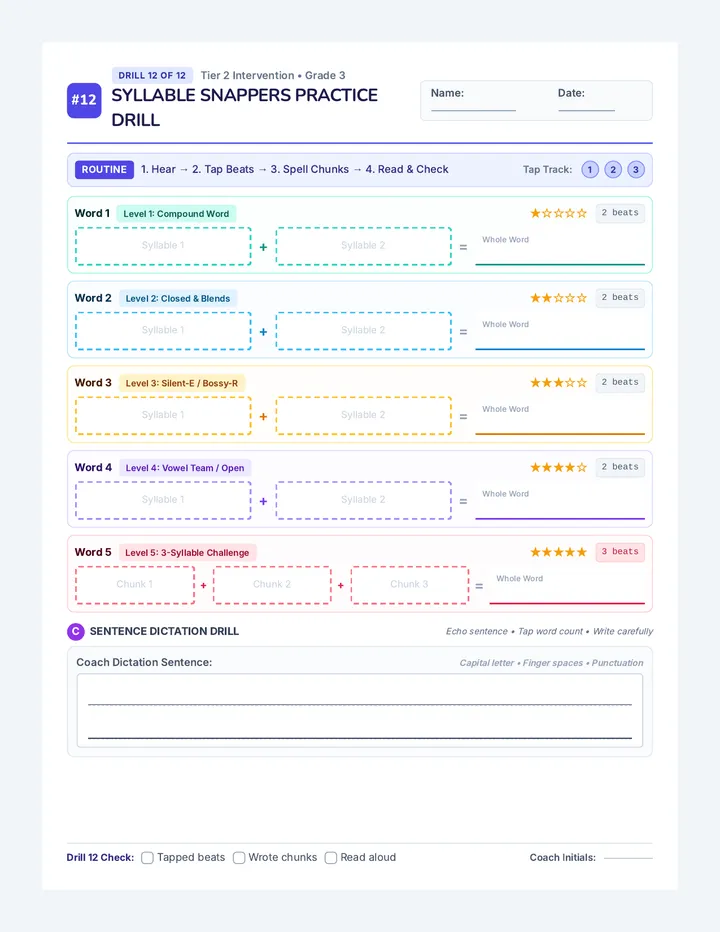
A printable 1-page multisyllabic spelling practice drill (Drill 12) for third grade students featuring 5 progressive difficulty levels from compound words to a 3-syllable challenge, blank chunk boxes, tap track, and sentence dictation.

SW

Stephanie Wooten