Lenny.com
Explore
Create
ActivitiesNewMathEnglish Language ArtsScience & EngineeringSocial StudiesGlobal LanguagesHealth & Physical EducationSpecial EducationCounseling & Life SkillsArts & CreativityESL
Lenny.com
Lenny.com
Explore
Create
ActivitiesNewMathEnglish Language ArtsScience & EngineeringSocial StudiesGlobal LanguagesHealth & Physical EducationSpecial EducationCounseling & Life SkillsArts & CreativityESL
Lenny.com
Lenny.com

Solutions

Lenny for EducatorsLenny for SchoolsLenny for Districts

Product

ExploreSign inCreateSupportAbout

Resources

Getting startedMTSS Acceleration Program

© 2026 Lenny Learning Inc.

TermsPrivacyAccessibility
LinkedInInstagramX
Lenny
Special EducationSensory Processing & RegulationSensory Preferences IdentificationSensory Tool UseCommunicating Sensory NeedsSensory Overload RecognitionDeep Breathing PracticeMovement Break UtilizationIndependent Calming Strategy UsePersonalized Calming RoutinePersonal Sensory Diet CreationProactive Sensory BreaksEmotion Intensity RecognitionDysregulation RecoveryPositive Behavior SupportUnderstanding Social StoriesPersonal Social Story CreationEmotional Regulation FrameworksPersonal Trigger IdentificationSelecting Regulation StrategiesReinforcement System ResponseSelf-Monitoring & RewardsLearning Positive AlternativesCross-Setting Skill GeneralizationSocial CommunicationEye Contact & Personal SpaceContext-Appropriate GreetingsAppropriate Volume & ToneConversation Turn-TakingTopic Maintenance in DiscussionEffective Help-SeekingBody Language InterpretationFacial Expression RecognitionIdioms & Figurative LanguageSocial Problem IdentificationSocial Solution GenerationSocial Decision EvaluationTask ManagementMinimal Prompting Task StartSelf-Talk for StartingStarter Strategies for Difficult TasksAge-Appropriate Task PersistenceStrategic Break ManagementSmooth Task TransitionsAdapting to Plan ChangesObstacle Problem-SolvingMulti-Day Project CompletionPlanning & OrganizationPhysical Material OrganizationVisual Schedule & Timer UseSequential Task BreakingTime Estimation SkillsTask PrioritizationDigital & Physical Workspace ManagementPersonalized Organization StrategiesDetailed Project PlanningMultiple Commitment BalancingAcademic Support StrategiesMath Manipulative UseVisual Math Problem RepresentationComplex Math Problem BreakdownText Highlighting & AnnotationVisualization While ReadingPredictions & Inferences from TextText Structure Graphic OrganizersWriting Graphic OrganizersSentence Frames & TemplatesStudy Guide CreationSpaced Repetition for MemoryAssistive Writing TechnologyWorking Memory SupportSingle-Step Direction FocusMulti-Step Direction FollowingInformation Chunking PracticeVisual Support Memory AidsMnemonic Device ApplicationEfficient Note-Taking SystemsGraphic Organizer Note-TakingNote Review & OrganizationSustained Complex Task AttentionAssistive TechnologySymbol-Word CommunicationAAC Device NavigationSpeech Recognition DictationDictation Text EditingText-to-Speech for ReadingDigital Calendar UseKeyboard Shortcuts NavigationProductivity App ManagementSelf-Advocacy SkillsCommunicating Learning NeedsRequesting AccommodationsAdvocating for Appropriate SupportsIEP & Student RightsUnderstanding IEP ComponentsMeaningful IEP Meeting ParticipationIDEA & Section 504 RightsProgress MonitoringTracking IEP Goal ProgressReflecting on AchievementData-Informed Instructional AdjustmentTransition PlanningCareer & Vocational Goal SettingExploring Post-Secondary OptionsIndependent Living Skills Planning

The Pivot Protocol

A multi-week emotional regulation and social self-advocacy curriculum designed specifically for high schoolers with ADHD and BIPs. This sequence provides a modern, gamified framework for identifying triggers, practicing coping mechanisms, tracking daily goals, and resolving peer conflicts.

JMJada Murray
Internal Radar

Establishes the foundation of self-awareness by helping students map their physical trigger responses ('Internal Radar') and setting up their baseline self-monitoring daily tracker.

Tactical Pauses

Focuses on calming techniques, active anger management, and frustration tolerance when triggers spike, introducing personalized 'Pivot Plans' for classroom situations.

Vocal Shield

Addresses social skills, self-advocacy with teachers, navigating peer-to-peer conflict, and reading social feedback cues without dysregulating.

Peer Calibration

Month 4 focus on peer-to-peer conflict resolution, de-escalating social tension, responding to sarcasm, and reading social feedback cues without dysregulating.

The Pivot Protocol

A multi-week emotional regulation and social self-advocacy curriculum designed specifically for high schoolers with ADHD and BIPs. This sequence provides a modern, gamified framework for identifying triggers, practicing coping mechanisms, tracking daily goals, and resolving peer conflicts.

JMJada Murray

PIVOT LESSON GUIDE

Step-by-Step Delivery Manual for 4 Months of BIP Interventions

TEACHER-FACING • v1.0

MONTH 3 Focus: Self-Advocacy & Neutral Scripting

Lesson 3 Facilitation: Running the Vocal Shield

Goal: Equip the student with concrete verbal scripts to negotiate boundaries and clarify classroom instructions without being confrontational.

Step 1: Role-play Scenario Cards (10 mins) Hand out the Pivot Scenario Cards (S-01, S-02). Let the student read the scenario card description.

Step 2: Compare Responses (5 mins) Discuss the difference between the "Friction Pivot" (low control/high reaction) and the "Vocal Shield Pivot" (high control/assertive script).

Step 3: Script Drafting (5 mins) Have the student draft a template sentence they will use if a teacher accuses them of off-task behavior.

Key Discussion Starters:

  • "Why is it harder to use your Vocal Shield when you feel embarrassed or defensive?"
  • "How can a flat, calm tone change the way a teacher responds to you?"

MONTH 4 Focus: Peer Drama & Monotone Shielding

Lesson 4 Facilitation: Practicing Peer Calibration

Goal: De-escalating social tension, group work imbalance, and ignoring sarcasm from peers.

Step 1: Decode Peer Signals (5 mins) Use the Peer Calibration Worksheet to read social cues and discuss typical high school friction points.

Step 2: Scripting Monotone Walls (10 mins) Help the student write three "Monotone Shielding" responses to sarcasm. Practice delivering them with flat facial expressions.

Step 3: Mediation Practice (5 mins) Simulate a group work dispute where members fail to divide slides fairly. Have the student use their de-escalation plan.

Key Discussion Starters:

  • "Why is a monotone voice so powerful against someone trying to start an argument?"
  • "What is your plan if a group mate ignores you twice in a row?"

THE PIVOT PROTOCOL • COUNSELOR FACILITATION GUIDE PAGE 2 OF 2

S-04

The Sarcastic Critic

Peer Conflict

During lunch, a peer makes a sarcastic comment about your sneakers, saying "Nice shoes, did you get those from a dumpster?" Several students nearby laugh, and you feel your jaw clenching and the urge to throw your milk carton at them.

Friction Pivot (Standard Response)

Insult them back, get in their face, or physically push them, leading to an immediate suspension threat.

Vocal Shield Pivot (Advocacy Response)

Use a flat, unbothered voice: "No, they're clean. Let's move on." or walk away immediately to another table.

Role-Play Prompt: Practice saying a neutral statement using a completely monotone, unreactive voice. Why does this stop the instigator?

S-05

Sudden Schedule Shift

Adaptability

You arrive at your favorite class, art, expecting to work on your clay sculpture. The teacher announces there's a surprise assembly, meaning your sculpture time is canceled and you have to go sit in a crowded, noisy gymnasium.

Friction Pivot (Standard Response)

Yell "This is stupid!", walk in the opposite direction, or lock yourself in a school bathroom stall in protest.

Vocal Shield Pivot (Advocacy Response)

Quietly ask the art teacher or your advocate: "Can I bring my headphones to sit near the gym exit so it is less overwhelming?"

Role-Play Prompt: Negotiate with your advocate for sensory support when plans change. How can we pivot safely?

S-06

Public Corrective Warning

BIP Goal Target

During quiet study time, you are tapping your desk rhythmically. Your teacher says out loud in front of the whole class, "Stop tapping, you are distracting everyone." You feel extremely embarrassed, defensive, and ready to snap back.

Friction Pivot (Standard Response)

Yell "Other people are talking!" or kick your desk leg, leading to classroom disruption behavior charges.

Vocal Shield Pivot (Advocacy Response)

Take a 3-second breathing pause, say "Got it," and swap the desk tapping for a silent hand-fidget under your desk.

Role-Play Prompt: Practice accepting constructive feedback with a simple "Got it" or "My bad," and pivot silently.

THE PIVOT PROTOCOL • SCENARIO-BASED DISCUSSION CARDS PAGE 2 OF 2

You might also like

Sixes Sevens Tiered Worksheet

Module Three Math Modifications

A comprehensive instructional sequence providing differentiated, reduced-workload, and visually scaffolded modifications for Eureka Math Grade 3 Module 3. Covers all 21 lessons organized across four focused mastery clusters with multi-tiered student practice and teacher modification guides.

ML

Michelle Low

8
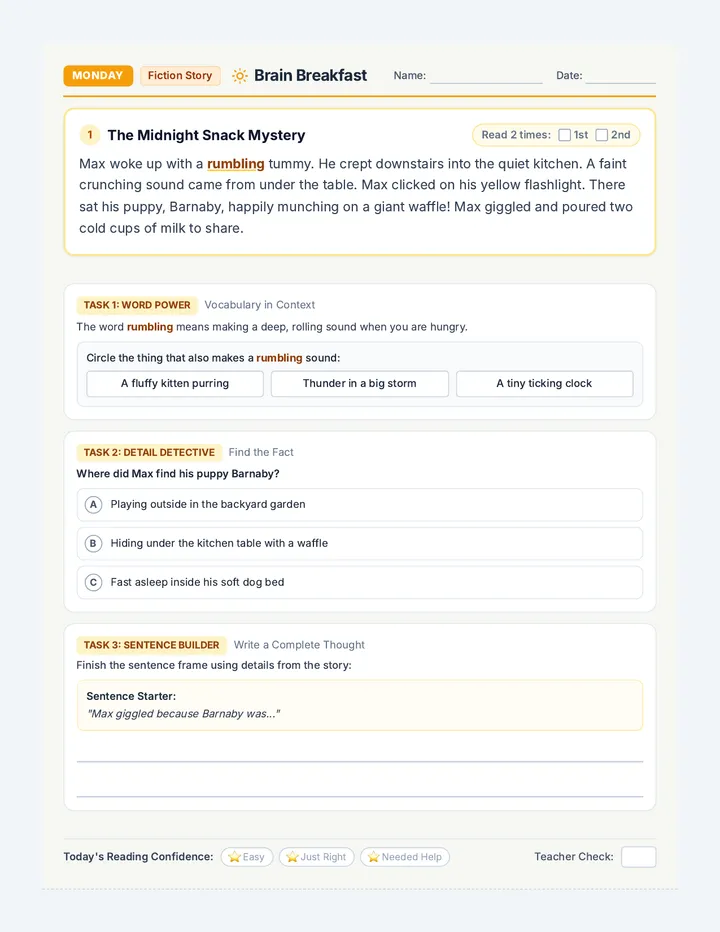
Brain Breakfast Student Packet

Brain Breakfast Routine

A weekly 5-day morning reading routine designed for 5th grade special education students reading at an accessible 2nd to 3rd grade level. Features alternating fiction and nonfiction passages with predictable, confidence-building comprehension, vocabulary, and writing tasks.

K

karima.dallas

2
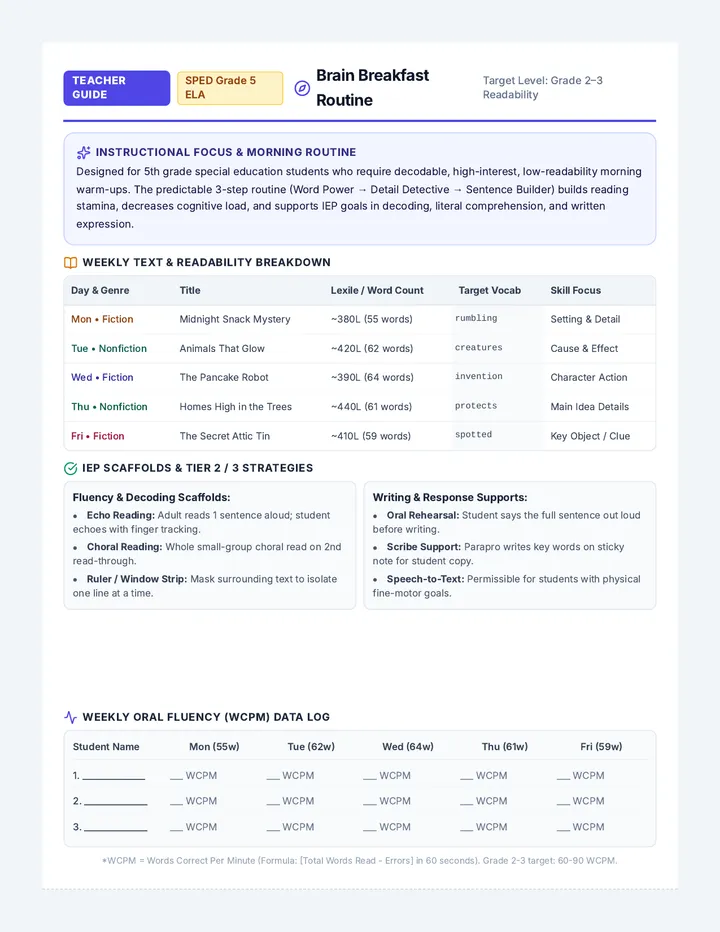
Brain Breakfast Teacher Guide

Brain Breakfast Teacher Guide

A comprehensive teacher companion and answer key providing IEP accommodations, readability levels, daily answers, and fluency tracking tools for the weekly morning reading routine.

K

karima.dallas

Mighty Hands Slides

Everyday Superpowers

A comprehensive three-lesson elementary sequence introducing occupational therapy through fine motor skills, sensory processing, and daily routines. Students learn how their bodies, brains, and daily habits work together to build independence and classroom success.

Lenny Avatar
Lenny
6
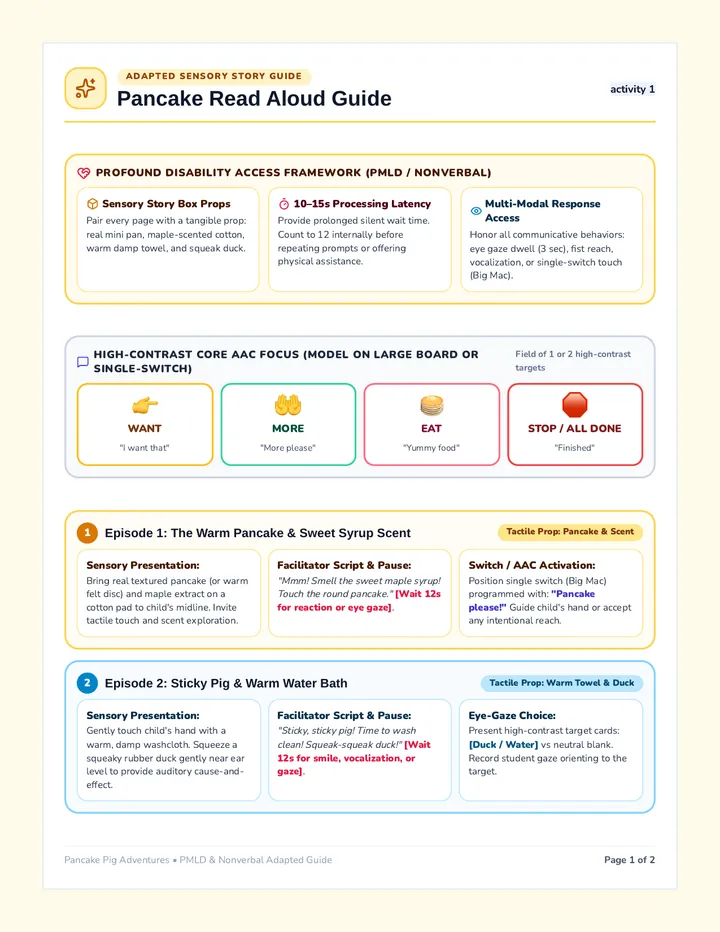
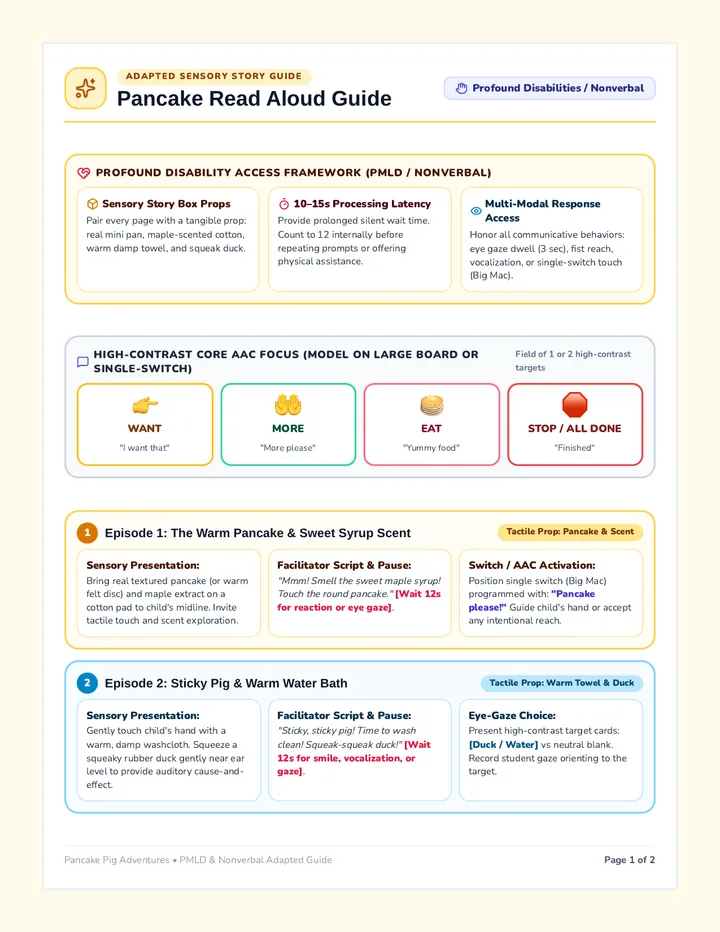
Pancake Sensory Story Guide

Pancake Pig Adventures

An adapted multi-sensory story kit for "If You Give a Pig a Pancake," designed specifically for nonverbal learners with profound disabilities. Features tangible object story facilitation, high-contrast 2-choice eye-gaze boards, errorless touch-and-paste placement mats, and low-fine-motor sensory art.

N

Natasha

5
Brain Breakfast Student Packet

Brain Breakfast Student Packet

A 5-day morning reading workbook for 5th grade special education students, featuring alternating fiction and nonfiction short passages with consistent daily vocabulary, comprehension, and sentence-writing routines.

K

karima.dallas

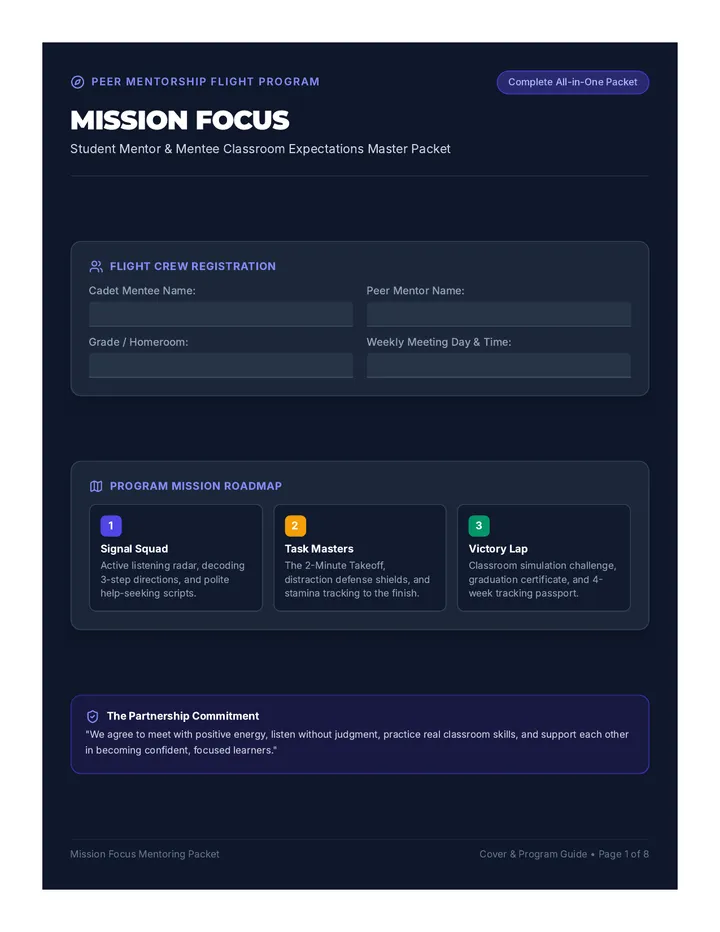
Mission Focus Printable Packet

Mission Focus Mentoring

A three-stage peer-mentoring sequence that equips student mentees with active listening, instruction-following, task initiation, and distraction-management routines through structured mentor coaching.

MP

Melissa Premo

1
Pancake Sensory Story Guide

Pancake Pig Adventures

An adapted multi-sensory story kit for "If You Give a Pig a Pancake," designed specifically for nonverbal learners with profound disabilities. Features tangible object story facilitation, high-contrast 2-choice eye-gaze boards, errorless touch-and-paste placement mats, and low-fine-motor sensory art.

N

Natasha

5
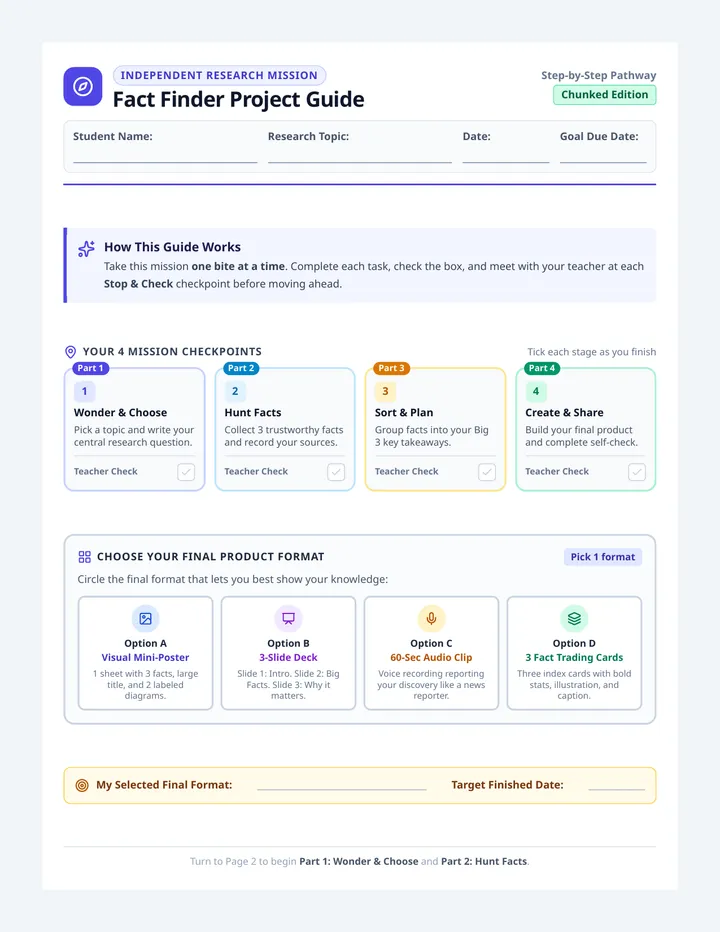
Fact Finder Project Guide

Fact Finder Project Guide

A structured, chunked research guide designed for students with learning differences. Includes visual milestones, scaffolded inquiry prompts, fact-organizing cards, and checkpoints for teacher sign-off.

Lenny Avatar
Lenny
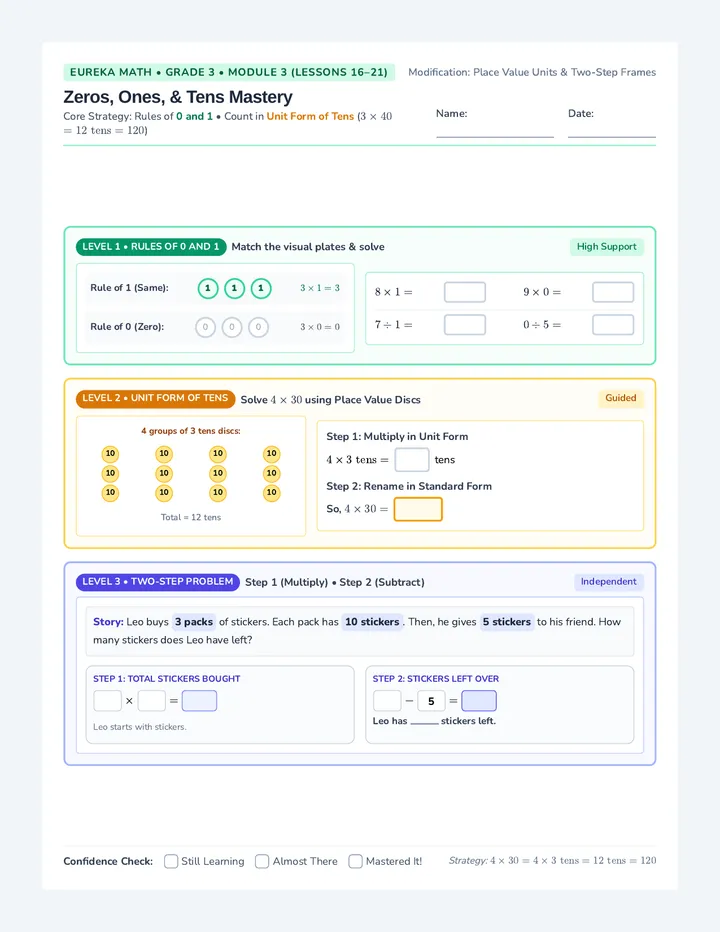
Zeros Ones Tens Tiered Practice

Zero One Ten Mastery

Scaffolded modification lesson for Eureka Grade 3 Module 3 Lessons 16-21 covering identity and zero rules, structured two-step word problem frames, and place value discs for multiplying multiples of 10.

ML

Michelle Low

2
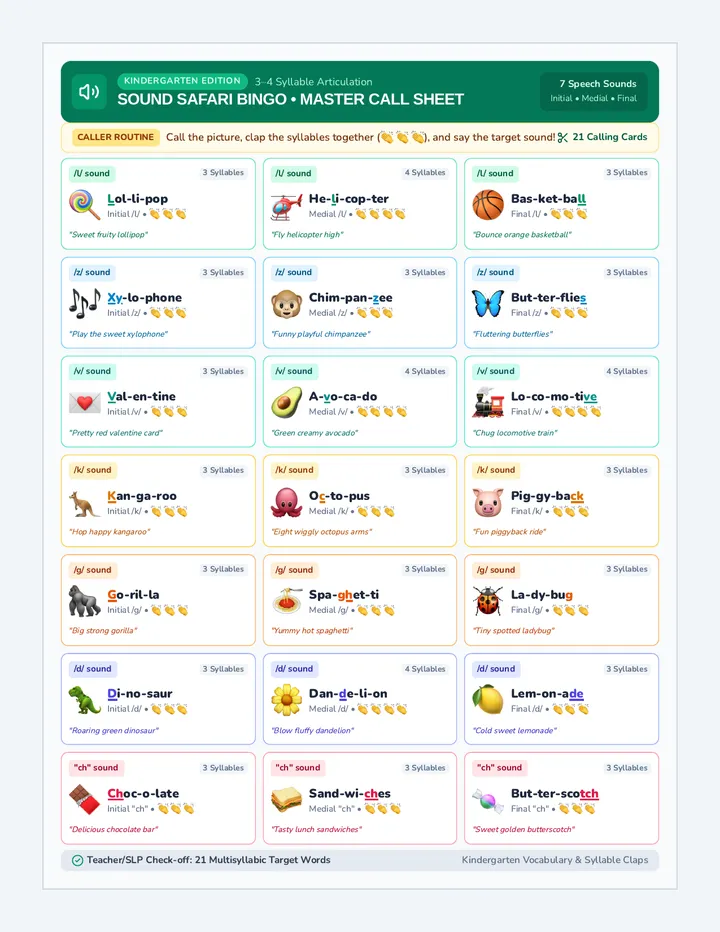
Sound Safari Bingo Game

Sound Safari Bingo Game

An articulation bingo game tailored for kindergarteners with 3-4 syllable picture words targeting /l/, /z/, /v/, /k/, /g/, /d/, and "ch" across initial, medial, and final positions. Includes 1 caller sheet and 3 unique player boards with syllable clapping cues.

BA

Beth Arinsburg

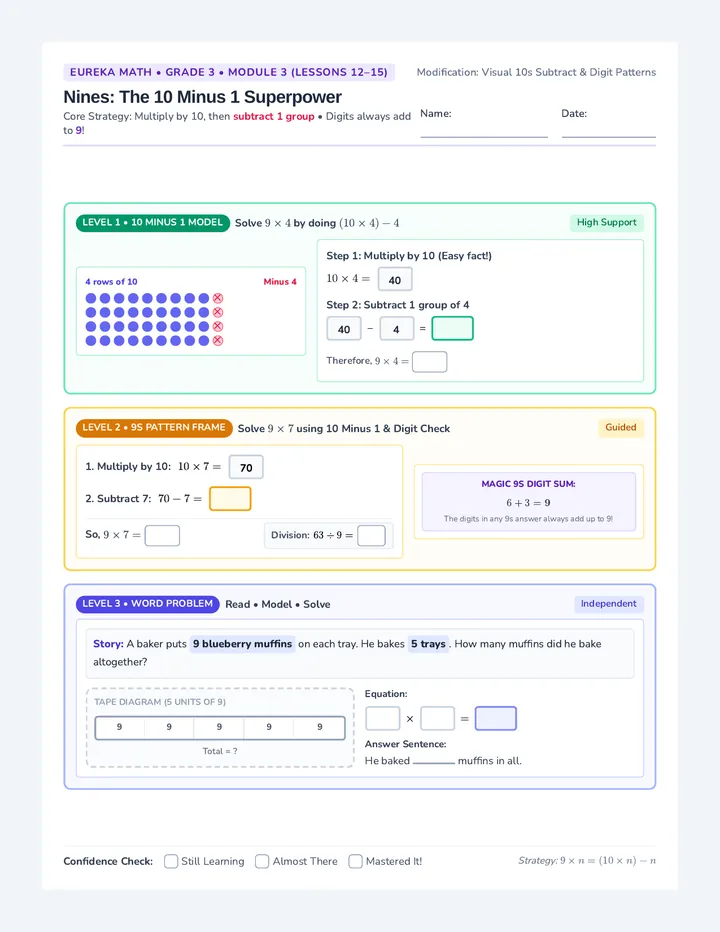
Nines Patterns Tiered Practice

Nine Pattern Power

Scaffolded modification lesson for Eureka Grade 3 Module 3 Lessons 12-15 focusing on units of 9. Integrates the 10 minus 1 visual subtractor model, finger patterns, and stepped division arrays.

ML

Michelle Low

2