Tool Clash Slides Tool Clash
Comparative Analysis of Standardized Independent Living Assessments
Lesson 01
The Paradox of Alex
One Student, Two Profiles, Zero Consensus.
Assessment A: Casey Life Skills
Daily Living Score: 88th Percentile
Strong in self-care and social skills
Result: Minimal transition needs identified.
Assessment B: AIR Self-Determination
Opportunity Score: 12th Percentile
Low ability to set goals and monitor progress
Result: Significant intervention required.
How can one student appear both "ready" and "unprepared"?
The Essential Question
How do educators select and utilize ecologically valid assessment data to determine legitimate independent living needs?
Core Assessment Taxonomy
Norm-Referenced
Compares performance against same-age peers across the nation.
Reliability Focus
Criterion-Referenced
Measures mastery of specific functional skills regardless of peers.
Mastery Focus
Ecological
Analyzes the environment and the discrepancy between demands and skills.
Context Focus
The Graduate Lens
1
Content Validity
Does the tool actually measure "Independent Living" in 2026? Does it include digital literacy? Community navigation? Health management?
2
Ecological Validity
Can the results be generalized to the student's actual future environment, or is it merely a reflection of test-taking ability?
3
Cultural Responsiveness
Does the assessment penalize students for family values or cultural norms that differ from Western "independence" standards?
Comparative Deep Dive
Feature Casey Life Skills AIR Self-Determination Primary Purpose Functional skills checklist across domains (housing, finance, etc.) Self-determination capacity vs. opportunity assessment Major Strength Comprehensive breadth; accessible for families Identifies environmental barriers (Opportunity) Key Weakness Self-report bias (Students often over-estimate) Abstract constructs can be hard to map to IL skills
Transition to Practice
In your groups, you will now evaluate "The Case of Alex" using the Tool Comparison Grid. Your goal: Resolve the contradictory data.
Analyze
Read the protocols
Critique
Identify the bias
Synthesize
Propose a 3rd tool
Assessment Selection Matrix Assessment Selection Matrix
Transition Planning & Independent Living Competencies
Student Name:
Date:
Instructions
Select three distinct transition assessment tools (e.g., Casey Life Skills, AIR, Brigance Transition, TPI-3). Critique each tool based on the criteria below to determine its suitability for your specific case study student.
Criterion Tool 01: ________________ Tool 02: ________________ Tool 03: ________________ Content Domains (Health, Finance, Social, etc.) Methodology (Self-report, Observation, Parent-report) Disability Suitability (Reading level, visual support, etc.) Cultural Bias Potential (Value of "independence" vs "interdependence")
01. Contradictory Data Analysis
If Tool 01 yields high scores but Tool 02 yields low scores for the same domain, what is your investigative next step? How do you determine which data point is "accurate"?
02. Recommendation for "Alex"
Based on your critique, which combination of tools (formal or informal) would provide the most legally defensible baseline for a student with moderate intellectual disabilities? Justify your selection.
Critical Consideration
Remember: A standardized score is only as valid as the student's ability to comprehend the prompt. For students with limited communication or high levels of people-pleasing, self-report measures often reflect "perceived ability" rather than "functional performance."
Barrier Blueprint Slides Barrier Blueprint
Conducting High-Fidelity Ecological Inventories
Lesson 02
The 20 Barrier Challenge
A virtual walk-through of a standard studio apartment.
[ 360° Virtual Render Placeholder ]
Spot the Barriers
Door Threshold? Counter Height? Switches?
Your Mission:
Imagine a student who uses a manual wheelchair. List every design element that would impede independence.
Note:
Think beyond ADA compliance. Focus on the functional flow of daily life.
Concept Definition
Environmental Analysis
An Ecological Inventory is a top-down assessment that starts with the demands of the environment and identifies the specific skills a student needs to function in that setting.
Paper Assessments
"What can the student do?"
Ecological Inventories
"What does the setting demand?"
The Inventory Protocol
01
Identify Setting
Break the setting into sub-environments (e.g., Grocery -> Checkout).
02
Task Analysis
Observe a typical person. Record every discrete step of the activity.
03
Map Skills
What cognitive or physical skills are required for each step?
04
Discrepancy
Compare required skills to current performance. Find the gap.
The Power of "Why"
Environment Demand
Student must push a button to open the laundry room door.
Student Discrepancy
Student lacks the fine motor strength to depress the button.
Instructional Target!
"We don't teach skills in a vacuum; we teach skills for a destination."
Ecological inventories ensure our IEP goals aren't just 'compliant'—they are relevant to the student's real life.
Ecological Inventory Protocol Environmental Analysis Tool
Ecological Inventory Protocol
Assessor:
Date:
Target Environment
Example: Local library, specific apartment, supermarket.
Sub-Environment
Example: Self-checkout kiosk, laundry room.
Target Activity
Example: Purchasing 3 items, sorting darks/lights.
| Step-by-Step Task Analysis
Discrepancy Analysis Synthesis
Critical Barriers Identified
List the top 3 environmental demands that do not currently align with student skills.
Proposed Accommodations/Modifications
Can the environment be changed, or is direct instruction required?
Draft Instructional Priority
Based on this inventory, what is the single most important skill the student needs to master to achieve independence in this specific sub-environment?
Goal must be observable and measurable based on inventory data.
Agency Slides Radical Agency
Person-Centered Methodologies in Transition Planning
Lesson 03
The Living Arrangement Clash
A common transition crossroads.
The Student: Maya
"I want to live downtown with my friend Sarah. I want my own key."
Goal: Autonomy
The Parents: Mr. & Mrs. G
"Maya needs supervision. We want her in a licensed group home where she's safe."
Goal: Security
Whose "data" carries more weight in the IEP process?
Student-Led
Person-Centered
The MAPS Process
Making Action Plans: A collaborative visioning tool.
History
What is the student's story? What highlights define them?
The Dream
No barriers: what does the perfect life look like in 5 years?
The Nightmare
What is the outcome we are collectively working to avoid?
The Profile
Identifying gifts and talents through the lens of the family and community.
The Needs
What concrete steps bridge the gap between "History" and "Dream"?
The PATH Framework
Strategic Planning
Unlike MAPS (vision), PATH is a strategic backward-mapping tool.
We start at the end-goal and work back to what happens tomorrow morning.
1
The North Star (Ultimate Purpose)
2
The Goal (One Year from now)
3
Grounding (The Present)
4
First Steps (Immediate Action)
Facilitation vs. Directing
Wait Time is Data
Silence is where the student processes agency. Do not fill the void for them.
Graphic Facilitation
Words can be gatekeepers. Use visuals and symbols to invite participation.
The Facilitator's Mantra
"Nothing about me, without me."
— DISABILITY RIGHTS SLOGAN
The Facilitation Lab
One student. One guardian. One neutral facilitator. Navigate the conflict to reach consensus.
Target: Consensus through Agency
Consensus Cards Activity Consensus Cards
Simulation Exercise
Person-Centered Facilitation
Simulation Brief
In groups of three, assign the roles of **Student**, **Guardian**, and **Facilitator**. Use a PATH or MAPS framework to navigate the conflicting priorities below. The Facilitator's goal is not to "pick a side," but to help the group reach a consensus based on the student's long-term vision.
Scenario 01: The Social Life
Student Position
"I want to go to parties and stay out until 1 AM with my coworkers. I'm 19!"
Guardian Position
"People will take advantage of you. You need a 9 PM curfew and to share your location 24/7."
Scenario 02: Financial Control
Student Position
"I earned this money. I want to buy a high-end gaming PC and some designer sneakers."
Guardian Position
"You need to save for rent and utilities. We should have a joint bank account where I approve all purchases."
Scenario 03: Employment
Student Position
"I hate the workshop. I want to work at the animal shelter, even if it's only 10 hours a week."
Guardian Position
"You need a full-time job with benefits. The shelter isn't 'real' work and won't support you long-term."
Scenario 04: Transportation
Student Position
"I'm taking the city bus. I can use the app and I'm not a baby anymore."
Guardian Position
"The bus is dangerous. I will drive you to work and pick you up every single day."
Facilitator's Reflection
What specific MAPS/PATH prompt did you use to bridge the gap?
How did you handle "The Nightmare" (the fear) of the guardian without dismissing the student's agency?
PLAAFP Architecture Slides PLAAFP Architecture
Data Synthesis and Technical Writing for Transition
Lesson 04
The Anatomy of a Rejection
Why this IEP failed a state compliance audit.
The "Problem" Goal
"Leo will manage his personal finances with 100% accuracy."
Audit Finding:
"Goal is unfounded. The PLAAFP contains no baseline data. Impact of disability is not described."
The Golden Rule
If it isn't in the PLAAFP, it cannot be in the Goals.
The PLAAFP is the legal justification for every service and accommodation.
Data Triangulation
Never rely on a single source of truth
Formal Data
Standardized scores and norm-referenced tests.
Informal Data
Ecological inventories and direct observations.
Person-Centered
Student dreams and family preferences.
The Synthesis Formula
1. Strength
What can the student do?
2. Need
What is the gap?
3. Impact
How does the disability impede life?
4. Baseline
What is the quantifiable level?
Drafting with Precision
AVOID VAGUE WORDS
"Alex has trouble with money."
USE PRECISE BASELINES
"Alex identifies the total cost on a receipt in 2/5 trials."
Transition Tip:
"Write for the student's future manager or landlord. Will they understand what helps the student succeed?"
Strength-Based
Data-Driven
Case Lab: Leo
Triangulate the formal, informal, and person-centered data to write a compliant PLAAFP for Community Participation.
PLAAFP Synthesis Lab PLAAFP Synthesis Lab
Case Study: Leo | Domain: Community Participation
Assessment Focus
Technical Writing & Data Triangulation
Source Material (Raw Data Packet)
Source 01: Standardized
Casey Life Skills
"Leo identifies as having 'Good' skills in community safety. Score: 74/100."
Source 02: Ecological
Bus Stop Inventory
"Observed Leo at the corner of Main & 4th. He did not look left-right-left before crossing. He approached the wrong bus #402 instead of #405."
Source 03: Person-Centered
Student Interview
"I want to go to the movies by myself. I'm scared of getting lost on the bus. I don't know how to read the schedule."
01. Strength Statement
Combine Casey scores with specific observed abilities.
02. Area of Need
Identify the discrepancy between his dream and the bus stop observation.
03. Impact of Disability
How does his specific disability (e.g., cognitive processing, anxiety) affect his community independence?
Final PLAAFP Draft
Write your synthesized paragraph below. Ensure it includes a clear, quantifiable baseline (e.g., X out of Y trials, % accuracy).
Legally Compliant Strength-Based Measurable Baseline
Word Count Target: 100-150 words
Self-Review Checklist
Does it reference at least two data sources?
Is the baseline specific to the target environment?
Does it lead logically to a measurable goal?
Monitoring Mastery Slides Monitoring Mastery
Designing Efficient Data Systems for Functional Growth
Lesson 05
The 30-Second Challenge
Real-world data collection isn't quiet.
The Scenario
Crowded store. Loud noises. 4 students. You need to record Leo's checkout accuracy.
THE RISK:
If the tool is complex, the data will be ignored or inaccurate.
Your Mission
Design a tool usable in under 30 seconds without stopping instruction.
Limit: 3 checkboxes max.
Instrument Selection
Task Analysis
Breaks a complex skill into discrete steps. Best for multi-step processes like laundry.
Frequency Count
Best for social skills or discrete behaviors like greetings or requests.
Independence
Measures the level of help required (The Prompting Hierarchy).
The Prompting Hierarchy
Most Intrusive
Full Physical Assistance
Model / Demonstration
Gestural / Pointing
Verbal Prompt
Success
Independent
Closing the Loop
Data collection is the act. Progress monitoring is the analysis.
Review data every 2 weeks.
Graph results visually.
Adjust instruction for flat trends.
Progress Trend
The Final Build
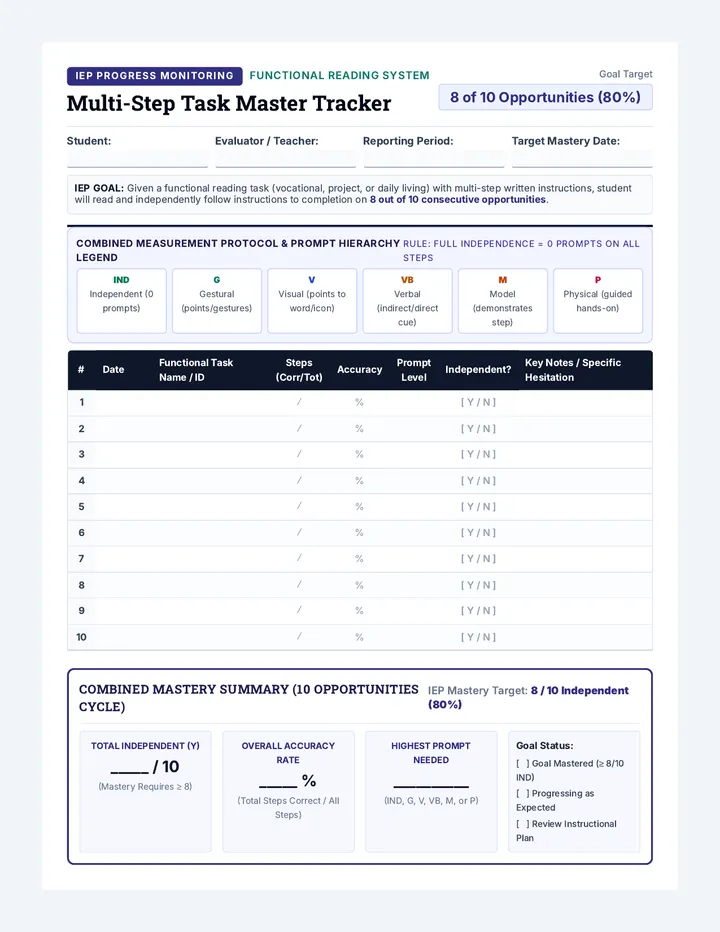
Using your Lesson 4 PLAAFP, design a mobile-ready progress monitoring tool for Leo. It must accurately track his journey to independence.
1. Define Metric
2. Create Tool
Data Design Challenge Worksheet Rapid Design Challenge
The 30-Second Data Sheet
Lesson 05 Capstone
Efficiency vs. Fidelity
Target Student
Leo (Community Participation Goal)
"Leo will navigate the city bus system from school to the library independently in 4 out of 5 trials."
Design Constraint
The "Real World" Test
The tool must be usable by a paraprofessional holding a bag, a phone, and a student's hand. No long sentences. No deep reflections.
Blueprint Area: Draft Your Data Sheet Below
[ Student Prototype Space ]
Think: Grid? Checkboxes? Tally marks? Level of independence code (I, V, G, M, P)?
01. Measurement Choice
Why did you choose this specific metric (e.g., prompting level vs. tally)?
02. User Experience
How will the user record data without stopping instruction?
03. Error Analysis
Does this tool allow for recording "why" a student failed a trial?
"The best data sheet is the one that actually gets filled out."
MOBILE READY AUDIT COMPLIANT