Daily Mastery Morning Work Packet
7th Grade • Week #3 5-Day Weekly Quest
Daily Morning Warmup
⚡ 5-Day Morning Mastery Quest • Week #3 ⚡
7TH GRADE MORNING WORK
Start your morning strong! Complete one focused quest each day across ELA, Math, History, and Science.
Student Mission Profile
Week #3 Edition
Student Name
Homeroom / Teacher
Class Period
Week #3 Mastery Goal
Week #3 Daily Quest Completion Log (5 Days)
Check or star each day! ★
Day 1 (Mon)
ELA Block
Author Claims
★ [ ]
Day 2 (Tue)
Math Block
Add / Subtract
★ [ ]
Day 3 (Wed)
Math Block
Multiply / Divide
★ [ ]
Day 4 (Thu)
History Block
Confederation
★ [ ]
Day 5 (Fri)
Science Block
Speed Lab
★ [ ]
7th Grade Morning Work • Week #3 (5-Day Series) Keep in your daily binder • 10-15 Min Daily Routine
7th Grade • Week #3
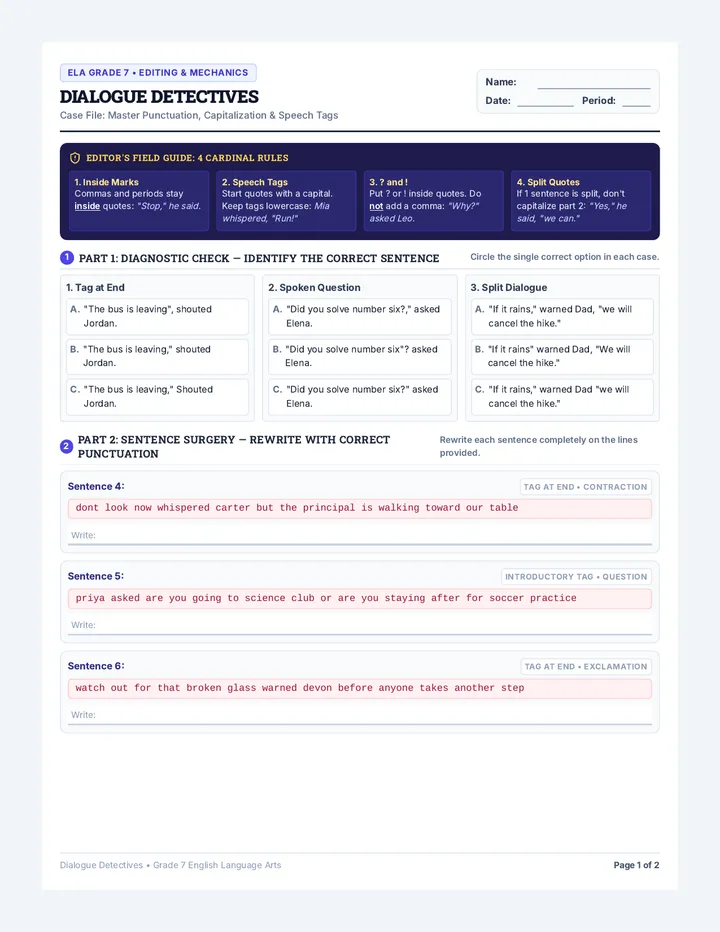
Day 1 (Monday): ELA Author's Claim & Evidence
Day 1 of 5
Name: __________________________
Date: ______________
Class Period: ______
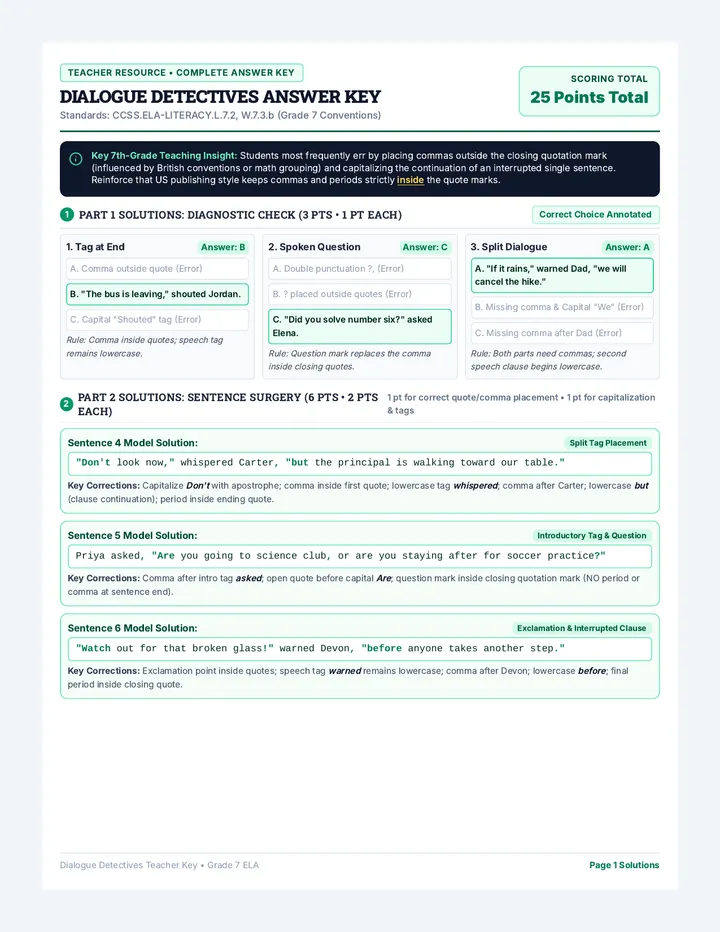
Skill Focus: Author's Claim, Evidence & Counterclaims
An author's claim is the main argument or thesis. Writers strengthen their claim with factual evidence and by acknowledging a counterclaim (opposing view) with a solid rebuttal.
Reading Passage: The Case for Autonomous Ocean Cleaners
Non-Fiction Tech & Ecology
Plastic pollution in our oceans has reached catastrophic levels, with over eight million metric tons entering marine ecosystems annually. While volunteer coastal cleanups build community awareness, they cannot reach massive offshore garbage vortexes. Deploying fleets of solar-powered autonomous marine drones is the single most effective solution to restore our oceans.
Critics argue that robotic vessels require high upfront investments compared to traditional boat sweeps. However, operational data disproves this doubt: autonomous drones operate 24/7 with zero crew fuel expenses, collecting over 50 tons of microplastics per month per unit. The long-term environmental protection far exceeds the initial manufacturing cost.
1. What is the author's primary claim in this passage? (State in your own words)
2. Cite two specific pieces of evidence from the text that prove autonomous drones are effective.
Evidence Piece 1:
Evidence Piece 2:
3A. What counterclaim does the author address?
3B. What rebuttal is used to defeat it?
7th Grade Week #3 Morning Work Day 1 (Monday) • English Language Arts
7th Grade • Week #3
Day 2 (Tuesday): Adding & Subtracting Integers
Day 2 of 5
Name: __________________________
Date: ______________
Class Period: ______
Step-by-Step Worked Examples & Model Strategies
Model 1: Adding Different Signs \( -8 + 14 \)
- Check signs: One negative (\(-8\)), one positive (\(14\)).
- Subtract absolute values: \( 14 - 8 = 6 \).
- Keep sign of larger absolute value: \( |14| > |-8| \).
- Final Answer: \( +6 \)
Model 2: Subtraction Rule \( -5 - (-12) \)
- Use Keep-Change-Change: Rewrite as addition.
- Keep \(-5\), Change \(-\) to \(+\), Change \(-12\) to \(+12\).
- Expression becomes: \( -5 + 12 \).
- Final Answer: \( 7 \)
A Integer Computation Fluency (Show your steps)
-
\( -15 + 9 = \)
-
\( -7 + (-13) = \)
-
\( 18 - (-6) = \)
-
\( -24 - 11 = \)
-
\( -32 - (-18) = \)
-
\( 45 + (-50) = \)
B Real-World Applications
7. Temperature Shift: At 6:00 AM, the temperature in Fairbanks, Alaska was \(-14^\circ\text{F}\). By 2:00 PM, the temperature rose by \(22^\circ\text{F}\). What was the temperature at 2:00 PM?
Equation & Answer:
8. Elevation Change: A scuba diver begins at an elevation of \(-45\text{ ft}\) below sea level. She ascends \(28\text{ ft}\) and then descends another \(15\text{ ft}\). What is her final elevation?
Equation & Answer:
7th Grade Week #3 Morning Work Day 2 (Tuesday) • Mathematics
7th Grade • Week #3
Day 3 (Wednesday): Multiplying & Dividing Integers
Day 3 of 5
Name: __________________________
Date: ______________
Class Period: ______
Step-by-Step Worked Examples & Sign Rules
Model 1: Multiplying \( (-7) \times (-8) \)
- Sign Rule: \((-) \times (-) = (+)\) | \((-) \times (+) = (-)\)
- Multiply absolute values: \( 7 \times 8 = 56 \).
- Both signs negative \(\rightarrow\) Product is positive \( (+56) \).
Model 2: Division \( (-72) \div 9 \)
- Sign Rule: \((-) \div (+) = (-)\) | \((-) \div (-) = (+)\)
- Divide absolute values: \( 72 \div 9 = 8 \).
- Different signs \(\rightarrow\) Quotient is negative \( (-8) \).
A Integer Computation Drill
-
\( (-6) \times 8 = \)
-
\( (-9) \times (-4) = \)
-
\( 48 \div (-6) = \)
-
\( (-63) \div (-7) = \)
5. Order of Operations:
Evaluate: \( (-4) \times 6 - (-15) \div 3 \)
Step-by-step work:
6. Bank Account Multi-Step:
Elena has \(\$45\). She makes \(3\) withdrawals of \(\$20\) each, then deposits \(\$35\). What is her final balance?
Step-by-step work:
7. Error Analysis: Spot & Fix the Mistake
Incorrect Work: \( -18 - 3 \times (-4) \)
Student did: \( -21 \times (-4) = 84 \) ✘
What went wrong?
Correct Solution:
Show correct order of ops:
7th Grade Week #3 Morning Work Day 3 (Wednesday) • Mathematics
7th Grade • Week #3
Day 4 (Thursday): Articles of Confederation & Shays' Rebellion
Day 4 of 5
Name: __________________________
Date: ______________
Class Period: ______
Historical Context: America's First Constitution (1781–1789)
After declaring independence in 1776, American leaders deliberately created a weak national government under the Articles of Confederation because they feared another tyrannical king. Most governing power remained with individual states.
No Power to Tax
Congress could only request state funds, leaving the national treasury broke and unable to pay war debts.
No National Executive
There was no President to enforce laws passed by Congress; states routinely ignored national policies.
Unanimous Amendments
Changing the Articles required approval from all 13 states, making it nearly impossible to fix broken laws.
Crisis Point: Shays' Rebellion (1786–1787)
Turning Point
Debt-burdened Massachusetts farmers led by Daniel Shays shut down state courts to halt farm foreclosures. When the rebellion raided the Springfield federal arsenal, Congress was powerless: it had no authority to send troops. George Washington warned: "We are fast verging to anarchy and confusion!"
1. Why did the Founders deliberately create such a weak national government when writing the Articles?
2. How did Shays' Rebellion convince leaders like Washington, Madison, and Hamilton that the Articles had to be replaced?
7th Grade Week #3 Morning Work Day 4 (Thursday) • Social Studies / History
7th Grade • Week #3
Day 5 (Friday): Speed Calculations & Motion Lab
Day 5 of 5
Name: __________________________
Date: ______________
Class Period: ______
Speed Formula & Step-by-Step Model Problem
Speed = Distance ÷ Time (\( s = \frac{d}{t} \))
Worked Model Problem:
A motorized rover travels \(345\text{ meters}\) in \(15\text{ minutes}\). What is its average speed in \(\text{m/min}\)?
Given: \(d = 345\text{ m}\), \(t = 15\text{ min}\)
Formula: \(s = \frac{345}{15}\)
Step-by-Step Long Division:
- Set up division: \( 15 \enclose{longdiv}{345} \).
- \( 34 \div 15 = 2 \) (remainder \( 4 \)).
- Bring down \(5\): \( 45 \div 15 = 3 \).
- Final Answer: \( 23\text{ m/min} \)
1. Cheetah Sprint Speed Calculation Calculate Speed
A cheetah sprints \(480\text{ meters}\) in \(16\text{ seconds}\). Calculate the cheetah's speed in \(\text{m/s}\).
1. Identify: \(d=\) ____, \(t=\) ____
2. Set Up Division:
3. Answer with Units:
2. Rover Trial Data: Calculate Speeds
Complete the table
| Rover | Distance | Time | Speed (\( s = \frac{d}{t} \)) |
|---|
| Alpha | \( 540\text{ m} \) | \( 18\text{ s} \) | |
| Beta | \( 840\text{ m} \) | \( 24\text{ s} \) | |
3. Science Reflection:
If two objects travel the same distance of \(100\text{ m}\), why does the object taking less time have a higher speed?
7th Grade Week #3 Morning Work Day 5 (Friday) • Science