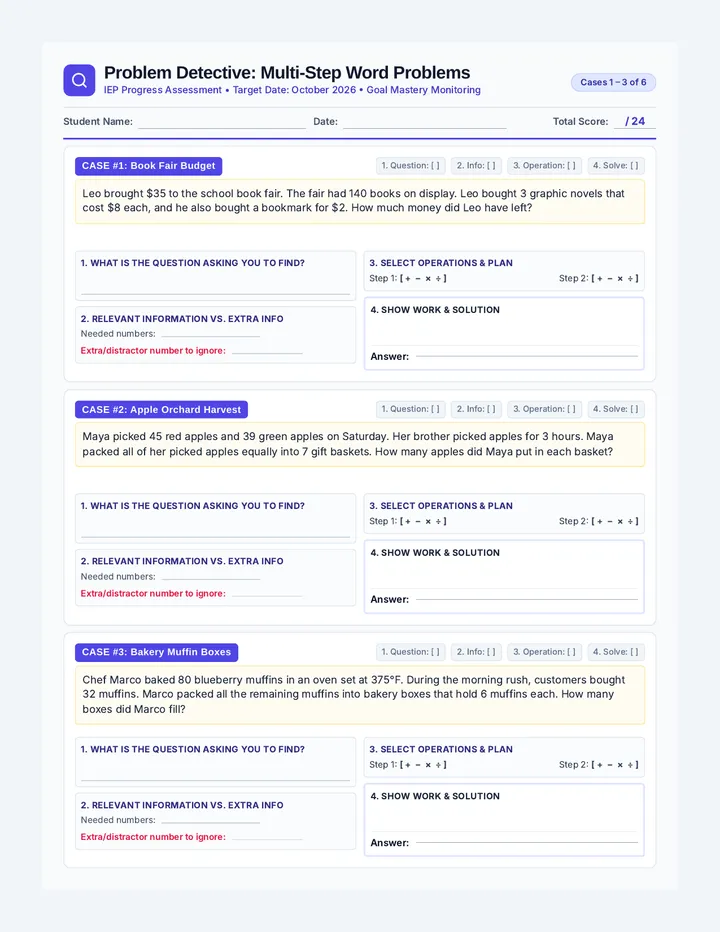
Problem Detective Assessment Problem Detective: Multi-Step Word Problems
IEP Progress Assessment • Target Date: October 2026 • Goal Mastery Monitoring
Cases 1 – 3 of 6
Student Name:
Date:
Total Score: / 24
CASE #1: Book Fair Budget
1. Question: [ ] 2. Info: [ ] 3. Operation: [ ] 4. Solve: [ ]
Leo brought $35 to the school book fair. The fair had 140 books on display. Leo bought 3 graphic novels that cost $8 each, and he also bought a bookmark for $2. How much money did Leo have left?
1. What is the question asking you to find?
2. Relevant Information vs. Extra Info
Needed numbers:
Extra/distractor number to ignore:
3. Select Operations & Plan
Step 1: [ + − × ÷ ] Step 2: [ + − × ÷ ]
4. Show Work & Solution
Answer:
CASE #2: Apple Orchard Harvest
1. Question: [ ] 2. Info: [ ] 3. Operation: [ ] 4. Solve: [ ]
Maya picked 45 red apples and 39 green apples on Saturday. Her brother picked apples for 3 hours. Maya packed all of her picked apples equally into 7 gift baskets. How many apples did Maya put in each basket?
1. What is the question asking you to find?
2. Relevant Information vs. Extra Info
Needed numbers:
Extra/distractor number to ignore:
3. Select Operations & Plan
Step 1: [ + − × ÷ ] Step 2: [ + − × ÷ ]
4. Show Work & Solution
Answer:
CASE #3: Bakery Muffin Boxes
1. Question: [ ] 2. Info: [ ] 3. Operation: [ ] 4. Solve: [ ]
Chef Marco baked 80 blueberry muffins in an oven set at 375°F. During the morning rush, customers bought 32 muffins. Marco packed all the remaining muffins into bakery boxes that hold 6 muffins each. How many boxes did Marco fill?
1. What is the question asking you to find?
2. Relevant Information vs. Extra Info
Needed numbers:
Extra/distractor number to ignore:
3. Select Operations & Plan
Step 1: [ + − × ÷ ] Step 2: [ + − × ÷ ]
4. Show Work & Solution
Answer:
PART 2
Problem Detective: Multi-Step Word Problems
Student: Cases 4 – 6 of 6
CASE #4: Soccer Car Wash Fundraiser
1. Question: [ ] 2. Info: [ ] 3. Operation: [ ] 4. Solve: [ ]
The soccer team won their match 4 to 1 on Saturday. To buy new practice jerseys, 6 players each washed 5 cars. They charged $8 for each car washed. Then, the coach donated $40 to their fund. What was the total amount of money raised?
1. What is the question asking you to find?
2. Relevant Information vs. Extra Info
Needed numbers:
Extra/distractor info:
3. Select Operations & Plan
Step 1: [ + − × ÷ ] Step 2: [ + − × ÷ ]
4. Show Work & Solution
Answer:
CASE #5: Art Studio Markers
1. Question: [ ] 2. Info: [ ] 3. Operation: [ ] 4. Solve: [ ]
In art room 14, Ms. Rivera had 96 new colored markers. She distributed them equally across 8 student tables. At Table 2, students discovered that 3 markers were completely dried out and had to be thrown away. How many usable markers remained at Table 2?
1. What is the question asking you to find?
2. Relevant Information vs. Extra Info
Needed numbers:
Extra/distractor number to ignore:
3. Select Operations & Plan
Step 1: [ + − × ÷ ] Step 2: [ + − × ÷ ]
4. Show Work & Solution
Answer:
CASE #6: Museum Field Trip Bus
1. Question: [ ] 2. Info: [ ] 3. Operation: [ ] 4. Solve: [ ]
The 5th grade classes are traveling 18 miles to the science museum. Class A has 24 students, Class B has 27 students, and 5 parent chaperones are joining them. The chartered bus has 64 passenger seats. How many empty seats will be left on the bus?
1. What is the question asking you to find?
2. Relevant Information vs. Extra Info
Needed numbers:
Extra/distractor number to ignore:
3. Select Operations & Plan
Step 1: [ + − × ÷ ] Step 2: [ + − × ÷ ]
4. Show Work & Solution
Answer:
IEP Progress Summary Checklist
Target Criterion: 80% accuracy across 3 consecutive trials
Determine Goal: ___ / 6
Identify Info: ___ / 6
Select Ops: ___ / 6
Calculation: ___ / 6
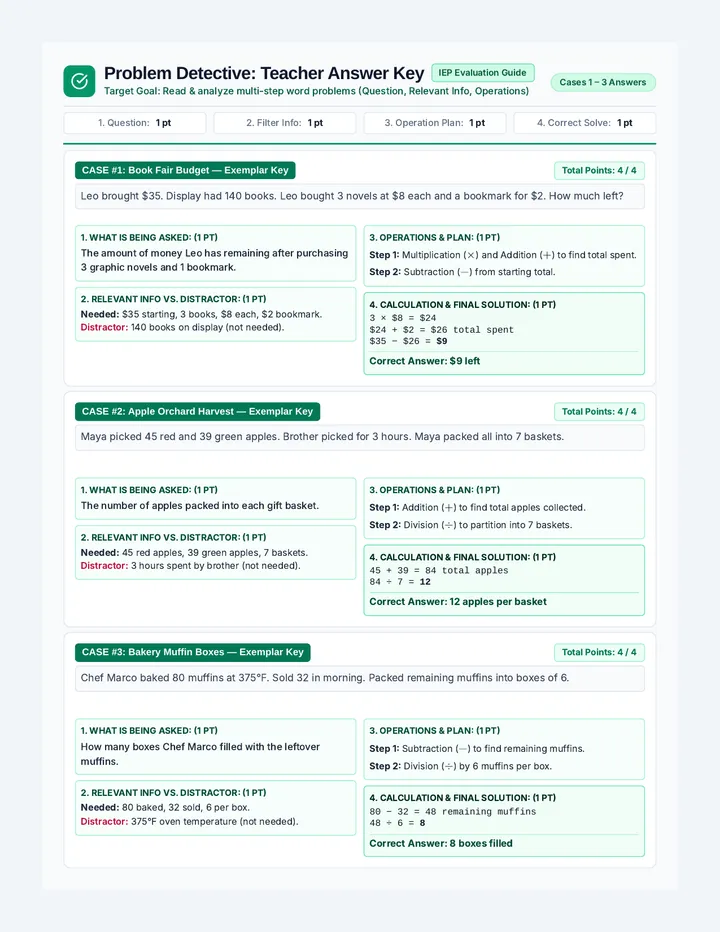
Problem Detective Answer Key Problem Detective: Teacher Answer Key
IEP Evaluation Guide
Target Goal: Read & analyze multi-step word problems (Question, Relevant Info, Operations)
Cases 1 – 3 Answers
1. Question: 1 pt
2. Filter Info: 1 pt
3. Operation Plan: 1 pt
4. Correct Solve: 1 pt
CASE #1: Book Fair Budget — Exemplar Key Total Points: 4 / 4
Leo brought $35. Display had 140 books. Leo bought 3 novels at $8 each and a bookmark for $2. How much left?
1. What is being asked: (1 pt)
The amount of money Leo has remaining after purchasing 3 graphic novels and 1 bookmark.
2. Relevant Info vs. Distractor: (1 pt)
Needed: $35 starting, 3 books, $8 each, $2 bookmark.
3. Operations & Plan: (1 pt)
Step 1: Multiplication (\(\times\)) and Addition (\(+\)) to find total spent.Step 2: Subtraction (\(-\)) from starting total.
4. Calculation & Final Solution: (1 pt)
3 × $8 = $24$9
Correct Answer: $9 left
CASE #2: Apple Orchard Harvest — Exemplar Key Total Points: 4 / 4
Maya picked 45 red and 39 green apples. Brother picked for 3 hours. Maya packed all into 7 baskets.
1. What is being asked: (1 pt)
The number of apples packed into each gift basket.
2. Relevant Info vs. Distractor: (1 pt)
Needed: 45 red apples, 39 green apples, 7 baskets.
3. Operations & Plan: (1 pt)
Step 1: Addition (\(+\)) to find total apples collected.Step 2: Division (\(\div\)) to partition into 7 baskets.
4. Calculation & Final Solution: (1 pt)
45 + 39 = 84 total apples12
Correct Answer: 12 apples per basket
CASE #3: Bakery Muffin Boxes — Exemplar Key Total Points: 4 / 4
Chef Marco baked 80 muffins at 375°F. Sold 32 in morning. Packed remaining muffins into boxes of 6.
1. What is being asked: (1 pt)
How many boxes Chef Marco filled with the leftover muffins.
2. Relevant Info vs. Distractor: (1 pt)
Needed: 80 baked, 32 sold, 6 per box.
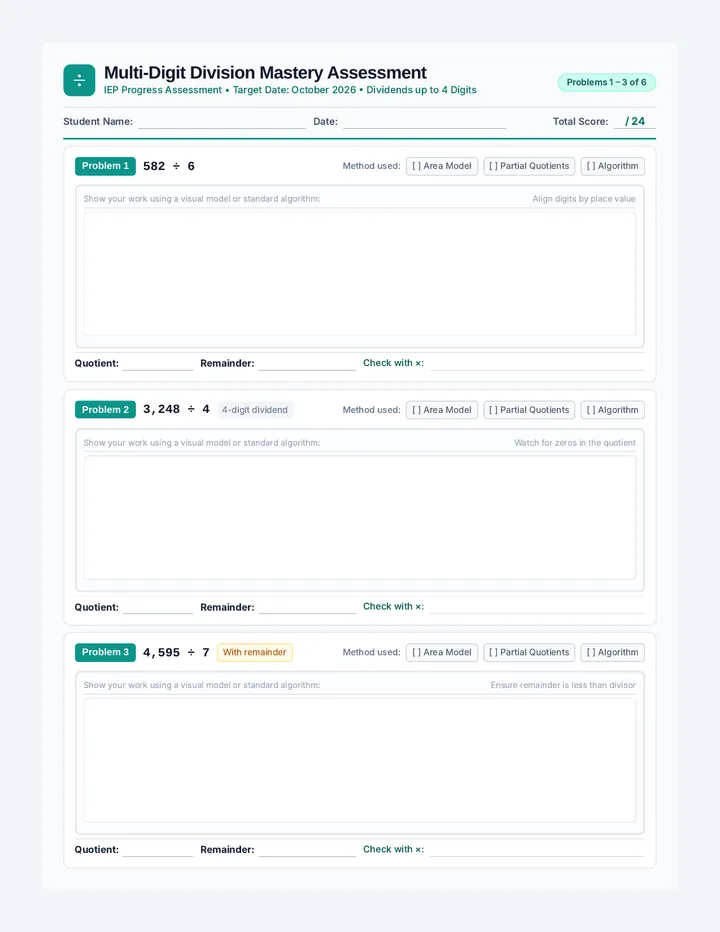
Division Mastery Assessment Multi-Digit Division Mastery Assessment
IEP Progress Assessment • Target Date: October 2026 • Dividends up to 4 Digits
Problems 1 – 3 of 6
Student Name:
Date:
Total Score: / 24
Problem 1 582 ÷ 6
Method used: [ ] Area Model [ ] Partial Quotients [ ] Algorithm
Show your work using a visual model or standard algorithm: Align digits by place value
Quotient: Remainder:
Check with ×:
Problem 2 3,248 ÷ 4 4-digit dividend
Method used: [ ] Area Model [ ] Partial Quotients [ ] Algorithm
Show your work using a visual model or standard algorithm: Watch for zeros in the quotient
Quotient: Remainder:
Check with ×:
Problem 3 4,595 ÷ 7 With remainder
Method used: [ ] Area Model [ ] Partial Quotients [ ] Algorithm
Show your work using a visual model or standard algorithm: Ensure remainder is less than divisor
Quotient: Remainder:
Check with ×:
PART 2
Multi-Digit Division Mastery Assessment
Student: Problems 4 – 6 of 6
Problem 4 1,728 ÷ 12 2-digit divisor
Method used: [ ] Area Model [ ] Partial Quotients [ ] Algorithm
Show your work using a visual model or standard algorithm: Tip: List multiples of 12 (12, 24, 36, 48...)
Quotient: Remainder:
Check with ×:
Problem 5 3,548 ÷ 24 2-digit divisor with remainder
Method used: [ ] Area Model [ ] Partial Quotients [ ] Algorithm
Show your work using a visual model or standard algorithm: Remainder must be less than 24
Quotient: Remainder:
Check with ×:
Problem 6 Real-World Application
Method: [ ] Model [ ] Algorithm
A food distribution warehouse received 2,160 cans of soup. Workers packed the cans equally into 18 large crates to ship to neighborhood shelters. How many cans of soup were placed in each crate?
Answer with unit label:
Check with ×:
Multi-Digit Division IEP Progress Tracker
Target Criterion: 80% accuracy (19+ / 24 total points)
Visual Model: ___ / 6
Standard Alg: ___ / 6
Remainders: ___ / 6
Verification: ___ / 6
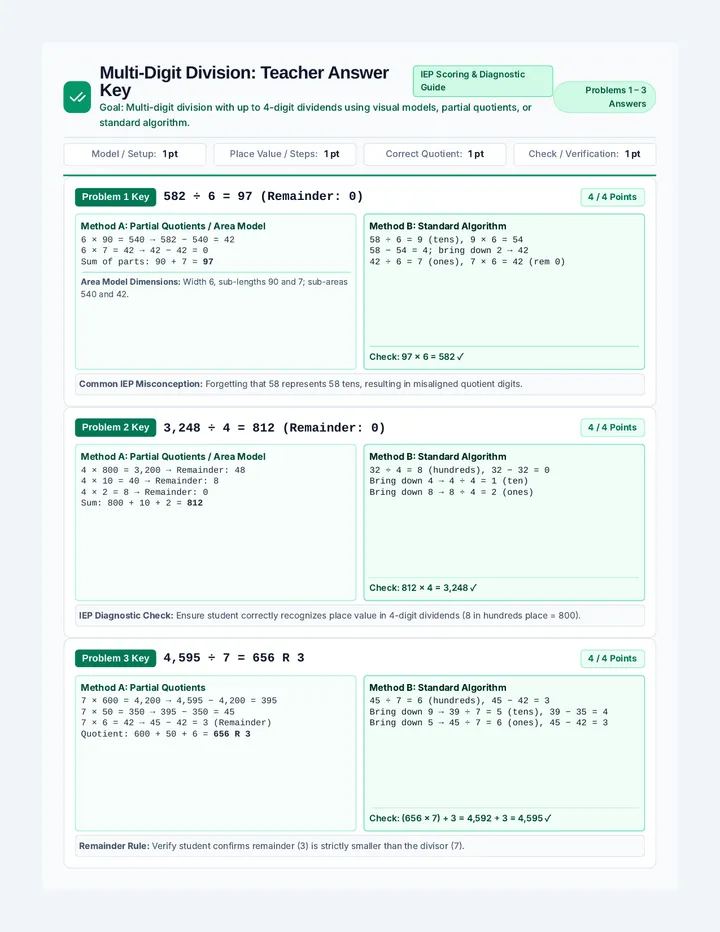
Division Mastery Answer Key Multi-Digit Division: Teacher Answer Key
IEP Scoring & Diagnostic Guide
Goal: Multi-digit division with up to 4-digit dividends using visual models, partial quotients, or standard algorithm.
Problems 1 – 3 Answers
Model / Setup: 1 pt
Place Value / Steps: 1 pt
Correct Quotient: 1 pt
Check / Verification: 1 pt
Problem 1 Key 582 ÷ 6 = 97 (Remainder: 0)
4 / 4 Points
Method A: Partial Quotients / Area Model
6 × 90 = 540 → 582 − 540 = 4297
Area Model Dimensions: Width 6, sub-lengths 90 and 7; sub-areas 540 and 42.
Method B: Standard Algorithm
58 ÷ 6 = 9 (tens), 9 × 6 = 54
Check: 97 × 6 = 582 ✓
Common IEP Misconception: Forgetting that 58 represents 58 tens, resulting in misaligned quotient digits.
Problem 2 Key 3,248 ÷ 4 = 812 (Remainder: 0)
4 / 4 Points
Method A: Partial Quotients / Area Model
4 × 800 = 3,200 → Remainder: 48812
Method B: Standard Algorithm
32 ÷ 4 = 8 (hundreds), 32 − 32 = 0
Check: 812 × 4 = 3,248 ✓
IEP Diagnostic Check: Ensure student correctly recognizes place value in 4-digit dividends (8 in hundreds place = 800).
Problem 3 Key 4,595 ÷ 7 = 656 R 3
4 / 4 Points
Method A: Partial Quotients
7 × 600 = 4,200 → 4,595 − 4,200 = 395656 R 3
Method B: Standard Algorithm
45 ÷ 7 = 6 (hundreds), 45 − 42 = 3
Check: (656 × 7) + 3 = 4,592 + 3 = 4,595 ✓
Remainder Rule: Verify student confirms remainder (3) is strictly smaller than the divisor (7).
PART 2
Multi-Digit Division: Teacher Answer Key & Rubric