Lenny.com
Explore
Create
ActivitiesNewMathEnglish Language ArtsScience & EngineeringSocial StudiesGlobal LanguagesHealth & Physical EducationSpecial EducationCounseling & Life SkillsArts & CreativityESL
Lenny.com
Lenny.com
Explore
Create
ActivitiesNewMathEnglish Language ArtsScience & EngineeringSocial StudiesGlobal LanguagesHealth & Physical EducationSpecial EducationCounseling & Life SkillsArts & CreativityESL
Lenny.com
Lenny.com

Solutions

Lenny for EducatorsLenny for SchoolsLenny for Districts

Product

ExploreSign inCreateSupportAbout

Resources

Getting startedMTSS Acceleration Program

© 2026 Lenny Learning Inc.

TermsPrivacyAccessibility
LinkedInInstagramX
Lenny

Polynomial Identities

Algebraic expansions and factorizations including difference of squares, perfect square trinomials, and sum or difference of cubes. Builds proficiency in proving equalities through algebraic manipulation and connecting identities to geometric models.

MathNumbers & CountingCounting ObjectsNumber NamesComparing NumbersNumber OperationsCounting SequenceNumbers 0-10Place Value Understanding and SystemAdd and Subtract Within 20Addition and Subtraction ConceptsAddition and Subtraction EquationsAddition and Subtraction ProblemsFoundations for MultiplicationMultiplication and Division PropertiesMultiply and Divide Within 100Multiplication and Division ProblemsFactors and MultiplesProperties of OperationsPatterns and RelationshipsGenerate and Analyze PatternsMulti-Digit ArithmeticPlace Value OperationsMulti-Digit and Decimal OperationsNumerical ExpressionsFour Operations and PatternsFour Operations Problem SolvingMeasurement & DataMeasurable AttributesMeasuring LengthsMeasure and Estimate Lengths in Standard UnitsRelate Addition and Subtraction to LengthClassifying and Counting ObjectsTime and MoneyArea Concepts and MeasurementPerimeter and Area MeasuresAngle Concepts and MeasurementTime, Volume, and MassMeasurement Unit ConversionsGeometryIdentifying ShapesShapes and AttributesShape Attributes and ReasoningShapes and CompositionClassifying 2D FiguresGeometric Figures and RelationshipsLines, Angles, and ShapesAngle, Area, and VolumeGeometric MeasurementVolume of 3D ShapesCoordinate Plane ApplicationsTransformations in the PlaneCongruence and SimilarityUnderstand congruence in terms of rigid motionsSimilarity and TransformationsProve Theorems Involving SimilarityPythagorean TheoremTrigonometry for General TrianglesMake Geometric ConstructionsProve Geometric TheoremsTheorems About CirclesFind Arc Lengths And Areas of Sectors of CirclesVolume FormulasRelationships Between Two-Dimensional and Three-Dimensional ObjectsProve Simple Geometric Theorems AlgebraicallyTranslate Between Geometric Description and Equation for Conic SectionApply Geometric Concepts in Modeling SituationsFractions & DecimalsFractions as NumbersBuilding FractionsFraction Equivalence and OrderingAdding and Subtracting FractionsMultiplying and Dividing FractionsDividing FractionsDecimal FractionsMulti-Digit Computation and FactorsAdd, Subtract, Multiply, and Divide Rational NumbersRational Number SystemIrrational Numbers and ApproximationsRatiosRatios and ProportionsProportional RelationshipsUnit RateAlgebraAlgebraic ExpressionsGenerate Equivalent ExpressionsQuantitative RelationshipsProportional Relationships and Linear EquationsEquations and InequalitiesEquation Solving and ReasoningLinear Equations and SystemsGraph Equations and InequalitiesSystems of EquationsReal-World Algebraic ProblemsQuantitative Reasoning with UnitsExpression StructureEquivalent Expression FormsRadicals and Integer ExponentsRational ExponentsRational and Irrational NumbersPolynomial OperationsPolynomial IdentitiesPolynomial Zeros and FactorsRational ExpressionsComplex Number OperationsComplex Numbers in PolynomialsComplex Numbers on PlaneStatistics & ProbabilityRepresent and Interpret DataData DistributionsStatistical VariabilityProbability ModelsCompound Event ProbabilitiesStatistical SamplingInterpret Categorical and Quantitative DataBivariate Data PatternsInterpret Linear ModelsComparing Two PopulationsRandom Processes in StatisticsIndependence and Conditional ProbabilityExpected ValuesProbability-Based Decision MakingStatistical Inference and ConclusionsFunctionsFunction Concepts and NotationDefine and Compare FunctionsInterpret Functions in ContextAnalyze Function RepresentationsModel Relationships with FunctionsIdentify Linear vs Exponential GrowthDistinguish Between Function TypesCompare Growth RatesInterpret Function ExpressionsBuild Functions from RelationshipsConstruct and Model FunctionsTransform and Combine FunctionsModel Comparison and SelectionSolve Exponential EquationsTrigonometryTrigonometric Ratios Involving Right TrianglesTrigonometric Functions and Unit CircleModel with Trigonometric FunctionsTrigonometric IdentitiesVectors & MatricesIntroduction to Vectors and MatricesVector QuantitiesVector OperationsMatrix OperationsCalculusLimits and ContinuityDerivative Concepts and NotationDerivative Rules and TechniquesApplications of DerivativesOptimization ProblemsRelated RatesCurve Sketching and AnalysisIntegration Concepts and NotationAntiderivatives and Indefinite IntegralsDefinite Integrals and AreaFundamental Theorem of CalculusIntegration TechniquesApplications of IntegrationDifferential EquationsSequences and SeriesParametric and Polar FunctionsVector-Valued Functions

Videos

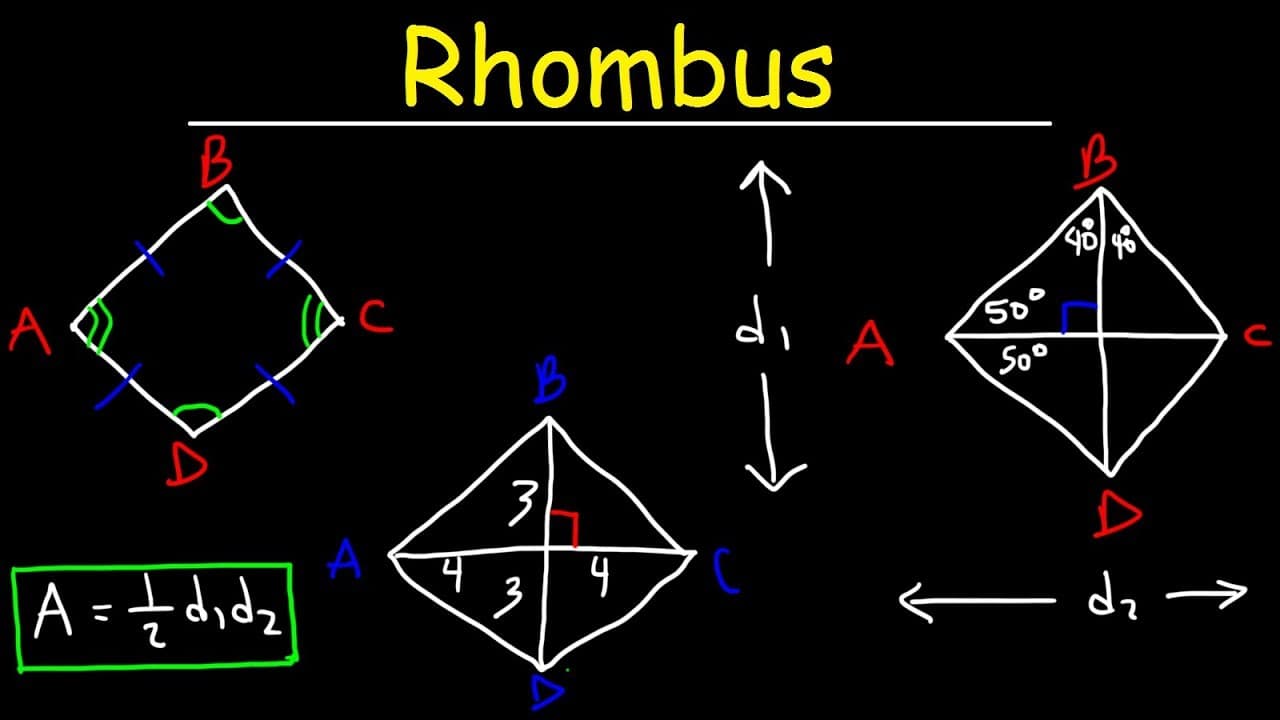
Mastering the Rhombus: Properties, Area, and Angles

Mastering the Rhombus: Properties, Area, and Angles

This comprehensive math tutorial provides a deep dive into the geometric properties of a rhombus, guiding students from basic definitions to complex algebraic applications. The video begins by defining a rhombus as a special quadrilateral and parallelogram, explaining core features such as congruent sides, parallel opposite sides, and angle relationships. It visualizes how diagonals bisect angles, bisect each other, and intersect at perpendicular right angles, forming the foundation for area and perimeter calculations. The content progresses through a series of five increasing difficult example problems. These examples demonstrate how to calculate area using diagonals, determine perimeter using the Pythagorean theorem, and solve for missing angles using triangle sum properties. Later sections integrate algebra, challenging students to solve linear and quadratic equations to find side lengths and angle measures. The video concludes with a complex problem involving infinite solutions, encouraging critical thinking about mathematical identities. For educators, this video serves as an excellent resource for a Geometry or Algebra unit. It connects geometric concepts with algebraic solving skills, reinforcing the importance of the Pythagorean theorem and factoring quadratics in geometric contexts. The clear, step-by-step walkthroughs make it suitable for introducing new concepts, guided practice, or independent review for students struggling with the properties of quadrilaterals.
The Organic Chemistry TutorThe Organic Chemistry Tutor

22mins 30s

Solving Quadratic Equations Using Standard Form

Solving Quadratic Equations Using Standard Form

This educational video provides a comprehensive guide on how to solve quadratic equations by utilizing the standard form. The instructor, Justin, bridges the gap between previously learned forms (factored and vertex) and the standard form, explaining how to manipulate equations to identify roots. The lesson progresses from simple reviews of standard form structure to solving complex equations where terms must be rearranged and factored.

Miacademy & MiaPrep Learning ChannelMiacademy & MiaPrep Learning Channel

7mins 58s

Proving the Sum of an Arithmetic Series Formula

Proving the Sum of an Arithmetic Series Formula

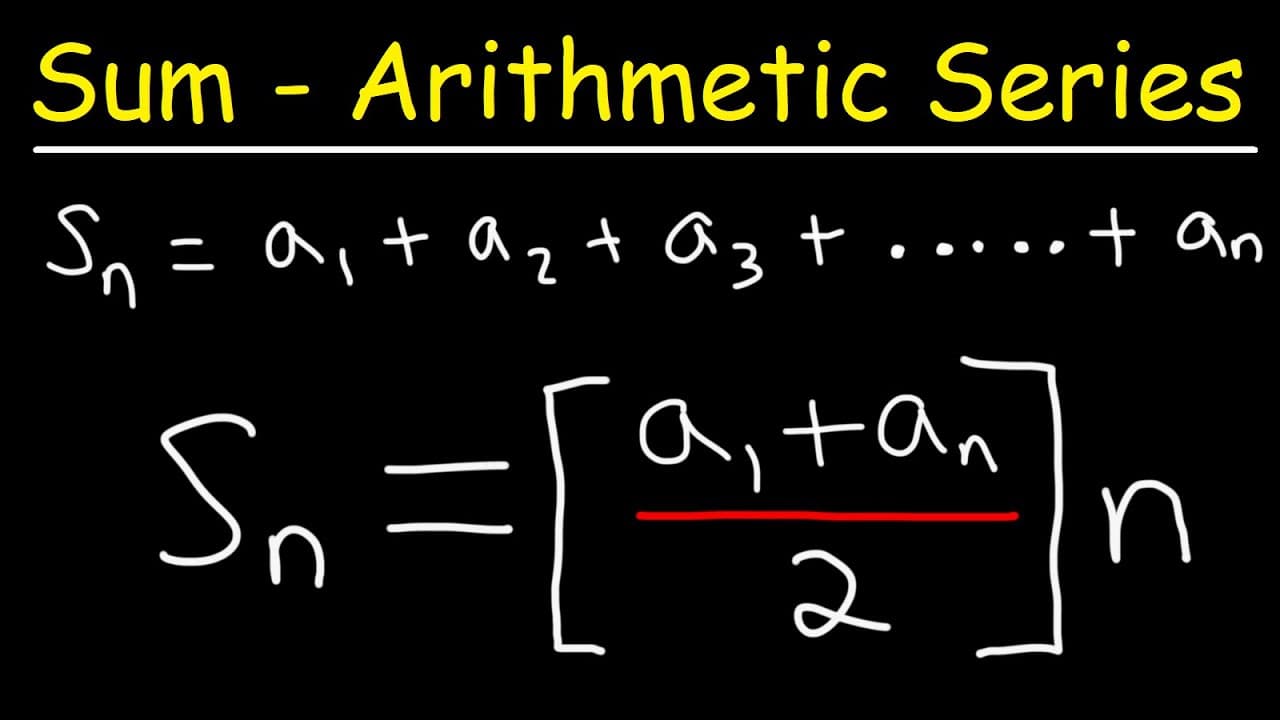
A focused mathematics tutorial that explains the difference between arithmetic sequences and series, demonstrates how to calculate the partial sum of a series, and provides a step-by-step algebraic proof for the arithmetic series sum formula. The video begins by distinguishing between a sequence (a list of numbers) and a series (the sum of those numbers) using a specific numerical example (5, 8, 11, 14, 17). The core of the video explores the derivation of the formula Sn = n/2 * (a1 + an). The instructor uses the "Gaussian method" of writing the series sum forwards and backwards, then adding the two equations together. This visual algebraic demonstration highlights how the common differences cancel out, leaving a clean result that proves why the formula works. This resource is highly valuable for high school Algebra II or Pre-Calculus classrooms. It moves beyond rote memorization by teaching the "why" behind the math. Teachers can use this to introduce the concept of formal proofs or to help students visualize the symmetry inherent in arithmetic progressions.

The Organic Chemistry TutorThe Organic Chemistry Tutor

6mins 38s

Mastering Polynomial Factoring Techniques

Mastering Polynomial Factoring Techniques

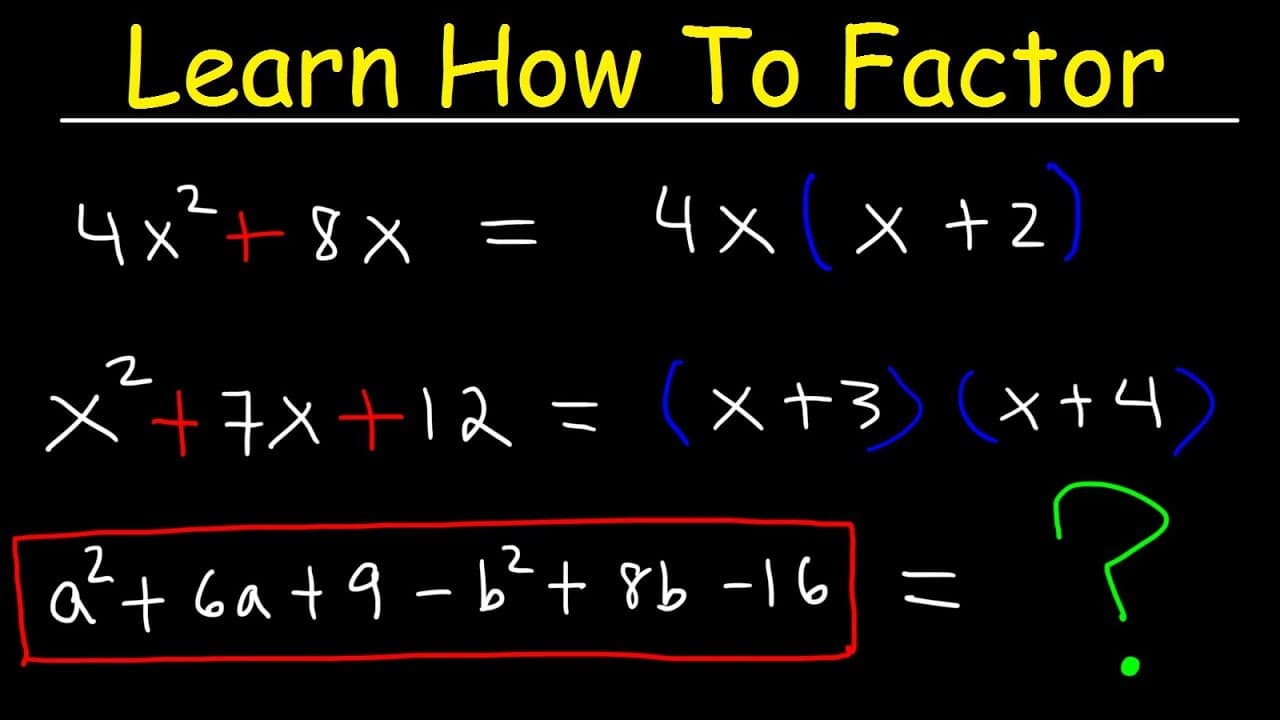
This comprehensive algebra tutorial provides a masterclass in factoring polynomials, progressing from fundamental concepts to advanced techniques. The video systematically covers every major factoring method required for high school algebra, including Greatest Common Factor (GCF), factoring by grouping, trinomials with leading coefficients of 1 and non-1, special products like perfect square trinomials and difference of squares, and the sum and difference of cubes. It concludes by demonstrating how to apply these skills to solve quadratic equations. The content emphasizes pattern recognition and procedural fluency. Key themes include identifying the structure of algebraic expressions, verifying results through multiplication (FOIL), and manipulating terms to fit standard factoring formulas. The video explicitly teaches the logic behind "splitting the middle term" for complex trinomials and offers specific tests to identify perfect square trinomials, helping students move beyond guessing to using reliable algorithms. For educators, this video serves as a modular library of factoring techniques. It can be used as a complete review for Algebra 2 students or broken into segments for Algebra 1 instruction. The visual examples are clear and numerous, providing opportunities for "pause and predict" activities where students attempt problems before seeing the solution. The inclusion of complex, multi-step problems and equation solving makes it valuable for connecting abstract factoring skills to finding zeros of functions.

The Organic Chemistry TutorThe Organic Chemistry Tutor

34mins 46s

Mastering Complex Rational Expressions

Mastering Complex Rational Expressions

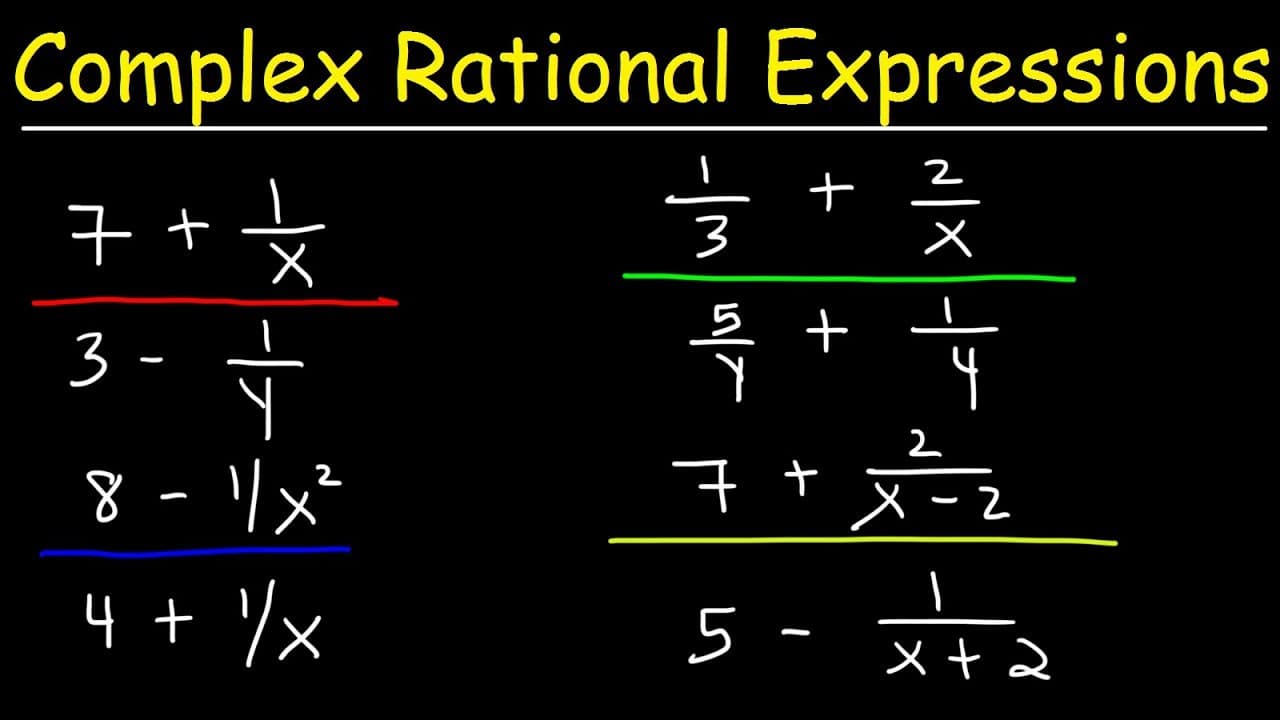
This comprehensive math tutorial guides students through the process of simplifying complex fractions and rational expressions. Starting with basic arithmetic complex fractions, the video progressively introduces variables, difference of squares, and quadratic trinomials. The primary method taught is multiplying the numerator and denominator by the Least Common Denominator (LCD) to eliminate internal fractions, a technique that streamlines the simplification process. The video covers key algebraic themes including finding common denominators for integers and variables, distributing terms, combining like terms, and factoring polynomials. It specifically demonstrates how to handle complex expressions where the denominators are binomials, requiring students to factor quadratics before finding the LCD. The tutorial concludes with a challenging problem that synthesizes all these skills, requiring the 'AC method' for factoring trinomials with leading coefficients greater than one. For educators, this video serves as an excellent resource for Algebra I, Algebra II, and Pre-Calculus units on rational expressions. It provides a scaffolded approach that helps students transition from concrete arithmetic concepts to abstract algebraic manipulation. The clear, step-by-step visual working of problems makes it useful for introducing the topic, reviewing before a test, or providing remediation for students struggling with multi-step algebraic procedures.

The Organic Chemistry TutorThe Organic Chemistry Tutor

12mins 46s

Solving a Complex Equation Involving Exponents and Quadratics

Solving a Complex Equation Involving Exponents and Quadratics

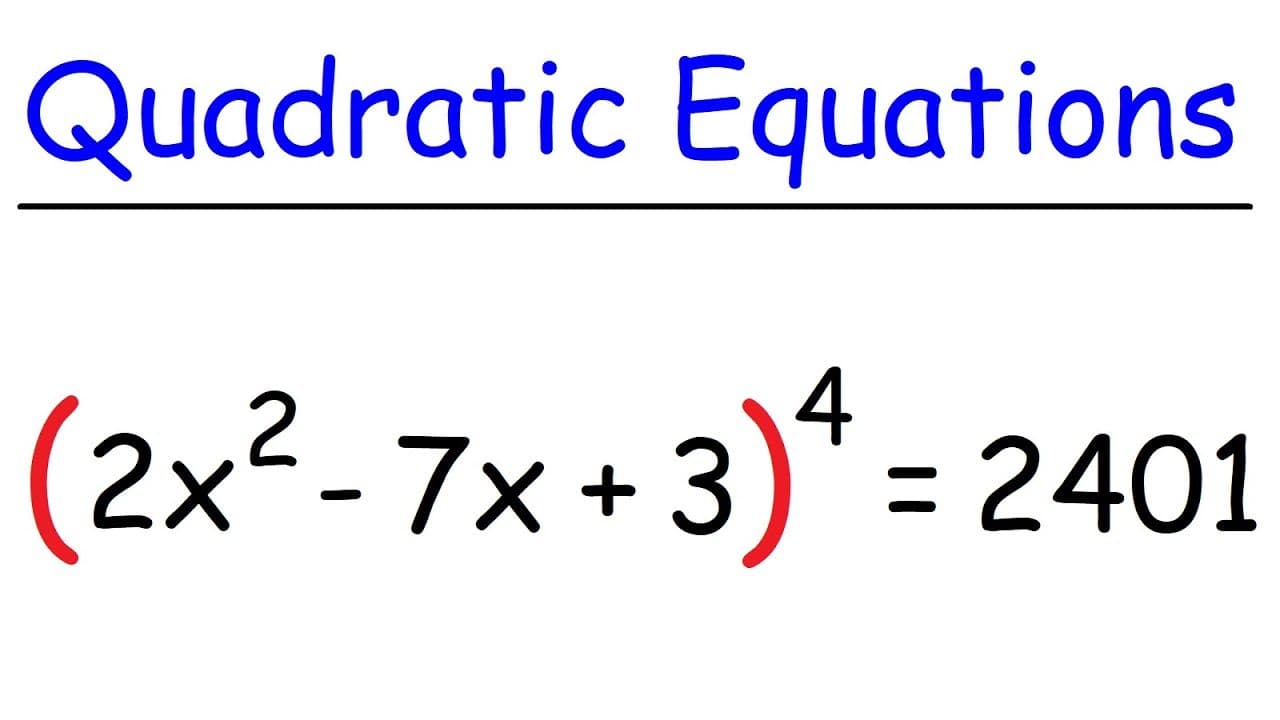
This video presents a detailed walkthrough of solving a complex algebraic equation involving a quadratic expression raised to the fourth power. The narrator guides viewers through a multi-step process that includes using inverse operations to remove the exponent, setting up a quadratic equation, factoring a trinomial with a leading coefficient greater than one, and applying the zero product property to find the values of x. The content covers key algebraic themes such as working with rational exponents and roots, solving quadratic equations in the form ax^2 + bx + c = 0, and the specific technique of factoring by grouping (often called the 'ac method'). Additionally, the video emphasizes the importance of verifying solutions by substituting the calculated values back into the original equation to ensure accuracy. This resource is highly valuable for high school Algebra II and Pre-Calculus classrooms. It serves as an excellent model for solving multi-layered problems that require students to synthesize different skills. Teachers can use this video to demonstrate how to handle equations where a polynomial is nested inside a power, or as a specific tutorial on how to factor tricky quadratics where the leading coefficient is not 1.

The Organic Chemistry TutorThe Organic Chemistry Tutor

7mins 12s

Materials

Figurative Patterns Slides Orientation Fix

Figurative Patterns Slides Orientation Fix

Fixed Slide 6 where the visualization of two paired triangular numbers forming a rectangle was missing. Replaced the previous layout with explicit flex rows to ensure the dots render correctly and clearly show how $T_4$ and its twin create a $4 \times 5$ rectangle. Label positioning and container sizing were also refined for better clarity. Adjusted Slide 4 to fill vertical space more effectively.

BC

Brenda Coombs

Square Steps Rap Slides

Square Steps Rap Slides

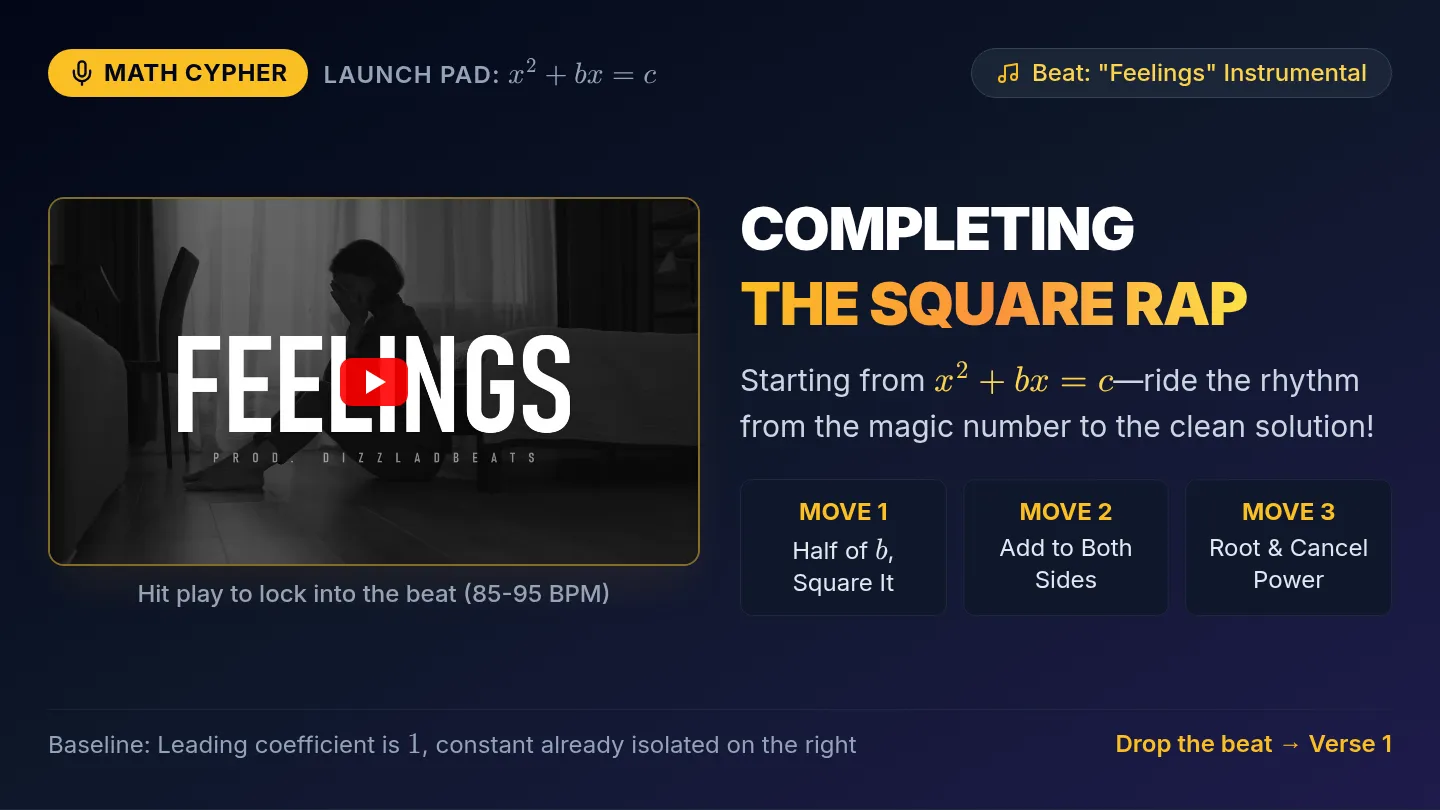
Interactive presentation slides featuring polished rap lyrics starting directly from x^2 + bx = c, an embedded backing track, rhythm counts, step-by-step algebraic breakdowns, and live example walk-throughs.

H

Harlston

Composite Polynomials Worksheet

Composite Polynomials Worksheet

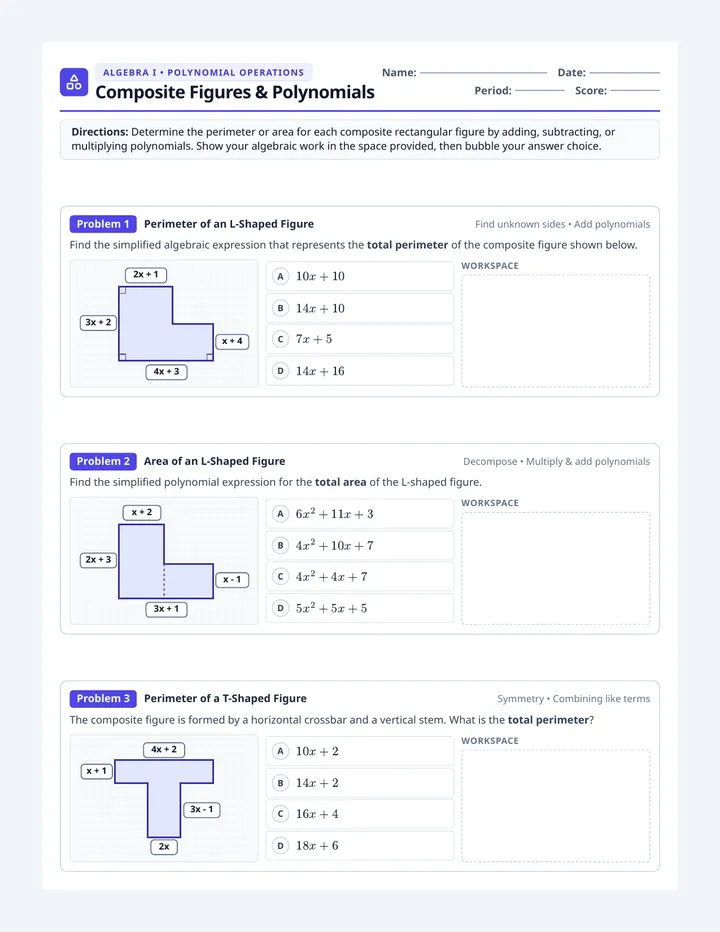
A two-page printable high school Algebra I worksheet containing 6 multiple-choice problems on finding the perimeter and area of composite rectangular figures using polynomial addition, subtraction, and multiplication, featuring crisp, bold SVG geometric diagrams with high-contrast dimension labels and student workspaces.

JW

Jessica Waters

Polynomial Operations Practice Worksheet

Polynomial Operations Practice Worksheet

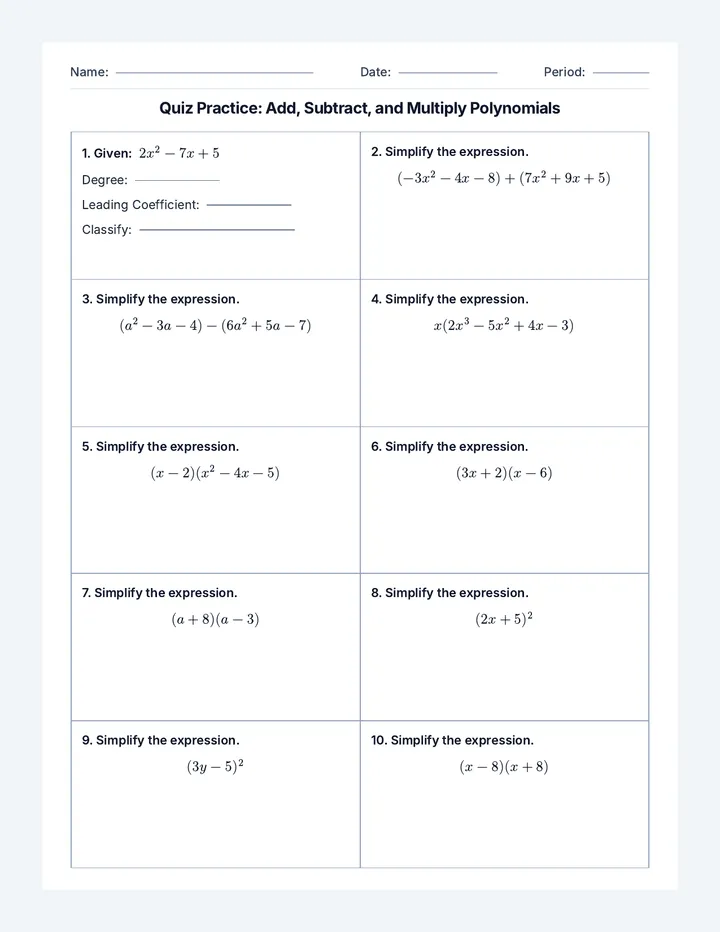
A clean, print-ready practice worksheet featuring 10 polynomial problems matching the exact structure and difficulty of the original quiz. It covers classifying polynomials, adding, subtracting, monomial multiplication, binomial by trinomial multiplication, FOIL binomial multiplication, and special products.

MR

Mahuya Roy Chowdhury

Factor Forge Worksheet

Factor Forge Worksheet

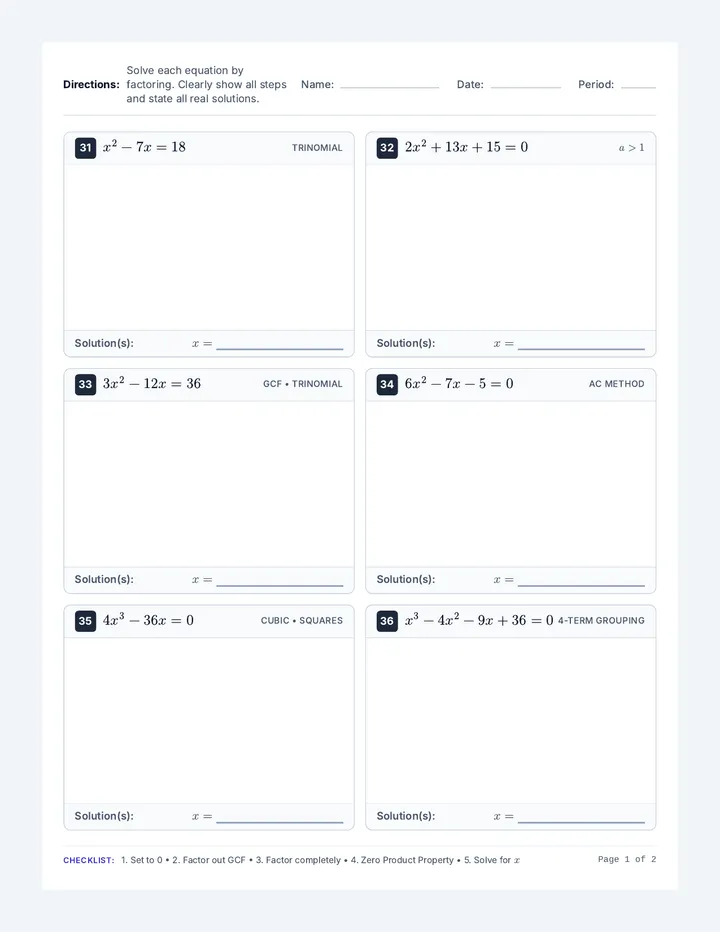
A streamlined 2-page Algebra II resource featuring problems #31–#36 with expanded student workspaces on page 1 and complete step-by-step solutions on page 2.

AR

Angie Rice

Quadratic Arsenal Slides

Quadratic Arsenal Slides

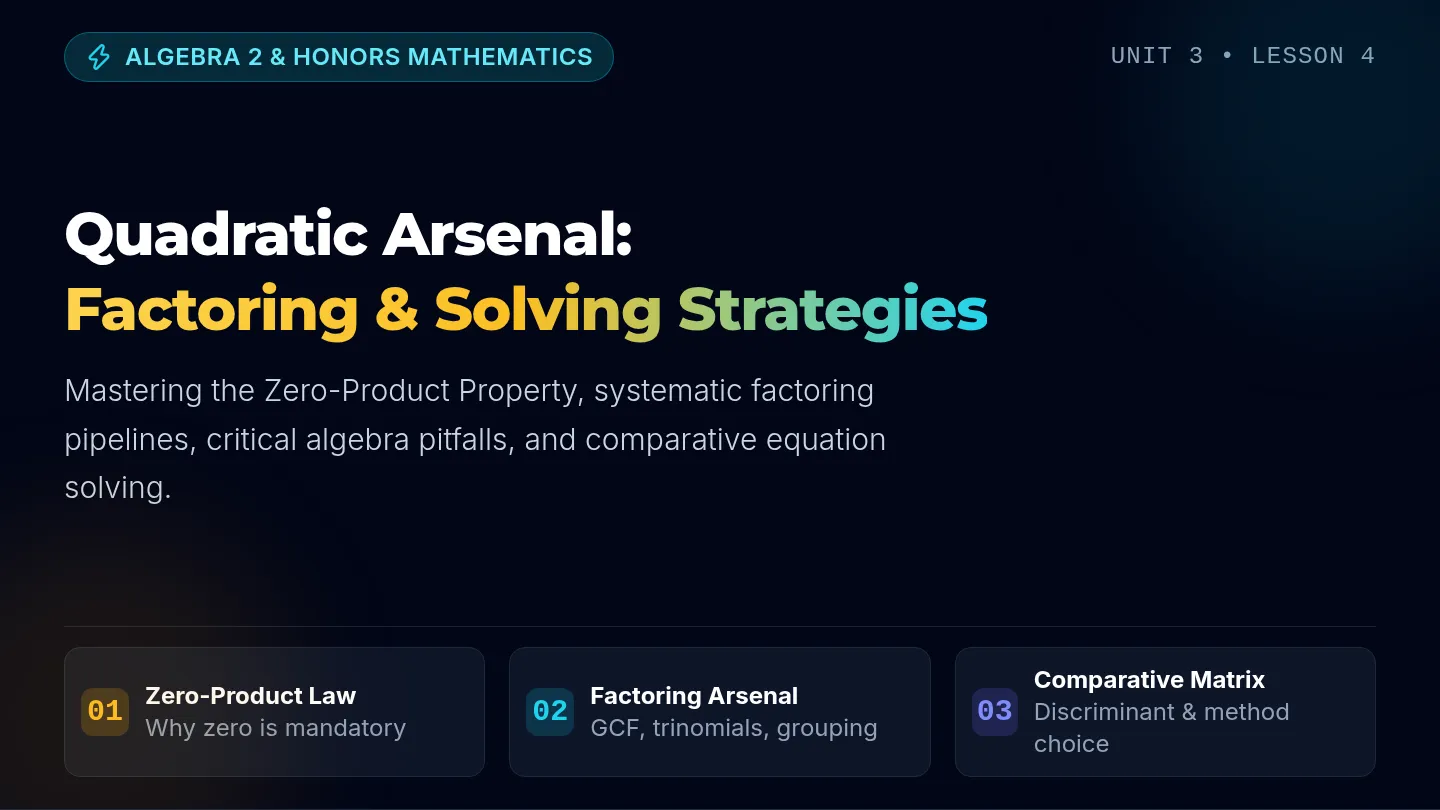
A comprehensive 10-slide high-rigor Algebra 2 and Honors presentation covering quadratic factoring techniques, zero-product property fundamentals, algebraic traps, comparative solving methods, discriminant diagnostics, and quadratic-form substitutions.

R

Robinson

Sequences

Project Mission Slides Final

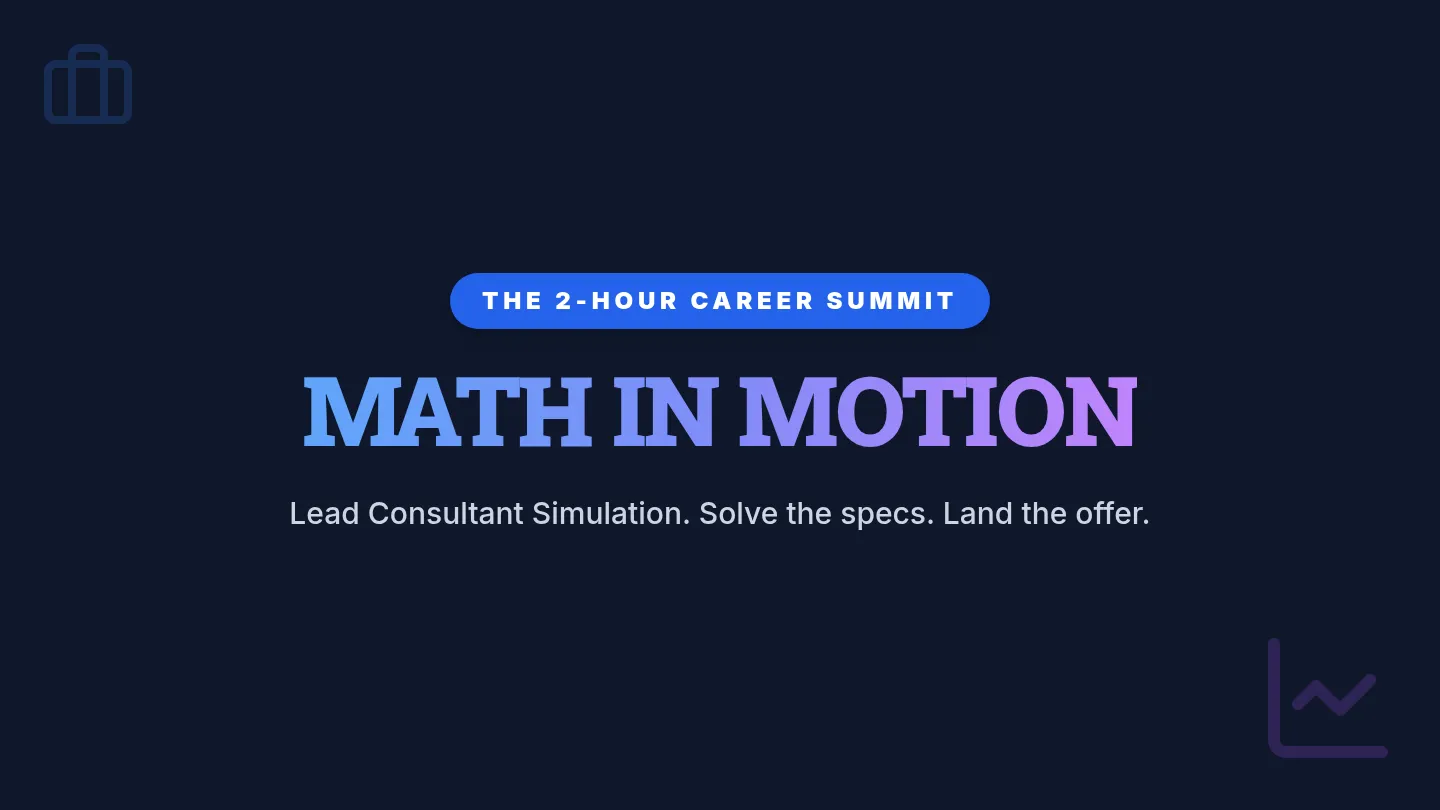
Math in Motion: The 2-Hour Summit

A high-intensity, 120-minute math simulation. Students act as lead consultants, completing a high-speed skill warmup before selecting a professional sector (Music, Urban Planning, Rocket Science, or Sports Analytics) to solve a series of complex work orders.

EL

Elsa LaLone

102
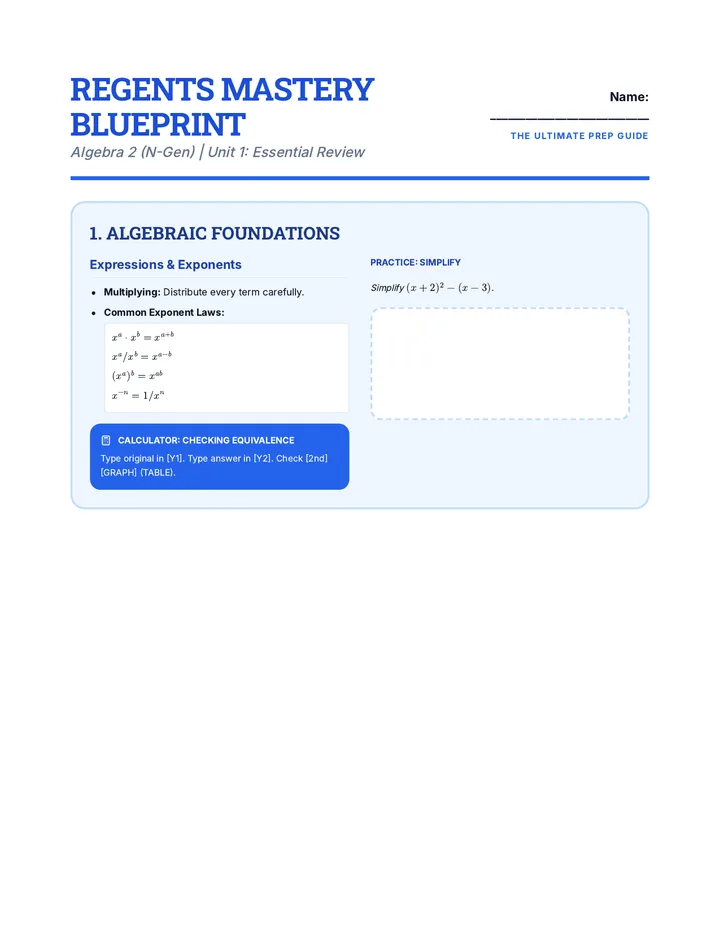
Regents Mastery Blueprint Study Guide

Regents Mastery Suite

A comprehensive review suite for the New York State Mathematics Regents exams, including Algebra 1, Geometry, and Algebra 2, featuring mastery blueprints, calculator strategies, and exam-taking tips.

KB

Kayla Borozny

15
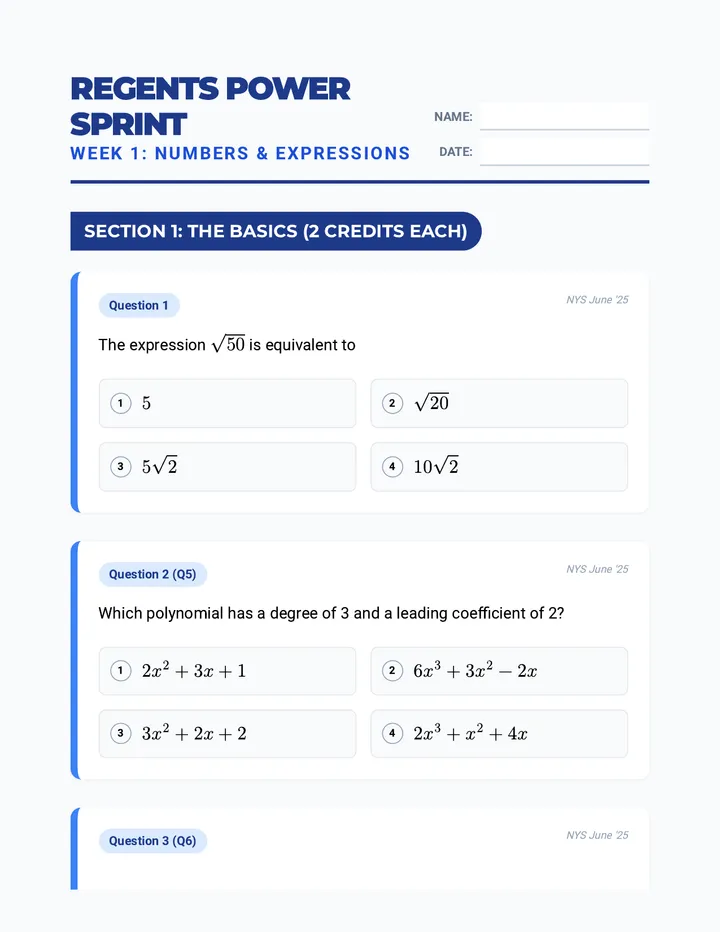
Week 1 Power Sprint Worksheet

Regents Road Map

A comprehensive 10-week preparation sequence designed to get students ready for the Algebra I Regents exam by May 15th, featuring bi-weekly 30-minute practice sessions and visual anchor charts.

L

laura.clar

31
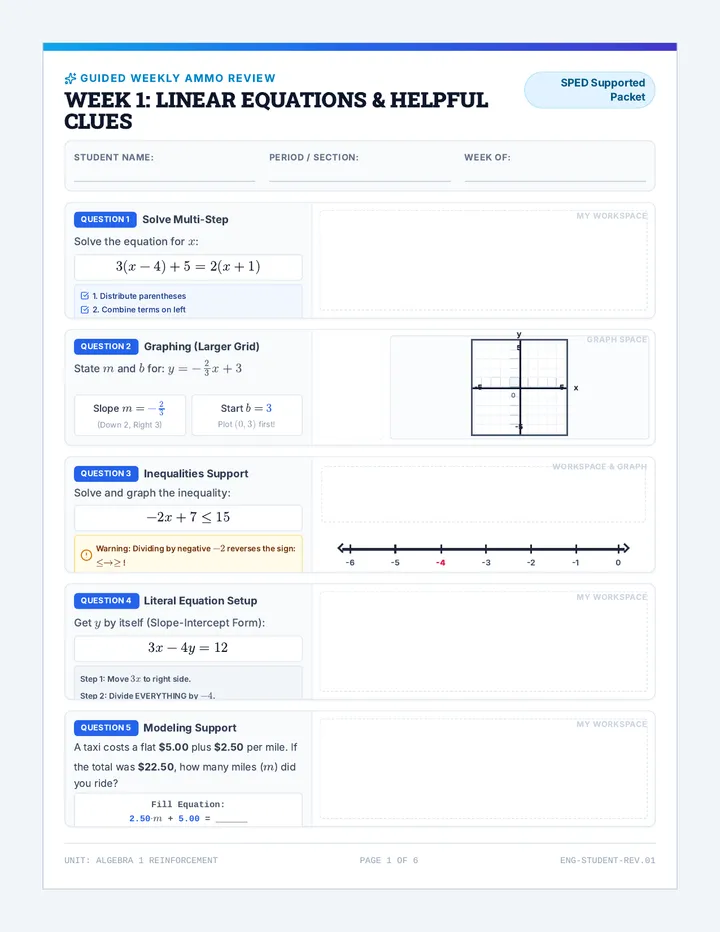
Algebra Ammo Student Booklet

Algebra Ammo Review Unit

A comprehensive 6-week Algebra 1 review unit comprising structured daily bellringers and a detailed teacher answer key with worked-out solutions and misconceptions.

T

timothy.nixon

2
Foundations Slides

Algebra Archive Review

A comprehensive 3-day review sequence for the Algebra I Regents examination, focusing on foundations, systems, and polynomial operations. Each 75-minute lesson provides a balance of guided instruction and independent practice with problems modeled after the NYS Interim Assessment.

AO

Archie Olson

9
Power Play Worksheet

Algebra Architect Recovery

A comprehensive grade recovery packet for 9th Grade Algebra 1 students, covering exponent laws, exponential functions, polynomial operations, and factoring techniques.

DG

Dakota Griffith

8

Lessons

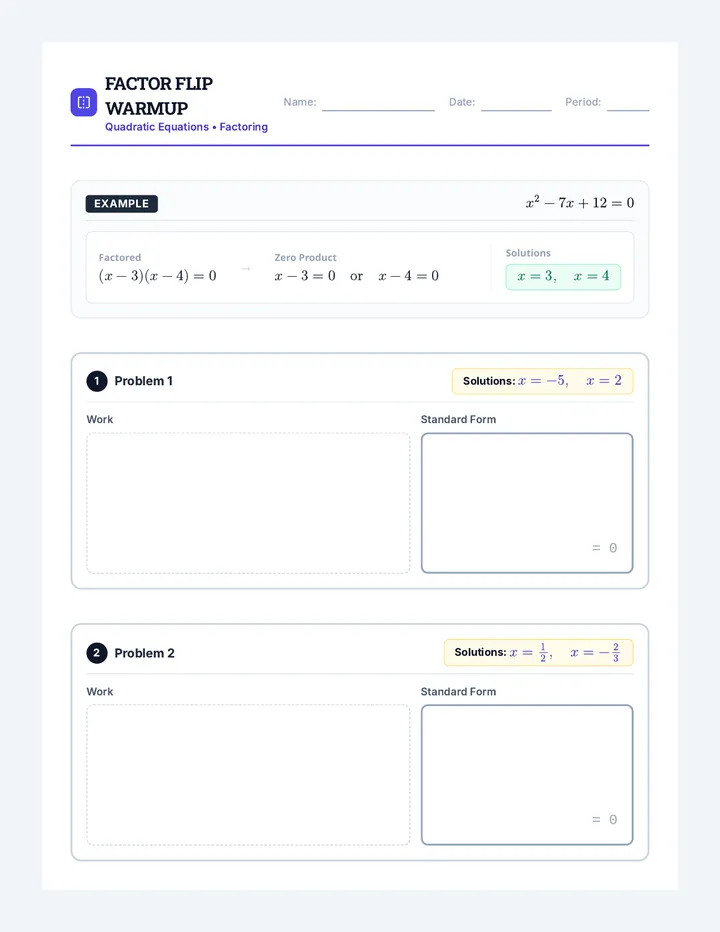
Factor Flip Warmup

Factor Flip

A targeted opening lesson focused on connecting quadratic factors with solutions and constructing standard-form equations from given roots.

AR

Angie Rice

6
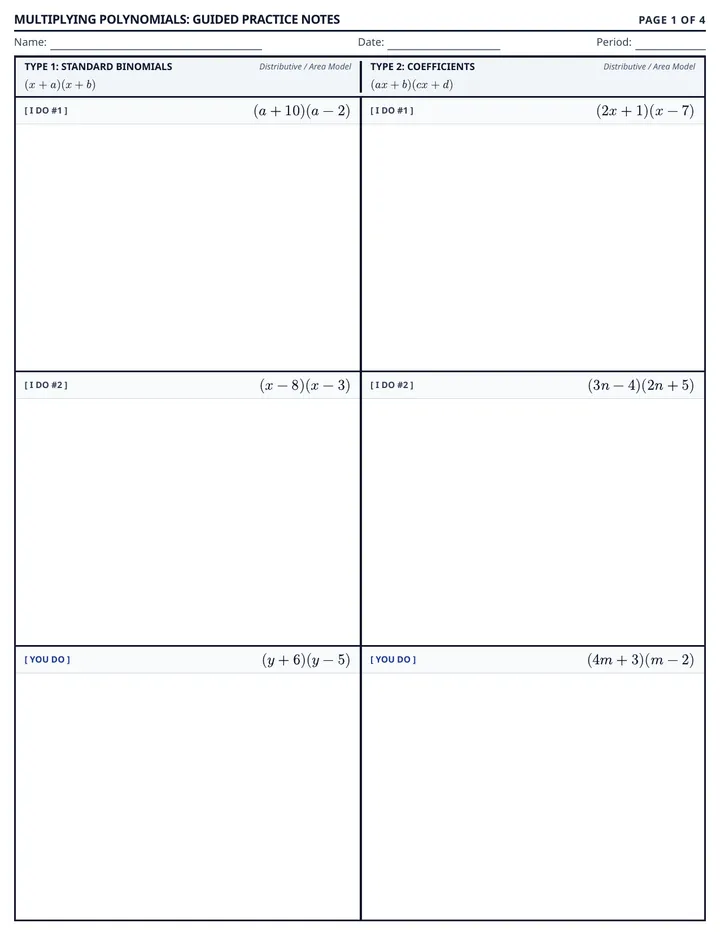
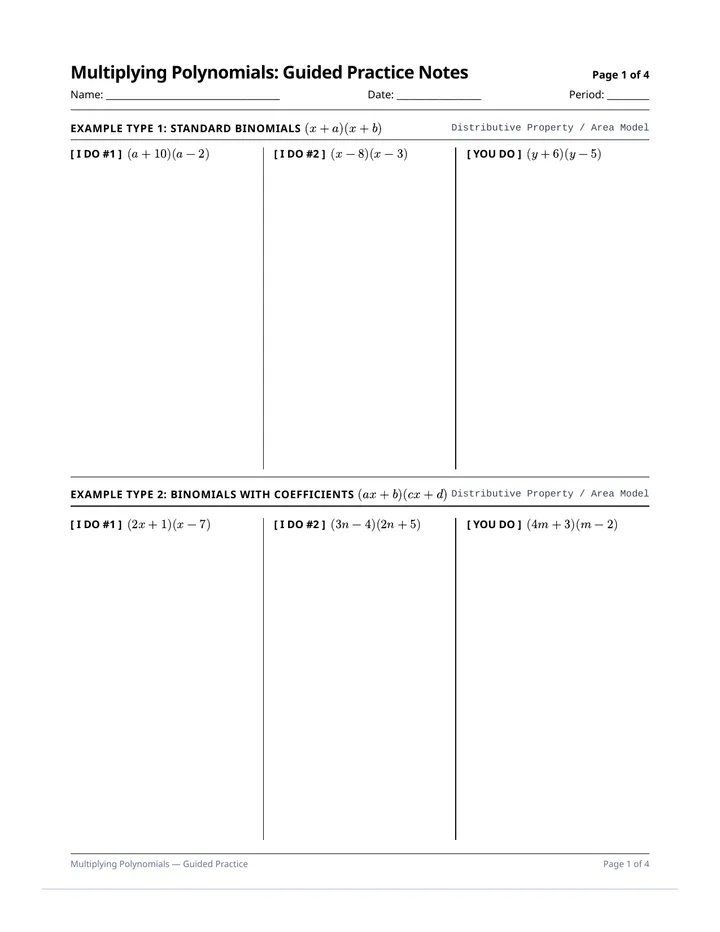
Polynomial Power Practice Notes

Polynomial Multiplication Mastery

A complete guided practice unit for multiplying polynomials covering standard binomials, leading coefficients, binomials with trinomials, and special product patterns.

MR

Mahuya Roy Chowdhury

2
Algebra 1 Formula Sheet

Algebra 1 Assessment

A comprehensive final assessment for Algebra 1 covering linear equations, systems, exponents, polynomials, and quadratic functions. Includes free response and graphing sections to evaluate deep understanding.

JF

Jim Fusaro

3
Function Faceoff Slides

Function Faceoff

A comprehensive AVID-style lesson comparing linear and quadratic functions through inquiry-based algebraic methods and Cornell Note-taking.

JC

Jennifer Cimaglia

4
Polynomial Products Guided Notes

Polynomial Products

A complete instructional unit on multiplying polynomials, featuring structured guided notes with modeled and scaffolded examples, comprehensive independent practice, and teacher answer keys.

MR

Mahuya Roy Chowdhury

3
Equation Elixirs Worksheet

Algebra Alchemy

A foundational algebra lesson focusing on polynomial operations and factoring techniques, presented through the lens of mathematical alchemy. Students practice combining terms, distributing, and breaking down complex expressions using GCF and grouping methods.

M

mastronardil

6