Lenny.com
Explore
Create
ActivitiesNewMathEnglish Language ArtsScience & EngineeringSocial StudiesGlobal LanguagesHealth & Physical EducationSpecial EducationCounseling & Life SkillsArts & CreativityESL
Lenny.com
Lenny.com
Explore
Create
ActivitiesNewMathEnglish Language ArtsScience & EngineeringSocial StudiesGlobal LanguagesHealth & Physical EducationSpecial EducationCounseling & Life SkillsArts & CreativityESL
Lenny.com
Lenny.com

Solutions

Lenny for EducatorsLenny for SchoolsLenny for Districts

Product

ExploreSign inCreateSupportAbout

Resources

Getting startedMTSS Acceleration Program

© 2026 Lenny Learning Inc.

TermsPrivacyAccessibility
LinkedInInstagramX
Lenny

Find Arc Lengths And Areas of Sectors of Circles

Calculation of arc lengths and sector areas using central angles and radius measurements. Applies proportional reasoning to circular geometry in both degrees and radians.

MathNumbers & CountingCounting ObjectsNumber NamesComparing NumbersNumber OperationsCounting SequenceNumbers 0-10Place Value Understanding and SystemAdd and Subtract Within 20Addition and Subtraction ConceptsAddition and Subtraction EquationsAddition and Subtraction ProblemsFoundations for MultiplicationMultiplication and Division PropertiesMultiply and Divide Within 100Multiplication and Division ProblemsFactors and MultiplesProperties of OperationsPatterns and RelationshipsGenerate and Analyze PatternsMulti-Digit ArithmeticPlace Value OperationsMulti-Digit and Decimal OperationsNumerical ExpressionsFour Operations and PatternsFour Operations Problem SolvingMeasurement & DataMeasurable AttributesMeasuring LengthsMeasure and Estimate Lengths in Standard UnitsRelate Addition and Subtraction to LengthClassifying and Counting ObjectsTime and MoneyArea Concepts and MeasurementPerimeter and Area MeasuresAngle Concepts and MeasurementTime, Volume, and MassMeasurement Unit ConversionsGeometryIdentifying ShapesShapes and AttributesShape Attributes and ReasoningShapes and CompositionClassifying 2D FiguresGeometric Figures and RelationshipsLines, Angles, and ShapesAngle, Area, and VolumeGeometric MeasurementVolume of 3D ShapesCoordinate Plane ApplicationsTransformations in the PlaneCongruence and SimilarityUnderstand congruence in terms of rigid motionsSimilarity and TransformationsProve Theorems Involving SimilarityPythagorean TheoremTrigonometry for General TrianglesMake Geometric ConstructionsProve Geometric TheoremsTheorems About CirclesFind Arc Lengths And Areas of Sectors of CirclesVolume FormulasRelationships Between Two-Dimensional and Three-Dimensional ObjectsProve Simple Geometric Theorems AlgebraicallyTranslate Between Geometric Description and Equation for Conic SectionApply Geometric Concepts in Modeling SituationsFractions & DecimalsFractions as NumbersBuilding FractionsFraction Equivalence and OrderingAdding and Subtracting FractionsMultiplying and Dividing FractionsDividing FractionsDecimal FractionsMulti-Digit Computation and FactorsAdd, Subtract, Multiply, and Divide Rational NumbersRational Number SystemIrrational Numbers and ApproximationsRatiosRatios and ProportionsProportional RelationshipsUnit RateAlgebraAlgebraic ExpressionsGenerate Equivalent ExpressionsQuantitative RelationshipsProportional Relationships and Linear EquationsEquations and InequalitiesEquation Solving and ReasoningLinear Equations and SystemsGraph Equations and InequalitiesSystems of EquationsReal-World Algebraic ProblemsQuantitative Reasoning with UnitsExpression StructureEquivalent Expression FormsRadicals and Integer ExponentsRational ExponentsRational and Irrational NumbersPolynomial OperationsPolynomial IdentitiesPolynomial Zeros and FactorsRational ExpressionsComplex Number OperationsComplex Numbers in PolynomialsComplex Numbers on PlaneStatistics & ProbabilityRepresent and Interpret DataData DistributionsStatistical VariabilityProbability ModelsCompound Event ProbabilitiesStatistical SamplingInterpret Categorical and Quantitative DataBivariate Data PatternsInterpret Linear ModelsComparing Two PopulationsRandom Processes in StatisticsIndependence and Conditional ProbabilityExpected ValuesProbability-Based Decision MakingStatistical Inference and ConclusionsFunctionsFunction Concepts and NotationDefine and Compare FunctionsInterpret Functions in ContextAnalyze Function RepresentationsModel Relationships with FunctionsIdentify Linear vs Exponential GrowthDistinguish Between Function TypesCompare Growth RatesInterpret Function ExpressionsBuild Functions from RelationshipsConstruct and Model FunctionsTransform and Combine FunctionsModel Comparison and SelectionSolve Exponential EquationsTrigonometryTrigonometric Ratios Involving Right TrianglesTrigonometric Functions and Unit CircleModel with Trigonometric FunctionsTrigonometric IdentitiesVectors & MatricesIntroduction to Vectors and MatricesVector QuantitiesVector OperationsMatrix OperationsCalculusLimits and ContinuityDerivative Concepts and NotationDerivative Rules and TechniquesApplications of DerivativesOptimization ProblemsRelated RatesCurve Sketching and AnalysisIntegration Concepts and NotationAntiderivatives and Indefinite IntegralsDefinite Integrals and AreaFundamental Theorem of CalculusIntegration TechniquesApplications of IntegrationDifferential EquationsSequences and SeriesParametric and Polar FunctionsVector-Valued Functions

Videos

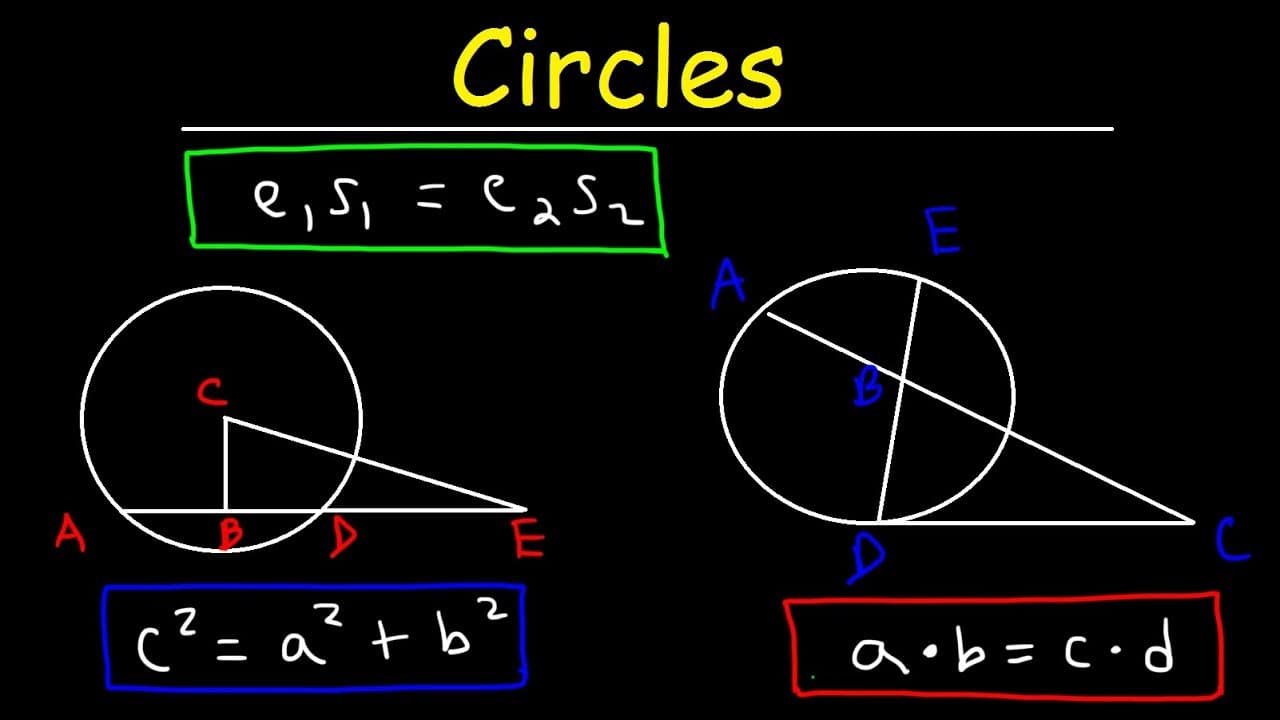
Mastering Central Angles, Arcs, and Chords in Circles

Mastering Central Angles, Arcs, and Chords in Circles

This comprehensive geometry tutorial breaks down the fundamental properties of circles, focusing on the relationships between central angles, arcs, and chords. The video begins by defining basic terminology, distinguishing between minor and major arcs, and explaining how to calculate arc measures based on central angles. It uses clear, high-contrast visual diagrams on a digital blackboard to illustrate how radii form isosceles triangles when connected by chords, a critical concept for solving circle geometry problems. The content progresses from basic definitions to complex problem-solving scenarios. Viewers learn how to identify semicircles, calculate major arc measures by subtracting minor arcs from 360 degrees, and use the properties of triangles to find missing angle measures. The final section introduces advanced applications involving special right triangles (30-60-90) to calculate chord lengths and the distance from the center to a chord, integrating trigonometry concepts with circle geometry. For educators, this video serves as an excellent instructional tool for High School Geometry units. It provides a scaffolded approach to teaching circle theorems, moving from vocabulary acquisition to multi-step application problems. The clear step-by-step narration allows teachers to pause for student practice, making it ideal for flipped classrooms, review sessions, or direct instruction on solving for missing lengths and angles within circles.

The Organic Chemistry TutorThe Organic Chemistry Tutor

13mins 45s

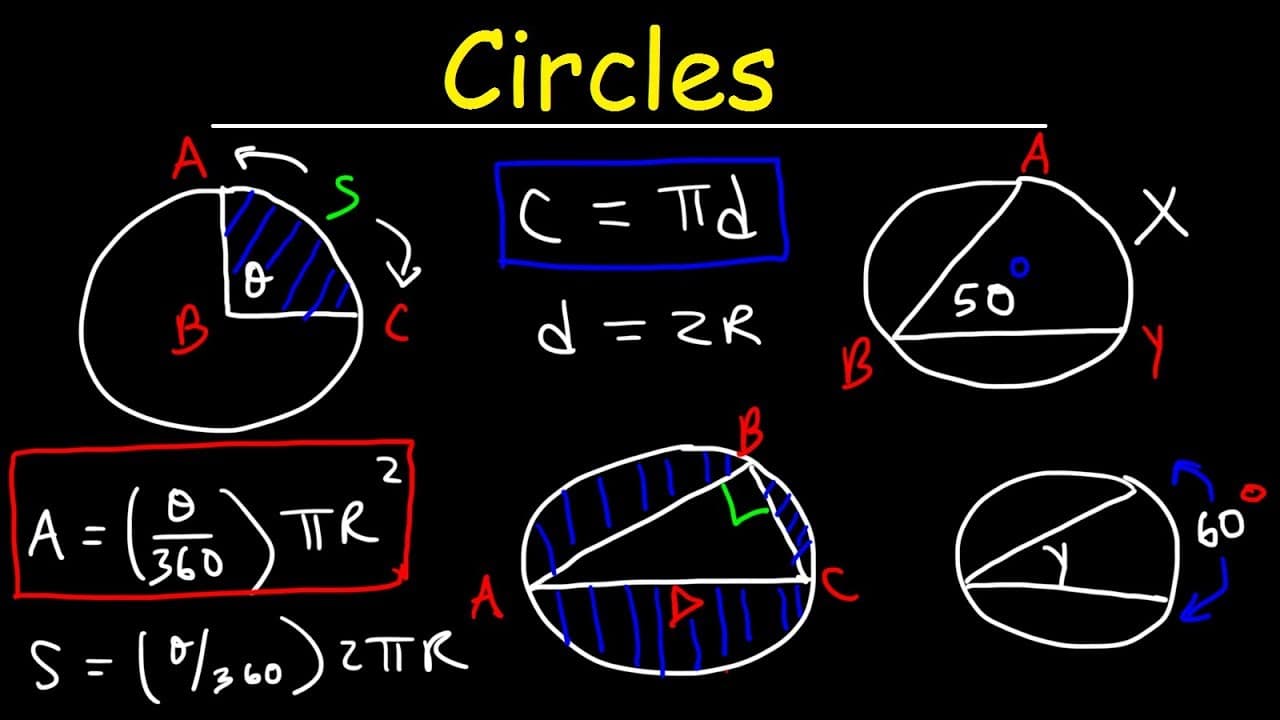
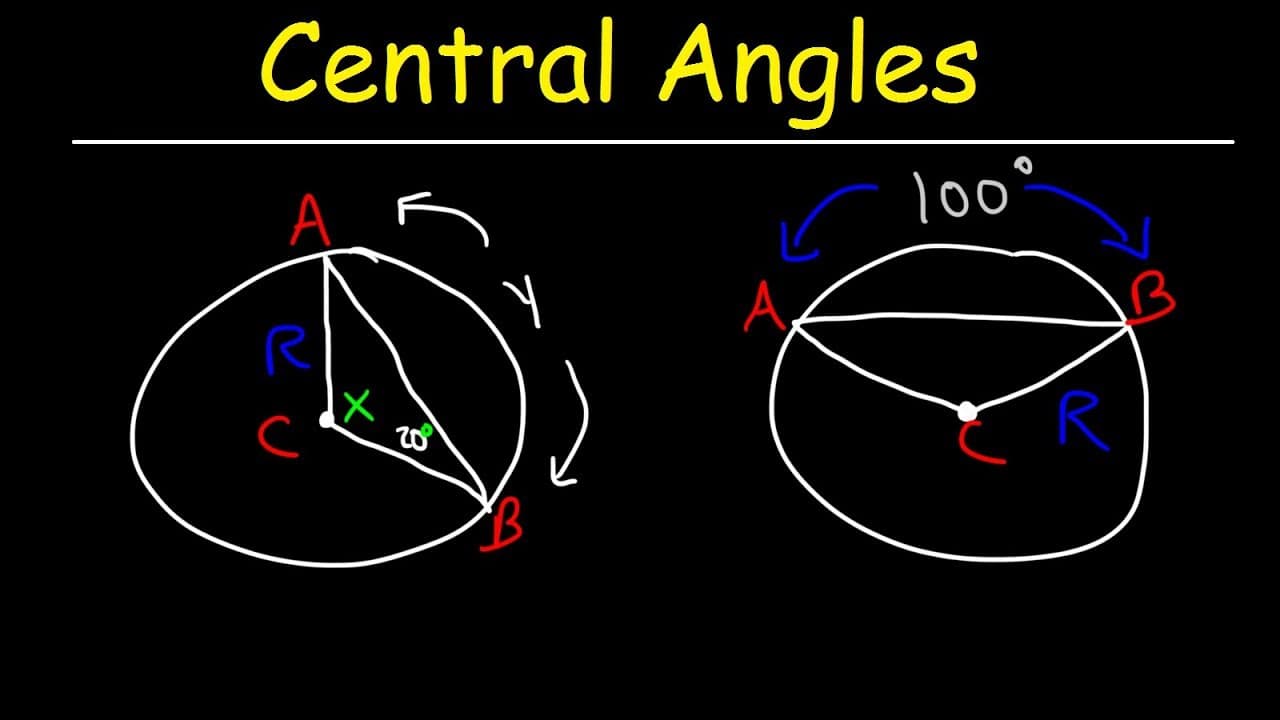
Understanding Circles: Area, Circumference, Arcs, and Angles

Understanding Circles: Area, Circumference, Arcs, and Angles

This comprehensive math tutorial provides an in-depth exploration of circle geometry, moving from basic definitions to complex problem-solving. The video begins by defining fundamental components such as the radius, diameter, circumference, and area, clearly establishing the relationship between these elements. It progresses to more advanced concepts including sectors, arc lengths, chords, and the theorems governing central and inscribed angles. The narration uses a blackboard style to visually demonstrate how formulas are derived and applied. Key themes include the distinction between central and inscribed angles, calculating the area of sectors and segments, and using the Pythagorean theorem within circle contexts. The video explicitly covers the Inscribed Angle Theorem—demonstrating that an inscribed angle is half the measure of its intercepted arc—and explores how to calculate arc lengths and sector areas using degrees. It concludes with multi-step word problems that require synthesizing multiple concepts, such as finding the area of a shaded region by subtracting a triangle's area from a circle's area. For educators, this video serves as an excellent instructional tool for high school geometry units. It can be used to introduce new vocabulary, demonstrate the application of formulas, or review for standardized tests. The step-by-step problem-solving sections allow teachers to pause and let students attempt calculations before seeing the solution, making it ideal for interactive classroom learning or independent study for students needing remediation on geometric concepts.
The Organic Chemistry TutorThe Organic Chemistry Tutor

18mins 7s

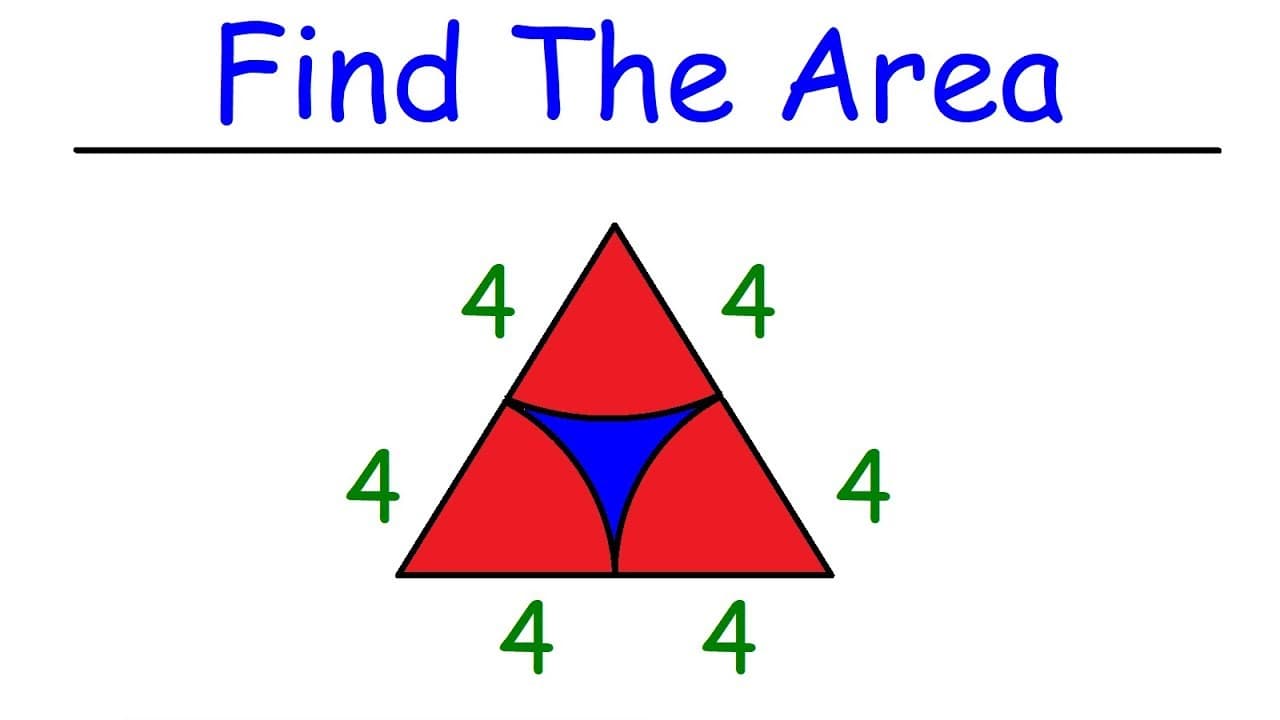
Solving for the Area of a Shaded Region Between Three Circles

Solving for the Area of a Shaded Region Between Three Circles

This educational video provides a clear, step-by-step tutorial on solving a classic geometry problem: calculating the area of a specific shaded region bounded by three circular sectors within an equilateral triangle. The narrator breaks down the problem into manageable components, demonstrating how to identify the shapes involved, recall appropriate area formulas, and logically deduce missing information like angles and side lengths. The video explores key geometric themes including the properties of equilateral triangles, the area of circular sectors, and the "subtraction method" for finding composite areas. It reinforces the relationship between degrees and fractional parts of a circle, as well as the distinction between exact answers involving radicals and pi versus decimal approximations. For educators, this video serves as an excellent model for teaching complex area problems. It can be used to demonstrate how to decompose difficult shapes, review essential formulas for triangles and circles, and practice algebraic simplification. It is particularly useful for High School Geometry classes preparing for standardized tests, as it emphasizes methodical problem-solving and precision in calculation.

The Organic Chemistry TutorThe Organic Chemistry Tutor

5mins 26s

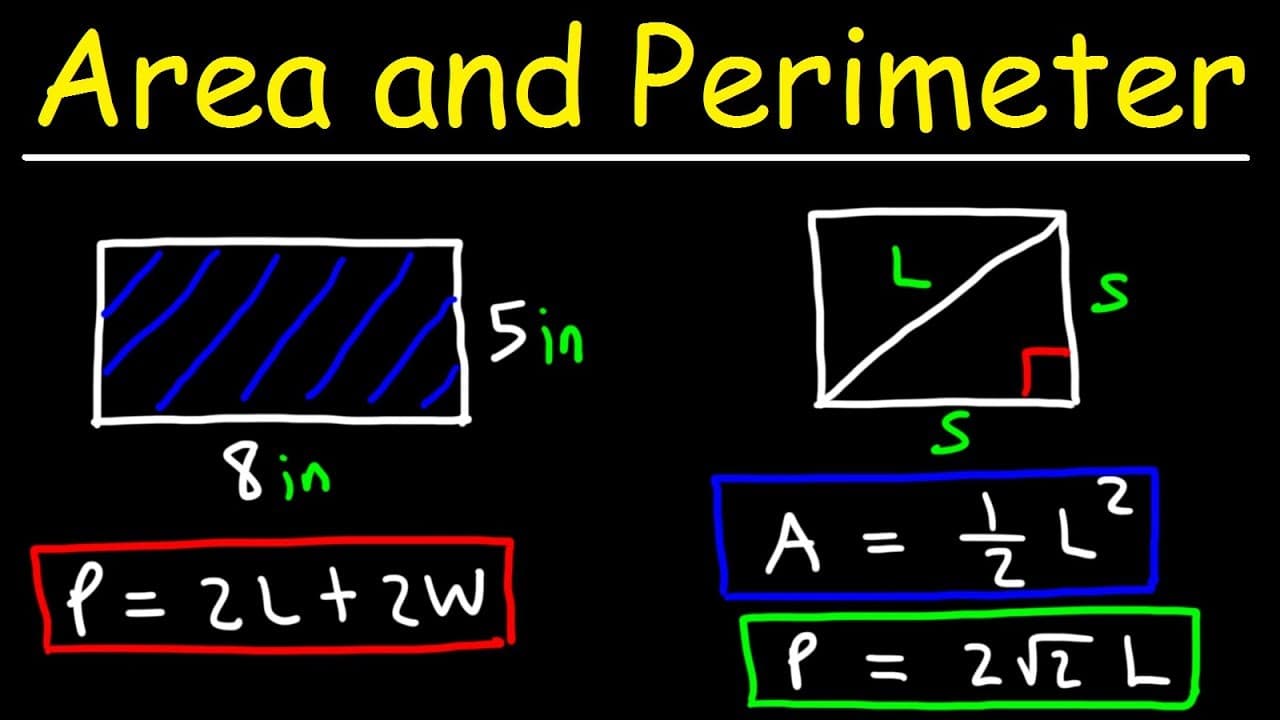
Calculating Area and Perimeter of Rectangles, Squares, and Circles

Calculating Area and Perimeter of Rectangles, Squares, and Circles

This comprehensive math tutorial guides students through calculating the area and perimeter of common geometric shapes, progressing from basic arithmetic to algebraic problem-solving. The video begins with fundamental examples of rectangles and squares, clearly defining area as the two-dimensional space inside a figure and perimeter as the total distance around it. It then transitions into more complex territory, introducing circle calculations involving pi, radius, and diameter. The content advances in difficulty by presenting "working backwards" problems where students must find side lengths given a perimeter, and geometry problems that require the Pythagorean theorem to relate diagonals to side lengths. The final segment demonstrates how to solve word problems where dimensions are defined algebraically, requiring the setup and solution of quadratic equations. This progression allows the video to serve both as an introduction for younger students (in the first half) and a robust review of algebraic geometry for older students. Educators can use this video to differentiate instruction within a single class. The segmented nature allows teachers to assign specific timestamps based on student readiness—using the first half for basic geometry review and the second half for enrichment or algebra application. The step-by-step walkthroughs of word problems are particularly valuable for modeling mathematical thinking and showing how to translate text into mathematical equations.

The Organic Chemistry TutorThe Organic Chemistry Tutor

17mins 49s

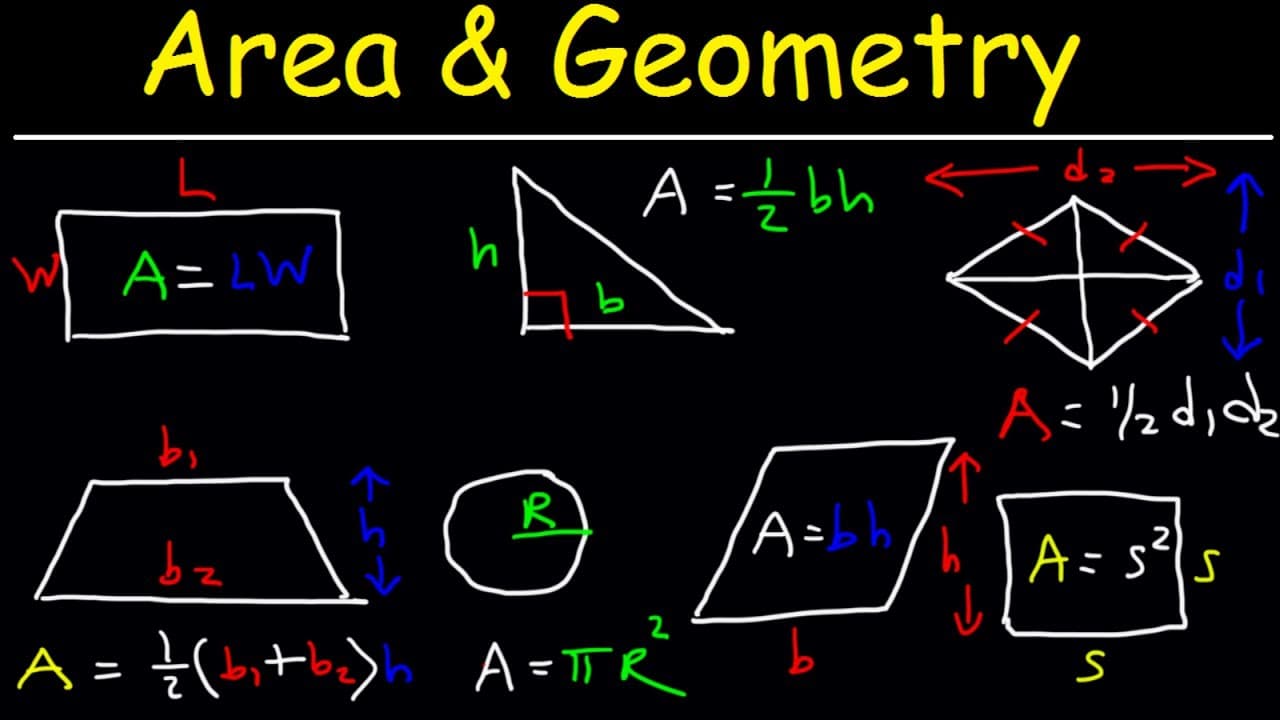
Mastering Area Formulas: From Rectangles to Complex Shapes

Mastering Area Formulas: From Rectangles to Complex Shapes

This comprehensive math tutorial provides a systematic breakdown of how to calculate the area for a wide variety of geometric shapes. The video moves from simple concepts to more complex applications, covering rectangles, triangles (including right, equilateral, and scalene), circles, sectors, parallelograms, trapezoids, rhombuses, and squares. It demonstrates not just the basic area formulas, but also how to use the Pythagorean theorem to derive missing dimensions like height or base length needed for calculation. Key themes include the application of specific area formulas, the importance of units (like square feet), and problem-solving strategies for composite shapes. The video introduces advanced techniques for high school geometry, such as finding the area of a triangle given two sides and an included angle (SAS) using sine, and finding the area of a scalene triangle given three sides (SSS) using Heron's Formula. It also addresses how to calculate the area of shaded regions by subtracting the area of one shape from another. This resource is highly valuable for middle and high school math classrooms as both an introduction and a review tool. Teachers can use specific segments to target individual shapes or use the entire video to show the progression of geometric concepts. The step-by-step walkthroughs clarify common stumbling blocks, such as distinguishing between slant height and vertical height, identifying the correct base in complex figures, and working with radicals in answers.

The Organic Chemistry TutorThe Organic Chemistry Tutor

20mins 35s

Solving 18 Circle Geometry Problems

Solving 18 Circle Geometry Problems

This comprehensive math tutorial provides a deep dive into circle geometry, guiding students through 18 distinct practice problems that cover a wide range of standard high school geometry concepts. The video functions as a rigorous review session, perfect for test preparation, moving methodically from basic concepts like arc measures and inscribed angles to more complex multi-step problems involving tangents, secants, and systems of equations with mutually tangent circles. Key themes explored include the relationship between central and inscribed angles, the properties of chords and their distance from the center, and the various theorems concerning intersecting chords, secants, and tangents. The video also covers the "Power of a Point" theorems regarding segment lengths, properties of tangential quadrilaterals, and how to use the Pythagorean theorem to find lengths in circle-tangent problems. Later sections address arc length and sector area, rounding out a full unit's worth of material. For educators, this video is an invaluable resource for differentiation and review. Teachers can assign specific timestamps corresponding to current topics (e.g., just the chord problems) or use the video as a "station" for students who need remediation on specific circle theorems. The step-by-step visual working of equations supports students in understanding not just the geometric principles, but the algebraic manipulation required to solve them.

The Organic Chemistry TutorThe Organic Chemistry Tutor

50mins 29s

Materials

Circle Secrets Cheat Sheet

Circle Secrets Cheat Sheet

An expanded single-page reference sheet for circle geometry. Now includes boundary formulas (circumference, area, arc length) and a comprehensive section on angle relationships (central, inscribed, interior, and exterior angles) with visual aids. All fractional formulas have been updated to use division by 2 and the diagrams have been refined for clarity.

C

Courtney.Smiley

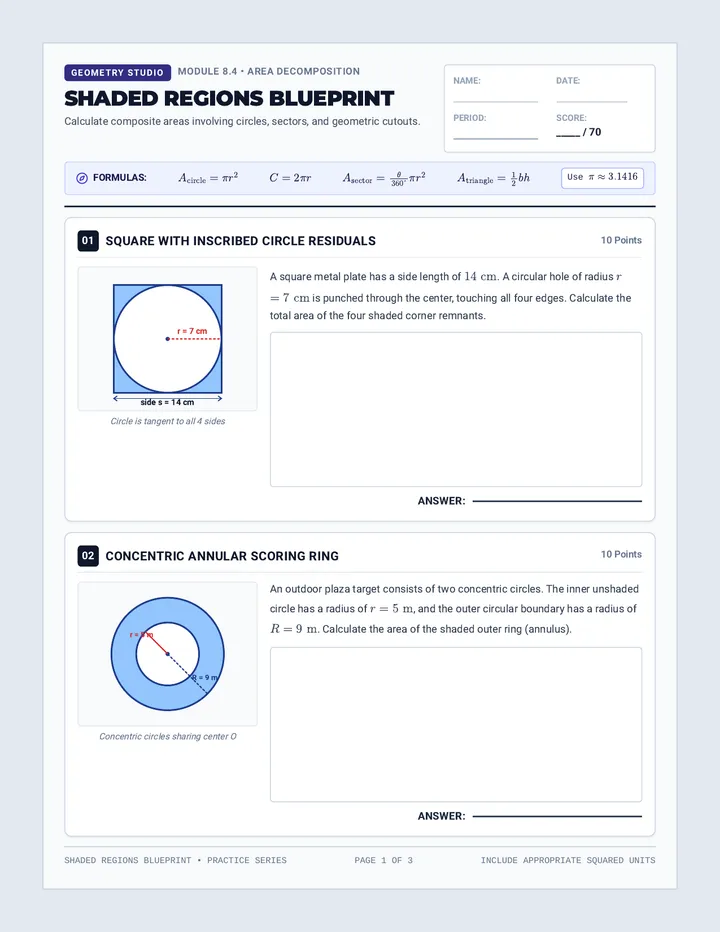
Shaded Regions Blueprint Worksheet

Shaded Regions Blueprint Worksheet

A 7-question geometry worksheet on calculating complex shaded areas involving circles, sectors, and composite figures, featuring technical blueprint diagrams, open student workspaces, and clean answer blanks.

J

jeffreychadwick.inspiretx

Circle Secrets Reference Sheet

Circle Secrets Reference Sheet

A circle geometry reference sheet with updated formula rendering and cleaner diagrams that remove redundant borders for a professional look. Diagrams are now clipped and footer text is expanded for clarity.

C

Courtney.Smiley

Circle Secrets Reference Sheet

Circle Secrets Reference Sheet

A highly condensed, single-page circle geometry reference sheet. It includes formulas for circumference, area, arc length, and angle relationships, featuring corrected inscribed polygon diagrams where vertices accurately touch the circle's edge. Layout and mathematical rendering are optimized for clarity and a strict single-page print format.

C

Courtney.Smiley

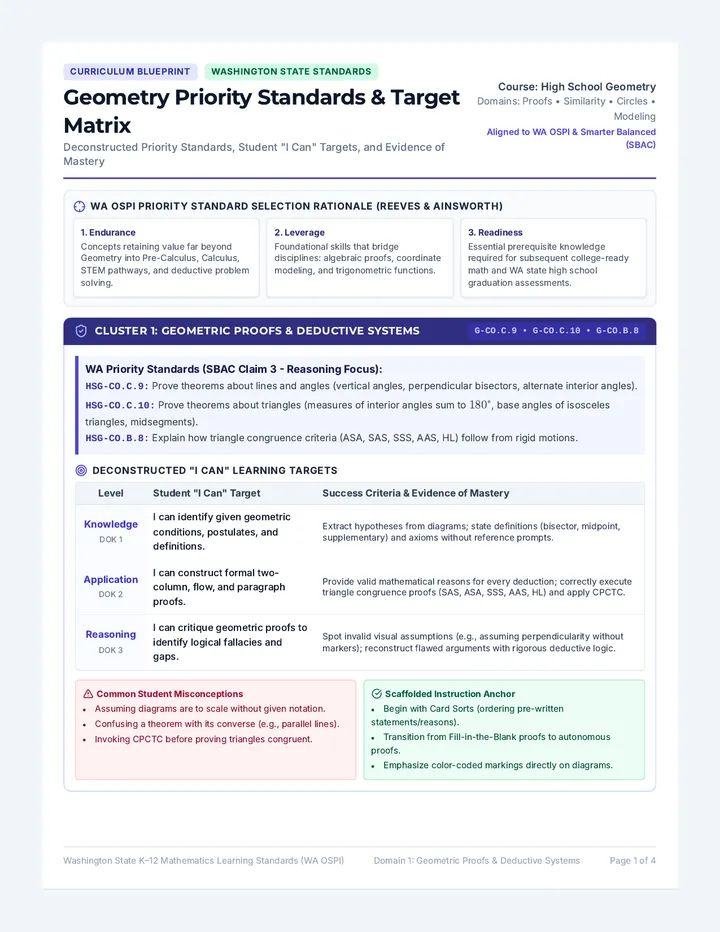
Geometry Targets Matrix Guide

Geometry Targets Matrix Guide

A comprehensive curriculum planning guide aligned to the Washington State K-12 Mathematics Learning Standards (OSPI / CCSS-M) that deconstructs high school geometry priority standards into rigorous, student-facing learning targets across proofs, similarity, circles, and geometric modeling. Features detailed success criteria, common student misconceptions, Smarter Balanced claim alignments, and instructional pacing recommendations.

Sequences

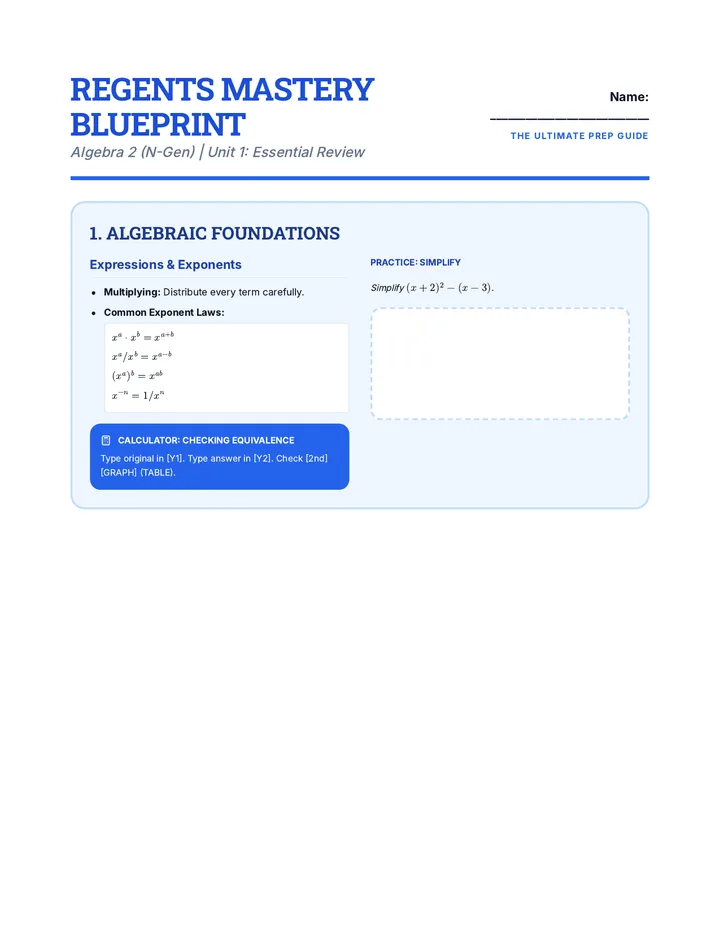
Regents Mastery Blueprint Study Guide

Regents Mastery Suite

A comprehensive review suite for the New York State Mathematics Regents exams, including Algebra 1, Geometry, and Algebra 2, featuring mastery blueprints, calculator strategies, and exam-taking tips.

KB

Kayla Borozny

15
Strategy Blueprint Slides

ACT Math Mastery

A comprehensive ACT Math preparation program focusing on essential strategies, high-yield Algebra and Geometry concepts, and realistic practice to boost scores.

AL

ava larumbe

26
Elite Math Teacher Guide

Advanced ACT Mastery

A comprehensive prep sequence for the most challenging questions on the ACT Math and Science sections. It focuses on high-level conceptual blueprints for math topics like complex numbers and matrices, alongside speed-reading and data-interpretation strategies for the Science section.

AL

ava larumbe

29
Orbit Optics Slides

Arc Architects

A problem-based learning unit exploring the mathematics of circles and arcs through the lenses of satellite technology and landscape architecture. Students apply arc length and sector area formulas to solve real-world design and engineering challenges.

6
Slice Logic Slides

Circle Slices

A Tier 2 intervention sequence focused on foundational circle geometry concepts, specifically arc length proportionality and sector area using similarity reasoning. Students move from concrete measurement to abstract formula derivation.

4
Radian Discovery Slides

Trig Foundation Toolkit

A Tier 2 intervention sequence focused on foundational trigonometry concepts, specifically the relationship between radian measure and arc length on the unit circle.

5

Lessons

Daily Reflection Log Worksheet

TSIA2 Math Blitz

A comprehensive 15-day review program for the TSIA2 mathematics assessment, featuring daily high-yield questions covering all four core areas (Quantitative, Algebraic, Geometric, and Probabilistic reasoning) alongside a structured student tracking and reflection log.

PR

Penne Reed

2
Circle Blueprint Reference Sheet

Circle Sleuths Assessment

A comprehensive assessment covering circle geometry, including angle relationships, arc measures, and circle components. Students will identify circle parts, calculate angle and arc measures using various theorems, and determine circumference and arc length.

C

Courtney.Smiley

3
Drafting Circles Teacher Guide

Circle Slices

A comprehensive lesson covering the calculation of arc length, area of a sector, and area of a segment within circles, utilizing a precision drafting theme.

KC

Kavin Comer

8
Score Surge Recording Sheet

TSIA2 Score Surge

A high-impact 90-minute review session structured into three 30-minute stations covering the four major TSIA2 mathematics domains. Students rotate through hands-on collaborative problem-solving stations targeting algebra, quantitative and geometric reasoning, and data analysis.

LF

Lindsey Foulks

5
Circle Quest Worksheet

Circle Quest Challenge

A creative geometry project where students demonstrate their mastery of circle parts and theorems by illustrating 30 distinct geometric concepts within a set of circles.

AC

Anjoe Calamba

3
Circle Canvas Slides

Circle Canvas

A creative art-based project where students apply circle geometry concepts—arc length, sector area, and inscribed angles—to design and calculate a geometric masterpiece.

DE

Donia ElSayed

5