Elite Math Teacher Guide Elite Math Blueprint
Teacher Instructional Guide
Module 01
ACT Advanced Mathematics
Duration
90-120 Minutes
Target Score
30 - 36 Range
Focus Areas
Alg, Trig, Stats, Geo
Lesson Objectives
01
Identify and dismantle advanced ACT math "traps" designed to mislead high-scoring students.
02
Master high-level content: Matrix operations, Trigonometric identities, and Combinatorics.
03
Apply architectural problem-solving frameworks to complex, multi-step geometry and data analysis problems.
Pacing Guide
Time Activity Description 15 min Diagnostic Break Administer the "Advanced Diagnostic Quiz" to pinpoint specific student gaps. 30 min Trap Analysis Interactive lecture on the 4 major advanced trap categories (see next page). 20 min Strategy Design Students complete the "Strategy Blueprint Organizer" based on sample problem types. 45 min Blueprint Practice Individual or partner work on the "Blueprint Problem Set" with real-time feedback.
Required Materials
Advanced Diagnostic Quiz
Strategy Blueprint Organizer
Blueprint Problem Set
Answer Keys (Diagnostic & Practice)
Instructional Blueprint: Advanced Traps
Key conceptual hurdles for students aiming for a 36.
Trap 01
Matrix Multiplication Order
If A is 2x3 and B is 3x4,
The ACT Hook
Questions often ask for the product of two matrices where one order is impossible. Students often rush and assume they can multiply in either order like scalars.
Teaching Point
Inner dimensions MUST match. Outer dimensions are the result. \( (m \times \underline{n}) \times (\underline{n} \times p) = (m \times p) \).
Trap 02
Period vs. Frequency
\( y = a \sin(bx) \)
The ACT Hook
Asking for the "period" but providing \( b \) in the answer choices. Students often see \( b \) in the equation and pick it immediately.
Teaching Point
The period is the "horizontal stretch". If \( b > 1 \), the period shrinks. If \( 0 < b < 1 \), the period grows.
Trap 03
Ambiguous Triangles
Law of Sines:
The ACT Hook
Providing SSA (Side-Side-Angle) and asking for a missing angle. One answer choice is often "Cannot be determined" or includes two possible angles.
Teaching Point
Always check if the supplemental angle (\( 180^\circ - \theta \)) is also possible when using Law of Sines in an SSA scenario.
Trap 04
Expected Value vs Average
\( E(X) = \sum [x \cdot P(x)] \)
The ACT Hook
A table of values with uneven probabilities. Students sum the values and divide by the number of entries (simple mean).
Teaching Point
Expected value is a WEIGHTED average. Every outcome must be multiplied by its specific probability before summing.
The "Architect's Rule"
"If the question looks like a level 10 difficulty (Questions 50-60), the first answer you calculate in 5 seconds is almost certainly a trap. Re-read for hidden conditions like 'inclusive', 'integer', or 'undefined'."
Strategy Blueprint Organizer Strategy Blueprint
ADVANCED ACT MATH TRACKER
NAME:
DATE:
The final 10 questions on the ACT (51-60) aren't just about harder math—they are about better blueprints. Use this sheet to build your mental framework for when you encounter complex concepts.
01. MATRIX OPERATIONS
If I see...
A matrix product [A][B] or a question about matrix dimensions...
My blueprint is...
02. TRIGONOMETRIC GRAPHS
If I see...
A sine or cosine wave with modified period or vertical shift...
My blueprint is...
03. LOGS & EXPONENTS
If I see...
Variables in exponents or "log base x" expressions...
My blueprint is...
04. COMPLEX GEOMETRY
If I see...
Inscribed 3D shapes or "equation of a circle" problems...
My blueprint is...
05. DATA & PROBABILITY
If I see...
"Expected value", permutations, or probability of independent events...
My blueprint is...
The "Final Ten" Verification
Always ask: Did I answer the specific question asked? (e.g., area vs circumference, x vs x+2, period vs frequency)
Advanced Diagnostic Quiz Diagnostic Blueprint
Target 36 Assessment
NAME:
DATE:
Specifications: Identify the correct response for each architectural challenge. These problems simulate the difficulty of the final 10 questions of the ACT Math section. Use \( \pi \approx 3.14 \) where necessary.
01
Matrix \( A \) has dimensions \( 2 \times 3 \) and matrix \( B \) has dimensions \( 3 \times 4 \). If matrix \( C = AB \), what are the dimensions of matrix \( C \)?
A. \( 2 \times 3 \)
B. \( 3 \times 3 \)
C. \( 2 \times 4 \)
D. \( 4 \times 2 \)
E. \( 3 \times 4 \)
02
For the imaginary unit \( i \), what is the value of \( i^{42} + i^{43} + i^{44} \)?
A. \( -1 \)
B. \( i \)
C. \( 0 \)
D. \( -i \)
E. \( 1-i \)
03
What is the period of the function \( f(x) = 4 \cos(3x - \pi) + 2 \)?
A. \( 3 \)
B. \( \frac{2\pi}{3} \)
C. \( 2\pi \)
D. \( \frac{\pi}{3} \)
E. \( 6\pi \)
04
A circle in the standard \( (x,y) \) coordinate plane is given by the equation \( x^2 + 8x + y^2 - 10y = 8 \). What is the radius of this circle?
A. \( \sqrt{8} \)
B. \( 7 \)
C. \( 49 \)
D. \( \sqrt{41} \)
E. \( 8 \)
05
In a game, a player rolls a fair six-sided die. If the roll is a 6, they win $12. If the roll is any other number, they lose $3. What is the expected value, in dollars, of a single roll?
A. \( -0.50 \)
B. \( 0.00 \)
C. \( 0.50 \)
D. \( 1.50 \)
E. \( 4.50 \)
06
If \( \log_x 64 = \frac{3}{2} \), what is the value of \( x \)?
A. \( 16 \)
B. \( 4 \)
C. \( 8 \)
D. \( 32 \)
E. \( 96 \)
07
What is the remainder when the polynomial \( P(x) = 2x^3 - 5x^2 + x - 7 \) is divided by \( (x - 3) \)?
A. \( 5 \)
B. \( -1 \)
C. \( 2 \text{R} 5 \)
D. \( 5 \)
E. \( -7 \)
08
A committee of 3 students is to be chosen from a group of 8. How many different committees are possible?
A. \( 24 \)
B. \( 56 \)
C. \( 336 \)
D. \( 112 \)
E. \( 40,320 \)
Diagnostic Quiz Answer Key Diagnostic Key
Teacher Solution Manual
Internal Document
Advanced ACT Blueprint
1. C
2. D
3. B
4. B
5. A
6. A
7. D
8. B
9. A
10. C
01. Matrices (C)
Rule: \((m \times n) \times (n \times p) = (m \times p)\). Here, \((2 \times \underline{3}) \times (\underline{3} \times 4) = (2 \times 4)\).
02. Complex Numbers (D)
\(i^{42} = (i^4)^{10} \cdot i^2 = 1 \cdot -1 = -1\).
03. Trig Graphs (B)
Period of \( \cos(bx) \) is \( 2\pi/b \). Here \( b = 3 \), so period is \( 2\pi/3 \).
04. Circles (B)
Complete the square: \( (x^2 + 8x + 16) + (y^2 - 10y + 25) = 8 + 16 + 25 = 49 \). \( r^2 = 49 \), so \( r = 7 \).
05. Expected Value (A)
\( E(X) = (1/6 \cdot 12) + (5/6 \cdot -3) = 2 + (-2.50) = -0.50 \).
Diagnostic Remediation
Missed 1, 2: Alg & Matrix Basics
Missed 3, 10: Trig Mastery Needed
Missed 4, 9: Coord/Vector Geometry
Missed 5, 8: Stats & Probability
Missed 6, 7: Adv Algebra (Logs/Poly)
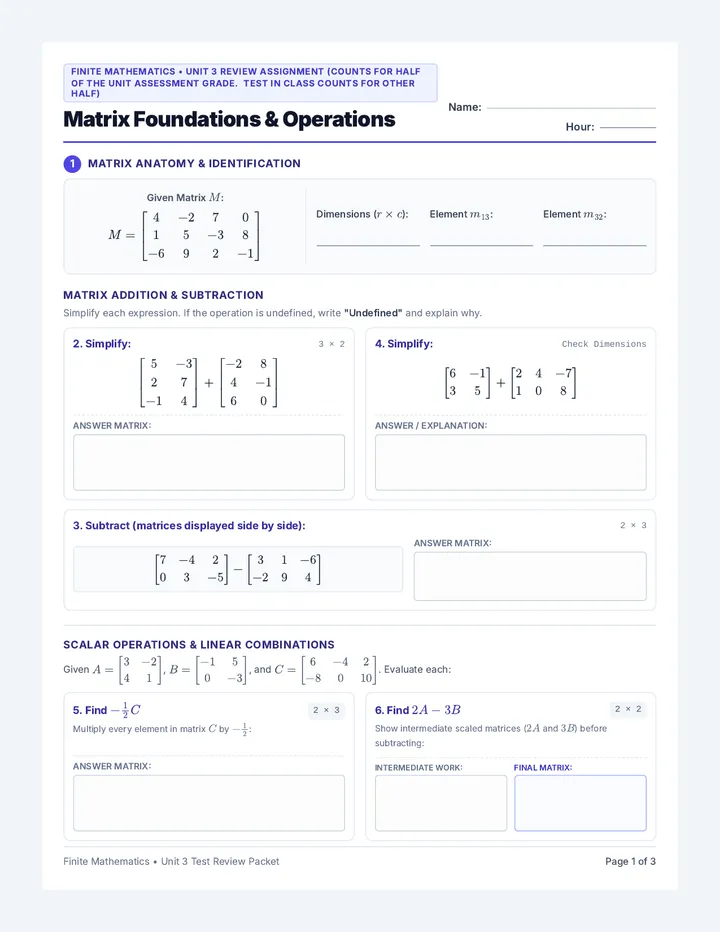
Blueprint Problem Set Blueprint Practice
Target 36 Skill Drill
NAME: ____________________
Section: Advanced Modules
Module A: Advanced Algebra
1. If \( f(x) = 2x - 3 \) and \( g(x) = x^2 + 1 \), what is the value of \( f(g(f(2))) \)?
2. Solve for \( x \): \( 2^{3x-1} = 16^{x+2} \)
3. Given matrix \( M = \begin{bmatrix} 2 & 3 \\ 1 & 4 \end{bmatrix} \), find the determinant of \( M \).
Module B: Trig & Pre-Calc
4. In triangle \( ABC \), \( \angle A = 30^\circ \), \( a = 10 \), and \( b = 10\sqrt{3} \). Find all possible values for \( \angle B \).
5. Simplify: \( \frac{\sin(2\theta)}{\sin(\theta)} \)
Module C: Data & Statistics
6. A jar contains 4 red marbles and 6 blue marbles. If two marbles are drawn without replacement, what is the probability that both are red?
7. Find the Expected Value of X based on the table:
Module D: Geometry
8. A cylinder with a radius of 4 inches and a height of 10 inches is filled with water. If the water is poured into a rectangular prism with a base of 8 inches by 5 inches, what will be the height of the water in the prism?
9. Find the equation of the line that passes through the point (2, -3) and is perpendicular to the line \( 3x - 4y = 8 \).
10. A regular hexagon is inscribed in a circle with a radius of 6 cm. What is the area of the hexagon?
"Architectural mastery requires precision. Check your units and rounding on every final step."
Problem Set Answer Key Solutions Manual
Blueprint Practice Key
Teacher Resource
ACT Prep Module 01
1. Function Composition
\( f(2) = 2(2) - 3 = 1 \).
2. Exponential Equations
Set bases equal: \( 2^{3x-1} = (2^4)^{x+2} \).
3. Matrix Determinant
\( \det(M) = ad - bc = (2)(4) - (3)(1) = 8 - 3 = 5 \).
4. Law of Sines (Ambiguous)
\( \frac{10}{\sin 30^\circ} = \frac{10\sqrt{3}}{\sin B} \Rightarrow \frac{10}{0.5} = \frac{10\sqrt{3}}{\sin B} \Rightarrow 20 = \frac{10\sqrt{3}}{\sin B} \).
5. Double Angle Identity
\( \sin(2\theta) = 2\sin\theta\cos\theta \).
6. Dependent Probability
\( P(R1) = 4/10 = 2/5 \). \( P(R2 | R1) = 3/9 = 1/3 \).
7. Expected Value
\( E(X) = (10 \cdot 0.2) + (20 \cdot 0.5) + (30 \cdot 0.3) \).
8. Volume Conservation
\( V_{cylinder} = \pi r^2 h = \pi (4^2)(10) = 160\pi \approx 502.4 \).
9. Perpendicular Lines
\( 4y = 3x - 8 \Rightarrow y = \frac{3}{4}x - 2 \). Perpendicular slope \( m = -4/3 \).
10. Hexagon Area
A regular hexagon consists of 6 equilateral triangles. Triangle side \( s = r = 6 \).
Trap Master Guide Trap Master Guide
Elite ACT Math Strategy
HIGH DANGER ZONE
REVISION: 2026.02.14
The final 10 questions on the ACT (51–60) are designed to exploit common mental shortcuts. High-scoring students often fall into these "traps" because they recognize the concept but miss the nuance. Mastery requires identifying the trap before you touch your calculator.
01
The Matrix Dimension Mirror
The Setup
You are given Matrix A \((2 \times 3)\) and Matrix B \((3 \times 2)\). The question asks for the product \(BA\). You see the numbers match and assume it's possible.
The ACT Hook
Most students automatically do \(AB\) because it's alphabetical. But \(AB\) and \(BA\) are not the same and may not even both exist.
The Blueprint
Inner dimensions must match for the product to exist. The outer dimensions determine the result.
\( [m \times \mathbf{n}] \times [\mathbf{n} \times p] \rightarrow [m \times p] \)
Ex: \((2 \times 3) \times (3 \times 2) = (2 \times 2)\).
02
The Trig Period Paradox
The Setup
Consider \(y = 3 \sin(4x)\). The question asks: "What is the period of the function?"
The ACT Hook
Answer choice A will be 4. Answer choice B will be 3. Answer choice C will be \( \pi/2 \). Students pick 4 because it is "the number in the spot."
The Blueprint
The coefficient \(b\) is the frequency (how many waves in \(2\pi\)). The period is the length of one wave.
\( \text{Period} = \frac{2\pi}{|b|} \)
In \(y = 3 \sin(4x)\), \(b = 4\).
03
The SSA Ghost Angle
The Setup
You are given two sides and a non-included angle (SSA). You use Law of Sines to find a missing angle \( \theta \). Your calculator gives you \( 40^\circ \).
The ACT Hook
Students pick 40° and move on. However, if SSA is present, there might be TWO possible triangles—one acute and one obtuse.
The Blueprint
Whenever using Law of Sines with SSA, check the supplement: \( 180^\circ - \theta \).
\( \sin(40^\circ) = \sin(140^\circ) \)
Check if \(140^\circ + \text{original angle} < 180^\circ\). If it is, the obtuse triangle is also valid. The ACT might ask for "the sum of possible values" or "the larger value."
Matrix Dimension Slides Matrix Mastery
Cracking the Dimension Mirror Trap
Matrix Anatomy
Dimensions are always listed as
Mnemonic:
"RC Cola" (Rows then Columns)
[
A
B
C
D
E
F
]
2 Rows × 3 Columns
The Golden Rule
To multiply matrices, the Inner Dimensions must match.
(m × n)
×
(n × p)
Inner Numbers
Must be identical
Outer Numbers
Define the Result Size
The "Mirror" Trap
"If A × B works, then B × A must work, right?" NO.
A × B
(2 × 3) × (3 × 4)
Defined
Result: 2 × 4
B × A
(3 × 4) × (2 × 3)
UNDEFINED
4 ≠ 2!
The Architect's Check
The ACT will often give you a matrix multiplication question and include "Undefined" as Choice E.
The Trap
Multiplying in the wrong order (\(AB\) instead of \(BA\)). The trap answer is choice A.
The Pro Tip
Write dimensions under the matrix names before you start any work.
Strategy Blueprint Answer Key The Blueprint Key
Facilitation & Answer Guide
Teacher Only
Module: Advanced Strategies
What is a "Blueprint"?
On the ACT, students often fail not because they lack knowledge, but because they lack a starting point for complex problems. A "Blueprint" is a standardized mental protocol. It’s an "If/Then" logic chain that bypasses the "stare at the page" phase.
01. Matrix Operations
Ideal Student Answer
"I write the dimensions for both matrices immediately (RC Cola). I check if the inner numbers match. If they don't, I stop and look for 'Undefined'. If they do, the outers tell me my answer size."
Teacher Tip Remind students that the ACT often puts the product of the wrong order (AB instead of BA) as choice A to catch rushers.
02. Trigonometric Graphs
Ideal Student Answer
"I identify the 'b' value first. I use the formula Period = \(2\pi/b\). I don't pick 'b' as the period. I also check 'k' for the vertical shift (the new midline)."
Teacher Tip Have students draw one full wave and label the period length vs the frequency to visualize the difference.
03. Logs & Exponents
Ideal Student Answer
"I use 'Circular Logic': the base raised to the answer equals the big number (\(b^c = a\)). If it’s a property question, I expand/condense before solving."
Teacher Tip Logs are just another way to write exponents. Students should translate them to exponent form as their "blueprint" for solving.
04. Complex Geometry
Ideal Student Answer
"If it's a circle, I move constants to the right and complete the square for x and y to find the center and \(r^2\). If it's 3D, I find the 2D cross-section area first."
Teacher Tip The "Completing the Square" blueprint is the #1 way to solve ACT circle problems (usually Q55+).
05. Data & Probability
Ideal Student Answer
"For expected value, I multiply each row: (Value × Probability) and then sum them all up. For probability, I check if it's 'with' or 'without' replacement."
Teacher Tip Expected Value is Choice A trap fodder. Students will try to just average the outcomes. The Blueprint enforces the weights.
Final Ten Masterclass Slides Final Ten Masterclass
The 10 Subjects for Score 36
01
Matrix Dimensions
The Inner Numbers must match to multiply.
The Result Size:
\[ (m \times \mathbf{n}) \times (\mathbf{n} \times p) = (m \times p) \]
Pro Blueprint:
If the inner numbers don't match, the product is Undefined. This is often Choice E.
02
Powers of i
Rem 1
\(i\)
Rem 2
\(-1\)
Rem 3
\(-i\)
Rem 0
\(1\)
"Divide the exponent by 4. The remainder tells you which step of the cycle you are on."
03
Trig Period
Formula:
\[ \text{Period} = \frac{2\pi}{b} \]
Where \(b\) is the coefficient of \(x\).
The Trap:
The ACT will provide \(b\) as Choice A. Always use the formula to find the length of the wave.
04
Circle Geometry
Standard Form of a Circle:
\[ (x-h)^2 + (y-k)^2 = r^2 \]
The Blueprint Move:
If the equation is expanded (\(x^2 + 8x...\)), you MUST complete the square for both \(x\) and \(y\).
"Divide by 2, then square it."
05
Expected Value
Expected Value (\(E\)) is a Weighted Average.
\[ E = \sum [(\text{Outcome}) \times (\text{Prob})] \]
Step 1
Multiply each outcome by its probability.
Step 2
Add all the results together.
06
Logarithms
The Circle Rule:
\[ \log_{\mathbf{b}} \mathbf{x} = \mathbf{y} \]
\[ \mathbf{b}^{\mathbf{y}} = \mathbf{x} \]
Master Trick:
The "Base" of the log stays the "Base" of the exponent. The other two numbers swap sides.
07
Remainder Theorem
To find the remainder when \(P(x)\) is divided by \((x - c)\)...
Just solve for \(P(c)\)!
Plug the root into the function.
"If \(P(c) = 0\), then \((x-c)\) is a factor!"
08
Counting Logic
Permutations
ORDER MATTERS
Used for titles (Pres/VP), racing spots, or specific arrangements.
Combinations
The i Factor Slides The i Factor
Mastering Complex Numbers for the ACT
What is i?
The imaginary unit \(i\) is defined as the square root of \(-1\).
\[ i = \sqrt{-1} \]
\[ i^2 = -1 \]
The ACT Perspective
Almost every ACT test has 1-2 questions involving \(i\). They usually show up between questions 40 and 60.
"Treat \(i\) like a variable (like \(x\)), but always replace \(i^2\) with \(-1\)."
The Cycle of Powers
The powers of \(i\) repeat every 4 steps.
\(i^1\)
\(i\)
\(i^2\)
\(-1\)
\(i^3\)
\(-i\)
\(i^4\)
\(1\)
PRO TIP
To solve any high power (like \(i^{57}\)), divide the exponent by 4 and look at the remainder.
Complex Arithmetic
Addition / Subtraction
Combine like terms. (Real with Real, Imaginary with Imaginary)
\((3 + 2i) + (1 - 5i) = 4 - 3i\)
Multiplication
Use FOIL, but remember to convert \(i^2\).
\((1 + i)(2 - i) = 2 - i + 2i - i^2\)
\( = 2 + i - (-1) = 3 + i\)
The Trap
"Students often forget that \(-i^2\) becomes +1. This one error sinks most multiplication questions."
The Conjugate Blueprint
When you see a complex number in the denominator, you must rationalize it.
The Move:
Multiply the top and bottom by the Conjugate.
Example:
\[ \frac{1}{2 + i} \times \frac{2 - i}{2 - i} \]
\[ = \frac{2 - i}{4 - i^2} = \frac{2 - i}{5} \]
Notice: The denominator became a REAL number!
The i Factor Workout The i Factor Workout
Complex Number Mastery
Name:
Date:
Mission: Simplify each expression completely. For powers of \(i\), reduce to \(i, -1, -i,\) or \(1\). For complex arithmetic, write in \(a + bi\) form.
Module A: Power Cycles
1. Simplify \(i^{15}\)
Work area...
2. Simplify \(i^{100}\)
Work area...
3. Simplify \(i^{22} + i^{24}\)
Work area...
4. Simplify \(3i^4 - 2i^2\)
Work area...
Module B: Operations
5. \((5 + 4i) + (2 - 7i)\)
Work area...
6. \((10 - 3i) - (6 + i)\)
Work area...
7. \(3i(2 - 4i)\)
Work area...
8. \((2 + i)(3 - i)\)
Work area...
Module C: Conjugates
9. Simplify: \( \frac{10}{1 + i} \)
Show rationalization steps...
Final Ten Scenarios
These problems match the complexity of the ACT's hardest questions.
10
For the imaginary unit \(i\), which of the following is equivalent to \( \frac{(1+i)^2}{i} \)?
A. 2
B. -2
C. 2i
D. -2i
E. 0
Space for Calculation
11
Which of the following describes all complex numbers \(z\) such that \( z + \bar{z} = 0 \)? (Note: \( \bar{z} \) is the complex conjugate of \(z\)).
A. \(z\) must be a real number.
B. \(z\) must be an imaginary number (no real part).
C. \(z\) must be equal to 0.
D. \(z\) must be equal to 1.
E. No such complex numbers exist.
Explain your reasoning using \( z = a + bi \)
12
If \( x^2 + 4x + 13 = 0 \), what are the roots of the equation in the complex plane?
Use the quadratic formula: \( x = \frac{-b \pm \sqrt{b^2 - 4ac}}{2a} \)
The i Factor // Workout Section ACT Advanced Math Track
The i Factor Answer Key Solution Manual
The i Factor Key
Teacher Resource
Complex Numbers Track
1. \(i^{15}\)
\( 15 / 4 = 3 \) Remainder 3. \( i^3 = -i \).
2. \(i^{100}\)
\( 100 / 4 = 25 \) Remainder 0. \( i^0 = 1 \).
3. \(i^{22} + i^{24}\)
\( i^2 + i^0 = -1 + 1 = 0 \).
4. \(3i^4 - 2i^2\)
\( 3(1) - 2(-1) = 3 + 2 = 5 \).
5. Addition
\( (5+2) + (4i-7i) = 7 - 3i \).
6. Subtraction
\( (10-6) + (-3i-i) = 4 - 4i \).
7. Scalar Multiplication
\( 6i - 12i^2 = 6i - 12(-1) = 12 + 6i \).
8. FOIL
\( 6 - 2i + 3i - i^2 = 6 + i - (-1) = 7 + i \).
9. Rationalization
\( \frac{10}{1+i} \cdot \frac{1-i}{1-i} = \frac{10(1-i)}{1-i^2} = \frac{10-10i}{1-(-1)} = \frac{10-10i}{2} = 5 - 5i \).
10. \(\frac{(1+i)^2}{i}\)
\( (1+i)^2 = 1 + 2i + i^2 = 1 + 2i - 1 = 2i \).
11. \( z + \bar{z} = 0 \)
\( (a+bi) + (a-bi) = 2a \). If \( 2a = 0 \), then \( a = 0 \). This means there is no real part. Answer: B
12. Quadratic Roots
\( x = \frac{-4 \pm \sqrt{16 - 4(1)(13)}}{2} = \frac{-4 \pm \sqrt{16 - 52}}{2} = \frac{-4 \pm \sqrt{-36}}{2} \).
Wave Rhythm Slides Wave Rhythms
Cracking Period and Frequency
The Wave Equation
\[ y = a \sin(b(x - h)) + k \]
a
Amplitude
The height from the midline. (Vertical stretch)
b
Frequency
The number of waves in \(2\pi\). (Horizontal stretch)
The Frequency Trap
Common Student Error:
"The equation is \(y = \sin(4x)\), so the period must be 4."
This is Choice A on the ACT. It is always wrong.
The Blueprint:
Period is the length of one wave. Frequency is the speed.
\[ \text{Period} = \frac{2\pi}{b} \]
Visualizing Shift
h = Phase Shift
Horizontal movement. Remember: \((x - h)\) moves Right, \((x + h)\) moves Left.
k = Vertical Shift
The Midline of the graph. The wave oscillates around \(y = k\).
Architectural Model
The Trig Checklist
On Question 55+, ask yourself:
1
Is the question asking for period OR frequency? (Always check twice!)
2
Is the midline at zero, or is there a \(k\) value shifting it up/down?
3
If there are two waves, which one is compressed? (Higher \(b\) = shorter period)
Wave Rhythm Workout Wave Rhythm Workout
Trig Function Mastery
NAME:
DATE:
Focus: Identify Amplitude, Frequency, Period, and Midline for each function. Use the blueprint: \( \text{Period} = 2\pi/b \).
Module A: The Core Components
1. \( y = 5 \sin(2x) + 3 \)
AMPLITUDE:
PERIOD:
MIDLINE:
Show period calculation here...
2. \( y = -2 \cos(\frac{\pi}{4}x) - 1 \)
AMPLITUDE:
PERIOD:
MIDLINE:
Show period calculation here...
Module B: Horizontal Shifts
3. Describe the horizontal shift for \( y = \sin(x - \pi/2) \):
Work area...
4. Write an equation for a sine wave with amplitude 4, period \(\pi\), and shifted up 2 units:
Equation area...
Final Ten Wave Challenges
Questions 55-60 often present waves in "real world" contexts or compare two different waves.
05
The height of a buoy in the ocean, in feet, is modeled by the function \( h(t) = 3 \sin(0.4\pi t) + 12 \), where \(t\) is the number of seconds after noon. What is the time, in seconds, for the buoy to complete one full cycle (from peak to peak)?
A. 0.4
B. 2.5
C. 5
D. 12
E. 15
Space for Blueprint Application
06
Function \(f(x) = \sin(x)\) and function \(g(x) = \sin(3x)\) are graphed on the same coordinate plane for \( 0 \leq x \leq 2\pi \). At how many points do the graphs of \(f\) and \(g\) intersect on this interval?
F. 3
G. 4
H. 5
J. 6
K. 7
Mental Sketch or Logic Area
07
What is the minimum value of the function \( y = -3 \cos(2x - \pi) + 8 \)?
A. 2
B. 5
C. 8
D. 11
E. 13
Blueprint Tip: Min Value = Midline - Amplitude
Wave Rhythms // ACT ADVANCED Target 36 Tracking
Wave Rhythm Answer Key Solutions Manual
Wave Rhythm Key
Teacher Resource
Advanced Trig Track
1. \( y = 5 \sin(2x) + 3 \)
Amp: 5
Freq (b): 2
Period: \(\pi\) (\(2\pi/2\))
Midline: \(y = 3\)
2. \( y = -2 \cos(\frac{\pi}{4}x) - 1 \)
Amp: 2
Freq (b): \(\pi/4\)
Period: 8 (\(\frac{2\pi}{\pi/4}\))
Midline: \(y = -1\)
3. Horizontal Shift
The wave is shifted Right by \(\pi/2\) units.
4. Equation Writing
Amp=4, Period=\(\pi \Rightarrow b = 2\pi/\pi = 2\). Shifted up 2 \(\Rightarrow k = 2\).
\( y = 4 \sin(2x) + 2 \)
5. Buoy Challenge (C)
One full cycle = Period. \( b = 0.4\pi \).
6. Intersection Challenge (H)
\( \sin(x) = \sin(3x) \). This happens at \(x = 0, \pi/2, \pi, 3\pi/2, 2\pi\) for a total of 5 points on the interval inclusive.
7. Minimum Value (B)
Midline is at 8. Amplitude is 3 (absolute value of -3).
Teacher Insight
Problems like #5 and #6 are common differentiators for the 30+ score range. Students often struggle to convert real-world descriptions (like 'seconds per cycle') into the abstract period formula. Always reinforce that "One full cycle" = Period.
Wave Rhythm Walkthrough Guide Wave Rhythm Walkthrough
Step-by-Step Solution Guide
Teacher Guide
REF: WAVE-RHYTHM-X1
The Master Wave Blueprint
\[ y = a \sin(b(x-h)) + k \]
|a| = Amplitude (Vertical stretch)
b = Frequency (Waves in \(2\pi\))
2π/b = Period (Length of one wave)
k = Midline (Vertical shift)
Problem 1: \( y = 5 \sin(2x) + 3 \)
Step 1 Identify a. The leading number is 5. So, Amplitude = 5.
Step 2 Identify b. The number in front of x is 2. This is the frequency.
Step 3 Calculate Period. Formula is \( 2\pi/b \). Here, \( 2\pi/2 = \pi \). So, Period = π.
Step 4 Identify k. The constant added at the end is 3. So, Midline is y = 3.
Problem 2: \( y = -2 \cos(\frac{\pi}{4}x) - 1 \)
Step 1 Amplitude is absolute. Even though \( a = -2 \), the Amplitude = 2. (The negative just flips the wave upside down).
Step 2 Period uses \( b = \pi/4 \). Period = \( \frac{2\pi}{\pi/4} = 2\pi \cdot \frac{4}{\pi} = 8 \). So, Period = 8.
Step 3 Midline is the constant. Midline is y = -1.
Problem 3: Phase Shift
Equation: \( y = \sin(x - \pi/2) \).
Result: Shifted Right by π/2.
Problem 4: Build Equation
Amp=4 \(\rightarrow a = 4\).
y = 4 sin(2x) + 2
Problem 5: The Buoy Logic
"What is the time for the buoy to complete one full cycle?"
Key Logic "One full cycle" is the definition of the Period. This is a decoding challenge.
Step 1 Find b from the equation \( h(t) = 3 \sin(0.4\pi t) + 12 \). Here, \( b = 0.4\pi \).
Step 2 Apply blueprint: Period = \( 2\pi/b \).
\[ \text{Period} = \frac{2\pi}{0.4\pi} = \frac{2}{0.4} = 5 \]
Correct Choice: C
Problem 6: Intersections
"At how many points do sin(x) and sin(3x) intersect on [0, 2π]?"
Visual Logic \( \sin(x) \) completes 1 wave. \( \sin(3x) \) completes 3 waves. They will always intersect at the start (\(x=0\)), the middle (\(x=\pi\)), and the end (\(x=2\pi\)).
Calculus Logic Set them equal: \( \sin(x) = \sin(3x) \).
Correct Choice: H
Problem 7: Minimum Value
"What is the minimum value of y = -3 cos(2x - π) + 8?"
Step 1 Midline is 8. The center of the wave is at \(y = 8\).
Geometry Grandeur Slides Geometric Grandeur
The Architectural Masterclass
Circle Blueprints
Standard Form:
\[ (x-h)^2 + (y-k)^2 = r^2 \]
Center is always (h, k). Watch the signs!
The ACT Trap:
They give you the equation in General Form.
The Solution:
Complete the square for both x and y to find the radius and center.
3D Structural Design
V
Volume Logic
\( V = \text{Area of Base} \times \text{Height} \)
Works for cylinders, prisms, and boxes.
SA
Surface Area
Sum of all face areas.
ACT Trap: "Open Top" or "Hollow" shapes.
Pro Blueprint:
"If the shape is composite, break it down into basic blueprints (boxes and cylinders)."
Coordinate Schematics
Perpendicular Slopes
\( m_1 \cdot m_2 = -1 \)
"Negative Reciprocal." If \( m = 3/4 \), then \( m_\perp = -4/3 \).
Midpoint Strategy
The Average of the coordinates. Used for centers of circles and bisecting lines.
The Distance Blueprint
\[ d = \sqrt{(x_2-x_1)^2 + (y_2-y_1)^2} \]
"Just the Pythagorean Theorem in disguise!"
The Master Builder Checklist
On Questions 51–60, verify:
1
Did you use the radius or the diameter? (The most common circle trap!)
2
Is the shape hollow or open? (Check for "lidless" or "open top" cylinders.)
3
Are the units consistent? (Convert feet to inches or meters to cm before calculating.)
Geometry Grandeur Workout Geometric Grandeur
The Architectural Masterclass
Name:
Date:
Mission: Apply advanced architectural blueprints to solve high-difficulty geometry problems. Pay special attention to unit conversions and multi-step visualization.
Module A: Circle Equations
1. A circle is defined by the equation \( x^2 - 12x + y^2 + 10y = 11 \). What is the area of this circle in square units?
Show the "Complete the Square" blueprint steps here...
2. A circle in the standard coordinate plane has a center at \((-3, 4)\) and passes through the origin \((0, 0)\). What is the equation of this circle?
Calculate radius first...
Module B: 3D Structural Analysis
3. A cone with a height of 12 inches and a base radius of 5 inches is placed inside a cylindrical tank with a radius of 6 inches and a height of 15 inches. If the tank is filled with water to the top of the cone, what is the volume of the water in cubic inches? (Volume of cone = \( \frac{1}{3}\pi r^2 h \))
Visualize the "Hollow" space...
Module C: Coordinate Geometry
4. Line \(L\) has the equation \( y = \frac{2}{3}x - 5 \). Line \(M\) is perpendicular to Line \(L\) and passes through the point \((4, -2)\). What is the y-intercept of Line \(M\)?
Identify perpendicular slope...
5. Point \(A\) is at \((1, 5)\) and Point \(B\) is at \((7, -3)\). What is the length of the segment \(AB\)?
Distance blueprint application...
Final Boss Scenarios
06
A regular octagon is inscribed in a square with a side length of 10 units. If the vertices of the octagon are formed by cutting off the four corners of the square, what is the area of the octagon in square units?
A. \( 100 - 50\sqrt{2} \)
B. \( 200(\sqrt{2}-1) \)
C. \( 100(\sqrt{2}-1) \)
D. 75
E. 80
Sketch the triangles removed from the corners...
07
In the standard \((x,y,z)\) coordinate system, a sphere is centered at \((2, -3, 5)\) and has a radius of 4. Which of the following is the equation of the sphere?
A. \( (x+2)^2 + (y-3)^2 + (z+5)^2 = 4 \)
B. \( (x-2)^2 + (y+3)^2 + (z-5)^2 = 16 \)
C. \( (x-2)^2 + (y+3)^2 + (z-5)^2 = 4 \)
D. \( (x+2)^2 + (y-3)^2 + (z+5)^2 = 16 \)
E. \( x^2 + y^2 + z^2 = 38 \)
Note: The 3D blueprint follows the 2D circle logic!
Geometric Grandeur // Workout Track ACT Score 36 Blueprint
Geometry Grandeur Answer Key Solution Manual
Geometric Grandeur Key
Teacher Resource
Advanced Geometry Track
1. Circle Area via Completing the Square
\( (x^2 - 12x + 36) + (y^2 + 10y + 25) = 11 + 36 + 25 \).
Result: 72π square units
2. Circle Equation from Points
Distance from \((-3, 4)\) to \((0, 0)\) is \( \sqrt{(-3)^2 + 4^2} = \sqrt{9 + 16} = 5 \). So \( r = 5, r^2 = 25 \).
Result: (x + 3)² + (y - 4)² = 25
3. 3D Volume Comparison
Cylinder volume to the height of the cone (12 inches): \( V_{cyl} = \pi (6)^2 (12) = 432\pi \).
Result: 332π cubic inches
4. Perpendicular y-intercept
Slope \( m_1 = 2/3 \). Perpendicular slope \( m_2 = -3/2 \).
Result: 4
5. Distance Formula
\( d = \sqrt{(7 - 1)^2 + (-3 - 5)^2} = \sqrt{6^2 + (-8)^2} = \sqrt{36 + 64} = 10 \).
Result: 10
6. Inscribed Octagon Area (B)
The octagon is formed by removing 4 isosceles right triangles from the square. If the octagon is regular, the sides must be equal. This leads to the formula for area: \( 200(\sqrt{2}-1) \). Let students explore the ratio of the corner cuts to the side length.
Result: B
7. 3D Sphere Equation (B)
Equation: \( (x - x_0)^2 + (y - y_0)^2 + (z - z_0)^2 = r^2 \).
Result: B
Teacher Insight
Coordinate geometry on the final ten questions almost always involves perpendicular slopes. Circles almost always require completing the square. If a student sees these, they should immediately pull out the corresponding Blueprint.
Trig Titan Slides Trig Titan
Advanced Identities & Laws
The Golden Identity
This is the most frequently tested identity in the Final Ten.
\[ \sin^2 \theta + \cos^2 \theta = 1 \]
The ACT Hook:
Questions will hide this in larger expressions.
Example: Simplify \( 5\sin^2\theta + 5\cos^2\theta \).
Unit Circle Blueprints
Coordinates:
\( (\cos \theta, \sin \theta) \)
Radians:
\( \pi = 180^\circ \)
Key ACT Values:
30° (\(\pi/6\))
\( (\frac{\sqrt{3}}{2}, \frac{1}{2}) \)
60° (\(\pi/3\))
\( (\frac{1}{2}, \frac{\sqrt{3}}{2}) \)
"Cosine is X, Sine is Y"
Non-Right Triangles
Law of Sines
\[ \frac{a}{\sin A} = \frac{b}{\sin B} \]
Best for: Angle-Angle-Side (AAS) or Side-Side-Angle (SSA).
Law of Cosines
\[ a^2 = b^2 + c^2 - 2bc \cos A \]
Best for: Side-Angle-Side (SAS) or Side-Side-Side (SSS).
The SSA Danger Zone
The Trap:
When given Side-Side-Angle, your calculator only gives the acute angle.
The Blueprint:
Always check the supplement (\(180^\circ - \theta\)).
"If \(180 - \theta + \text{Original Angle} < 180\), then TWO triangles exist."
The Trig Titan Checklist
On Questions 51–60, verify:
1
Can this expression be simplified using \( \sin^2 + \cos^2 = 1 \)?
2
Are you in Degrees or Radians mode? (The #1 source of 'calculated' errors!)
3
Is it SSA? If yes, have you accounted for the second possible angle?
Trig Titan Workout Trig Titan Workout
Mastering Advanced Identities & Laws
Name:
Date:
Mission: Navigate the advanced trigonometric landscape using identities, the unit circle, and non-right triangle laws. Show all blueprints used.
Module A: Advanced Identities
1. Simplify the expression: \( \frac{\sin^2 \theta + \cos^2 \theta}{\tan \theta \cdot \cos \theta} \)
Show cancellation steps...
2. Given that \( \sin \theta = \frac{3}{5} \) and \( \theta \) is in Quadrant II, what is the value of \( \cos \theta \)?
Use Pythagorean Identity...
Module B: Unit Circle Schematics
3. What is the value of \( \sin(\frac{4\pi}{3}) \)?
Identify Quadrant and Reference...
4. What is the value of \( \cos(150^\circ) \)?
RC Cola (Rows vs Columns logic for X/Y)...
Module C: Non-Right Blueprints
5. In triangle \(ABC\), \(a = 8\), \(b = 10\), and \( \angle C = 60^\circ \). What is the length of side \(c\)?
Identify SAS vs AAS...
Final Ten Trig Challenges
These problems simulate the highest difficulty tier (Questions 56–60).
06
For all \( x \) such that \( \cos x \neq 0 \), which of the following is equivalent to \( (1 - \sin x)(1 + \sin x) \)?
A. 1
B. \( \sin^2 x \)
C. \( \cos^2 x \)
D. \( \tan^2 x \)
E. 0
FOIL and Identify...
07
In triangle \(PQR\), side \(p = 12\) and side \(q = 15\). If the measure of \( \angle P = 40^\circ \), how many distinct triangles can be formed with these given dimensions?
F. 0
G. 1
H. 2
J. 3
K. Infinitely Many
Apply the SSA Blueprint: Check \( \sin Q = \frac{q \sin P}{p} \) and then check the supplement.
08
The terminal side of an angle \( \theta \) in standard position passes through the point \( (-\sqrt{3}, 1) \). What is the value of \( \theta \) in radians?
A. \( \frac{\pi}{6} \)
B. \( \frac{2\pi}{3} \)
C. \( \frac{5\pi}{6} \)
D. \( \frac{7\pi}{6} \)
E. \( \frac{11\pi}{6} \)
Find the reference angle and determine the quadrant...
Trig Titan // Workout Track ACT Score 36 Masterclass
Trig Titan Answer Key Solution Manual
Trig Titan Key
Teacher Resource
Advanced Trig Track
1. Identity Simplification
Numerator: \( \sin^2 + \cos^2 = 1 \).
Result: csc θ
2. Quadrant II Trig
\( \sin^2 + \cos^2 = 1 \Rightarrow (\frac{3}{5})^2 + \cos^2 = 1 \).
Result: -4/5
3. Unit Circle: sin(4π/3)
\( 4\pi/3 \) is in Quadrant III. Reference angle is \( \pi/3 \) (60°).
Result: -√3/2
4. Unit Circle: cos(150°)
150° is in Quadrant II. Reference angle is 30°.
Result: -√3/2
5. Law of Cosines (SAS)
\( c^2 = 8^2 + 10^2 - 2(8)(10)\cos(60^\circ) \).
Result: 2√21 or ≈ 9.17
6. FOIL Simplification (C)
\( (1-\sin x)(1+\sin x) = 1 - \sin^2 x \).
Result: C
7. Ambiguous SSA (H)
\( \frac{12}{\sin 40^\circ} = \frac{15}{\sin Q} \Rightarrow \sin Q = \frac{15 \sin 40^\circ}{12} \approx 0.803 \).
Result: H (2 triangles)
8. Terminal Side Angle (C)
Point \( (-\sqrt{3}, 1) \) is in Quadrant II. \( x = -\sqrt{3}, y = 1 \).
Result: C
Teacher Insight
ACT Trig is more about application than derivation. If students know the Pythagorean identity and the basic unit circle coordinates (\(1/2\) and \(\sqrt{3}/2\)), they can solve 90% of advanced trig questions without a calculator.
Calculus Catalysts Slides Calculus Catalysts
High-Level ACT Optimization
The Limit Blueprint
A limit describes the value a function approaches, even if it never actually reaches it.
\[ \lim_{x \to c} f(x) = L \]
The ACT Strategy:
Most ACT limits can be solved by Substitution. Plug the value in! If you get \( 0/0 \), factor and cancel first.
Instantaneous Rate
Average Rate
Slope between two points.
\[ \frac{y_2 - y_1}{x_2 - x_1} \]
Instantaneous Rate
Slope at exactly one point.
"On the ACT, look for the word Tangent. The slope of the tangent line is the instantaneous rate of change."
Function Optimization
Finding the Maximum or Minimum value of a function.
The Parabola Blueprint:
Vertex \( x = -\frac{b}{2a} \)
Calculus Logic:
Max/Min occurs where the slope is ZERO. If you're given a rate equation, find where it equals zero to optimize.
The Infinity Blueprint
When \( x \to \infty \), look at the Degrees:
The Catalyst Checklist
High-Difficulty Verification:
1
Did you plug the number in first? (Substitution usually works!)
2
Are you looking for the tangent slope (Derivative logic) or secant slope (Algebra logic)?
3
For rational functions, check the degrees to find the horizontal asymptote.
Calculus Catalysts Workout Calculus Catalysts
Intro to Limits & Rates
Name:
Date:
Mission: Apply limit blueprints and rate-of-change logic to solve these high-level algebraic scenarios. Remember: substitution is your first tool!
Module A: The Limit Blueprint
1. Evaluate the limit: \( \lim_{x \to 3} \frac{x^2 - 9}{x - 3} \)
Factor and simplify first...
2. What is the value of \( \lim_{x \to \infty} \frac{4x^2 + 7x}{2x^2 - 5} \)?
Apply the Infinity Blueprint (compare degrees)...
Module B: Rates & Tangents
3. A car's position is modeled by \( p(t) = 3t^2 + 5t + 10 \). If the car's instantaneous velocity at time \(t\) is given by the function \( v(t) = 6t + 5 \), what is the car's velocity at \( t = 4 \) seconds?
Just evaluate the velocity function...
4. A line is tangent to the curve \( y = x^2 \) at the point \((3, 9)\). If the slope of the tangent line at any point \(x\) is \( 2x \), what is the equation of the tangent line at \((3, 9)\)?
Identify slope, then use point-slope form...
Module C: Max/Min Blueprints
5. A projectile is launched into the air. Its height in meters is modeled by \( h(t) = -5t^2 + 20t + 2 \). At what time \(t\) does the projectile reach its maximum height?
Use the Parabola Blueprint (Vertex x = -b/2a)...
Final Boss Scenarios
06
The function \( f(x) = \frac{ax^2 + 12}{3x^2 - 4} \) has a horizontal asymptote at \( y = 4 \). What is the value of \( a \)?
A. 3
B. 4
C. 12
D. 1
E. 0
Recall the Infinity Blueprint for Top = Bottom degrees...
07
Which of the following is the best description of the instantaneous rate of change of a function \( f(x) \) at the point where \( x = a \)?
A. The slope of the secant line through \( (a, f(a)) \) and \( (a+h, f(a+h)) \).
B. The slope of the tangent line to the curve at \( (a, f(a)) \).
C. The average of the function's values over the interval \( [0, a] \).
D. The y-intercept of the function's graph.
E. The value of the limit as \( x \) approaches 0.
Calculus Catalysts // Workout Track ACT Advanced Sequence
Calculus Catalysts Answer Key Solution Manual
Calculus Catalysts Key
Teacher Resource
Advanced Calculus Track
1. Limit via Factoring
Direct substitution gives \( 0/0 \). Factor the numerator: \( \frac{(x-3)(x+3)}{x-3} \).
Result: 6
2. Limit to Infinity
Degrees are equal (both \( x^2 \)).
Result: 2
3. Instantaneous Velocity
Evaluate \( v(t) = 6t + 5 \) at \( t = 4 \):
Result: 29 units/sec
4. Tangent Line Equation
Slope at \( x = 3 \) is \( m = 2(3) = 6 \). Point is \( (3, 9) \).
Result: y = 6x - 9
5. Projectile Optimization
Maximum height occurs at the vertex: \( t = -b/2a \).
Result: 2 seconds
6. Asymptote Logic (C)
Horizontal asymptote is the limit to infinity.
Result: C
7. Instantaneous Rate Description (B)
"The slope of the tangent line to the curve at a point."
Result: B
Teacher Insight
ACT "Calculus" is almost entirely conceptual. If students understand that Tangent = Instantaneous Rate and Limit = Approaching Value, they can solve any of these questions using basic algebra tools like substitution and factoring.
Science Speed Logic Slides Science Speed Logic
The "Straight to Data" Strategy
The Great Myth
ACT Science is NOT a science test.
It is a high-speed logic and data interpretation test.
The Reality:
95% of the answers are in the graphs and tables. Only 5% require outside science knowledge.
Rule #1: Ignore the Text
Don't read the passage.
Go straight to the first question. Let the question tell you where to look.
Step 1
Read the question.
Step 2
Locate the figure (Fig 1, Table 2).
Step 3
Match the units/labels.
Variable Schematics
Independent (X)
The thing the scientists Change. (Time, Temperature, Amount)
Dependent (Y)
The thing they Measure. (Growth, Result, Change)
Trend Spotting:
Direct: Both go up. (+, +)
Inverse: One goes up, one goes down. (+, -)
The One Exception
Conflicting Viewpoints (Passage 7):
This is the only passage where you MUST read the text.
Blueprint:
Label what each scientist believes. "Scientist 1 = Water, Scientist 2 = Heat." Focus on the difference.
The Move:
Go Scientist by Scientist. Don't try to understand the theory—just identify their Mechanism.
The Logic Checklist
Speed Execution Rules:
1
Did you look for "Figure X" or "Table Y" first? (Ignore the rest!)
2
Match the Units. If the question says Celsius, don't look at Kelvin.
3
If the data point isn't on the graph, use the trend to guess (Extrapolate).
Science Speed Logic Workout Science Logic Workout
Speed & Data Interpretation
Name:
Date:
Mission: Practice the "Straight to Data" strategy. Answer these logical reasoning questions without needing to read a full passage. Focus on variable identification and trend spotting.
Module A: Variable Logic
Scenario: A group of scientists measured the growth of bacteria at different temperatures (20°C, 30°C, and 40°C) over 48 hours.
Independent Variable:
Dependent Variable:
Control Variable:
Hint: Independent is what they change. Dependent is what they measure.
Module B: Trend Deciphering
2. Table 1 shows that as the pressure of a gas increases, the volume of the gas decreases. What type of relationship exists between pressure and volume?
Directly Proportional
Inversely Proportional
3. If a graph shows a line starting at the bottom-left and moving to the top-right, what is the trend of the Y-variable as the X-variable increases?
Module C: Beyond the Data
4. In an experiment, the boiling point of a liquid was 100°C at 1 atm and 120°C at 2 atm. Based on this trend, what would be the most likely boiling point at 3 atm?
A. 110°C
B. 120°C
C. 140°C
D. 180°C
E. 200°C
5. Scientist A claims that the extinction of dinosaurs was caused by a meteor impact. Scientist B claims it was caused by massive volcanic eruptions. What is the key point of disagreement between the two scientists?
Focus on the "Mechanism" of extinction...
Science Speed Logic // ACT Mastery Logic vs Knowledge Track
Science Speed Logic Answer Key Solution Manual
Science Logic Key
Teacher Resource
Science Speed Track
1. Variable Logic
Independent: Temperature (20, 30, 40°C)
Dependent: Bacteria Growth
Control: Time (48 hours), Type of bacteria, amount of nutrients.
2. Relationship Type
Since one increases (Pressure) and the other decreases (Volume), the relationship is Inversely Proportional.
3. Graph Trends
A line from bottom-left to top-right indicates that as X increases, Y Increases (Direct relationship).
4. Extrapolation Challenge (C)
The trend is +20°C per 1 atm.
5. Point of Disagreement
The cause/mechanism of extinction. One believes it was an external astronomical event (meteor), while the other believes it was an internal geological event (volcanoes).
Teacher Insight
The ACT Science section rewards Speed of Search over depth of knowledge. Remind students that they are "Data Hunters." If they can't find a variable name in 5 seconds, they should move to the next question and come back—the answer is always there, often hidden in plain sight as a figure label.