Lenny.com
Explore
Create
ActivitiesNewMathEnglish Language ArtsScience & EngineeringSocial StudiesGlobal LanguagesHealth & Physical EducationSpecial EducationCounseling & Life SkillsArts & CreativityESL
Lenny.com
Lenny.com
Explore
Create
ActivitiesNewMathEnglish Language ArtsScience & EngineeringSocial StudiesGlobal LanguagesHealth & Physical EducationSpecial EducationCounseling & Life SkillsArts & CreativityESL
Lenny.com
Lenny.com

Solutions

Lenny for EducatorsLenny for SchoolsLenny for Districts

Product

ExploreSign inCreateSupportAbout

Resources

Getting startedMTSS Acceleration Program

© 2026 Lenny Learning Inc.

TermsPrivacyAccessibility
LinkedInInstagramX
Lenny

Prove Simple Geometric Theorems Algebraically

Coordinate geometry techniques, including the distance, midpoint, and slope formulas, verify properties of polygons. Establishes formal proofs for parallel and perpendicular lines within a coordinate plane.

MathNumbers & CountingCounting ObjectsNumber NamesComparing NumbersNumber OperationsCounting SequenceNumbers 0-10Place Value Understanding and SystemAdd and Subtract Within 20Addition and Subtraction ConceptsAddition and Subtraction EquationsAddition and Subtraction ProblemsFoundations for MultiplicationMultiplication and Division PropertiesMultiply and Divide Within 100Multiplication and Division ProblemsFactors and MultiplesProperties of OperationsPatterns and RelationshipsGenerate and Analyze PatternsMulti-Digit ArithmeticPlace Value OperationsMulti-Digit and Decimal OperationsNumerical ExpressionsFour Operations and PatternsFour Operations Problem SolvingMeasurement & DataMeasurable AttributesMeasuring LengthsMeasure and Estimate Lengths in Standard UnitsRelate Addition and Subtraction to LengthClassifying and Counting ObjectsTime and MoneyArea Concepts and MeasurementPerimeter and Area MeasuresAngle Concepts and MeasurementTime, Volume, and MassMeasurement Unit ConversionsGeometryIdentifying ShapesShapes and AttributesShape Attributes and ReasoningShapes and CompositionClassifying 2D FiguresGeometric Figures and RelationshipsLines, Angles, and ShapesAngle, Area, and VolumeGeometric MeasurementVolume of 3D ShapesCoordinate Plane ApplicationsTransformations in the PlaneCongruence and SimilarityUnderstand congruence in terms of rigid motionsSimilarity and TransformationsProve Theorems Involving SimilarityPythagorean TheoremTrigonometry for General TrianglesMake Geometric ConstructionsProve Geometric TheoremsTheorems About CirclesFind Arc Lengths And Areas of Sectors of CirclesVolume FormulasRelationships Between Two-Dimensional and Three-Dimensional ObjectsProve Simple Geometric Theorems AlgebraicallyTranslate Between Geometric Description and Equation for Conic SectionApply Geometric Concepts in Modeling SituationsFractions & DecimalsFractions as NumbersBuilding FractionsFraction Equivalence and OrderingAdding and Subtracting FractionsMultiplying and Dividing FractionsDividing FractionsDecimal FractionsMulti-Digit Computation and FactorsAdd, Subtract, Multiply, and Divide Rational NumbersRational Number SystemIrrational Numbers and ApproximationsRatiosRatios and ProportionsProportional RelationshipsUnit RateAlgebraAlgebraic ExpressionsGenerate Equivalent ExpressionsQuantitative RelationshipsProportional Relationships and Linear EquationsEquations and InequalitiesEquation Solving and ReasoningLinear Equations and SystemsGraph Equations and InequalitiesSystems of EquationsReal-World Algebraic ProblemsQuantitative Reasoning with UnitsExpression StructureEquivalent Expression FormsRadicals and Integer ExponentsRational ExponentsRational and Irrational NumbersPolynomial OperationsPolynomial IdentitiesPolynomial Zeros and FactorsRational ExpressionsComplex Number OperationsComplex Numbers in PolynomialsComplex Numbers on PlaneStatistics & ProbabilityRepresent and Interpret DataData DistributionsStatistical VariabilityProbability ModelsCompound Event ProbabilitiesStatistical SamplingInterpret Categorical and Quantitative DataBivariate Data PatternsInterpret Linear ModelsComparing Two PopulationsRandom Processes in StatisticsIndependence and Conditional ProbabilityExpected ValuesProbability-Based Decision MakingStatistical Inference and ConclusionsFunctionsFunction Concepts and NotationDefine and Compare FunctionsInterpret Functions in ContextAnalyze Function RepresentationsModel Relationships with FunctionsIdentify Linear vs Exponential GrowthDistinguish Between Function TypesCompare Growth RatesInterpret Function ExpressionsBuild Functions from RelationshipsConstruct and Model FunctionsTransform and Combine FunctionsModel Comparison and SelectionSolve Exponential EquationsTrigonometryTrigonometric Ratios Involving Right TrianglesTrigonometric Functions and Unit CircleModel with Trigonometric FunctionsTrigonometric IdentitiesVectors & MatricesIntroduction to Vectors and MatricesVector QuantitiesVector OperationsMatrix OperationsCalculusLimits and ContinuityDerivative Concepts and NotationDerivative Rules and TechniquesApplications of DerivativesOptimization ProblemsRelated RatesCurve Sketching and AnalysisIntegration Concepts and NotationAntiderivatives and Indefinite IntegralsDefinite Integrals and AreaFundamental Theorem of CalculusIntegration TechniquesApplications of IntegrationDifferential EquationsSequences and SeriesParametric and Polar FunctionsVector-Valued Functions

Videos

Zero vs. Undefined: Calculating Slope for Horizontal and Vertical Lines

Zero vs. Undefined: Calculating Slope for Horizontal and Vertical Lines

This educational video provides a clear and methodical explanation of how to determine the slope of horizontal and vertical lines on a coordinate plane. The instructor, Justin, guides viewers through the process of plotting points, using the rise-over-run method, and applying the slope formula to mathematically prove why horizontal lines have a slope of zero while vertical lines have an undefined slope. The video specifically addresses the mathematical impossibility of dividing by zero in the context of vertical lines.

Miacademy & MiaPrep Learning ChannelMiacademy & MiaPrep Learning Channel

4mins 27s

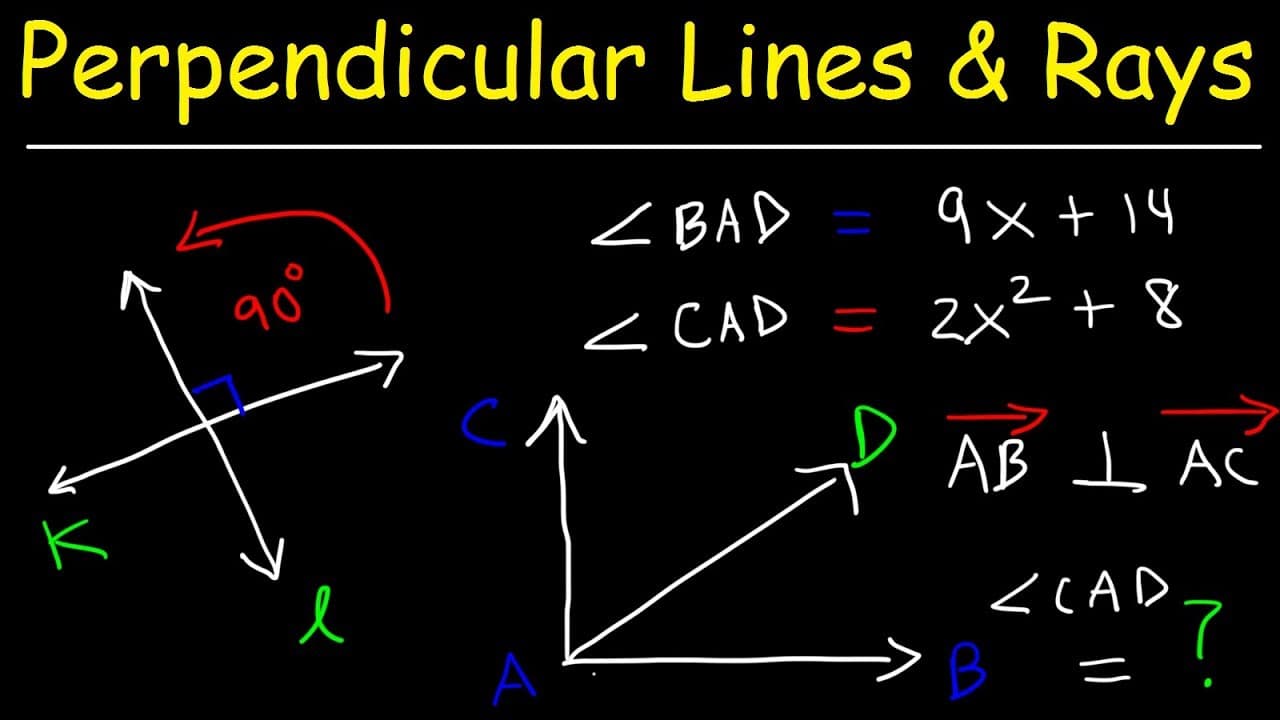
Using Algebra to Find Angles Between Perpendicular Rays

Using Algebra to Find Angles Between Perpendicular Rays

This educational math tutorial provides a comprehensive guide to understanding perpendicular lines, rays, and segments, blending geometric concepts with algebraic problem-solving. The video begins by defining perpendicularity, explaining that perpendicular lines intersect at 90-degree angles, and clarifying the relationship between their slopes as negative reciprocals. It establishes the foundational notation and visual cues used in geometry to identify right angles formed by intersecting segments and rays. The core of the video focuses on a complex multi-step problem that integrates geometry with algebra. A scenario is presented where a right angle is split into two smaller adjacent angles defined by algebraic expressions involving quadratics ($2x^2 + 8$) and linear terms ($9x + 14$). The narrator walks through setting up an equation based on the complementary angle theorem, solving a quadratic equation with a leading coefficient greater than one, factoring by grouping, and determining valid solutions for the variable $x$. For educators and students, this video serves as an excellent bridge between Algebra I and Geometry. It demonstrates why algebraic skills like factoring quadratic trinomials are essential for solving geometric problems. The step-by-step breakdown of the "AC method" for factoring and the verification process at the end underscores the importance of checking work, making it a valuable resource for high school math classrooms focusing on analytic geometry.

The Organic Chemistry TutorThe Organic Chemistry Tutor

10mins 55s

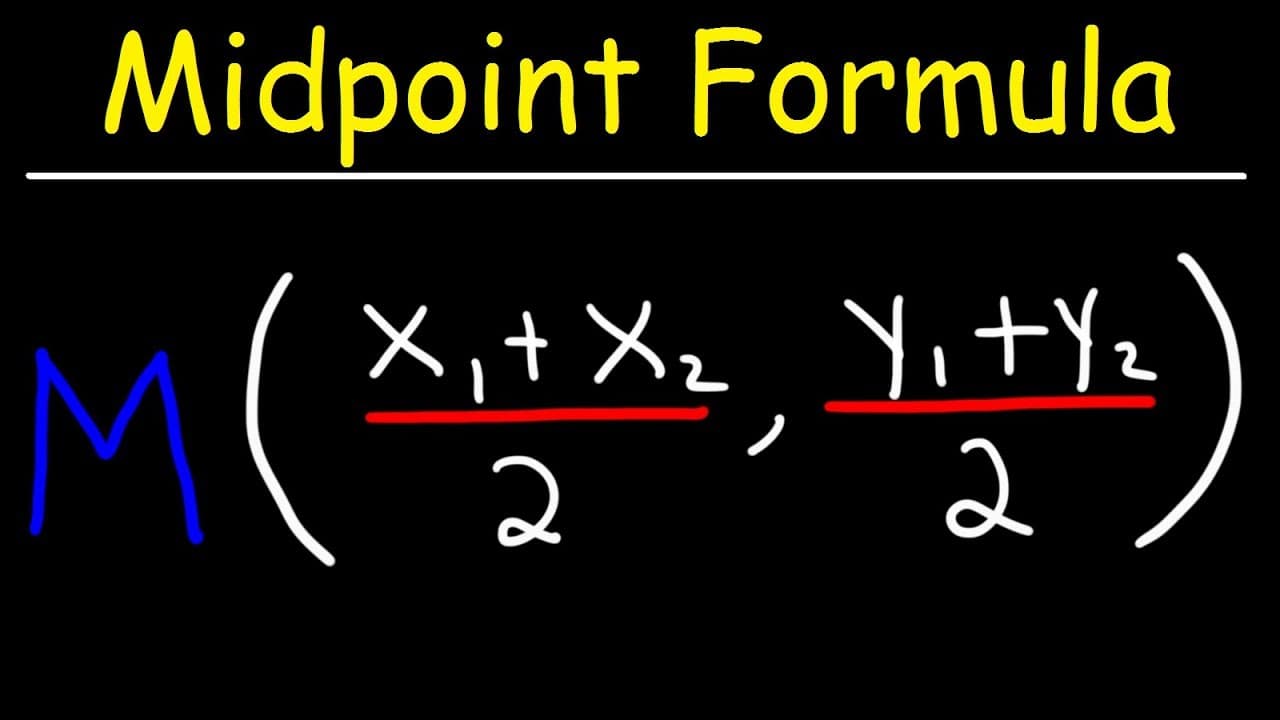
Calculating Midpoints with Integers and Fractions

Calculating Midpoints with Integers and Fractions

This educational math tutorial provides a comprehensive guide to finding the midpoint between two points on a coordinate plane. The video follows a progressive structure, beginning with the fundamental concept that a midpoint is essentially the average of x-coordinates and y-coordinates. It starts with simple examples using positive integers to establish the basic formula (x1+x2)/2, (y1+y2)/2, allowing students to grasp the core logic without arithmetic distractions. The content advances to more complex scenarios, introducing negative numbers to reinforce integer operations rules. The latter half of the video shifts focus to advanced algebraic skills by calculating midpoints for coordinates that involve fractions. This section demonstrates how to handle complex fractions (fractions within fractions), finding common denominators, and simplifying results, making it an excellent resource for reviewing fraction arithmetic within a geometry context. For educators, this video serves as a versatile tool for Algebra 1 and Geometry classrooms. It can be used to introduce the midpoint formula, review prerequisite skills like averaging and integer operations, or challenge advanced students with complex fraction problems. The clear, step-by-step derivation of answers on a digital blackboard makes it easy for students to follow along, take notes, and practice independently by pausing the video before solutions are revealed.
The Organic Chemistry TutorThe Organic Chemistry Tutor

11mins 12s

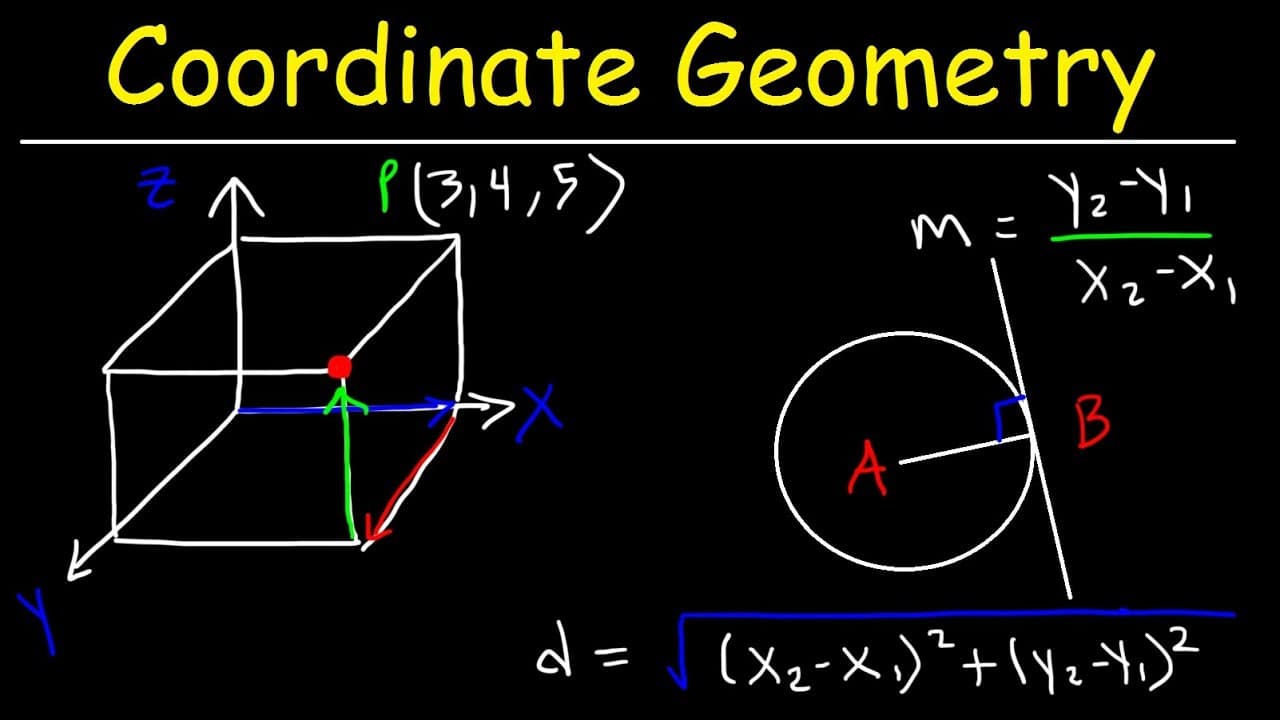
Mastering Coordinate Geometry: 9 Key Problem Types Solved

Mastering Coordinate Geometry: 9 Key Problem Types Solved

This comprehensive tutorial video guides students through nine distinct coordinate geometry problems, covering a wide range of high school math concepts. The video progresses from basic coordinate identification to more advanced topics like 3D coordinates and equations of lines within triangles. Each problem is presented clearly with a black background and colored diagrams, followed by a step-by-step walkthrough of the solution using algebraic and geometric principles. The video explores key themes including the distance and midpoint formulas, equations of circles and tangent lines, calculating areas of polygons defined by linear equations, and working with 3D coordinate systems. It also delves into advanced triangle properties, specifically teaching how to find the equations for medians, perpendicular bisectors, and altitudes. Specific formulas like the point-to-line distance formula and the area of an equilateral triangle are introduced and applied. For educators, this video serves as an excellent resource for scaffolding instruction or reviewing for a unit test. The segmented nature of the video allows teachers to assign specific problems that align with their current lesson—for example, using the circle segment when teaching conics, or the triangle segment when discussing centroids and orthocenters. The visual demonstrations help demystify abstract formulas by connecting them directly to graphical representations.

The Organic Chemistry TutorThe Organic Chemistry Tutor

33mins 2s

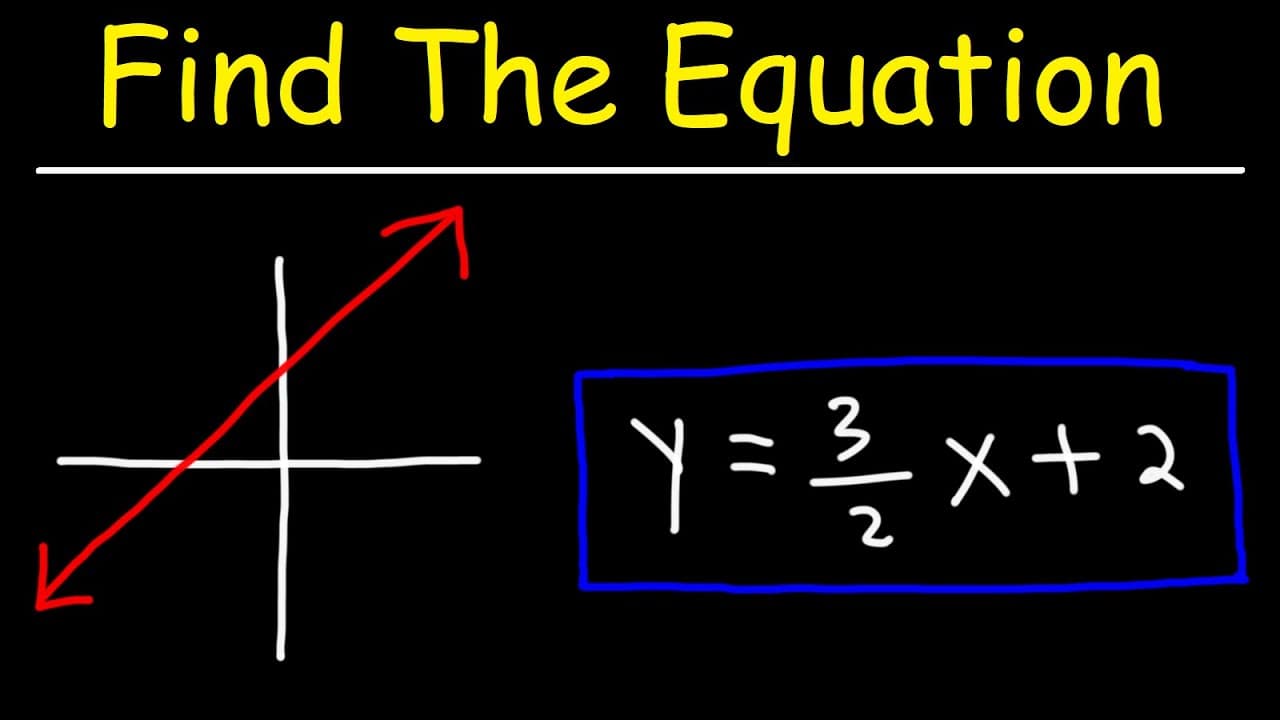
Writing Equations of Lines from Graphs and Converting Forms

Writing Equations of Lines from Graphs and Converting Forms

This instructional video provides a comprehensive tutorial on determining the equation of a line directly from a graph. The narrator guides viewers through the process of identifying the necessary components of a linear equation—specifically the slope (m) and the y-intercept (b)—to construct the equation in slope-intercept form (y = mx + b). The video uses three distinct examples (color-coded red, blue, and green lines) on a coordinate plane to demonstrate how to visually identify the y-intercept and calculate the slope using the "rise over run" method. Key themes include linear functions, coordinate geometry, and algebraic manipulation. Beyond basic graphing, the video advances to more complex concepts by demonstrating how to convert linear equations from slope-intercept form into standard form and point-slope form. This covers essential algebraic skills required for standardized testing where answer choices may be presented in various formats. For educators, this video serves as an excellent direct instruction tool or review resource for Algebra 1 units on linear equations. The clear, step-by-step visual breakdown allows students to see the connection between the geometric representation of a line and its algebraic equation. The inclusion of form conversion (slope-intercept to standard and point-slope) makes it particularly useful for differentiated instruction, catering to students ready for advanced formatting while solidifying basics for others.

The Organic Chemistry TutorThe Organic Chemistry Tutor

10mins 5s

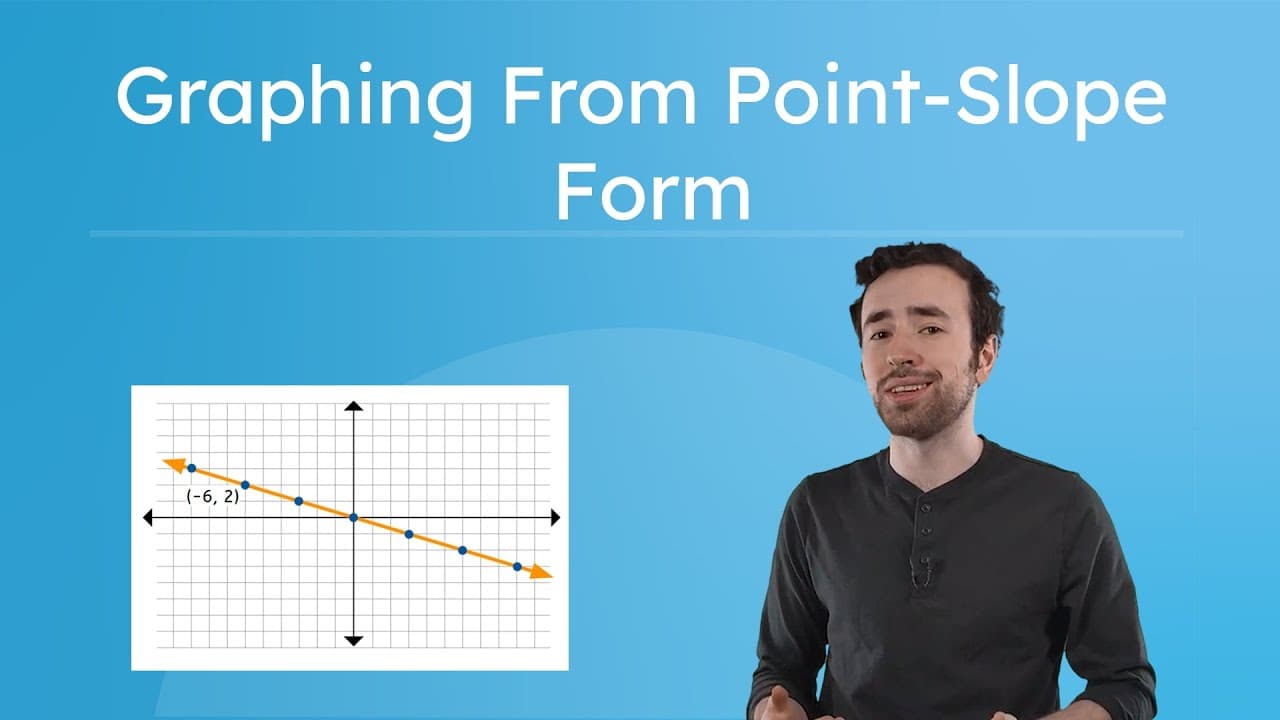
How to Graph a Line Using Point-Slope Form

How to Graph a Line Using Point-Slope Form

This educational math video teaches students how to graph linear equations directly from point-slope form without converting to other forms first. The narrator guides viewers through the process of reverse-engineering the equation $y - y_1 = m(x - x_1)$ to identify the slope ($m$) and a specific coordinate point $(x_1, y_1)$ on the line. Special emphasis is placed on interpreting positive and negative signs correctly within the equation parentheses. The video explores key themes of algebraic structure, coordinate geometry, and visual graphing techniques. It specifically breaks down the cognitive steps needed to extract numerical values from an algebraic formula, focusing on the common student stumbling block of recognizing that $(x + 6)$ implies an x-coordinate of $-6$. The lesson includes a guided example followed by an independent practice problem where students pause the video to test their understanding. For classroom application, this video is an excellent resource for Algebra 1 units on linear functions. It provides a procedural scaffold for students who struggle with multi-step algebraic manipulations, offering them a direct method to visualize equations. Teachers can use this to differentiate instruction, helping visual learners connect abstract formulas to concrete graphical representations.

Miacademy & MiaPrep Learning ChannelMiacademy & MiaPrep Learning Channel

5mins 3s

Materials

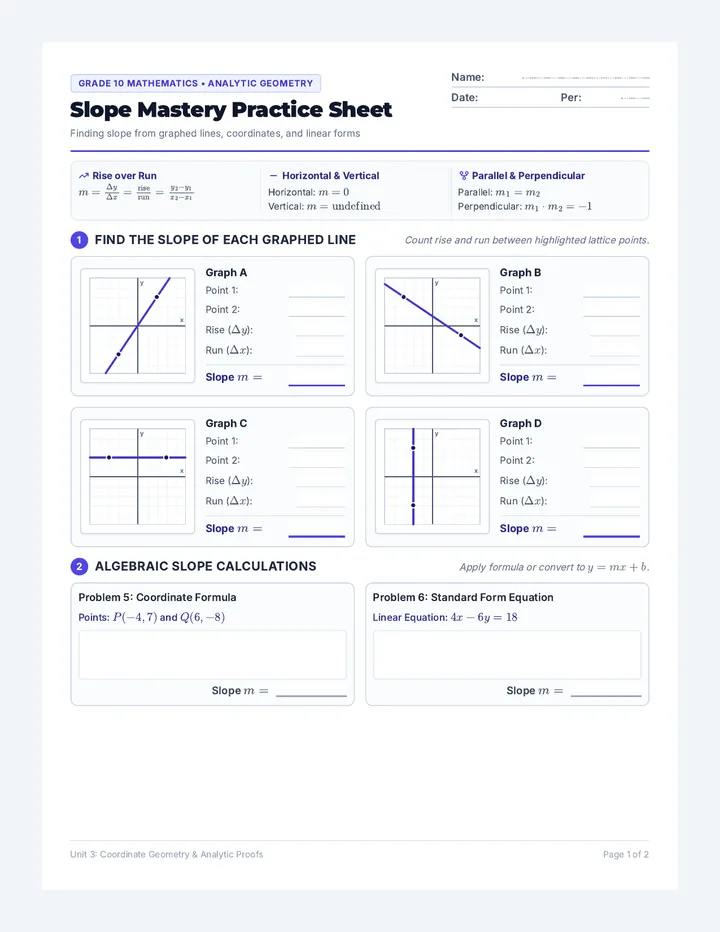
Slope Mastery Practice Sheet

Slope Mastery Practice Sheet

A 10th-grade geometry practice worksheet featuring prominent coordinate grid graphs with graphed lines for students to find slope via rise-over-run and coordinates. Also includes algebraic conversions, parallel/perpendicular visual and algebraic comparisons, and coordinate geometric proofs.

D

dfleisch

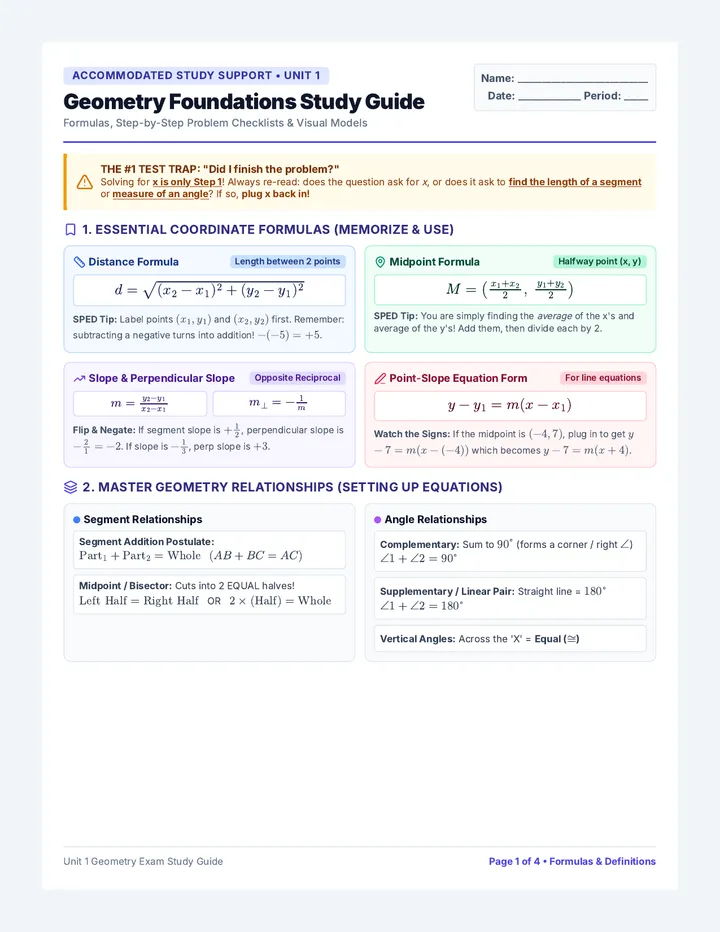
Geometry Essentials Study Guide

Geometry Essentials Study Guide

A 4-page comprehensive Special Education study guide for Unit 1 Geometry covering segments, midpoints, coordinate geometry, perpendicular bisectors, and angle relationships. Features dedicated formula reference boxes, color-coded step-by-step algorithms, visual models, annotated examples, and scaffolded practice frames with common trap alerts.

T

timothy.nixon

Sequences

Equation Balancing Student Packet

Distance Detectives

A highly visual geometry unit focused on applying algebraic formulas to coordinate planes. Students use coordinate grids, step-by-step graphic organizers, and tactile representations to solve real-world distance and segment length problems.

D

deeohnny.jackson

64
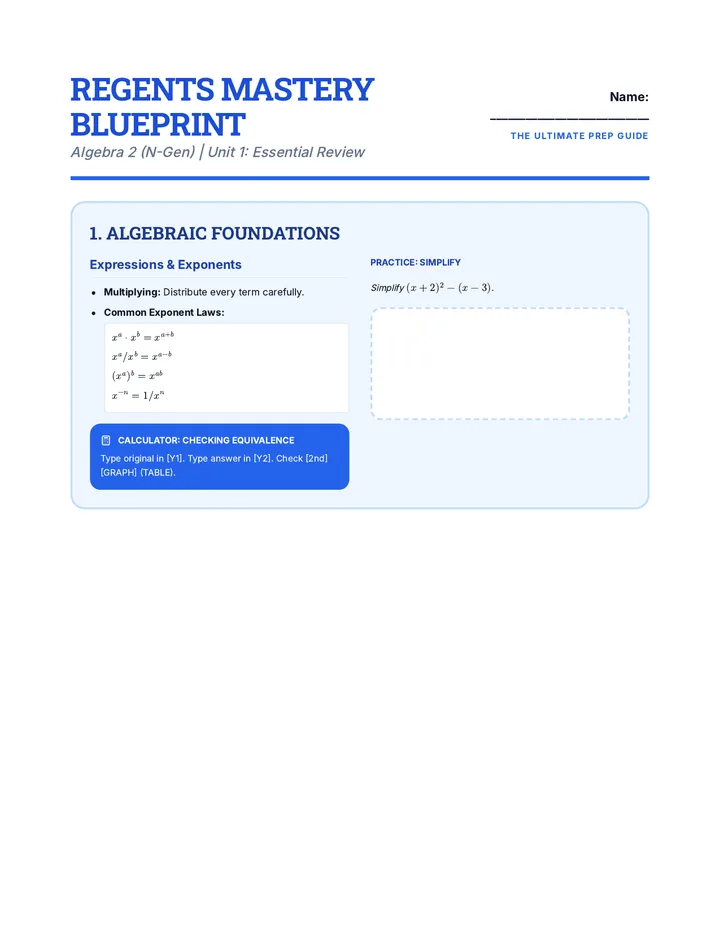
Regents Mastery Blueprint Study Guide

Regents Mastery Suite

A comprehensive review suite for the New York State Mathematics Regents exams, including Algebra 1, Geometry, and Algebra 2, featuring mastery blueprints, calculator strategies, and exam-taking tips.

KB

Kayla Borozny

15
Trapezoid Survey A Answer Key

Quadrilateral Coordinate Land

A high-level coordinate geometry sequence where students apply coordinate algebra formulas to identify and verify the properties of quadrilaterals and other polygons on the coordinate plane.

M

mastronardil

14
Segment Postulates Guided Notes

Segment Geometry

A two-part sequence exploring segment addition, subtraction, and midpoint relationships through visual GCR deductive reasoning and algebraic modeling.

C

Courtney.Smiley

17
Parallel Path Packet Student

Linear Logic Blueprints

A series of algebra and geometry foundation lessons designed with a technical blueprint aesthetic, focusing on precision, organized computation, and visual clarity in mathematical steps.

D

david.marques

5
Congruence Logic Quiz pocket edition

Congruence Chronicles

An exploration of geometric congruence, coordinate geometry, and the formal logic required for mathematical proofs.

SR

Saifel-Dein Raja

2

Lessons

Unit 2 Test Student Copy

Grid and Graph Mastery

A comprehensive 9th-grade assessment lesson covering coordinate geometry, functions, slope, and graph interpretation through review, testing, and reflection.

KC

Kris Coyne

6
Urban Architect Guide

Boundary Blueprint

A high school geometry lesson where students learn to construct Voronoi diagrams using perpendicular bisectors to solve real-world spatial optimization problems in urban planning.

BW

Brian Whalen

5
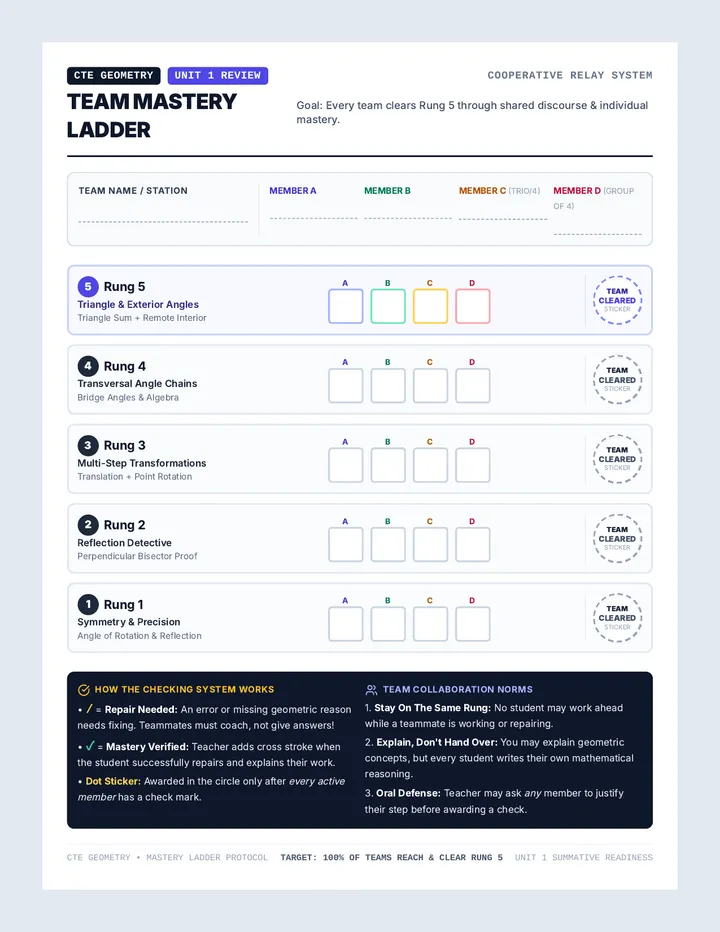
Mastery Ladder Tracking Sheet

Geometry Ladder Relay

Collaborative 5-rung mastery review activity for CTE Geometry Unit 1 covering symmetry, reflections, multi-step transformations, parallel transversal angle chains, and exterior angle theorems across four parallel student versions plus a Spanish edition.

MM

Matthew McIntyre

9
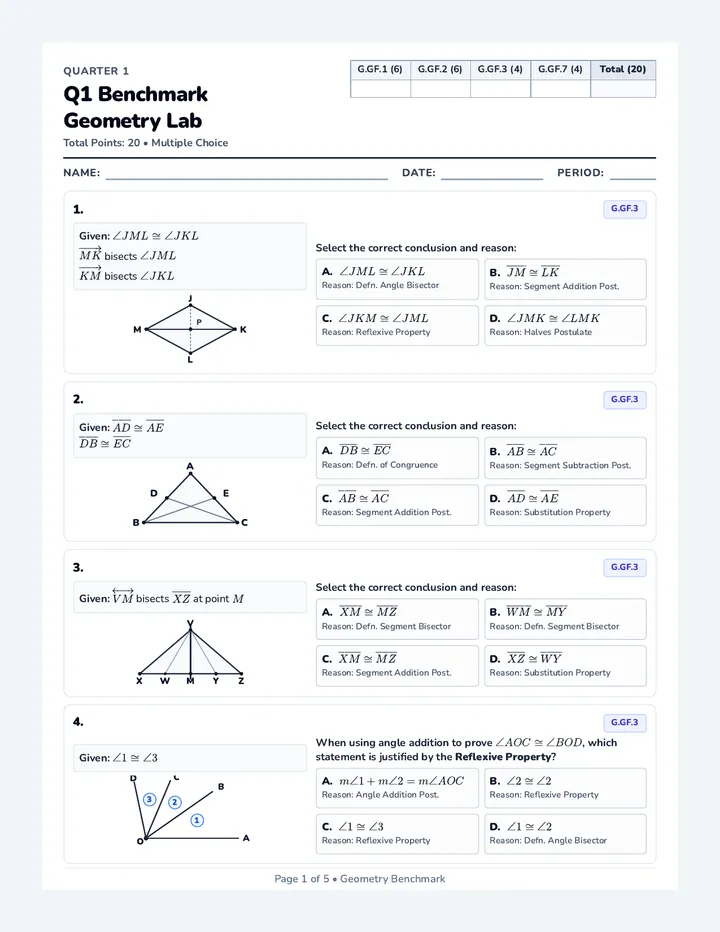
Geometry Benchmark Test

Geometry Benchmark

Quarter 1 Benchmark assessment covering geometric definitions, deductive logic, collinearity, angle relationships, segment algebra, and coordinate geometry formulas with student test and teacher answer key.

C

Courtney.Smiley

3
Slope Workshop Slides

Slope Workshop

A clear, step-by-step lesson on writing equations for parallel and perpendicular lines in slope-intercept form, featuring visual guides and structured practice.

MD

Michele deSousa

3
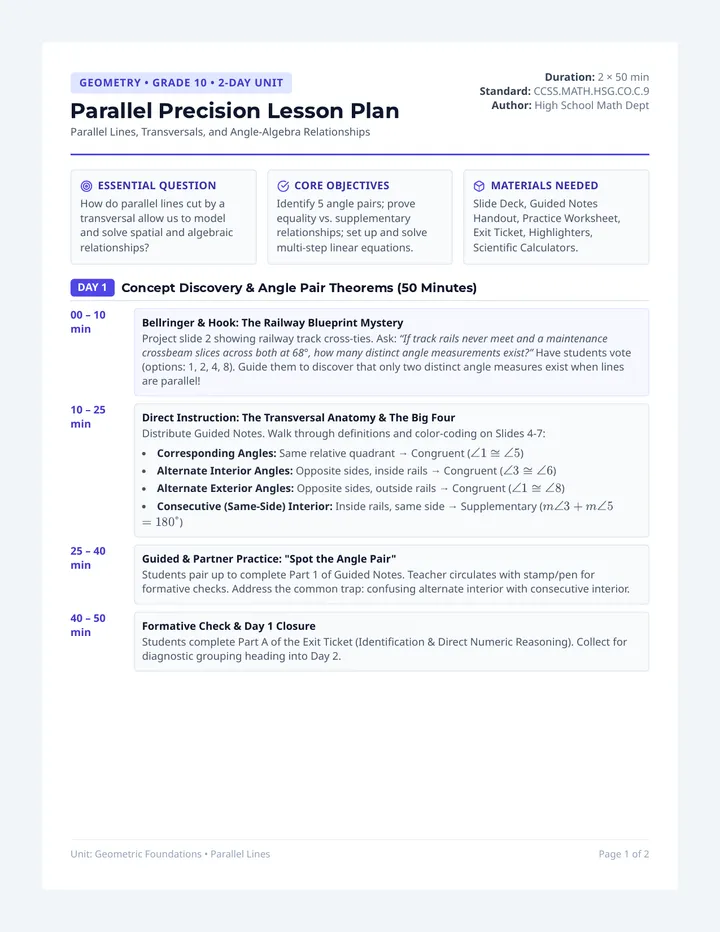
Parallel Precision Lesson Plan

Parallel Precision

A comprehensive two-day unit on parallel lines intersected by transversals for 10th-grade geometry students. Learners discover and apply angle pair theorems—including alternate interior, alternate exterior, corresponding, and consecutive interior angles—to solve geometric puzzles and multi-step algebraic equations.

J

jminear

6