Lenny.com
Explore
Create
ActivitiesNewMathEnglish Language ArtsScience & EngineeringSocial StudiesGlobal LanguagesHealth & Physical EducationSpecial EducationCounseling & Life SkillsArts & CreativityESL
Lenny.com
Lenny.com
Explore
Create
ActivitiesNewMathEnglish Language ArtsScience & EngineeringSocial StudiesGlobal LanguagesHealth & Physical EducationSpecial EducationCounseling & Life SkillsArts & CreativityESL
Lenny.com
Lenny.com

Solutions

Lenny for EducatorsLenny for SchoolsLenny for Districts

Product

ExploreSign inCreateSupportAbout

Resources

Getting startedMTSS Acceleration Program

© 2026 Lenny Learning Inc.

TermsPrivacyAccessibility
LinkedInInstagramX
Lenny

Compare Growth Rates

Analyzes differences between linear, quadratic, and exponential functions as inputs increase. Equips learners to identify dominance and relative rates of change using tables, graphs, and algebraic limits.

MathNumbers & CountingCounting ObjectsNumber NamesComparing NumbersNumber OperationsCounting SequenceNumbers 0-10Place Value Understanding and SystemAdd and Subtract Within 20Addition and Subtraction ConceptsAddition and Subtraction EquationsAddition and Subtraction ProblemsFoundations for MultiplicationMultiplication and Division PropertiesMultiply and Divide Within 100Multiplication and Division ProblemsFactors and MultiplesProperties of OperationsPatterns and RelationshipsGenerate and Analyze PatternsMulti-Digit ArithmeticPlace Value OperationsMulti-Digit and Decimal OperationsNumerical ExpressionsFour Operations and PatternsFour Operations Problem SolvingMeasurement & DataMeasurable AttributesMeasuring LengthsMeasure and Estimate Lengths in Standard UnitsRelate Addition and Subtraction to LengthClassifying and Counting ObjectsTime and MoneyArea Concepts and MeasurementPerimeter and Area MeasuresAngle Concepts and MeasurementTime, Volume, and MassMeasurement Unit ConversionsGeometryIdentifying ShapesShapes and AttributesShape Attributes and ReasoningShapes and CompositionClassifying 2D FiguresGeometric Figures and RelationshipsLines, Angles, and ShapesAngle, Area, and VolumeGeometric MeasurementVolume of 3D ShapesCoordinate Plane ApplicationsTransformations in the PlaneCongruence and SimilarityUnderstand congruence in terms of rigid motionsSimilarity and TransformationsProve Theorems Involving SimilarityPythagorean TheoremTrigonometry for General TrianglesMake Geometric ConstructionsProve Geometric TheoremsTheorems About CirclesFind Arc Lengths And Areas of Sectors of CirclesVolume FormulasRelationships Between Two-Dimensional and Three-Dimensional ObjectsProve Simple Geometric Theorems AlgebraicallyTranslate Between Geometric Description and Equation for Conic SectionApply Geometric Concepts in Modeling SituationsFractions & DecimalsFractions as NumbersBuilding FractionsFraction Equivalence and OrderingAdding and Subtracting FractionsMultiplying and Dividing FractionsDividing FractionsDecimal FractionsMulti-Digit Computation and FactorsAdd, Subtract, Multiply, and Divide Rational NumbersRational Number SystemIrrational Numbers and ApproximationsRatiosRatios and ProportionsProportional RelationshipsUnit RateAlgebraAlgebraic ExpressionsGenerate Equivalent ExpressionsQuantitative RelationshipsProportional Relationships and Linear EquationsEquations and InequalitiesEquation Solving and ReasoningLinear Equations and SystemsGraph Equations and InequalitiesSystems of EquationsReal-World Algebraic ProblemsQuantitative Reasoning with UnitsExpression StructureEquivalent Expression FormsRadicals and Integer ExponentsRational ExponentsRational and Irrational NumbersPolynomial OperationsPolynomial IdentitiesPolynomial Zeros and FactorsRational ExpressionsComplex Number OperationsComplex Numbers in PolynomialsComplex Numbers on PlaneStatistics & ProbabilityRepresent and Interpret DataData DistributionsStatistical VariabilityProbability ModelsCompound Event ProbabilitiesStatistical SamplingInterpret Categorical and Quantitative DataBivariate Data PatternsInterpret Linear ModelsComparing Two PopulationsRandom Processes in StatisticsIndependence and Conditional ProbabilityExpected ValuesProbability-Based Decision MakingStatistical Inference and ConclusionsFunctionsFunction Concepts and NotationDefine and Compare FunctionsInterpret Functions in ContextAnalyze Function RepresentationsModel Relationships with FunctionsIdentify Linear vs Exponential GrowthDistinguish Between Function TypesCompare Growth RatesInterpret Function ExpressionsBuild Functions from RelationshipsConstruct and Model FunctionsTransform and Combine FunctionsModel Comparison and SelectionSolve Exponential EquationsTrigonometryTrigonometric Ratios Involving Right TrianglesTrigonometric Functions and Unit CircleModel with Trigonometric FunctionsTrigonometric IdentitiesVectors & MatricesIntroduction to Vectors and MatricesVector QuantitiesVector OperationsMatrix OperationsCalculusLimits and ContinuityDerivative Concepts and NotationDerivative Rules and TechniquesApplications of DerivativesOptimization ProblemsRelated RatesCurve Sketching and AnalysisIntegration Concepts and NotationAntiderivatives and Indefinite IntegralsDefinite Integrals and AreaFundamental Theorem of CalculusIntegration TechniquesApplications of IntegrationDifferential EquationsSequences and SeriesParametric and Polar FunctionsVector-Valued Functions

Videos

Comparing Linear vs. Exponential Growth: Which Wins?

Comparing Linear vs. Exponential Growth: Which Wins?

This video provides a clear, step-by-step comparison between linear and exponential functions using real-world financial scenarios. It begins with a classic "lottery dilemma"—choosing between a large daily lump sum (linear) or a penny that doubles daily (exponential)—to illustrate the explosive nature of exponential growth. The narrator, Justin, uses graphs to visually demonstrate how exponential functions, despite often starting with smaller values, eventually surpass linear functions due to their compounding nature. The video progresses to more complex scenarios, such as comparing two savings accounts with different terms to determine which is more profitable over a specific time frame. It introduces the critical concept that while exponential growth always wins eventually, it may not be the better choice in the short term. The final segment dives into advanced comparisons between different exponential functions, teaching students how to identify true growth factors even when exponents are manipulated (e.g., converting a fractional exponent into a standard growth rate). For educators, this video is an excellent tool for Algebra 1 and 2 curriculums. It bridges the gap between abstract equations and tangible outcomes using money, a topic that naturally engages students. The visual graphing sequences effectively scaffold the concept of "rate of change" and provide opportunities for students to predict, calculate, and analyze functional behavior before seeing the solution.
Miacademy & MiaPrep Learning ChannelMiacademy & MiaPrep Learning Channel

5mins 52s

Understanding Tetration: Repeated Exponentiation Explained

Understanding Tetration: Repeated Exponentiation Explained

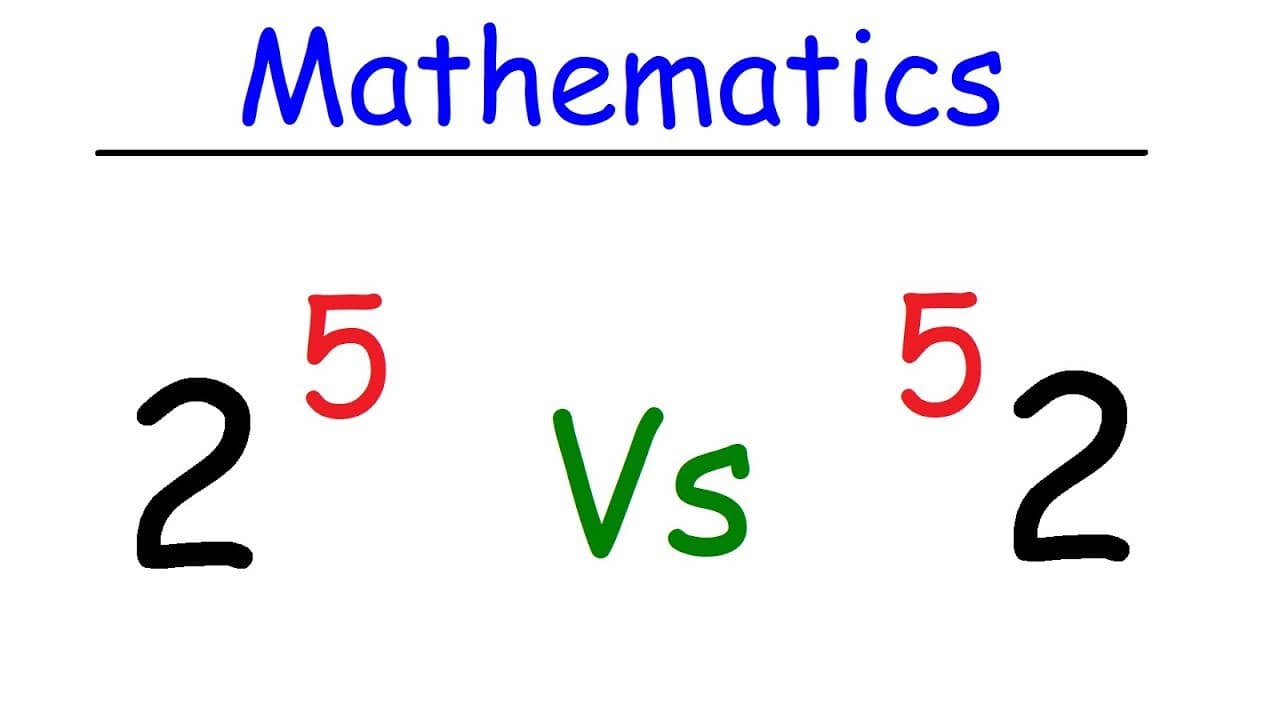
This educational mathematics video introduces the advanced concept of tetration by establishing a logical progression from basic arithmetic operations. It begins by defining addition as repeated counting and multiplication as repeated addition, then establishes exponentiation as repeated multiplication. This pattern is used to define tetration as repeated exponentiation, providing a clear conceptual framework for understanding this higher-order operation. The video explores key mathematical properties including commutativity and associativity. It demonstrates how addition and multiplication are commutative (order doesn't matter), while exponentiation and tetration are not. A significant portion of the video is dedicated to the 'order of operations' for stacked exponents, clarifying the crucial difference between $(3^3)^3$ and $3^{(3^3)}$. It visually demonstrates how parentheses change the calculation path and the final result, highlighting the rapid growth rates associated with these operations. For educators, this video is an excellent resource for enrichment in Algebra or Pre-Calculus classes. It deepens student understanding of operational hierarchies and inverse functions. The video concludes by introducing 'super roots'—the inverse of tetration—and solving equations like $^2x = 27$, offering a novel way to challenge students' algebraic reasoning and problem-solving skills.

The Organic Chemistry TutorThe Organic Chemistry Tutor

12mins 9s

Mastering Limits at Infinity and Horizontal Asymptotes

Mastering Limits at Infinity and Horizontal Asymptotes

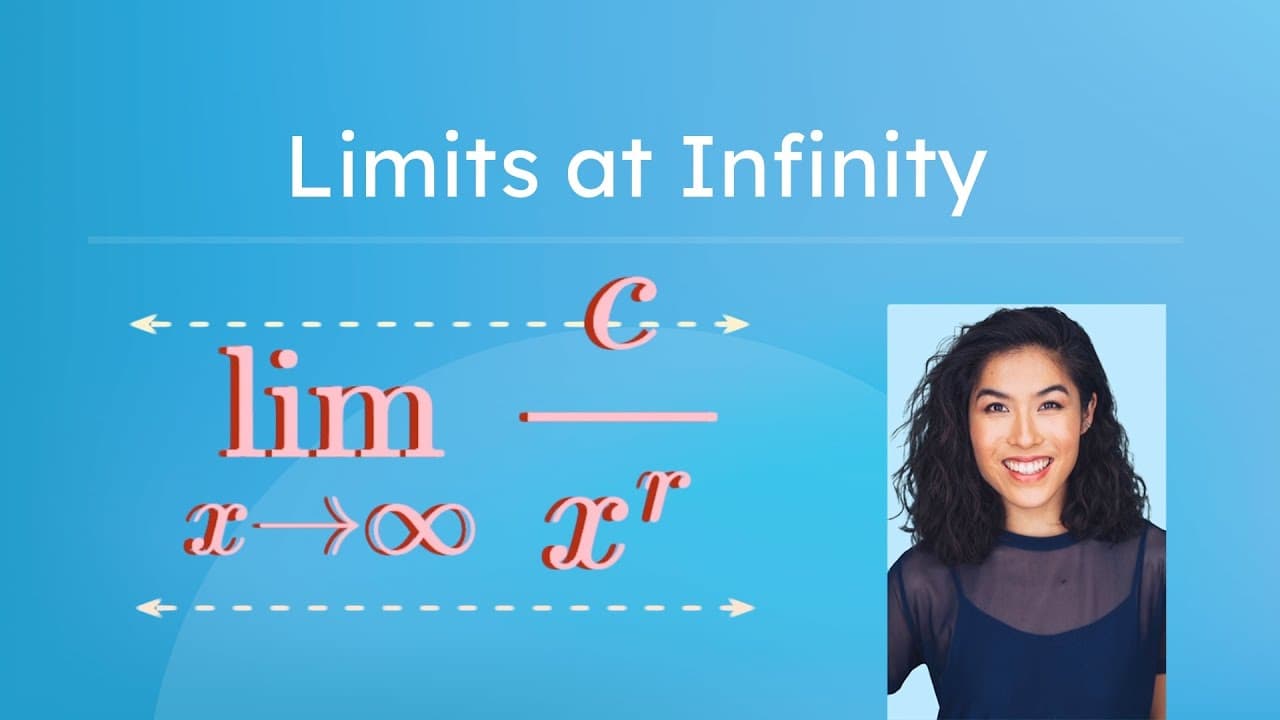
This educational video provides a comprehensive guide to understanding limits at infinity, a fundamental concept in Precalculus and Calculus. It bridges the gap between graphical intuition and algebraic rigor by connecting limits at infinity directly to the concept of horizontal asymptotes. The video progresses from visual inspection of rational function graphs to formal definitions using limit notation, and finally to analytic methods for evaluating limits without graphing calculators. The content explores key themes such as end behavior, rational functions, and the algebraic manipulation required to solving limits. It specifically addresses how the degrees of the numerator and denominator influence the limit, covering three main cases: when the denominator's degree is higher (limit is 0), when degrees are equal (limit is the ratio of leading coefficients), and when the numerator's degree is higher (limit is infinite or DNE). It also touches upon special cases involving oscillating trigonometric functions and exponential functions. For educators, this video is an excellent resource for introducing or reinforcing the concept of end behavior in a rigorous way. It moves beyond simple memorization of rules by explaining the "why" behind them through the technique of dividing by the highest power of x. The clear step-by-step examples make it suitable for flipped classrooms, review sessions, or as a primary instructional tool for introducing the analytic evaluation of limits.

Miacademy & MiaPrep Learning ChannelMiacademy & MiaPrep Learning Channel

17mins 40s

Comparing Linear and Exponential Growth Models

Comparing Linear and Exponential Growth Models

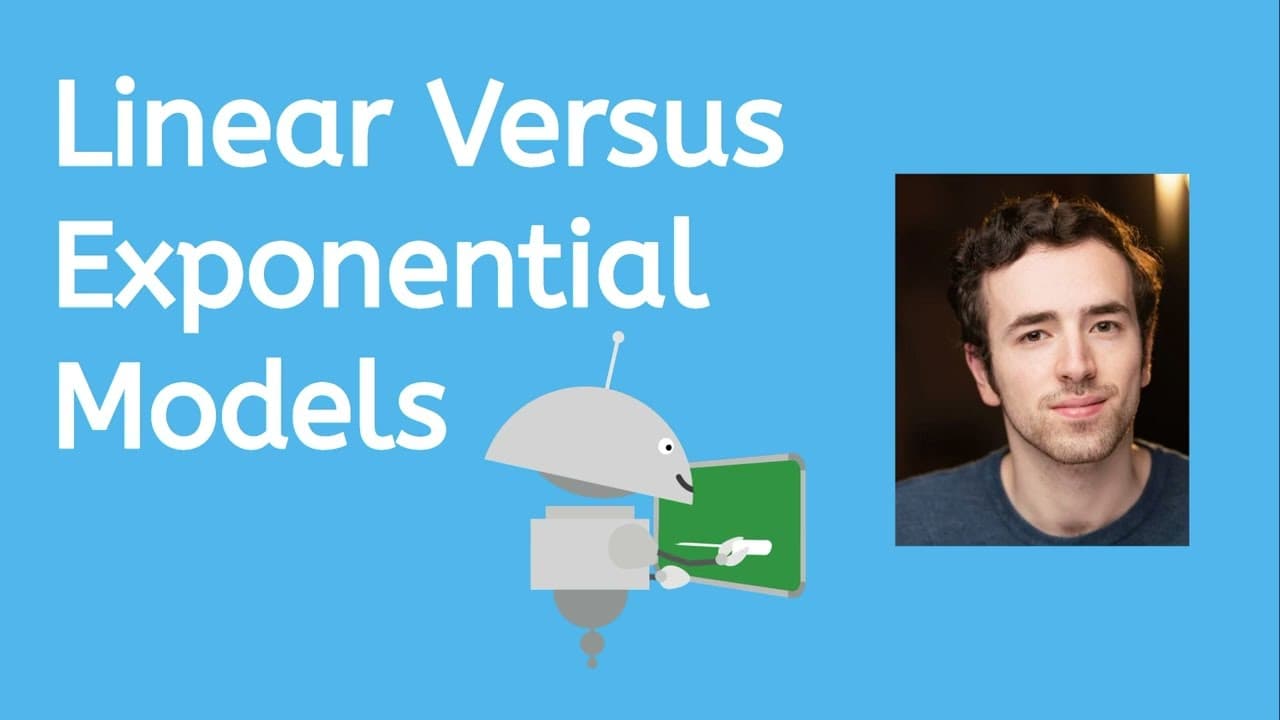
This educational video clarifies the fundamental differences between linear and exponential growth models through visual representation. Building on previous concepts of slope, the narrator, Justin, transitions from analyzing numerical data tables to interpreting graphical models. The video explicitly demonstrates how linear data produces a straight line with a constant slope, while exponential data creates a curve that becomes progressively steeper, illustrating why a single slope value is insufficient for modeling exponential growth. Key themes include data analysis, graphical modeling, and pattern recognition. The video contrasts the additive nature of linear growth (constant rate of change) with the multiplicative nature of exponential growth (changing rate of change). It introduces the concept of a mathematical "model" as a visual line or curve that represents a set of data points, emphasizing how to match specific data behaviors—like adding a constant versus multiplying by a factor—to their corresponding visual shapes. Ideally suited for Algebra I classrooms, this resource helps students bridge the gap between abstract numerical tables and visual graphs. It addresses the common student struggle of distinguishing functions based on data behavior alone. Teachers can use this video to introduce graphing exponential functions or as a review tool to reinforce the visual distinctions between linear and exponential relationships before moving on to complex real-world applications.

Miacademy & MiaPrep Learning ChannelMiacademy & MiaPrep Learning Channel

3mins 20s

Materials

Function Faceoff Graphic Organizer

Function Faceoff Graphic Organizer

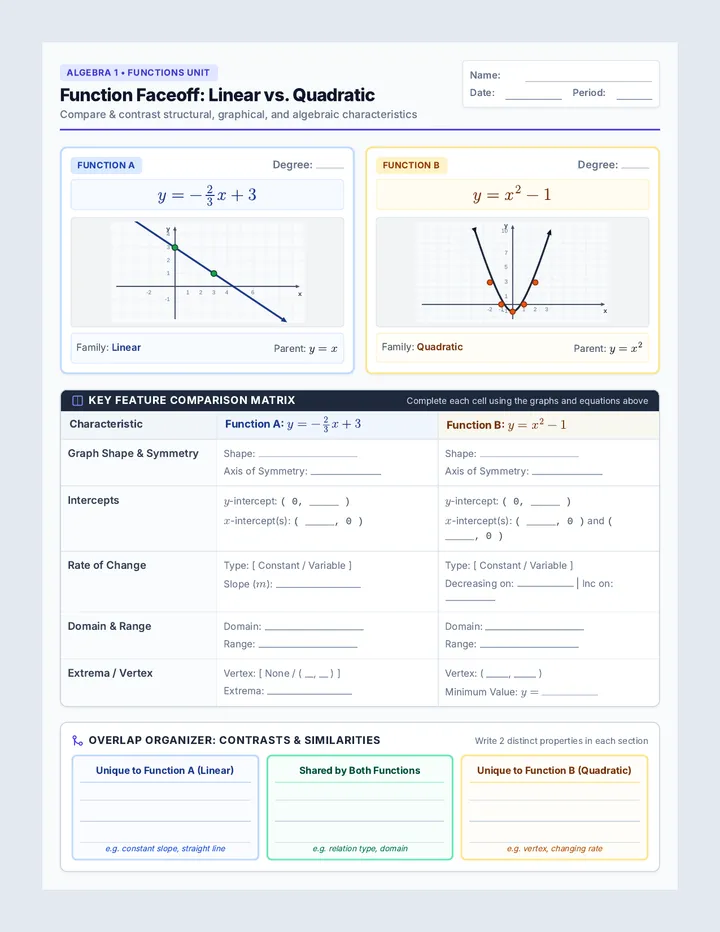
A comprehensive two-page compare and contrast graphic organizer analyzing linear vs. quadratic functions using y = -2/3x + 3 and y = x^2 - 1. Includes side-by-side graphical and algebraic feature matrices, a three-column overlap comparison organizer, rate-of-change tables examining first and second finite differences, system intersection analysis, and conceptual synthesis prompts.

CR

Candice Richardson

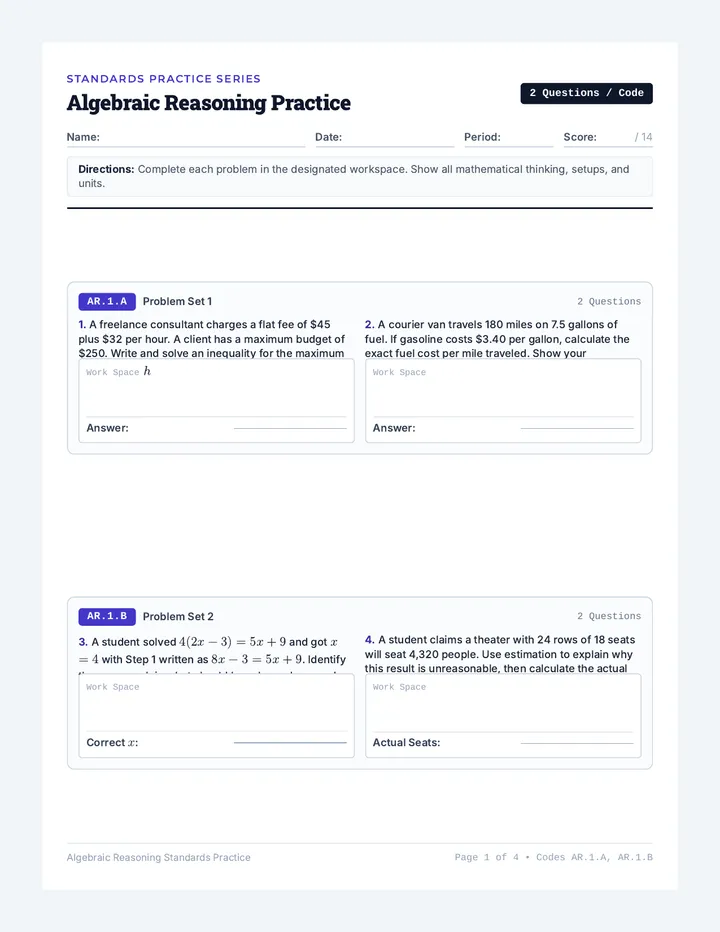
Algebraic Reasoning Practice Worksheet

Algebraic Reasoning Practice Worksheet

A four-page printable worksheet featuring two targeted math problems for each of the seven process codes (AR.1.A through AR.1.G), complete with designated student work boxes and a metacognitive self-audit tracker.

MR

Mahuya Roy Chowdhury

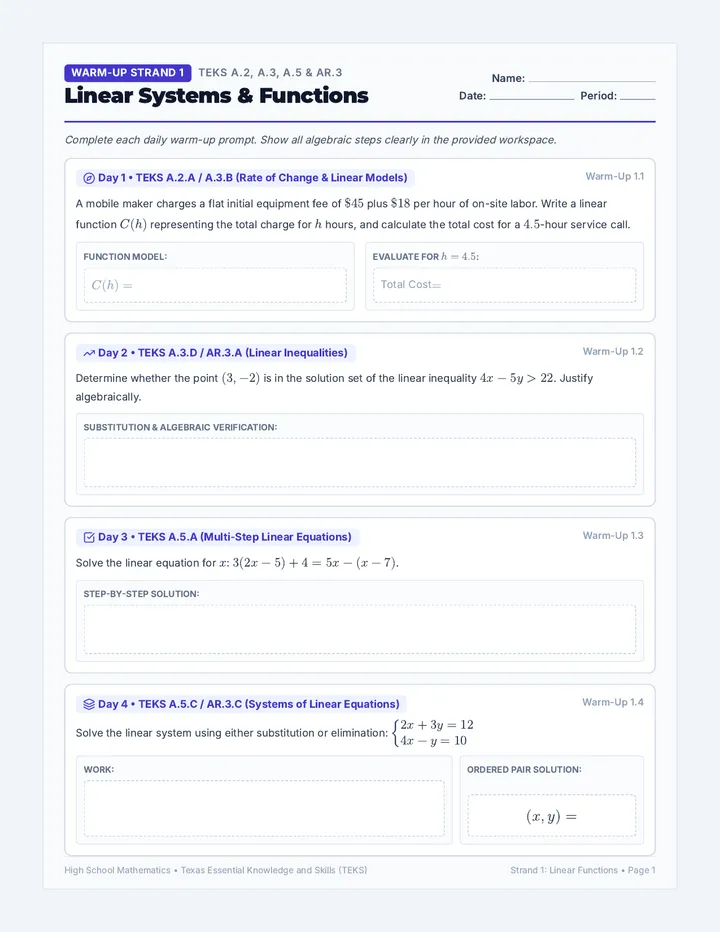
Algebra Warm-Up Question Bank

Algebra Warm-Up Question Bank

A comprehensive 5-page Texas Algebra warm-up question bank covering linear, quadratic, exponential, polynomial/radical operations, and advanced Algebraic Reasoning standards AR.7.A through AR.7.E.

MR

Mahuya Roy Chowdhury

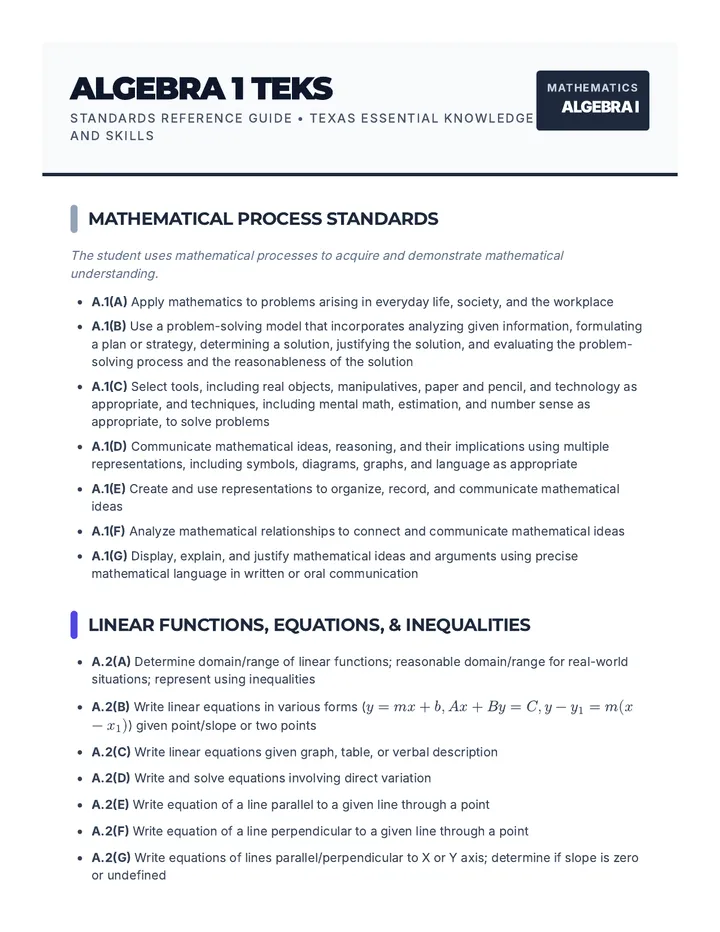
Algebra 1 TEKS Reference Guide

Algebra 1 TEKS Reference Guide

A comprehensive, formatted reference list of all Algebra 1 Texas Essential Knowledge and Skills (TEKS) organized by standard strands for teacher use. Includes Process Standards.

M

mbatey

Sequences

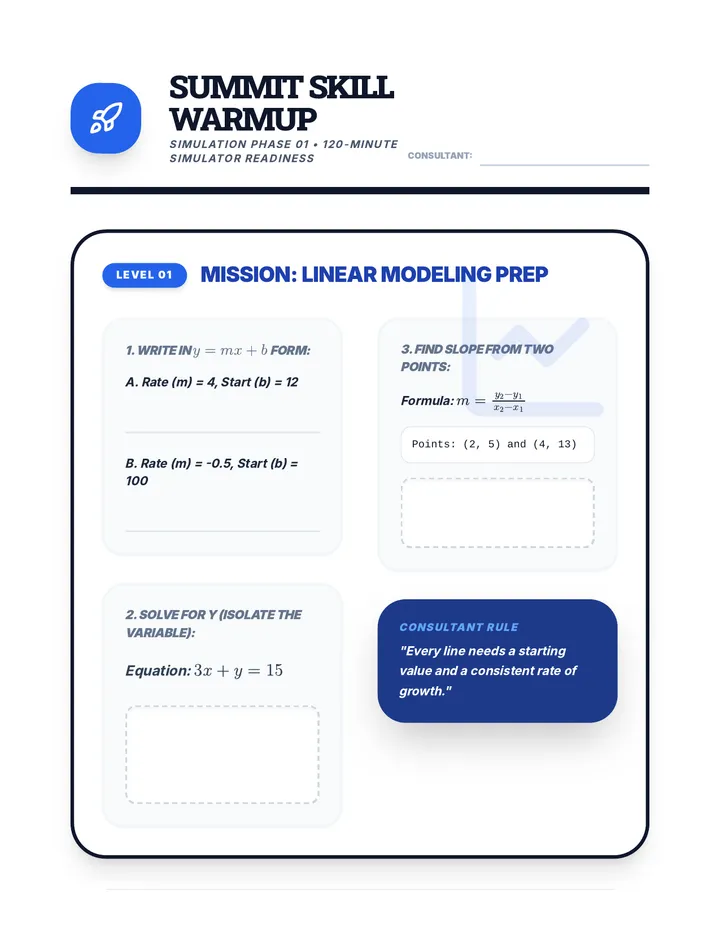
Foundation Missions Part 1 Final

Math in Motion: The 2-Hour Summit

A high-intensity, 120-minute math simulation. Students act as lead consultants, completing a high-speed skill warmup before selecting a professional sector (Music, Urban Planning, Rocket Science, or Sports Analytics) to solve a series of complex work orders.

EL

Elsa LaLone

102
Project Mission Slides Final

Math in Motion: The 2-Hour Summit

A high-intensity, 120-minute math simulation. Students act as lead consultants, completing a high-speed skill warmup before selecting a professional sector (Music, Urban Planning, Rocket Science, or Sports Analytics) to solve a series of complex work orders.

EL

Elsa LaLone

102
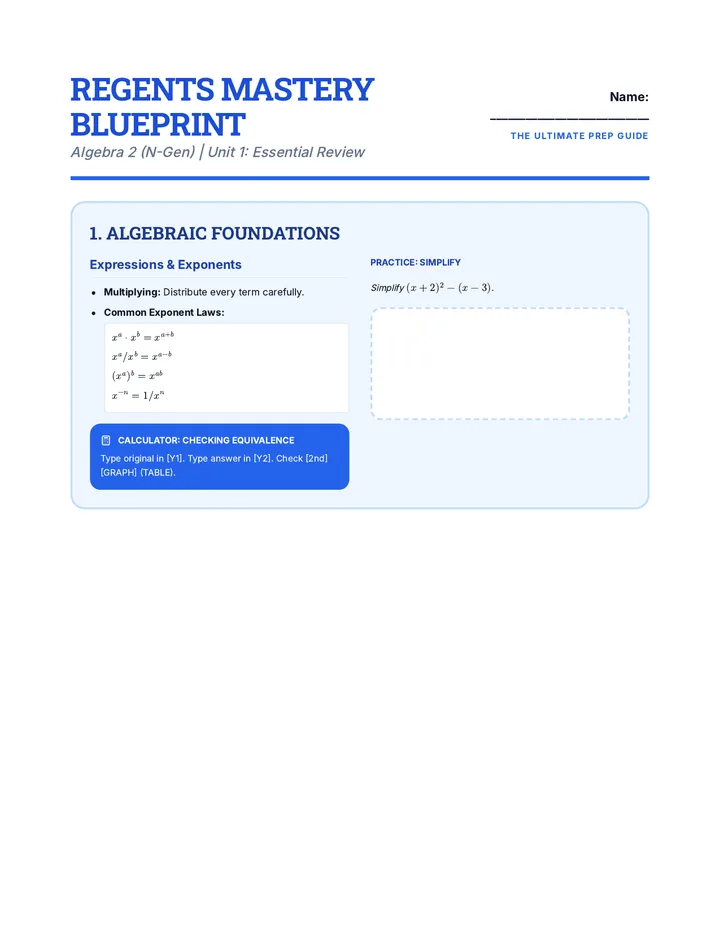
Regents Mastery Blueprint Study Guide

Regents Mastery Suite

A comprehensive review suite for the New York State Mathematics Regents exams, including Algebra 1, Geometry, and Algebra 2, featuring mastery blueprints, calculator strategies, and exam-taking tips.

KB

Kayla Borozny

15
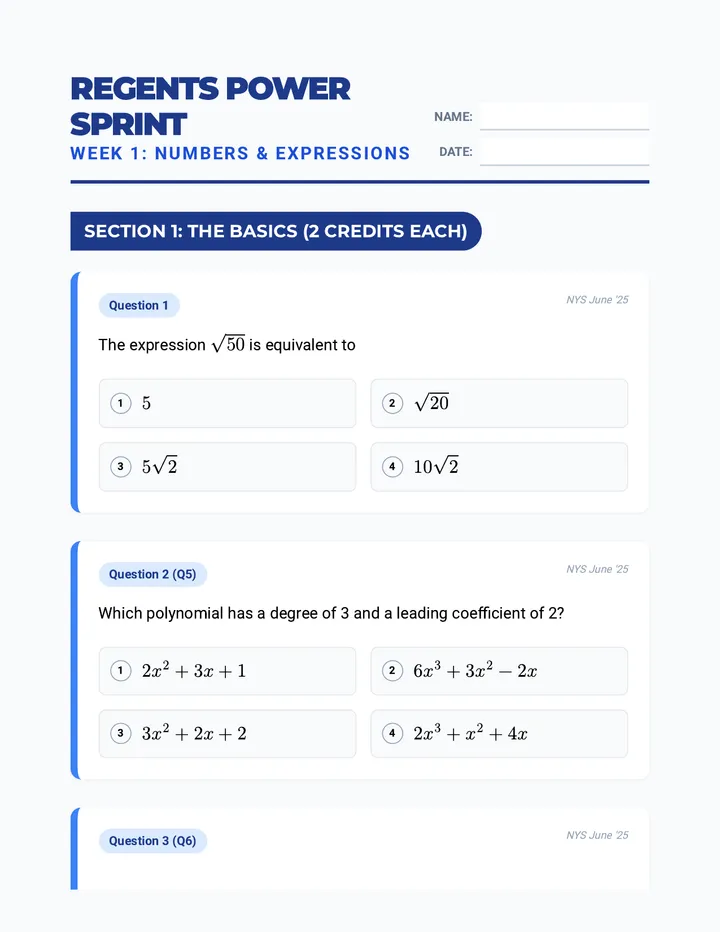
Week 1 Power Sprint Worksheet

Regents Road Map

A comprehensive 10-week preparation sequence designed to get students ready for the Algebra I Regents exam by May 15th, featuring bi-weekly 30-minute practice sessions and visual anchor charts.

L

laura.clar

31
Temple Craftsmen Slides

Middle School Math Block

A multi-subject middle school mathematics block for Week 1, covering 6th Grade Geometry (Temple Craftsmen: polygon decomposition, nets, surface area) and 7th/8th Grade Math (Faithful Stewards: proportional relationships, linear equations, inequalities, transversals) from a Christian perspective.

JR

Jamens Ray II

59
Tile Architects Worksheet

Concept Lab Math

A specialized Tier 3 intervention sequence for 8th-grade students performing at a 5th-grade level, focusing on bridging foundational arithmetic to high school algebra concepts. This sequence uses concrete-representational-abstract (CRA) methods to explore area modeling, systems of equations, exponential patterns, and inequalities.

A

achurchill

6

Lessons

Function Faceoff Slides

Function Faceoff

A comprehensive AVID-style lesson comparing linear and quadratic functions through inquiry-based algebraic methods and Cornell Note-taking.

JC

Jennifer Cimaglia

4
Linear Legends Worksheet

Regents Raid

A comprehensive series of five review worksheets designed to prepare students for the NYS Algebra I Regents exam, covering key standards from linear equations to statistics.

CW

Cheyenne Watkins

6
Buffalo Commute Showdown Reference

Drive the Deal

A financial literacy and algebra lesson where students compare car ownership models and use systems of linear equations to find the break-even point between fuel-efficient and gas-guzzling vehicles.

AG

Anna Gomez

5
Algebra 1 Quarter 3 Exam Document

Algebra 1 Quarter 3 Assessment

A comprehensive assessment covering Systems of Equations and Exponential Functions for Algebra 1 students in their 3rd Quarter.

AC

Anjoe Calamba

2
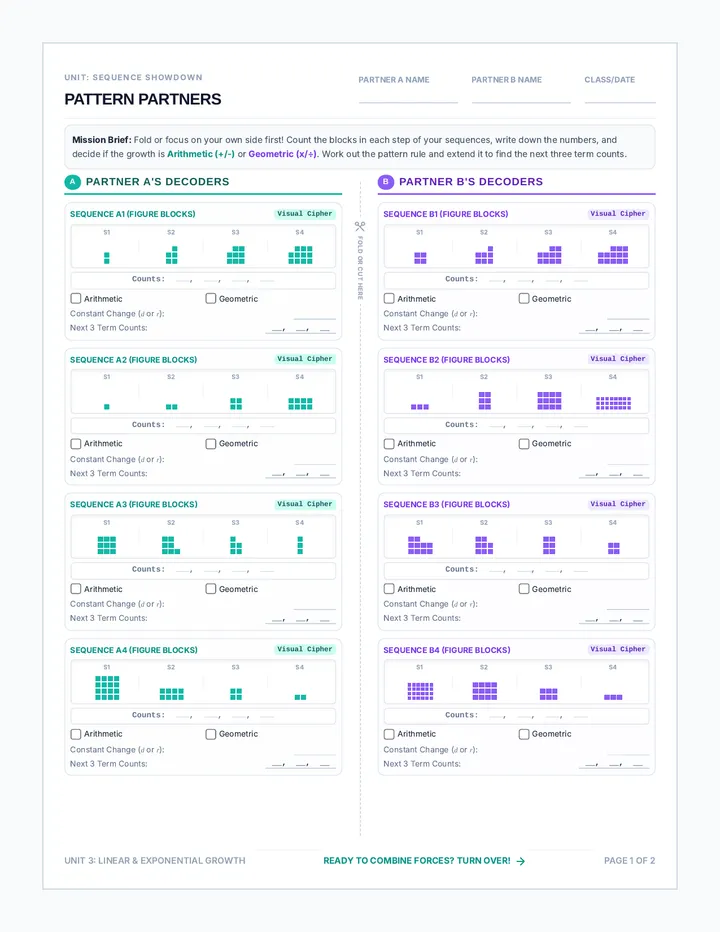
Pattern Partners Worksheet

Sequence Showdown

A collaborative partner lesson where students analyze, sort, and contrast arithmetic and geometric sequences. Partners work side-by-side to find common differences and ratios, extend sequences, and synthesize their understanding through deep conceptual comparisons.

M

mastronardil

2
Interest Insight Teacher Guide

Debt Detectives

An 8th-grade math mini-lesson exploring how credit card interest grows over time, comparing simple and compound growth, and analyzing the impact of late fees.

AG

Anna Gomez

3