Middle School Math Block A multi-subject middle school mathematics block for Week 1, covering 6th Grade Geometry (Temple Craftsmen: polygon decomposition, nets, surface area) and 7th/8th Grade Math (Faithful Stewards: proportional relationships, linear equations, inequalities, transversals) from a Christian perspective.
JR Jamens Ray II Temple Craftsmen
A 5-day lesson block for 6th Grade Geometry, focusing on constructing sacred spaces, decomposing composite altar planes, sketching Tabernacle tent nets, and calculating surface area.
Temple Craftsmen Slides
A 6-slide visual presentation guide for 6th Grade Math, organized strictly by Day (Day 1 to 5) to teach polygon decomposition, nets, and surface area of sacred structures using a temple craftsman theme, with no mentions of altars.
Temple Craftsmen Workbook
A comprehensive 10-page student geometry workbook containing daily practice sheets themed around building temples, altars, and folding models of the Tabernacle tent, featuring at least 5 questions per day.
Temple Craftsmen Quizzes
A 5-page compilation of daily 5-question quizzes to assess student progress in temple altar slicing, missing sanctuary dimensions, Tabernacle nets, and tapestry surface area.
Temple Craftsmen Rubric
A professional 1-page printable assessment rubric for grading student work in sacred space layouts, altar slicing, nets, and surface area calculations.
Temple Craftsmen Game Guide
A comprehensive 2-page teacher reference guide detailing supplies, building/running steps, and check-for-understanding prompts for all 5 temple craftsmen geometry games.
Temple Craftsmen Teacher Helper Guide
A comprehensive 2-page teacher reference script and analogy helper explaining 6th grade geometry concepts in an extremely simplified, kid-friendly way.
Temple Craftsmen Drill Sheets
A 2-page student math drill pack containing 25 specific practice questions on polygon decomposition, missing dimensions, nets, and surface area calculations.
Temple Craftsmen Teacher Cheat Sheet
A comprehensive 2-page teacher reference guide containing lesson overviews, common misconceptions, questioning prompts, and full step-by-step answer keys for the workbook, quizzes, and drill sheets.
Faithful Stewards
A 5-day lesson block for 7th and 8th Grade Math, focusing on biblical stewardship ratios, keeping business scales balanced, and navigating the straight transversals.
Faithful Stewards Slides
A 10-slide visual presentation guide for 7th and 8th Grade Math, strictly organized by Day and Grade level to teach rates, equations, inequalities, and transversal angle relationships using a Christian stewardship theme.
Faithful Stewards Workbook
A comprehensive 10-page student workbook containing daily practice sheets for 7th Grade proportional reasoning and 8th Grade equations, inequalities, and transversals themed around faithful biblical stewardship, with at least 5 questions per day.
Faithful Stewards Quizzes
A 5-page compilation of daily 5-question quizzes to assess student progress in 7th Grade proportional reasoning and 8th Grade equations, inequalities, and transversals.
Faithful Stewards Rubric
A professional 1-page printable assessment rubric for grading student work in 7th Grade proportions and 8th Grade algebraic equations and transversals.
Faithful Stewards Game Guide
A comprehensive 2-page teacher reference guide detailing supplies, building/running steps, and check-for-understanding prompts for all 5 math games.
Faithful Stewards Teacher Helper Guide
A comprehensive 2-page teacher reference script and analogy helper explaining 7th & 8th grade math concepts in an extremely simplified, kid-friendly way.
Middle School Notebook Slides
A highly structured, predictable 16-slide visual notebook copying guide tailored for students on the spectrum, featuring clear daily visual schedules, literal step-by-step math examples, and structured mini-quizzes.
Faithful Stewards Drill Sheets
A 2-page student math drill pack containing 25 specific practice questions on unit rates, constants of proportionality, variable-balancing equations, inequalities, and transversal angle proofs using a Christian stewardship theme.
Middle School Games Slides
A comprehensive 6-slide presentation containing all classroom games, rules, supplies, and interactive challenge boards for Grades 6-8 Math, organized by Day.
Faithful Stewards Icebreaker Slides
A comprehensive 13-slide revamped icebreaker presentation for 7th & 8th Grade, designed with predictable visual schedules, low-anxiety choice cards, and Christian fellowship values for students on the spectrum.
Bible Trivia Game Slides
An engaging, low-stress 10-slide visual hand-raise Bible trivia game designed with predictable choices, calm pacing, and unrevealed options without emojis for active classroom play.
Medium Bible Trivia Slides
An engaging, medium-difficulty 10-slide visual Bible trivia game designed with unrevealed multiple-choice options, calm pacing, and clear hand-raise turn rules for classroom play.
Hard Bible Trivia Slides
An engaging, hard-difficulty 10-slide visual Bible trivia game designed with unrevealed multiple-choice options, calm pacing, and clear hand-raise turn rules for classroom play.
Bible Trivia Answer Key
A comprehensive 2-page teacher reference guide containing complete solution keys, option letters, and scripture references for all classroom Bible games, including Easy, Medium, Hard, Prophecy, and Jeopardy.
Prophecy Fulfillment Trivia Slides
An engaging 10-slide visual hand-raise Bible trivia game connecting Old Testament Messianic prophecies to their Gospel fulfillments in Jesus Christ, designed with unrevealed options for classroom play.
Jeopardy Bible Game Slides
An engaging 14-slide Jeopardy-style Bible game featuring 3 categories (Old Testament Heroes, New Testament Miracles, Bible Wisdom & Numbers) with 100 to 400 point values.
Jeopardy Bible Game Kit
A 3-page printable classroom interactive game kit featuring a master game board, 12 tactile cut-out clue cards (100 to 400 points), and team scorekeeper sheets for physical hands-on play.
Parables & Covenants Trivia Slides
An engaging 10-slide visual hand-raise Bible trivia game featuring 8 fresh questions on the Parables of Jesus, designed with unrevealed options for classroom play.
Stewardship Economics
A 10-day Christian elective course in Economics & Personal Finance, covering scarcity, economic systems, supply/demand, indicators, fiscal/monetary policy, and financial stewardship.
Stewardship Economics Slides
A 10-slide visual presentation guide for the 10-day Stewardship Economics elective, strictly organized by Day to teach scarcity, market forces, macroeconomic health, and personal finance from a Christian stewardship perspective.
Stewardship Economics Workbook
A comprehensive 10-page student economics workbook containing daily practice and personal finance ledger sheets themed around wise stewardship, featuring at least 5 questions per day.
Stewardship Economics Quizzes
A 5-page compilation of daily 5-question quizzes to assess student progress in economic systems, market forces, indicators, fiscal policy, and financial stewardship.
Stewardship Economics Rubric
A professional 1-page printable assessment rubric for grading student portfolios, market charts, policy designs, and case study written justifications in the economics elective.
Stewardship Economics Game Guide
A comprehensive 2-page teacher reference guide detailing supplies, building/running steps, and check-for-understanding prompts for all 10 economics & personal finance games.
Stewardship Economics Teacher Helper Guide
A comprehensive 2-page teacher reference script and analogy helper explaining economics & personal finance concepts in an extremely simplified, kid-friendly way.
Stewardship Economics Drill Sheets
A 2-page student math drill pack containing 25 specific practice questions on scarcity, market supply/demand, macroeconomic indicators, and personal tithing budgets.
Stewardship Economics Teacher Cheat Sheet
A comprehensive 2-page teacher reference guide containing lesson overviews, common misconceptions, questioning prompts, and full step-by-step answer keys for the economics workbook, quizzes, and drills.
Stewardship Economics Games Slides
A comprehensive 11-slide presentation containing all classroom games, rules, supplies, and interactive challenge boards for the Stewardship Economics elective, organized by Day.
Data Stewards
A 10-day Christian algebra & statistics course for 9th Grade Math, covering one-variable statistics, center and spread, outliers, linear equations, and rearranging formulas from a stewardship perspective.
Data Stewards Slides
A 10-slide visual presentation guide for the 10-day 9th Grade Data Stewards course, strictly organized by Day to teach statistics, equations, inequalities, and formulas from a Christian perspective.
Data Stewards Workbook
A comprehensive 10-page student workbook containing daily practice sheets for 9th Grade statistics, equations, inequalities, and literal formulas, with at least 5 questions per page.
Data Stewards Quizzes
A 5-page compilation of daily 5-question quizzes to assess student progress in 9th Grade statistics, equations, inequalities, and literal formulas.
Data Stewards Rubric
A professional 1-page printable assessment rubric for grading 9th Grade statistics, equations, inequalities, and literal formulas portfolios.
Data Stewards Game Guide
A comprehensive 2-page teacher reference guide detailing supplies, building/running steps, and check-for-understanding prompts for all 10 math & statistics games.
Data Stewards Teacher Helper Guide
A comprehensive 2-page teacher reference script and analogy helper explaining 9th grade algebra and statistics concepts in an extremely simplified, kid-friendly way.
Data Stewards Drill Sheets
A 2-page student math drill pack containing 25 specific practice questions on center/spread, outlier boundaries, variable isolation equations, inequalities, and rearranging literal formulas.
Data Stewards Teacher Cheat Sheet
A comprehensive 2-page teacher reference guide containing lesson overviews, common misconceptions, questioning prompts, and full step-by-step answer keys for the workbook, quizzes, and drill sheets.
Symmetry Stewards
A 10-day Christian geometry course for 10th Grade Math, covering rigid transformations, reflection/rotational symmetry, triangle congruence criteria (SSS/SAS/ASA), and parallel line angle proofs from a stewardship perspective.
Symmetry Stewards Slides
A 10-slide visual presentation guide for the 10-day 10th Grade Symmetry Stewards course, strictly organized by Day to teach rigid transformations, symmetry, congruence, and parallel line proofs from a Christian perspective.
Symmetry Stewards Workbook
A comprehensive 10-page student geometry workbook containing daily practice sheets for 10th Grade transformations, symmetry, congruence, and parallel line proofs, with at least 5 questions per page.
Symmetry Stewards Quizzes
A 5-page compilation of daily 5-question quizzes to assess student progress in 10th Grade transformations, symmetry, congruence, and parallel line proofs.
Symmetry Stewards Rubric
A professional 1-page printable assessment rubric for grading 10th Grade geometry transformations, symmetry, congruence, and parallel line proofs portfolios.
Symmetry Stewards Game Guide
A comprehensive 2-page teacher reference guide detailing supplies, building/running steps, and check-for-understanding prompts for all 10 geometry games.
Symmetry Stewards Teacher Helper Guide
A comprehensive 2-page teacher reference script and analogy helper explaining 10th grade geometry concepts in an extremely simplified, kid-friendly way.
Symmetry Stewards Drill Sheets
A 2-page student math drill pack containing 25 specific practice questions on transformations, lines of symmetry, triangle congruence, and midsegment relationships.
Symmetry Stewards Teacher Cheat Sheet
A comprehensive 2-page teacher reference guide containing lesson overviews, common misconceptions, questioning prompts, and full step-by-step answer keys for the workbook, quizzes, and drill sheets.
Kingdom Functions
A 10-day Christian algebra & functions course for 11th Grade Math, covering domain and range, inverse relationships, evaluating function notation, factoring polynomial zeros, and the Remainder Theorem from a stewardship perspective.
Kingdom Functions Slides
A 10-slide visual presentation guide for the 10-day 11th Grade Kingdom Functions course, strictly organized by Day to teach function notation, inverses, factors, zeros, and the Remainder Theorem from a Christian perspective.
Kingdom Functions Workbook
A comprehensive 10-page student workbook containing daily practice sheets for 11th Grade statistics, equations, inequalities, and literal formulas, with at least 5 questions per page.
Kingdom Functions Quizzes
A 5-page compilation of daily 5-question quizzes to assess student progress in 11th Grade domain/range, inverses, function notation, factoring zeros, and the Remainder Theorem.
Kingdom Functions Rubric
A professional 1-page printable assessment rubric for grading 11th Grade domain/range, inverses, function notation, factoring zeros, and the Remainder Theorem portfolios.
Kingdom Functions Game Guide
A comprehensive 2-page teacher reference guide detailing supplies, building/running steps, and check-for-understanding prompts for all 10 algebra & functions games.
Kingdom Functions Teacher Helper Guide
A comprehensive 2-page teacher reference script and analogy helper explaining 11th grade algebra and functions concepts in an extremely simplified, kid-friendly way.
Kingdom Functions Drill Sheets
A 2-page student math drill pack containing 25 specific practice questions on domain/range, finding inverses, factoring polynomials to find zeros, and the Remainder Theorem.
Kingdom Functions Teacher Cheat Sheet
A comprehensive 2-page teacher reference guide containing lesson overviews, common misconceptions, questioning prompts, and full step-by-step answer keys for the workbook, quizzes, and drill sheets.
Middle School Math Block A multi-subject middle school mathematics block for Week 1, covering 6th Grade Geometry (Temple Craftsmen: polygon decomposition, nets, surface area) and 7th/8th Grade Math (Faithful Stewards: proportional relationships, linear equations, inequalities, transversals) from a Christian perspective.
JR Jamens Ray II
Temple Craftsmen Slides Grade 6 Geometry
Week 1 Block
TEMPLE CRAFTSMEN
Honoring God through precise geometry! Slice temple courtyard floorplans, construct tabernacles, and measure sacred spaces.
Floorplan Slicing Tent Nets Sacred Wrapping
Let's Learn Geometry!
DAY 1
Slicing Temple Floorplans!
Topic: Decomposition
The Floorplan Slice Analogy
If we are building an L-shaped temple courtyard, we chop it into two simple blocks to measure the area easily!
• Block A (Left): 4m × 10m = 40 m²
• Block B (Right): 8m × 5m = 40 m²
Total Area = 40 + 40 = 80 m²!
A B
We call this "Decomposition"—which is just a fancy word for chopping!
DAY 2
Slicing Slanted Roof Trusses!
Topic: Slanted Slices
Slanted Structural Trusses!
Some temple roofs and walkways are slanted. Use straight dividing lines to split them into Triangles and Rectangles !
• Triangle 1 Area: \(\frac{1}{2} \times b \times h\)
• Rectangle Area: \(b \times h\)
• Triangle 2 Area: \(\frac{1}{2} \times b \times h\)
No matter how you slice it, the total area space is always identical!
DAY 3
Finding Hidden Sanctuary Walls!
Topic: Parallel Math
The Parallel Puzzle
Some sanctuary walls don't have numbers on our blueprints. We look at other parallel walls to find them!
• Horizontal Wall: \(12 - 6 = \mathbf{6\ cm}\)
• Vertical Wall: \(10 - 5 = \mathbf{5\ cm}\)
Total Width = 12 cm 6 cm X = ? Total Height = 10 cm
Parallel lines must balance out perfectly on both sides of our temple layouts!
DAY 4
The Tabernacle Tent Net!
Topic: Nets
Unfolding the Sanctuary
The Tabernacle is shaped like a triangular prism. If we peel open the sides and lay it flat...
We see its 2D folding pattern, which we call a Net !
Nets show us every single face shape needed to fold a solid structure!
DAY 5
Wrapping Sacred Objects!
Topic: Surface Area
Total Outside Coverage!
How much gold leaf or tapestry paper is needed to fully cover a sacred pyramid box?
• Square Base Area: 6 × 6 = 36 cm²
• 4 Side Triangles (each): ½ × 6 × 5 = 15 cm²
Total SA = 36 + 4×15 = 96 cm²!
Surface area is just flat, outer face areas added up together!
Temple Craftsmen Workbook Temple Craftsmen • Day 1
Slicing Floorplans
NC.6.G.1
Name: _________________
Date: ________
Chop an L-shaped floorplan into two standard rectangles. Find each area and sum: \(Area = b \times h\).
Day 1 Exercises (5 Questions):
3 cm 4 cm 6 cm 7 cm
1. Area of Block A (Vertical):______ cm²
2. Area of Block B (Horizontal):______ cm²
3. Total Area = ______ cm²
• 4. A courtyard has a 12m × 8m rectangular lawn. An indented rect is 4m × 3m. What is the remaining grass area?
Answer: __________________ m²
• 5. True or False: Chopping an L-shape horizontally yields the same total area as chopping vertically.
Answer: __________________
KSR Learning Series © 2026 Page 1 of 10
Temple Craftsmen • Day 2
Slanted Structural Trusses
NC.6.G.1
For slanted structures, use dividing lines to split them into triangles and rectangles . Formula: \(Area = \frac{1}{2} \times b \times h\).
Day 2 Exercises (5 Questions):
8 in 7 in 12 in
1. Area of Rectangle:
2. Area of Triangle:
3. Total Area = ______ in²
• 4. A slanted truss has a base of 10 cm and height of 6 cm. What is its triangular area?
Answer: __________________ cm²
• 5. What is the area of a right triangle with base 8 in and height 12 in?
Answer: __________________ in²
KSR Learning Series © 2026 Page 2 of 10
Temple Craftsmen • Day 3
Hidden Sanctuary Walls
NC.6.G.1
Find unlabeled segment values on our blueprints by comparing them directly to parallel side dimensions.
Day 3 Exercises (5 Questions):
Total Width = 13 ft Total Height = 8 ft Known Width = 6 ft 4 ft Wall X = ?
1. Find Wall X (Horizontal): 13 - 6 = ______ ft
2. Find Wall Y (Vertical): 8 - 4 = ______ ft
3. Calculate Area of Rectangle 1 (13 × 4) = ______ ft²
4. Calculate Area of Rectangle 2 (7 × 4) = ______ ft²
5. Combined Total Area = ______ ft²
KSR Learning Series © 2026 Page 3 of 10
Temple Craftsmen • Day 4
Temple Craftsmen Quizzes Temple Craftsmen Assessment
Day 1 Quiz: Slicing Altar Stones
5 Questions • 5 Pts
Craftsman Name: _________________
Date: ________
1. What does it mean to "decompose" or slice a complex altar stone in geometry?
A To enlarge its size B To break it into simpler shapes (like rectangles) C To paint its border D To melt it down
2. An altar layout is made of a rectangle (5m × 3m) and a square (3m × 3m). What is the total combined area of the altar?
15 m² 18 m² 24 m² 45 m²
3. True or False: Slicing a composite altar stone in different directions (e.g. horizontally vs. vertically) will give you different total area values.
TRUE FALSE
4. An L-shaped sanctuary altar consists of two non-overlapping blocks. Block A is 8 ft × 4 ft, and Block B is 6 ft × 3 ft. What is the total area of the altar?
Answer: _______________________ sq ft
5. Draw a quick sketch of how you would chop this T-shaped altar stone into two rectangles:
Write down your formula strategy:
Temple Craftsmen Series Page 1 of 5
Temple Craftsmen Assessment
Day 2 Quiz: Slanted Altar Planes
5 Questions • 5 Pts
Craftsman Name: _________________
Date: ________
1. Besides rectangles, which geometric shape is most commonly used to slice slanted or irregular polygons?
A Circles B Triangles C Octagons D Ovals
2. A slanted altar is sliced into a rectangle (6 cm × 4 cm) and a right triangle with a base of 4 cm and a height of 3 cm. What is the total area?
24 cm² 30 cm² 36 cm² 12 cm²
3. When slicing an irregular stone, what must you do with the individual areas of all the sliced components to find the total area?
A Subtract them from each other B Multiply them together C Add them together D Divide the largest by the smallest
4. If an irregular slanted layout is partitioned into three triangles, each with an area of 14 in², what is the total combined area?
Answer: _______________________ sq in
5. Explain why different slice lines on the same altar layout still result in the exact same total area value.
Write your explanation here...
Temple Craftsmen Series Page 2 of 5
Temple Craftsmen Assessment
Day 3 Quiz: Sanctuary Blueprints
5 Questions • 5 Pts
Craftsman Name: _________________
Date: ________
1. On a temple blueprint, the total horizontal width is 18 feet. One known top wall segment is 10 feet. What is the remaining horizontal wall segment width?
Temple Craftsmen Rubric Temple Craftsmen • Teacher Resource
Geometry Assessment Rubric
CCSS.MATH.6.G
GRADING TOOL
Use this rubric to assess student notebooks, daily homework, and performance assessments in 6th Grade Area and Surface Area.
Evaluation Category Advanced (4 pts) Proficient (3 pts) Developing (2 pts) Beginning (1 pt) Strategic Decomposition (G6.G.1) Decomposes irregular polygons flawlessly. Selects highly efficient lines, resulting in minimal and simple components (rectangles and triangles). Decomposes polygons correctly into recognizable rectangles and triangles. Partition strategy is clear and logical. Partitions polygons but shapes are not standard, or contains overlapping sub-shapes that lead to counting errors. Unable to identify components or partition shapes. Shows minimal understanding of splitting geometry. Calculation Accuracy Calculates sub-areas, missing sides, and final composite/surface area with 100% precision. Arithmetic is flawless. Area and dimension calculations are correct with only 1 minor arithmetic or calculation error. Formula setups are correct. Calculations are partially correct. Contains multiple arithmetic errors, but follows correct general formula pathways. Major calculation errors. Does not use correct area or surface area formulas. Arithmetic is inconsistent. Net Sketching (G6.G.4) Draws perfect, mathematically scaled 3D nets on a grid. All face shapes match, bases are perfectly placed, and edges align perfectly. Draws a highly recognizable 2D net. Correct number and shapes of faces are shown, and coordinates align functionally. Draws a net with incorrect face proportions or misaligned bases (e.g. triangles do not meet properly at vertices). Fails to draw recognizable nets. Draws random shapes that cannot assemble into a 3D solid when folded. Written Reasoning Communicates complex reasoning eloquently. Explains how different partitions yield matching total area. Incorporates high-level geometry terms. Explains strategies clearly using math terms. Justifies division lines and calculations logic in complete, coherent sentences. Provides partial written explanations. Uses basic descriptions ("I split it") without describing the underlying mathematical reasons. Leaves explanations blank or provides answers that show no connection to mathematical logic or geometry terms.
SCORING SCALE: 14 - 16 Pts: Advanced (A) | 11 - 13 Pts: Proficient (B) | 8 - 10 Pts: Developing (C) | Below 8 Pts: Beginning (D/F)
Temple Craftsmen Game Guide Temple Craftsmen • Teacher Playbook
Geometry Game Setup Guide
Week 1 Games
TEACHER ONLY
Master Game Supplies:
• Graph paper, blank grid templates, cardboard shape pieces (squares, triangles, rectangles), printed prism/pyramid paper nets, scissors, clear tape, rulers, colored pencils, team scorecards, timers, and gold star tokens.
Day 1 Game • NC.6.G.1
Challenge: Altar Builders
Build & Run: Teams receive 3 irregular altar stones. Using rulers and colored pencils, students draw partition lines to slice each into simpler rectangles and triangles. They calculate individual areas and sum them.
• Supplies: Altar cards, rulers, colors.
• Check: Demand two different partition plans for the same shape!
Day 2 Game • NC.6.G.1ii
Challenge: Sanctuary Architects
Build & Run: Teams receive temple design sheets. They must sketch a functional floor plan that contains exactly 1 sanctuary room rectangle and 2 triangular closets. They label dimensions and compute total area.
• Supplies: Sanctuary templates, grid paper.
• Check: Ask why their partition works. Require square units!
Day 3 Game • NC.6.G.1
Challenge: Build the Sanctuary Lot
Build & Run: Teams receive blank sanctuary lots and physical cardboard shape pieces. They arrange tiles to create courtyard layouts (altar, grass) without overlapping. They calculate sections and total area.
• Supplies: Lot grids, shape tiles.
• Check: Verify diagram borders, math operations, and units.
KSR Learning Series © 2026 Page 1 of 2
Temple Craftsmen • Teacher Playbook
Geometry Game Setup Guide
Week 1 Games
TEACHER ONLY
Day 4 Game • NC.6.G.4
Challenge: Tabernacle Net Detective
Build & Run: Teams receive flat paper net sheets for the Tabernacle tents. Students inspect flat patterns and predict which ones will fold into a perfect solid. They cut, fold, tape, and calculate total surface area.
• Supplies: Printed nets, scissors, tape.
• Check: Require every single face to be labeled before adding!
Day 5 Game • NC.6.G.1
Challenge: Altar Boss Battle
Build & Run: Independent standards-based mastery day. Students receive composite-area and surface-area challenge cards. They work individually (no group help, no templates) to solve and defend their calculations in writing.
• Supplies: Challenge cards, rulers, pencils.
Temple Craftsmen Teacher Helper Guide Temple Craftsmen • Teacher Helper
Kid-Friendly Teaching Script
Grade 6 Math
SCRIPT PACK
This guide translates geometry into playful, simple stories. Use the verbal scripts and board sketches below to deliver effortless mini-lessons!
Concept 1: Slicing Altar Stones (Decomposition)
The Analogy: "If you are building an L-shaped temple altar stone, you don't try to lift and measure the whole thing at once! You slice it in half to make two neat rectangles that fit right in your hands."
Say This: "Hey math craftsmen! Look at this massive, funny L-shaped altar stone on the board. We don't have a formula for an L-shape, but we DO know how to find the area of a rectangle. Let's take our imaginary chisels and SLICE it right here! Zoom! Now we have two friendly rectangles: Block A and Block B. Let's find the area of both and add them up!"
Board Drawing: Draw a simple L-shape with a dashed orange dividing line.
Concept 2: Unfolded Tabernacle Tents (Nets)
The Analogy: "When craftsmen built the Tabernacle tent in the wilderness, they didn't construct it as a hard 3D solid. They made flat canvas patterns first, then folded and raised it together!"
Say This: "Pretend you are preparing the fabrics for the Tabernacle. If you lay the tent fabric completely flat on the floor, what shape does it make? In math, we call that flat pattern a Net! Look at this flat design: it has three rectangles and two triangles. If we fold it up, those triangles meet to make a tent-shaped sanctuary base!"
Board Drawing: Draw a basic cross-shaped net of a cube alongside a folded 3D cube.
KSR Learning Series © 2026 Page 1 of 2
Temple Craftsmen • Teacher Helper
Kid-Friendly Teaching Script
Grade 6 Math
SCRIPT PACK
Concept 3: Tapestry Coverings (Surface Area)
The Analogy: "If you are sewing a beautiful golden tapestry to fully cover a holy chest, you need enough fabric to cover every single outside wall of the chest. Not too little, not too much. Just enough to wrap it perfectly!"
Say This: "Craftsmen, we want to cover our sanctuary incense box with tapestries! To find out how much fabric we need, we can't just measure the floor. We have to measure the square floor AND the four triangular walls! Let's find the area of the square, calculate the area of the four triangles, and add them all up. That total is our Surface Area!"
Board Drawing: Draw a square pyramid net. Highlight and shade each face in a different color.
Run-Time Questioning Checklist:
Temple Craftsmen Drill Sheets Temple Craftsmen • Geometry Drills
Section A: Area & Dimensions
Fluency Practice
15 QUESTIONS
Name: _________________
Date: ________
Period: ___
Drill 1: Composite Altar Area Calculations (10 Questions)
Slice the composite structures below. Calculate the total combined area (formulas: Rect = b × h, Tri = ½ × b × h):
1. Rectangle A (4 × 5) joined with Square B (3 × 3).
______ m²
2. Rectangle A (10 × 2) joined with Rectangle B (6 × 4).
______ m²
3. Square A (6 × 6) joined with Right Triangle B (b=4, h=6).
______ m²
4. Rectangle A (8 × 3) joined with Triangle B (b=8, h=5).
______ m²
5. Two identical squares (5 × 5) joined corner-to-corner.
______ m²
6. Large Rect (12 × 8) with interior cut-out Rect (4 × 3).
______ m²
7. Right Triangle A (b=6, h=8) joined with Rectangle B (6 × 5).
______ m²
8. T-Shape: Top Rect (10 × 2), Vertical Column Rect (3 × 8).
______ m²
9. Arrow Shape: Rectangle shaft (2 × 8) joined with a triangular point base (b=8, h=4).
______ m²
10. Steps Shape: Three adjacent vertical rectangles (each 2m wide, heights of 3m, 5m, and 7m).
______ m²
Drill 2: Finding Parallel Missing Dimensions (5 Questions)
Calculate the missing wall segment value by comparing parallel dimension pairs:
11. Total Width = 20 ft. Left Segment = 12 ft. Find Missing Right Segment X: ______ ft
12. Total Height = 14 m. Bottom Segment = 9 m. Find Missing Top Segment Y: ______ m
13. Top Width = 8 cm. Bottom Left = 3 cm. Bottom Right = 2 cm. Find Missing Mid Segment X: ______ cm
14. Left Height = 18 in. Right Segment 1 = 6 in. Right Segment 2 = 5 in. Find Missing Segment Y: ______ in
15. Total Width = 35 yd. Inner Segment A = 15 yd. Inner Segment B = 10 yd. Find Remaining Segment X: ______ yd
Temple Craftsmen Series Page 1 of 2
Temple Craftsmen • Geometry Drills
Section B: Nets & Surface Area
Fluency Practice
10 QUESTIONS
Name: _________________
Date: ________
Period: ___
Drill 3: 3D Solids Nets Analysis (5 Questions)
Examine the descriptions of flat patterns. Write the name of the folded 3D solid it assembles into:
16. A flat net featuring 6 identical, connected squares: __________________
Temple Craftsmen Teacher Cheat Sheet Temple Craftsmen • Teacher Resource
Teacher Reference Cheat Sheet
Week 1 Instructional Guide
PEDAGOGY
Weekly Lesson Pacing Overview
Day 1: Decomposition
Split basic composite shapes into simple rectangles. Focus on horizontal vs vertical splits.
Day 2: Irregular Shapes
Deconstruct hexagons/pentagons into triangles + rectangles. Compare strategies.
Day 3: Missing Sides
Use parallel line subtraction/addition to find hidden lengths on custom floorplans.
Day 4: 3D Nets
Match flat 2D nets to 3D solid names (cube, prism, pyramid). Scale-draw a net on a grid.
Day 5: Surface Area
Sum the areas of all faces of unfolded nets. Introduce real-world wrapping tasks.
Common Student Misconceptions
1. Adding Internal Boundaries: Students often calculate the perimeter of composite shapes and attempt to add internal dividing lines. Reinforce that internal lines are strictly for splitting area, not counting border lengths.
2. Forgetting the Triangle "Half": In Day 2 and Day 5 calculations, students frequently calculate a triangle's area as \(base \times height\), forgetting to divide by 2. Draw a rectangle alongside the triangle to visually remind them it is exactly half of the rectangle!
3. Net Folding Confusion: When visualizing 3D nets, students struggle to see which edges fold to meet. Use physical paper printouts of nets for hands-on folding practice.
4. Misjudging Surface Area Units: Students often write units as cubic (\(cm^3\)) because the object is 3D. Emphasize that surface area is a flat, wrap-around cover, so it must use square units (\(cm^2\)).
Strategic Questioning Prompts
During Decomposition
"If we split this polygon horizontally instead of vertically, what happens to the individual areas? Why does the total sum remain identical?"
During Net Representation
"How can you look at a flat 2D net and immediately know if it will form a prism or a pyramid when folded? What faces do you look for?"
KSR Learning Series © 2026 Page 1 of 2
Temple Craftsmen • Teacher Resource
Workbook, Quiz, & Drills Answer Key
Week 1 Solutions
SOLUTIONS
Workbook & Quiz Answers
• Workbook Day 1: Rect A = 18. Rect B = 12. Total = 30 cm² . Stairs total = 22 m² .
• Workbook Day 2: Rect (8×7=56) + Tri (½×4×7=14). Total =
Faithful Stewards Slides Grades 7 & 8 Combined Math
Week 1 Block
FAITHFUL STEWARDS
Honoring God with fair sharing ratios, balanced business scales, and navigating the straight and narrow transversals.
Sharing Ratios Balance Scales Straight Crossroads
Let's Play Math!
DAY 1
7th Grade: Sharing Ratios (Unit Rates)
Topic: Unit Rates
Stewardship means sharing resources fairly. Divide total cups of water by the number of travelers to find the unit rate \(k\)!
• 3 Travelers drink 12 gallons of water.
• Divide: \(12 \div 3 = \mathbf{4}\) gallons/person!
Equation: \(y = 4x\)
Steward Rule: Unit rate is always how much for exactly ONE traveler!
DAY 1
8th Grade: Keeping Business Scales Balanced
Topic: Inverse Steps
Biblical business uses honest balances! Solve by performing the same operations on both sides to isolate variable x!
Original: \(3(x + 4) = 27\)
• Distribute 3: \(3x + 12 = 27\)
• Subtract 12: \(3x = 15\)
• Divide by 3: \(x = 5\)!
Steward Rule: Keep both sides of the equals sign perfectly balanced!
DAY 2
7th Grade: The Constant Multiplier \(k\)
Topic: Direct Variation
Find the constant multiplier \(k\) and write the direct variation formula: \(y = kx\) .
• Gallons (\(x\)): 4, 8, 12
• Miles (\(y\)): 80, 160, 240
k = 80/4 = 20 ⇒ Formula: \(y = 20x\)!
Steward Rule: Direct formulas link x and y with a single, unchanging rate!
DAY 2
8th Grade: Variables on Both Sides
Topic: Solution Types
Move variable terms to one side. Simplify to discover the solution type !
• \(x = 4\): One unique answer.
• \(5 = 12\): No solution (false statement!).
• \(8 = 8\): Infinite solutions (always true!).
Steward Rule: If letters disappear, look closely at the remaining numbers!
DAY 3
7th Grade: Honest Proportional Tables
Topic: Table Proofs
A table represents direct proportional variation (honest sharing) ONLY if dividing y by x always gives the same number!
• Table A: 10/2 = 5, 20/4 = 5 → PROPORTIONAL!
Faithful Stewards Workbook Faithful Stewards • Day 1
Measuring Steps & Balance Scales
NC.7.RP / NC.8.EE
Ranger: _________________
Date: ________
7th Grade: Sharing Ratios
Find the gallons of water just ONE person gets on our desert mapping table:
People (x) Gallons (y) 3 people 12 gallons 5 people 20 gallons
1. Find y/x row 1: 12 ÷ 3 = ______
2. Find y/x row 2: 20 ÷ 5 = ______
3. Unit rate k = ______ gallons/person
8th Grade: Balance the scale!
Solve by performing the exact same operations on both sides of the equals sign:
• 4. Distribute 3: \(3(x + 4) = 27 \implies 3x + 12 = 27\)
• 5. Subtract 12 and divide by 3: \(3x = 15 \implies \mathbf{x = \_\_\_\_\_\_}\)
KSR Learning Series © 2026 Page 1 of 10
Faithful Stewards • Day 2
Balanced Letters & Steps
NC.7.RP / NC.8.EE
7th Grade: Constants & Equations
• Gallons (x): 4, 8, 12
• Miles (y): 80, 160, 240
1. k = ______ miles/gallon
2. Form: \(y = kx\) → y = ______ x
3. Find miles (y) if gallons (x) = 15: y = ______
8th Grade: Variables on Both Sides
Move variable terms to one side. Tell if there is one, none, or infinite solutions:
• 4. Solve: \(4x + 6 = 2x + 14 \implies 2x = 8 \implies \mathbf{x = \_\_\_\_\_\_}\)
• 5. Solve: \(3x + 5 = 3x + 12 \implies \mathbf{5 = 12}\) → Solution: ______
KSR Learning Series © 2026 Page 2 of 10
Faithful Stewards • Day 3
Proportionality & Inequalities
NC.7.RP / NC.8.EE
7th Grade: Proportional vs. Non-Proportional
• Table A: (2, 10), (4, 20) → Ratio = ______
1. Table A PROPORTIONAL: YES / NO
• Table B: (1, 120), (2, 200) → Ratio = ______
2. Table B PROPORTIONAL: YES / NO
3. Write direct variation equation for Table A: y = ______ x
8th Grade: Inequalities & Number Lines
Solve the inequality. Remember to flip the sign arrow if you divide by a negative!
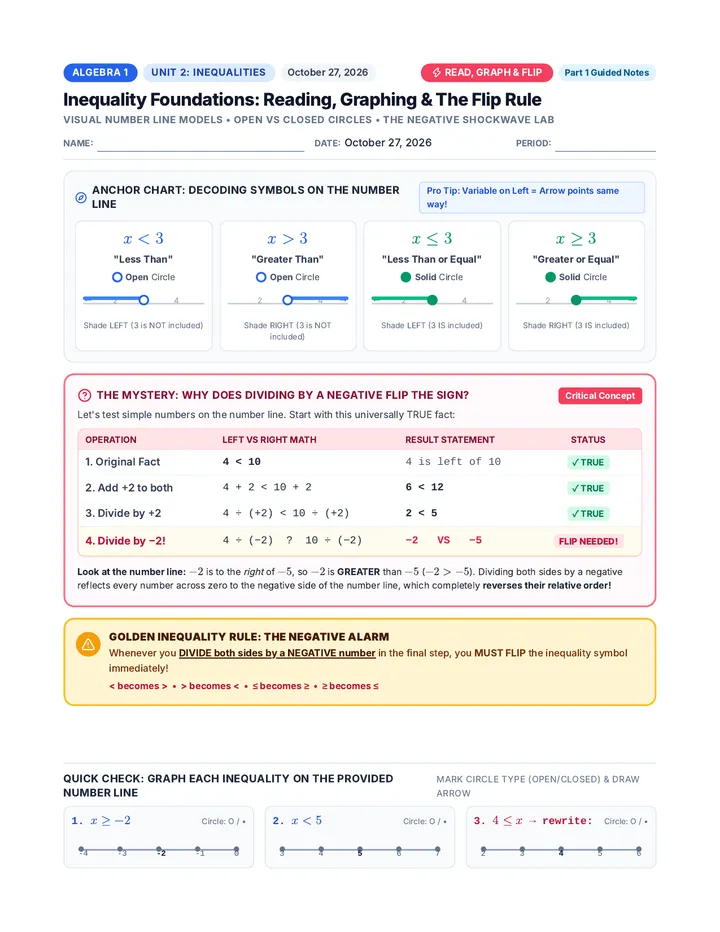
• 4. Solve: \(-2x + 8 > 14 \implies -2x > 6 \implies \mathbf{x \_\_\_\_\_\_}\)
Faithful Stewards Quizzes Faithful Stewards Assessment
Day 1 Quiz: Rates & Multi-Step Equations
5 Questions per Grade
Steward: _________________
Date: ________
Grade: 7th / 8th
7th Grade Proportions
1. A truck travels 90 miles on 3 gallons of fuel. What is its unit rate in miles per gallon?
A 20 mpg B 30 mpg C 40 mpg D 50 mpg
2. What constitutes a "proportional" relationship between x and y in a data table?
The differences are always identical The ratio \(\frac{y}{x}\) remains constant
3. Table values: (2, 8), (4, 16), (5, 20). Is this relationship proportional? If yes, what is k?
Answer: _______________________
4. A direct variation relationship has a constant rate of k = 6. What is the value of y when x = 4?
10 1.5 24 36
5. Write the direct proportional equation for a constant unit rate of k = 12.
y = _______________________
8th Grade Equations
1. Solve the multi-step algebraic equation: \(3(x - 5) = 15\)
A x=5 B x=10 C x=0 D x=20
2. When solving an equation, what is the core purpose of performing "inverse operations" on both sides?
To isolate the variable on one side To change the variable's value
3. Solve: \(-4x + 9 = -11\). Show your balanced inverse steps.
Answer: _______________________
4. What is the first step you should perform to solve the equation: \(\frac{x}{3} - 4 = 6\)?
Multiply both sides by 3 Add 4 to both sides
5. Solve: \(5x + 14 = 34\)
x = _______________________
Faithful Stewards Series Page 1 of 5
Faithful Stewards Assessment
Day 2 Quiz: Constant k & Variable Balances
5 Questions per Grade
Steward: _________________
Date: ________
Grade: 7th / 8th
7th Grade Proportions
1. If \(y\) varies directly with \(x\), and \(y = 20\) when \(x = 4\), what is the value of the constant rate \(k\)?
A 2 B 4 C 5 D 8
2. Write the direct proportional equation for a dataset where k = 0.5.
Answer: _______________________
3. In the direct proportional variation formula \(y = kx\), what mathematical operation occurs between constant k and variable x?
Addition Multiplication
4. A map's scale varies proportionally. If 2 inches represents 50 miles, what is the scale constant k in miles/inch?
25 miles/inch 50 miles/inch
5. Values: (3, 15), (6, 30), (10, y). If proportional, solve for y.
Faithful Stewards Rubric Faithful Stewards • Teacher Resource
Grades 7 & 8 Assessment Rubric
NC.7.RP / NC.8.EE / G.5
GRADING TOOL
Use this rubric to assess student notebooks, daily homework, and combined-grade performance assessments in 7th/8th Grade Proportions, Equations, and Transversals.
Evaluation Category Advanced (4 pts) Proficient (3 pts) Developing (2 pts) Beginning (1 pt) Proportional Reasoning (7th Grade) Discovers constant k flawlessly. Perfectly connects tables, direct equations (\(y = kx\)), and graphs. Identifies non-proportional datasets with clear proof. Calculates unit rates correctly. Writes matching equations and plots coordinate points with only minor inaccuracies. Calculates ratios but struggles to connect to the linear equation format. Plots coordinates with multiple quadrant or intercept errors. Unable to calculate basic unit rates or fill proportional tables. Shows fundamental confusion of ratios. Equations & Isolation (8th Grade) Solves variables on both sides with complete accuracy. Isolates variables flawlessly, flips inequality signs properly, and graphs solutions correctly. Solves equations and inequalities using inverse steps with only 1 minor arithmetic or formatting slip. Graphs boundaries correctly. Solves equations but forgets to flip the inequality sign with negative multipliers, or fails to maintain balanced sides. Major errors in variable isolation. Cannot identify inverse operations. Leaves equation workspaces blank. Transversals & Parallel lines (8th) Flawlessly identifies corresponding, vertical, alternate interior, and supplementary angles. Solves missing angle weights with 100% logic. Correctly identifies transversal angle relationships and solves missing values with only 1 minor logical slip. Struggles to identify angle categories. Confuses supplementary sums (180°) with complementary sums (90°). Unable to solve angles crossed by transversals. Fails to recognize congruent parallel line pairs. Written Explanations & Reasoning Defends mathematical strategies eloquently. Explains solution types and transversal alignments using high-level vocabulary and complete logic. Explains strategy clearly. Uses standard mathematical vocabulary properly to justify actions in complete sentences. Provides partial written explanations. Uses basic descriptions ("I split it") without describing the underlying mathematical reasons. Leaves explanations blank or provides answers that show no connection to mathematical logic or geometry terms.
Faithful Stewards Game Guide Faithful Stewards • Teacher Playbook
Grades 7 & 8 Game Setup Guide
Week 1 Games
TEACHER ONLY
Combined-Grade Management System:
• The Teacher Table: Spend 5-8 minutes teaching Grade A's mini-lesson while Grade B completes a warm-up or independent task. Then, switch! During games, circulate to check answers and pull students for 2-minute whiteboard reteaches.
Day 1 Games • NC.7.RP.1 / NC.8.EE.7
Stewardship Store (7th) vs. Honest Equation Battle (8th)
7th Grade: Students shop deal cards (e.g., 4 water bottles for $8). They calculate the cost of 1 bottle and explain the unit rate before "purchasing". 8th Grade: Whiteboard showdown! Solve multi-step equations one at a time. Hold up boards on the buzzer.
• 7th Supplies: Deal cards, fake money.
• 8th Supplies: Mini-whiteboards, dry-erase markers.
Day 2 Games • NC.7.RP.2.b / NC.8.EE.7ii
Mystery Rate K Matching (7th) vs. Equation Escape (8th)
7th Grade: Match table, equation, and graph cards with the same constant rate k. 8th Grade: Solve 5 equations. The answer values combine into a secret keypad code to escape the desert outpost!
• 7th Supplies: Matching envelopes, cards.
• 8th Supplies: Keypad clue sheets, optional locks.
Day 3 Games • NC.7.RP.2.a / NC.8.EE.7i
Honest Ratios or NOT (7th) vs. Solution Type Sort (8th)
7th Grade: Sort card datasets into "Proportional" or "Non-Proportional" piles and justify mathematically. 8th Grade: Sort equations under 3 target signs: One, None, or Infinite solutions.
• 7th Supplies: Sorting boards, tables/graphs.
• 8th Supplies:Whiteboards, sorting sign labels.
KSR Learning Series © 2026 Page 1 of 2
Faithful Stewards • Teacher Playbook
Grades 7 & 8 Game Setup Guide
Week 1 Games
TEACHER ONLY
Day 4 Games • NC.7.RP.2.c / NC.8.G.5
Stewardship Graph It (7th) vs. Inequality War (8th)
7th Grade: Match direct proportional equation cards to coordinate grid lines, then plot and draw them on paper. 8th Grade: Fast-paced inequality battle. Flip cards, solve on whiteboards, and place correct boundaries on coordinate strips. Higher boundary value wins!
• 7th Supplies: Coordinate sheets, rulers.
• 8th Supplies: Number line strips, inequality cards.
Day 5 • Mastery Boss Battles
Faithful Stewards Teacher Helper Guide Faithful Stewards • Teacher Helper
Kid-Friendly Teaching Script
Grades 7 & 8 Math
SCRIPT PACK
This helper guide translates combined-grade algebra and rates into playful, biblically grounded stories. Use these scripts and board drawings to guide Period 2 smoothly!
Concept 1: Sharing Ratios (7th Grade Rates)
The Analogy: "If you have a big basket of bread and fish for a crowd of hungry travelers, you want to make sure everyone gets an honest, equal portion! You divide the total food by the number of travelers to see what one person's fair share is!"
Say This: "Stewards! Look at this water table. 3 travelers drink 12 gallons. How much is that for just ONE person? Let's share 12 gallons among 3 people: \(12 \div 3 = 4\) gallons! That's our unit rate k. Since everyone gets the same fair share, we can write our formula: \(y = 4x\)! Now we can predict water for any number of travelers!"
Board Drawing: Draw 3 person stick figures leading to 4 water drop icons each.
Concept 2: Balancing Honest Scales (8th Grade Equations)
The Analogy: "The Bible tells us to use honest balances in our business. If you have weights on a balance scale, both sides must remain perfectly level! If you add weight to one side, you must add the exact same weight to the other!"
Say This: "Stewards, look at this equation: \(5x + 12 = 2x + 27\). The equals sign is our balance scale center. We have mystery weights (x) and constants on both sides! To keep the scale balanced, let's remove \(2x\) from both sides. Zoom! Now we have \(3x + 12 = 27\). Let's subtract 12 from both sides next! \(3x = 15\). Divide by 3, and our mystery x is exactly 5!"
Board Drawing: Draw a simple balancing hanger scale with 5 blocks + 12g balancing 2 blocks + 27g.
KSR Learning Series © 2026 Page 1 of 2
Faithful Stewards • Teacher Helper
Kid-Friendly Teaching Script
Grades 7 & 8 Math
SCRIPT PACK
Concept 3: The Straight & Narrow Crossroads (8th Grade Transversals)
The Analogy: "If you walk down two straight parallel tracks representing a straight path, and a slanted crossroad cuts straight across both... the corners at the top crossroad are identical twin angles to the corners at the bottom crossroad!"
Say This: "Look at this map. These two parallel orange lines are straight pathways. The slanted line is our crossroad. Look at Angle A (top right) and Angle B (bottom left, alternate interior). They are inside the tracks and on opposite sides of the street. They are congruent twins! If Angle A is 65°, Angle B is exactly 65° too!"
Middle School Notebook Slides Structured Math Notebook Guide
Grades 6 - 8
DAILY NOTEBOOK BLUEPRINTS
A highly predictable, step-by-step visual copying guide for your daily math journal.
Predictable Layouts Literal Examples Visual Schedules
My Quiet Math Journal
DAY 1
Day 1: Notes & Vocabulary
1. COPY NOTES 2. SEE EXAMPLES 3. QUIZ
GRADE 6 GEOMETRY
Slicing Courtyards
Draw a straight dotted line to cut a composite L-shape into two separate rectangles. Calculate both areas and add them: \(Area = b \times h\) .
Literal Vocabulary:
• Decomposition: Drawing lines to cut a big shape.
• Area: Number of grid squares inside.
GRADE 7 MATH
Sharing Ratios
Divide total gallons of water (y) by total people (x) to find gallons for exactly ONE person : \(k = \frac{y}{x}\) .
Literal Vocabulary:
• Ratio: One number divided by another.
• Unit Rate (k): The amount for exactly ONE.
GRADE 8 MATH
Balance Scales
Equations are like balance scales. To find x, perform identical operations on the left and right sides.
Literal Vocabulary:
• Equation: Two equal expressions.
• Inverse: The opposite operation.
Spectrum Guide: Copy the highlighted vocabulary boxes exactly as shown. Use quiet voices.
DAY 1
Day 1: Solved Step-by-Step Examples
1. COPY NOTES 2. SEE EXAMPLES 3. QUIZ
G6: L-Shape division
Predictable step-by-step:
Step 1: Slice vertically.
Step 2: Area A = \(3 \times 6 = \mathbf{18\ m^2}\)
Step 3: Area B = \(4 \times 3 = \mathbf{12\ m^2}\)
Step 4: Total = \(18 + 12 = \mathbf{30\ m^2}\)
G7: 12 gal for 3 people
Predictable step-by-step:
Step 1: Identify inputs (3) & outputs (12).
Step 2: Divide output ÷ input.
Step 3: \(k = \frac{12}{3} = \mathbf{4}\) gallons/person
Step 4: Formula: \(y = 4x\)
G8: Solving \(3(x+4)=27\)
Predictable step-by-step:
Faithful Stewards Drill Sheets Faithful Stewards • Math Drills
Section A: Stewardship Ratios & Equations
Fluency Practice
15 QUESTIONS
Name: _________________
Date: ________
Period: ___
Drill 1: Biblical Stewardship Ratios (10 Questions)
Calculate the constant unit rate (k = y/x) and write its variation equation (y = kx):
1. Point (2, 10). Find k and write equation:
y = ______ x
2. Point (3, 18). Find k and write equation:
y = ______ x
3. Point (5, 2.5). Find k and write equation:
y = ______ x
4. Point (8, 48). Find k and write equation:
y = ______ x
5. Map Scale: 3 inches represents 120 miles. Find k (miles/inch):
k = ______
6. Double Number Line: 4 cups of oil for every 10 loaves of bread. Find k (oil/bread):
k = ______
7. Store price: 5 sacks of grain cost $45. Find the unit price (k):
k = $______/sack
8. Walking rate: Messenger covers 15 miles in 6 hours. Find speed k (miles/hour):
k = ______ mph
9. Water storage: Sanctuary cistern loses 30 gallons in 12 days. Find k (gallons/day):
k = ______ gpd
10. Scale model: 1.5 cm represents 30 meters on temple blueprint. Find scale k:
k = ______ m/cm
Drill 2: Scales of Justice Balance (5 Questions)
Solve the following algebraic equations using inverse operations to balance the scales:
11. Solve for x: \(3(x + 4) = 27\) x = ______
12. Solve for x: \(2x - 7 = 15\) x = ______
13. Solve for x: \(5(x - 2) = 15\) x = ______
14. Solve for x: \(\frac{x}{3} - 4 = 6\) x = ______
15. Solve for x: \(-2x + 9 = -11\) x = ______
KSR Learning Series © 2026 Page 1 of 2
Faithful Stewards • Math Drills
Section B: Solution Types & Transversal Paths
Fluency Practice
10 QUESTIONS
Name: _________________
Date: ________
Period: ___
Drill 3: Solution Type Classification (5 Questions)
Simplify each linear equation. State whether it has One Unique , No , or Infinite solutions:
16. Equation: \(2x + 7 = 2x + 15\) → simplified: \(7 = 15\) __________________
17. Equation: \(4(x + 2) = 4x + 8\) → simplified: \(8 = 8\) __________________
18. Equation: \(5x + 14 = 34\) → simplified: \(5x = 20 \implies x = 4\) __________________
Middle School Games Slides Middle School Math Games
Week 1 Board
MATH GAME SHOWDOWN
Rules, supplies, and live game challenges for Grades 6, 7, and 8!
Slice Shapes (G6) Unit Rates (G7) Balance Scales (G8)
Let's Play & Learn!
DAY 1 GAMES
Day 1: Slicing & Balance Showdown
15 Minute Game Limit
6TH GRADE
Shape Builders
Slices irregular floorplans. Find smaller areas and sum them.
• Supplies: Shape tiles, rulers.
• Goal: Solve 3 card shapes!
7TH GRADE
Unit Rate Store
Shop at the desert outpost. Calculate the cheapest price of 1 water bottle!
• Supplies: Deal cards, fake money.
• Goal: Buy the best deal!
8TH GRADE
Equation Battle
Fast whiteboard battle! Solve one equation at a time on the buzzer.
• Supplies: Whiteboards, markers.
• Goal: Solve & justify first!
No guess rule: Show your balanced steps before scoring gold stars!
DAY 2 GAMES
Day 2: Design & Escape Showdown
15 Minute Game Limit
6TH GRADE
Area Architects
Design a house layout on paper with 1 main room and 2 triangular closets!
• Supplies: Grid templates, rulers.
• Goal: Label every wall!
7TH GRADE
Mystery K Match
Table, graph, and equation cards are hidden. Match them with matching constant k!
• Supplies: Envelope packs, cards.
• Goal: Group the matching sets!
8TH GRADE
Equation Escape
Solve 5 balanced equations. The final values combine to unlock the keypad code!
• Supplies: Clue sheets, lock boxes.
• Goal: Solve all & unlock first!
No guess rule: Show your balanced steps before scoring gold stars!
DAY 3 GAMES
Day 3: Sorting & Lot Design Showdown
15 Minute Game Limit
6TH GRADE
Build the Lot
Design a playground lot. Arrange standard cardboard tiles without overlapping!
• Supplies: Lot templates, shape tiles.
• Goal: Sum up all section areas!
7TH GRADE
Proportional or NOT
Collect tables and graphs. Sort them into "Proportional" or "NOT" and justify!
• Supplies: Sorting boards, tables.
Faithful Stewards Icebreaker Slides Grades 7 & 8 Community Day
Orientation
WELCOME TO OUR CLASS!
A safe, peaceful space to meet people, have fun, and learn how our classroom community works together.
Be Respectful Be Yourself Safe Environment
You Belong Here!
SCHEDULE
Today's Visual Roadmap
Predictable Order
Our 5 Steps Today:
1 60-Second Match Challenge
2 Low-Stress Choice Games
3 Speed-Connections & Bingo
4 Teacher Speed Round
5 3-Question Exit Ticket
Ways You Can Participate:
Choose the method that feels comfortable for you:
• Option A: Speak out loud to the group.
• Option B: Write your answers on a whiteboard.
• Option C: Point or show hand gestures.
• Option D: Work quietly with a single partner.
Need a break? Show your teacher the quiet break sign anytime!
Our Goal: A calm, encouraging classroom for everyone.
OPENER
Connection Match Challenge!
Timer: 60 Seconds
Find 1 Thing in Common!
Look at your nearest neighbor. Find ONE thing you both share in common!
Challenge Rule:
It cannot be: "we go to this school", "we are in 7th/8th grade", or "we are humans"!
Helpful Ideas to Ask:
🐕 Do you have a pet?
🎨 Favorite drawing hobby?
🍕 Favorite meal/snack?
🎮 Favorite video game?
🎵 Favorite worship song?
☀️ Favorite season?
Be ready to share your match in one short sentence!
GAME #1
Two Truths & A Made-Up Fact!
Honesty & Fun
Can your classmates spot the fake?
On your paper or whiteboard, write down 3 statements about yourself:
• 2 Statements: Must be 100% TRUE facts!
• 1 Statement: A made-up fun story.
How Classmates Vote:
1. The volunteer reads all 3 statements.
2. Classmates vote by holding up 1, 2, or 3 fingers.
3. Reveal the true facts and celebrate interesting hobbies!
Tip: Keep made-up facts creative and believable!
Bible Trivia Game Slides Classroom Bible Game
Raise Your Hand!
KINGDOM TRIVIA QUEST
A calm, friendly game to celebrate Bible stories, test our knowledge, and encourage one another.
1. Read the Question 2. Raise a Calm Hand 3. Share Your Choice!
Indoor quiet voices
QUESTION 1
The Days of Creation
Genesis 1
On Day 1 of Creation, what did God speak into existence?
Raise your hand to choose A, B, or C:
A "Let there be ocean fish"
B "Let there be light!"
C "Let there be mountains"
Hint: Look at the very beginning of Genesis 1!
QUESTION 2
Noah's Ark Messenger
Genesis 8
Which gentle bird flew back carrying an olive leaf branch?
Raise your hand to choose A, B, or C:
A A peaceful Dove
B A soaring Eagle
C A colorful Parrot
Hint: This bird is a universal symbol of peace and comfort!
QUESTION 3
King Solomon's Prayer
1 Kings 3
When God asked Solomon what he desired, what did he request?
Raise your hand to choose A, B, or C:
A Chest of gold coins
B Wisdom and a discerning heart
C A giant army of chariots
Hint: Solomon wanted understanding to lead God's people well!
QUESTION 4
David at the Brook
1 Samuel 17
How many smooth stones did young David collect from the stream?
Raise your hand to choose A, B, or C:
A 1 single stone
B 5 smooth stones
C 12 river stones
Hint: He put them into his shepherd's pouch before meeting Goliath!
QUESTION 5
Jonah's Journey
Jonah 1
What creature did the Lord provide to rescue Jonah in the deep sea?
Raise your hand to choose A, B, or C:
A A great fish / whale
B A friendly sea turtle
C A fishing rowboat
Hint: Jonah spent 3 days and 3 nights praying inside this ocean giant!
QUESTION 6
The Famous Psalm
Psalm 23
How does the famous Psalm 23 begin?
Raise your hand to choose A, B, or C:
A "The Lord is my Shepherd, I shall not want."
Medium Bible Trivia Slides Medium Challenge Trivia
Level 2 Quest
KINGDOM SCHOLAR TRIVIA
A medium-difficulty hand-raising quest covering Old and New Testament history, kings, and prophets!
1. Read the Question 2. Raise a Calm Hand 3. Choose A, B, or C!
Level: Medium
QUESTION 1
Old Testament Longevity
Genesis 5:27
Who is recorded as the oldest living man in the Bible (living 969 years)?
Raise your hand to choose A, B, or C:
A Abraham
B Methuselah
C Enoch
Hint: He was the grandfather of Noah!
QUESTION 2
Interpreter of Dreams
Genesis 41
Who interpreted Pharaoh's dream of seven healthy cows and seven thin cows?
Raise your hand to choose A, B, or C:
A Daniel
B Joseph of Egypt
C Aaron
Hint: He was given a coat of many colors by his father Jacob!
QUESTION 3
The Sacred Mountain
Exodus 19
On which mountain did Moses receive the Ten Commandments from God?
Raise your hand to choose A, B, or C:
A Mount Sinai
B Mount Carmel
C Mount of Olives
Hint: It is also called Mount Horeb in scripture!
QUESTION 4
River of the Gospels
Matthew 3:13
In which river was Jesus baptized by John the Baptist?
Raise your hand to choose A, B, or C:
A The Nile River
B The Jordan River
C The Euphrates River
Hint: The Israelites also crossed this river to enter the Promised Land!
QUESTION 5
The Called Disciple
Matthew 9:9
Which apostle worked as a tax collector before answering Jesus' call?
Raise your hand to choose A, B, or C:
A Simon Peter
B Matthew (Levi)
C James the Son of Zebedee
Hint: He wrote the first gospel account in the New Testament!
QUESTION 6
Bible Structure
Canon Structure
How many books are in the New Testament?
Raise your hand to choose A, B, or C:
A 39 books
B 27 books
C 66 books
Hard Bible Trivia Slides Master Challenge Trivia
Level 3 Quest
KINGDOM MASTER TRIVIA
A hard-difficulty hand-raising quest covering deep biblical history, prophets, ancient languages, and scriptural details!
1. Read the Question 2. Raise a Calm Hand 3. Choose A, B, or C!
Level: Hard
QUESTION 1
The Priest of Salem
Genesis 14 & Hebrews 7
Who was the King of Salem and Priest of God Most High who brought bread and wine to Abraham?
Raise your hand to choose A, B, or C:
A Melchizedek
B Abimelech
C Jethro
Hint: Abraham gave him a tithe of tenth of everything!
QUESTION 2
Tribal Allotments
Joshua 13:33
Which tribe of Israel did not receive a physical territory of land because the Lord was their inheritance?
Raise your hand to choose A, B, or C:
A Tribe of Benjamin
B Tribe of Levi (The Levites)
C Tribe of Dan
Hint: They were consecrated to serve as priests in the Tabernacle!
QUESTION 3
First Convert in Europe
Acts 16:14
In the city of Philippi, which businesswoman and seller of purple cloth became Paul's first European convert?
Raise your hand to choose A, B, or C:
A Priscilla
B Lydia of Thyatira
C Phoebe
Hint: The Lord opened her heart while sitting by the riverside!
QUESTION 4
The Revelation Island
Revelation 1:9
To which Aegean island was the Apostle John exiled when he recorded the Book of Revelation?
Raise your hand to choose A, B, or C:
A The Island of Crete
B The Island of Patmos
C The Island of Malta
Hint: He was on this island "for the word of God and the testimony of Jesus"!
QUESTION 5
The Three Youths
Daniel 1:6-7
What were the original Hebrew names of Shadrach, Meshach, and Abednego?
Raise your hand to choose A, B, or C:
A Hananiah, Mishael, & Azariah
B Shem, Ham, & Japheth
C Eliphaz, Bildad, & Zophar
Hint: These faithful Hebrew youths stood firm in the fiery furnace!
QUESTION 6
The Valley of Dry Bones
Bible Trivia Answer Key Kingdom Trivia • Master Teacher Key
Bible Trivia & Jeopardy Answer Key
Classroom Games Guide
SOLUTIONS BOOKLET
Teacher reference containing complete solutions, option letters, and scripture citations for all classroom trivia and Jeopardy games.
Level 1: Easy Trivia Solutions (8 Questions)
EASY
• Q1: Creation Day 1 → B ("Let there be light!") (Gen 1:3)
• Q2: Noah's Messenger → A (A Dove 🕊️) (Gen 8:11)
• Q3: Solomon's Prayer → B (Wisdom & Understanding) (1 Ki 3:9)
• Q4: David at Brook → B (5 Smooth Stones) (1 Sam 17:40)
• Q5: Jonah's Rescue → A (A Great Fish / Whale) (Jonah 1:17)
• Q6: Psalm 23 Line → A ("The Lord is my Shepherd") (Ps 23:1)
• Q7: Fruits of Spirit → B (Love, Joy, Peace, etc.) (Gal 5:22)
• Q8: Armor Shield → A (The Shield of Faith) (Eph 6:16)
Level 2: Medium Trivia Solutions (8 Questions)
MEDIUM
• Q1: Oldest Man → B (Methuselah - 969 yrs) (Gen 5:27)
• Q2: Dream Interpreter → B (Joseph of Egypt) (Gen 41)
• Q3: Law Mountain → A (Mount Sinai) (Exodus 19)
• Q4: Baptism River → B (The Jordan River) (Matt 3:13)
• Q5: Tax Collector → B (Matthew / Levi) (Matt 9:9)
• Q6: NT Book Count → B (27 Books) (66 total in Bible)
• Q7: Fire Prophet → A (Elijah) (1 Kings 18)
• Q8: Damascus Road → A (Saul / Apostle Paul) (Acts 9)
Prophecy Fulfillment Solutions (8 Questions)
PROPHECY
• P1 Birthplace: A (Bethlehem) (Mic 5:2 → Matt 2:1)
• P2 Virgin Birth: B (Born to Mary) (Isa 7:14 → Lk 1)
• P3 Entry: A (Rode donkey on Palm Sun) (Zech 9:9)
• P4 30 Silver: B (Judas betrayal) (Zech 11:12)
• P5 Silent Lamb: A (Silent before Pilate) (Isa 53:7)
• P6 Robe Lots: B (Cast lots for robe) (Ps 22:18)
• P7 No Broken Bones: A (Legs not broken) (Ps 34:20)
• P8 Risen: B (Rose on third day!) (Ps 16:10)
Prophecy Fulfillment Trivia Slides Messianic Prophecy Trivia
Raise Your Hand!
PROMISE & FULFILLMENT
Discover how Old Testament prophecies written hundreds of years earlier were perfectly fulfilled in the life and ministry of Jesus!
1. Read the OT Prophecy 2. Raise a Calm Hand ✋ 3. Match the Fulfillment!
Indoor quiet voices
PROPHECY 1
The Promised Birthplace
Micah 5:2 → Matthew 2:1
📜 OT Prophecy (Micah 5:2):
How was this prophecy fulfilled in the life of Jesus?
A Jesus was born in the town of Bethlehem
B Jesus was crowned king in Rome
C Jesus built a great fortress in Jerusalem
Hint: Mary and Joseph traveled to this small Judean town for the census!
PROPHECY 2
The Miracle of Immanuel
Isaiah 7:14 → Luke 1:34-35
📜 OT Prophecy (Isaiah 7:14):
How was this miracle fulfilled in the Gospels?
A Jesus arrived from heaven on a cloud
B Jesus was born to the virgin Mary by the Holy Spirit
C Jesus was adopted by the high priest in the temple
Hint: Angel Gabriel announced this miraculous birth to Mary!
PROPHECY 3
The Humble King's Entry
Zechariah 9:9 → Matthew 21:5
📜 OT Prophecy (Zechariah 9:9):
When did Jesus fulfill this prophecy?
A When He rode a donkey colt into Jerusalem on Palm Sunday
B When He walked across the Sea of Galilee
C When He climbed the Mount of Transfiguration
Hint: Crowds laid palm branches on the road and shouted "Hosanna!"
PROPHECY 4
The Betrayal Price
Zechariah 11:12-13 → Matthew 26:15
📜 OT Prophecy (Zechariah 11:12):
How was this exact price fulfilled in the Gospels?
Jeopardy Bible Game Slides Kingdom Jeopardy Showdown
Raise Hand to Pick!
OT Heroes
100 Pts
200 Pts
300 Pts
400 Pts
NT Miracles
100 Pts
200 Pts
300 Pts
400 Pts
Wisdom & Numbers
100 Pts
200 Pts
300 Pts
400 Pts
Turn Rule: Choose category & points, then raise hand to answer! No shouting out
OT HEROES
100 Points Clue
Exodus 14
This prophet stretched out his staff and led Israel out of Egypt across the parted Red Sea.
Raise hand to choose A, B, or C:
A Moses
B Joshua
C Gideon
Hint: He was given the Ten Commandments on Mount Sinai!
OT HEROES
200 Points Clue
1 Samuel 17
This young shepherd boy defeated the giant Goliath using a sling and trust in the Lord.
Raise hand to choose A, B, or C:
A David
B Jonathan
C Samson
Hint: He later became the great king of Israel and wrote many Psalms!
OT HEROES
300 Points Clue
Book of Esther
This brave Jewish queen risked her life by approaching King Xerxes to save her people from Haman's wicked plot.
Raise hand to choose A, B, or C:
A Ruth
B Esther (Hadassah)
C Deborah
Hint: "For such a time as this!"
OT HEROES
400 Points Clue
2 Kings 2
This great prophet was taken up into heaven in a whirlwind with a chariot and horses of fire.
Raise hand to choose A, B, or C:
A Elijah
B Elisha
C Isaiah
Hint: His disciple Elisha saw him ascend and inherited his cloak!
NT MIRACLES
100 Points Clue
John 2
Jesus performed His very first recorded miracle by turning water into wine at a wedding in this town.
Raise hand to choose A, B, or C:
A Cana of Galilee
B Nazareth
C Jericho
Hint: Mary told the servants: "Do whatever He tells you."
NT MIRACLES
200 Points Clue
Matthew 14
Jeopardy Bible Game Kit Interactive Classroom Kit
Kingdom Jeopardy Game Board
Tactile Play Sheet
GAME BOARD
Teacher & Team Leader Sheet: Post this on your wall or table. Place physical token markers or cross off point values as teams choose categories!
OT Heroes
NT Miracles
Wisdom & Numbers
100 Pts [ ] Selected
100 Pts [ ] Selected
100 Pts [ ] Selected
200 Pts [ ] Selected
200 Pts [ ] Selected
200 Pts [ ] Selected
300 Pts [ ] Selected
300 Pts [ ] Selected
300 Pts [ ] Selected
400 Pts [ ] Selected
400 Pts [ ] Selected
400 Pts [ ] Selected
Live Team Scorekeeper:
Team 1:
Team 2:
Team 3:
Team 4:
KSR Learning Series © 2026 Page 1 of 3
Interactive Classroom Kit
Tactile Cut-Out Clue Cards
12 Clue Cards
CUT & DRAW
Cut along the dashed scissor lines ✂️. Hand cards to teams or draw from an envelope when point values are picked!
OT HEROES100 PTS
Led Israel out of Egypt across parted Red Sea:
A) Moses
Ref: Exodus 14
NT MIRACLES100 PTS
Turned water into wine at this wedding town:
A) Cana
Ref: John 2
WISDOM100 PTS
How many primary apostles did Jesus choose?
A) 7
Ref: Matthew 10
OT HEROES200 PTS
Defeated giant Goliath with a sling & stone:
A) David
Ref: 1 Sam 17
NT MIRACLES200 PTS
Fed 5,000 with 2 fish and how many loaves?
A) 3
Ref: Matt 14
WISDOM200 PTS
Days Jesus fasted in the wilderness:
A) 14
Ref: Matt 4
OT HEROES300 PTS
Brave queen who saved her people from Haman:
A) Ruth
Parables & Covenants Trivia Slides The Parables of Jesus
Raise Your Hand!
PARABLES & STORIES QUEST
A fresh set of trivia questions celebrating the wise stories, parables, and lessons taught by Jesus!
1. Read the Story Clue 2. Raise a Calm Hand ✋ 3. Choose A, B, or C!
Indoor quiet voices
QUESTION 1
The Wounded Traveler
Luke 10:30-37
In the Parable of the Good Samaritan, who stopped to bandage the wounded traveler on the road?
Raise your hand to choose A, B, or C:
A A temple priest
B A Samaritan traveler
C A passing Roman guard
Hint: He brought him to an inn and paid for all his care!
QUESTION 2
The Welcoming Father
Luke 15:20-24
When the lost younger son returned home humble and hungry, how did his father respond?
Raise your hand to choose A, B, or C:
A Ran to embrace him and threw a joyful celebration
B Sent him away to work on a neighbor's farm
C Locked the front gates of the house
Hint: He gave him the best robe, a ring, and new sandals!
QUESTION 3
The Sower's Harvest
Matthew 13:8
In the Parable of the Sower, what happened to the seeds that fell on good, rich soil?
Raise your hand to choose A, B, or C:
A Birds came and ate them immediately
B They grew and produced an abundant crop of 30, 60, and 100 times!
C They dried up under the hot sun
Hint: The good soil represents an open heart that hears and understands God's Word!
QUESTION 4
The Precious Pearl
Matthew 13:45-46
When the merchant seeking fine pearls discovered one pearl of great value, what did he do?
Raise your hand to choose A, B, or C:
A He sold all that he had to buy it
B He hid it under a rock in the desert
C He asked for three more pearls
Hint: The kingdom of heaven is worth more than all earthly treasures!
QUESTION 5
The Good Shepherd's Search
Luke 15:4-7
If a shepherd has 100 sheep and discovers that 1 has wandered away, what does he do?
Raise your hand to choose A, B, or C:
A He leaves the 99 in the open country to go search for the 1 lost sheep
Stewardship Economics Slides Stewardship Economics Elective
10-Day Block
STEWARDSHIP ECONOMICS
Honoring God through wise resource choices, market principles, and personal financial care.
God's Provision Just Weights Wise Saving
Ledger No. SECON-U1-10D
DAY 1
Resource Scarcity & Allocation Systems
Objective: Analyze how societies allocate God's gifts
The Stewardship Question
God has blessed the earth with finite physical resources, but human wants are unlimited.
Societies answer: What, How, and For Whom to produce.
Traditional
Based on historical customs and ancestral heritage.
Command
Decided entirely by central government planners.
Market
Guided entirely by consumer demands and price signals.
Mixed
A blend of market freedom with critical regulatory safety blocks.
Stewardship Economics Elective Biblical core: "The earth is the Lord's, and everything in it." (Psalm 24:1)
DAY 2
Supply, Demand, & Just Price Balances
Objective: Find market clearing equilibrium
Equilibrium (E) D S
Buyers and sellers use prices to coordinate.
Demand Curve (D): Consumers buy less when price is high.
Supply Curve (S): Sellers make more when price is high.
Stewardship Economics Elective Biblical core: "Just balances, just weights... shall ye have." (Leviticus 19:36)
DAY 3
Measuring National Blessings & GDP
Objective: Understand macroeconomic indicators
How to Measure Economic Health:
National performance can be measured using 3 giant indicators:
• GDP (Gross Domestic Product): Year's final output.
• CPI (Inflation): The rise of general pricing levels.
• Unemployment Rate: % actively looking for work.
Stewardship Economics Elective A healthy nation requires balanced spending across households, investment, and exports!
DAY 4
Government Policy & Cycle Stabilizers
Objective: Compare Fiscal and Monetary tools
Fiscal Policy (Congress)
The government's use of taxation rates and public spending budgets to stimulate or cool down economic performance.
Stewardship Economics Workbook Stewardship Economics • Day 1
Economic Systems spectrum
EPF.E.1.1
Steward: _________________
Date: ________
God has provided finite resources, but human desires are infinite. We must choose how to allocate these resources.
Day 1 Exercises (5 Questions):
1. Government central planning board makes all choices: Traditional / Command / Market
2. Ancestral custom and heritage decides resource allocation: Traditional / Command / Market
3. Private consumers and market prices decide allocation: Traditional / Command / Market
4. What system blends market freedom with regulatory laws? __________________
5. Describe the opportunity cost of choosing wheat over sugar on a 1,000-acre farm:
Answer: __________________________________________________
KSR Learning Series © 2026 Page 1 of 10
Stewardship Economics • Day 2
Supply, Demand, & Just Prices
EPF.E.1.3
Market Conditions (5 Questions):
1. Price = $800. (QS 500 > QD 100): Surplus / Shortage
2. Price = $500. (QS 300 = QD 300): Equilibrium
3. Price = $200. (QS 100 < QD 600): Surplus / Shortage
• 4. Law of Demand: As price increases, quantity demanded Increases / Decreases .
• 5. Law of Supply: As price increases, quantity supplied Increases / Decreases .
KSR Learning Series © 2026 Page 2 of 10
Stewardship Economics • Day 3
Measuring Macroeconomic Health
EPF.E.2.1
Business Cycle Waves (5 Questions):
Identify the wave stage (Expansion, Peak, Contraction, Trough):
1. National GDP declines for 6 consecutive months: Recession / Expansion
2. Consumer confidence is highest; factories at 100% capacity: Peak / Trough
3. What index is used to measure price inflation rate? __________________
4. GDP formula: \(GDP = C + I + G + (\_\_\_\_\_ - \_\_\_\_\_)\) → Net Exports
5. Which component of GDP is typically the largest? __________________
KSR Learning Series © 2026 Page 3 of 10
Stewardship Economics • Day 4
Stabilizing the Business Cycle
EPF.E.2.3
Day 4 Exercises (5 Questions):
Stewardship Economics Quizzes Stewardship Economics Assessment
Days 1 & 2 Quizzes
10 Questions total
Student: _________________
Date: ________
Day 1 Quiz: Systems
1. Which system allocates resources based on custom?
[ ] Traditional
[ ] Command
2. Who makes all choices in a command economy?
[ ] Planners
[ ] Buyers
3. True or False: Mixed economies have zero regulations.
[ ] True
[ ] False
4. Specialization is based on having what advantage?
[ ] Comparative
[ ] Absolute
5. What balances out unlimited wants?
Answer: ______________
Day 2 Quiz: Price Equilibrium
1. According to the Law of Demand, high price leads to:
[ ] Lower purchases
[ ] Higher purchases
2. A price above equilibrium creates a market:
[ ] Surplus
[ ] Shortage
3. What curve slopes upward to the right?
[ ] Supply curve
[ ] Demand curve
4. Market clearing occurs at what point?
[ ] Equilibrium
[ ] Shortage
5. What happens when QD exceeds QS?
Answer: ______________
KSR Learning Series © 2026 Page 1 of 5
Stewardship Economics Assessment
Days 3 & 4 Quizzes
10 Questions total
Day 3 Quiz: Macro Indicators
1. What does GDP measure?
[ ] Year's final output
[ ] Accumulated debt
2. A CPI rise indicates high:
[ ] Inflation
[ ] Deflation
3. Official recession is defined as how many quarters of GDP decline?
[ ] 2 quarters
[ ] 4 quarters
4. Unemployment rises during what wave stage?
[ ] Expansion
[ ] Contraction
5. What component of GDP is typically the largest?
Answer: ______________
Day 4 Quiz: Stabilization Policies
1. Who runs Fiscal Policy in the US?
[ ] Congress / President
[ ] The Federal Fed
2. Which is a core operational Fed monetary tool?
[ ] Discount interest rate
[ ] Corporate tax rates
3. To combat high inflation, Congress should:
[ ] Raise tax rates
[ ] Raise public spending
Stewardship Economics Rubric Stewardship Economics • Teacher Resource
Economics Assessment Rubric
EPF.E.1-3
GRADING TOOL
Use this rubric to assess student portfolio sheets, market analyses, policy designs, and case study written defenses.
Evaluation Category Advanced (4 pts) Proficient (3 pts) Developing (2 pts) Beginning (1 pt) Market Charting & Analysis (EPF.E.1.3) Flawlessly maps demand/supply curves, intercepts, and shift dynamics. Correctly predicts price and quantity adjustments with zero errors. Correctly graphs and identifies curves. Predicts shift directions and price adjustments with only 1 minor analytical error. Graphs curves but fails to show correct equilibrium points, or incorrectly predicts the direction of market shifts. Fails to draw recognizable graphs or predict price adjustments. Shows major conceptual confusion. Stabilization Design (EPF.E.2.3) Flawlessly coordinates fiscal (Congress) and monetary (Fed) policy responses to address inflation and recession crises with 100% precision. Correctly selects policy actions with only 1 minor misalignment (e.g. suggests correct monetary action but incorrect fiscal detail). Confuses operations of fiscal and monetary tools. Proposes contractionary policies when expansionary are needed. Proposes random or counter-productive policy actions that would worsen the stated economic crisis. Allocation Systems (EPF.E.1.1) Accurately compares allocation spectrums. Shows deep understanding of how scarcity drives mixed economies and global interdependence. Correctly classifies systems and describes basic comparative trade dynamics with high clarity. Struggles to differentiate market and command features, or misunderstands trade advantages. Incapable of explaining the difference between command and mixed economies. Leaves spectrum sections blank. Written Defense & Justification Defends policy trade-offs (e.g. unemployment vs. inflation) with highly advanced, cohesive, and sophisticated written economic reasoning. Provides clear, coherent written explanations. Uses core economic vocabulary terms properly to justify actions. Written response is brief, repetitive, or lacks specific vocabulary connections to back up claims. Leaves written justifications blank, or writes responses completely unrelated to basic economic principles.
SCORING SCALE: 14 - 16 Pts: Advanced (A) | 11 - 13 Pts: Proficient (B) | 8 - 10 Pts: Developing (C) | Below 8 Pts: Beginning (D/F)
Stewardship Economics Game Guide Stewardship Economics • Teacher Playbook
Economics Game Playbook (Days 1-5)
Elective Games
TEACHER ONLY
Master Game Supplies:
• Fake money tokens, buyer/seller cards, transaction ledgers, economic crisis cards, business cycle posters, and golden star tokens.
Day 1 Game • EPF.E.1.1
Challenge: Scarcity Marketplace
Build & Run: Teams receive limited factors of production (tokens representing land, labor, tools) and must make production choices. Change resources between rounds to simulate scarcity shifts.
Day 2 Game • EPF.E.1.3
Challenge: Market Maker
Build & Run: Split class into buyers (maximum price limits) and sellers (minimum reserve prices). Run fast-paced trading rounds at various price tags. Track and graph successful transactions.
Day 3 Game • EPF.E.2.1
Challenge: Economy Check-Up
Build & Run: Teams read national scenario cards (e.g. rising CPI, declining housing builds) and identify what they suggest about current business cycle phases.
KSR Learning Series © 2026 Page 1 of 2
Stewardship Economics • Teacher Playbook
Economics Game Playbook (Days 6-10)
Elective Games
TEACHER ONLY
Day 6 Game • EPF.E.1.1
Challenge: Personal Finance Ledger
Build & Run: Students receive income and fixed expense cards. They draft a monthly balanced budget, ensuring at least 10% is allocated to local charity savings.
Day 7 Game • EPF.E.4.1
Challenge: Silk Road Specialization
Build & Run: Teams represent ancient trade outposts. Calculate comparative advantages on linen and spices, then conduct neighborly bartering transactions.
Day 8 Game • EPF.E.1.3
Challenge: Shift Maker
Build & Run: Flip crisis event cards (e.g. drought, cheap batteries). Students must quickly draw the correct supply/demand curve shift and predict price directions on whiteboards.
KSR Learning Series © 2026 Page 2 of 2
Stewardship Economics Teacher Helper Guide Stewardship Economics • Teacher Helper
Kid-Friendly Teaching Script
Elective Course
SCRIPT PACK
This helper guide translates macroeconomics and personal finance into playful, simple analogies. Use these verbal scripts and drawing prompts to deliver effortless mini-lessons!
Concept 1: Finite Gifts vs. Infinite Desires (Scarcity)
The Analogy: "God created a beautiful garden with limited fruit trees. If you pick all the apples today, there won't be any left for apple pie tomorrow. We must manage these finite blessings wisely!"
Say This: "Hey, future business leaders! Imagine you are handed a box of 10 gold star tokens. You want to buy a toy, a book, and candy, but each costs 5 tokens! Oh no! You can't buy all three. That is what we call Scarcity! We must choose how to allocate our tokens wisely, which means sacrificing one alternative choice. The value of what you gave up is your opportunity cost!"
Board Drawing: Draw a treasure chest with 10 tokens, and 3 item cards valued at 5 tokens each.
Concept 2: Balancing the Market Scales (Equilibrium)
The Analogy: "If a seller wants $50 for a single cup of lemonade, nobody will buy it. If they charge $0.10, they will sell out immediately but can't buy more lemons. The perfect price balances the seller's cost and the buyer's pocket!"
Say This: "Rangers, look at this market chart! The red line is Demand—buyers wanting a fair deal. The green line is Supply—sellers wanting a fair return. Where they cross is our sweet spot: Market Equilibrium! At this just price, there are no shortages and no leftover surpluses. The market clears perfectly!"
Board Drawing: Sketch intersecting supply and demand curves. Label the center 'Just Price'.
KSR Learning Series © 2026 Page 1 of 2
Stewardship Economics • Teacher Helper
Kid-Friendly Teaching Script
Elective Course
SCRIPT PACK
Concept 3: The 10% Stewardship Rule (Personal Ledger)
The Analogy: "If you harvest 10 sweet apples from your orchard, you set aside exactly 1 apple as a thank-you offering for God's blessings. This 10% is our tithing savings, which we use to help our neighbors!"
Say This: "Future stewards, let's look at our household budget ledger. When you receive an income, the very first step is to allocate 10% of that money to your stewardship tithing bowl! If you earn $100, $10 goes straight to help others. This is our primary financial commitment. The remaining $90 is for food, savings, and other needs!"
Board Drawing: Draw 10 small coin jars. Color 1 jar in solid gold to represent tithing.
Stewardship Economics Drill Sheets Stewardship Economics • Drills
Section A: Systems & Markets
Fluency Practice
15 QUESTIONS
Name: _________________
Date: ________
Period: ___
Drill 1: Allocation Systems & Scarcity (10 Questions)
Classify the systems (Traditional, Command, Market, Mixed) and analyze scarcity trade-offs:
1. Government planners set output quotas:
____________
2. Customs of ancestors allocate crops:
____________
3. Consumer supply/demand drives prices:
____________
4. Private markets blended with safety laws:
____________
5. Opportunity cost of buying wheat over sugar:
____________
6. Country A can produce 1 linen in 2 hours; Country B takes 5 hours. Who holds absolute advantage?
____________
7. Country A opportunity cost to make 1 coin = 0.5 boots; Country B = 2 boots. Who holds comparative advantage in coins?
____________
8. In mixed market systems, which component typically makes up the largest GDP share?
____________
9. What term describes goods purchased from foreign neighbors?
____________
10. What term describes home goods sold to foreign neighbors?
____________
Drill 2: Market Price Equilibrium (5 Questions)
Determine equilibrium results based on supply and demand interactions:
11. Price is below equilibrium (QD > QS). This creates a: __________________
12. Price is above equilibrium (QS > QD). This creates a: __________________
13. Consumer income rises. The Demand curve shifts: __________________
14. A major factory machine breaks down. The Supply curve shifts: __________________
15. Demand curve shifts rightward. Equilibrium price: __________________
KSR Learning Series © 2026 Page 1 of 2
Stewardship Economics • Drills
Section B: Macro Indicators & Ledgers
Fluency Practice
10 QUESTIONS
Name: _________________
Date: ________
Period: ___
Drill 3: National Economic Indicators (5 Questions)
Determine the correct macroeconomic metric (GDP, CPI, Unemployment, or Cycle wave):
16. GDP has risen for 9 consecutive months; jobs are high: __________________
17. The primary index used to measure price inflation: __________________
18. Stage of business cycle with maximum output but rising inflation: __________________
Stewardship Economics Teacher Cheat Sheet Stewardship Economics • Teacher Resource
Teacher Reference Cheat Sheet
10-Day Elective Course
PEDAGOGY
10-Day Elective Pacing Overview
Day 1 Systems Compare market, command, and mixed allocation.
Day 2 Price S/D direct variation curves & equilibrium.
Day 3 GDP Macro indicators & CPI inflation waves.
Day 4 Policies Taxes & interest rate stabilizers.
Day 5 Review Mid-way synthesis portfolio review.
Day 6 Budgets Opportunity cost & balanced ledgers.
Day 7 Trade Comparative advantage & silk roads.
Day 8 Shifts Predict pricing under major supply shifts.
Day 9 Cycle Run-time policy selector drills.
Day 10 Portfolio Stagflation case studies and defenses.
Core Economics Misconceptions
1. Scarcity is solvable: Students often believe technology or discovery can eliminate scarcity. Clarify that scarcity is a permanent physical limitation of finite resources on a finite planet, which forces trade-offs regardless of wealth levels.
2. Taxes are always expansionary: Students confuse fiscal taxes and government spending. Remind them that taxing takes money out of circulation (contractionary), while government spending injects cash back into communities (expansionary).
Strategic Discussion Starters
On Personal Budgets
"How does allocating a mandatory 10% tithe or savings beforehand encourage disciplined variable spending?"
On Policy Stabilizers
"If monetary interest rate hikes cool inflation, how might they simultaneously slow job growth and investments?"
KSR Learning Series © 2026 Page 1 of 2
Stewardship Economics • Teacher Resource
Workbook, Quiz, & Drills Answer Keys
Week 1 Solutions
SOLUTIONS
Workbook & Quiz Answers
Workbook Solutions:
• Day 1: Planners = Command; Ancestors = Traditional; Prices = Market.
• Day 2: $800 = Surplus, $200 = Shortage.
• Day 3: GDP decl. = Contraction; High Cap = Peak.
• Day 4: Taxes = Fiscal; Discount rate = Monetary.
• Day 6: Savings = $50 (Job) and $5 (Gifts).
• Day 7: Country A (Ships), Specialization YES.
• Day 8: Supply (Right), Price (Decrease).
• Day 9: Fed (Raise rates), Congress (Raise taxes).
Quiz Answers (1-10):
• Day 1: 1.Trad | 2.Planners | 3.False | 4.Comp | 5.Scarcity.
• Day 2: 1.Lower | 2.Surplus | 3.Supply | 4.Equil | 5.Shortage.
Stewardship Economics Games Slides Stewardship Economics Games
10-Day Showdown
ECONOMICS PLAYBOOK
Daily interactive classroom games, rules, and challenge boards for your elective class!
Active Learning Trade & Barter Wise Management
Let's Play & Learn!
DAY 1 GAME
The Scarcity Marketplace Challenge
15 Minute Game Limit
Allocate God's Resources!
Your team receives limited factors of production (Tokens representing Land, Labor, and Tools).
Rule 1: You cannot produce everything! Choose between growing grain or building housing.
Rule 2: When a drought event card flips, adjust your production choices!
SCARCITY FACTOR KIT
• 10 Land tokens
• 5 Labor blocks
• 3 Tool cards
No guess rule: Show your opportunity cost ledger before scoring star tokens!
DAY 2 GAME
The Market Maker Simulation
15 Minute Game Limit
Buyers vs. Sellers Showdown!
The classroom transforms into a live trading floor.
Buyers: Hold cards with maximum spending limits.
Sellers: Hold cards with minimum reserve limits.
The Goal: Barter to agree on a mutually beneficial market price!
No guess rule: Report all completed transactions on the ledger board!
DAY 3 GAME
The Economy Check-Up Challenge
15 Minute Game Limit
Measure National Indicators!
Your team is a panel of macroeconomic specialists.
• Flip scenario cards showing changes in GDP growth, CPI inflation, and unemployment.
• Diagnose the business cycle stage (Expansion, Peak, Contraction, Trough) and explain why!
No guess rule: Provide specific statistical evidence before filing your report!
DAY 4 GAME
The Policy Maker Showdown
15 Minute Game Limit
Congress vs. The Fed!
National crises are emerging! High inflation (12%) or high unemployment (9%).
• Select fiscal tools (raise taxes/cut spending) or monetary tools (raise rates/cut supply).
• Predict output effects on growth, jobs, and market prices!
No guess rule: Explain the cause-and-effect relationship to stabilize the cycle!
DAY 5
The Mid-Way Economics Boss Battle!
Data Stewards Slides 9th Grade Algebra & Stats
10-Day Block
DATA STEWARDS
Honoring God through precise statistics, balanced variables, and structural formula logic.
Statistics Balanced Equations Rearrange Formulas
Ledger No. ALG-U1-10D
DAY 1
Comparing Center & Spread
Objective: Interpret median vs. mean distributions
How to Measure Distribution:
We use two pairs of statistics to describe any dataset:
• Center: Mean (average) or Median (middle point).
• Spread: Standard Deviation (SD) or IQR (Interquartile Range).
DATASET BOX PLOT Min (5) Q1 (15) Median (22) Q3 (32) Max (45)
Data Stewards Block Stewardship core: Honesty in reporting distributions!
DAY 2
Outlier Impact Analysis
Objective: Analyze extreme-point skewing
Extreme Data Points
An outlier is an extreme data point that lies far outside the rest of the dataset.
Outliers heavily pull the Mean and Standard Deviation , while the Median remains highly stable!
OUTLIER FORMULA LIMIT
Interquartile Range (IQR):
\(IQR = Q_3 - Q_1\)
Outlier Threshold Boundaries:
\(Q_1 - 1.5(IQR)\)
\(Q_3 + 1.5(IQR)\)
Data Stewards Block Recall: Median is resistant to extreme skewing!
DAY 3
Solving One-Variable Equations
Objective: Create and solve balance statements
Create linear formulas to represent unknowns. Isolate variables step-by-step while maintaining balance:
Formula: \(4x - 12 = 48\)
• Add 12: \(4x = 60\)
• Divide by 4: \(x = 15\)!
Data Stewards Block Rule: Perform matching operations on both sides of the equals sign!
DAY 4
Rearranging Literal Formulas
Objective: Isolate targeted literal variables
Sometimes, we need to solve for a specific variable in a formula. We treat all other letters as constant values!
Simple Interest: \(I = Prt\)
• Solve for Rate (r): \(r = \frac{I}{Pt}\)
Data Stewards Block Isolate your target variable using inverse algebraic steps!
DAY 5
The Week 1 Stats & Algebra Boss Battle!
Topic: Weekly Assessment
Prove your mastery over center, spread, outlier limit boundaries, and variable rearranging!
Data Stewards Workbook Data Stewards • Day 1
Center & Spread
NC.M1.S-ID.2
Name: _________________
Date: ________
Solve central tendency (Mean, Median) and spread (SD, IQR) calculations:
Day 1 Exercises (5 Questions):
1. Dataset: [10, 15, 20, 25, 30]. Find Mean: __________
2. Dataset: [10, 15, 20, 25, 30]. Find Median: __________
3. Dataset: [5, 5, 20, 35, 35]. Find Mean: __________
4. Dataset: [5, 5, 20, 35, 35]. Find Median: __________
5. Dataset: [2, 4, 6, 8, 10]. Find Mean: __________
Workspace...
KSR Learning Series © 2026 Page 1 of 10
Data Stewards • Day 2
Outlier Threshold Limits
NC.M1.S-ID.3
Name: _________________
Date: ________
Day 2 Exercises (5 Questions):
Boundaries: \(Q_1 - 1.5(IQR)\) and \(Q_3 + 1.5(IQR)\):
1. If \(Q_1 = 15, Q_3 = 35\). Solve IQR: IQR = ______
2. Calculate Lower outlier boundary limit: ______
3. Calculate Upper outlier boundary limit: ______
4. Is a score of 70 considered an outlier? (YES / NO): ______
5. If \(Q_1 = 10, Q_3 = 30\). Solve IQR: IQR = ______
Workspace...
KSR Learning Series © 2026 Page 2 of 10
Data Stewards • Day 3
Solving Linear Equations
NC.M1.A-CED.1
Name: _________________
Date: ________
Day 3 Exercises (5 Questions):
1. Solve for x: \(4x - 12 = 48\): x = ______
2. Solve for x: \(2x + 7 = 15\): x = ______
3. Solve for x: \(-3x + 15 = 0\): x = ______
4. Solve for x: \(\frac{x}{3} - 4 = 6\): x = ______
5. Solve for x: \(5x + 8 = 38\): x = ______
Workspace...
KSR Learning Series © 2026 Page 3 of 10
Data Stewards • Day 4
Rearranging Formulas
NC.M1.A-CED.4
Name: _________________
Date: ________
Day 4 Exercises (5 Questions):
Rearrange each literal equation to isolate target variable:
1. Solve \(I = Prt\) for Principal (P): P = ____________
2. Solve Area \(A = bh\) for base (b): b = ____________
3. Solve Perimeter \(P = 4s\) for side (s): s = ____________
4. Solve distance \(d = rt\) for rate (r): r = ____________
5. Solve volume \(V = lwh\) for width (w): w = ____________
Workspace...
KSR Learning Series © 2026 Page 4 of 10
Data Stewards Quizzes Data Stewards Assessment
Days 1 & 2 Quizzes
10 Questions total
Student: _________________
Date: ________
Day 1: Center & Spread
1. Which metric describes the exact middle of an ordered list?
[ ] Mean (average)
[ ] Median (middle)
2. Standard Deviation is a metric of:
[ ] Center
[ ] Spread
3. Find the median of: [5, 12, 18, 22, 35]
[ ] 18
[ ] 12
4. True or False: Mean is resistant to highly skewed datasets.
[ ] True
[ ] False
5. What does IQR stand for in statistics?
Answer: ______________
Day 2: Outliers
1. What multiplier of IQR is used to spot outliers?
[ ] 1.5
[ ] 2.0
2. If Q1 = 10, Q3 = 30. Find IQR:
[ ] 20
[ ] 40
3. An extreme point heavily pulls which center metric?
[ ] Mean
[ ] Median
4. Outliers represent abnormal, extreme events.
[ ] True
[ ] False
5. Calculate Q3 + 1.5(IQR) if Q3=30, IQR=20:
Limit = ______________
KSR Learning Series © 2026 Page 1 of 5
Data Stewards Assessment
Days 3 & 4 Quizzes
10 Questions total
Day 3: Linear Equations
1. Solve the equation: \(3x - 5 = 10\)
[ ] x = 5
[ ] x = 15
2. First step to solve \(\frac{x}{4} + 2 = 8\) is:
[ ] Subtract 2
[ ] Multiply by 4
3. Solve: \(-2x = 18\)
[ ] x = -9
[ ] x = 9
4. Equations require identical actions on both sides.
[ ] True
[ ] False
5. Solve: \(4x + 10 = 34\)
x = ______________
Day 4: Rearranging Formulas
1. Solve \(I = Prt\) for Principal (P):
[ ] P = I / rt
[ ] P = Irt
2. In literal equations, non-target letters are treated as:
[ ] Constant values
[ ] Unknown variables
3. Solve \(A = bh\) for base (b):
[ ] b = A / h
[ ] b = Ah
4. True or False: Rearranging formulas changes its math validity.
[ ] True
[ ] False
5. Solve \(P = 4s\) for side length (s):
Data Stewards Rubric Data Stewards • Teacher Resource
Algebra & Stats Assessment Rubric
NC.M1.S-ID / A-CED
GRADING TOOL
Use this rubric to assess student notebooks, daily homework, and 9th Grade statistics/algebra weekly assessments.
Evaluation Category Advanced (4 pts) Proficient (3 pts) Developing (2 pts) Beginning (1 pt) Stats & Distributions (M1.S-ID.2) Flawlessly maps mean/median and SD/IQR. Correctly identifies shape and skewness with zero analytical errors. Calculates and identifies center/spread metrics with only 1 minor arithmetic slip. Correctly identifies skewed shapes. Calculates metrics but confuses SD with IQR, or incorrectly explains how outliers skew mean values. Fails to calculate basic mean/median values. Shows major conceptual confusion. Solving Equations (M1.A-REI.1) Solves variables on both sides with complete accuracy. Isolates variables flawlessly and justifies every step of distribution and arithmetic. Solves multi-step equations using inverse steps with only 1 minor arithmetic or formatting slip. Justifies steps in writing. Solves equations but fails to maintain balanced sides, or confuses operations when moving variable terms. Major errors in variable isolation. Cannot identify inverse operations. Leaves equation workspaces blank. Rearranging Formulas (M1.A-CED.4) Isolates target literal variables flawlessly. Shows deep understanding of treating other letters as constants. Correctly rearranges literal formulas with only 1 minor algebraic or formatting slip. Struggles to isolate literal terms. Confuses division/multiplication steps when rearranging letters. Fails to rearrange basic literal formulas. Shows major conceptual confusion. Written Reasoning Communicates complex reasoning eloquently. Explains outlier effects and equation steps using high-level vocabulary and complete logic. Explains strategy clearly. Uses standard mathematical vocabulary properly to justify actions in complete sentences. Provides vague or incomplete explanations ("I solved it"). Shows limited connection to formal algebraic vocabulary. Leaves reasoning sections completely blank. Shows no attempt to explain math logic or strategy.
SCORING SCALE: 14 - 16 Pts: Advanced (A) | 11 - 13 Pts: Proficient (B) | 8 - 10 Pts: Developing (C) | Below 8 Pts: Beginning (D/F)
Teacher Feedback Comments: ________________________________________________________________________________
Data Stewards Game Guide Data Stewards • Teacher Playbook
Algebra & Stats Games Playbook (Days 1-5)
9th Grade Games
TEACHER ONLY
Master Game Supplies:
• Data set cards, calculators, whiteboard kits, marker pens, timer clocks, score sheets, tithing budget scenario slips, and formula puzzle sets.
Day 1 Game • M1.S-ID.2
Challenge: Data Detectives
Build & Run: Pairs compare two statistical data sets. They calculate mean, median, standard deviation, and IQR, and choose the most appropriate statistics to defend their conclusions in context.
Day 2 Game • M1.S-ID.3
Challenge: Outlier Impact Lab
Build & Run: Pairs receive dataset cards, add an extreme outlier value, recalculate mean and median, and analyze which metric shifts more.
Day 3 Game • M1.A-CED.1
Challenge: Scenario Translator
Build & Run: Students translate verbal word-problem scenarios into one-variable equations and solve them on whiteboards.
KSR Learning Series © 2026 Page 1 of 2
Data Stewards • Teacher Playbook
Algebra & Stats Games Playbook (Days 6-10)
9th Grade Games
TEACHER ONLY
Day 6 Game • M1.A-REI.1
Challenge: Beat the Teacher
Build & Run: Teacher displays complex multi-step equation solutions containing deliberate errors. Students work in pairs to spot the first invalid step and correct it on whiteboards.
Day 7 Game • M1.A-CED.1
Challenge: Constraint Warrior
Build & Run: Real-world budget constraint challenges. Students translate scenarios into inequalities, solve boundaries, and graph solutions on number lines.
Day 8 Game • M1.A-CED.4
Challenge: Literal Match Relay
Build & Run: Teams compete to rearrange literal formulas. Match formula cards to their isolated variable equivalent cards in a fast-paced relay.
KSR Learning Series © 2026 Page 2 of 2
Data Stewards Teacher Helper Guide Data Stewards • Teacher Helper
9th Grade Teaching Script
9th Grade Math
SCRIPT PACK
This helper guide translates algebra and statistics into playful stories. Use these scripts and board drawings to guide Period 4 smoothly!
Concept 1: Center & Spread (Statistics)
The Analogy: "If you and your friends are lining up by height, the middle person is the Median. The Average is like trying to share everyone's heights equally. Spread is how far apart the tallest and shortest are standing!"
Say This: "Hey data stewards! Look at this lineup of numbers. The middle number is our median. If we add an extreme giant number at the end, our median barely moves! But our mean (average) flies way up! We call that giant number an Outlier, and it skews our average! We must choose our reporting metrics carefully to stay accurate!"
Board Drawing: Draw 5 stick figures with heights: 4ft, 4.5ft, 5ft, 5.5ft, and a giant 10ft figure.
Concept 2: Solving Balanced Scales (Algebra)
The Analogy: "Imagine a double-pan balance scale. If you subtract 5 pounds from one side, you must subtract 5 pounds from the other side to keep it balanced. This is how we isolate mystery variables!"
Say This: "Look at this equation: \(3x + 12 = x + 30\). Let's move our variable letters first! Subtract x from both sides: \(2x + 12 = 30\). Now subtract 12 from both sides: \(2x = 18\). Divide by 2, and x is exactly 9! The scale is perfectly balanced!"
Board Drawing: Sketch a balanced hanger scale with 3 boxes + 12 balancing 1 box + 30.
KSR Learning Series © 2026 Page 1 of 2
Data Stewards • Teacher Helper
9th Grade Teaching Script
9th Grade Math
SCRIPT PACK
Concept 3: Literal Formula Rearranging (Rearranging Variables)
The Analogy: "If you have a recipe for chocolate chip cookies, and you want to solve for how many chocolate chips are needed, you rearrange the ingredients list so 'chips' is sitting all by itself on the counter!"
Say This: "Stewards, look at our simple interest formula: \(I = Prt\). What if we want to isolate Rate (r) all by itself? We treat other letters (P and t) like constant numbers! Since P and t are multiplying r, let's divide both sides by Pt! Zoom! Now we have: \(r = \frac{I}{Pt}\). The formula is rearranged!"
Board Drawing: Write \(I = Prt\) on the board. Circle the letter \(r\) in a bright color, then draw division lines.
Run-Time Questioning Checklist:
Check if students actually grasp the algebraic structures behind their calculations:
Data Stewards Drill Sheets Data Stewards • Algebra Drills
Section A: Statistics & Linear Equations
Fluency Practice
15 QUESTIONS
Name: _________________
Date: ________
Period: ___
Drill 1: Center & Spread (10 Questions)
Calculate the Mean and Median for each described numerical dataset:
1. [5, 15, 20, 25, 35]. Find Median:
______
2. [5, 15, 20, 25, 35]. Find Mean:
______
3. [10, 10, 20, 30, 30]. Find Mean:
______
4. [10, 10, 20, 30, 30]. Find Median:
______
5. [2, 4, 6, 8, 10, 50]. Outlier value is:
______
6. [1, 2, 3, 4, 100]. Which center metric shifts more when adding outlier 100?
Mean / Median
7. If \(Q_1 = 15\) and \(Q_3 = 35\), calculate Interquartile Range (IQR):
______
8. Calculate outlier upper limit boundary if \(Q_3 = 35\) and \(IQR = 20\):
______
9. Calculate outlier lower limit boundary if \(Q_1 = 15\) and \(IQR = 20\):
______
10. Is score 70 an outlier in dataset [Q1=15, Q3=35, IQR=20]?
YES / NO
Drill 2: Multi-Step Balanced Equations (5 Questions)
Solve each linear equation using inverse operations:
11. Solve for x: \(4x - 12 = 48\) x = ______
12. Solve for x: \(3(x + 4) = 2(x + 10)\) x = ______
13. Solve for x: \(2x + 7 = 15\) x = ______
14. Solve for x: \(5x + 8 = 3x + 18\) x = ______
15. Solve for x: \(-3x + 15 = 0\) x = ______
KSR Learning Series © 2026 Page 1 of 2
Data Stewards • Algebra Drills
Section B: Solution Types & Literal Formulas
Fluency Practice
10 QUESTIONS
Name: _________________
Date: ________
Period: ___
Drill 3: Solution Type Classification (5 Questions)
Simplify each linear equation. State whether it has One Unique , No , or Infinite solutions:
16. Equation: \(2x + 7 = 2x + 15\) → simplified: \(7 = 15\) __________________
17. Equation: \(4(x + 2) = 4x + 8\) → simplified: \(8 = 8\) __________________
18. Equation: \(5x + 14 = 34\) → simplified: \(5x = 20\) __________________
19. Equation: \(x + 4 = x + 12\) → simplified: \(4 = 12\) __________________
20. Equation: \(x + 4 = x + 4\) → simplified: \(4 = 4\) __________________
Data Stewards Teacher Cheat Sheet Data Stewards • Teacher Resource
9th Grade Algebra & Stats Cheat Sheet
10-Day Algebra Block
PEDAGOGY
10-Day Pacing Overview
Day 1 Stats Compare median/mean and IQR/SD.
Day 2 Outliers Spot skewed distributions & outliers.
Day 3 Equations Create & solve 1-variable equations.
Day 4 Formulas Rearrange literal equations.
Day 5 Review Mid-way synthesis portfolio review.
Day 6 Level Up Solve multi-step equations on both sides.
Day 7 Constraints Solve & graph inequality limits.
Day 8 Literal Rearrange complex formulas.
Day 9 Stations Stations practice & quiz prep.
Day 10 Portfolio Real-world case study defenses.
Core Algebra Misconceptions
1. Outlier Skewing: Students believe outliers skew the median just as much as the mean. Clarify that the median represents only the middle point's position, making it highly resistant to extreme outliers.
2. Literal Sign Reversals: When rearranging formulas (e.g. solving \(P = 2w + 2h\) for w), students confuse addition and division steps. Have them treat non-target letters as physical blocks to isolate the target systematically.
KSR Learning Series © 2026 Page 1 of 2
Data Stewards • Teacher Resource
Workbook, Quiz, & Drills Answer Keys
Week 1 Solutions
SOLUTIONS
Workbook & Quiz Answers
Workbook Solutions:
• Day 1: Sum=100 ÷ 5 ⇒ Mean = 20 . Median = 20 .
• Day 2: Upper boundary limit = 35 + 30 = 65 . 70 is an outlier ⇒ YES .
• Day 3: \(4x = 60 \implies \mathbf{x = 15}\).
• Day 4: \(I = Prt \implies \mathbf{r = \frac{I}{Pt}}\).
• Day 6: \(3x+12 = 2x+20 \implies \mathbf{x = 8}\).
• Day 7: \(10x \le 70 \implies \mathbf{x \le 7}\) items.
• Day 8: \(P = 2w+2h \implies 2w=P-2h \implies \mathbf{w = \frac{P-2h}{2}}\).
• Day 9: Station 1: IQR=20, Limit = 30 + 30 = 60 . Station 2: \(b = \frac{2A}{h}\).
• Day 10: \(25x \le 250 \implies \mathbf{x \le 10}\) books.
Quiz Answers (1-10):
• Day 1: 1.Median | 2.Spread | 3.18 | 4.False | 5.Interquartile Range.
• Day 2: 1.1.5 | 2.20 | 3.Mean | 4.True | 5.65.
• Day 3: 1.x=5 | 2.Subtract 2 | 3.x = -9 | 4.True | 5.x = 6.
• Day 4: 1.P = I/rt | 2.Constants | 3.b = A/h | 4.False | 5.s = P/4.
Symmetry Stewards Slides 10th Grade Geometry
10-Day Block
SYMMETRY STEWARDS
Honoring God through rigid transformations, perfect mirror symmetry, and logical geometric proofs.
Rigid Motion Mirror Symmetry Justified Proofs
Ledger No. GEOM-U1-10D
DAY 1
Slide, Flip, & Turn!
Objective: Understand rigid movements
Preserving Size & Shape
Rigid motions move a shape without changing its size, wall lengths, or angles.
• Translation: Sliding along a flat path.
• Reflection: Flipping over a mirror line.
• Rotation: Turning around a central pivot.
RIGID ROTATION MODEL
Symmetry Stewards Block Rigid motions create perfectly congruent figures!
DAY 2
Mirror & Rotational Symmetry
Objective: Identify lines and angles of symmetry
SACRED GEOMETRY SYMMETRY
Perfect Harmony
A shape has symmetry if a transformation carries the shape directly back onto itself.
Line Symmetry: The shape can be folded in half along a mirror line so both halves match.
Rotational Symmetry: The shape can be turned less than 360° around a center pivot and still look identical.
Symmetry Stewards Block Biblical core: Reflecting God's beauty through ordered design!
DAY 3
Triangle Congruence Theorems
Objective: Prove triangles are congruent
How can we prove two triangles are identical twins without measuring every single wall and angle?
We use shortcut theorems based on matching congruent parts:
• SSS: Side-Side-Side matching.
• SAS: Side-Angle-Side matching.
• ASA: Angle-Side-Angle matching.
Symmetry Stewards Block Rule: Proving congruence requires pointing to exact, structured evidence!
DAY 4
Line & Triangle Angle Proofs
Objective: Justify geometric relationships
Justifying our Claims
A theorem is an always-true mathematical claim that has been logically proven.
• Angle-Sum: 3 angles inside any triangle sum to exactly 180° .
• Exterior Angle: Outer corner equals sum of opposite 2 inner corners.
Symmetry Stewards Workbook Symmetry Stewards • Day 1
Rigid Transformations
NC.M2.G-CO.2
Name: _________________
Date: ________
Rigid transformations move shapes preserving all side lengths and angle measures.
Day 1 Exercises (5 Questions):
1. Translate point (2, 5) by rule (x - 3, y + 4): (_____, _____)
2. Reflect point (4, -3) over the horizontal x-axis: (_____, _____)
3. Reflect point (-2, 6) over the vertical y-axis: (_____, _____)
4. Translate point (-1, -1) by rule (x + 5, y - 2): (_____, _____)
5. Is a dilation (scale factor 2) a rigid motion? (YES / NO): ______
Workspace...
KSR Learning Series © 2026 Page 1 of 10
Symmetry Stewards • Day 2
Symmetry & Mirror Lines
NC.M2.G-CO.3
Name: _________________
Date: ________
Day 2 Exercises (5 Questions):
1. How many lines of reflection symmetry does a standard Greek cross have? ______ lines
2. What is the smallest angle of rotation symmetry for a regular square? ______°
3. How many lines of reflection symmetry does an equilateral triangle have? ______ lines
4. What is the smallest angle of rotation symmetry for a regular hexagon? ______°
5. How many lines of reflection symmetry does a regular rectangle have? ______ lines
Workspace...
KSR Learning Series © 2026 Page 2 of 10
Symmetry Stewards • Day 3
Triangle Congruence criteria
NC.M2.G-CO.8
Name: _________________
Date: ________
Day 3 Exercises (5 Questions):
Identify the congruent criteria (SSS, SAS, ASA, or HL):
1. Three corresponding sides of two triangles are congruent: ________
2. Two matching sides and their included angle are congruent: ________
3. Two matching angles and their included side are congruent: ________
4. In right triangles, matching hypotenuse and leg are congruent: ________
5. True or False: SSA (Side-Side-Angle) proves triangle congruence. ________
Workspace...
KSR Learning Series © 2026 Page 3 of 10
Symmetry Stewards • Day 4
Line & Triangle Angle Proofs
NC.M2.G-CO.9
Name: _________________
Date: ________
Day 4 Exercises (5 Questions):
1. Triangle interior Angle A = 50°, Angle B = 60°. Find Angle C: C = ______°
2. Triangle interior Angle A = 45°, Angle B = 45°. Find Angle C: C = ______°
Symmetry Stewards Quizzes Symmetry Stewards Assessment
Days 1 & 2 Quizzes
10 Questions total
Student: _________________
Date: ________
Day 1: Rigid Transformations
1. Which transformation represents sliding a shape along a straight path?
[ ] Translation
[ ] Rotation
2. A reflection flip always preserves which structural elements?
[ ] Wall lengths & angles
[ ] Coordinate origin positions
3. True or False: Dilations are considered rigid motions.
[ ] True
[ ] False
4. What coordinate rule represents a translation of 3 units right?
[ ] (x + 3, y)
[ ] (x, y + 3)
5. What is the image of (2, 5) flipped over the x-axis?
Answer: (_____, _____)
Day 2: Symmetry
1. How many lines of reflection symmetry does a standard Greek cross have?
[ ] 4 lines
[ ] 2 lines
2. What is the smallest angle of rotation symmetry for a square?
[ ] 90°
[ ] 180°
3. Rotational symmetry turned less than 360° is congruent.
[ ] True
[ ] False
4. A standard equilateral triangle has how many lines of symmetry?
[ ] 3 lines
[ ] 1 line
5. What angle of symmetry does a regular hexagon have?
Angle = ______________
KSR Learning Series © 2026 Page 1 of 5
Symmetry Stewards Assessment
Days 3 & 4 Quizzes
10 Questions total
Day 3: Triangle Congruence
1. Which criterion proves congruence using all three matching sides?
[ ] SSS
[ ] SAS
2. Side-Angle-Side requires the matching angle to be:
[ ] Included between sides
[ ] Opposite the base side
3. SSS, SAS, and ASA are valid congruence shortcut criteria.
[ ] True
[ ] False
4. AAA (Angle-Angle-Angle) proves triangle congruence.
[ ] True
[ ] False (only similarity)
5. What does the 'S' stand for in SAS?
Answer: ______________
Day 4: Angle Proofs
1. Interior angles of any triangle sum to exactly:
[ ] 180°
[ ] 360°
2. If Angle A = 50° and Angle B = 60°: Find Angle C:
[ ] 70°
[ ] 90°
3. Exterior angle equals the sum of 2 opposite interior angles.
Symmetry Stewards Rubric Symmetry Stewards • Teacher Resource
Geometry Assessment Rubric
NC.M2.G-CO.8-10
GRADING TOOL
Use this rubric to assess student notebooks, daily homework, and 10th Grade geometry weekly assessments.
Evaluation Category Advanced (4 pts) Proficient (3 pts) Developing (2 pts) Beginning (1 pt) Rigid Transformations (M2.G-CO.2) Flawlessly maps translations, reflections, and rotations on coordinate grids. Correctly preserves side lengths and angles. Correctly transforms shapes with only 1 minor coordinate error. Correctly preserves shapes. Transforms shapes but incorrectly identifies mirror lines, or confuses translations with dilations. Fails to map basic transformations. Shows major conceptual confusion. Congruence Criteria (M2.G-CO.8) Flawlessly applies SSS, SAS, and ASA congruence criteria to prove triangle pairs are congruent. Correctly selects and applies congruence shortcuts with only 1 minor logical slip. Confuses congruence shortcuts. Selects AAA or SSA when proving congruence. Fails to identify congruence relationships. Leaves workspaces blank. Geometric Justification (M2.G-CO.9) Flawlessly justifies parallel line, transversal angle, and triangle midsegment relationships using logical theorems. Correctly justifies and solves angle measurements with only 1 minor logical slip. Struggles to identify angle relationships. Confuses alternate interior with corresponding angles. Unable to solve transversal angles. Fails to recognize congruent parallel line pairs. Written Reasoning Defends geometric proofs eloquently. Explains transformations and congruence using high-level vocabulary and complete logic. Explains strategy clearly. Uses standard mathematical vocabulary properly to justify actions in complete sentences. Provides vague or incomplete explanations ("I solved it"). Shows limited connection to formal geometric vocabulary. Leaves reasoning sections completely blank. Shows no attempt to explain math logic or strategy.
SCORING SCALE: 14 - 16 Pts: Advanced (A) | 11 - 13 Pts: Proficient (B) | 8 - 10 Pts: Developing (C) | Below 8 Pts: Beginning (D/F)
Teacher Feedback Comments: ________________________________________________________________________________
KSR Learning Series © 2026 Page 1 of 1
Symmetry Stewards Game Guide Symmetry Stewards • Teacher Playbook
Geometry Games Playbook (Days 1-5)
10th Grade Games
TEACHER ONLY
Master Game Supplies:
• Coordinate cards, figure tiles, tracing paper, protractors, angle relationship diagrams, rulers, team scoring ledgers, and star tokens.
Day 1 Game • M2.G-CO.2
Challenge: Transformation Relay
Build & Run: Set up 4 coordinate stations. At each station, teams must quickly identify a transformation (slide, flip, or turn) and decide whether it is rigid.
Day 2 Game • M2.G-CO.3
Challenge: Symmetry Hunt
Build & Run: Post sacred geometry patterns (Greek cross, rose window) around the room. Students use tracing paper to discover lines of reflection and rotational angles.
Day 3 Game • M2.G-CO.8
Challenge: Congruence Court
Build & Run: Teams act as attorneys in "Congruence Court". Each card provides triangle clues; students must prove congruence using SSS, SAS, or ASA.
KSR Learning Series © 2026 Page 1 of 2
Symmetry Stewards • Teacher Playbook
Geometry Games Playbook (Days 6-10)
10th Grade Games
TEACHER ONLY
Day 6 Game • M2.G-CO.9
Challenge: Angle Detective
Build & Run: Students receive complex parallel line diagrams. They must identify alternate interior or corresponding angle relationships before calculating missing values.
Day 7 Game • M2.G-CO.10
Challenge: Triangle Theorem Relay
Build & Run: Fast-paced team race. Solve triangle angle-sums or exterior angles on whiteboard ledgers, then sprint to tag your teammate.
Day 8 Game • M2.G-CO.10
Challenge: Midsegment Balance
Build & Run: Pairs match midsegment lengths to their parallel triangle bases. Create algebraic balanced statements to solve for hidden midsegment values.
KSR Learning Series © 2026 Page 2 of 2
Symmetry Stewards Teacher Helper Guide Symmetry Stewards • Teacher Helper
10th Grade Teaching Script
10th Grade Math
SCRIPT PACK
This helper guide translates geometry transformations and congruence into playful, simple stories. Use these scripts and board drawings to guide Period 4 smoothly!
Concept 1: Slide, Flip, & Turn (Rigid Motion)
The Analogy: "If you pick up a wooden toy blocks from the chest, slide it across the table, flip it upside down, or spin it around... it is still the exact same block! It didn't grow, shrink, or morph!"
Say This: "Hello, geometry stewards! Today, we are playing with geometric transformations. If we slide a shape, flip it over a line, or turn it around a pivot, we are doing a rigid motion. The shape's size, side lengths, and interior angles remain perfectly congruent! Let's map these moves on our coordinate grids!"
Board Drawing: Draw a triangle in Quadrant I, translate it to Quadrant II, and reflect it into Quadrant III.
Concept 2: Proving Twins (Triangle Congruence)
The Analogy: "If you buy two matching puzzle pieces, they are identical twins. In geometry, we prove two triangles are twin congruent if they match on SSS (Side-Side-Side) or SAS (Side-Angle-Side)!"
Say This: "Stewards, we don't have to measure all 6 parts of two triangles to prove they are congruent. If we prove that three matching sides match (SSS), or two sides and their included angle match (SAS), the triangles are identical twins! This is a mathematically guaranteed congruence proof!"
Board Drawing: Sketch two congruent triangles. Mark matching tick marks on their sides to show SSS congruence.
KSR Learning Series © 2026 Page 1 of 2
Symmetry Stewards • Teacher Helper
10th Grade Teaching Script
10th Grade Math
SCRIPT PACK
Concept 3: The Half-Length Bridge (Triangle Midsegments)
The Analogy: "If you construct a small pedestrian walking bridge connecting the midpoints of two sides of a triangular valley, that bridge is parallel to the floor base and is exactly half as long as the valley floor!"
Say This: "Stewards, look at this midsegment line on our triangle blueprint. It connects the exact middle points of the left and right walls. This segment is perfectly parallel to our bottom base. If our bottom base wall is 14 cm, our midsegment bridge is exactly half of that: 7 cm! This is the triangle midsegment theorem!"
Board Drawing: Draw a large triangle with base 14 cm, and a midsegment labeled 7 cm.
Run-Time Questioning Checklist:
Symmetry Stewards Drill Sheets Symmetry Stewards • Geometry Drills
Section A: Rigid Motions & Mirror Symmetry
Fluency Practice
15 QUESTIONS
Name: _________________
Date: ________
Period: ___
Drill 1: Coordinate Transformations & Rigid Motion (10 Questions)
Apply the coordinate rules to map each transformed vertex:
1. Translate (2, 5) by (x - 3, y + 4):
(_____, _____)
2. Reflect (4, -3) over the x-axis:
(_____, _____)
3. Reflect (-2, 6) over the y-axis:
(_____, _____)
4. Translate (-1, -1) by (x + 5, y - 2):
(_____, _____)
5. Rotate (3, 4) 90° clockwise:
(_____, _____)
6. Is a dilation (scale factor 2) a rigid motion?
YES / NO
7. A rigid motion transformation preserves:
Congruence / Similarity
8. Reflection over y-axis coordinate mapping rule is:
(-x, y) / (x, -y)
9. Reflection over x-axis coordinate mapping rule is:
(-x, y) / (x, -y)
10. Rotate (1, 1) 180° around central origin:
(_____, _____)
Drill 2: Mirror & Rotational Lines of Symmetry (5 Questions)
Determine lines and angles of symmetry for each described geometric figure:
11. How many lines of reflection symmetry does a standard Greek cross have? ______ lines
12. What is the smallest angle of rotation symmetry for a regular square? ______°
13. How many lines of reflection symmetry does an equilateral triangle have? ______ lines
14. What is the smallest angle of rotation symmetry for a regular hexagon? ______°
15. How many lines of reflection symmetry does a regular circle have? ______ lines
KSR Learning Series © 2026 Page 1 of 2
Symmetry Stewards • Geometry Drills
Section B: Congruence Proofs & Transversals
Fluency Practice
10 QUESTIONS
Name: _________________
Date: ________
Period: ___
Drill 3: Triangle Congruence Criteria (5 Questions)
Determine the correct triangle congruence theorem (SSS, SAS, ASA, or HL):
16. Three corresponding sides of two triangles are equal: __________________
17. Two matching sides and their included angle are equal: __________________
18. Two matching angles and their included side are equal: __________________
19. In right triangles, matching hypotenuse and leg are equal: __________________
Symmetry Stewards Teacher Cheat Sheet Symmetry Stewards • Teacher Resource
Teacher Reference Cheat Sheet
10-Day Geometry Block
PEDAGOGY
10-Day Geometry Pacing Overview
Day 1 Slide Rigid translations, reflections, & rotations.
Day 2 Mirror Identify lines & angles of symmetry.
Day 3 Twins Prove triangle congruence SSS, SAS, ASA.
Day 4 Proofs Justify triangle interior angle sums (180°).
Day 5 Review Mid-way review & boss battle.
Day 6 Level Up Parallel line transversal angle proofs.
Day 7 Angle-Sum Solve exterior & interior angles.
Day 8 Mid Calculate midsegment base proportions.
Day 9 Stations Stations review & quiz prep.
Day 10 Portfolio Real-world geometric design portfolio.
Core Geometry Misconceptions
1. Congruence shortcuts: Students attempt to use SSA or AAA to prove triangle congruence. Reinforce that SSA does not guarantee a unique matching shape, and AAA only guarantees similarity (matching shape but different size).
2. Same-Side Interior Sums: When lines are parallel, students assume same-side interior angles are congruent. Remind them that alternate interior are congruent, but same-side interior are supplementary (adding to 180°).
KSR Learning Series © 2026 Page 1 of 2
Symmetry Stewards • Teacher Resource
Workbook, Quiz, & Drills Answer Keys
Week 1 Solutions
SOLUTIONS
Workbook & Quiz Answers
Workbook Solutions:
• Day 1: Translation; Reflection; Rotation.
• Day 2: Greek cross lines = 4 . Rotation angle = 90° .
• Day 3: SSS; SAS.
• Day 4: Angle C = 180° - 120° = 60° .
• Day 6: Angle A = 180°-115° = 65° . Angle B = 65° .
• Day 7: x = 120° - 50° = 70° .
• Day 8: Midsegment = ½ × 14 = 7 cm .
• Day 9: Station 1: SSS. Station 2: Base = 2 × 8 = 16 cm .
• Day 10: Angle 6 = 110° . Midsegment = 9 cm .
Quiz Answers (1-10):
• Day 1: 1.Translation | 2.Lengths & angles | 3.False | 4.(x+3, y) | 5.(2, -5).
• Day 2: 1.4 | 2.90° | 3.True | 4.3 | 5.60°.
• Day 3: 1.SSS | 2.Included | 3.True | 4.False | 5.Side.
• Day 4: 1.180° | 2.70° | 3.True | 4.True | 5.100°.
Kingdom Functions Slides 11th Grade Algebra & Functions
10-Day Block
KINGDOM FUNCTIONS
Honoring God through relational inverses, polynomial structures, and exact mathematical boundaries.
Inverses Remainder Cipher Zeros & Factors
Ledger No. COV-FUN-10D
DAY 1
Function Features & Inverses
Objective: Map domain, range, and inverses
Mapping the Relations
A **Function** maps every input (domain) to exactly one output (range).
An **Inverse** function, written as \(f^{-1}(x)\), reverses the mapping, swapping the domain and range!
INVERSE MAPPING SWAP
Original Function \(f(x)\):
Domain \(X \implies\) Range \(Y\)
Inverse Function \(f^{-1}(x)\):
Domain \(Y \implies\) Range \(X\)
Kingdom Functions Block Inverses mirror functions across the line \(y = x\)!
DAY 2
Evaluating Function Notation
Objective: Evaluate f(x) for specific inputs
Input and Output
The notation \(f(x)\) simply means the output value when the input is \(x\).
Rule: \(f(x) = x^2 - 4\)
• Evaluate \(f(3)\): \(3^2 - 4 = 9 - 4 = \mathbf{5}\)!
(x, f(x))
Kingdom Functions Block Function ordered pairs are written as \((x, f(x))\)!
DAY 3
Factors, Zeros, & Intercepts
Objective: Connect polynomial structures to graphs
The **Zeros** of a polynomial are the input values that make the output equal to exactly **zero**!
These zeros represent the exact **x-intercepts** on a coordinate graph!
Polynomial: \(f(x) = (x - 2)(x + 3)\)
• Zeros: \(x = 2\) and \(x = -3\)!
Kingdom Functions Block Factoring a polynomial unlocks its x-intercepts immediately!
DAY 4
The Remainder Theorem Cipher
Objective: Evaluate polynomials using division
The Division Secret
If we divide a polynomial \(f(x)\) by linear term \((x - a)\), the remainder is exactly equal to evaluating \(f(a)\)!
• Divide \(f(x)\) by \((x - 2)\) → Remainder is \(R\).
• The remainder \(R\) is exactly equal to \(f(2)\)!
Kingdom Functions Block If the remainder is zero, then \((x - a)\) is a perfect factor!
DAY 5
The Functions Boss Battle!
Topic: Weekly Assessment
Unleash Your Algebraic Powers!
Prove your mastery over domains, ranges, inverse swappings, zeros, factors, and the Remainder Theorem!
Kingdom Functions Workbook Kingdom Functions • Day 1
Inverses & Domains
NC.M3.F-IF.7
Name: _________________
Date: ________
Solve inverse domain and range mappings: (Inverses swap x and y values!)
Day 1 Exercises (5 Questions):
1. Domain of original function is \([-3, 8]\). Find Inverse Range: __________
2. Range of original function is \([0, 20]\). Find Inverse Domain: __________
3. Function point is (1, 4). What is the matching inverse point? (_____, _____)
4. Function point is (2, 8). What is the matching inverse point? (_____, _____)
5. True or False: If f(x) is 1-to-1, then its inverse relation is a function. ______
Workspace...
KSR Learning Series © 2026 Page 1 of 10
Kingdom Functions • Day 2
Coded Function Notation
NC.M3.F-IF.2
Name: _________________
Date: ________
Day 2 Exercises (5 Questions):
Evaluate function \(f(x) = x^2 - 4\) for each target input:
1. Evaluate \(f(3)\): ______
2. Evaluate \(f(-1)\): ______
3. Evaluate \(f(0)\): ______
4. Evaluate \(f(2)\): ______
5. Evaluate \(f(-2)\): ______
Workspace...
KSR Learning Series © 2026 Page 2 of 10
Kingdom Functions • Day 3
Factors & x-Intercepts
NC.M3.A-APR.3
Name: _________________
Date: ________
Day 3 Exercises (5 Questions):
Solve the zeros (x-intercepts) for each factored polynomial:
1. Zeros of \(f(x) = (x - 2)(x + 3)\) are: x = ______ and x = ______
2. Zeros of \(f(x) = (x - 5)(x - 1)\) are: x = ______ and x = ______
3. Zeros of \(f(x) = x(x + 4)\) are: x = ______ and x = ______
4. Zeros of \(f(x) = (x - 10)(x + 10)\) are: x = ______ and x = ______
5. If a polynomial has root x = 6, what is its linear factor? (x - ______)
Workspace...
KSR Learning Series © 2026 Page 3 of 10
Kingdom Functions • Day 4
The Remainder Theorem
NC.M3.A-APR.2
Name: _________________
Date: ________
The leftover division remainder is exactly equal to evaluating root \(f(a)\):
Day 4 Exercises (5 Questions):
1. Find remainder of \(f(x) = x^2 + 3\) divided by \((x - 1)\): R = ______
2. Find remainder of \(f(x) = x^2 - 4x + 7\) divided by \((x - 3)\): R = ______
3. Find remainder of \(f(x) = x^3 - 2x^2 + 5\) divided by \((x - 2)\): R = ______
Kingdom Functions Quizzes Kingdom Functions Assessment
Days 1 & 2 Quizzes
10 Questions total
Student: _________________
Date: ________
Day 1: Inverses & Domains
1. What is the mathematical notation of an inverse function?
[ ] \(f^{-1}(x)\)
[ ] \(f(x)\)
2.Swapping a function's mapping elements swaps:
[ ] Domain & Range
[ ] Roots & Zeros
3. True or False: Every relation has a mathematically valid inverse function.
[ ] True
[ ] False (must be 1-to-1)
4. Function points are (1, 4), (2, 8). Find inverse points:
[ ] (4, 1), (8, 2)
[ ] (-1, -4), (-2, -8)
5. Swapped range of original function becomes inverse:
Answer: ______________
Day 2: Function Notation
1. Given \(f(x) = x^2 - 4\). Solve for \(f(3)\):
[ ] 5
[ ] 9
2. Function coordinates are graphed as points:
[ ] (x, f(x))
[ ] (f(x), x)
3. Given \(g(x) = 2x + 5\). Solve for \(g(-1)\):
[ ] 3
[ ] 7
4. Evaluating function notation means solving output.
[ ] True
[ ] False
5. Evaluate \(f(0)\) for \(f(x) = -3x + 12\):
f(0) = ______________
KSR Learning Series © 2026 Page 1 of 5
Kingdom Functions Assessment
Days 3 & 4 Quizzes
10 Questions total
Day 3: Factors & Zeros
1. Zeros of a polynomial are where the graph crosses the:
[ ] x-axis
[ ] y-axis
2. Factored form: \(f(x) = (x - 2)(x + 3)\). Zeros are:
[ ] x=2, x=-3
[ ] x=-2, x=3
3. Zeros are also called coordinates roots/intercepts.
[ ] True
[ ] False
4. Factor \(x^2 - 9\) to find its zero intercepts:
[ ] x=3, x=-3
[ ] x=9, x=-9
5. What is the factored form divisor name for root x=5?
Divisor = (______________)
Day 4: Remainder Theorem
1. Dividing \(f(x)\) by \((x - 2)\) gives a remainder of:
[ ] f(2)
[ ] f(-2)
2. If \(f(x) = x^3 - 2x^2 + 5\), evaluate \(f(2)\) directly:
[ ] 5
[ ] 13
3. If remainder is zero, then the divisor is a perfect factor.
[ ] True
Kingdom Functions Rubric Kingdom Functions • Teacher Resource
Algebra & Functions Rubric
NC.M3.F-IF / A-APR
GRADING TOOL
Use this rubric to assess student notebooks, daily homework, and 11th Grade algebra/functions weekly assessments.
Evaluation Category Advanced (4 pts) Proficient (3 pts) Developing (2 pts) Beginning (1 pt) Inverses & Domains (M3.F-IF.7) Flawlessly maps domains and ranges of original functions onto their inverse functions. Swaps coordinates and graphs with zero errors. Correctly maps and swaps domains with only 1 minor coordinate error. Correctly graphs inverse lines. Confuses domain with range, or fails to swap coordinates when finding inverse functions. Fails to map basic domains or find inverses. Shows major conceptual confusion. Zeros & Factors (M3.A-APR.3) Flawlessly connects factored polynomial structures to zeros and coordinate x-intercepts with zero errors. Correctly factors and locates zeros with only 1 minor logical slip. Struggles to factor, or confuses multiplicity signs on coordinate graphs. Fails to identify basic zeros or factor. Leaves workspaces blank. Remainder Theorem (M3.A-APR.2) Flawlessly applies the Remainder Theorem and synthetic division to solve polynomial remainders with zero errors. Correctly applies remainder calculations and division with only 1 minor algebraic error. Confuses remainder calculations, or fails to evaluate f(a) correctly. Unable to solve basic remainders or divide. Shows major conceptual confusion. Written Reasoning Defends algebraic proofs eloquently. Explains inverses and remainder ciphers using high-level vocabulary and complete logic. Explains strategy clearly. Uses standard mathematical vocabulary properly to justify actions in complete sentences. Provides vague or incomplete explanations ("I solved it"). Shows limited connection to formal algebraic vocabulary. Leaves reasoning sections completely blank. Shows no attempt to explain math logic or strategy.
SCORING SCALE: 14 - 16 Pts: Advanced (A) | 11 - 13 Pts: Proficient (B) | 8 - 10 Pts: Developing (C) | Below 8 Pts: Beginning (D/F)
Teacher Feedback Comments: ________________________________________________________________________________
KSR Learning Series © 2026 Page 1 of 1
Kingdom Functions Game Guide Kingdom Functions • Teacher Playbook
Functions Games Playbook (Days 1-5)
11th Grade Games
TEACHER ONLY
Master Game Supplies:
• Graph cards, table cards, polynomial cards, feature checklists, envelopes, whiteboard kits, marker pens, and star tokens.
Day 1 Game • M3.F-IF.7
Challenge: Function Detective
Build & Run: Pairs receive graph cards. They analyze representation domains, ranges, intercepts, increasing intervals, and simple inverse relationships.
Day 2 Game • M3.F-IF.2
Challenge: Function Machine Match
Build & Run: Students draw an input card and a rule, calculate the output, and match the corresponding output card in envelope piles around the room.
Day 3 Game • M3.A-APR.3
Challenge: Zero Hunt
Build & Run: Relay race! Students match polynomials to their factored-form cards, zero/solution cards, and coordinate graph intercepts in matching envelopes.
KSR Learning Series © 2026 Page 1 of 2
Kingdom Functions • Teacher Playbook
Functions Games Playbook (Days 6-10)
11th Grade Games
TEACHER ONLY
Day 6 Game • M3.F-IF.7
Challenge: Peak & Trough Hunt
Build & Run: Set up 4 stations featuring polynomial graphs. Students analyze turning points, local maxima/minima, and increasing/decreasing intervals on whiteboards.
Day 7 Game • M3.F-BF.4a
Challenge: Identity Verification Relay
Build & Run: Teams compete to verify if two functions are inverses. Evaluate composites \(f(g(x)) = x\) and \(g(f(x)) = x\) on whiteboard boards and race to tag.
Day 8 Game • M3.A-APR.3
Challenge: Polynomial Structural Sort
Build & Run: Sort factored polynomials under target columns based on their zeros and multiplicities (touches vs. crosses coordinate intercepts).
KSR Learning Series © 2026 Page 2 of 2
Kingdom Functions Teacher Helper Guide Kingdom Functions • Teacher Helper
11th Grade Teaching Script
11th Grade Math
SCRIPT PACK
This helper guide translates functions and polynomial ciphers into playful, simple stories. Use these scripts and board drawings to guide Period 4 smoothly!
Concept 1: Swapping Maps (Function Inverses)
The Analogy: "If you put on your socks and then your shoes, the inverse is undoing that relationship—taking off your shoes first, and then your socks! Swapping the domain and range reverses the mapping!"
Say This: "Hello, math stewards! A function is like a mail carrier delivering a letter from House X (Domain) to Mailbox Y (Range). An inverse function is the return trip—delivering from Mailbox Y back to House X! To write the inverse formula, we swap our x and y variables and isolate our new y. It's like tracing your footsteps back home!"
Board Drawing: Draw two circles representing set X and set Y, with directional mapping arrows.
Concept 2: Evaluating Coded Notation (Evaluating f(x))
The Analogy: "A function notation \(f(x)\) is like a secret decoder ring. If you slide the number 3 into the ring, the cipher outputs the secret letter E! The 'x' is our slot; the output is our value!"
Say This: "Rangers, look at this secret decoder formula: \(f(x) = x^2 - 4\). Let's evaluate \(f(3)\). This means we take our slot 'x', pull it out, and drop the number 3 in its place! \(3^2 - 4 = 9 - 4 = \mathbf{5}\). The secret output is exactly 5! Every point on our graph is written as coordinate pair \((x, f(x))\)!"
Board Drawing: Sketch a 'Function Machine' box. Input x goes in; rule \(f(x)\) processes; output y comes out.
KSR Learning Series © 2026 Page 1 of 2
Kingdom Functions • Teacher Helper
11th Grade Teaching Script
11th Grade Math
SCRIPT PACK
Concept 3: Finding Zeros (Roots & intercepts)
The Analogy: "If you walk along a hilly path, the zeros are the exact locations where your feet touch the flat sea-level ground! These are the crossings on our coordinate graph!"
Say This: "Stewards, factoring a polynomial lets us find its roots—or 'zeros'—instantly! If we have \(f(x) = (x - 2)(x + 3)\), our zeros are the numbers that make either parentheses equal to zero. That's \(x = 2\) and \(x = -3\). These represent the exact x-intercept coordinate crossings on our graph!"
Board Drawing: Draw a wavy polynomial curve. Highlight and circle the crossings on the horizontal x-axis.
Concept 4: The Remainder Theorem Cipher
Kingdom Functions Drill Sheets Kingdom Functions • Algebra Drills
Section A: Domains & Inverses
Fluency Practice
15 QUESTIONS
Name: _________________
Date: ________
Period: ___
Drill 1: Domains, Ranges & Function Notation (10 Questions)
Solve each domain mapping or evaluate function values:
1. f(x) = 2x - 5. Find f(4):
______
2. f(x) = x² - 3. Find f(-2):
______
3. f(x) = 5 - 3x. Find f(0):
______
4. f(x) = x³ + 2. Find f(2):
______
5. Function domain is \([-3, 8]\). Range is \([0, 20]\). Find Inverse Domain:
______
6. Function domain is \([-3, 8]\). Range is \([0, 20]\). Find Inverse Range:
______
7. Coordinates are \((1, 5), (2, 10)\). Swap values to find inverse coordinates:
(_____, _____), etc.
8. True or False: Every relation has a mathematically valid inverse function.
TRUE / FALSE
9. What line on a coordinate graph acts as the mirror for inverse functions?
y = x / y = -x
10. Evaluate composite value \(f(g(2))\) if \(f(x) = x + 3\) and \(g(x) = 2x\):
______
Drill 2: Finding Inverse Functions (5 Questions)
Calculate the formula for inverse function \(f^{-1}(x)\) by swapping x and y:
11. Find the inverse \(f^{-1}(x)\) for \(f(x) = 2x + 6\): f^-1 = ______
12. Find the inverse \(f^{-1}(x)\) for \(f(x) = 3x - 9\): f^-1 = ______
13. Find the inverse \(f^{-1}(x)\) for \(f(x) = \frac{x}{5}\): f^-1 = ______
14. Find the inverse \(f^{-1}(x)\) for \(f(x) = -x + 4\): f^-1 = ______
15. Find the inverse \(f^{-1}(x)\) for \(f(x) = \frac{x - 3}{2}\): f^-1 = ______
KSR Learning Series © 2026 Page 1 of 2
Kingdom Functions • Algebra Drills
Section B: Zeros & Remainder Theorem
Fluency Practice
10 QUESTIONS
Name: _________________
Date: ________
Period: ___
Drill 3: Zeros, Multiplicities & Factors (5 Questions)
Factor the polynomials and identify their zero intercepts:
16. Factored form: \(f(x) = (x - 2)(x + 5)\). Zeros are: __________________
17. Factored form: \(f(x) = (x - 4)(x + 2)^2\). Zero x = -2 multiplicity is: __________________
18. Factored form: \(f(x) = (x - 1)^3(x + 6)\). Zero x = 1 multiplicity is: __________________
19. If a polynomial has zero at x = 5, what is its corresponding factor? ( x - ______ )
Kingdom Functions Teacher Cheat Sheet Kingdom Functions • Teacher Resource
Teacher Reference Cheat Sheet
10-Day Algebra Block
PEDAGOGY
10-Day Functions Pacing Overview
Day 1 Inverses Swap domain/range of functions.
Day 2 Notation Evaluate \(f(x)\) coordinate graphing.
Day 3 Zeros Find x-intercepts of factored forms.
Day 4 Remainder Apply Remainder Theorem division.
Day 5 Review Mid-way review & boss battle.
Day 6 Features Turning points and intervals.
Day 7 Proving Verify inverses \(f(g(x))=x\).
Day 8 Factor Multiplicity of polynomial roots.
Day 9 Stations Stations review & quiz prep.
Day 10 Portfolio Real-world design portfolios.
Core Functions Misconceptions
1. Inverse Swaps: Students often assume that finding an inverse function is simply taking the reciprocal of the function, e.g., \(f^{-1}(x) = \frac{1}{f(x)}\). Clarify that the inverse reverses the relational map, swapping variables x and y.
2. Remainder Evaluation Signs: When applying the Remainder Theorem, students divide by \((x - a)\) but mistakenly evaluate \(f(-a)\) instead of \(f(a)\). Emphasize that evaluating the root of the divisor is required.
KSR Learning Series © 2026 Page 1 of 2
Kingdom Functions • Teacher Resource
Workbook, Quiz, & Drills Answer Keys
Week 1 Solutions
SOLUTIONS
Workbook & Quiz Answers
Workbook Solutions:
• Day 1: Inverse Domain = [0, 10] ; Pairs = (3,1), (6,2) .
• Day 2: \(f(3) = \mathbf{5}\), \(f(-1) = \mathbf{-3}\), \(f(0) = \mathbf{-4}\).
• Day 3: Zeros: x = 2 and x = -3 .
• Day 4: Remainder \(R = f(2) = \mathbf{5}\).
• Day 6: Turning Peak = ( -1, 2 ) ; Trough = ( 1, -2 ) .
• Day 7: Both compositions simplify directly to x .
• Day 8: x=4 multiplicity = 1 ; x=-2 multiplicity = 2 .
• Day 9: Station 1: f(-1) . Station 2: \(f^{-1}(x) = \mathbf{\frac{x+9}{3}}\).
• Day 10: Part 1 Remainder = 4 . Part 2 largest zero = 5 .
Quiz Answers (1-10):
• Day 1: 1.\(f^{-1}(x)\) | 2.Domain/Range | 3.False | 4.(4,1), (8,2) | 5.Domain.
• Day 2: 1.5 | 2.(x, f(x)) | 3.3 | 4.True | 5.12.
The Tabernacle Tent Net Identify the unfolded face shapes of these 2D net patterns. Write down their 3D folded solid names:
Day 4 Exercises (5 Questions): 1. Solid: ________________
2. Solid: ________________
• 3. How many faces does a rectangular prism have?
Answer: __________________
• 4. How many triangular faces does a triangular pyramid net have?
Answer: __________________
• 5. True or False: All faces of a cube net must be identical squares.
Answer: __________________
KSR Learning Series © 2026 Page 4 of 10
Wrapping Sacred Objects Compute total outer surface area (SA). Add base and all surrounding triangle faces.
Day 5 Exercises (5 Questions): 1. Area of Square Base (6 × 6): ______ cm²
2. Area of 1 Side Triangle (½ × 6 × 5): ______ cm²
3. Area of all 4 triangles (4 × 15): ______ cm²
4. Total SA (Base + 4 Tris) = ______ cm²
• 5. What is the surface area of a cube that has 6 identical square faces, each of area 9 cm²?
Answer: __________________ cm²
KSR Learning Series © 2026 Page 5 of 10
Prism Surface Area A Prism net has two identical bases and rectangular sides. Add up the area of every single face to find its total surface area!
Day 6 Exercises (5 Questions): 1. Area of 2 bases (3×2 each): ______ cm²
2. Side pairs A (5×2 each): ______ cm²
3. Side pairs B (5×3 each): ______ cm²
• 5. What is the total Surface Area of a cube with side length 4 cm?
Answer: __________________ cm²
KSR Learning Series © 2026 Page 6 of 10
Pyramid Surface Area A Pyramid net has only one polygon base, and all of its lateral sides are triangles that meet at a point. Add all outer faces!
Day 7 Exercises (5 Questions): 1. Base area (b=8, h=6): ______ cm²
2. Area of 1 side (b=8, h=10): ______ cm²
3. Area of all 3 sides: ______ cm²
• 5. Find the Surface Area of a square pyramid with base area 16 cm² and 4 lateral triangles of area 8 cm² each.
Answer: __________________ cm²
KSR Learning Series © 2026 Page 7 of 10
Area vs. Surface Area Choose whether to use Area (flat 2D space) or Surface Area (total outer 3D wrapping) for these tasks:
Day 8 Exercises (5 Questions): • 1. Laying down flat tiles on the temple floor: AREA / SURFACE AREA
• 2. Painting the outside walls of a rectangular prism pillar: AREA / SURFACE AREA
• 3. Putting a gold leaf cover around the entire Arc model: AREA / SURFACE AREA
• 4. Measuring the grassy lawn inside the sanctuary walls: AREA / SURFACE AREA
• 5. Wrapping a pyramid gift box in patterned tapestry: AREA / SURFACE AREA
KSR Learning Series © 2026 Page 8 of 10
Review Stations
Day 9 Exercises (5 Questions): 1. Slice L-shape (8×10 overall, indented 4×4). Total Area = ______ m²
2. What 3D solid folds from a net with 1 rectangular base and 4 lateral triangles? ______
3. Cube has side length 5 in. What is its total surface area? ______ sq in
4. How many rectangular faces does a triangular prism net have? ______
5. If a prism base has area 12 cm², and its 3 side faces have area 10 cm² each, find total SA: ______ cm²
KSR Learning Series © 2026 Page 9 of 10
Temple Craftsmen • Day 10
Real-World Temple Design Performance Task: Design a mini-tabernacle shrine block inside a 10m × 10m lot. Traces its borders, draw its flat 3D net, and compute the total materials wrapping coverage.
Day 10 Exercises (5 Questions): 1. Area of 10 × 10 Lot: ______ m²
2. Area of 4 × 4 interior structure: ______ m²
3. Remaining yard area: ______ m²
4. Base area of 4 × 4 structure: ______ m²
5. Total SA if 4 lateral triangles are 12m² each: ______ m²
KSR Learning Series © 2026 Page 10 of 10
2. To find a missing vertical wall dimension on a blueprint, you should compare other parallel _____________ dimensions.
A Horizontal width B Vertical height C Slanted perimeter D Inner diagonal
3. The left vertical wall of a temple sanctuary is 12 m. A parallel wall segment on the right is 5 m. What is the length of the remaining missing vertical wall segment?
4. An L-shaped temple room has total width 15 ft and total height 10 ft. The indented corner has dimensions of 5 ft width and 4 ft height. What is the carpet area?
Answer: _______________________ sq ft
5. Calculate the value of missing wall segment Y on this blueprint section:
Total Height = 6cm 2cm Y = ?
Write your math formula:
Temple Craftsmen Series Page 3 of 5
Temple Craftsmen Assessment
Day 4 Quiz: Tabernacle Nets Craftsman Name: _________________
1. Which 3D geometric solid folds from a net that contains six identical square faces?
A Rectangular Prism B Cube C Square Pyramid D Triangular Prism
2. How many rectangular faces does the flat paper net of a triangular Tabernacle tent have?
3. A flat 2D net features 1 central square base and 4 surrounding triangular faces. What 3D solid is formed when folded?
A Triangular Prism B Rectangular Prism C Square Pyramid D Triangular Pyramid
4. A net has a hexagonal base and 6 surrounding triangular faces. What is the specific name of this folded solid?
Answer: _______________________
5. List the shapes of the faces you would need to draw in the flat net of a rectangular sanctuary chest:
Answer list: __________________________________________________________________
Temple Craftsmen Series Page 4 of 5
Temple Craftsmen Assessment
Day 5 Quiz: Tapestry Coverings Craftsman Name: _________________
1. What is the fundamental difference between calculating Area versus calculating Surface Area of an object?
A Area is 3D, Surface Area is 2D B Area is for flat 2D shapes, Surface Area is for 3D solids C Area uses cubic units, Surface Area uses linear units D There is no difference
2. A wooden toy altar block is a perfect cube with a side length of 3 inches. What is its total surface area?
9 sq in 27 sq in 54 sq in 36 sq in
3. A triangular altar's net is composed of three rectangles (areas = 15, 15, and 15) and two triangles (areas = 6 and 6). What is its total Surface Area?
4. A cardboard square pyramid box has a base side length of 4 cm and lateral triangle heights of 6 cm. What is its total surface area?
Answer: _______________________ sq cm
5. Why are surface area answers always written in square units (like cm²) even though they describe 3D solids?
Write your explanation here...
Temple Craftsmen Series Page 5 of 5
Teacher Feedback Comments: ________________________________________________________________________________
KSR Learning Series © 2026 Page 1 of 1
• Check: Use the 4-part rubric (diagram, partition, math, units).
Game operating checklist:
• 10-15 minute limit: Keep a visual countdown timer on the screen.
• No guess rule: Do not award tokens or points until students explain their thinking.
• Reteach Pulls: As you circulate, pull struggling students for 2-minute whiteboard help.
KSR Learning Series © 2026 Page 2 of 2
Use these quick follow-up questions to check if students actually understand the concepts behind their arithmetic:
• "What did you slice?" (Force them to describe the sub-rectangles).
• "Is there another way?" (Encourage alternative horizontal/vertical splits).
• "What do those flat triangles fold to make?" (Verify 3D visualization).
• "Why are your units squared?" (Emphasize flat coverage vs. linear lines).
KSR Learning Series © 2026 Page 2 of 2
17. A net with 1 central square and 4 identical lateral triangles: __________________
18. A net featuring 3 rectangles and 2 congruent triangles on the bases: __________________
19. A net featuring 1 central hexagon and 6 congruent surrounding triangles: __________________
20. A net featuring 6 rectangular faces, where opposite pairs match size: __________________
Drill 4: Surface Area Calculations (5 Questions) Calculate the total outer surface area (SA) for each described 3D solid pattern:
21. Cube SA:
22. Rectangular Chest SA:
23. Tabernacle Tent SA:
24. Square Pyramid SA:
25. Large Cube SA:
KSR Learning Series © 2026 Page 2 of 2
70 in²
• Workbook Day 3: X = 13-6 = 7 ft . Y = 8-4 = 4 ft . Total Area = 80 ft² .
• Workbook Day 4: Net A (Cube), Net B (Tri Prism), Net C (Pyramid).
• Workbook Day 5: Prob 1 (Tri Prism) = 72 in² . Prob 2 (Pyramid) = 96 cm² .
• Quiz 1: 1.B | 2.24m² | 3.FALSE | 4.50 sq ft | 5.Area is 22 cm²
• Quiz 2: 1.B | 2.30cm² | 3.C | 4.42 sq in | 5.Same space remains.
• Quiz 3: 1.8ft | 2.B | 3.7m | 4.130 sq ft | 5.Y = 4 cm
• Quiz 4: 1.B | 2.3 | 3.C | 4.Hexagonal Pyramid | 5.6 rects
• Quiz 5: 1.B | 2.54 sq in | 3.57 | 4.64 sq cm | 5.Surface is 2D
Drill Sheets Answers (25 Questions) 1. (4×5) + (3×3) = 20 + 9 = 29 m²
2. (10×2) + (6×4) = 20 + 24 = 44 m²
3. (6×6) + (½×4×6) = 36 + 12 = 48 m²
4. (8×3) + (½×8×5) = 24 + 20 = 44 m²
5. (5×5) + (5×5) = 25 + 25 = 50 m²
6. (12×8) - (4×3) = 96 - 12 = 84 m²
7. (½×6×8) + (6×5) = 24 + 30 = 54 m²
8. (10×2) + (3×8) = 20 + 24 = 44 m²
9. (2×8) + (½×8×4) = 16 + 16 = 32 m²
10. (2×3) + (2×5) + (2×7) = 6+10+14 = 30 m²
Drill 2: Missing Dimensions
13. X = 8 - (3+2) = 8 - 5 = 3 cm
14. Y = 18 - (6+5) = 18 - 11 = 7 in
15. X = 35 - (15+10) = 35 - 25 = 10 yd
Drill 3 & 4: Nets & Surface Area
21. 6 faces × 16 = 96 sq in
22. 2(12) + 2(15) + 2(20) = 24+30+40 = 94 sq in
23. 24+24+24 + 6+6 = 84 sq in
24. 25 + (4 × 10) = 25 + 40 = 65 sq in
25. 6 faces × 100 = 600 sq cm
KSR Learning Series © 2026 Page 2 of 2
• Table B: 120/1 = 120, 200/2 = 100 → NON-PROPORTIONAL!
Steward Rule: If ratios change, the relationship is NOT proportional!
8th Grade: Solving & Graphing Inequalities Solve inequalities using balanced steps. Secret Rule: Flip the arrow direction if you divide by a negative!
• \(-2x + 8 > 14 \implies -2x > 6\)
• Divide by -2 (Flip arrow!):
Steward Rule: Open circle means "not equal to". Closed circle means "equal to"!
7th Grade: Direct Variation Graphs A proportional coordinate graph must always meet two conditions:
Must be a straight line .
Must pass directly through the central origin point (0,0) !
Steward Rule: If a straight line does not cross (0,0), it is non-proportional!
8th Grade: The Straight and Narrow Crossroads
Angle Twins on Crossroads! When a straight road cuts across parallel streets, matching angle positions are identical twins !
• Straight street angles sum to 180° .
• Angle A = 180° - 115° = 65° .
• Angle B (Alternate Interior) = 65° .
Steward Rule: Alternate interior and corresponding angles are equal!
The Ultimate Week 1 Boss Battle!
Prove Your Stewardship Powers! Today, we set aside the games and teamwork. You are on an independent mission to complete your Week 1 assessment ledger.
7th: Stewardship Boss Battle
1. Show all division work for unit rates.
2. Balance every equation step-by-step.
3. Reverse sign arrow when dividing by negatives.
4. Match transversal crossroads angle values!
Steward Rule: Trust your math, check your steps, and win!
• 5. Draw solutions on the line. Open/closed circle on -3? ______
KSR Learning Series © 2026 Page 3 of 10
Faithful Stewards • Day 4
Graphs & Crossroads
7th Grade: Connect Tables to Graphs A proportional line passes directly through origin. Let's find coordinates:
• 1. Find coordinates for k = 3: (0,0), (1, 3), (2, ______) and (3, ______)
• 2. Write direct proportional formula: y = ______ x
• 3. Is the coordinate point (10, 30) on this graph line? YES / NO
8th Grade: Transversals & Parallel Lines Angle A and 115° are straight line supplementary angles. Alternating interior Angle B equals A:
• 4. Angle A = 180° - 115° = ______°
• 5. Angle B = ______° (Twin alternate interior)
KSR Learning Series © 2026 Page 4 of 10
Faithful Stewards • Day 5
Stewardship Master Run 15 gallons used every 2 days. What is the unit rate k?
• 1. Calculate rate k: 15 ÷ 2 = ______ gallons/day
• 2. Write direct proportional formula: y = ______ x
• 3. How many gallons used in 10 days? ______ gallons
Solve: \(40x = 30x + 20\) for meeting hour:
• 4. Subtract 30x: 10x = ______
• 5. Divide by 10: x = ______ hours!
KSR Learning Series © 2026 Page 5 of 10
Faithful Stewards • Day 6
Percent Tax & Contextual Equations
7th Grade: Tax, Tip, & Discounts An ancient merchant charges a 5% tax on a $40 roll of linen fabric. Find the final cost:
• 1. Calculate Tax amount: $40 × 0.05 = $______
• 2. Find Total Bill: $40 + $______ = $______
• 3. If there was a $10 discount first, discounted cost = $______
8th Grade: Contextual Word Equations Solve: \(5x + 20 = -10x + 50\) representing the meeting points:
• 4. Shift variable: 15x + 20 = 50 ⇒ 15x = ______
• 5. Divide by 15: x = ______ hours
KSR Learning Series © 2026 Page 6 of 10
Faithful Stewards • Day 7
Scales & Constraints
7th Grade: Map Scale Drawings A blueprint scale is 1 inch = 50 miles. If two wells are 3.5 inches apart on paper:
• 1. Actual distance: 3.5 inches × 50 miles/inch = ______ miles
• 2. Distance on paper for 250 real-world miles: 250 ÷ 50 = ______ inches
• 3. True or False: Scale constant k is 50 miles/inch. ______
8th Grade: Inequality Constraints "You have a budget of $100. Renting a tent is $40 flat; each chair is $10."
• 4. Write inequality statement: \(10x + 40 \le 100 \implies 10x \le 60\)
• 5. Solve for max chairs x: x ≤ ______ chairs
KSR Learning Series © 2026 Page 7 of 10
Faithful Stewards • Day 8
Rates & Angle Twins
7th Grade: Multi-Step Rate & Percent A merchant offers a 20% discount on a $150 sheep, plus 8% sales tax on the discounted price:
• 1. Discount Price: $150 - ($150 × 0.20) = $______
• 2. Tax: $120 × 0.08 = $______
• 3. Final Price = $______ + $______ = $______
8th Grade: Transversal Proofs Review parallel lines cut by a transversal. Answer the matching twins:
• 4. Angle 1 = 115°. Find vertical Angle 3 = ______°
• 5. Angle 3 = 115°. Find alternate interior Angle 6 = ______°
KSR Learning Series © 2026 Page 8 of 10
Faithful Stewards • Day 9
Period 2 Review Stations • 1. Calculate tax on $200 with 6% rate: $______
• 2. Find total bill: $200 + tax = $______
• 3. Find cost after 10% discount: $______
8th Grade Inequality Constraints
• 4. Solve: \(-4x + 12 \ge 28 \implies -4x \ge 16 \implies \mathbf{x \le \_\_\_\_\_\_}\)
• 5. Draw solutions on the line. Open/closed circle? ______
KSR Learning Series © 2026 Page 9 of 10
Faithful Stewards • Day 10
Stewardship Portfolio Review Commercial Scaling Project:
• 1. Scale ratio is 1:200. Map length = 12 cm. What is actual length? ______ meters
• 2. Map length for 10 meters: ______ cm
• 3. Is the scale constant k = 200? ______
• 4. Angle 1 and Angle 8 are alternate exterior. If Angle 1 = 110°, Angle 8 = ______°
• 5. Are they congruent (equal) or supplementary? ______
KSR Learning Series © 2026 Page 10 of 10
y = _______________________
8th Grade Equations 1. Solve the equation for x: \(5x + 8 = 2x + 23\)
2. When solving, the simplified result is \(9 = 9\). How many solutions does this linear equation have?
Exactly One Solution Infinitely Many Solutions
3. Solve: \(2x + 7 = 2x + 15\). State the final equation result and solution type.
Answer: _______________________
4. Solve: \(6(x - 2) = 4x + 8\). Show your distribution and variables-to-one-side math.
x = _______________________
5. What is the solution type for the equation \(x + 4 = x + 4\)?
Answer: _______________________
Faithful Stewards Series Page 2 of 5
Faithful Stewards Assessment
Day 3 Quiz: Proportional Tables & Inequalities Steward: _________________
7th Grade Proportions 1. Table values: (2, 5), (4, 10), (6, 15). Prove whether this table represents direct proportional variation.
2. A table contains points (1, 6), (2, 10), and (3, 14). Why is this relationship non-proportional?
The ratios are not constant (6, 5, 4.67) The values do not increase
3. Identify the unit rate (k) from points (3, 18), (5, 30), and (8, 48).
k = _______________________
4. A proportional table must always match what basic coordinate value when x is zero?
A (0,1) B (1,0) C (0,0) D (1,1)
5. If k = 1.5, write the missing y value in point (6, y):
y = _______________________
8th Grade Equations 1. Solve the inequality statement: \(-3x + 12 < 27\)
A x < -5 B x > -5 (sign flipped!)
2. When graphing \(x \ge 4\) on a number line, what type of circle should be drawn on 4?
Open circle Closed circle (solid)
3. Solve and state the final inequality: \(5x - 9 \le 16\)
Answer: _______________________
4. Solve: \(-x + 4 > 10\)
x = _______________________
5. Why must the inequality direction be reversed when dividing by a negative constant?
Briefly explain: __________________________________
Faithful Stewards Series Page 3 of 5
Faithful Stewards Assessment
Day 4 Quiz: Proportional Graphs & Transversals Steward: _________________
7th Grade Proportions 1. A line on a coordinate graph represents direct proportional variation. Which two conditions must it meet?
Curved; starts at origin Straight line; passes through origin (0,0)
2. A proportional line on a coordinate graph passes through (1, 4.5). What is the constant unit rate k?
3. Plot points on a coordinate graph: (0,0), (2, 8), (4, 16). Write its equation y = kx.
y = _______________________
4. True or False: If a graph shows a perfectly straight line that crosses the y-axis at (0, 5), it represents a proportional relationship.
5. On a proportional graph, if x increases by 1, y always increases by ________.
Answer: _______________________
8th Grade Equations 1. When a transversal intersects parallel lines, what term describes opposite angles that meet at the central vertex?
A Corresponding B Vertical Angles
2. True or False: Alternate interior angles are supplementary (add up to 180°).
3. Two parallel lines are cut by a transversal. If Angle 1 measures 75°, what is the measure of its corresponding Angle 5?
Answer: _______________________
4. Solve the supplementary angle: Angle X and 45° form a straight line. What is Angle X?
Angle X = _______________________
5. What geometric name is given to two angles inside parallel lines on opposite sides of a transversal?
Answer: _______________________
Faithful Stewards Series Page 4 of 5
Faithful Stewards Assessment
Day 5 Quiz: Weekly Mastery Review Steward: _________________
7th Grade Proportions 1. On an map, 3 inches represents 150 miles. What is the unit rate scale (k)?
50 miles/inch 150 miles/inch
2. If proportional line coordinates are (1, 15) and (3, 45), what is the correct direct proportional equation?
3. Identify the missing coordinate value in the proportional pair (4, ______), if k = 7.5:
Answer: _______________________
4. Solve the unit price of camel feed: 5 bags cost $45. What is the cost per bag?
5. If x represents hours of walking and y represents distance in miles, what does k describe?
Explain: __________________________________
8th Grade Equations 1. Solve the variables on both sides equation: \(3x + 10 = x + 30\)
A x=5 B x=10 C x=15 D x=20
2. Solve the inequality and flip sign: \(-5x - 7 \ge 18\)
3. Solve: \(4(x + 2) = 4x + 8\). Identify the solution type.
Answer: _______________________
4. A transversal cuts parallel lines. Angle 1 measures 130°. What is the measure of Alternate Exterior Angle 8?
Angle 8 = _______________________
5. Write the algebraic equation representing "5 times a number plus 8 equals 2 times the same number plus 20":
Equation: _______________________
Faithful Stewards Series Page 5 of 5
SCORING SCALE: 14 - 16 Pts: Advanced (A) | 11 - 13 Pts: Proficient (B) | 8 - 10 Pts: Developing (C) | Below 8 Pts: Beginning (D/F)
Teacher Feedback Comments: ________________________________________________________________________________
Faithful Stewards Series © 2026 Page 1 of 1
7th Grade: Stewardship Boss Battle: Independent mastery. Students solve mixed unit rate, equation, and proportional comparison cards without helpers. 8th Grade: Honest Scales Boss Battle: Solve multi-step variables-on-both-sides equations, inequality flips, and supplementary transversal angle relations.
• 7th Supplies: Core challenge cards, paper.
• 8th Supplies: Whiteboards, algebraic test sheets.
No-Guess Playbook Guidelines:
• Check for Understanding: Require students to state a math sentence (e.g. "Water costs $2 per bottle") before any purchase or code unlock can occur.
• Whiteboard Verification: For 8th-grade equations, require verification of the variable in the original formula card.
• Active Reteach: Spot common mistakes and pull 2-3 students aside for immediate whiteboard modeling.
KSR Learning Series © 2026 Page 2 of 2
Board Drawing: Draw two parallel lines crossed by a line. Use an orange marker to highlight equal alternate interior twins.
Running Period 2 Smoothly: Since you are teaching two grade levels simultaneously, follow this simple rotation rhythm:
• Rhythm: Teach 7th Grade at your small-group table while 8th Grade completes their workspace warmup. Then, switch!
• The "No Guess" Rule: When students buy things in the Stewardship Store or escape in the Equation Escape, do not accept quick guesses. They must explain their balanced math in full complete sentences!
• Support: Use the game guides to hand out physical tokens and track team progress.
KSR Learning Series © 2026 Page 2 of 2
Step 1: Distribute: \(3x+12 = 27\)
Step 2: Subtract 12: \(3x = 15\)
Step 3: Divide by 3: \(x = 5\)
Spectrum Guide: Copy the calculations. Ensure your numbers align in tidy vertical columns.
Day 1 Mini-Quiz! 1. COPY NOTES 2. SEE EXAMPLES 3. QUIZ
Q: A composite shape has two blocks: A (2×3) and B (4×5). What is the total area?
Q: A messenger travels 120 miles in 4 hours. What is their unit speed rate k (miles/hour)?
Q: Solve the balanced scale equation for x: \(2x - 5 = 15\)
Spectrum Guide: Write down your answers. Work quietly at your desk.
Day 2: Notes & Vocabulary 1. COPY NOTES 2. SEE EXAMPLES 3. QUIZ
Slanted Roofs Chop slanted temple roofs into right triangles. Formula: \(Area = \frac{1}{2} \times b \times h\) .
• Partition: Slicing lines.
• Triangle: Exactly half rectangle.
Constant Rate k Direct variation locks variables together with constant multiplier \(k\). Equation: \(y = kx\) .
• Constant k: Unchanging rate.
• Direct Variation: Values rise together.
Balanced Letters Move variable letter terms to one side. Simplify to determine final solution types.
• Coefficient: Number multiplying x.
• Solution: One, None, or Infinite.
Spectrum Guide: Copy the highlighted vocabulary boxes exactly as shown. Use quiet voices.
Day 2: Solved Step-by-Step Examples 1. COPY NOTES 2. SEE EXAMPLES 3. QUIZ
Step 1: Rect: \(8 \times 7 = \mathbf{56\ sq\ in}\)
Step 2: Tri: \(\frac{1}{2} \times 4 \times 7 = \mathbf{14\ sq\ in}\)
Step 3: Total = \(56 + 14 = \mathbf{70\ sq\ in}\)
Step 1: (4, 80) → \(k = \frac{80}{4} = \mathbf{20}\)
Step 2: (8, 160) → \(k = \frac{160}{8} = \mathbf{20}\)
Step 3: Formula: \(y = 20x\)
Step 1: Shift variable: \(2x + 6 = 14\)
Step 2: Shift number: \(2x = 8\)
Step 3: Divide by 2: \(x = 4\)
Check: If equations simplify to false statement (e.g. 5=12), there is No Solution!
Day 2 Mini-Quiz! 1. COPY NOTES 2. SEE EXAMPLES 3. QUIZ
Q: Find the area of a right triangle that has a base of 6 cm and a height of 5 cm.
Q: If y = 10 when x = 2, find the constant of proportionality k and write the equation.
Q: How many solutions does this balanced equation have? \(5x + 3 = 5x + 12\)
Write down your answers in your notebook!
Day 3: Notes & Vocabulary 1. COPY NOTES 2. SEE EXAMPLES 3. QUIZ
Parallel Walls Subtract opposing parallel side values to discover unlabeled wall heights on blueprints.
• Parallel: Opposite lines.
• Dimension: Size label of wall.
Is It Fair? Ratios are only proportional (fair sharing) if dividing y by x always gives the exact same constant \(k\).
• Proportional Table: All ratios equal.
• Constant: Multiplier matches.
Unbalanced Scales Solve inequalities. Flip the comparison arrow direction if you divide by a negative coefficient!
• Inequality: Unbalanced statement.
• Boundary: Limit point on line.
Ranger Rule: Always show the inequality arrow direction in your sketches!
Day 3: Solved Step-by-Step Examples 1. COPY NOTES 2. SEE EXAMPLES 3. QUIZ
Step 1: Identify parallel total: 13m.
Step 2: Subtract known: 13 - 6 = 7m.
Step 3: Missing X = \(\mathbf{7\ m}\)
Check proportional tables:
Step 1: Row 1: \(10 \div 2 = 5\)
Step 2: Row 2: \(20 \div 4 = 5\)
Step 3: Constant k = 5 (YES!)
Step 1: Subtract 8: \(-2x > 6\)
Step 2: Divide by -2 (FLIP sign!):
Step 3: Answer: \(x < -3\)
Check: If you divide or multiply by a positive number, the arrow sign does NOT flip!
Day 3 Mini-Quiz! 1. COPY NOTES 2. SEE EXAMPLES 3. QUIZ
Q: Total blueprint height is 15 in. The known bottom wall is 9 in. What is the missing top parallel height?
Q: Is this table proportional? Row 1: (1, 6), Row 2: (2, 10), Row 3: (3, 14).
Q: Solve the unbalanced scale inequality statement: \(-3x > 15\)
Write down your answers in your notebook!
Day 4: Notes & Vocabulary 1. COPY NOTES 2. SEE EXAMPLES 3. QUIZ
Tabernacle Nets A flat pattern that folds to make a 3D solid. Triangular prisms have 3 rects and 2 bases.
• Net: Flat pattern layout.
• Prism: Connects equal bases.
Coordinate Graphs Direct variation graphs are straight lines that pass directly through origin (0,0) .
• Origin: Central coordinates (0,0).
• Grid: Coordinate graph axes.
Crossroad Twins When parallel streets are cut by a transversal road, alternate and corresponding angle twins are equal!
• Parallel: Streets never crossing.
• Transversal: Slanted road.
Ranger Rule: Always color-code matching alternate interior twins!
Day 4: Solved Step-by-Step Examples 1. COPY NOTES 2. SEE EXAMPLES 3. QUIZ
Triangular Prism pattern:
Step 1: 3 Rectangles side-by-side.
Step 2: 2 Triangles connected on bases.
Point (2, 6) is on proportional line:
Step 1: Find Constant rate: \(k = \frac{y}{x} = \frac{6}{2} = 3\).
Step 2: Formula: \(y = 3x\)
Solve straight road angle:
Step 1: Supplementary sum: \(180°\).
Step 2: Solve A: \(180° - 115° = 65°\).
Step 3: Twin B (alternate) = 65°
Check: Supplementary angles must add up to exactly 180 degrees!
Day 4 Mini-Quiz! 1. COPY NOTES 2. SEE EXAMPLES 3. QUIZ
Q: How many rectangular lateral faces does the flat net of a triangular prism have?
Q: True or False: If a straight line crosses the coordinate chart y-axis at (0, 4), it is proportional.
Q: Parallel lines cut by transversal. If Angle 1 is 120°, what is Corresponding Angle 5?
Write down your answers in your notebook!
Day 5: Notes & Vocabulary 1. COPY NOTES 2. SEE EXAMPLES 3. QUIZ
Tapestry Wrap Surface area is the total outside paper needed to cover a box. Sum the area of all flat faces.
• Surface Area: Outside face area sum.
• Face sum: Adding up outer parts.
Combined Stewardship Synthesis Set direct proportional formulas equal to each other to solve combined system puzzles. Keep your whiteboards balanced and check your solutions to verify.
• System Balance: Both formulas matching.
• Linear comparison: Setting lines equal.
Ranger Rule: Finish your weekly notebook reviews and secure your star tokens!
Day 5: Solved Step-by-Step Examples 1. COPY NOTES 2. SEE EXAMPLES 3. QUIZ
G6: Pyramid Wrapping Paper
Base side=6cm, Triangle heights=5cm:
Step 1: Square Base: \(6 \times 6 = 36\ cm^2\)
Step 2: 1 Side Tri: \(\frac{1}{2} \times 6 \times 5 = 15\ cm^2\)
Step 3: 4 Side Tris: \(4 \times 15 = 60\ cm^2\)
Step 4: Total SA = \(36 + 60 = \mathbf{96\ cm^2}\)
G7/8: Combined Dune Chase
Solve \(40x = 30x + 20\):
Step 1: Subtract 30x: \(10x = 20\).
Step 2: Divide by 10: \(x = 2\).
Step 3: Rangers catch storm at 2 hours!
Check: Surface area answers must always feature square units (\(^2\))!
Day 5 Mini-Quiz! 1. COPY NOTES 2. SEE EXAMPLES 3. QUIZ
Q: A perfect cube toy box has a side length of 3 in. What is its total surface area?
Total SA = _________ sq in
Q: Solve this balanced scale chase equation for x: \(3x + 10 = x + 30\)
Write down your answers in your notebook! Excellent Week 1 work!
19. Equation: \(6(x - 2) = 4x + 8\) → simplified: \(2x = 20 \implies x = 10\) __________________
20. Equation: \(x + 4 = x + 12\) → simplified: \(4 = 12\) __________________
Drill 4: Transversal Angle Relationships (5 Questions) Solve the missing angle measurements based on parallel crossroad relationships:
21. Vertical Angle Proof:
22. Supplementary Angle Proof:
23. Corresponding Angle Proof:
24. Alternate Interior Angle Proof:
25. Alternate Exterior Angle Proof:
KSR Learning Series © 2026 Page 2 of 2
• Goal: Verify with constant k!
Solution Type Sort Simplify equations and sort them under: One, None, or Infinite solutions!
• Supplies: Equation cards, sort bins.
• Goal: Categorize all correctly!
No guess rule: Show your balanced steps before scoring gold stars!
Day 4: Folding & Coordinate Showdown
Net Detective Inspect flat paper nets. Predict which fold, cut them out, tape, and calculate total SA!
• Supplies: Printed nets, tape, scissors.
• Goal: Label every face first!
Graph It Given a direct equation card (e.g. y = 3x), plot points and draw on grid paper!
• Supplies: Coordinate grids, rulers.
• Goal: Pass directly through (0,0)!
Inequality War Flip inequality cards, solve on whiteboards, and plot limits. Higher boundary value wins!
• Supplies: Inequality cards, number lines.
• Goal: Check open/closed circles!
No guess rule: Show your balanced steps before scoring gold stars!
The Daily Boss Battle Showdown! Independent Mastery Mission
The Ultimate Weekly Test! Set aside the team cards and whiteboards. Today, you are on an independent mission to complete your assessment ledger!
Show how you slice composite temple layouts (6th), calculate unit rates (7th), balance algebraic scales (8th), and locate angle twins (8th)!
Ranger Grading Checklist:
1 6th Grade: Slice courtyard floorplans into rectangles.
2 7th Grade: Write direct equations \(y = kx\).
3 8th Grade: Isolate variables on both sides of scale.
4 8th Grade: Match alternate and corresponding twins!
Middle School Math Block Showdown Verify your calculations and secure your star tokens! Good luck!
This or That: Express Your Choice! 🎮 Video Games OR 🎬 Movies
☀️ Summer Sun OR ❄️ Winter Snow
💬 Texting OR 📞 Phone Calling
How to Play: • Side A (Left): Walk calmly to the left wall.
• Side B (Right): Walk calmly to the right wall.
Prefer to stay seated? Hold up Left or Right hands instead!
Walk calmly. No running or bumping!
Community Bingo!
Find classmates who match: Walk with your pencil and ask classmates politely. Write their name in the matching square:
1. Say: "Excuse me, do you have a pet?"
2. One name per classmate on your board.
3. Ask before writing their name!
4. Shout "BINGO" in an indoor speaking voice!
Indoor quiet voices. Respect everyone's personal space!
Would You Rather? A: Fly like an eagle OR B: Be super invisible
A: Unlimited books OR B: Unlimited free time
A: Explore ancient history OR B: Explore deep outer space
Defend Your Answer: There are no wrong answers!
Sentence Starter:
Listen patiently while your classmates share their reasons!
Speed-Connections! "What is a special skill or hobby you are really good at?"
"What is something you want to learn this school year?"
"What is one funny thing that always makes you laugh?"
"What is one positive goal you have for math class?"
Rotation Procedure: • Partner A talks for 45 seconds.
Feel free to write your answers down if speaking feels overwhelming!
Listen with kindness when your partner speaks!
The Mystery Classmate!
How well do you know your peers? Everyone writes one interesting secret fact about themselves on an index card—do not write your name!
Your teacher will mix the cards in a basket and read them out loud one by one.
• Raise a calm hand to make a guess.
• Correct guess scores 1 point for your table!
• Celebrate the unique talents God gave each classmate!
Honor your classmates' privacy and unique stories!
Building Our Classroom Covenant
What makes a great classroom? Together in your small groups, choose 3 core rules that will help everyone feel safe, respected, and ready to learn.
• Respect: Treat others the way you want to be treated.
• Encouragement: Lift people up; no put-downs.
• Focus: Keep learning time calm and productive.
Each team presents their favorite rule in a 30-second summary!
Get to Know Your Teacher! 1. Favorite food? [ Guess! ]
2. Favorite sport or team? [ Guess! ]
3. Favorite movie or show? [ Guess! ]
4. Dream vacation spot? [ Guess! ]
5. One major pet peeve? [ Guess! ]
Raise your hand to make a guess!
Teachers are people too! Let's build a joyful connection.
Our 5 Core Expectations Treat people with Christ-like kindness and patience.
Try your best even when math problems feel difficult.
Bring your pencil and journal. Own your choices.
No put-downs or excluding. Help each other grow.
We can laugh, enjoy games, and still get our work done!
"Love one another with brotherly affection." (Romans 12:10)
Exit Slip: Tell Your Teacher!
Answer on your index slip: 1. One new fact I learned about a classmate today:
2. One thing I want my teacher to know about how I learn best:
3. One personal goal I have for math class this term:
Hand your slip to the teacher before dismissal!
Thank you for a wonderful first day together!
B "The Lord is a mighty tower on a high hill."
C "The sun rises in the morning over the river."
Hint: It talks about green pastures and still waters!
Fruits of the Spirit
Which of these lists contains true Fruits of the Spirit? Raise your hand to choose A, B, or C:
A Speed, strength, and winning first place
B Love, Joy, Peace, Patience, Kindness
C Gold, silver, and fancy new clothes
Hint: These are inner virtues of Christ-like character!
The Armor of God
In the Armor of God, what is the protective 'Shield' named? Raise your hand to choose A, B, or C:
Hint: It protects believers from all fiery challenges!
Well Done, Faithful Stewards!
Awesome Job Today! You listened with patience, raised your hands with respect, and encouraged your classmates!
Everyone receives a participation star token for building a peaceful classroom community!
"Let all that you do be done in love."
Pack up quietly and prepare for dismissal!
Hint: 39 are in the Old Testament, making 66 total books in the Bible!
The Prophet of Fire
Which prophet prayed for fire from heaven on Mount Carmel? Raise your hand to choose A, B, or C:
Hint: Fire consumed the offering and even the water in the trench!
Transformed on the Road
Who saw a bright heavenly light on the road to Damascus? Raise your hand to choose A, B, or C:
A Saul (later Apostle Paul)
Hint: He heard Jesus speak to him and became the great apostle to the nations!
Well Done, Bible Scholars!
Level 2 Quest Complete! You listened with focus, raised your hands respectfully, and demonstrated impressive knowledge of God's Word!
⭐ Everyone earns a Kingdom Scholar star token for active classroom fellowship!
"Your word is a lamp to my feet and a light to my path."
Great job participating today! Pack up quietly.
Which prophet was shown a vision of a valley of dry bones brought to life by God's breath? Raise your hand to choose A, B, or C:
Hint: God commanded him: "Prophesy to these bones, and say to them, 'Hear the word of the Lord!'"
Original Biblical Languages
In what language was the vast majority of the Old Testament originally written? Raise your hand to choose A, B, or C:
A Ancient Hebrew (with portions in Aramaic)
Hint: The New Testament was written in Greek, while the Old Testament was Hebrew!
Old Testament Canonical Order
Which book of the Old Testament comes directly before the Book of Psalms? Raise your hand to choose A, B, or C:
Hint: It is a great book of wisdom and perseverance!
Grand Master Bible Scholars!
Level 3 Quest Complete! You mastered challenging questions on kings, covenants, prophets, and biblical history!
Everyone receives a Grand Master Scholar token for exceptional scripture knowledge!
"Grow in the grace and knowledge of our Lord."
Fantastic participation! Pack up with quiet excellence.
KSR Learning Series © 2026 Page 1 of 2
Kingdom Trivia • Teacher Key
Hard & Jeopardy Solutions
Level 3: Hard Trivia Solutions (8 Questions) • Q1 Salem King: A (Melchizedek) (Gen 14)
• Q2 Landless Tribe: B (Tribe of Levi) (Josh 13:33)
• Q3 European Convert: B (Lydia) (Acts 16:14)
• Q4 Island: B (Island of Patmos) (Rev 1:9)
• Q5 Hebrew Names: A (Hananiah/Mishael/Azariah)
• Q6 Dry Bones: B (Ezekiel) (Ezek 37)
• Q7 Language: A (Hebrew & Aramaic)
• Q8 Book Before Psalms: A (Job)
Jeopardy Game Solutions (12 Clues • 100 - 400 Pts) • 200: A (David) [1 Sam 17]
• 300: B (Esther) [Esth 4]
• 400: A (Elijah) [2 Ki 2]
• 200: B (5 Loaves) [Matt 14]
• 300: A (Peter) [Matt 14]
• 400: B (Lazarus) [John 11]
• 100: C (12 Disciples) [Matt 10]
• 200: B (40 Days) [Matt 4]
• 300: B (Solomon) [1 Ki 6]
• 400: A (7 Churches) [Rev 2]
1. Team selects Category & Points → 2. Read clue → 3. First calm raised hand answers → 4. Add point value to team tally!
KSR Learning Series © 2026 Page 2 of 2
A The tax collector Matthew paid 30 silver coins
B Judas Iscariot betrayed Jesus for exactly 30 silver coins
C The Roman soldiers paid 30 coins for the tomb guard
Hint: The chief priests counted out this exact amount from the temple treasury!
Silent Like a Lamb Isaiah 53:7 → Matthew 27:12-14
📜 OT Prophecy (Isaiah 53:7):
When did Jesus fulfill this silent posture? A When Jesus gave no answer to false accusations before Pilate
B When Jesus was praying alone in the wilderness
C When Jesus was resting in the fishing boat during the storm
Hint: Governor Pilate was greatly amazed that Jesus did not defend Himself!
Dividing His Clothing Psalm 22:18 → John 19:23-24
📜 OT Prophecy (Psalm 22:18):
How did the Roman soldiers fulfill this at the cross? A They sold His clothes at the temple market
B They threw dice (cast lots) to decide who got His seamless robe
C They tore His tunic into twelve pieces for the disciples
Hint: Because the tunic was woven in one piece without a seam, they decided not to tear it!
Not One Bone Broken Psalm 34:20 → John 19:33-36
📜 OT Prophecy (Psalm 34:20 & Exodus 12:46):
What happened when the soldiers came to Jesus on the cross? A They saw He was already dead, so they did not break His legs
B They broke all the crosses on the hill
C They removed the soldiers from guard duty
Hint: The soldiers broke the legs of the two thieves, but not Jesus!
Risen from the Grave Psalm 16:10 → Acts 2:31-32
📜 OT Prophecy (Psalm 16:10):
How was this triumphant promise fulfilled on Easter Sunday? A Jesus remained asleep in the garden
B Jesus rose victoriously from the dead on the third day!
C The disciples built a monument over the tomb
Hint: The angel said: "He is not here; He has risen, just as He said!"
Every Promise Fulfilled!
Faithful to Every Word! God's promises in the Old Testament were written centuries beforehand and were 100% fulfilled in Jesus Christ!
⭐ Everyone earns a Prophecy Scholar star token for excellent hand-raising and focus!
"For all the promises of God in Him are Yes, and in Him Amen."
Thank you for playing! Pack up with quiet excellence.
When Jesus fed a crowd of over 5,000 people, He multiplied 2 fish and how many barley loaves? Raise hand to choose A, B, or C:
Hint: There were 12 baskets of leftover bread fragments collected!
300 Points Clue
Which apostle stepped out of the boat during a stormy night and walked on water toward Jesus? Raise hand to choose A, B, or C:
Hint: When he looked at the waves he began to sink, but Jesus caught his hand!
400 Points Clue
In the village of Bethany, Jesus raised this friend from the dead after he had been in the tomb for 4 days. Raise hand to choose A, B, or C:
Hint: He was the brother of Mary and Martha!
100 Points Clue
How many apostles did Jesus choose to be His primary disciples? Raise hand to choose A, B, or C:
Hint: This number matches the twelve tribes of Israel!
200 Points Clue
How many days and nights did Jesus fast in the wilderness before His earthly ministry began? Raise hand to choose A, B, or C:
Hint: This number also matches the rain on Noah's Ark and Moses on Sinai!
300 Points Clue
Which king of Israel built the glorious First Temple in Jerusalem and wrote thousands of Proverbs? Raise hand to choose A, B, or C:
Hint: He was known across the ancient world for his unrivaled wisdom!
400 Points Clue
In the opening chapters of Revelation, how many churches in Asia Minor did John write letters to? Raise hand to choose A, B, or C:
Hint: These included Ephesus, Smyrna, Pergamum, and Philadelphia!
Jeopardy Champions!
Outstanding Teamwork! You demonstrated incredible knowledge of Old Testament heroes, Gospel miracles, and biblical numbers!
🏆 Tally your final team points. Every team receives a fellowship star token!
"Let the word of Christ dwell in you richly."
Pack up with quiet excellence. Great job today!
Walked on water with Jesus on a stormy night:
A) Peter
King who built the First Temple & Proverbs:
A) Saul
Ascended to heaven in chariot of fire:
A) Elijah
Raised from tomb after 4 days in Bethany:
A) Jairus' son
Churches in Asia John wrote letters to in Rev:
KSR Learning Series © 2026 Page 2 of 3
Interactive Classroom Kit
Team Scorecards & Buzzer Slips Cut along the dashed lines to provide each student team with their dedicated point tracker and written response card.
TEAM 1 SCORECARDBLUE TEAM
Team Members: ___________________________
Tally your earned points here (+100, +200, +300, +400)...
TEAM 2 SCORECARDINDIGO TEAM
Team Members: ___________________________
Tally your earned points here (+100, +200, +300, +400)...
TEAM 3 SCORECARDPURPLE TEAM
Team Members: ___________________________
Tally your earned points here (+100, +200, +300, +400)...
TEAM 4 SCORECARDGREEN TEAM
Team Members: ___________________________
Tally your earned points here (+100, +200, +300, +400)...
KSR Learning Series © 2026 Page 3 of 3
B He buys a new sheep at the local marketplace
C He builds a fence around the remaining 99
Hint: There is great joy in heaven over one sinner who repents!
The Tiny Seed That Grows
Jesus compared the kingdom of heaven to this tiny seed that grows into a great garden tree where birds nest: Raise your hand to choose A, B, or C:
Hint: Even small faith like this tiny seed can move mountains!
The Solid Foundation
The wise builder built his house upon what foundation so that the wind and rain could not knock it down? Raise your hand to choose A, B, or C:
Hint: Building on the Rock means hearing Jesus' words and doing them!
The Parable of the Talents
What commendation did the master give to the faithful servants who wisely multiplied their talents? Raise your hand to choose A, B, or C:
A "Go work in another city."
B "Well done, good and faithful servant!"
C "You should have kept them hidden in the dirt."
Hint: "You have been faithful over a few things; I will put you in charge of many things!"
Parables Quest Complete!
Wise & Faithful Learners! You listened with focus, raised your hands respectfully, and learned the wonderful stories and parables of Jesus!
⭐ Everyone earns a Kingdom Parable star token for active classroom fellowship!
"He who has ears to hear, let him hear."
Thank you for participating! Pack up quietly.
Monetary Policy (The Fed) The central bank's control of interest rates and the circulating money supply to maintain general currency value.
Stewardship Economics Elective Operating Checklist: Coordinated, fair interventions prevent hyperinflation!
Personal Budgets & Opportunity Costs Objective: Manage resources wisely
Because we face limited incomes, every purchase decision requires a trade-off.
The value of your next best alternative is your Opportunity Cost !
Stewardship Economics Elective Biblical core: "A good man out of the good treasure of his heart..." (Luke 6:45)
Trade, Specialization, & Interdependence Objective: Analyze trade advantages
Nations trade because of comparative advantage —producing at a lower opportunity cost than others.
• Imports: Goods we buy from neighbors.
• Exports: Blessings we sell to others.
Stewardship Economics Elective Trading promotes peace, sharing of resources, and mutual prosperity!
Graphing Curve Shifts & Market Spikes Objective: Predict price adjustments
Curves shift due to non-price factors:
• Demand shift left: Consumer buzz falls.
• Supply shift right: Lower production costs.
Equilibrium shifts to a new stable price!
Stewardship Economics Elective Rule: A shift left is always a decrease, a shift right is always an increase!
Business Cycles & National Wave Objective: Navigate expansions and contractions
The Wave of Economic Growth National outputs rise and fall in waves: Expansion , Peak , Contraction , and Trough .
Stewardship Economics Elective Biblical core: "In the day of prosperity be joyful, but in the day of adversity consider..." (Ecclesiastes 7:14)
Stewardship Portfolio Defense Objective: Defend your calculations
Wise Stewardship Defense A Christian steward is accountable. Today, you are called to defend your business decisions, budget plans, and macro-policy solutions.
1. Calculate direct variation curves correctly.
2. Draft a complete balanced household budget.
3. Select fiscal tools to fight severe recessions.
4. Explain trade comparative advantage in writing!
Stewardship Economics Elective "Well done, thou good and faithful servant... enter into the joy." (Matthew 25:21)
1. Cut tax rates to boost GDP: Expansionary / Contractionary
2. Drop public spending to cool inflation: Expansionary / Contractionary
3. Raise Discount interest rate: Easy Money / Tight Money
4. Expand circulating money supply: Easy Money / Tight Money
• 5. Which policy operates faster? Fiscal / Monetary
KSR Learning Series © 2026 Page 4 of 10
Stewardship Economics • Day 5
Unit 1 Mid-Way Review
Day 5 Exercises (5 Questions): • 1. CPI measures: Inflation / GDP output
• 2. Opportunity cost is: Value of next best choice / Cash spending
• 3. Standard Deviation is a metric of: Center / Spread
• 4. True or False: Intermediate goods are fully included in GDP. ______
• 5. Explain how rapid money printing affects currency value:
Answer: __________________________________________________
KSR Learning Series © 2026 Page 5 of 10
Stewardship Economics • Day 6
Opportunity Cost & Personal Ledgers Draft a household budget balancing monthly incomes and savings goals:
Day 6 Exercises (5 Questions): Income Source Spending Category Stewardship savings (10%) Job: $500 Food: $150 1. $______ (Job tithing) Gifts: $50 Books: $50 2. $______ (Gifts tithing)
• 3. Find Total Income: $500 + $50 = $______
• 4. Find Total Tithing Savings: $______
• 5. Is the remaining budget balanced (Spending ≤ Remaining)? YES / NO
KSR Learning Series © 2026 Page 6 of 10
Stewardship Economics • Day 7
Specialization & Neighborly Interdependence
Day 7 Exercises (5 Questions): Country A can build 1 ship for 5 labor blocks. Country B can build 1 ship for 12 labor blocks.
1. Who holds the absolute ship advantage? ______
2. Should they specialize and trade? ______
3. True or False: Specialization increases overall global efficiency. ______
4. Goods bought from foreign partners are: Imports / Exports
5. Goods sold to foreign partners are: Imports / Exports
KSR Learning Series © 2026 Page 7 of 10
Stewardship Economics • Day 8
Shifting Market Equilibrium Price
Day 8 Exercises (5 Questions): Scenario: A cheap solar panel discovery doubles electric factory output.
1. Shift direction of Supply curve: Left / Right
2. Resulting equilibrium market price: Increase / Decrease
• 3. A shift leftward on any curve represents a: Decrease / Increase
• 4. A shift rightward on any curve represents an: Decrease / Increase
• 5. True or False: Non-price determinants shift the entire curve. ______
KSR Learning Series © 2026 Page 8 of 10
Stewardship Economics • Day 9
Business Cycles & Policy Tools
Day 9 Exercises (5 Questions): Inflation reaches 12%. The dollar loses value.
1. Federal Fed action on discount interest rates: Raise / Lower
2. Congress action on income tax rates: Raise / Lower
3. Federal Fed action on money supply: Expand / Contract
4. Congress action on public works spending: Expand / Contract
5. Is this combined policy mix expansionary or contractionary? __________________
KSR Learning Series © 2026 Page 9 of 10
Stewardship Economics • Day 10
The Stagflation Portfolio The Stagflation Dilemma: A country faces 9% inflation AND 8% unemployment simultaneously. Why is this tough to fix?
Day 10 Exercises (5 Questions): • 1. Tools to fix unemployment usually: Worsen / Cool inflation.
• 2. Tools to cool inflation usually: Increase / Decrease unemployment.
• 3. Is printing money to pay debt helpful here? YES / NO
• 4. Coordinated policy matches Congress and Fed: YES / NO
• 5. True or False: Wise personal savings protect families during troughs. ______
KSR Learning Series © 2026 Page 10 of 10
4. Lowering reserve requirement has what impact on lending?
5. What policy operates faster: Fiscal or Monetary?
KSR Learning Series © 2026 Page 2 of 5
Stewardship Economics Assessment
Days 5 & 6 Quizzes
Day 5 Quiz: Mid-Way Review 1. Which is not included in GDP?
2. Opportunity cost represents the value of:
3. Scarcity is a permanent physical reality.
4. What is the largest contributor to inflation?
[ ] Rapid money supply rise
5. What index tracks general price changes?
Day 6 Quiz: Personal Finance 1. What % is traditional biblically-based savings tithe?
2. A balanced household ledger must ensure:
3. Opportunity cost of buying a car over a bike is:
[ ] The bike ride benefits
4. Personal savings are vital for cycle troughs.
5. Name a monthly household fixed expense:
KSR Learning Series © 2026 Page 3 of 5
Stewardship Economics Assessment
Days 7 & 8 Quizzes
Day 7 Quiz: Global Trade 1. Goods purchased from neighboring nations are:
2. Specialization helps countries trade at lower:
3. True or False: Trade barriers raise domestic prices.
4. Absolute advantage is based strictly on higher:
[ ] Physical output efficiency
[ ] Opportunity cost ratios
5. What is the opposite term of imports?
Day 8 Quiz: Market Shifts 1. Cheap solar technology shifts factory Supply:
2. An increase in consumer wealth shifts Demand:
3. Supply shifts leftward. Equilibrium price:
4. A shift left on any curve always represents:
5. What factor shifts demand but is NOT price?
KSR Learning Series © 2026 Page 4 of 5
Stewardship Economics Assessment
Days 9 & 10 Quizzes
Day 9 Quiz: Business Waves 1. GDP growth wave peaks occur at what stage?
2. Unemployment reaches maximum at what stage?
3. Federal Reserve raises discount rate to cool:
4. Congress cuts taxes during recession. This is:
5. What stage follows a contraction wave?
Day 10 Quiz: Portfolio review 1. Why is stagflation an economic crisis?
[ ] High inflation + high unemployment
[ ] High GDP + high savings rates
2. A Christian steward is ultimately accountable to:
3. True or False: Interest rate hikes encourage mortgages.
4. Balancing a personal ledger is part of:
[ ] Financial stewardship
[ ] Public command policy
5. What component of GDP represents international trade?
KSR Learning Series © 2026 Page 5 of 5
Teacher Feedback Comments: ________________________________________________________________________________
KSR Learning Series © 2026 Page 1 of 1
Run-Time Questioning Checklist: Check if students actually grasp the underlying principles behind their calculations:
• "What did you give up?" (Force them to state opportunity costs).
• "Is this price fair to both?" (Check equilibrium understanding).
• "Who owns these assets?" (Reinforce the stewardship core).
• "How does the budget balance?" (Verify spending <= income).
KSR Learning Series © 2026 Page 2 of 2
19. Stage of business cycle where output hits bottom before recovering: __________________
20. The spending formula: Consumer + Investment + Gov + Net Exports is: __________________
Drill 4: Personal Ledger Budgets (5 Questions) Calculate the balanced values for each personal budget scenario:
21. Tithing Jars:
22. Ledger Balance:
23. Interest Balance:
24. Sales Tax:
25. Net Savings:
KSR Learning Series © 2026 Page 2 of 2
• Day 3: 1.Output | 2.Inflation | 3.2 | 4.Contraction | 5.Consumer (C).
• Day 4: 1.Congress | 2.Discount | 3.Raise taxes | 4.Increases | 5.Monetary.
• Day 5: 1.Transfer | 2.Next best | 3.True | 4.Money rise | 5.CPI index.
• Day 6: 1.10% | 2.S ≤ I | 3.Bike benefits | 4.True | 5.Rent.
• Day 7: 1.Imports | 2.Opp costs | 3.True | 4.Output | 5.Exports.
• Day 8: 1.Right | 2.Right | 3.Increases | 4.Decrease | 5.Wealth.
• Day 9: 1.Peak | 2.Trough | 3.Inflation | 4.Expansion | 5.Trough.
• Day 10: 1.Coordinated action | 2.God | 3.False | 4.Stewardship | 5.X-M.
Drill Sheets Answers (25 Questions) Drill 3 & 4: Indicators & Budgets
25. 1,200 - (120 tithe + 600 fixed) = $480
KSR Learning Series © 2026 Page 2 of 2
Independent Mastery Mission
Prove Your Economic Wisdom! No more team cards or bartering! Today, you are on an independent mission to complete your Unit 1 portfolio sheet.
Student Grading Checklist:
• 1. Classify scarcity opportunity costs.
• 2. Graph supply and demand curves.
• 3. Locate macroeconomic wave peaks.
• 4. Apply expansionary fiscal stabilizers!
Stewardship Economics Elective Verify your indicators and secure your star tokens! Good luck!
The Personal Finance Ledger Game
Balance Your Household Ledger! Rangers receive income and variable spending cards (e.g. food bills, book purchases).
Rule 1: Always allocate exactly 10% to your stewardship tithing jar.
Rule 2: Ensure total spending does not exceed remaining income!
No guess rule: Show your balanced ledgers before scoring tithing credits!
The Silk Road Specialization
Bartering for Spices & Linen! Teams represent trading outposts. Determine your comparative advantages.
• Country A produces 1 linen in 2 hours.
• Country B produces 1 linen in 5 hours.
• Specialise in what you do most efficiently, and trade!
No guess rule: Calculate opportunity cost advantages before bartering!
The Shift Maker Game
Flip the Crisis Cards! Event cards flip showing major market changes (drought, new tech).
• Draw the correct supply or demand curve shift on your whiteboard.
• Predict whether prices will rise or fall. Higher accuracy wins!
No guess rule: Show the correct curve arrow shift to qualify!
The Business Cycle Match
Map the National Growth Wave! Economic indicators are fluctuating. Match the indicators to their correct cycle phase!
• Station 1: GDP has fallen for 6 months → Recession!
• Station 2: Consumer confidence is peak → Peak!
No guess rule: Provide a logical explanation before mapping!
The Stewardship Portfolio Showdown! Independent Mastery Mission
The Ultimate Financial Case Study! No more group games! Today, you are on an independent mission to complete and defend your Stewardship Economics portfolio.
Student Grading Checklist:
• 1. Calculate tithing ledgers accurately.
• 2. Map supply and demand curves.
• 3. Address stagflation crises logically.
• 4. Apply fiscal stabilizers under recession!
Stewardship Economics Elective Showdown Verify your portfolios and secure your tithing stars! Good luck!
Work individually on your Boss Battle sheet. Check and verify each solution to maximize your score.
1. Distinguish median and mean properties.
2. Apply \(1.5 \times IQR\) boundaries to spot outliers.
3. Rearrange simple formulas accurately.
4. Solve single-variable balances step-by-step.
Data Stewards Block Trust your calculations, stewards! Good luck!
Multi-Step Equations (Level Up) Objective: Solve variables on both sides
Level up your powers! Solve equations featuring distribution and parentheses on both sides:
Solve: \(3(x + 4) = 2(x + 10)\)
• Distribute: \(3x + 12 = 2x + 20\)
• Shift variable: \(x + 12 = 20\)
• Subtract 12: \(x = 8\)!
Data Stewards Block Verify your final variables in the original equation!
Contextual Inequalities Objective: Write inequality constraint statements
Translate real-world financial constraints into algebraic inequalities.
"Budget limit is $100. Rent is $40 flat; each item costs $10." → \(10x + 40 \le 100\) !
\(x \le 6\) items maximum!
Data Stewards Block Remember to choose open/closed boundary circles carefully!
Rearranging Complex Formulas Objective: Isolate variables algebraically
Stewardship requires managing resources. Use formulas for perimeter or interest and rearrange them to isolate specific inputs.
Perimeter: \(P = 2w + 2h\)
• Solve for Width (w): \(w = \frac{P - 2h}{2}\)
Data Stewards Block Isolate literal terms step-by-step using equal inverse steps!
Stewardship Portfolio Defense Objective: Defend your calculations
The Final Challenge Review and synthesize median, mean, outliers, balanced equations, literal formulas, and constraints to complete your Year 1 Algebra portfolio!
1. Graph distributions and highlight medians.
2. Solve multi-step equations with variables on both sides.
3. Rearrange literal geometric formulas.
4. Translate real-world budgets into inequalities!
Data Stewards Block "Enter into the joy." Trust your equations, and complete the mission!
Unit 1 Mid-Way Review Day 5 Exercises (5 Questions):
1. What represents standard deviation? (Center / Spread): __________
2. Find outlier boundary limits if Q1=5, Q3=15, IQR=10. Lower limit is: ______
3. Solve equation: \(-x + 4 = 10\). Find x: x = ______
4. Solve Simple Interest formula \(I = Prt\) for time (t): t = ____________
5. Solve equation: \(3x - 12 = 0\). Find x: x = ______
KSR Learning Series © 2026 Page 5 of 10
Variables on Both Sides Day 6 Exercises (5 Questions):
1. Solve: \(3(x + 4) = 2(x + 10)\). Find x: x = ______
2. Solve: \(2(x + 3) = 14\). Find x: x = ______
3. State solution type for: \(3x + 5 = 3x + 12\): ______
4. State solution type for: \(x + 4 = x + 4\): ______
5. Solve: \(5x + 8 = 3x + 18\). Find x: x = ______
KSR Learning Series © 2026 Page 6 of 10
Inequality Constraints Day 7 Exercises (5 Questions):
1. Solve inequality: \(-2x + 8 > 14\). Find x limit: x < ______
2. Budget maximum is $120. Service fee $50. Rate is $10. Inequality is: 10x + 50 ≤ 120
3. Solve inequality: \(10x + 50 \le 120\). Find x limit: x ≤ ______
4. Solve inequality: \(4x - 9 \le 11\). Find x limit: x ≤ ______
5. Solve inequality: \(-x + 4 \ge 10\). Find x limit: x ≤ ______
KSR Learning Series © 2026 Page 7 of 10
Literal Geometric Formulas Day 8 Exercises (5 Questions):
1. Solve Perimeter formula \(P = 2w + 2h\) for width (w): w = ____________
2. Solve Area of triangle \(A = \frac{1}{2}bh\) for base (b): b = ____________
3. Solve Circumference \(C = 2\pi r\) for radius (r): r = ____________
4. Solve standard equation \(y = mx + b\) for x: x = ____________
5. Solve distance \(d = rt\) for time (t): t = ____________
KSR Learning Series © 2026 Page 8 of 10
Unit Review Exercises Solve the general review fluency questions:
Day 9 Exercises (5 Questions):
1. Solve the outlier limit for Q1=5, Q3=15 (IQR=10). Lower limit is: ______
2. Solve the equation: \(5x + 12 = 2x + 27\). Find x: x = ______
3. Solve inequality: \(-4x + 12 \ge 28\). Find x limit: x ≤ ______
4. Solve area formula \(A = lw\) for width (w): w = ____________
5. What does SD stand for in statistics? ________________
KSR Learning Series © 2026 Page 9 of 10
Portfolio Design Defense Solve the final portfolio performance math questions:
Day 10 Exercises (5 Questions):
1. Solve balance chase equation: \(40x = 30x + 20\). Find x: x = ______ hours
2. Tithing budget of $400, base fee $150, books cost $25. Max books x: x = ______ books
3. Solve multi-step equation: \(-2(x - 5) = 10\). Find x: x = ______
4. Solve inequality: \(3x + 10 \le x + 30\). Find x: x ≤ ______
5. Solve the formula \(P = 2a + 2b\) for literal variable a: a = ____________
KSR Learning Series © 2026 Page 10 of 10
KSR Learning Series © 2026 Page 2 of 5
Days 5 & 6 Quizzes
Day 5: Mid-Way Review 1. Which describes a standard deviation value?
2. A value 50 is inside limits [10, 45]. It is:
3. Solve: \(-x + 4 = 10\)
4. Solve \(V = lwh\) for height (h):
5. Solve: \(3x - 12 = 0\)
Day 6: Variables on Both Sides 1. Solve the equation: \(4x + 6 = 2x + 14\)
2. Solve the equation: \(3x + 5 = 3x + 12\)
3. Solve: \(2(x + 3) = 14\)
4. Equation \(x + 4 = x + 4\) has infinite solutions.
5. Solve: \(5x + 8 = 3x + 18\)
KSR Learning Series © 2026 Page 3 of 5
Days 7 & 8 Quizzes
Day 7: Contextual Inequalities 1. Solve the inequality: \(-2x + 8 > 14\)
[ ] x < -3 (sign flipped!)
2. Maximum budget is $100. Rent is $40. Chair rate is $10. Inequality is:
3. Solve: \(4x - 9 \le 11\)
4. True or False: Dividing by positive numbers flips the sign arrow.
5. Solve: \(-x + 4 \ge 10\)
Day 8: Literal Rearranging 1. Solve Perimeter \(P = 2w + 2h\) for width (w):
2. Solve Area of triangle \(A = \frac{1}{2}bh\) for base (b):
3. Solve \(C = 2\pi r\) for radius (r):
4. Solve \(y = mx + b\) for x:
5. Solve \(d = rt\) for t:
KSR Learning Series © 2026 Page 4 of 5
Days 9 & 10 Quizzes
Day 9: Stations Review 1. Solve the outlier limit for Q1=5, Q3=15 (IQR=10):
2. Solve the equation: \(5x + 12 = 2x + 27\)
3. Solve: \(-4x + 12 \ge 28\)
4. Solve \(A = lw\) for width (w):
5. What does SD stand for in statistics?
Day 10: Portfolio Assessment 1. Solve the budget chase: \(40x = 30x + 20\)
2. A tithing fund of $400, books cost $25, base fee $150. Max books x:
3. Solve: \(-2(x - 5) = 10\)
4. High school Data Stewards manage resources with:
5. Solve the formula \(P = 2a + 2b\) for a:
KSR Learning Series © 2026 Page 5 of 5
KSR Learning Series © 2026 Page 1 of 1
• "Which metric skews more?" (Verify outlier mean skewing).
• "Why did you flip the sign?" (Check negative multiplier rules).
• "How does a literal equation behave?" (Verify variable treatment).
• "Is your boundary open or closed?" (Check inequality graphing bounds).
KSR Learning Series © 2026 Page 2 of 2
Drill 4: Literal Formula Rearranging (5 Questions) Rearrange each described algebraic equation to isolate the target literal variable:
21. Simple Interest formula:
22. Rectangle Perimeter:
23. Distance rate:
24. Triangle Area:
25. Circumference:
KSR Learning Series © 2026 Page 2 of 2
• Day 5: 1.Spread | 2.Outlier | 3.x = -6 | 4.h = V/lw | 5.x = 4.
• Day 6: 1.x=4 | 2.No Solution | 3.x=4 | 4.True | 5.x=5.
• Day 7: 1.x < -3 | 2.10x+40 ≤ 100 | 3.x ≤ 5 | 4.False | 5.x ≤ -6.
• Day 8: 1.w = (P-2h)/2 | 2.b = 2A/h | 3.r = C/2\pi | 4.x = (y-b)/m | 5.t = d/r.
• Day 9: 1.0 | 2.x=5 | 3.x ≤ -4 | 4.w = A/l | 5.Standard Deviation.
• Day 10: 1.x=2 | 2.10 books | 3.x=0 | 4.Truth & Precision | 5.a = (P-2b)/2.
Drill Sheets Answers (25 Questions) 8. Upper limit = 35 + 30 = 65
9. Lower limit = 15 - 30 = -15
Drill 3 & 4: Solutions & Rearranging
16. No Solution (7 = 15 is false)
17. Infinite Solutions (8 = 8 is true)
18. One Unique Solution (x = 4)
19. One Unique Solution (x = 10)
20. No Solution (4 = 12 is false)
KSR Learning Series © 2026 Page 2 of 2
Symmetry Stewards Block Always justify your geometric conclusions with logical reasons!
The Congruence & Symmetry Boss Battle! Prove your mastery over translations, reflections, lines of symmetry, SSS/SAS/ASA proofs, and angle sums!
Work independently. Write down your steps and justifications clearly in your assessment ledger.
1. Name coordinate transformations accurately.
2. Draw lines of reflection symmetry.
3. Select matching SSS/SAS congruence cases.
4. Solve missing triangle angles with proofs.
Symmetry Stewards Block Trust your definitions, stewards! Good luck!
Parallel Line Angle Justifications Objective: Prove transversal angle relationships
Level up your proof powers! When a transversal cuts parallel lines, we prove matching angles are equal:
• Alternate Interior: Congruent (equal).
• Corresponding: Congruent (equal).
• Same-Side Interior: Supplementary (adds to 180°).
Symmetry Stewards Block Transversal crossroad angles match perfectly on parallel paths!
Applying Triangle Angle Sums Objective: Solve and prove inner/outer angles
Solve complex multi-step angle puzzles inside triangles.
The sum of all interior angles is always 180° . Exterior corner equals the sum of two opposite interior corners!
If \(A = 50°\) and \(B = 70°\):
Symmetry Stewards Block Check: Straight line boundary supplementary angles sum to 180°!
Triangle Midsegment Relationships Objective: Prove midsegment length and balance
A **Midsegment** connects the midpoints of two sides of a triangle.
• Parallel to the base path.
• Midsegment Length = \(\frac{1}{2} \times Base\)!
Symmetry Stewards Block Midsegments create a smaller, perfectly proportional triangle inside!
Symmetry & Congruence Portfolio Objective: Defend your geometric proofs
A faithful steward defends claims with solid proof. Synthesize transformations, SSS/SAS/ASA, transversals, and midsegments to finalize your Year 2 geometry portfolio!
1. Map rigid transformations on coordinate axes.
2. Draft complete proofs using triangle congruence.
3. Solve transversal alternate angle relationships.
4. Calculate midsegment dimensions and explain proofs!
Symmetry Stewards Block Keep your proofs logical, clear, and complete! Excellent work!
3. Exterior angle is 120°. Opposite interior is x and 50°. Find x: x = ______°
4. Straight line boundary angle adjacent to 65° is: ______°
5. True or False: Sum of interior angles of any triangle is constant (180°). ______
KSR Learning Series © 2026 Page 4 of 10
Symmetry Stewards • Day 5
Mid-Way Review Mastery Day 5 Exercises (5 Questions):
1. What transformation maps point (x, y) onto (x + 2, y - 3)? Translation / Reflection
2. A standard rectangle has how many lines of symmetry? ______ lines
3. Two matching angles and included side proves congruence: ASA / SAS / SSS
4. Find third angle of triangle if two are 50° and 50°: ______°
5. What geometric term describes identical twin shapes? Congruent / Similar
KSR Learning Series © 2026 Page 5 of 10
Symmetry Stewards • Day 6
Transversal Angle Proofs Day 6 Exercises (5 Questions):
1. Alternate interior angles on parallel lines are: Equal / Supplementary
2. Same-side interior angles on parallel lines are: Equal / Supplementary
3. Angle 1 measures 115°. What is corresponding Angle 5? ______°
4. Angle A and 115° are straight line supplementary. Find A: ______°
5. What name describes opposite vertex angles? Vertical / Adjacent
KSR Learning Series © 2026 Page 6 of 10
Symmetry Stewards • Day 7
Triangle Angle Applications Day 7 Exercises (5 Questions):
1. Solve the third angle of triangle if two are 45° and 45°: ______°
2. Exterior angle is 120°. Opposite interior is x and 50°. Find x: x = ______°
3. Find exterior angle of triangle if opposite interior are 40° and 60°: ______°
4. True or False: Interior angles sum is always constant (180°). ______
5. Solve straight line supplementary adjacent to 65°: ______°
KSR Learning Series © 2026 Page 7 of 10
Symmetry Stewards • Day 8
Triangle Midsegments Day 8 Exercises (5 Questions):
1. If the triangle bottom base is 18 cm, find the midsegment: ______ cm
2. If the midsegment is 8 cm, find the triangle base: ______ cm
3. Midsegments connect the midpoints of how many sides? ______ sides
4. The midsegment is always parallel to the: Base / Diagonal
5. True or False: Midsegment length can exceed the base length. ______
KSR Learning Series © 2026 Page 8 of 10
Symmetry Stewards • Day 9
Unit Review Exercises Solve the general review geometry questions:
Day 9 Exercises (5 Questions):
1. A regular hexagon has rotational symmetry angle of: ______°
2. Triangle congruence SSS requires matching congruent: Sides only / Angles only
3. Triangle interior angles sum is always: ______°
4. The midsegment length is always parallel to the: Base / Transversal
5. What does SAS stand for in congruence? ________________
KSR Learning Series © 2026 Page 9 of 10
Symmetry Stewards • Day 10
Portfolio Design Defense Solve the final portfolio performance math questions:
Day 10 Exercises (5 Questions):
1. Parallel line angle 1 = 110°. Find alternate interior Angle 6: Angle 6 = ______°
2. Triangle base is 18 cm. Find its midsegment length: ______ cm
3. Solve equation: \(2x + 7 = 15\). Find x: x = ______
4. Symmetry represents balanced geometric design. (TRUE / FALSE): ______
5. Solve straight line supplementary adjacent to 80°: ______°
KSR Learning Series © 2026 Page 10 of 10
4. Straight line boundary angles are supplementary.
5. Solve exterior angle if opposite interior are 40° and 60°:
KSR Learning Series © 2026 Page 2 of 5
Symmetry Stewards Assessment
Days 5 & 6 Quizzes
Day 5: Mid-Way Review 1. Which is a rigid motion transformation?
2. A standard rectangle has how many lines of symmetry?
3. Proving triangle congruence SAS requires:
4. Find third angle of triangle if two are 50° and 50°:
5. What geometric term describes identical twins?
Day 6: Transversal Proofs 1. Alternate interior angles on parallel lines are:
2. Same-side interior angles on parallel lines are:
3. Angle 1 measures 115°. What is corresponding Angle 5?
4. Angle A and 115° are supplementary straight line. Find A:
5. What name describes opposite vertex angles?
KSR Learning Series © 2026 Page 3 of 5
Symmetry Stewards Assessment
Days 7 & 8 Quizzes
Day 7: Angle Sum Theorems 1. Solve the third angle of triangle if two are 45° and 45°:
2. Exterior angle is 120°. Opposite interior is x and 50°. Find x:
3. Solve: \(4x - 9 \le 11\)
4. True or False: Interior angles sum is always constant (180°).
5. Solve straight line supplementary adjacent to 65°:
Day 8: Triangle Midsegments 1. The midsegment of a triangle is parallel to the:
2. Midsegment length is exactly what fraction of the base?
3. If the triangle base is 18 cm, find the midsegment:
4. If the midsegment is 8 cm, find the triangle base:
5. Midsegments connect the midpoints of how many sides?
KSR Learning Series © 2026 Page 4 of 5
Symmetry Stewards Assessment
Days 9 & 10 Quizzes
Day 9: Stations Review 1. A regular hexagon has rotational symmetry angle of:
2. Triangle congruence SSS requires matching congruent:
3. Triangle interior angles sum is always:
4. The midsegment length is always parallel to the:
5. What does SAS stand for in congruence?
Day 10: Portfolio Assessment 1. Parallel line angle 1 = 110°. Alt interior Angle 6 is:
2. Triangle base is 18 cm. Find its midsegment length:
3. Solve: \(2x + 7 = 15\)
4. Symmetry represents balanced geometric design.
5. Solve straight line supplementary adjacent to 80°:
KSR Learning Series © 2026 Page 5 of 5
Check if students actually grasp the geometric principles behind their calculations:
• "What is the coordinate rule?" (Verify translation shifts).
• "Why does SAS work?" (Emphasize included angle importance).
• "How does the midsegment relate to the base?" (Verify parallel and half-length).
• "Are alternate interior angles equal?" (Check transversal angle proofs).
KSR Learning Series © 2026 Page 2 of 2
20. True or False: SSA (Side-Side-Angle) proves triangle congruence. __________________
Drill 4: Parallel line & Midsegment Theorems (5 Questions) Solve the missing values based on parallel and midsegment relationships:
21. Midsegment Base Length:
22. Base from Midsegment:
23. Alternate Interior Angle:
24. Corresponding Angle:
25. Same-Side Interior:
KSR Learning Series © 2026 Page 2 of 2
• Day 5: 1.Reflection | 2.2 | 3.Included | 4.80° | 5.Congruent.
• Day 6: 1.Congruent | 2.Supplementary | 3.115° | 4.65° | 5.Vertical.
• Day 7: 1.90° | 2.x=70° | 3.x≤5 | 4.True | 5.115°.
• Day 8: 1.Base | 2.One-half | 3.9 cm | 4.16 cm | 5.Two.
• Day 9: 1.60° | 2.Sides only | 3.180° | 4.Base | 5.Side-Angle-Side.
• Day 10: 1.110° | 2.9 cm | 3.x=4 | 4.True | 5.100°.
Drill Sheets Answers (25 Questions) 2. Flipped x-axis: (4, -(-3)) = (4, 3)
3. Flipped y-axis: (-(-2), 6) = (2, 6)
4. (-1+5, -1-2) = (4, -3)
5. Rotated 90° CW: (4, -3)
6. NO (dilations scale size)
10. Rotated 180°: (-1, -1)
Drill 3 & 4: Congruence & Proofs
20. FALSE (not a congruence shortcut)
21. Midsegment = ½(24) = 12 cm
23. Alt interior: Angle 6 = Angle 3 = 65°
24. Corresponding: Angle 6 = Angle 2 = 65°
25. Same-Side interior sum 180°: Angle 6 = 65°
KSR Learning Series © 2026 Page 2 of 2
1. Map domain and range on inverse functions.
2. Evaluate function notations \(f(x)\) for constants.
3. Factor polynomials to locate zero coordinates.
4. Apply the Remainder Theorem to isolate divisors!
Kingdom Functions Block Trust your equations, stewards! Good luck!
Analyzing Advanced Graph Features Objective: Locate turning points and intervals
Level up your graphing powers! Analyze functions for:
• Turning Points: Peaks and troughs.
• Intervals: Where curve is rising or falling.
• End Behavior: As x goes to infinity.
Kingdom Functions Block Every polynomial graph tells a structural, continuous story!
Inverse Function Identifications Objective: Verify inverse algebraic identities
To prove that function \(g(x)\) is the exact inverse of \(f(x)\), we compose them!
Both compositions must simplify directly to the variable \(x\):
\(f(g(x)) = x\) and \(g(f(x)) = x\)!
Kingdom Functions Block Inverses undo each other, leaving only the original input x!
Polynomial Factor Structures Objective: Connect structural algebra to zeros
Covenant stewards value structure. A polynomial in factored form reveals its zeros instantly.
Factored form: \(f(x) = (x - 4)(x + 2)^2\)
• Zeros: \(x = 4\) (single) and \(x = -2\) (multiplicity 2)!
Kingdom Functions Block Factored structures expose graph intercepts instantly!
Stewardship Functions Portfolio Objective: Defend your calculations
A faithful steward defends claims with solid algebraic proof. Synthesize domain, range, inverses, polynomial zeros, and the Remainder Theorem to finalize your Year 3 Functions portfolio!
1. Map domain and range for inverse functions.
2. Evaluate function notations with exact values.
3. Apply the Remainder Theorem using polynomial division.
4. Locate all polynomial zeros and graph intercepts!
Kingdom Functions Block Keep your proofs logical, clear, and complete! Excellent work!
4. Is \((x - 1)\) a factor of \(f(x) = x^3 - x\)? (Check if remainder is 0): YES / NO
5. Find remainder of \(f(x) = 4x + 10\) divided by \((x + 2)\): R = ______
KSR Learning Series © 2026 Page 4 of 10
Kingdom Functions • Day 5
Unit 1 Mid-Way Review Day 5 Exercises (5 Questions):
1. What is the range of inverse function \(f^{-1}(x)\)? Original Domain / Original Range
2. Evaluate \(f(-2)\) if \(f(x) = 2x^2\): ______
3. True or False: Factored polynomial \(f(x) = x(x - 5)\) has zero at origin. ______
4. Find remainder of \(f(x) = 5\) divided by \((x - 2)\): R = ______
5. What is the inverse function of \(f(x) = x\)? f^-1(x) = ______
KSR Learning Series © 2026 Page 5 of 10
Kingdom Functions • Day 6
Advanced Graph Features Day 6 Exercises (5 Questions):
Analyze the cubic polynomial graph \(f(x) = x^3 - 3x\). Locate intervals:
1. Find y-coordinate of peak turning point at x = -1: y = ______
2. Find y-coordinate of trough turning point at x = 1: y = ______
3. Is the graph increasing on interval \((-1, 1)\)? (YES / NO): ______
4. Is the graph decreasing on interval \((-1, 1)\)? (YES / NO): ______
5. What is the leading degree of a cubic polynomial? ______
KSR Learning Series © 2026 Page 6 of 10
Kingdom Functions • Day 7
Proving Inverse Identities Day 7 Exercises (5 Questions):
Calculate the inverse formulas \(f^{-1}(x)\) by swapping x and y:
1. Find inverse \(f^{-1}(x)\) for \(f(x) = 2x + 6\): f^-1 = ____________
2. Find inverse \(f^{-1}(x)\) for \(f(x) = 3x - 9\): f^-1 = ____________
3. Find inverse \(f^{-1}(x)\) for \(f(x) = \frac{x}{5}\): f^-1 = ____________
4. Find inverse \(f^{-1}(x)\) for \(f(x) = -x + 4\): f^-1 = ____________
5. Find inverse \(f^{-1}(x)\) for \(f(x) = \frac{x - 3}{2}\): f^-1 = ____________
KSR Learning Series © 2026 Page 7 of 10
Kingdom Functions • Day 8
Polynomial Multiplicities Day 8 Exercises (5 Questions):
1. Given \(f(x) = (x - 4)(x + 2)^2\). List distinct zeros: ______ and ______
2. Find multiplicity of root zero x = 4: ______
3. Find multiplicity of root zero x = -2: ______
4. If root multiplicity is 2, graph touches/bounces on x-axis: TRUE / FALSE
5. If root multiplicity is 1, graph crosses the x-axis: TRUE / FALSE
KSR Learning Series © 2026 Page 8 of 10
Kingdom Functions • Day 9
Unit Review Exercises Solve the general review function questions:
Day 9 Exercises (5 Questions):
1. If we divide \(f(x)\) by \((x + 1)\), the remainder equals: f( ______ )
2. Solve inverse function \(f^{-1}(x)\) for \(f(x) = 3x - 9\): f^-1 = ____________
3. Polynomial \(f(x) = (x - 2)(x + 5)\) has x-intercepts at: (_____,0) and (_____,0)
4. Solve remainder if \(f(x) = x^2 - 4x + 7\) is divided by \((x - 3)\): R = ______
5. What is the leading degree of a cubic polynomial? ______
KSR Learning Series © 2026 Page 9 of 10
Kingdom Functions • Day 10
Functions Portfolio Review Day 10 Exercises (5 Questions):
1. Solve composite \(f(g(2))\) if \(f(x) = x + 3\) and \(g(x) = 2x\): ______
2. Find largest zero x of polynomial \(f(x) = (x - 5)(x + 1)(x - 1)\): x = ______
3. Solve: \(f(x) = 0\) for quadratic \(f(x) = x^2 - 16\): x = ______ and ______
4. Functions map domains onto ranges proportionally. (TRUE / FALSE): ______
5. Solve the formula \(P = 2a + 2b\) for literal variable a: a = ____________
KSR Learning Series © 2026 Page 10 of 10
4. Synthetic division is another valid remainder checker.
5. Find remainder if \(f(x) = x^2 + 3\) is divided by \((x - 1)\):
Remainder = ______________
KSR Learning Series © 2026 Page 2 of 5
Kingdom Functions Assessment
Days 5 & 6 Quizzes
Day 5: Mid-Way Review 1. The range of a function becomes the inverse's:
2. Evaluate \(f(-2)\) if \(f(x) = 2x^2\):
3. Factored polynomial \(f(x) = x(x - 5)\) has zero at origin.
4. Find remainder of \(f(x) = 5\) divided by \((x - 2)\):
5. What is the inverse function of \(f(x) = x\)?
Day 6: Advanced Graph Features 1. Turning points on polynomial graphs represent:
2. Cubic graph \(f(x) = x^3 - 3x\) has peak turning point at:
3. Curve is increasing when output values are:
[ ] Rising from left to right
[ ] Falling from left to right
4. Cubic polynomials have at most how many turning points?
5. Where does a positive cubic graph end on the right?
KSR Learning Series © 2026 Page 3 of 5
Kingdom Functions Assessment
Days 7 & 8 Quizzes
Day 7: Proving Inverses 1. To prove \(g(x)\) is the inverse of \(f(x)\), evaluate:
2. Both compositions must simplify directly to:
3. Solve inverse \(f^{-1}(x)\) for \(f(x) = 2x + 6\):
4. True or False: If f(g(x)) = x, then g(f(x)) is always guaranteed to be x.
5. Solve inverse of \(f(x) = \frac{x}{3}\):
Day 8: Polynomial structures 1. Factored form: \(f(x) = (x - 4)(x + 2)^2\). How many distinct zeros exist?
[ ] 2 zeros (x=4 and x=-2)
2. The zero x = -2 has a multiplicity of:
[ ] 2 (touches the x-axis)
[ ] 1 (crosses the x-axis)
3. If a zero has multiplicity 1, the graph at that point:
[ ] Touches and bounces off
4. Multiplicity is determined by the factor's exponent.
5. Identify zeros of \(f(x) = (x - 5)^3\):
KSR Learning Series © 2026 Page 4 of 5
Kingdom Functions Assessment
Days 9 & 10 Quizzes
Day 9: Stations Review 1. If we divide \(f(x)\) by \((x + 1)\), the remainder equals evaluating:
2. Solve the inverse function \(f^{-1}(x)\) for \(f(x) = 3x - 9\):
3. Polynomial \(f(x) = (x - 2)(x + 5)\) has x-intercepts at:
4. Solve the remainder if \(f(x) = x^2 - 4x + 7\) is divided by \((x - 3)\):
5. What is the leading degree of a cubic polynomial?
Day 10: Portfolio Assessment 1. Solve the composite value \(f(g(2))\) if \(f(x) = x + 3\) and \(g(x) = 2x\):
2. Find the largest zero x of polynomial \(f(x) = (x - 5)(x + 1)(x - 1)\):
3. Solve: \(f(x) = 0\) for \(f(x) = x^2 - 16\)
4. Functions map domains onto ranges proportionally.
5. Solve the formula \(P = 2a + 2b\) for a:
KSR Learning Series © 2026 Page 5 of 5
The Analogy: "If you are sharing 10 cookies among 3 friends, each gets 3, and there is 1 cookie left over as a remainder. The Remainder Theorem lets us calculate this leftover piece immediately without doing long division!"
Say This: "Rangers! If we divide polynomial \(f(x)\) by \((x - a)\), the leftover remainder is exactly equal to evaluating \(f(a)\)! We drop 'a' straight into our function machine to find the remainder instantly! If the remainder is zero, we've found a perfect divisor factor! It's like finding a key that unlocks the door perfectly!"
Board Drawing: Draw a division symbol with a remainder highlighted in a star.
KSR Learning Series © 2026 Page 2 of 2
20. Factor quadratic \(f(x) = x^2 - 16\) to find its zero intercepts: x = ______ and x = ______
Drill 4: The Remainder Theorem (5 Questions) Calculate the polynomial remainder (R) using direct function evaluation:
21. Remainder Proof:
22. Remainder Proof:
23. Remainder Proof:
24. Factor Check:
25. Polynomial Evaluation:
KSR Learning Series © 2026 Page 2 of 2
• Day 3: 1.x-axis | 2.x=2, x=-3 | 3.True | 4.x=3, x=-3 | 5.x-5.
• Day 4: 1.f(2) | 2.5 | 3.True | 4.True | 5.4.
• Day 5: 1.Domain | 2.8 | 3.True | 4.5 | 5.x.
• Day 6: 1.Peaks/troughs | 2.( -1, 2 ) | 3.Rising | 4.2 | 5.Infinity.
• Day 7: 1.f(g(x)) & g(f(x)) | 2.x | 3.(x-6)/2 | 4.True | 5.3x.
• Day 8: 1.2 | 2.2 | 3.Crosses | 4.True | 5.x=5.
• Day 9: 1.f(-1) | 2.(x+9)/3 | 3.(2,0), (-5,0) | 4.4 | 5.3.
• Day 10: 1.7 | 2.x=5 | 3.x=4, x=-4 | 4.True | 5.(P-2b)/2.
Drill Sheets Answers (25 Questions) Drill 1: Domains & Notation
2. f(-2) = (-2)² - 3 = 4 - 3 = 1
4. f(2) = 2³ + 2 = 8 + 2 = 10
5. Inverse Domain = [0, 20]
6. Inverse Range = [-3, 8]
7. Inverse pairs: (5, 1) and (10, 2)
8. FALSE (must be 1-to-1)
10. f(g(2)) = f(4) = 4 + 3 = 7
Drill 2: Finding Inverses
11. x = 2y+6 ⇒ f^-1(x) = (x - 6)/2
12. x = 3y-9 ⇒ f^-1(x) = (x + 9)/3
13. x = y/5 ⇒ f^-1(x) = 5x
14. x = -y+4 ⇒ f^-1(x) = -x + 4
15. x = (y-3)/2 ⇒ f^-1(x) = 2x + 3
Drill 3 & 4: Zeros & Remainders
16. Zeros: x = 2 and x = -5
17. Multiplicity = 2 (touches)
18. Multiplicity = 3 (crosses inflecting)
20. Factored (x-4)(x+4) ⇒ Zeros: x = 4 and x = -4
21. R = f(1) = 1^2 + 3 = 4
22. R = f(3) = 3^2 - 4(3) + 7 = 9-12+7 = 4
23. R = f(2) = 2^3 - 2(2^2) + 5 = 8-8+5 = 5
24. R = f(1) = 1^3 - 1 = 0 ⇒ YES
25. R = f(-2) = 4(-2) + 10 = -8 + 10 = 2
KSR Learning Series © 2026 Page 2 of 2