Lenny.com
Explore
Create
ActivitiesNewMathEnglish Language ArtsScience & EngineeringSocial StudiesGlobal LanguagesHealth & Physical EducationSpecial EducationCounseling & Life SkillsArts & CreativityESL
Lenny.com
Lenny.com
Explore
Create
ActivitiesNewMathEnglish Language ArtsScience & EngineeringSocial StudiesGlobal LanguagesHealth & Physical EducationSpecial EducationCounseling & Life SkillsArts & CreativityESL
Lenny.com
Lenny.com

Solutions

Lenny for EducatorsLenny for SchoolsLenny for Districts

Product

ExploreSign inCreateSupportAbout

Resources

Getting startedMTSS Acceleration Program

© 2026 Lenny Learning Inc.

TermsPrivacyAccessibility
LinkedInInstagramX
Lenny

Prove Geometric Theorems

Logical deduction and formal proof methods applied to lines, angles, and polygons. Builds mastery of axioms and postulates while establishing properties of congruence and similarity.

MathNumbers & CountingCounting ObjectsNumber NamesComparing NumbersNumber OperationsCounting SequenceNumbers 0-10Place Value Understanding and SystemAdd and Subtract Within 20Addition and Subtraction ConceptsAddition and Subtraction EquationsAddition and Subtraction ProblemsFoundations for MultiplicationMultiplication and Division PropertiesMultiply and Divide Within 100Multiplication and Division ProblemsFactors and MultiplesProperties of OperationsPatterns and RelationshipsGenerate and Analyze PatternsMulti-Digit ArithmeticPlace Value OperationsMulti-Digit and Decimal OperationsNumerical ExpressionsFour Operations and PatternsFour Operations Problem SolvingMeasurement & DataMeasurable AttributesMeasuring LengthsMeasure and Estimate Lengths in Standard UnitsRelate Addition and Subtraction to LengthClassifying and Counting ObjectsTime and MoneyArea Concepts and MeasurementPerimeter and Area MeasuresAngle Concepts and MeasurementTime, Volume, and MassMeasurement Unit ConversionsGeometryIdentifying ShapesShapes and AttributesShape Attributes and ReasoningShapes and CompositionClassifying 2D FiguresGeometric Figures and RelationshipsLines, Angles, and ShapesAngle, Area, and VolumeGeometric MeasurementVolume of 3D ShapesCoordinate Plane ApplicationsTransformations in the PlaneCongruence and SimilarityUnderstand congruence in terms of rigid motionsSimilarity and TransformationsProve Theorems Involving SimilarityPythagorean TheoremTrigonometry for General TrianglesMake Geometric ConstructionsProve Geometric TheoremsTheorems About CirclesFind Arc Lengths And Areas of Sectors of CirclesVolume FormulasRelationships Between Two-Dimensional and Three-Dimensional ObjectsProve Simple Geometric Theorems AlgebraicallyTranslate Between Geometric Description and Equation for Conic SectionApply Geometric Concepts in Modeling SituationsFractions & DecimalsFractions as NumbersBuilding FractionsFraction Equivalence and OrderingAdding and Subtracting FractionsMultiplying and Dividing FractionsDividing FractionsDecimal FractionsMulti-Digit Computation and FactorsAdd, Subtract, Multiply, and Divide Rational NumbersRational Number SystemIrrational Numbers and ApproximationsRatiosRatios and ProportionsProportional RelationshipsUnit RateAlgebraAlgebraic ExpressionsGenerate Equivalent ExpressionsQuantitative RelationshipsProportional Relationships and Linear EquationsEquations and InequalitiesEquation Solving and ReasoningLinear Equations and SystemsGraph Equations and InequalitiesSystems of EquationsReal-World Algebraic ProblemsQuantitative Reasoning with UnitsExpression StructureEquivalent Expression FormsRadicals and Integer ExponentsRational ExponentsRational and Irrational NumbersPolynomial OperationsPolynomial IdentitiesPolynomial Zeros and FactorsRational ExpressionsComplex Number OperationsComplex Numbers in PolynomialsComplex Numbers on PlaneStatistics & ProbabilityRepresent and Interpret DataData DistributionsStatistical VariabilityProbability ModelsCompound Event ProbabilitiesStatistical SamplingInterpret Categorical and Quantitative DataBivariate Data PatternsInterpret Linear ModelsComparing Two PopulationsRandom Processes in StatisticsIndependence and Conditional ProbabilityExpected ValuesProbability-Based Decision MakingStatistical Inference and ConclusionsFunctionsFunction Concepts and NotationDefine and Compare FunctionsInterpret Functions in ContextAnalyze Function RepresentationsModel Relationships with FunctionsIdentify Linear vs Exponential GrowthDistinguish Between Function TypesCompare Growth RatesInterpret Function ExpressionsBuild Functions from RelationshipsConstruct and Model FunctionsTransform and Combine FunctionsModel Comparison and SelectionSolve Exponential EquationsTrigonometryTrigonometric Ratios Involving Right TrianglesTrigonometric Functions and Unit CircleModel with Trigonometric FunctionsTrigonometric IdentitiesVectors & MatricesIntroduction to Vectors and MatricesVector QuantitiesVector OperationsMatrix OperationsCalculusLimits and ContinuityDerivative Concepts and NotationDerivative Rules and TechniquesApplications of DerivativesOptimization ProblemsRelated RatesCurve Sketching and AnalysisIntegration Concepts and NotationAntiderivatives and Indefinite IntegralsDefinite Integrals and AreaFundamental Theorem of CalculusIntegration TechniquesApplications of IntegrationDifferential EquationsSequences and SeriesParametric and Polar FunctionsVector-Valued Functions

Videos

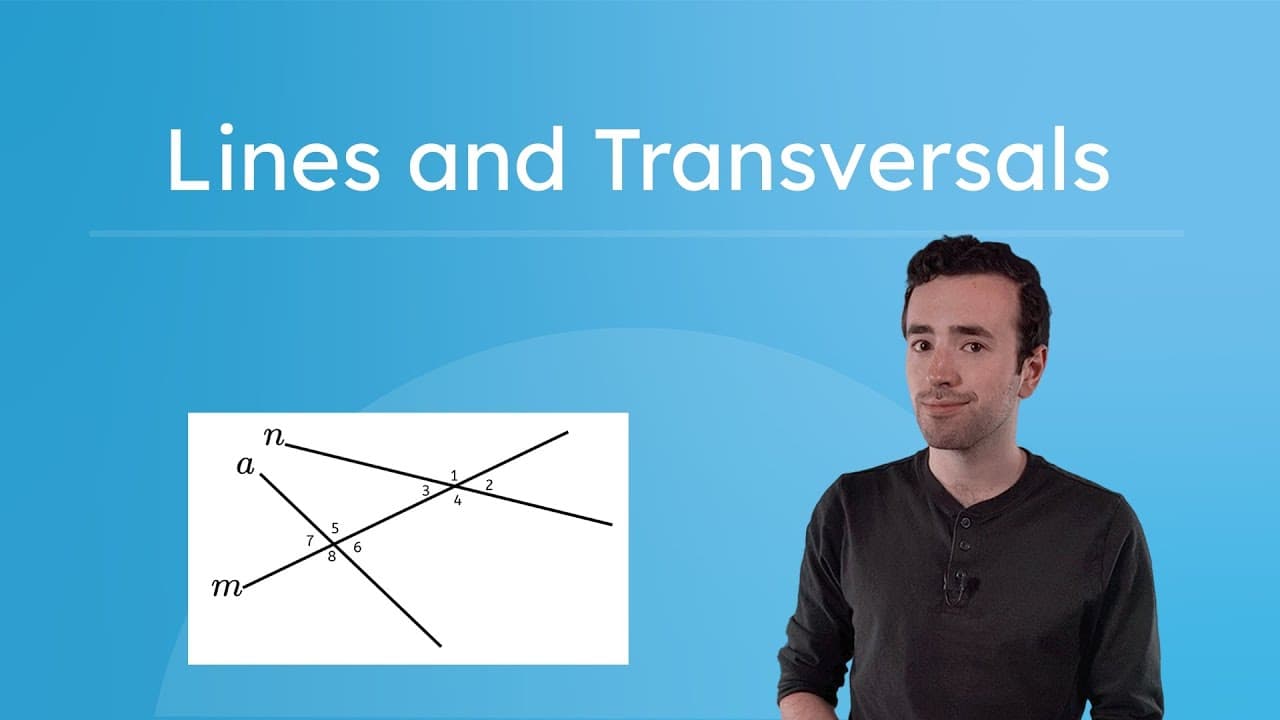
Identifying Angle Pairs Created by Transversals

Identifying Angle Pairs Created by Transversals

This educational mathematics video introduces students to the fundamental geometric concepts of lines and transversals. It begins by clearly defining what a transversal line is—a line that intersects two or more other lines—and establishing the necessary vocabulary for the unit. The video uses clear, color-coded diagrams to visualize the intersections and the eight distinct angles formed when a transversal cuts across a pair of lines. The core of the video focuses on identifying specific angle pairs based on their positions relative to the lines and the transversal. It introduces a helpful "sandwich" analogy to distinguish between the "interior" (the meat and cheese inside the lines) and "exterior" (the buns outside the lines) regions of the diagram. Students learn to identify and define five key angle relationships: alternate exterior angles, alternate interior angles, consecutive interior angles, corresponding angles, and vertical angles. The video is highly structured for classroom use, offering definitions, visual examples, and a guided practice problem at the end. It actively encourages student participation by asking them to pause and predict answers before revealing the solutions. This resource is excellent for laying the groundwork for future lessons on parallel lines and proofs, providing students with the terminology needed to describe geometric relationships accurately.

Miacademy & MiaPrep Learning ChannelMiacademy & MiaPrep Learning Channel

12mins 20s

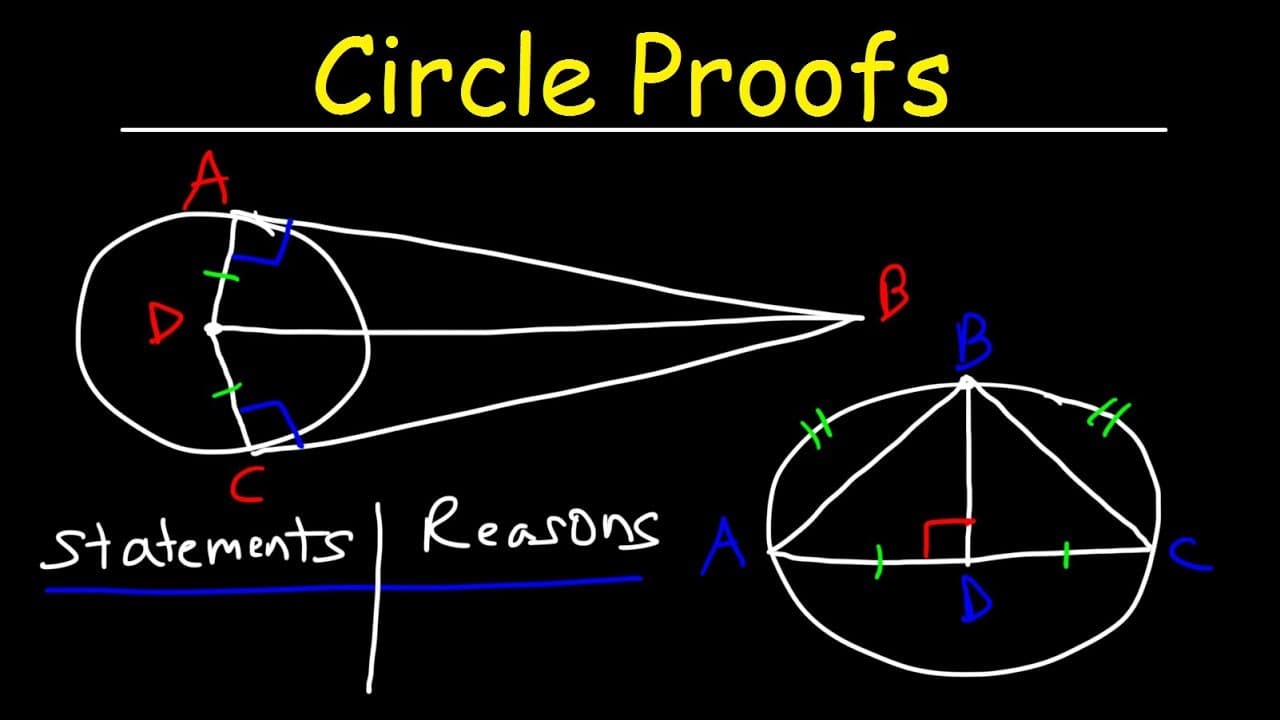
Proving Tangent Segments are Congruent with Two-Column Proof

Proving Tangent Segments are Congruent with Two-Column Proof

This video provides a clear, step-by-step walkthrough of a geometric proof demonstrating that two tangent segments drawn from an external point to a circle are congruent. The instructor constructs a two-column proof, a fundamental tool in high school geometry, to logically derive the conclusion using properties of circles and triangles. Key mathematical concepts explored include the definition of perpendicular lines, properties of radii, the reflexive property, and the Hypotenuse-Leg (HL) Theorem for triangle congruence. The video illustrates how to set up a diagram, identify given information, and systematically list statements and reasons to reach a valid conclusion. This resource is highly valuable for geometry students learning to construct formal proofs. It models mathematical reasoning and justifies a common theorem—the Two Tangent Theorem—rather than simply asking students to memorize it. Teachers can use this video to reinforce the connection between circle geometry and triangle congruence or as a model for writing rigorous two-column proofs.

The Organic Chemistry TutorThe Organic Chemistry Tutor

4mins 35s

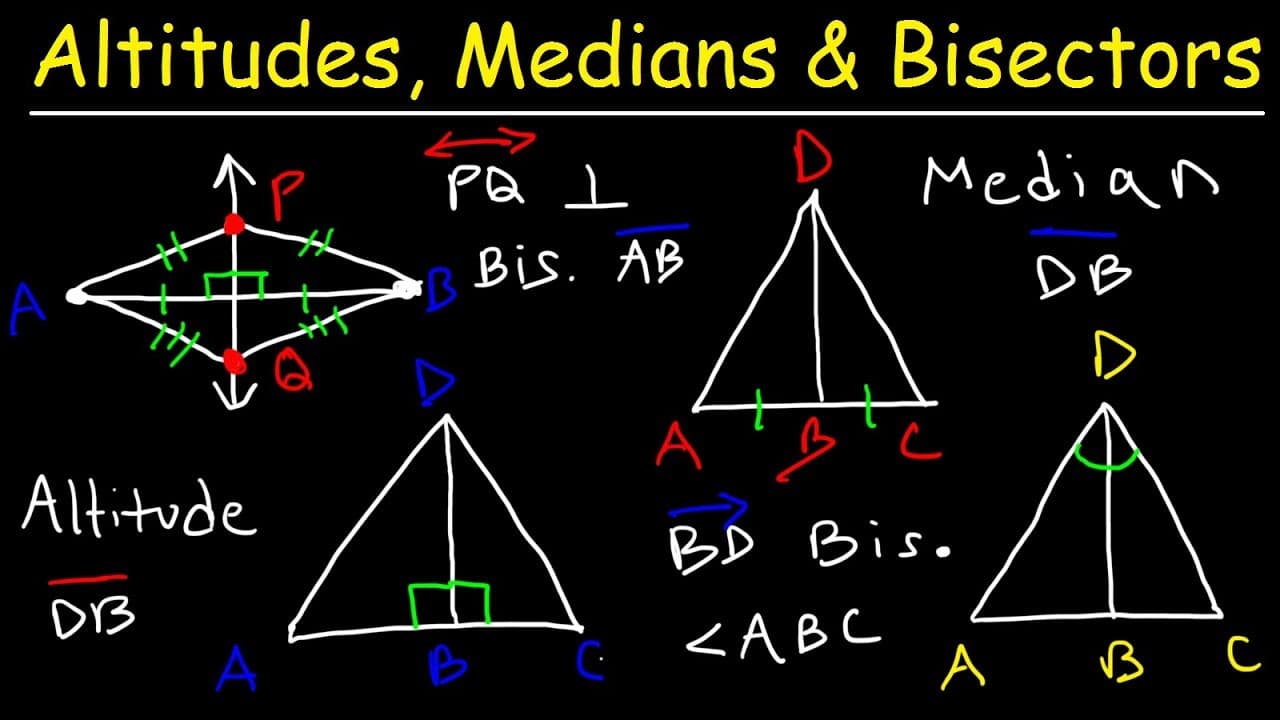
Identifying Medians, Altitudes, and Bisectors in Triangles

Identifying Medians, Altitudes, and Bisectors in Triangles

This comprehensive geometry tutorial breaks down the specific definitions and properties of four critical line segments associated with triangles: the median, altitude, perpendicular bisector, and angle bisector. Using clear, hand-drawn diagrams, the narrator explains the unique characteristics of each segment, such as how a median connects to a midpoint while an altitude forms a right angle. The video carefully distinguishes between often-confused terms by highlighting visual markers like tick marks for congruence and squares for right angles.

The Organic Chemistry TutorThe Organic Chemistry Tutor

10mins 18s

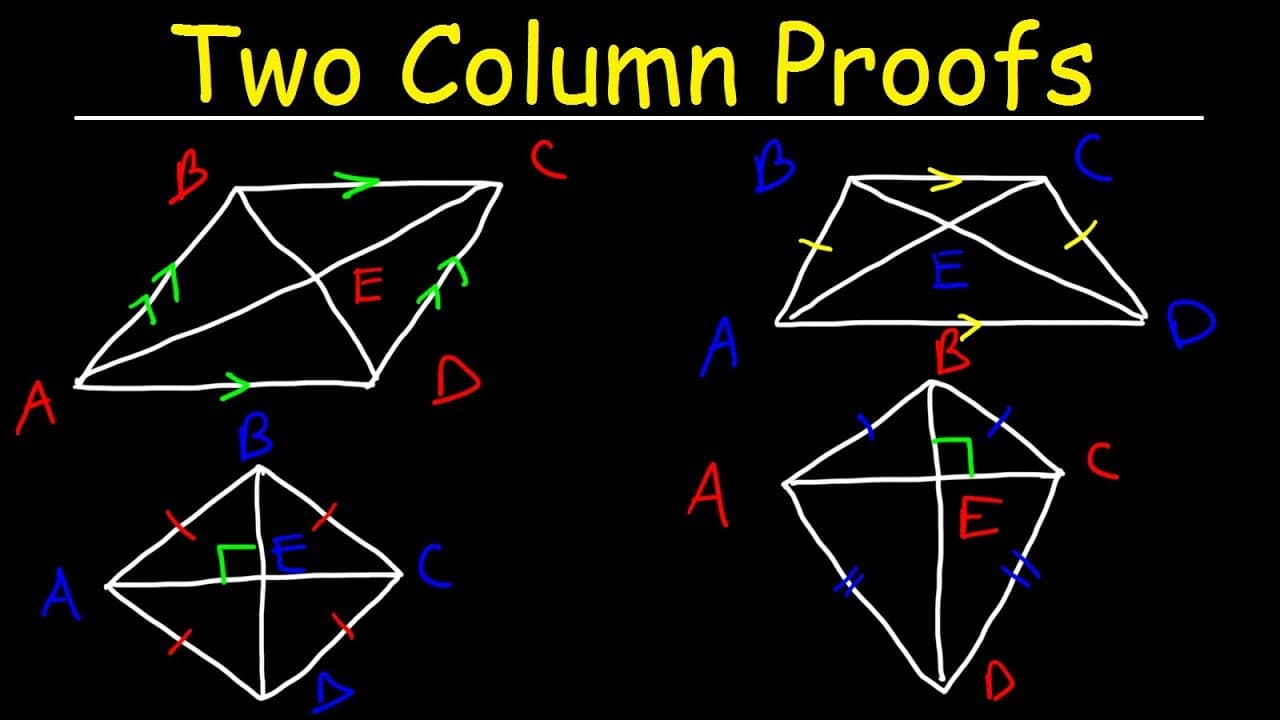
How to Solve Two-Column Proofs for Quadrilaterals

How to Solve Two-Column Proofs for Quadrilaterals

This educational video provides a comprehensive tutorial on constructing two-column geometric proofs involving four specific types of quadrilaterals: parallelograms, isosceles trapezoids, rhombuses, and kites. The narrator systematically guides viewers through four distinct examples, demonstrating how to use the given information (the properties of the shape) to prove that specific line segments within the figures are congruent. The video emphasizes the use of triangle congruence theorems such as AAS (Angle-Angle-Side), ASA (Angle-Side-Angle), and SAS (Side-Angle-Side), as well as the CPCTC principle (Corresponding Parts of Congruent Triangles are Congruent). The central themes explored include the specific properties of quadrilaterals (e.g., opposite sides of a parallelogram are parallel, base angles of an isosceles trapezoid are congruent, diagonals of a rhombus bisect angles) and the application of logic to build a valid mathematical argument. The video also reviews foundational geometric concepts like vertical angles, alternate interior angles formed by parallel lines, and the reflexive property of congruence. For educators, this video serves as an excellent modeling tool for high school geometry classrooms. It bridges the gap between learning the properties of shapes and applying them in formal proofs, a common struggle for students. Teachers can use the individual examples as direct instruction segments, pausing to let students predict the next step or the reason for a statement. It is particularly useful for reinforcing how to identify congruent triangles hidden within quadrilaterals to prove properties about diagonals and segments.
The Organic Chemistry TutorThe Organic Chemistry Tutor

20mins 18s

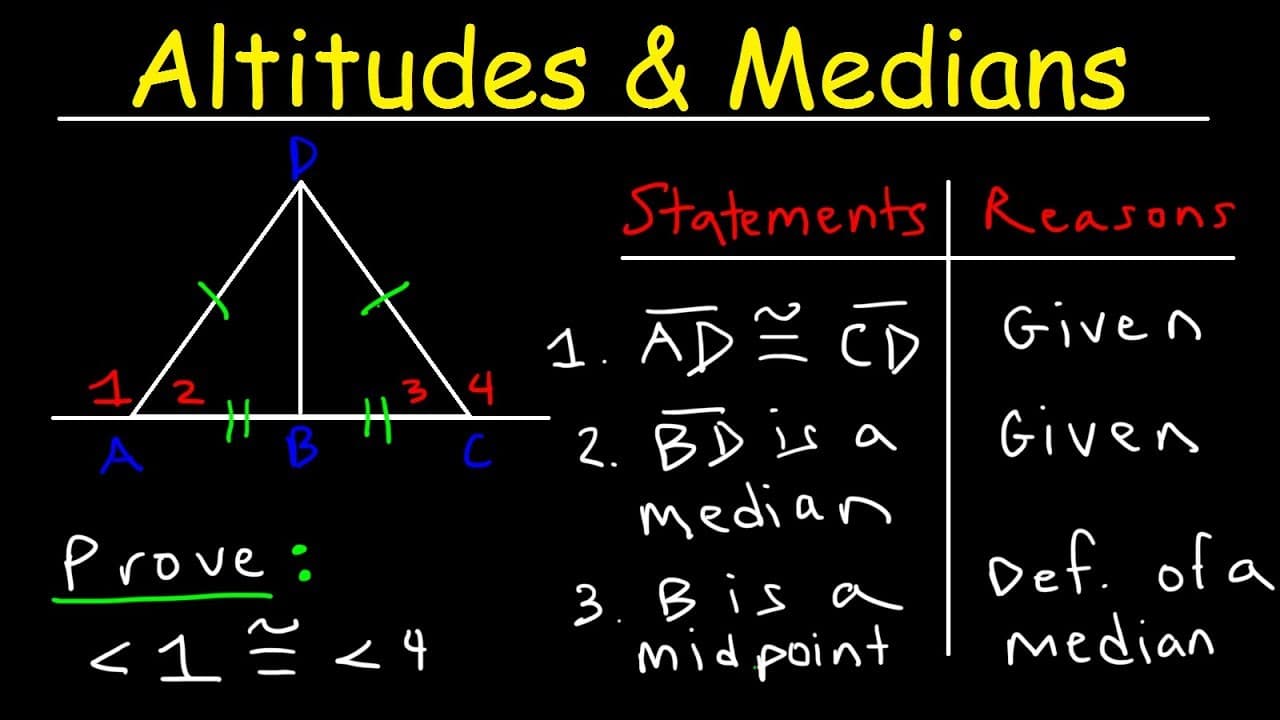
How to Write Two-Column Proofs with Medians and Altitudes

How to Write Two-Column Proofs with Medians and Altitudes

This educational video provides a detailed tutorial on writing two-column proofs in high school geometry, specifically focusing on triangles involving medians and altitudes. The narrator guides viewers through two distinct problems, demonstrating how to logically structure arguments using statements and reasons. The first problem proves the congruence of exterior base angles in an isosceles-like setup using medians, while the second problem proves a line segment is a median given that it is an altitude and an angle bisector. The content explores fundamental geometry concepts including the definitions of medians and altitudes, the reflexive property of congruence, triangle congruence postulates (SSS and ASA), and the principle of CPCTC (Corresponding Parts of Congruent Triangles are Congruent). It also touches on supplementary angles and linear pairs. The step-by-step approach models the rigorous thinking required for mathematical proofs, showing students how to translate given information into a logical sequence of deductions. This video is highly valuable for geometry teachers and students as a resource for mastering the difficult skill of writing formal proofs. It breaks down the often-intimidating two-column format into manageable steps, explaining the "why" behind each move. It serves as an excellent model for classroom instruction, allowing teachers to pause and let students predict the next logical step, or as a review tool for students struggling with the mechanics of geometric reasoning.

The Organic Chemistry TutorThe Organic Chemistry Tutor

11mins 51s

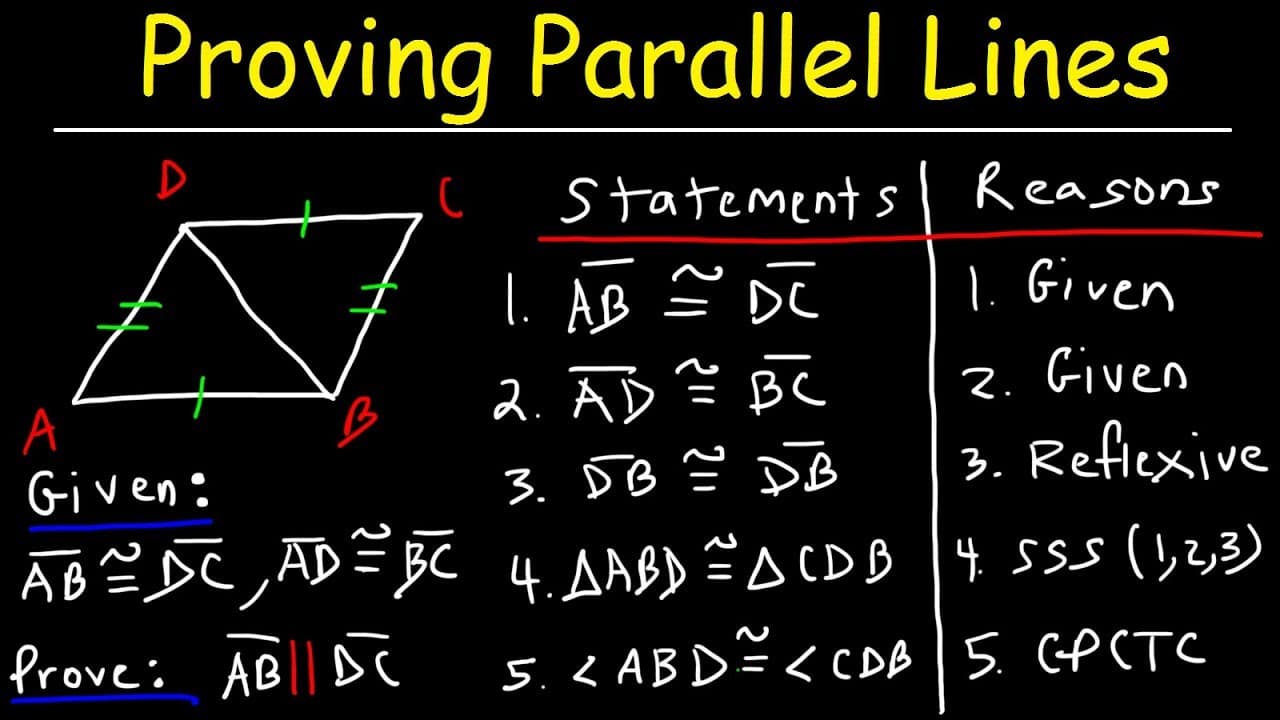
Proving Parallel Lines Using Angle Theorems and Geometry Proofs

Proving Parallel Lines Using Angle Theorems and Geometry Proofs

This educational video provides a comprehensive tutorial on geometry concepts focused on proving that lines are parallel. The instructor uses digital handwriting on a blackboard style background to visually demonstrate theorems involving transversals, including Alternate Interior Angles, Alternate Exterior Angles, Corresponding Angles, and Same-Side Interior Angles. The video clearly distinguishes between the forward theorems (if lines are parallel, then angles are congruent) and their converses (if angles are congruent, then lines are parallel), which is the focus of this lesson.

The Organic Chemistry TutorThe Organic Chemistry Tutor

10mins 26s

Materials

Geometry Proofs Reference Guide

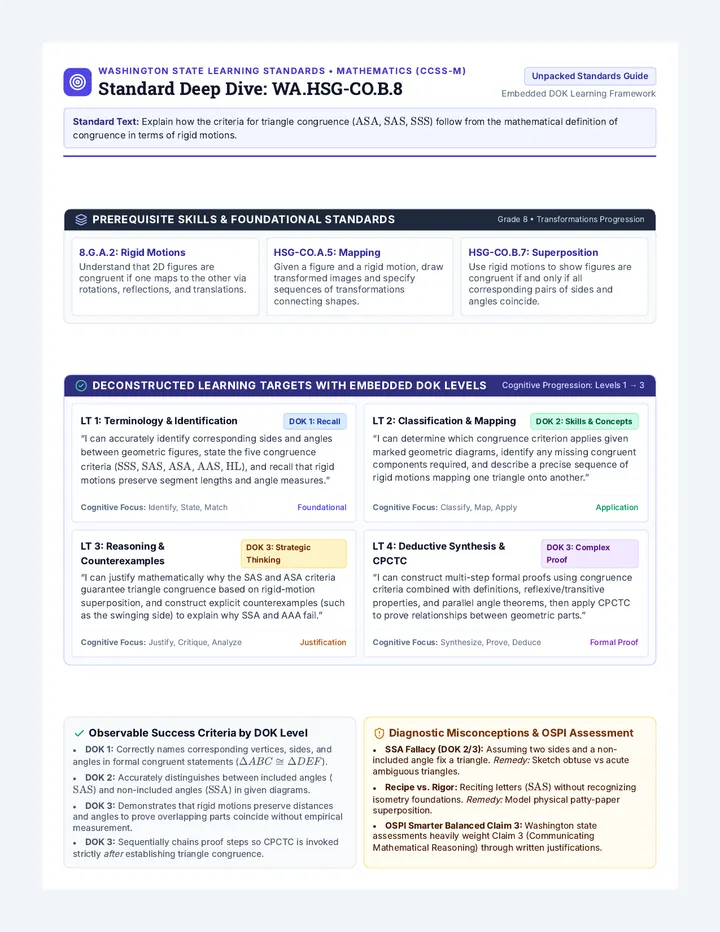
Geometry Proofs Reference Guide

An instructional standards breakdown for Washington State high school geometry, featuring a full deconstruction of standard WA.HSG-CO.B.8 with Webb's DOK cognitive levels embedded directly into the progressive student learning targets, success criteria, and prerequisites.

MS

Melissa Super-Greene

Postulate Practice Slides

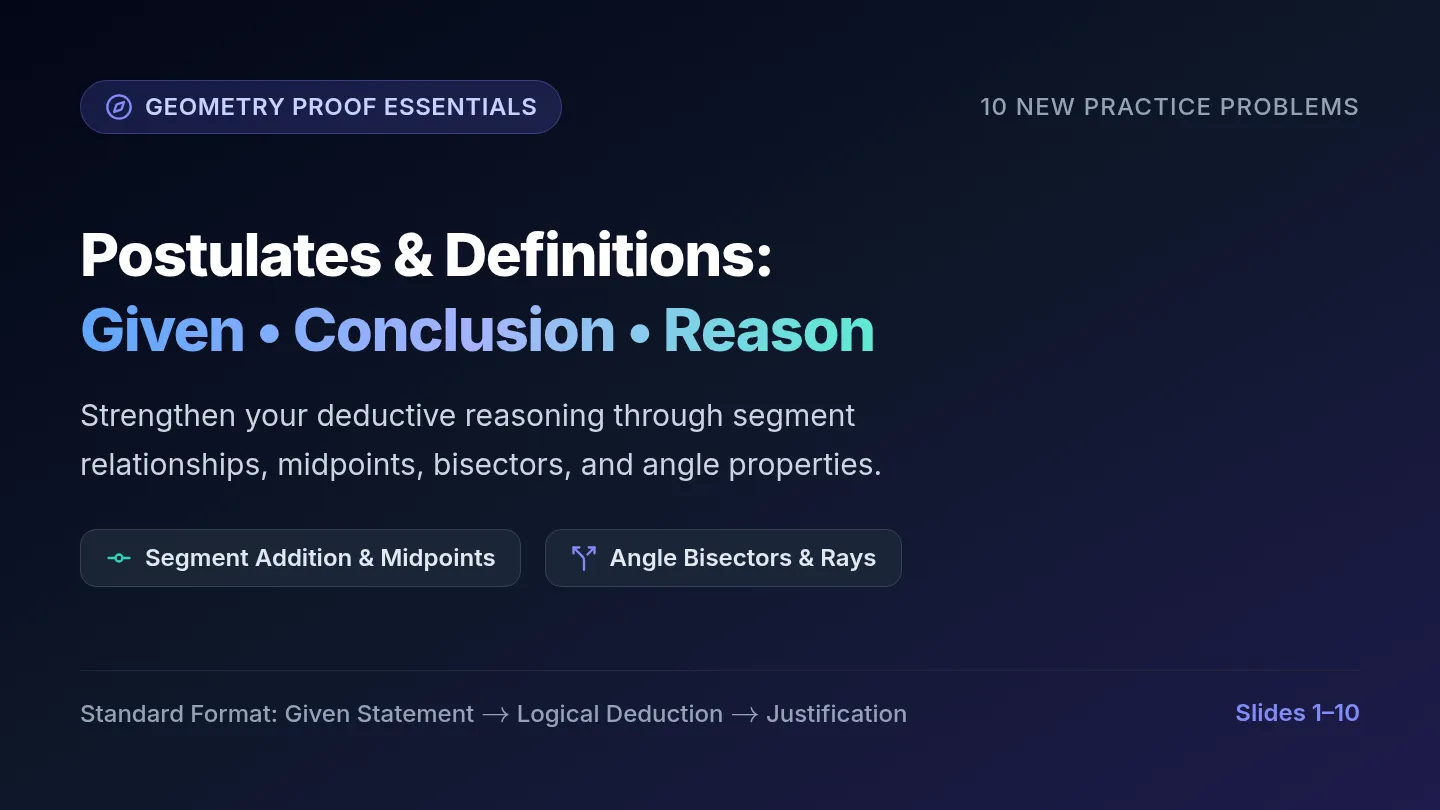
Postulate Practice Slides

A 10-problem geometry slide deck presenting Given-Conclusion-Reason practice tasks centered on segment relationships and angle bisectors with vector diagrams.

C

Courtney.Smiley

Parallel Lines Angle Worksheet

Parallel Lines Angle Worksheet

A comprehensive 40-question geometry worksheet on parallel lines cut by transversals, focused directly on finding angle measures and solving algebraic equations without relationship-naming questions.

J

jeffreychadwick.inspiretx

Angle Alliances Review Worksheet

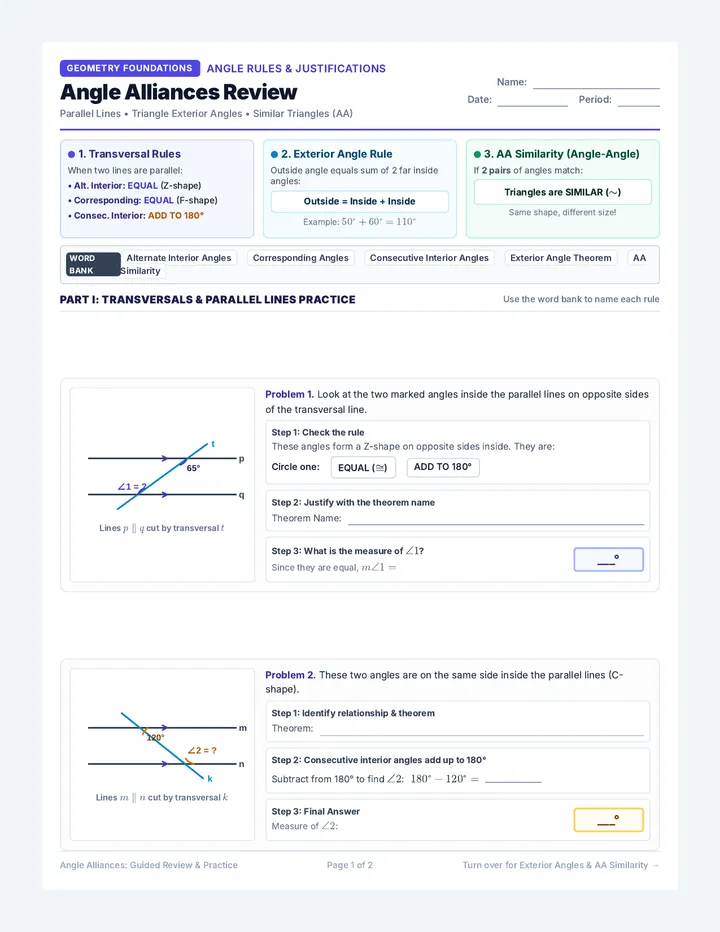
Angle Alliances Review Worksheet

A highly accessible two-page review worksheet on transversals, triangle exterior angles, and AA similarity designed for 8th graders working below grade level. Uses concrete angle measures with no or minimal algebra, helpful visual reminder cards, a theorem word bank, and scaffolded justification stems.

L

Logan-Greene

Right Triangle Blueprint Reading Handout

Right Triangle Blueprint Reading Handout

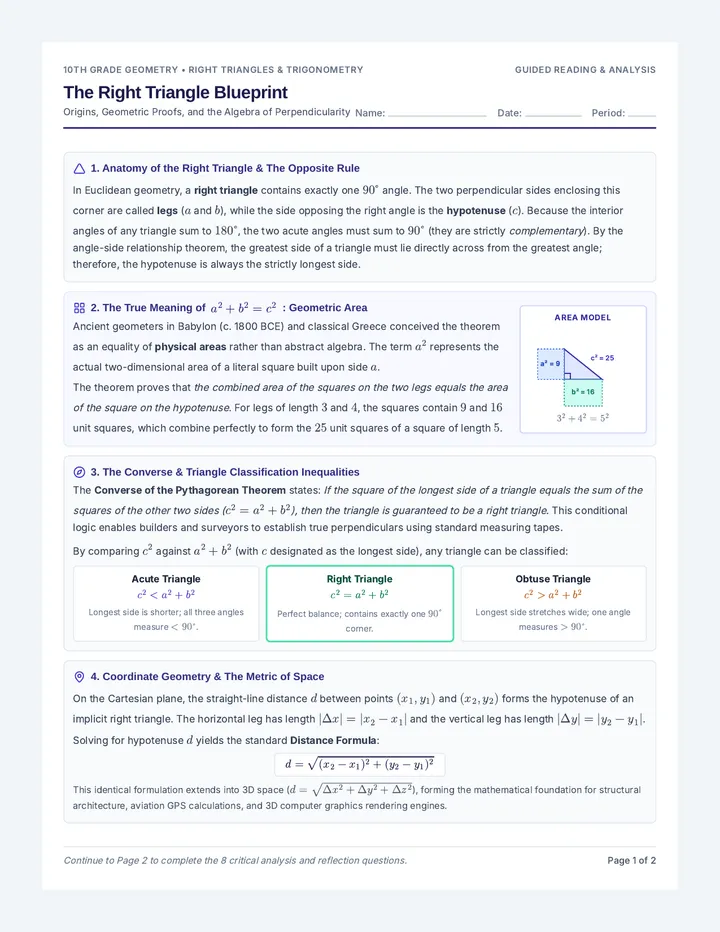
A high school geometry reading assignment and reflection guide covering the Pythagorean theorem, geometric proofs, triangle classification using the converse, and coordinate distance applications, followed by eight analytical reflection questions.

AR

Angie Rice

Triangle Angles Detective Worksheet

Triangle Angles Detective Worksheet

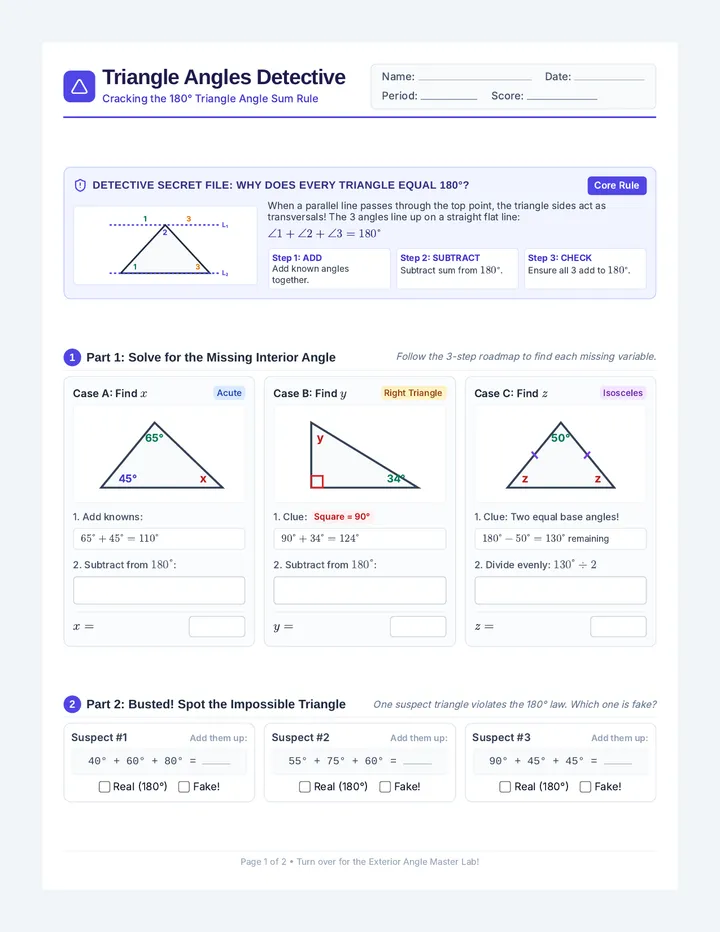
A comprehensive 8th-grade math worksheet centered on angles in a triangle with an expanded, dedicated focus on the Exterior Angle Theorem. Includes visual proof anchors, identifying remote interior angles, multiple orientations, working backward, and a multi-step exterior angle mystery challenge.

L

Logan-Greene

Sequences

Regents Mastery Blueprint Study Guide

Regents Mastery Suite

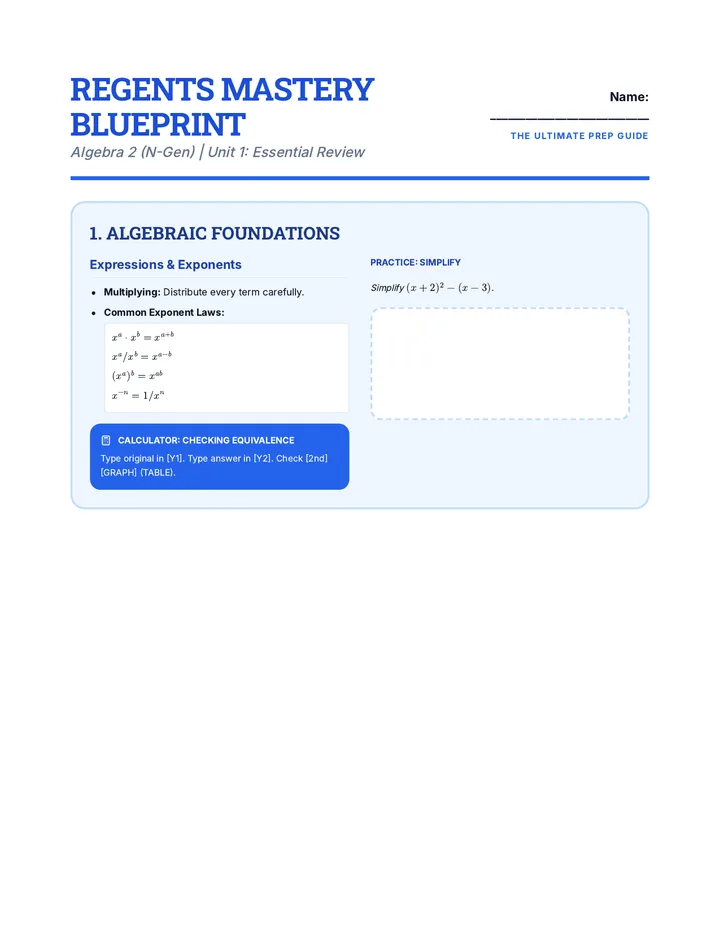
A comprehensive review suite for the New York State Mathematics Regents exams, including Algebra 1, Geometry, and Algebra 2, featuring mastery blueprints, calculator strategies, and exam-taking tips.

KB

Kayla Borozny

15
Temple Craftsmen Slides

Middle School Math Block

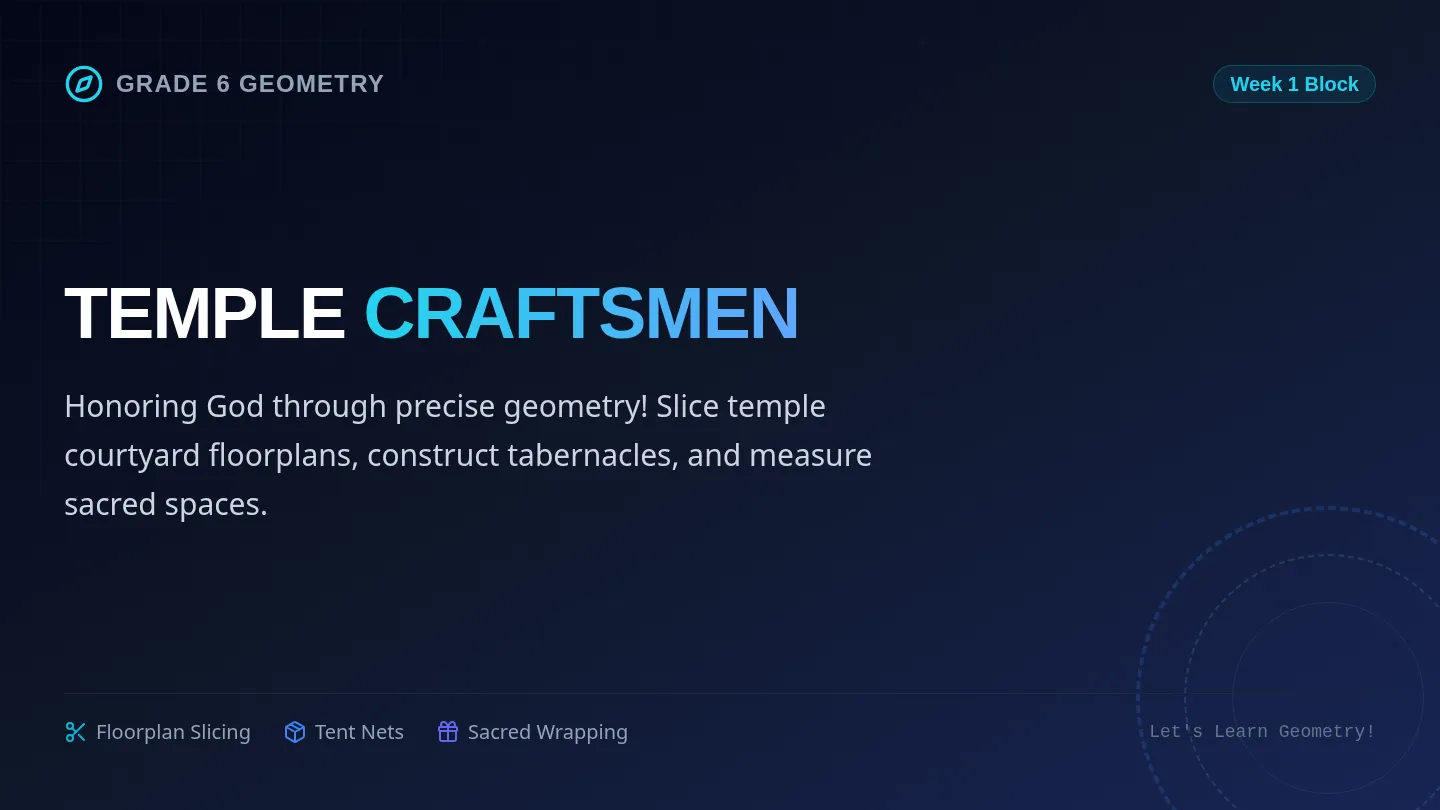
A multi-subject middle school mathematics block for Week 1, covering 6th Grade Geometry (Temple Craftsmen: polygon decomposition, nets, surface area) and 7th/8th Grade Math (Faithful Stewards: proportional relationships, linear equations, inequalities, transversals) from a Christian perspective.

JR

Jamens Ray II

59
Segment Postulates Guided Notes

Segment Geometry

A two-part sequence exploring segment addition, subtraction, and midpoint relationships through visual GCR deductive reasoning and algebraic modeling.

C

Courtney.Smiley

17
Congruence Logic Quiz pocket edition

Congruence Chronicles

An exploration of geometric congruence, coordinate geometry, and the formal logic required for mathematical proofs.

SR

Saifel-Dein Raja

2
Angle Foundations Slides

Parallel Proof Protocol

A comprehensive multi-day geometry sequence covering angle relationships, formal two-column, flowchart, and paragraph proofs, converses, and auxiliary line applications for parallel lines cut by transversals.

J

jminear

9
Triangle Inequality Worksheet

Triangle Geometry Unit

A unit on the properties of triangles, specifically focusing on the Triangle Inequality Theorem and how side lengths determine the possibility of forming a triangle.

HF

Hannah Fernandes

2

Lessons

Geometry Unit Form A Review

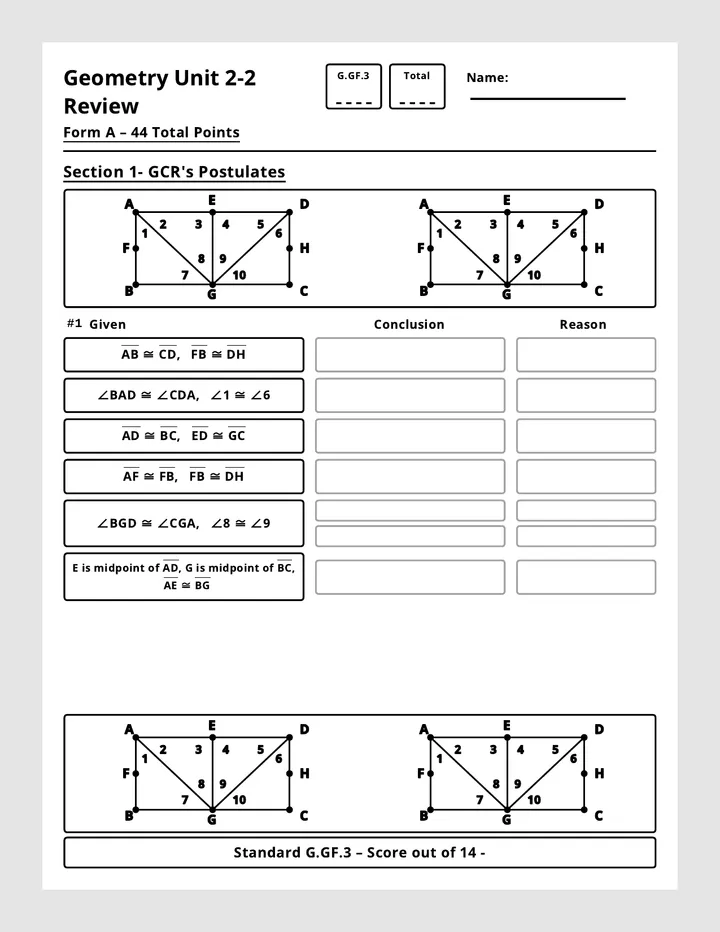
Unit 2-2 Review

A comprehensive unit review on geometric definitions, postulates, and deductive chain reasoning. Includes two parallel review forms and complete teacher answer keys covering angle and segment relationships.

C

Courtney.Smiley

4
Triangle Sum Secrets Handout

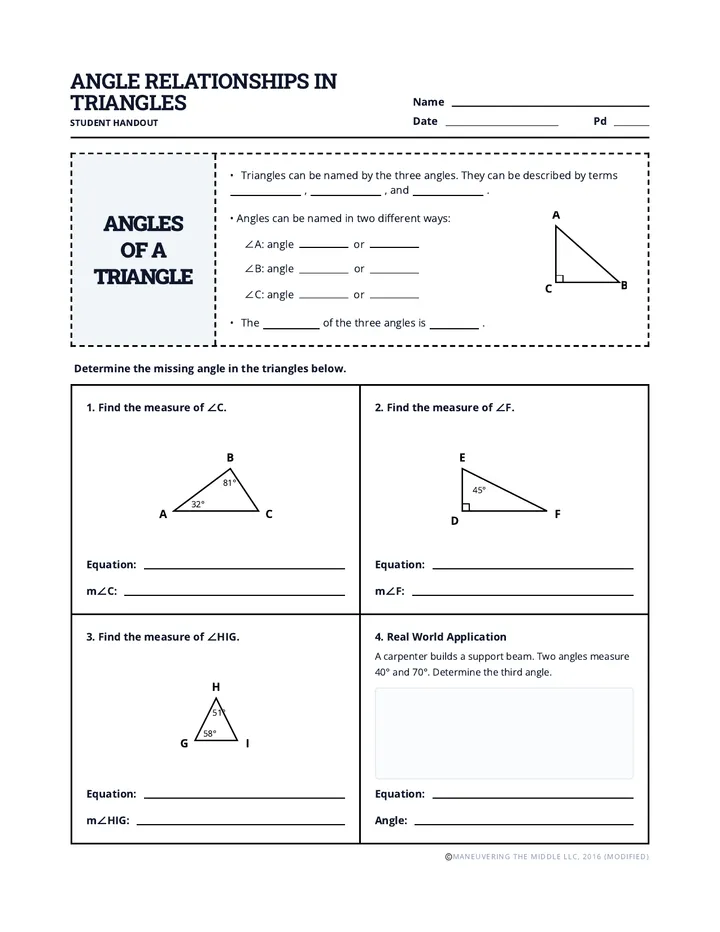
Triangle Sum Secrets

A simplified lesson on the Triangle Sum Rule, focusing on 3-letter angle naming and solving for missing angles using one-step equations with whole numbers.

HF

Hannah Fernandes

6
Mastery Ladder Tracking Sheet

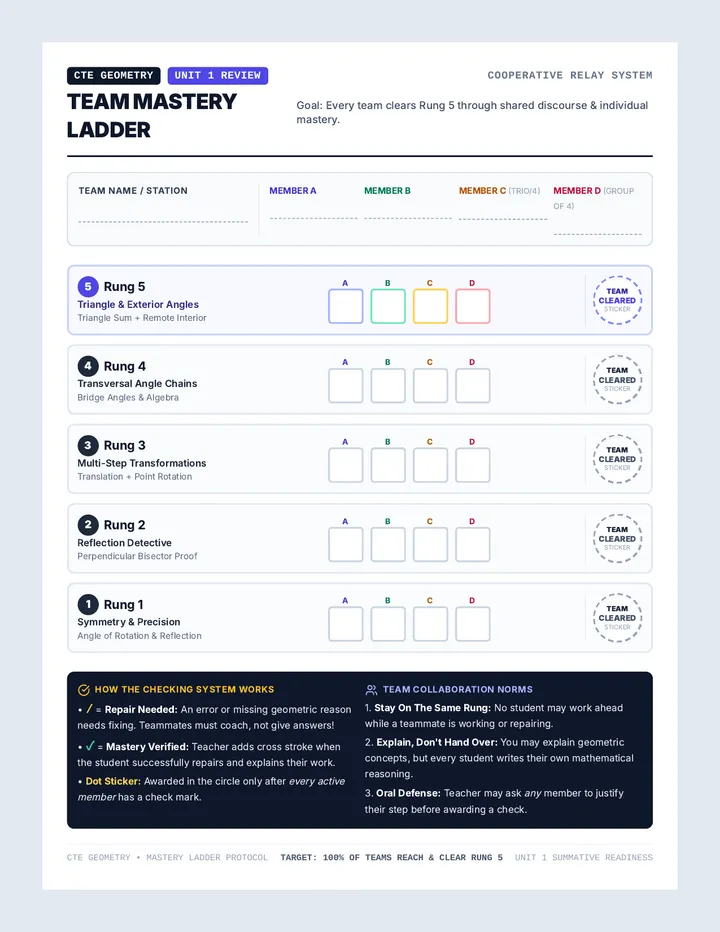
Geometry Ladder Relay

Collaborative 5-rung mastery review activity for CTE Geometry Unit 1 covering symmetry, reflections, multi-step transformations, parallel transversal angle chains, and exterior angle theorems across four parallel student versions plus a Spanish edition.

MM

Matthew McIntyre

9
Day 1 Review Packet

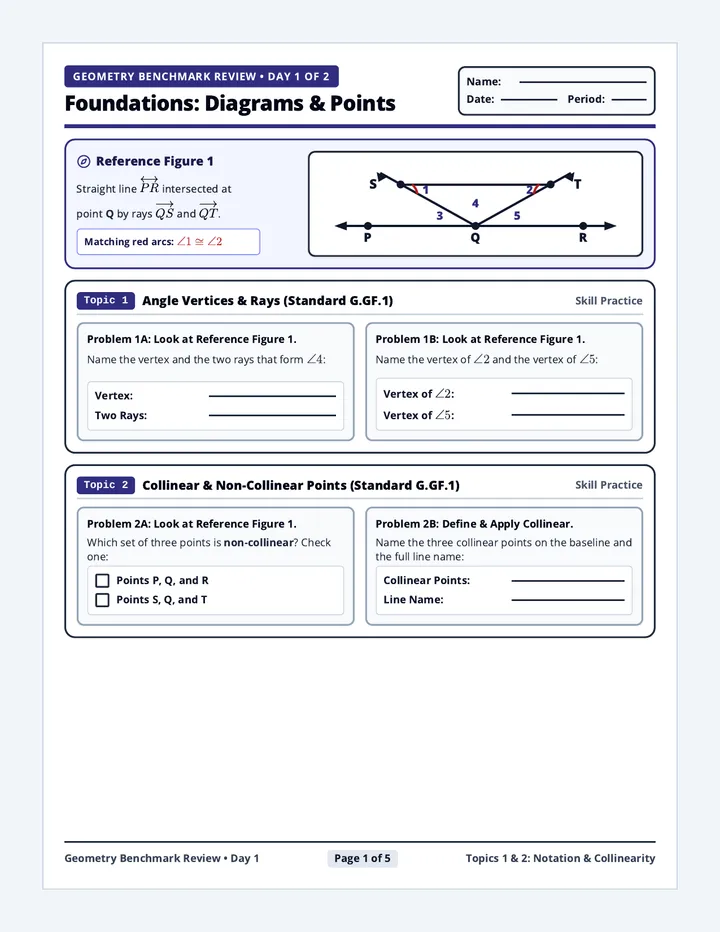
Geometry Benchmark Review

A structured two-day Quarter 1 Geometry Benchmark Review program featuring spacious, high-contrast, dyslexia-friendly student packets and comprehensive step-by-step answer keys covering geometric foundations, conditional logic, deductive postulates, and coordinate formulas.

C

Courtney.Smiley

6
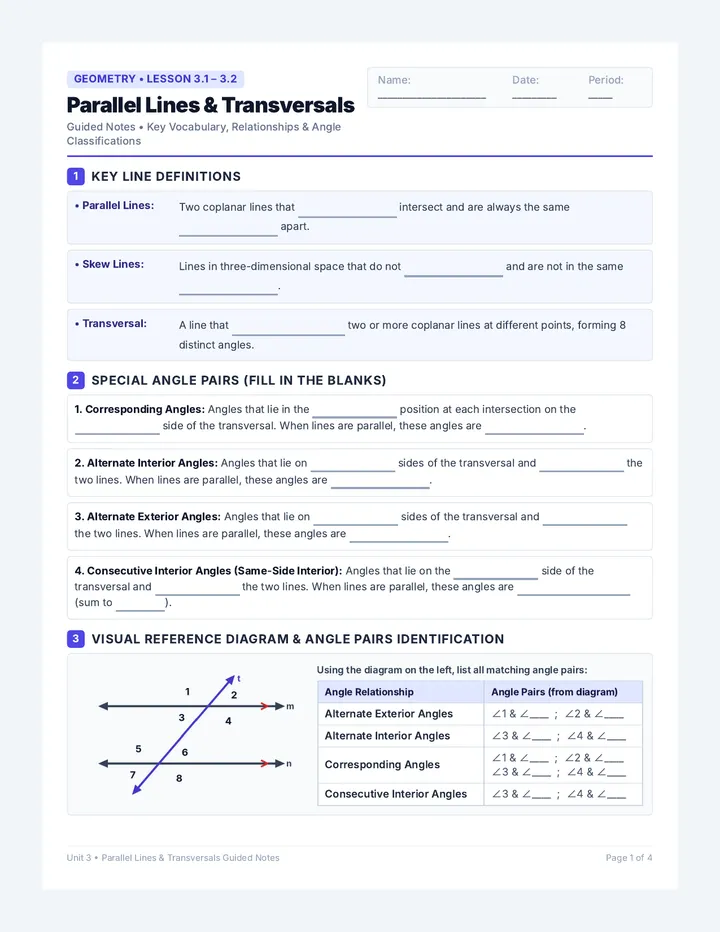
Parallel Lines Transversals Guided Notes

Parallel Precision

An instructional geometry lesson investigating angle relationships formed by parallel lines and transversals, algebraic equation solving, and geometric proof converses.

C

Courtney.Smiley

3
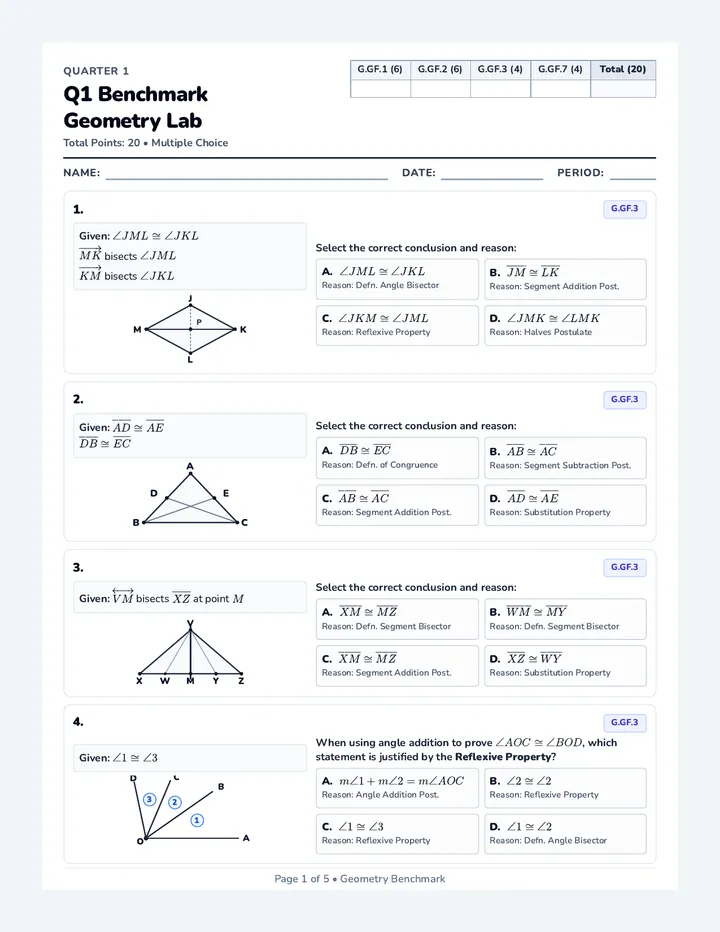
Geometry Benchmark Test

Geometry Benchmark

Quarter 1 Benchmark assessment covering geometric definitions, deductive logic, collinearity, angle relationships, segment algebra, and coordinate geometry formulas with student test and teacher answer key.

C

Courtney.Smiley

3