Application of derivatives to identify absolute extrema within constrained systems. Addresses problems in surface area maximization, cost minimization, and physical efficiency.
A strategic masterclass for the ACT Science section, focusing on speed-reading data sets, identifying experimental variables, and decoding scientific logic. This lesson emphasizes the 'Straight to the Data' approach to maximize score in the 35-minute time limit.
An introductory exploration of calculus-adjacent concepts tested on the ACT, focusing on limits, instantaneous rates of change, and function optimization. Students will master the Limit Blueprint and apply rate-of-change logic to complex algebraic scenarios.
An intensive masterclass on advanced trigonometric identities, the unit circle, and non-right triangle laws. Students will master the Pythagorean identities, Law of Sines/Cosines, and the specific ACT-style unit circle coordinates required for top-tier scores.
A specialized deep dive into advanced geometry concepts including circle equations, 3D volume/surface area of complex shapes, and coordinate geometry involving perpendicularity and distance. Students will master completing the square for circles and visualizing 3D cross-sections.
A specialized deep dive into trigonometric functions, mastering the critical distinction between period and frequency. Students will apply the 2π/b blueprint to decode sine and cosine graphs and solve high-difficulty periodic motion problems.
A focused deep dive into imaginary and complex numbers. Students will master powers of i, arithmetic with complex conjugates, and solving quadratic equations with complex roots—all through the lens of ACT-style 'Final Ten' questions.
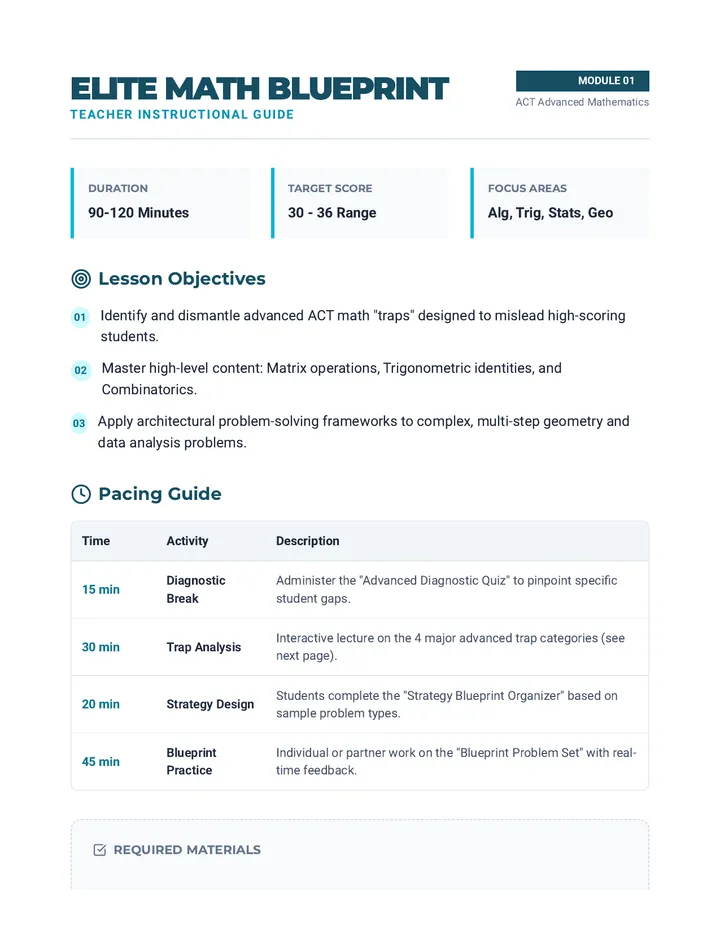
A comprehensive lesson focused on high-level ACT Math topics including matrices, complex functions, trigonometry, and advanced statistics. The lesson emphasizes identifying common 'traps' and applying architectural-style problem-solving strategies.
The sequence culminates with a realistic physics modeling lesson. Students set up and analyze parametric equations for projectiles, accounting for gravity and initial velocity vectors.
Students solve complex motion problems, such as finding the time when a particle is moving perpendicular to its position vector or closest to the origin.
A comparative analysis lesson where students rigorously distinguish between the net change in position (displacement vector) and the total scalar distance traveled (integral of speed).
Students extend calculus operations to vector components. They perform component-wise differentiation and integration to find velocity vectors from position and position vectors from velocity.
Students formally define vector-valued functions and explore limits and continuity. They learn to visualize the domain and output as vectors pointing to a path.
A detailed, step-by-step walkthrough of the Wave Rhythm Workout, breaking down the logic for core wave components, real-world modeling, and finding minimum values using the midline-amplitude blueprint.
The detailed answer key for the Science Speed Logic Workout, providing explanations for variable identification, trend spotting, and scientific reasoning questions.
A specialized student practice worksheet for the ACT Science section, focusing on identifying independent/dependent variables, trend spotting, and basic scientific reasoning logic.
A visual slide deck covering strategic masterclass for the ACT Science section, focusing on speed-reading data sets, identifying experimental variables, and decoding scientific logic. This deck emphasizes the 'Straight to the Data' approach. Revised for font size compliance (min 24px).
The detailed answer key for the Calculus Catalysts Workout, providing step-by-step solutions for limits, instantaneous rate of change, and basic function optimization problems.
A student practice worksheet for calculus-adjacent ACT concepts, featuring limits, instantaneous rate of change logic, and function optimization problems.
A visual slide deck explaining introductory calculus concepts for the ACT, including limits, instantaneous rate of change, and basic function optimization using standard blueprints. Revised for font size compliance (min 24px).
The detailed answer key for the Trig Titan Workout, including step-by-step solutions for identities, the unit circle, and non-right triangle problems.
A comprehensive practice worksheet for advanced ACT trigonometry, featuring sections on identities, the unit circle, Law of Sines/Cosines, and 'Final Ten' challenge problems.
A visual slide deck covering advanced ACT trigonometry: Pythagorean identities, the unit circle, Law of Sines/Cosines, and the ambiguous SSA case. Revised for font size compliance (min 24px).
The detailed answer key for the Geometric Grandeur Workout, providing step-by-step solutions for circle equations, 3D volume, and coordinate geometry problems.
A specialized geometry workout featuring problems on circle equations, 3D volume visualization, and coordinate geometry, including advanced 'Final Ten' style challenges like inscribed octagons and 3D coordinate spheres.
A comprehensive prep sequence for the most challenging questions on the ACT Math and Science sections. It focuses on high-level conceptual blueprints for math topics like complex numbers and matrices, alongside speed-reading and data-interpretation strategies for the Science section.
An advanced exploration of vector-valued functions and their applications in modeling 2D motion and force, preparing students for multivariable calculus.
A comprehensive unit for 12th Grade Calculus students focusing on the derivation and application of derivatives in polar coordinates. Students transition from Cartesian slope to polar slope, analyze horizontal and vertical tangency, investigate behavior at the pole, and solve optimization problems involving polar curves.
This sequence explores the calculus of polar functions, focusing on differentiation techniques. Students will learn to calculate slopes of tangent lines, identify horizontal and vertical tangents, analyze behavior at the pole, and apply optimization to find maximum and minimum distances from the origin.
A graduate-level exploration of expected value applications in finance, covering utility theory, portfolio optimization, risk-neutral pricing, and tail risk metrics. Students transition from theoretical foundations to computational implementation using Monte Carlo methods.
A graduate-level exploration of the Calculus of Variations, focusing on optimizing functionals. Students derive the Euler-Lagrange equation and apply it to physics and geometry problems like the Brachistochrone and Isoperimetric challenges.
A graduate-level sequence on constrained optimization, covering Lagrange Multipliers, KKT conditions, and sensitivity analysis for economics and engineering applications.
A comprehensive graduate-level exploration of numerical optimization algorithms, moving from first-order gradient descent to second-order Newton methods and computationally efficient Quasi-Newton approaches. Students analyze convergence rates, stability, and strategies for navigating complex, non-convex landscapes.
This sequence establishes the rigorous mathematical underpinnings necessary for advanced optimization work, moving beyond procedural calculus to analysis-based proofs. Students explore the intersection of topology, set theory, and multivariate calculus to determine the existence and uniqueness of optimal solutions.
An inquiry-based exploration of calculus optimization, focusing on real-world efficiency in travel time, infrastructure cost, and business profit. Students progress from geometric shortest-paths to complex rate-based modeling.
A comprehensive workshop series on optimization in calculus. Students master the Extreme Value Theorem, learn to translate complex word problems into mathematical models, and apply differentiation to find optimal outcomes in number theory and geometric contexts.
A project-based calculus sequence where students use optimization to design efficient packaging. They transition from physical modeling to algebraic functions and derivative-based solutions to maximize volume and minimize material costs.