Formal connection between differentiation and integration through the evaluation of definite integrals using antiderivatives. Addresses both parts of the theorem to solve area problems and calculate rates of change.
This graduate-level sequence explores the pedagogical content knowledge (PCK) needed to teach mathematical sequences and limits. It traces the historical development from Zeno's paradoxes to modern rigor, equipping educators to address common student misconceptions through inquiry-based instruction.
A comprehensive unit for 12th Grade Calculus students focusing on the integration of polar functions to find area, arc length, and surface area. Students transition from Cartesian thinking to radial accumulation, mastering the geometry of circular sectors and polar coordinate transformations.
This calculus sequence guides 11th-grade students through the integration techniques required to calculate area and arc length within polar coordinate systems. From the geometric derivation of the polar sector formula to complex multi-curve regions and boundary measurements, students apply integral calculus to circular geometries.
A graduate-level exploration of expected value through the lens of measure theory, covering Lebesgue integration, fundamental inequalities, convergence theorems, and conditional expectation using Sigma-algebras.
This sequence explores calculus in the polar coordinate system, focusing on differentiation and integration. Students will master finding slopes of tangent lines, calculating areas of polar regions and intersection areas, and determining arc lengths of polar curves.
An inquiry-based exploration of convergence tests for infinite series, focusing on visualization, logical justification, and strategic selection of testing methods. Students develop a comprehensive understanding of how to determine the behavior of unending sums.
This sequence explores the intersection of calculus and geometry through infinite series and fractals. Students investigate convergence and divergence using visual area models, fractal dimensions, and physical simulations like block stacking.
A graduate-level exploration of the Calculus of Variations, focusing on optimizing functionals. Students derive the Euler-Lagrange equation and apply it to physics and geometry problems like the Brachistochrone and Isoperimetric challenges.
A rigorous graduate-level sequence exploring the existence, uniqueness, and stability of solutions to ordinary differential equations using functional analysis and metric space theory.
A comprehensive sequence for undergraduate calculus students exploring the construction, convergence, and real-world utility of power series. Students move from the technical mechanics of convergence tests to applying Taylor series in physics and engineering contexts.
This sequence introduces undergraduate students to first-order differential equations through geometric visualization, analytical solving techniques (separation, integrating factors), and real-world modeling of thermal, biological, and electrical systems.
A comprehensive advanced calculus unit exploring the use of vector-valued functions to model and analyze motion in 2D and 3D space. Students will master differentiation, integration, and arc length calculations within a kinematic context, culminating in complex projectile modeling.
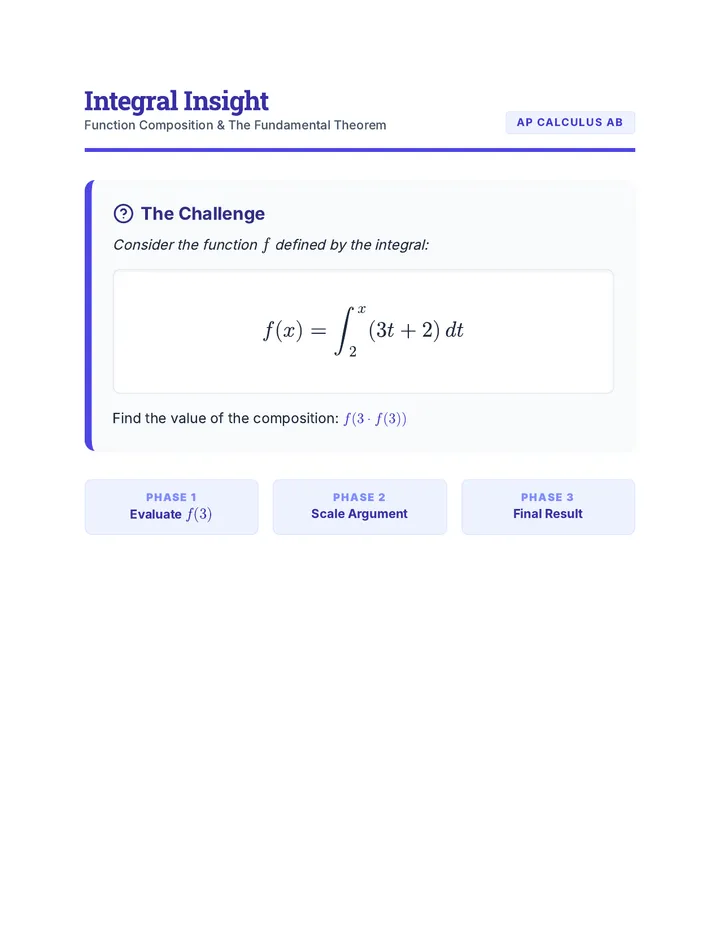
A focused study on applying the Fundamental Theorem of Calculus to evaluate functions defined by integrals. Students will practice finding specific values by integrating and evaluating at given boundaries.
Une leçon complète sur le calcul intégral appliqué à l'économie, couvrant l'intégration par parties, l'indice de Gini et les surplus du consommateur et du producteur.
A 12th-grade calculus prep lesson that bridges algebraic symmetry with integral properties, teaching students to use even and odd function characteristics to simplify definite integrals.
An undergraduate-level exploration of Euler's number (e) that synthesizes its financial, analytical, and series-based definitions through a rigorous proof-based approach.
A specialized AP Calculus lesson exploring the unique geometric and analytical properties of Euler's number. Students use graphing software to discover why e is the unique base where the function's height, slope, and area under the curve are identical.
A high-school level lesson for AP Calculus and Statistics students focusing on using Desmos for complex integrals and statistical calculations, emphasizing the balance between manual understanding and technological efficiency.
Design an inquiry-based lesson plan that guides students to discover the concept of a limit.
Identify and diagnose common student misconceptions regarding limits and infinite sequences.
Investigate the 19th-century shift toward the formal epsilon-delta definition of limits.
Analyze the intuitive use of infinitesimals by Newton and Leibniz and the logical critiques they faced.
Examine Zeno's paradoxes and Archimedes' Method of Exhaustion to understand early struggles with infinite processes.
The sequence concludes with finding the surface area of solids formed by revolving polar curves around the polar axis or the line theta = pi/2.
A comprehensive, step-by-step solution for the AP Calculus problem f(3f(3)), detailing the evaluation of the inner function, the input scaling, and the final integral calculation using the Fundamental Theorem of Calculus.
Guide de correction détaillé pour les exercices d'intégrales appliquées à l'économie (IPP, Gini, Surplus).
Feuille d'exercices sur les intégrales appliquées à l'économie pour L1 Éco-Gestion (IPP, Gini, Surplus).
Présentation visuelle pour le cours de calcul intégral appliqué à l'économie (IPP, Surplus, Gini).
A comprehensive teacher guide for the Symmetry Shortcuts lesson, including pacing details, discussion prompts, and strategies for addressing common misconceptions.
A structured reflection journal document for calculus students to synthesize their learning on even/odd function properties and their application to definite integrals.
Customized graph paper for sketching even and odd functions, designed to help students visualize positive and negative area under the curve for calculus prep.
A visual slide deck for 12th-grade students that connects function symmetry (even/odd) to calculus integral shortcuts, including an embedded instructional video and guided discussion prompts.
Teacher answer key for the Golden Function worksheet, including specific numerical values for slopes and conceptual guidance for the discussion questions.
A set of four discussion prompt cards designed to spark higher-order thinking during the AP Calculus activity on Euler's Number and the properties of e^x.
A printable exit ticket for the Euler Synthesis lesson, featuring four slips per page for paper-saving. Prompts students to reflect on why e is considered "natural".
A student worksheet for the AP Calculus lesson on e^x. Includes a warm-up sketching area, a video notes section, an activity table for comparing exponential bases, and a closure reflection.