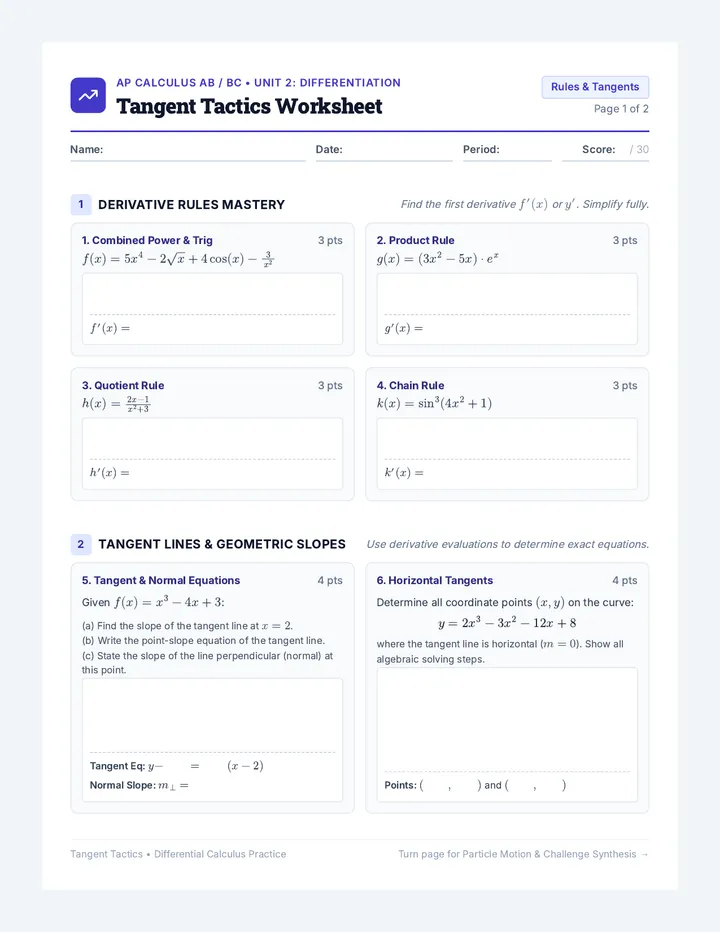
Power, product, quotient, and chain rules for differentiating algebraic and transcendental functions. Strengthens skills in implicit differentiation and trigonometric derivatives for modeling rates of change.
Detailed answer key for the Trig Derivative Worksheet, featuring step-by-step logic, rule identification (product, quotient, chain), and notes on function continuity at specific points.
A playful and colorful alphabet tracing sheet for Kindergarten students, featuring uppercase letters with dotted guides, associated animal/object emojis for phonics, and ample practice space.
Visually engaging instructional slides for trigonometric derivatives, including mnemonic devices for the "co-functions", step-by-step chain rule examples, and interactive check-for-understanding questions.
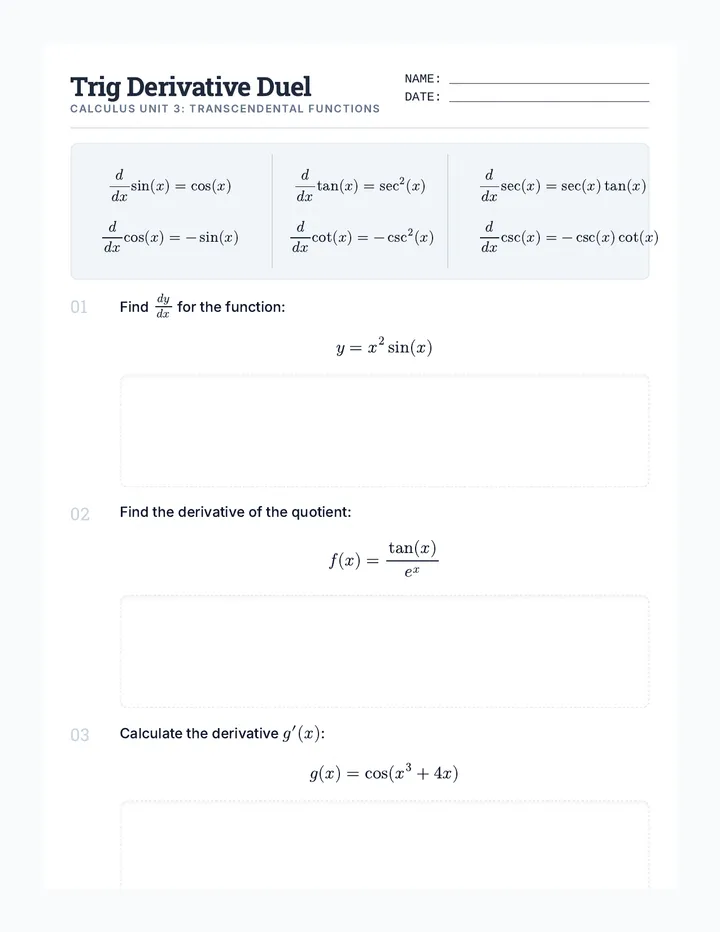
A structured practice worksheet for trigonometric derivatives, featuring basic differentiation, product/quotient rules, and complex chain rule applications. Includes space for detailed student work and a quick reference guide.
The detailed answer key for the Calculus Catalysts Workout, providing step-by-step solutions for limits, instantaneous rate of change, and basic function optimization problems.
A student practice worksheet for calculus-adjacent ACT concepts, featuring limits, instantaneous rate of change logic, and function optimization problems.
A visual slide deck explaining introductory calculus concepts for the ACT, including limits, instantaneous rate of change, and basic function optimization using standard blueprints. Revised for font size compliance (min 24px).
The detailed answer key for the Trig Titan Workout, including step-by-step solutions for identities, the unit circle, and non-right triangle problems.
A comprehensive practice worksheet for advanced ACT trigonometry, featuring sections on identities, the unit circle, Law of Sines/Cosines, and 'Final Ten' challenge problems.
A visual slide deck covering advanced ACT trigonometry: Pythagorean identities, the unit circle, Law of Sines/Cosines, and the ambiguous SSA case. Revised for font size compliance (min 24px).
The detailed answer key for the Geometric Grandeur Workout, providing step-by-step solutions for circle equations, 3D volume, and coordinate geometry problems.
A specialized geometry workout featuring problems on circle equations, 3D volume visualization, and coordinate geometry, including advanced 'Final Ten' style challenges like inscribed octagons and 3D coordinate spheres.
A diverse collection of resources spanning high-level mathematics and early literacy, providing targeted practice for trigonometric derivatives and foundational letter formation.
A comprehensive prep sequence for the most challenging questions on the ACT Math and Science sections. It focuses on high-level conceptual blueprints for math topics like complex numbers and matrices, alongside speed-reading and data-interpretation strategies for the Science section.
This sequence explores numerical analysis through the lens of sequences, focusing on iterative methods to approximate solutions to complex equations. Students investigate fixed-point iteration, Newton's method, convergence rates, and the transition into chaotic behavior.
This sequence bridges the gap between discrete mathematics and quantitative finance, focusing on the application of geometric series to asset valuation, loan amortization, and risk management. Graduate students will develop the mathematical foundations for pricing complex financial instruments and understanding market dynamics.
A comprehensive unit for 12th Grade Calculus students focusing on the derivation and application of derivatives in polar coordinates. Students transition from Cartesian slope to polar slope, analyze horizontal and vertical tangency, investigate behavior at the pole, and solve optimization problems involving polar curves.
A comprehensive unit on parametric equations and their applications in modeling motion. Students move from the basics of parametric curves to advanced calculus concepts like derivatives, concavity, vectors, and arc length.
An advanced 11th-grade Calculus unit focusing on the integration of parametric and polar coordinate systems. Students analyze motion, calculate complex areas, perform error analysis, and complete a final synthesis project based on particle kinematics.
This sequence bridges the gap between radical notation and exponential notation, establishing a unified system for algebraic manipulation. Students begin by defining rational exponents through the lens of roots and powers, then systematically apply the laws of exponents to simplify expressions containing fractional powers.
This calculus sequence guides 11th-grade students through the integration techniques required to calculate area and arc length within polar coordinate systems. From the geometric derivation of the polar sector formula to complex multi-curve regions and boundary measurements, students apply integral calculus to circular geometries.
This sequence explores the calculus of polar functions, focusing on differentiation techniques. Students will learn to calculate slopes of tangent lines, identify horizontal and vertical tangents, analyze behavior at the pole, and apply optimization to find maximum and minimum distances from the origin.
This sequence introduces students to parametric equations through the lens of particle motion and physics simulations. Students progress from basic plotting and parameter elimination to advanced calculus applications involving derivatives, vectors, and arc length.
A sequence for undergraduate students bridging pre-calculus and calculus by focusing on the analytical properties of functions with rational exponents. Students explore graphing, algebraic rewriting, rationalizing for limits, and growth comparison.
A foundational journey through the uppercase alphabet, focusing on stroke order, pen control, and letter recognition for early learners.
Master the derivatives of the six trigonometric functions through visual explanation and structured practice, including chain rule and product rule applications.
An introductory exploration of calculus-adjacent concepts tested on the ACT, focusing on limits, instantaneous rates of change, and function optimization. Students will master the Limit Blueprint and apply rate-of-change logic to complex algebraic scenarios.
An intensive masterclass on advanced trigonometric identities, the unit circle, and non-right triangle laws. Students will master the Pythagorean identities, Law of Sines/Cosines, and the specific ACT-style unit circle coordinates required for top-tier scores.
A specialized deep dive into advanced geometry concepts including circle equations, 3D volume/surface area of complex shapes, and coordinate geometry involving perpendicularity and distance. Students will master completing the square for circles and visualizing 3D cross-sections.
A specialized deep dive into trigonometric functions, mastering the critical distinction between period and frequency. Students will apply the 2π/b blueprint to decode sine and cosine graphs and solve high-difficulty periodic motion problems.
A focused deep dive into imaginary and complex numbers. Students will master powers of i, arithmetic with complex conjugates, and solving quadratic equations with complex roots—all through the lens of ACT-style 'Final Ten' questions.
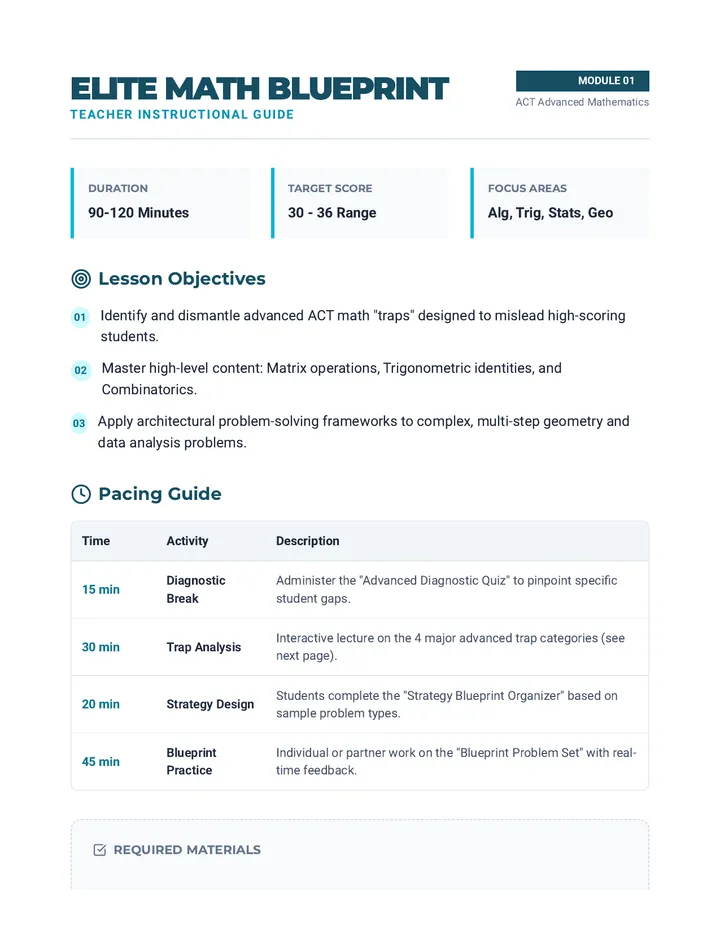
A comprehensive lesson focused on high-level ACT Math topics including matrices, complex functions, trigonometry, and advanced statistics. The lesson emphasizes identifying common 'traps' and applying architectural-style problem-solving strategies.
A specialized AP Calculus lesson exploring the unique geometric and analytical properties of Euler's number. Students use graphing software to discover why e is the unique base where the function's height, slope, and area under the curve are identical.
A high-speed review of logarithmic expansion properties designed to build the algebraic fluency required for Calculus. Students learn to recognize patterns in complex rational expressions to expand logs instantly, facilitating easier differentiation and integration.
This lesson focuses on calculating the difference quotient for radical functions using the conjugate method. It includes a conjugate warm-up, guided video notes for a complex radical example, a collaborative group relay activity, and a conceptual preview of derivatives.
An 11th-grade honors lesson connecting the limit definition of the derivative to instantaneous velocity through rocket launch simulations. Students will analyze height functions to determine peak altitude and impact force.