Lenny.com
Explore
Create
ActivitiesNewMathEnglish Language ArtsScience & EngineeringSocial StudiesGlobal LanguagesHealth & Physical EducationSpecial EducationCounseling & Life SkillsArts & CreativityESL
Lenny.com
Lenny.com
Explore
Create
ActivitiesNewMathEnglish Language ArtsScience & EngineeringSocial StudiesGlobal LanguagesHealth & Physical EducationSpecial EducationCounseling & Life SkillsArts & CreativityESL
Lenny.com
Lenny.com

Solutions

Lenny for EducatorsLenny for SchoolsLenny for Districts

Product

ExploreSign inCreateSupportAbout

Resources

Getting startedMTSS Acceleration Program

© 2026 Lenny Learning Inc.

TermsPrivacyAccessibility
LinkedInInstagramX
Lenny

Addition and Subtraction Problems

One- and two-step word problems involving joining, separating, and comparing quantities. Develops strategies for modeling operations and understanding the inverse relationship between addition and subtraction.

MathNumbers & CountingCounting ObjectsNumber NamesComparing NumbersNumber OperationsCounting SequenceNumbers 0-10Place Value Understanding and SystemAdd and Subtract Within 20Addition and Subtraction ConceptsAddition and Subtraction EquationsAddition and Subtraction ProblemsFoundations for MultiplicationMultiplication and Division PropertiesMultiply and Divide Within 100Multiplication and Division ProblemsFactors and MultiplesProperties of OperationsPatterns and RelationshipsGenerate and Analyze PatternsMulti-Digit ArithmeticPlace Value OperationsMulti-Digit and Decimal OperationsNumerical ExpressionsFour Operations and PatternsFour Operations Problem SolvingMeasurement & DataMeasurable AttributesMeasuring LengthsMeasure and Estimate Lengths in Standard UnitsRelate Addition and Subtraction to LengthClassifying and Counting ObjectsTime and MoneyArea Concepts and MeasurementPerimeter and Area MeasuresAngle Concepts and MeasurementTime, Volume, and MassMeasurement Unit ConversionsGeometryIdentifying ShapesShapes and AttributesShape Attributes and ReasoningShapes and CompositionClassifying 2D FiguresGeometric Figures and RelationshipsLines, Angles, and ShapesAngle, Area, and VolumeGeometric MeasurementVolume of 3D ShapesCoordinate Plane ApplicationsTransformations in the PlaneCongruence and SimilarityUnderstand congruence in terms of rigid motionsSimilarity and TransformationsProve Theorems Involving SimilarityPythagorean TheoremTrigonometry for General TrianglesMake Geometric ConstructionsProve Geometric TheoremsTheorems About CirclesFind Arc Lengths And Areas of Sectors of CirclesVolume FormulasRelationships Between Two-Dimensional and Three-Dimensional ObjectsProve Simple Geometric Theorems AlgebraicallyTranslate Between Geometric Description and Equation for Conic SectionApply Geometric Concepts in Modeling SituationsFractions & DecimalsFractions as NumbersBuilding FractionsFraction Equivalence and OrderingAdding and Subtracting FractionsMultiplying and Dividing FractionsDividing FractionsDecimal FractionsMulti-Digit Computation and FactorsAdd, Subtract, Multiply, and Divide Rational NumbersRational Number SystemIrrational Numbers and ApproximationsRatiosRatios and ProportionsProportional RelationshipsUnit RateAlgebraAlgebraic ExpressionsGenerate Equivalent ExpressionsQuantitative RelationshipsProportional Relationships and Linear EquationsEquations and InequalitiesEquation Solving and ReasoningLinear Equations and SystemsGraph Equations and InequalitiesSystems of EquationsReal-World Algebraic ProblemsQuantitative Reasoning with UnitsExpression StructureEquivalent Expression FormsRadicals and Integer ExponentsRational ExponentsRational and Irrational NumbersPolynomial OperationsPolynomial IdentitiesPolynomial Zeros and FactorsRational ExpressionsComplex Number OperationsComplex Numbers in PolynomialsComplex Numbers on PlaneStatistics & ProbabilityRepresent and Interpret DataData DistributionsStatistical VariabilityProbability ModelsCompound Event ProbabilitiesStatistical SamplingInterpret Categorical and Quantitative DataBivariate Data PatternsInterpret Linear ModelsComparing Two PopulationsRandom Processes in StatisticsIndependence and Conditional ProbabilityExpected ValuesProbability-Based Decision MakingStatistical Inference and ConclusionsFunctionsFunction Concepts and NotationDefine and Compare FunctionsInterpret Functions in ContextAnalyze Function RepresentationsModel Relationships with FunctionsIdentify Linear vs Exponential GrowthDistinguish Between Function TypesCompare Growth RatesInterpret Function ExpressionsBuild Functions from RelationshipsConstruct and Model FunctionsTransform and Combine FunctionsModel Comparison and SelectionSolve Exponential EquationsTrigonometryTrigonometric Ratios Involving Right TrianglesTrigonometric Functions and Unit CircleModel with Trigonometric FunctionsTrigonometric IdentitiesVectors & MatricesIntroduction to Vectors and MatricesVector QuantitiesVector OperationsMatrix OperationsCalculusLimits and ContinuityDerivative Concepts and NotationDerivative Rules and TechniquesApplications of DerivativesOptimization ProblemsRelated RatesCurve Sketching and AnalysisIntegration Concepts and NotationAntiderivatives and Indefinite IntegralsDefinite Integrals and AreaFundamental Theorem of CalculusIntegration TechniquesApplications of IntegrationDifferential EquationsSequences and SeriesParametric and Polar FunctionsVector-Valued Functions

Videos

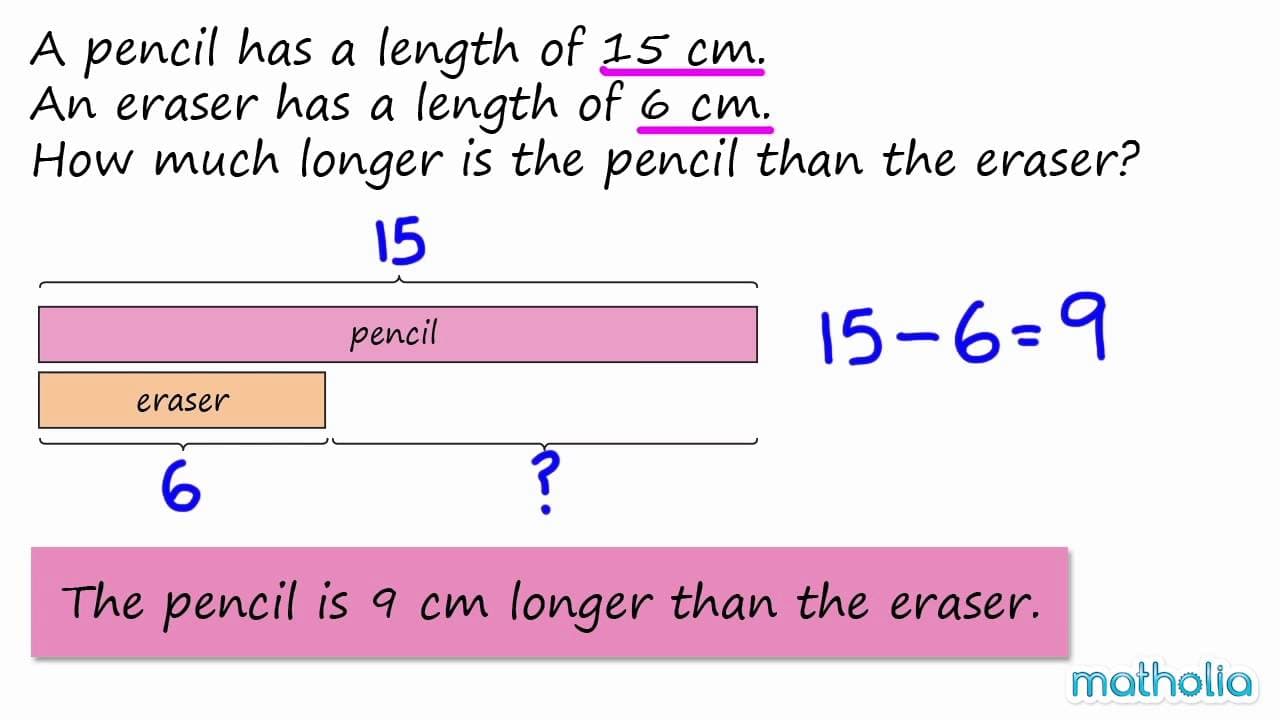
Solving Length Word Problems with Bar Models

Solving Length Word Problems with Bar Models

This educational video demonstrates how to use bar models to visualize and solve mathematical word problems involving the subtraction of lengths. Through clear, step-by-step examples, it guides students on how to translate text-based scenarios into visual representations to determine the correct mathematical operation.

MatholiaChannelMatholiaChannel

1min 48s

Solving a Subtraction Word Problem Using Place Value

Solving a Subtraction Word Problem Using Place Value

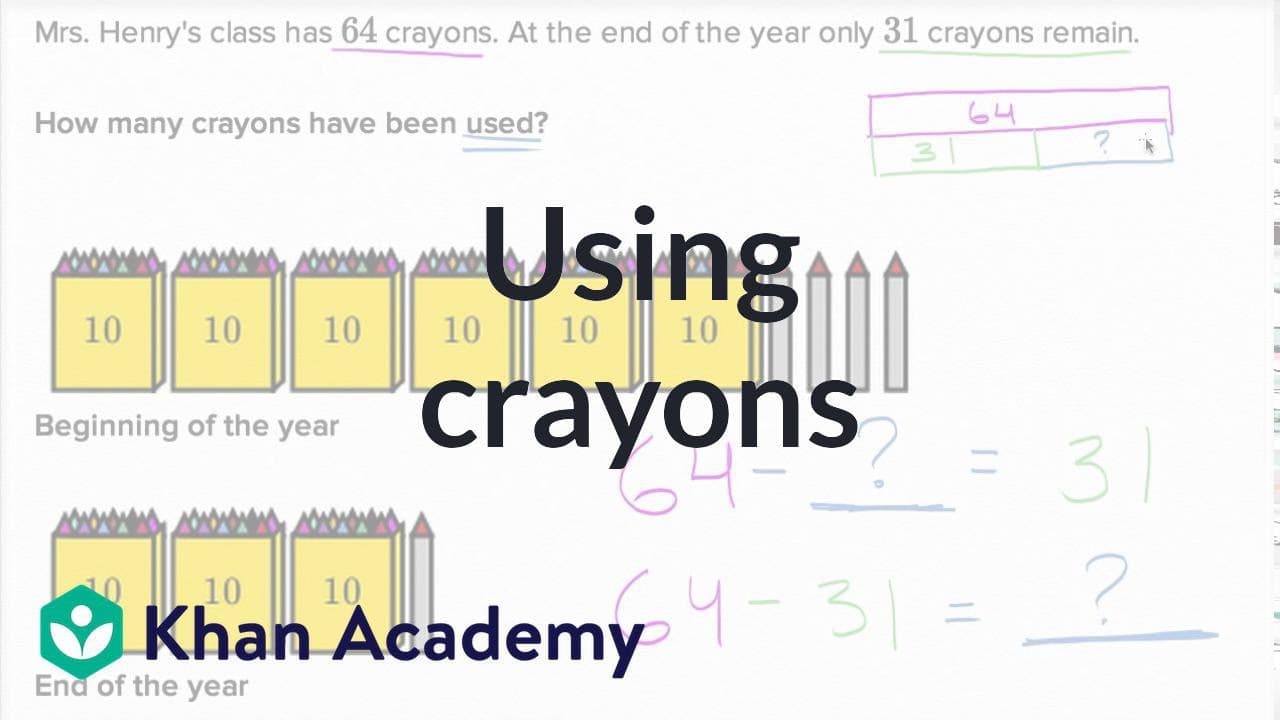
This educational video guides students through solving a math word problem involving subtraction with double-digit numbers. The narrator presents a scenario about a teacher named Mrs. Henry who starts the year with 64 crayons and ends with 31, challenging viewers to calculate how many crayons were used. The video demonstrates two distinct methods for solving the problem: constructing a subtraction equation using algebraic thinking and utilizing visual place value blocks to physically see the difference. Key themes include subtraction strategies, place value understanding (tens and ones), and the relationship between addition and subtraction equations (fact families). The video explicitly breaks down numbers into their constituent parts—for example, showing 64 as six groups of ten and four ones—helping students visualize abstract numbers as concrete quantities. For educators, this video serves as an excellent model for connecting abstract arithmetic to visual representations. It is particularly useful for introducing students to the concept of "finding the missing part" in a subtraction problem (Total - Part = Part) and for reinforcing column subtraction without regrouping. The dual approach allows teachers to differentiate instruction for students who prefer visual methods versus those ready for standard algorithms.

Khan AcademyKhan Academy

4mins 24s

Using Bar Graphs to Compare Quantities

Using Bar Graphs to Compare Quantities

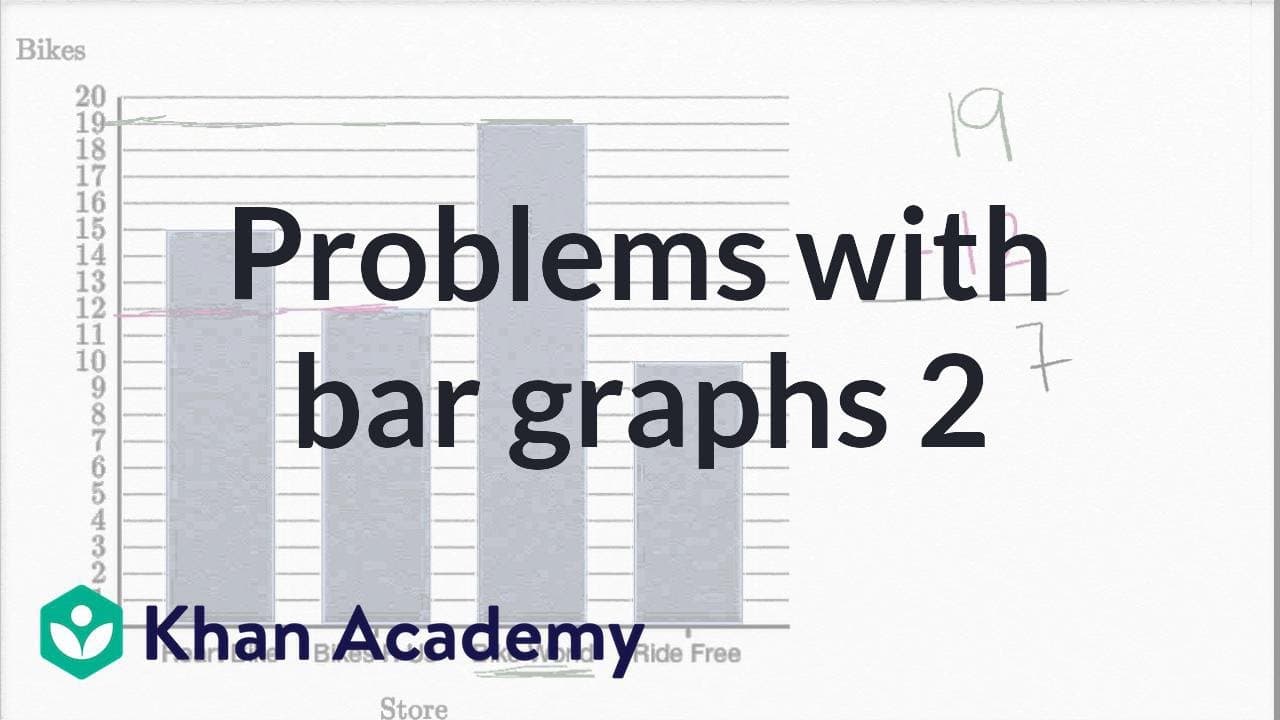
This video provides a clear, step-by-step tutorial on how to interpret data from a vertical bar graph to solve a comparison problem. The narrator demonstrates how to identify specific data points corresponding to different categories ('Bike World' and 'Bikes R Us') and determines the numerical value for each by reading the vertical axis. The content focuses on the key mathematical concept of finding the difference between two quantities. It explicitly models two distinct methods for solving the problem: first, by setting up a subtraction equation (19 - 12), and second, by visually counting the grid units on the graph to determine the 'gap' between the two bar heights. This dual approach reinforces the connection between arithmetic operations and visual data representation. This resource is excellent for early elementary classrooms introducing data analysis and graphing. It helps students transition from simply reading a graph to using the data to answer 'how many more' questions—a common hurdle for young learners. The video serves as a strong model for verifying answers, as it uses the visual counting method to check the arithmetic result.

Khan AcademyKhan Academy

1min 42s

How to Calculate Perimeter for Polygons

How to Calculate Perimeter for Polygons

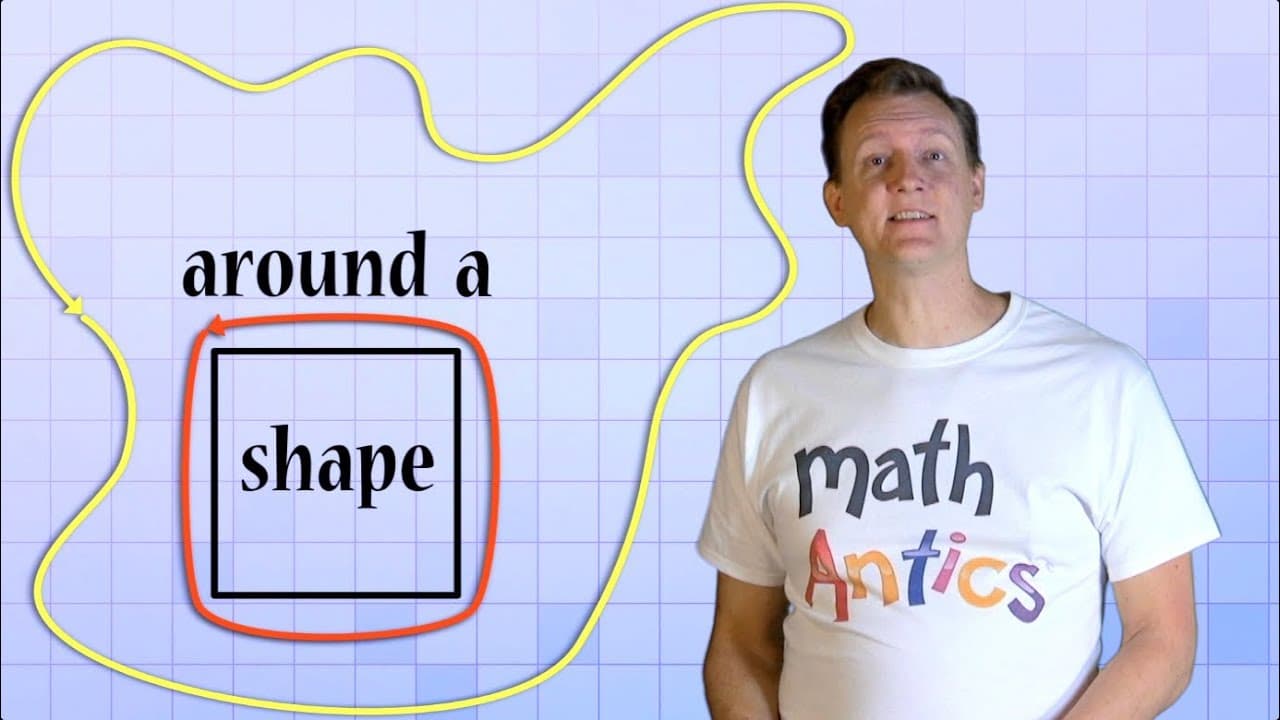
This engaging video introduces students to the concept of perimeter, defining it as the total distance around a two-dimensional shape. Through clear animations and visual metaphors, it explains why perimeter is considered a one-dimensional quantity, demonstrating this by "unfolding" a square into a straight line. The video moves from conceptual understanding to practical application, guiding viewers through the process of calculating perimeter for various polygons by summing their side lengths. The content covers three distinct levels of complexity: simple polygons like triangles and rectangles, regular polygons where multiplication can be used as a shortcut, and complex rectilinear shapes with missing side lengths. This final section is particularly valuable as it teaches a specific problem-solving strategy: using known parallel sides to deduce the lengths of unknown sides, a common hurdle in elementary geometry. For educators, this video serves as an excellent core lesson for introducing geometry measurements. It emphasizes the importance of including units in answers—a critical habit for science and math students. The visual demonstrations, particularly the "walking the path" analogy and the sliding segments to reveal missing lengths, provide intuitive scaffolds that help students grasp abstract geometric concepts.
mathanticsmathantics

7mins 29s

Calculating the Perimeter of Irregular Quadrilaterals

Calculating the Perimeter of Irregular Quadrilaterals

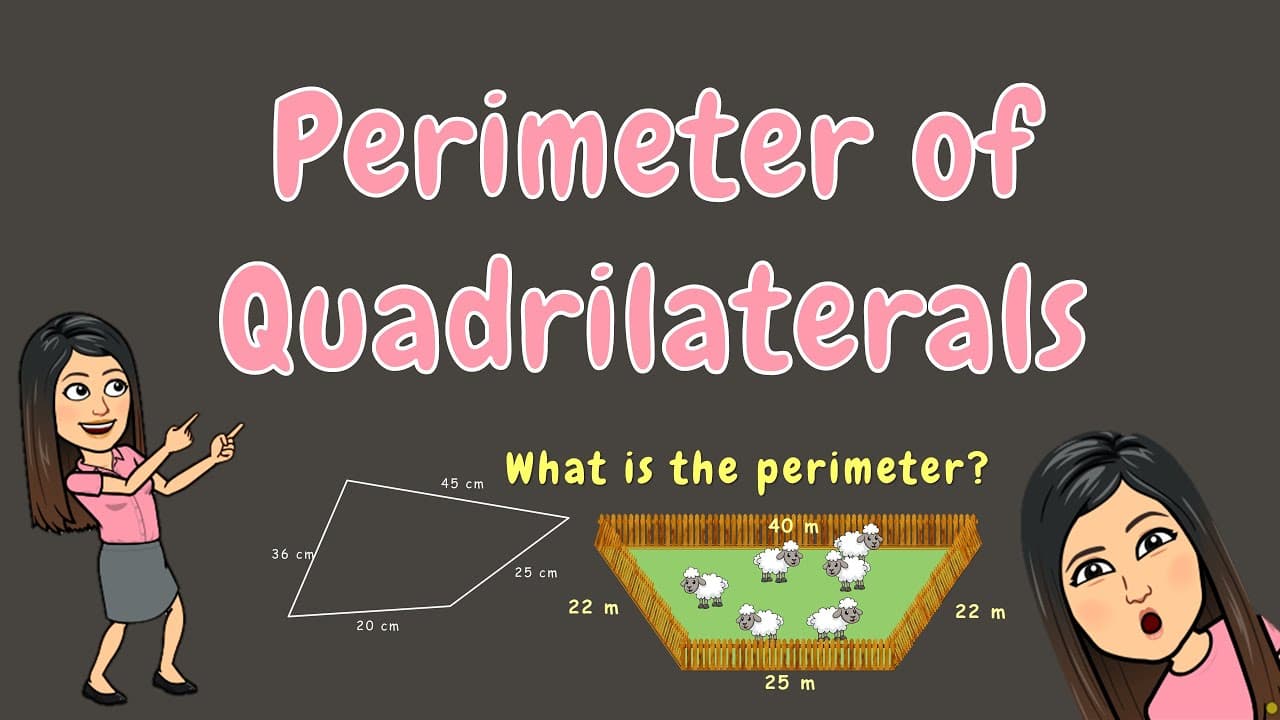
This educational math video provides a clear, step-by-step guide on how to calculate the perimeter of various quadrilaterals, specifically focusing on shapes that are not standard squares or rectangles. Through the use of animated characters and scenarios, it introduces the concept of perimeter as the total distance around a two-dimensional shape and demonstrates the standard algorithm of summing all side lengths to find the answer. The video covers multiple examples, starting with a character running around an irregular quadrilateral track, moving to geometric shapes like parallelograms and trapezoids, and culminating in a real-world word problem about fencing a plot of land for sheep. It concludes with a practice problem for students to attempt on their own, reinforcing the procedural knowledge required to solve these math problems. Teachers can use this video to introduce the concept of perimeter or to model problem-solving strategies for geometry word problems. The step-by-step visual calculations (stacking numbers for addition) model good mathematical habits for students. The video is particularly useful for visual learners who benefit from seeing side lengths highlighted and summed sequentially.

Sheena DoriaSheena Doria

4mins 18s

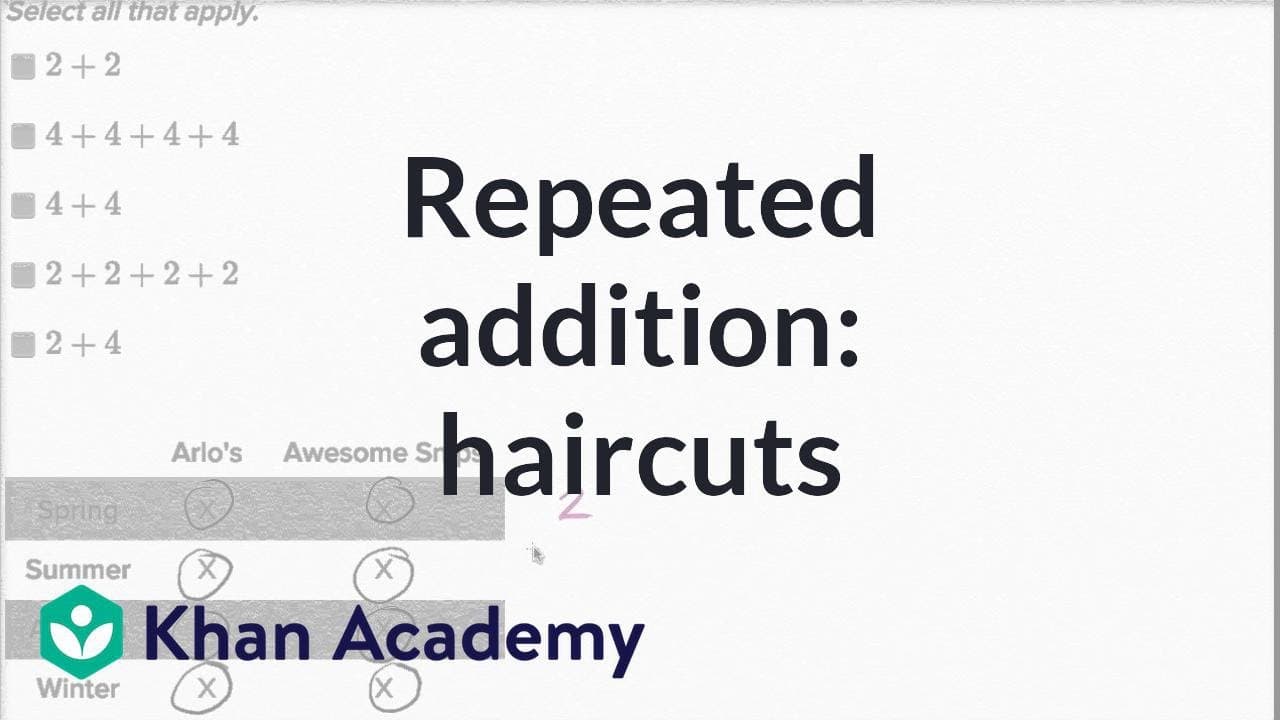
Solving Repeated Addition Word Problems with Haircuts

Solving Repeated Addition Word Problems with Haircuts

This educational video guides students through solving a math word problem involving repeated addition and data interpretation. The narrator breaks down a scenario where a character named Rafael gets two haircuts every season, using a visual table to organize the information across Spring, Summer, Autumn, and Winter. The video demonstrates how to translate a real-world situation into mathematical expressions. Key themes include repeated addition as a foundation for multiplication, interpreting data tables, and evaluating multiple mathematical expressions to find equivalent values. The video explicitly models how to extract numerical values from text and verify them against provided options, reinforcing the concept that the same total can be represented by different number sentences (e.g., 2+2+2+2 and 4+4). Ideally suited for early elementary classrooms, this resource helps teachers introduce or reinforce the connection between word problems and arithmetic operations. It provides a clear visual model for tracking data and offers a practical opportunity for students to practice checking their work by evaluating multiple-choice answers against their calculated total.

Khan AcademyKhan Academy

2mins 9s

Materials

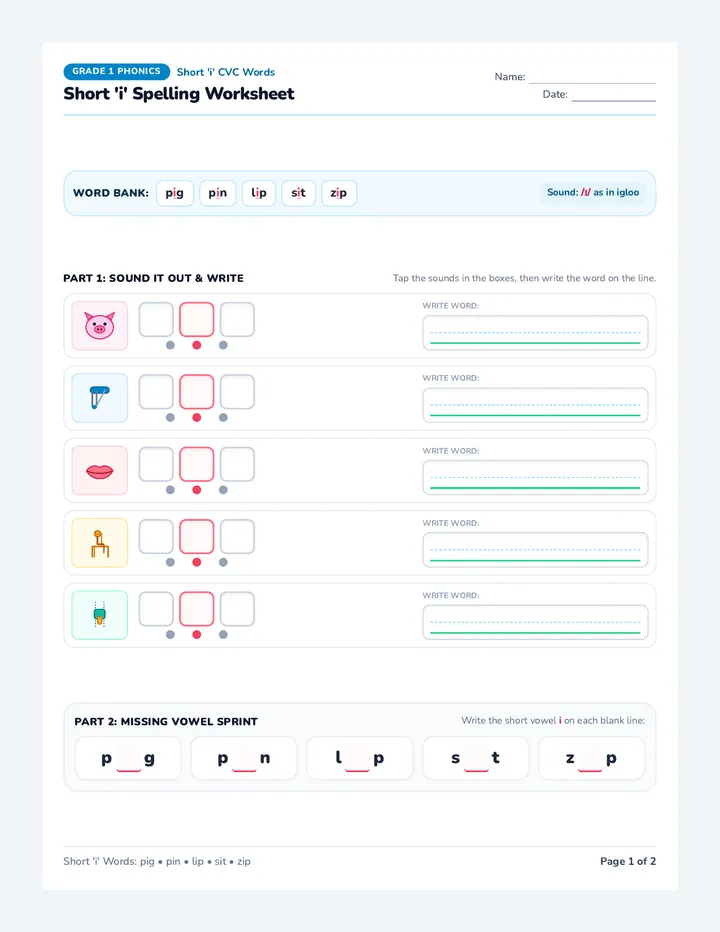
Short I Spelling Worksheet

Short I Spelling Worksheet

A two-page Grade 1 phonics and spelling worksheet focusing on 5 short I CVC words: pig, pin, lip, sit, and zip. Includes sound boxes, handwriting lines, word family sorting, cloze sentences, and a sentence writing challenge.

EA

Edith Asante

Everyday Math Workout Packet

Everyday Math Workout Packet

A comprehensive 20-day mixed review packet aligned with first-grade Everyday Math skills. Each daily page provides structured practice in counting on, turn-around facts, number line addition and subtraction up to 20, tally marks with data charts, decomposing numbers with parts-and-total frames, and story problems up to 12.

T

Terece.Williams

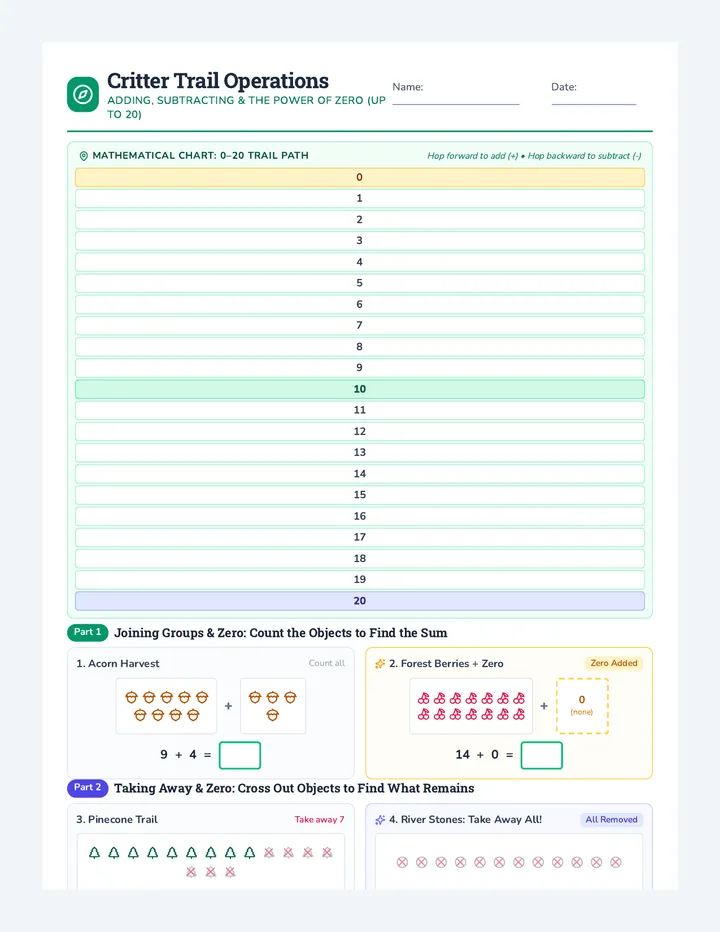
Critter Trail Operations Worksheet

Critter Trail Operations Worksheet

A 2-page print-ready mathematics worksheet for practicing addition and subtraction up to 20 with concrete object visuals, double ten-frames, a 0-20 number path chart, and focused practice with zero ('none') and missing parts.

RL

Rosa Langenstein

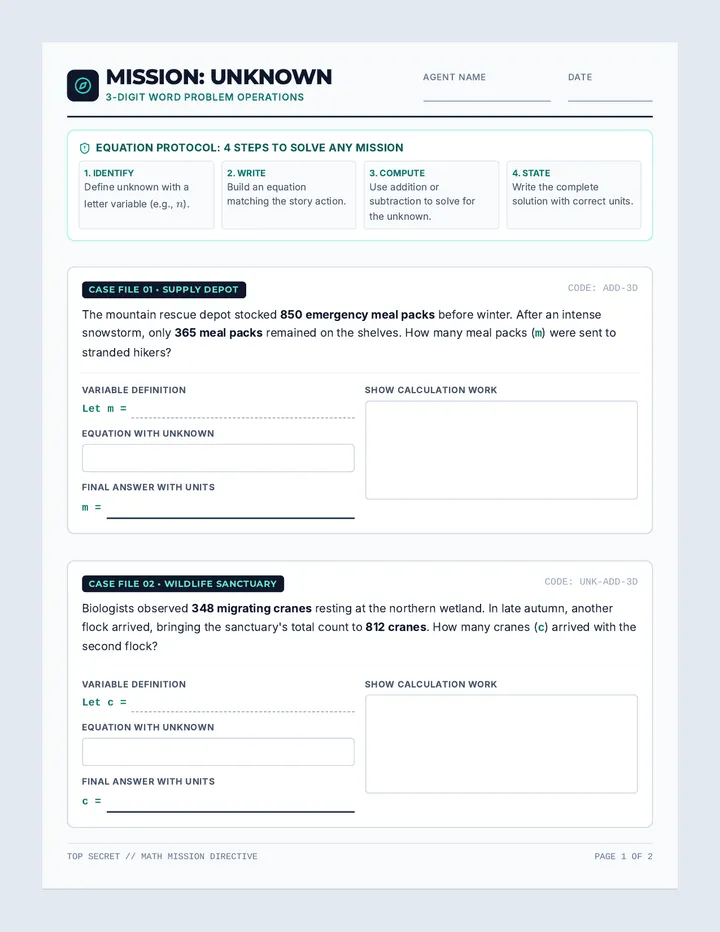
Mission Unknown Worksheet

Mission Unknown Worksheet

A two-page printable math worksheet for 3rd and 4th grade students to practice writing equations with variables and solving 3-digit addition and subtraction word problems.

AP

Allyson Parker

Math Safari Pretest Worksheet

Math Safari Pretest Worksheet

A student-friendly, 15-problem first grade math pre-test covering addition to 10, subtraction from 10, ten-frame and place value visuals, and one-step word problems within 10 with extra-large print and expanded workspaces.

M

mattiea

Book Jacket Studio Worksheet

Book Jacket Studio Worksheet

A comprehensive 2-page book jacket and front-matter design worksheet where students craft their own book cover illustration, back cover blurb, endorsements, dedication, table of contents, chapter names, preface, and interior illustration.

MG

MICHELLE GRIMALDI

Sequences

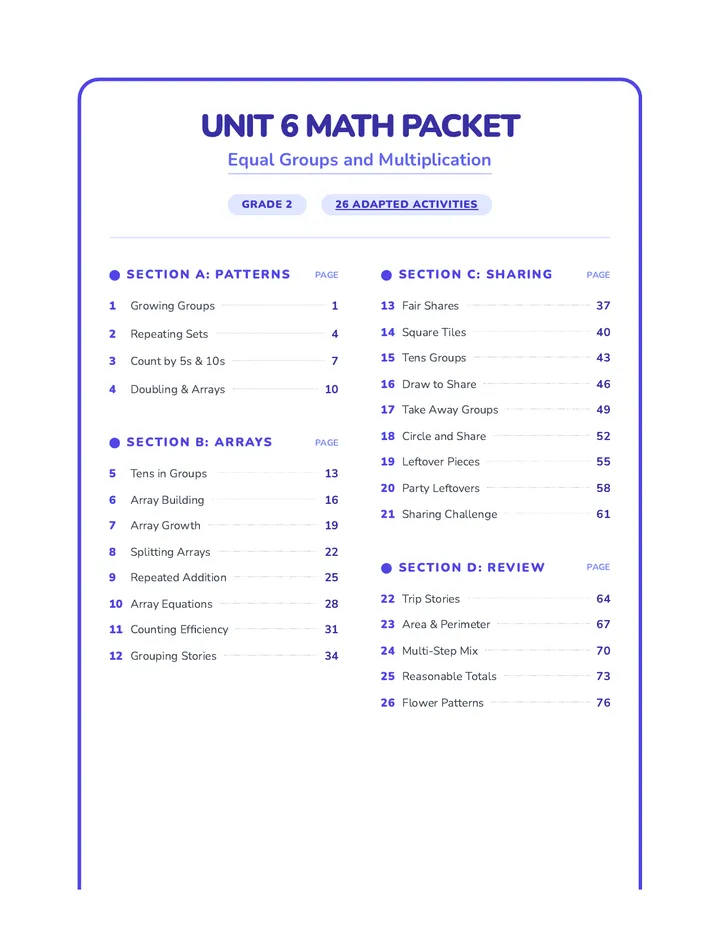
Packet Master TOC document

Unit 6 Equal Groups and Multiplication

A comprehensive Grade 2 math packet focused on skip counting, repeated addition, arrays, and equal groups.

N

nmack

39
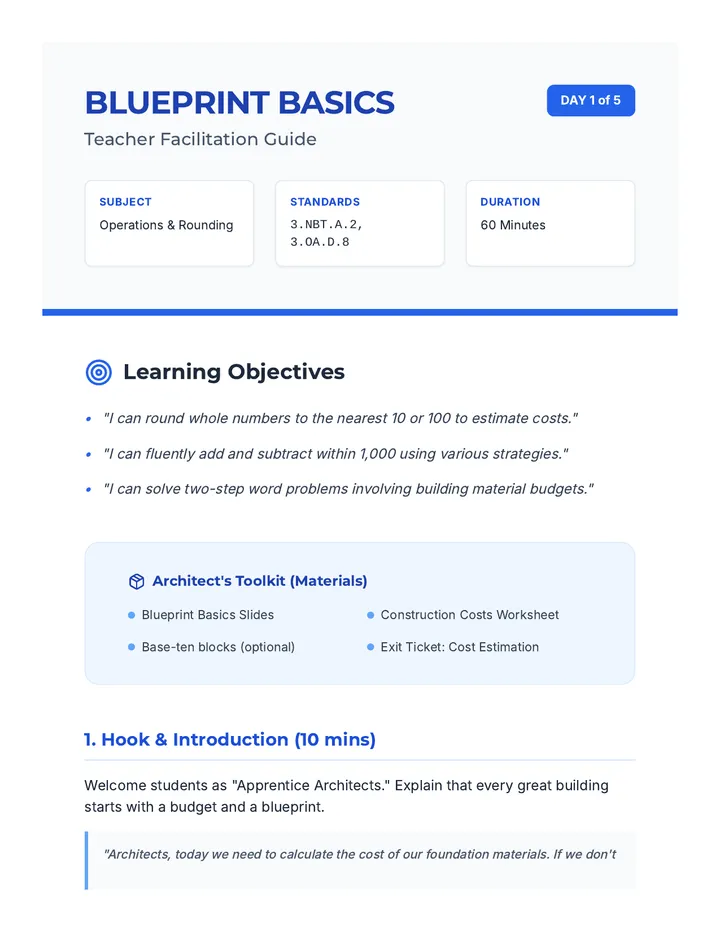
Blueprint Basics Teacher Guide

Master Builders Math Lab

A 5-day intensive math sequence for 3rd grade covering multiplication, division, multi-digit operations, fractions, area, and rounding through a "Master Builder" architectural theme. Students act as apprentice architects solving construction-themed math challenges.

TD

Taylor Doucet

25
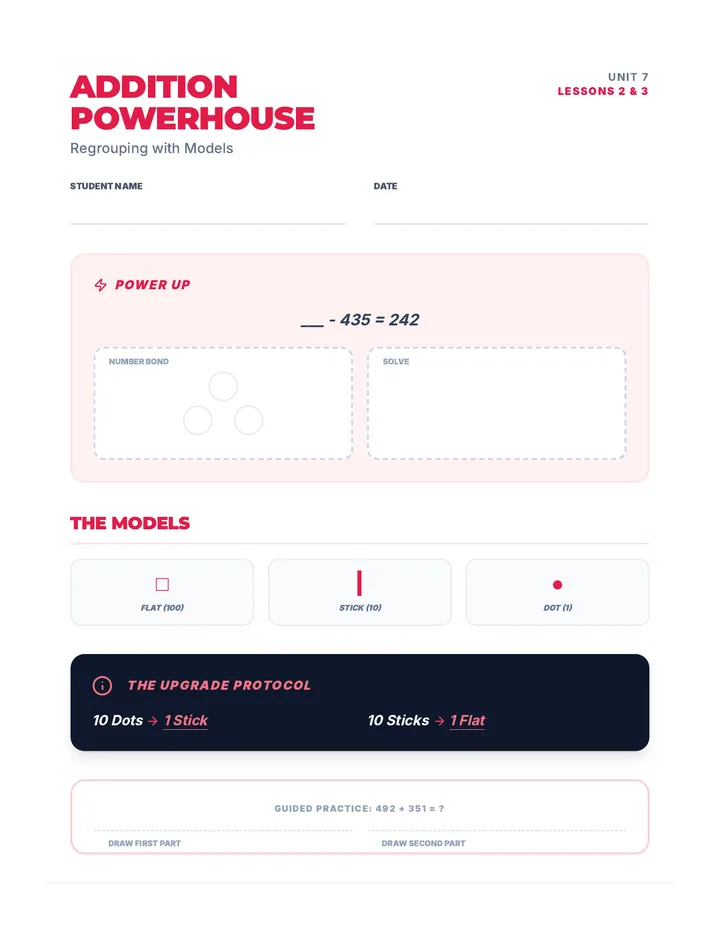
Addition Powerhouse Worksheet

Condensed Calculation

A condensed version of the LEAP Grade 2 Unit 7 curriculum, focusing on addition and subtraction to 1,000 with regrouping across multiple strategies.

MW

Melissa Wienke

34
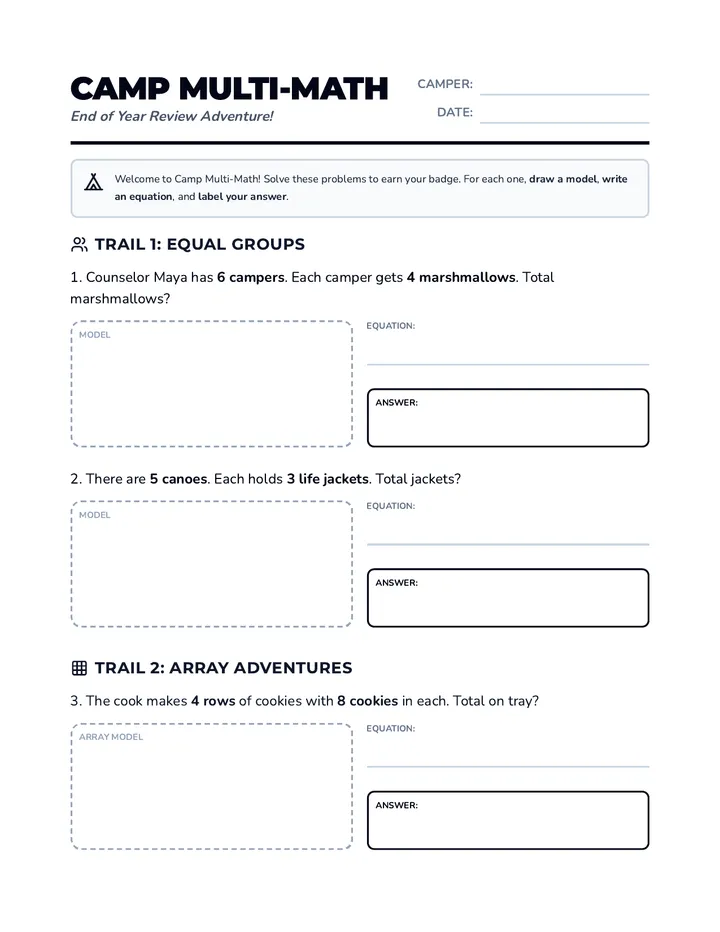
Camp Multi-Math Worksheet

Math Review Adventures

A collection of themed end-of-year math review adventures for different grade levels, focusing on spiraling key standards and problem-solving.

DB

Deborah Burton

21
Beginning Sounds Worksheet

Word Wizards

An engaging, high-impact 4-week literacy skills program for young learners. Features highly visual, fun printable worksheets focusing on beginning letter sounds, CVC phonics blending, sight word reading, and short stories.

Z

ziad

18
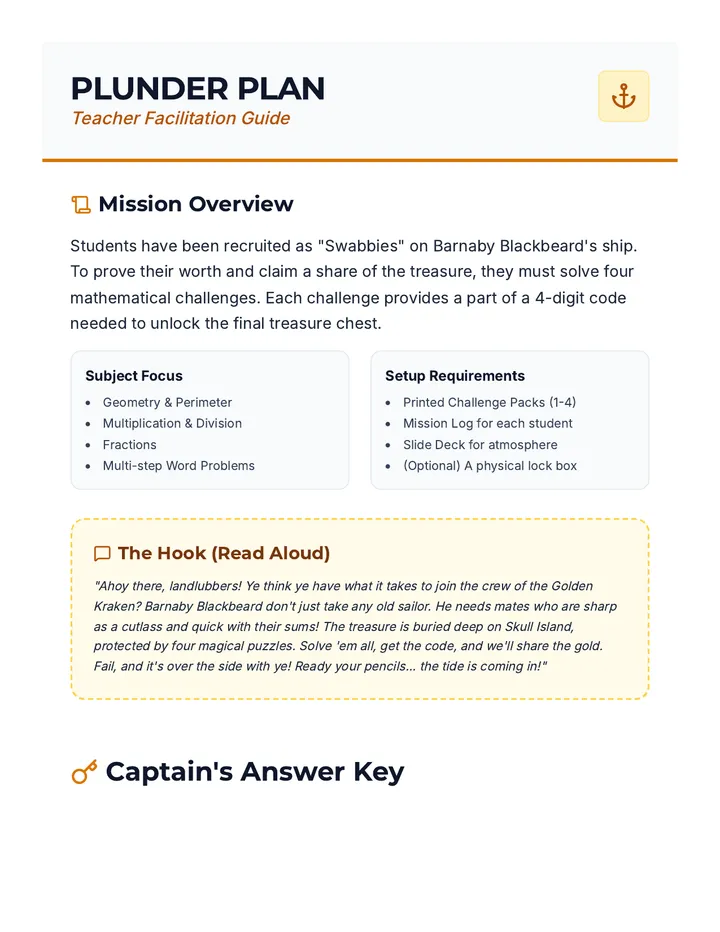
Plunder Plan Teacher Guide

Pirate Math Plunder

A pirate-themed 3rd grade math review escape room where students solve puzzles involving geometry, multiplication, division, fractions, and word problems to find the hidden treasure.

DG

Danielle Garland

12

Lessons

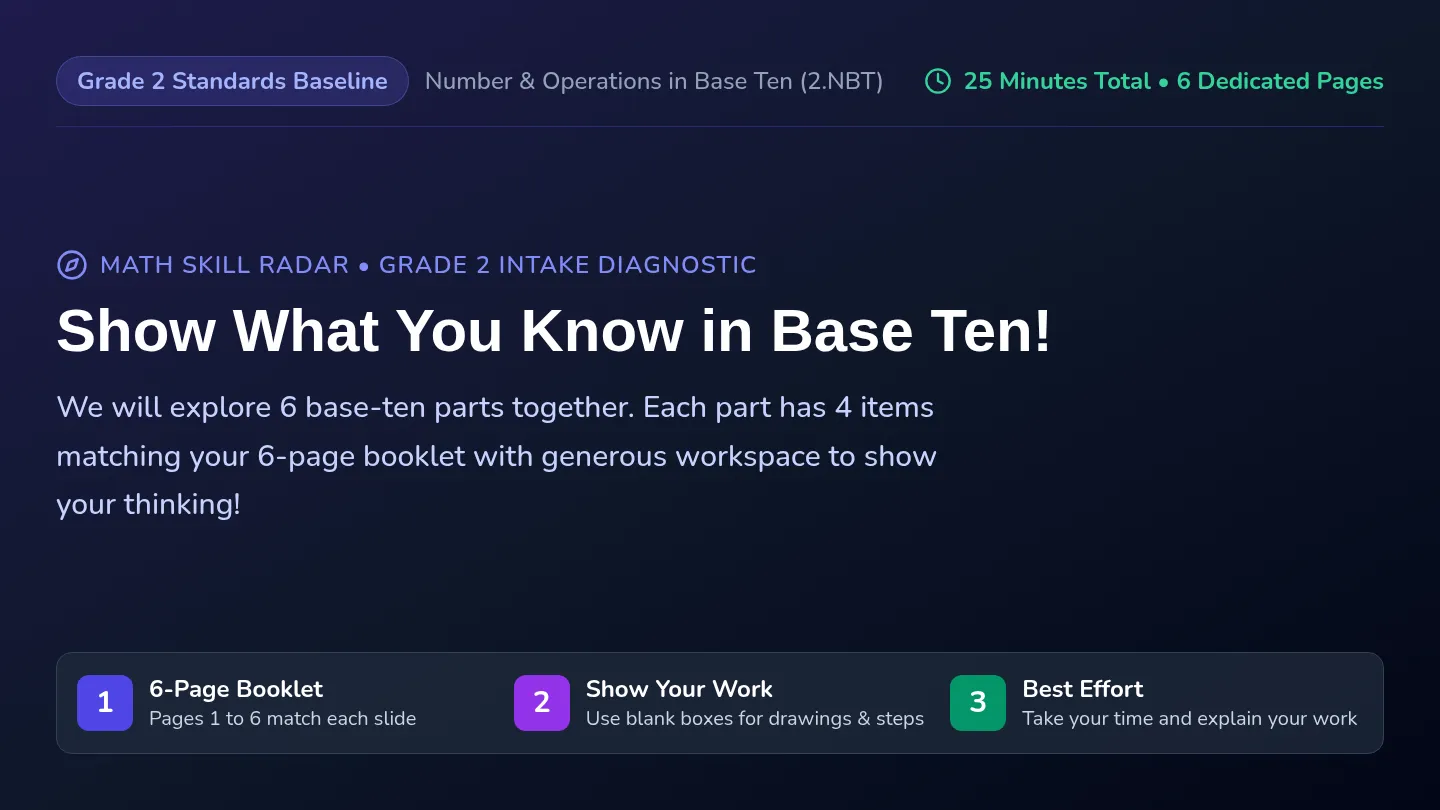
Math Radar Intake Slides

Math Skill Radar

A comprehensive baseline math diagnostic and intervention suite for special education spanning early numeracy through Grade 4. Features complete tiered intake assessments, practice packets, manipulative work mats, and master scoring keys for both 1st Grade Base Ten (1.NBT) and 2nd Grade Base Ten (2.NBT), alongside K-1 early number sense tools.

S

Sara

20
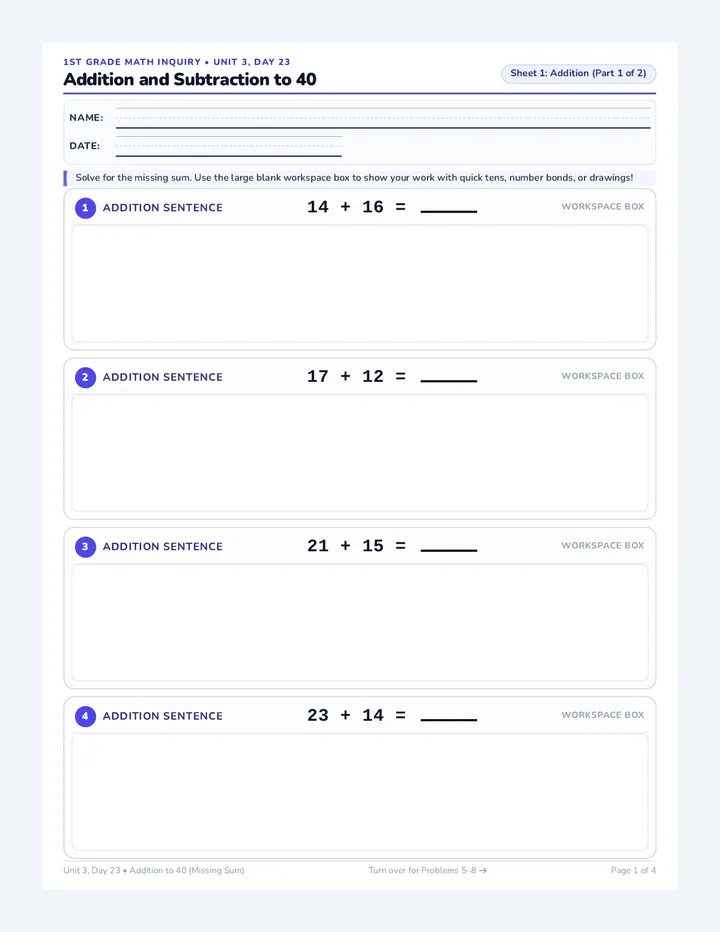
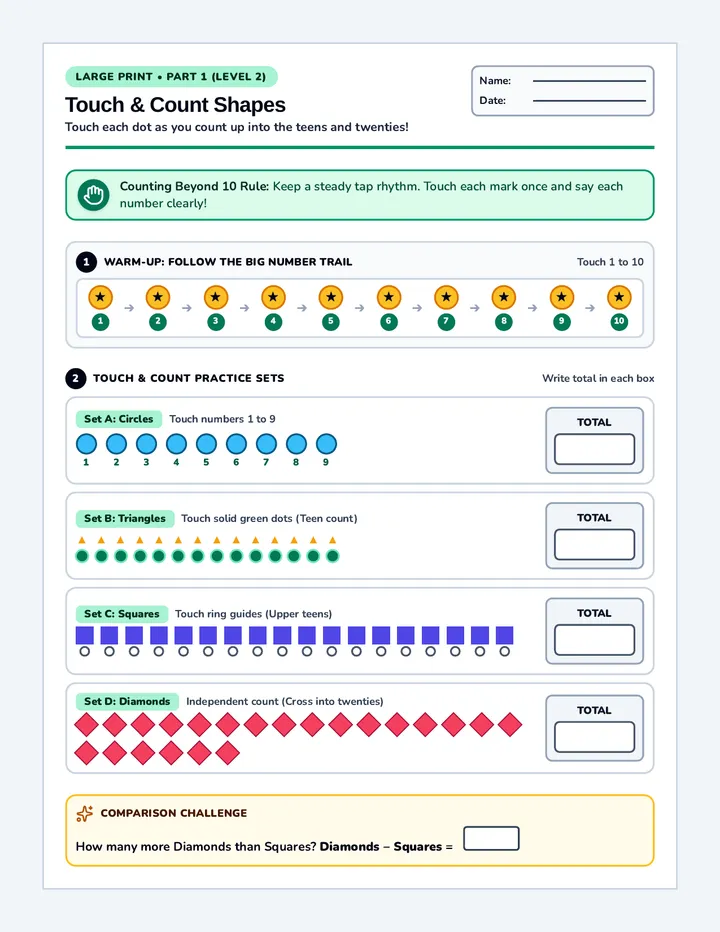
Operations Practice Worksheet

Operations Within Forty

A targeted primary mathematics lesson focused on mastering addition and subtraction number sentences within 40. Students demonstrate their mathematical thinking through dedicated visual workspaces and comparing challenge problems.

EB

Emily Brown

15
Blueprint Builders Slides

Blueprint Builders

A comprehensive lesson on adding and subtracting mixed numbers using visual area models and improper fraction conversions, themed around architectural blueprints and construction.

G

goodev

6
Cash Calculators Slides

Cash Calculators

A comprehensive lesson on mastering currency, from basic coin identification and skip counting to calculating mixed bills and making change in real-world market scenarios. Includes visual slides, scaffolded worksheets, and an interactive matching game.

DP

Deana Padgett

4
Number Fluency Practice Pack

Number Fluency Foundations

An advanced number fluency lesson combining higher-range shape tracking up to 24, tens-and-ones place value grouping up to 30, multi-interval skip counting (3s, 4s, 6s, off-decade 10s, reverse 5s), bridging-10 visual fast facts up to 20, and applied real-world word problem story worksheets with complete teacher keys.

S

Sara

10
Work Sample 2 Fruit Circle Graph

Data Detective Lab

A collection of 10 distinct data analysis work samples featuring bar and circle graphs, designed for MCAS Alt portfolio evidence. Each sample focuses on identifying key information, making comparisons, and calculating totals.

EE

Erin Esswein

10