Lenny.com
Explore
Create
ActivitiesNewMathEnglish Language ArtsScience & EngineeringSocial StudiesGlobal LanguagesHealth & Physical EducationSpecial EducationCounseling & Life SkillsArts & CreativityESL
Lenny.com
Lenny.com
Explore
Create
ActivitiesNewMathEnglish Language ArtsScience & EngineeringSocial StudiesGlobal LanguagesHealth & Physical EducationSpecial EducationCounseling & Life SkillsArts & CreativityESL
Lenny.com
Lenny.com

Solutions

Lenny for EducatorsLenny for SchoolsLenny for Districts

Product

ExploreSign inCreateSupportAbout

Resources

Getting startedMTSS Acceleration Program

© 2026 Lenny Learning Inc.

TermsPrivacyAccessibility
LinkedInInstagramX
Lenny

Transformations in the Plane

Translations, rotations, reflections, and dilations within the coordinate system. Examines congruence and similarity through geometric mapping and algebraic rules.

MathNumbers & CountingCounting ObjectsNumber NamesComparing NumbersNumber OperationsCounting SequenceNumbers 0-10Place Value Understanding and SystemAdd and Subtract Within 20Addition and Subtraction ConceptsAddition and Subtraction EquationsAddition and Subtraction ProblemsFoundations for MultiplicationMultiplication and Division PropertiesMultiply and Divide Within 100Multiplication and Division ProblemsFactors and MultiplesProperties of OperationsPatterns and RelationshipsGenerate and Analyze PatternsMulti-Digit ArithmeticPlace Value OperationsMulti-Digit and Decimal OperationsNumerical ExpressionsFour Operations and PatternsFour Operations Problem SolvingMeasurement & DataMeasurable AttributesMeasuring LengthsMeasure and Estimate Lengths in Standard UnitsRelate Addition and Subtraction to LengthClassifying and Counting ObjectsTime and MoneyArea Concepts and MeasurementPerimeter and Area MeasuresAngle Concepts and MeasurementTime, Volume, and MassMeasurement Unit ConversionsGeometryIdentifying ShapesShapes and AttributesShape Attributes and ReasoningShapes and CompositionClassifying 2D FiguresGeometric Figures and RelationshipsLines, Angles, and ShapesAngle, Area, and VolumeGeometric MeasurementVolume of 3D ShapesCoordinate Plane ApplicationsTransformations in the PlaneCongruence and SimilarityUnderstand congruence in terms of rigid motionsSimilarity and TransformationsProve Theorems Involving SimilarityPythagorean TheoremTrigonometry for General TrianglesMake Geometric ConstructionsProve Geometric TheoremsTheorems About CirclesFind Arc Lengths And Areas of Sectors of CirclesVolume FormulasRelationships Between Two-Dimensional and Three-Dimensional ObjectsProve Simple Geometric Theorems AlgebraicallyTranslate Between Geometric Description and Equation for Conic SectionApply Geometric Concepts in Modeling SituationsFractions & DecimalsFractions as NumbersBuilding FractionsFraction Equivalence and OrderingAdding and Subtracting FractionsMultiplying and Dividing FractionsDividing FractionsDecimal FractionsMulti-Digit Computation and FactorsAdd, Subtract, Multiply, and Divide Rational NumbersRational Number SystemIrrational Numbers and ApproximationsRatiosRatios and ProportionsProportional RelationshipsUnit RateAlgebraAlgebraic ExpressionsGenerate Equivalent ExpressionsQuantitative RelationshipsProportional Relationships and Linear EquationsEquations and InequalitiesEquation Solving and ReasoningLinear Equations and SystemsGraph Equations and InequalitiesSystems of EquationsReal-World Algebraic ProblemsQuantitative Reasoning with UnitsExpression StructureEquivalent Expression FormsRadicals and Integer ExponentsRational ExponentsRational and Irrational NumbersPolynomial OperationsPolynomial IdentitiesPolynomial Zeros and FactorsRational ExpressionsComplex Number OperationsComplex Numbers in PolynomialsComplex Numbers on PlaneStatistics & ProbabilityRepresent and Interpret DataData DistributionsStatistical VariabilityProbability ModelsCompound Event ProbabilitiesStatistical SamplingInterpret Categorical and Quantitative DataBivariate Data PatternsInterpret Linear ModelsComparing Two PopulationsRandom Processes in StatisticsIndependence and Conditional ProbabilityExpected ValuesProbability-Based Decision MakingStatistical Inference and ConclusionsFunctionsFunction Concepts and NotationDefine and Compare FunctionsInterpret Functions in ContextAnalyze Function RepresentationsModel Relationships with FunctionsIdentify Linear vs Exponential GrowthDistinguish Between Function TypesCompare Growth RatesInterpret Function ExpressionsBuild Functions from RelationshipsConstruct and Model FunctionsTransform and Combine FunctionsModel Comparison and SelectionSolve Exponential EquationsTrigonometryTrigonometric Ratios Involving Right TrianglesTrigonometric Functions and Unit CircleModel with Trigonometric FunctionsTrigonometric IdentitiesVectors & MatricesIntroduction to Vectors and MatricesVector QuantitiesVector OperationsMatrix OperationsCalculusLimits and ContinuityDerivative Concepts and NotationDerivative Rules and TechniquesApplications of DerivativesOptimization ProblemsRelated RatesCurve Sketching and AnalysisIntegration Concepts and NotationAntiderivatives and Indefinite IntegralsDefinite Integrals and AreaFundamental Theorem of CalculusIntegration TechniquesApplications of IntegrationDifferential EquationsSequences and SeriesParametric and Polar FunctionsVector-Valued Functions

Videos

How to Perform Rotations About the Origin

How to Perform Rotations About the Origin

This video provides a comprehensive tutorial on performing geometric rotations of shapes on a coordinate plane. The instructor, Justin, guides viewers through the core concepts of rotation, specifically focusing on rotating figures 90, 180, and 270 degrees about the origin. The video utilizes a clever "paper turning" technique to help students visualize how coordinates change during rotation without needing to memorize complex algebraic rules immediately. The content covers essential vocabulary such as "center of rotation," "clockwise (CW)," "counterclockwise (CCW)," "preimage," "image," "isometry," and "invariant points." It clarifies standard mathematical conventions, such as the default direction of rotation being counterclockwise when not specified. Through three distinct examples, the video demonstrates the equivalence between different rotations (e.g., 90° CCW is the same as 270° CW) and explores special cases where points located on the center of rotation remain fixed. This resource is highly valuable for middle and high school geometry classrooms. It bridges the gap between physical manipulation and abstract coordinate geometry. Teachers can use this video to introduce the concept of transformations or as a remediation tool for students struggling to visualize rotations. The step-by-step guided practice format allows for active participation, making it ideal for a flipped classroom model or independent study station.

Miacademy & MiaPrep Learning ChannelMiacademy & MiaPrep Learning Channel

11mins 23s

How to Rotate, Translate, and Reflect Shapes

How to Rotate, Translate, and Reflect Shapes

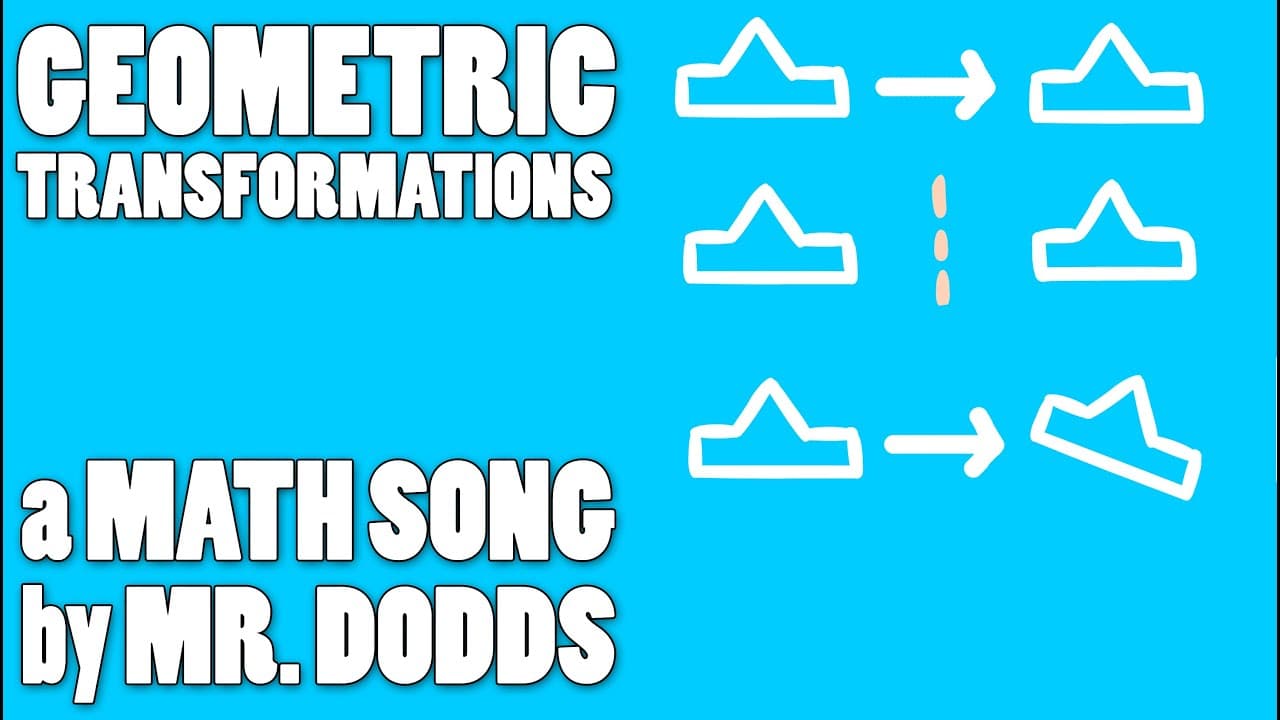
This engaging music video uses a catchy song to teach the fundamental concepts of geometric transformations and tessellations. Through simple, high-contrast animations and rhyming lyrics, the video defines key terms like polygons, rotation, translation, and reflection. It visualizes each concept clearly, showing shapes turning, sliding, and flipping to demonstrate the specific movements associated with each mathematical term. The video connects these transformations to the concept of tessellation, explaining how shapes must fit together perfectly without gaps or overlaps to cover a flat plane. It addresses the properties of polygons and demonstrates that not all shapes can tessellate effectively. The visual examples progress from simple geometric shapes to more complex puzzle-piece designs, showing how rotations, translations, and reflections are the tools used to create these patterns. Ideally suited for upper elementary and middle school mathematics classrooms, this video serves as an excellent mnemonic device for students learning geometry vocabulary. It simplifies complex spatial concepts into memorable soundbites ("turn it 'round," "shift it left," "copy it across"), making it a powerful hook for introducing a unit on rigid transformations or a review tool for reinforcing definitions before a test.

Mr. Colin DoddsMr. Colin Dodds

3mins 16s

Mastering Coordinate Notation for Geometric Translations

Mastering Coordinate Notation for Geometric Translations

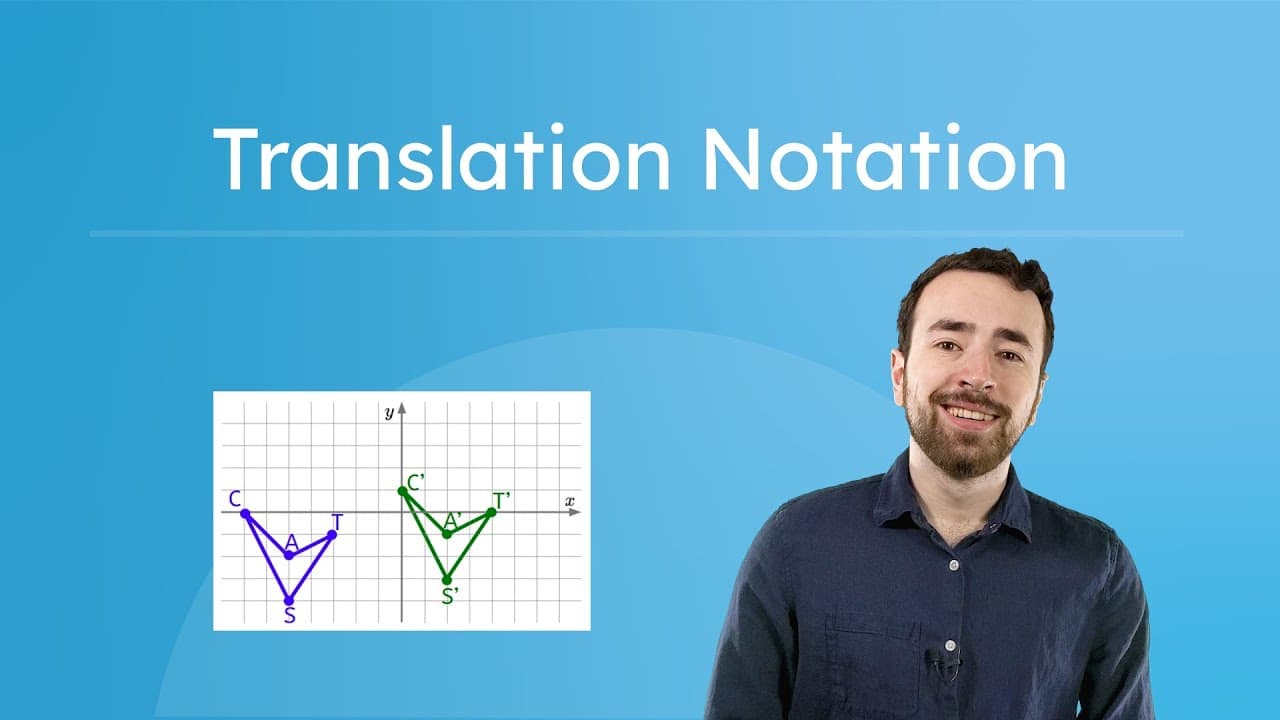
This instructional video guides students through the process of using coordinate notation to describe geometric translations. The lesson bridges the gap between visual transformations on a graph and algebraic rules, teaching students how to quantify shifts in position. It begins by reviewing previous examples to derive rules based on how x and y values change during a translation, then advances to applying these rules to find specific coordinates. The content focuses on four key examples that increase in complexity. First, students analyze graphed shapes to determine the change in coordinates (e.g., $(x-2, y-4)$). Then, they move to purely algebraic problems where they must calculate new image coordinates given a rule, and finally, work backward to find original preimage coordinates given the image and the rule. This progression strengthens algebraic solving skills within a geometric context. For educators, this video is an excellent resource for connecting geometry and algebra. It helps clarify the relationship between directional movement (left/right, up/down) and arithmetic operations (addition/subtraction). The clear, step-by-step breakdown makes it suitable for introducing the concept or for remediation, allowing students to visualize the 'why' behind the algebraic formulas used in transformations.

Miacademy & MiaPrep Learning ChannelMiacademy & MiaPrep Learning Channel

6mins 57s

How to Write Coordinate Notation for Dilations

How to Write Coordinate Notation for Dilations

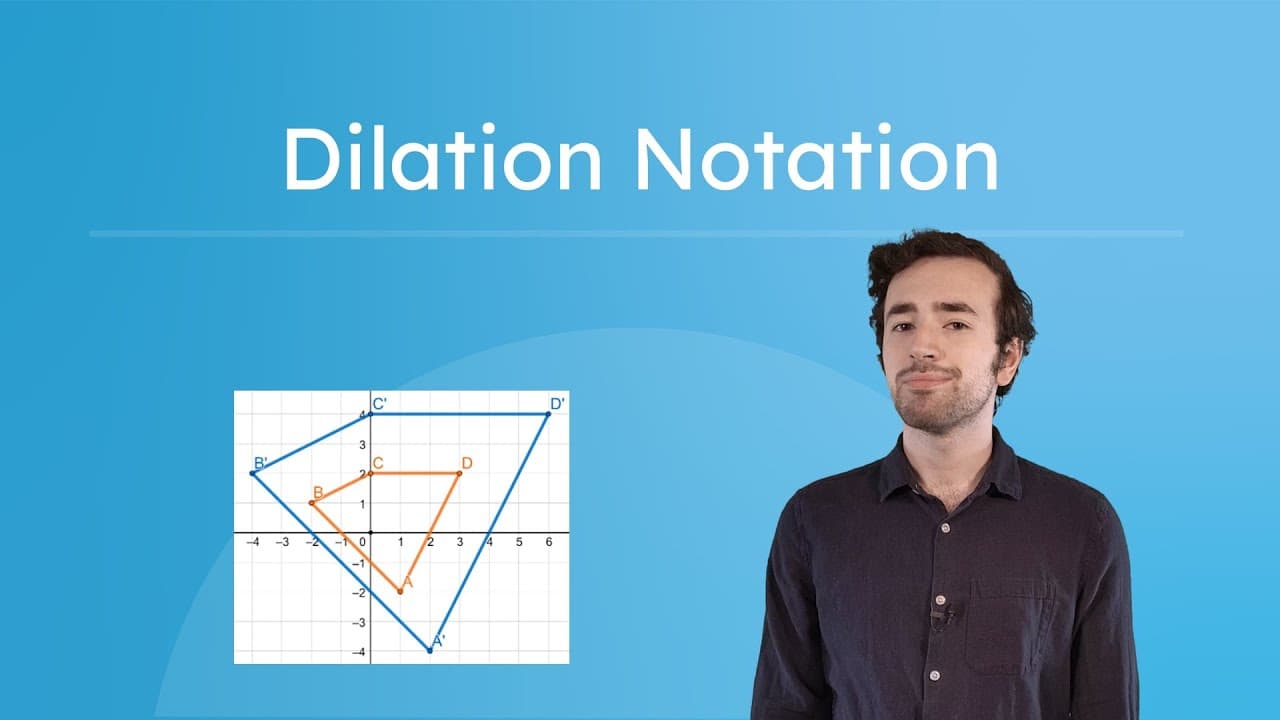
This instructional video provides a clear, step-by-step guide on how to write and interpret coordinate notation for geometric dilations centered at the origin. The lesson bridges the gap between visual transformations on a graph and their algebraic representations, showing students exactly how coordinates change when a shape is resized. It systematically covers four different types of problems: writing notation from given points, finding image coordinates given a rule, finding pre-image coordinates by working backward, and calculating the scale factor to determine the notation.

Miacademy & MiaPrep Learning ChannelMiacademy & MiaPrep Learning Channel

7mins 9s

Identifying Function Transformations from Graphs

Identifying Function Transformations from Graphs

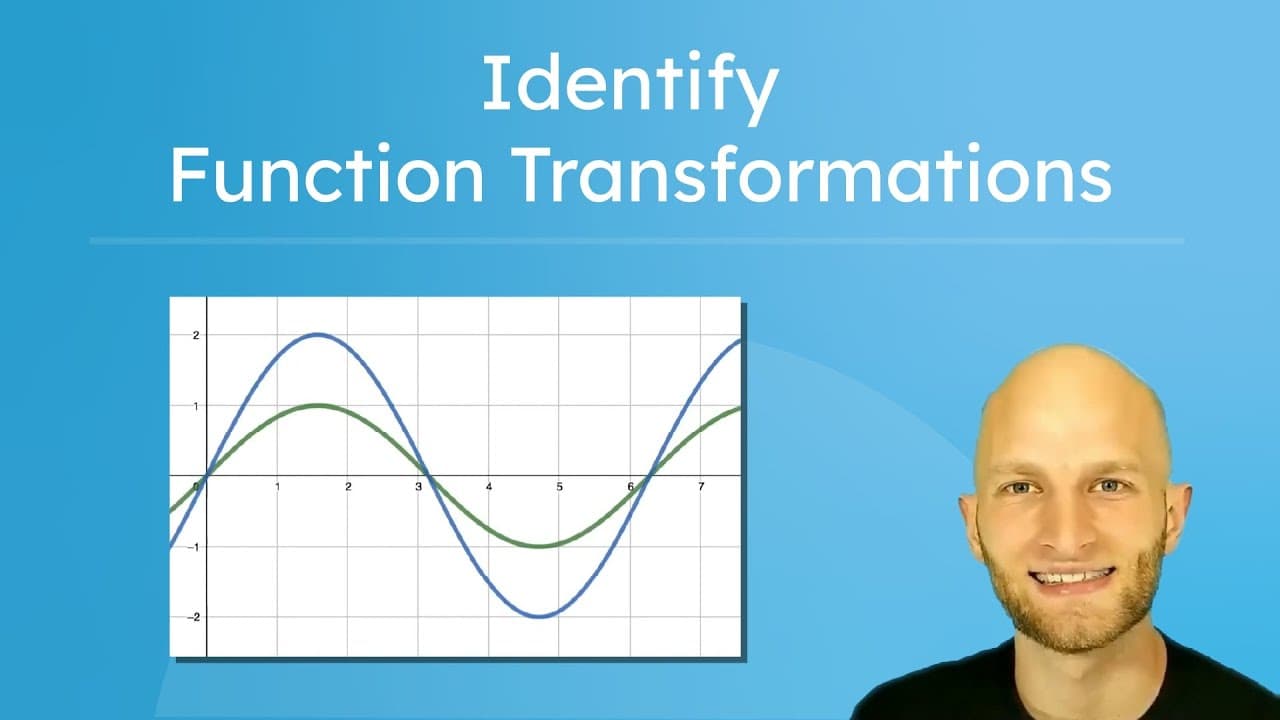
This instructional video provides a comprehensive tutorial on identifying function transformations by analyzing graphs. Narrated by Randy from MiaPrep, the video guides viewers through a series of practice problems involving various function families, including quadratic, absolute value, square root, cube root, trigonometric (sine), and cubic functions. The core objective is to determine how a 'parent' or initial function (green curve) has been transformed to create a new function (blue curve). The video explores four specific types of transformations: shifts (translations), reflections, vertical scaling, and horizontal scaling. For each example, the narrator employs a process of elimination, logically analyzing the visual characteristics of the graphs—such as vertex position, shape consistency, orientation, and invariant points—to determine the correct transformation. He explains why certain transformations are impossible based on the visual evidence, such as why a graph with a shifted vertex cannot merely be a reflection or scaling. This resource is highly valuable for Algebra II and Pre-Calculus classes as it emphasizes visual literacy and conceptual understanding over rote algebraic manipulation. By focusing on the graphical behavior of functions, it helps students develop an intuition for how mathematical operations affect geometric shapes. Teachers can use this video to model analytical thinking, introduce new function families, or review transformation rules before moving to algebraic definitions.
Miacademy & MiaPrep Learning ChannelMiacademy & MiaPrep Learning Channel

9mins 2s

Performing Geometric Translations on the Coordinate Plane

Performing Geometric Translations on the Coordinate Plane

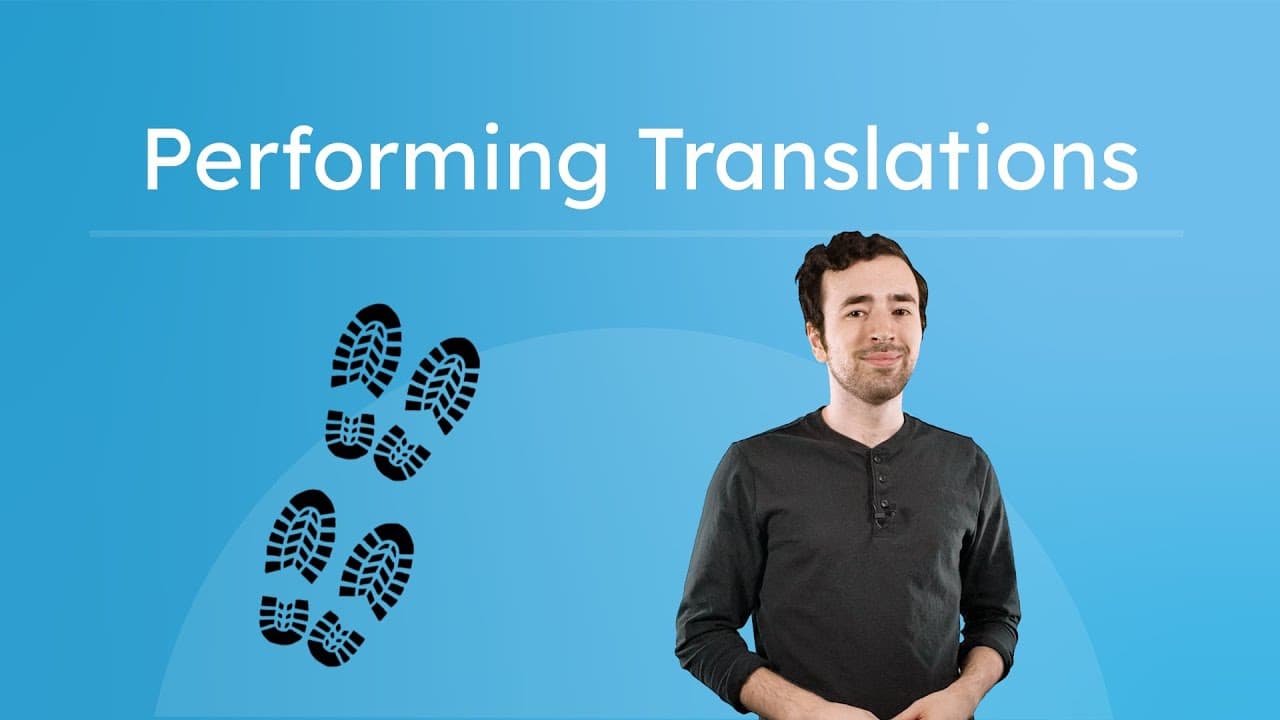
This educational video provides a clear and practical guide to understanding and performing geometric translations on a coordinate plane. Narrated by Justin, the lesson begins by defining a translation as a transformation that slides a figure horizontally, vertically, or both, without changing its size or shape. It uses real-world examples like staircases, window arrangements, and patterned rugs to help students visualize the concept of 'shifting' objects in space. The core of the video focuses on two step-by-step examples of translating geometric figures on a coordinate grid. Students learn how to map vertices from a pre-image to an image by counting units, label new coordinates using prime notation (e.g., A'), and determine if the transformation is an isometry. The video also introduces the concept of invariant points, clarifying why translations—unlike other transformations—do not have fixed points. For educators, this video serves as an excellent instructional tool for Middle School or High School Geometry units on Rigid Transformations. It encourages active participation by prompting students to pause and solve problems independently before revealing the answers. The content bridges abstract mathematical concepts with tangible visual examples, making it ideal for introducing the topic or reviewing coordinate geometry mechanics.

Miacademy & MiaPrep Learning ChannelMiacademy & MiaPrep Learning Channel

7mins 59s

Materials

Author Assumptions Detective Worksheet

Author Assumptions Detective Worksheet

A reading comprehension worksheet guiding students to cite text evidence where an author assumes prior knowledge, identify the hidden assumption, and analyze how background knowledge strengthens understanding, equipped with sentence starters.

MG

MICHELLE GRIMALDI

Sequences

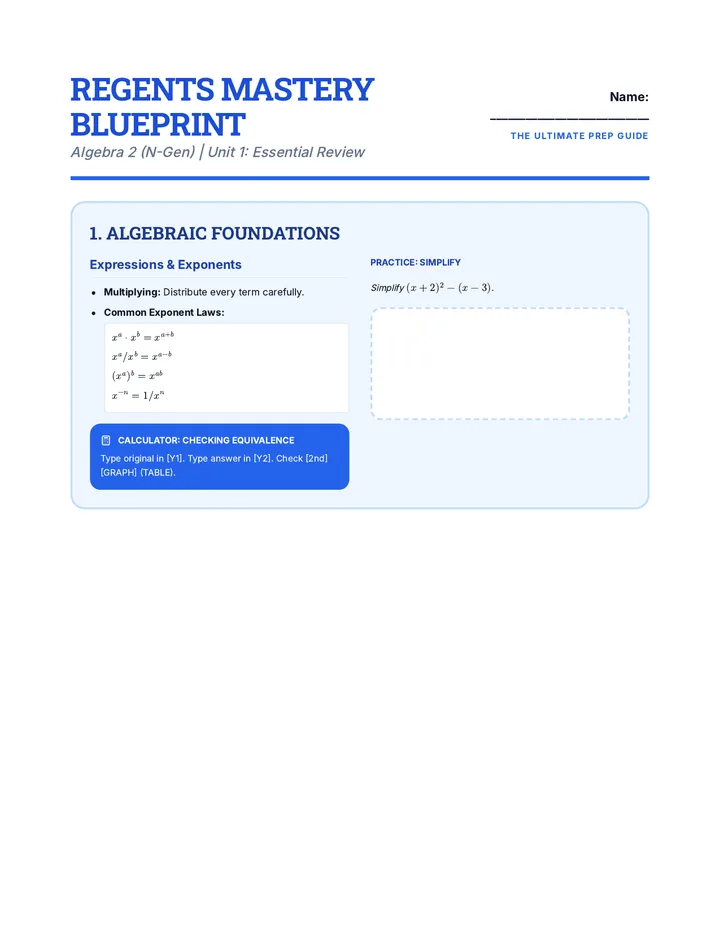
Regents Mastery Blueprint Study Guide

Regents Mastery Suite

A comprehensive review suite for the New York State Mathematics Regents exams, including Algebra 1, Geometry, and Algebra 2, featuring mastery blueprints, calculator strategies, and exam-taking tips.

KB

Kayla Borozny

15
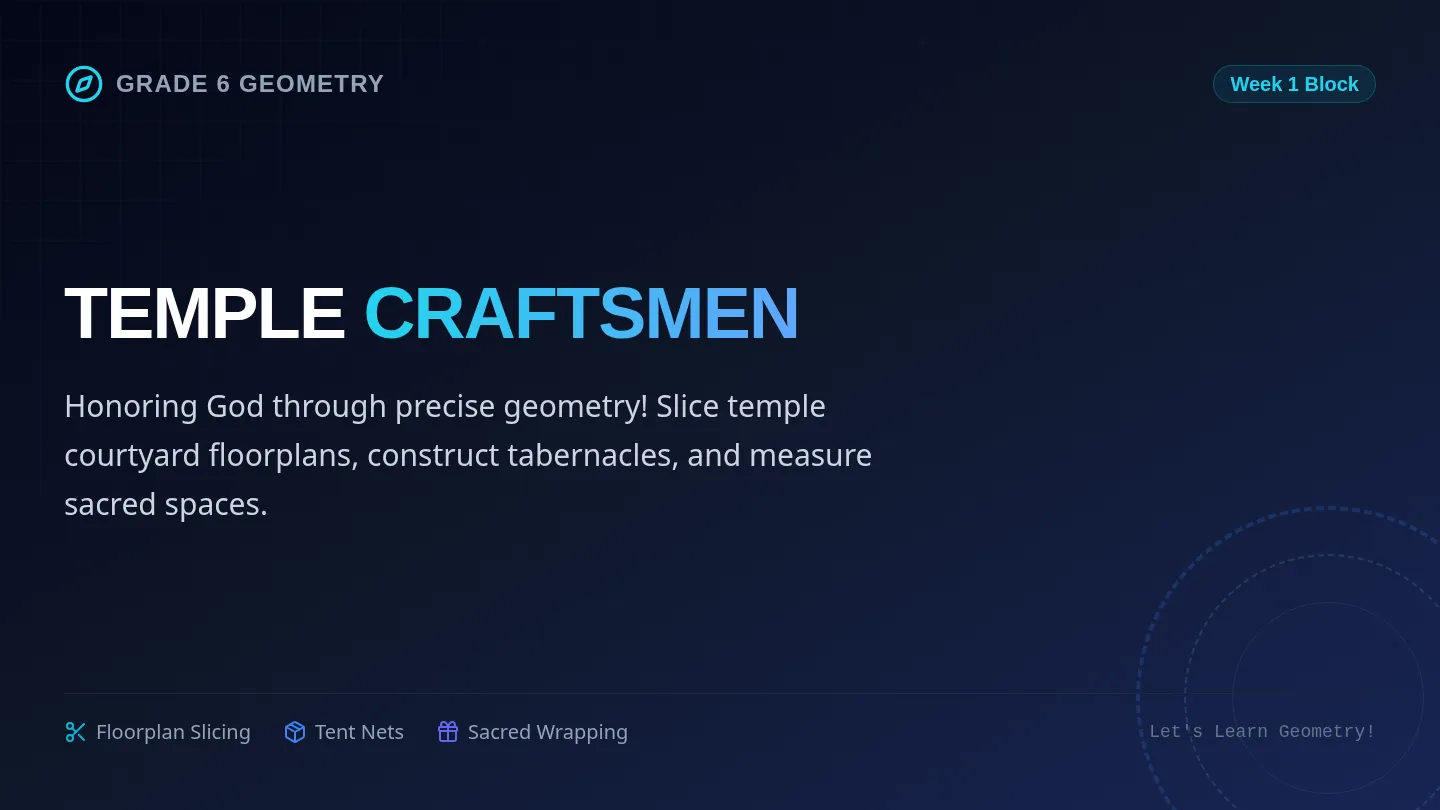
Temple Craftsmen Slides

Middle School Math Block

A multi-subject middle school mathematics block for Week 1, covering 6th Grade Geometry (Temple Craftsmen: polygon decomposition, nets, surface area) and 7th/8th Grade Math (Faithful Stewards: proportional relationships, linear equations, inequalities, transversals) from a Christian perspective.

JR

Jamens Ray II

59
Morning Work Cover Page

Brain Blueprint Math Review

A comprehensive 5-day math review sequence designed for middle school students preparing for state testing. The sequence covers number systems, expressions, ratios, geometry, and statistics through a 'Brain Blueprint' theme.

AA

alicia accapezzato

7
Défi Kangourou Exercices Document

Mission Kangourou

Un programme d'entraînement complet pour le concours Kangourou (niveau 4ème), couvrant la géométrie, la logique pure et les stratégies de résolution rapide.

E

Enseignante

7
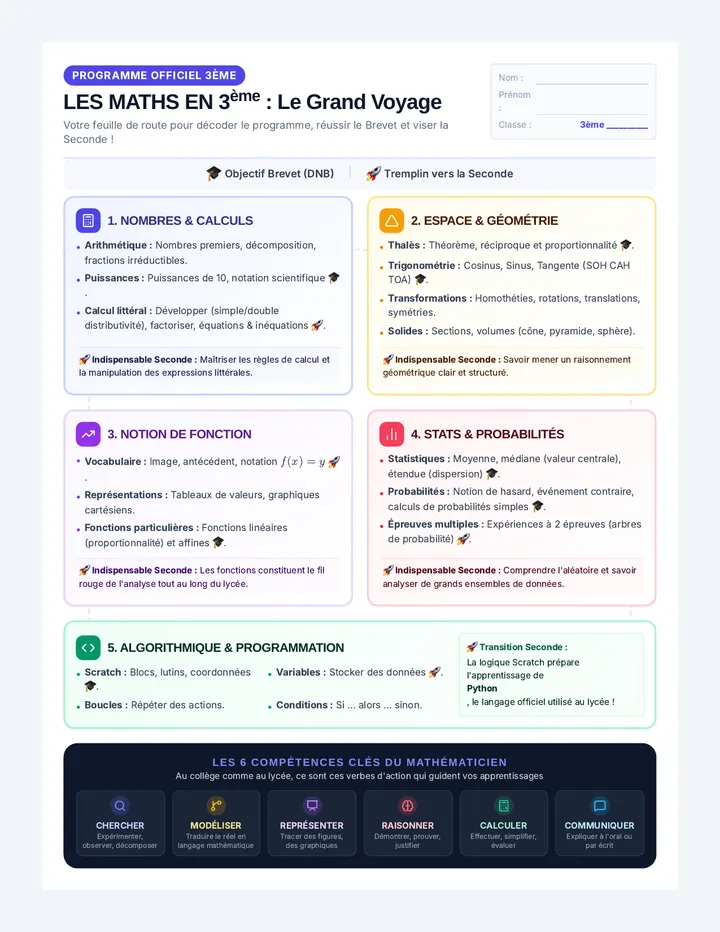
Maths 3eme Carte Mentale Document

Feuilles de Route Maths

Un ensemble de cartes mentales et d'infographies pédagogiques pour guider les élèves de collège (4ème, 3ème) dès la rentrée.

E

Enseignante

4
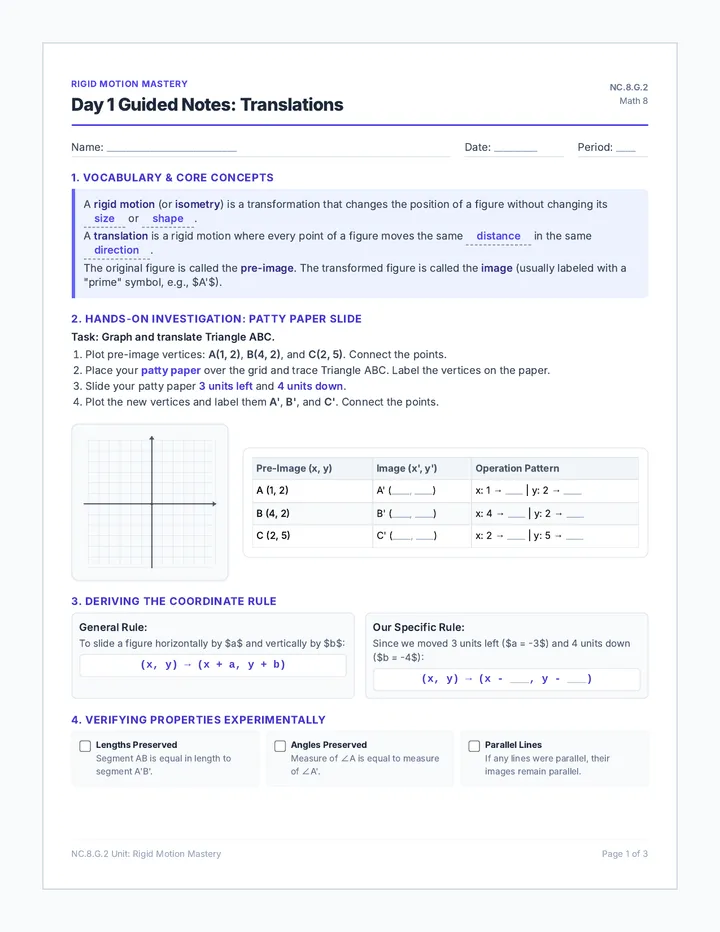
Rigid Motion Guided Notes

Rigid Motion Mastery

A 10-day instructional unit on rigid transformations and congruence mapping for 8th-grade mathematics, aligned with NC Math Standard 8.G.2. The sequence covers translations, reflections, and rotations, emphasizing coordinate rules, properties verification using patty paper, and composition of transformations to define and prove congruence.

ER

Enessia R. Jones

4

Lessons

Slide Squad Teacher Guide

Slide Squad

A scaffolded lesson on geometric translations that simplifies complex vocabulary, breaks down coordinate rules into manageable steps, and provides clear visual anchors for students.

EE

Erin Esswein

6
Pivot Points Facilitation Guide

Pivot Points Rotation Lesson

A high-school Geometry lesson focused on performing rotations about points other than the origin, featuring a three-step translation method and NYS Regents practice.

KB

Kayla Borozny

5
Unit 2 Test Student Copy

Grid and Graph Mastery

A comprehensive 9th-grade assessment lesson covering coordinate geometry, functions, slope, and graph interpretation through review, testing, and reflection.

KC

Kris Coyne

6
Prism Lab Lesson Plan Guided Notes Teacher Resource

Mirror World Reflections

An introductory lesson on geometric reflections, covering lines of reflection, x and y-axis reflections, and the concept of congruence.

EE

Erin Esswein

8
Vector Voyages Slides

Vector Voyages

A modified geometry lesson focused exclusively on translations, featuring visual aids, simplified language, and scaffolded practice for high school students.

EE

Erin Esswein

8
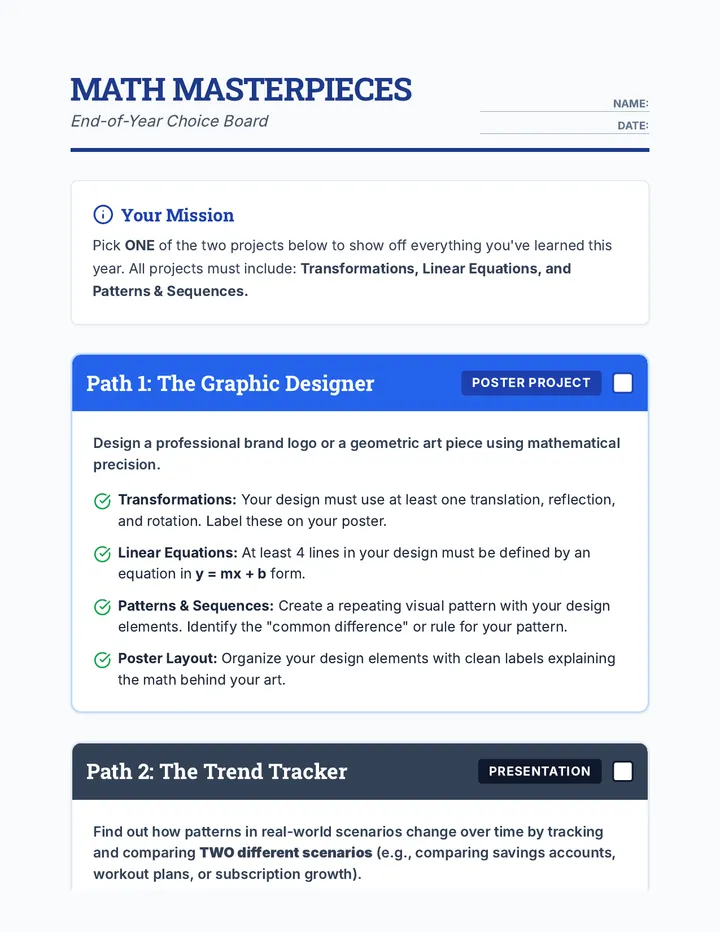
Project Choice Menu

Math Masterpieces Project

A creative end-of-year project where students choose between two paths to demonstrate mastery of transformations, linear equations, and patterns/sequences. Designed with scaffolded options for 8th-grade students.

JS

Jennifer Stevens

4