Lenny.com
Explore
Create
ActivitiesNewMathEnglish Language ArtsScience & EngineeringSocial StudiesGlobal LanguagesHealth & Physical EducationSpecial EducationCounseling & Life SkillsArts & CreativityESL
Lenny.com
Lenny.com
Explore
Create
ActivitiesNewMathEnglish Language ArtsScience & EngineeringSocial StudiesGlobal LanguagesHealth & Physical EducationSpecial EducationCounseling & Life SkillsArts & CreativityESL
Lenny.com
MathNumbers & CountingCounting ObjectsNumber NamesComparing NumbersNumber OperationsCounting SequenceNumbers 0-10Place Value Understanding and SystemAdd and Subtract Within 20Addition and Subtraction ConceptsAddition and Subtraction EquationsAddition and Subtraction ProblemsFoundations for MultiplicationMultiplication and Division PropertiesMultiply and Divide Within 100Multiplication and Division ProblemsFactors and MultiplesProperties of OperationsPatterns and RelationshipsGenerate and Analyze PatternsMulti-Digit ArithmeticPlace Value OperationsMulti-Digit and Decimal OperationsNumerical ExpressionsFour Operations and PatternsFour Operations Problem SolvingMeasurement & DataMeasurable AttributesMeasuring LengthsMeasure and Estimate Lengths in Standard UnitsRelate Addition and Subtraction to LengthClassifying and Counting ObjectsTime and MoneyArea Concepts and MeasurementPerimeter and Area MeasuresAngle Concepts and MeasurementTime, Volume, and MassMeasurement Unit ConversionsGeometryIdentifying ShapesShapes and AttributesShape Attributes and ReasoningShapes and CompositionClassifying 2D FiguresGeometric Figures and RelationshipsLines, Angles, and ShapesAngle, Area, and VolumeGeometric MeasurementVolume of 3D ShapesCoordinate Plane ApplicationsTransformations in the PlaneCongruence and SimilarityUnderstand congruence in terms of rigid motionsSimilarity and TransformationsProve Theorems Involving SimilarityPythagorean TheoremTrigonometry for General TrianglesMake Geometric ConstructionsProve Geometric TheoremsTheorems About CirclesFind Arc Lengths And Areas of Sectors of CirclesVolume FormulasRelationships Between Two-Dimensional and Three-Dimensional ObjectsProve Simple Geometric Theorems AlgebraicallyTranslate Between Geometric Description and Equation for Conic SectionApply Geometric Concepts in Modeling SituationsFractions & DecimalsFractions as NumbersBuilding FractionsFraction Equivalence and OrderingAdding and Subtracting FractionsMultiplying and Dividing FractionsDividing FractionsDecimal FractionsMulti-Digit Computation and FactorsAdd, Subtract, Multiply, and Divide Rational NumbersRational Number SystemIrrational Numbers and ApproximationsRatiosRatios and ProportionsProportional RelationshipsUnit RateAlgebraAlgebraic ExpressionsGenerate Equivalent ExpressionsQuantitative RelationshipsProportional Relationships and Linear EquationsEquations and InequalitiesEquation Solving and ReasoningLinear Equations and SystemsGraph Equations and InequalitiesSystems of EquationsReal-World Algebraic ProblemsQuantitative Reasoning with UnitsExpression StructureEquivalent Expression FormsRadicals and Integer ExponentsRational ExponentsRational and Irrational NumbersPolynomial OperationsPolynomial IdentitiesPolynomial Zeros and FactorsRational ExpressionsComplex Number OperationsComplex Numbers in PolynomialsComplex Numbers on PlaneStatistics & ProbabilityRepresent and Interpret DataData DistributionsStatistical VariabilityProbability ModelsCompound Event ProbabilitiesStatistical SamplingInterpret Categorical and Quantitative DataBivariate Data PatternsInterpret Linear ModelsComparing Two PopulationsRandom Processes in StatisticsIndependence and Conditional ProbabilityExpected ValuesProbability-Based Decision MakingStatistical Inference and ConclusionsFunctionsFunction Concepts and NotationDefine and Compare FunctionsInterpret Functions in ContextAnalyze Function RepresentationsModel Relationships with FunctionsIdentify Linear vs Exponential GrowthDistinguish Between Function TypesCompare Growth RatesInterpret Function ExpressionsBuild Functions from RelationshipsConstruct and Model FunctionsTransform and Combine FunctionsModel Comparison and SelectionSolve Exponential EquationsTrigonometryTrigonometric Ratios Involving Right TrianglesTrigonometric Functions and Unit CircleModel with Trigonometric FunctionsTrigonometric IdentitiesVectors & MatricesIntroduction to Vectors and MatricesVector QuantitiesVector OperationsMatrix OperationsCalculusLimits and ContinuityDerivative Concepts and NotationDerivative Rules and TechniquesApplications of DerivativesOptimization ProblemsRelated RatesCurve Sketching and AnalysisIntegration Concepts and NotationAntiderivatives and Indefinite IntegralsDefinite Integrals and AreaFundamental Theorem of CalculusIntegration TechniquesApplications of IntegrationDifferential EquationsSequences and SeriesParametric and Polar FunctionsVector-Valued Functions

Sequences and Series

Arithmetic and geometric progressions, summation notation, and convergence tests for infinite series. Connects patterns in numbers to limits and foundational calculus concepts.

Lenny.com

Solutions

Lenny for EducatorsLenny for SchoolsLenny for Districts

Product

ExploreSign inCreateSupportAbout

Resources

Getting startedMTSS Acceleration Program

© 2026 Lenny Learning Inc.

TermsPrivacyAccessibility
LinkedInInstagramX
Lenny

Videos

Mastering Math with the Desmos Online Graphing Calculator

Mastering Math with the Desmos Online Graphing Calculator

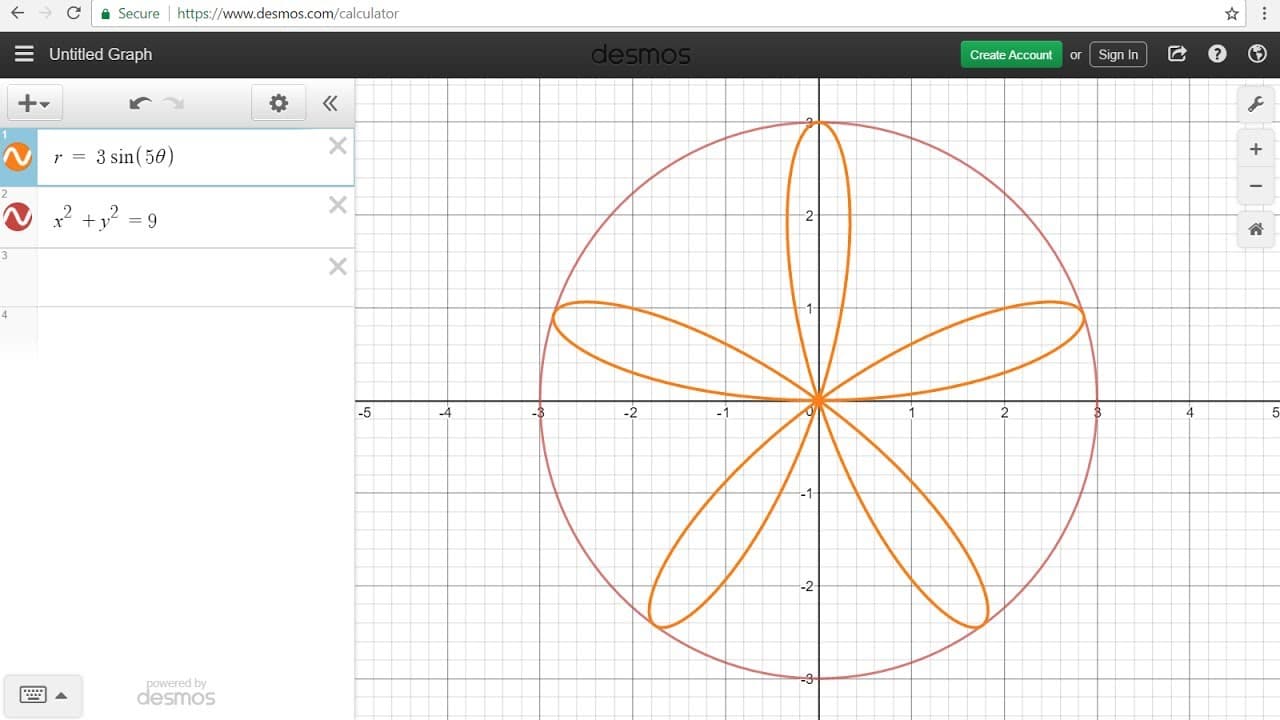
This comprehensive tutorial introduces students and educators to the Desmos online graphing calculator, a powerful and free tool for visualizing mathematics. The video begins with the basics of accessing the site and graphing simple functions like lines and parabolas, then progressively moves to more advanced topics including trigonometry, polar coordinates, and calculus operations. The narrator demonstrates not just how to plot graphs, but how to use the tool to solve equations, factor quadratics, and visualize systems of inequalities. Key mathematical themes include function families (linear, quadratic, cubic, absolute value, exponential, logarithmic), systems of equations and inequalities, trigonometry (degrees vs. radians), and statistical analysis (mean, standard deviation). The video also highlights the calculator's computational abilities, such as evaluating definite integrals, summations, and permutations, making it a versatile utility for various levels of math. For the classroom, this video serves as an excellent training resource for students transitioning from handheld calculators to computer-based tools. It allows teachers to show students how to verify their algebraic work visually, such as checking factors by looking at x-intercepts or solving systems by finding intersection points. The visual nature of the tool helps bridge the gap between abstract algebraic manipulation and concrete graphical understanding.
The Organic Chemistry TutorThe Organic Chemistry Tutor

13mins 58s

What Is the Number e and How Do We Calculate It?

What Is the Number e and How Do We Calculate It?

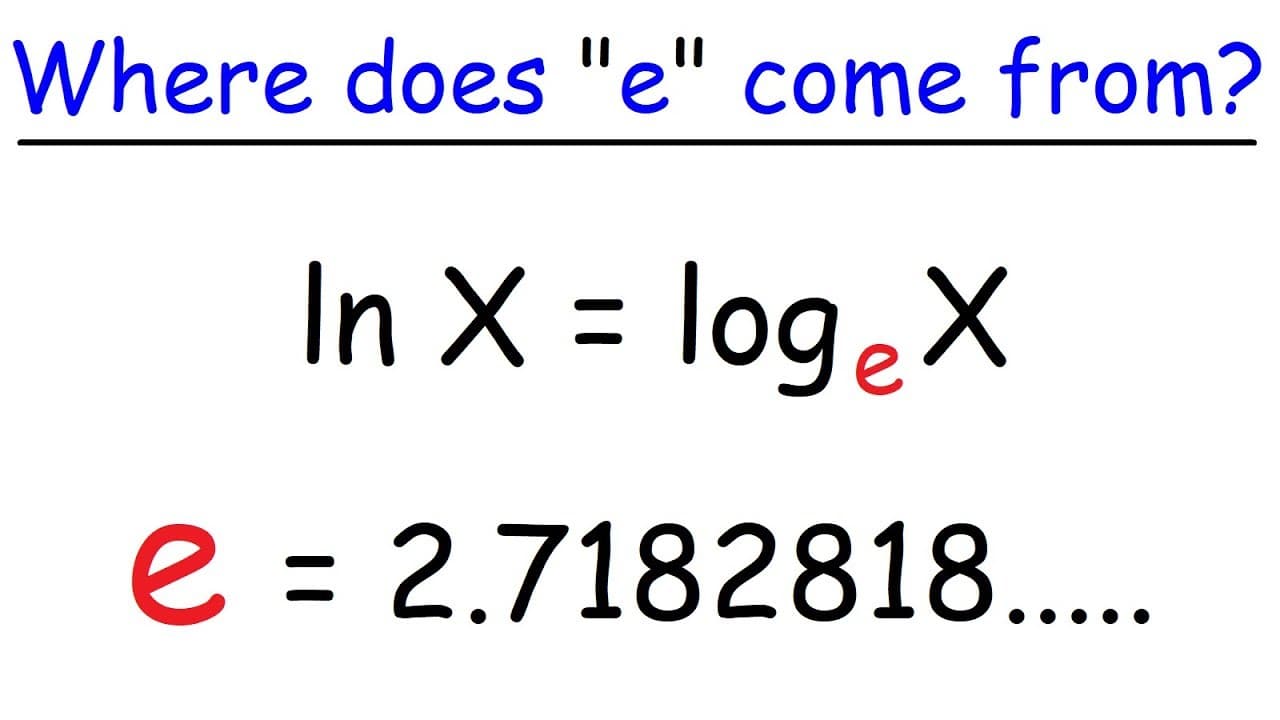
This educational video provides a comprehensive overview of the mathematical constant e, also known as Euler's number. It begins by defining e as an irrational number approximately equal to 2.718, commonly found in exponential functions and logarithms. The narrator then explores the origins of e through three distinct mathematical approaches: the formula for compound interest as the compounding frequency approaches infinity, the limit of (1 + n)^(1/n) as n approaches zero, and the infinite series of the reciprocals of factorials. Key themes include the relationship between discrete and continuous growth, the concept of limits and infinity in mathematics, and the unique properties of exponential functions in calculus. The video bridges the gap between algebraic financial formulas and advanced calculus concepts, demonstrating how a simple question about interest rates leads to the discovery of a fundamental constant of the universe. For educators, this video serves as an excellent bridge between Algebra II, Pre-Calculus, and Calculus. It visualizes abstract definitions, provides concrete numerical evidence for limits, and introduces the profound calculus properties of e^x—specifically that its slope and the area under its curve are equal to its value. This makes it a versatile tool for introducing the constant to beginners or deepening the understanding of advanced students studying derivatives and integrals.

The Organic Chemistry TutorThe Organic Chemistry Tutor

12mins 11s

Sequences

Integral Test Slides

Convergence Lab Tests

A rigorous unit for 12th-grade Calculus students focusing on the Integral Test, p-series, and Comparison Tests (Direct and Limit) to determine the convergence of positive-term infinite series. Students will build a logical framework for selecting the most efficient convergence test for various mathematical structures.

13
Ratio Test Teacher Guide

Series Blueprinting

This advanced sequence introduces powerful tools for analyzing series with factorials and powers, leading to the concept of power series. Students master the Ratio and Root tests, explore absolute versus conditional convergence, and conclude by connecting series to functions through Taylor polynomials.

21
Limit Threshold Slides

Rigorous Proofs in Analysis

An undergraduate-level introduction to Real Analysis focusing on the formal epsilon-N definition of limits, proof construction, Cauchy sequences, and the Bolzano-Weierstrass Theorem. Students transition from computational calculus to rigorous mathematical proof.

10
Fixed Point Slides

Iterative Insights

This sequence explores numerical analysis through the lens of sequences, focusing on iterative methods to approximate solutions to complex equations. Students investigate fixed-point iteration, Newton's method, convergence rates, and the transition into chaotic behavior.

10
Limit Horizons Slides

Infinite Destinations

This sequence guides undergraduate students from an intuitive understanding of sequence limits to rigorous analysis using algebraic laws, the Squeeze Theorem, L'Hôpital's Rule, and the Monotone Convergence Theorem. Students will explore how infinite processes behave as they approach infinity, bridging the gap between discrete sequences and continuous calculus.

11
Growth Dynamics Slides

System Dynamics and Chaos

A graduate-level exploration of discrete dynamical systems, moving from linear growth models to the complex, chaotic behavior of the logistic map. Students apply recursive sequences to model biological and economic phenomena, emphasizing stability analysis and bifurcation theory.

10

Lessons

Sigma Mastery Teacher Guide

Sigma Mastery

A comprehensive lesson on sigma notation where students master arithmetic, geometric, and infinite series through a hands-on rotation activity and collaborative problem-solving.

5
Convergence Lab Worksheet

Factorial Fast Track

Students explore the rapid convergence of the infinite series for e, comparing the efficiency of factorials to the standard limit definition. The lesson bridges the gap between basic limits and the Taylor Series for e^x.

4
Euler Constant Presentation Slides

Euler's Constant Synthesis

An undergraduate-level exploration of Euler's number (e) that synthesizes its financial, analytical, and series-based definitions through a rigorous proof-based approach.

4
Golden Mean Worksheet

Golden Mean Convergence

Students will investigate the geometric mean property of the Fibonacci sequence, comparing estimations of high-index terms using geometric means versus the Golden Ratio method. The lesson explores the convergence of recursive sequences to geometric behavior for large n.

4
Golden Blueprint Worksheet

Golden Blueprint Discovery

Students will explore the mathematical connection between nature and geometry by calculating ratios of recursive sequences (Fibonacci and Lucas). Through this investigation, they will discover the Golden Ratio (Phi) and the concept of a mathematical limit.

3
Sigma Signal Teacher Guide

Sigma Signal

A 12th-grade Pre-Calculus lesson focused on decoding, interpreting, and evaluating Sigma notation. Students transition from arithmetic series to the compact language of summation notation through video analysis and translation exercises.

3