Lenny.com
Explore
Create
ActivitiesNewMathEnglish Language ArtsScience & EngineeringSocial StudiesGlobal LanguagesHealth & Physical EducationSpecial EducationCounseling & Life SkillsArts & CreativityESL
Lenny.com
Lenny.com
Explore
Create
ActivitiesNewMathEnglish Language ArtsScience & EngineeringSocial StudiesGlobal LanguagesHealth & Physical EducationSpecial EducationCounseling & Life SkillsArts & CreativityESL
Lenny.com

Geometric Figures and Relationships

Properties of 2D and 3D shapes, including symmetry, congruence, and similarity. Develops spatial reasoning through the study of angles, lines, and coordinate transformations.

MathNumbers & CountingCounting ObjectsNumber NamesComparing NumbersNumber OperationsCounting SequenceNumbers 0-10Place Value Understanding and SystemAdd and Subtract Within 20Addition and Subtraction ConceptsAddition and Subtraction EquationsAddition and Subtraction ProblemsFoundations for MultiplicationMultiplication and Division PropertiesMultiply and Divide Within 100Multiplication and Division ProblemsFactors and MultiplesProperties of OperationsPatterns and RelationshipsGenerate and Analyze PatternsMulti-Digit ArithmeticPlace Value OperationsMulti-Digit and Decimal OperationsNumerical ExpressionsFour Operations and PatternsFour Operations Problem SolvingMeasurement & DataMeasurable AttributesMeasuring LengthsMeasure and Estimate Lengths in Standard UnitsRelate Addition and Subtraction to LengthClassifying and Counting ObjectsTime and MoneyArea Concepts and MeasurementPerimeter and Area MeasuresAngle Concepts and MeasurementTime, Volume, and MassMeasurement Unit ConversionsGeometryIdentifying ShapesShapes and AttributesShape Attributes and ReasoningShapes and CompositionClassifying 2D FiguresGeometric Figures and RelationshipsLines, Angles, and ShapesAngle, Area, and VolumeGeometric MeasurementVolume of 3D ShapesCoordinate Plane ApplicationsTransformations in the PlaneCongruence and SimilarityUnderstand congruence in terms of rigid motionsSimilarity and TransformationsProve Theorems Involving SimilarityPythagorean TheoremTrigonometry for General TrianglesMake Geometric ConstructionsProve Geometric TheoremsTheorems About CirclesFind Arc Lengths And Areas of Sectors of CirclesVolume FormulasRelationships Between Two-Dimensional and Three-Dimensional ObjectsProve Simple Geometric Theorems AlgebraicallyTranslate Between Geometric Description and Equation for Conic SectionApply Geometric Concepts in Modeling SituationsFractions & DecimalsFractions as NumbersBuilding FractionsFraction Equivalence and OrderingAdding and Subtracting FractionsMultiplying and Dividing FractionsDividing FractionsDecimal FractionsMulti-Digit Computation and FactorsAdd, Subtract, Multiply, and Divide Rational NumbersRational Number SystemIrrational Numbers and ApproximationsRatiosRatios and ProportionsProportional RelationshipsUnit RateAlgebraAlgebraic ExpressionsGenerate Equivalent ExpressionsQuantitative RelationshipsProportional Relationships and Linear EquationsEquations and InequalitiesEquation Solving and ReasoningLinear Equations and SystemsGraph Equations and InequalitiesSystems of EquationsReal-World Algebraic ProblemsQuantitative Reasoning with UnitsExpression StructureEquivalent Expression FormsRadicals and Integer ExponentsRational ExponentsRational and Irrational NumbersPolynomial OperationsPolynomial IdentitiesPolynomial Zeros and FactorsRational ExpressionsComplex Number OperationsComplex Numbers in PolynomialsComplex Numbers on PlaneStatistics & ProbabilityRepresent and Interpret DataData DistributionsStatistical VariabilityProbability ModelsCompound Event ProbabilitiesStatistical SamplingInterpret Categorical and Quantitative DataBivariate Data PatternsInterpret Linear ModelsComparing Two PopulationsRandom Processes in StatisticsIndependence and Conditional ProbabilityExpected ValuesProbability-Based Decision MakingStatistical Inference and ConclusionsFunctionsFunction Concepts and NotationDefine and Compare FunctionsInterpret Functions in ContextAnalyze Function RepresentationsModel Relationships with FunctionsIdentify Linear vs Exponential GrowthDistinguish Between Function TypesCompare Growth RatesInterpret Function ExpressionsBuild Functions from RelationshipsConstruct and Model FunctionsTransform and Combine FunctionsModel Comparison and SelectionSolve Exponential EquationsTrigonometryTrigonometric Ratios Involving Right TrianglesTrigonometric Functions and Unit CircleModel with Trigonometric FunctionsTrigonometric IdentitiesVectors & MatricesIntroduction to Vectors and MatricesVector QuantitiesVector OperationsMatrix OperationsCalculusLimits and ContinuityDerivative Concepts and NotationDerivative Rules and TechniquesApplications of DerivativesOptimization ProblemsRelated RatesCurve Sketching and AnalysisIntegration Concepts and NotationAntiderivatives and Indefinite IntegralsDefinite Integrals and AreaFundamental Theorem of CalculusIntegration TechniquesApplications of IntegrationDifferential EquationsSequences and SeriesParametric and Polar FunctionsVector-Valued Functions
Lenny.com

Solutions

Lenny for EducatorsLenny for SchoolsLenny for Districts

Product

ExploreSign inCreateSupportAbout

Resources

Getting startedMTSS Acceleration Program

© 2026 Lenny Learning Inc.

TermsPrivacyAccessibility
LinkedInInstagramX
Lenny

Videos

Parallel Lines and Transversals: From NYC Streets to Algebra

Parallel Lines and Transversals: From NYC Streets to Algebra

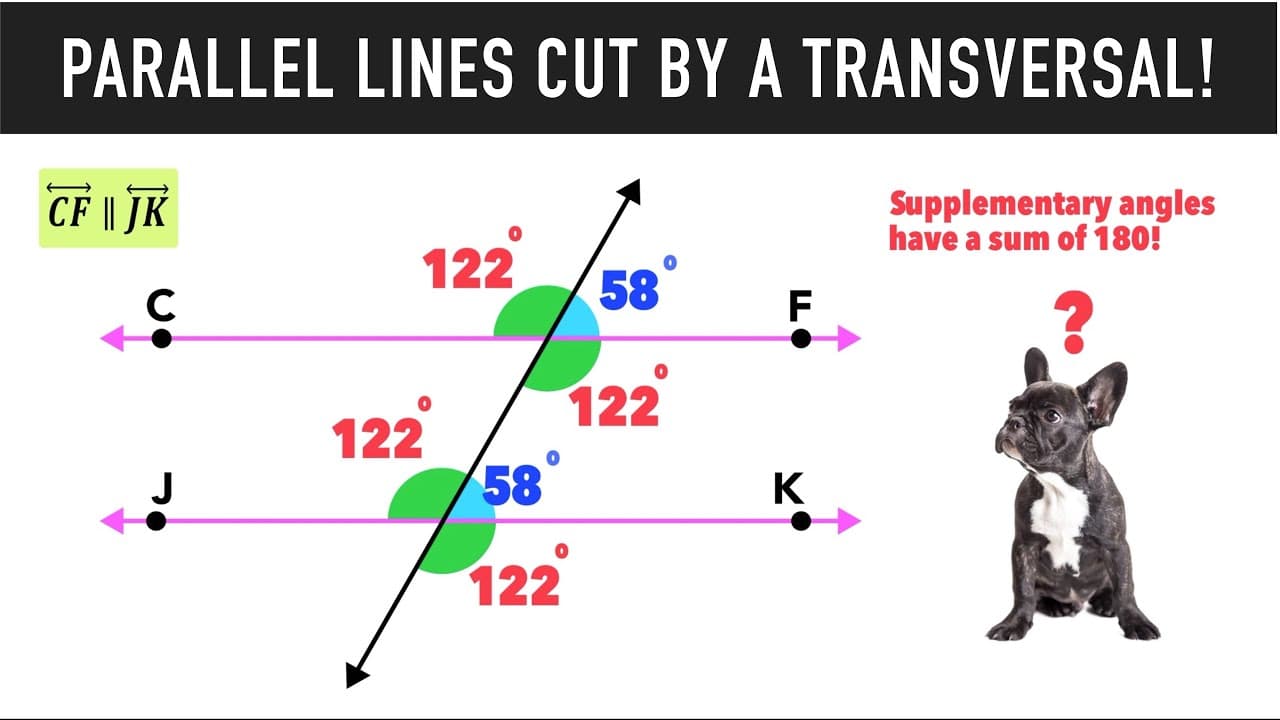
This engaging geometry lesson bridges the real world and abstract mathematics by introducing parallel lines and transversals through the lens of New York City's street grid. Starting with a Google Earth tour of Manhattan, students visualize how Avenues and Streets act as parallel and perpendicular lines, with Broadway serving as a famous real-world transversal. This concrete hook helps ground the subsequent theoretical concepts in a familiar context. The video then transitions to abstract geometric proofs, demonstrating why corresponding angles are congruent by visually sliding parallel lines on top of one another. It covers essential vocabulary including corresponding angles, vertical angles, and linear pairs (supplementary angles). A unique "X's and O's" visualization strategy is introduced to help students quickly identify congruent and supplementary relationships without getting bogged down in complex terminology, making the content accessible for diverse learners. Finally, the lesson connects geometry to algebra by modeling how to solve for unknown variables within angle measures. Students walk through a step-by-step problem solving process: identifying the angle relationship, setting up the algebraic equation (either setting expressions equal or summing to 180), solving for x, and substituting back to find the actual degrees. This video is an excellent resource for introduction, review, or remediation of angle relationships.

Mashup MathMashup Math

9mins 35s

Introduction to Geometry: Euclid's World and Study Skills

Introduction to Geometry: Euclid's World and Study Skills

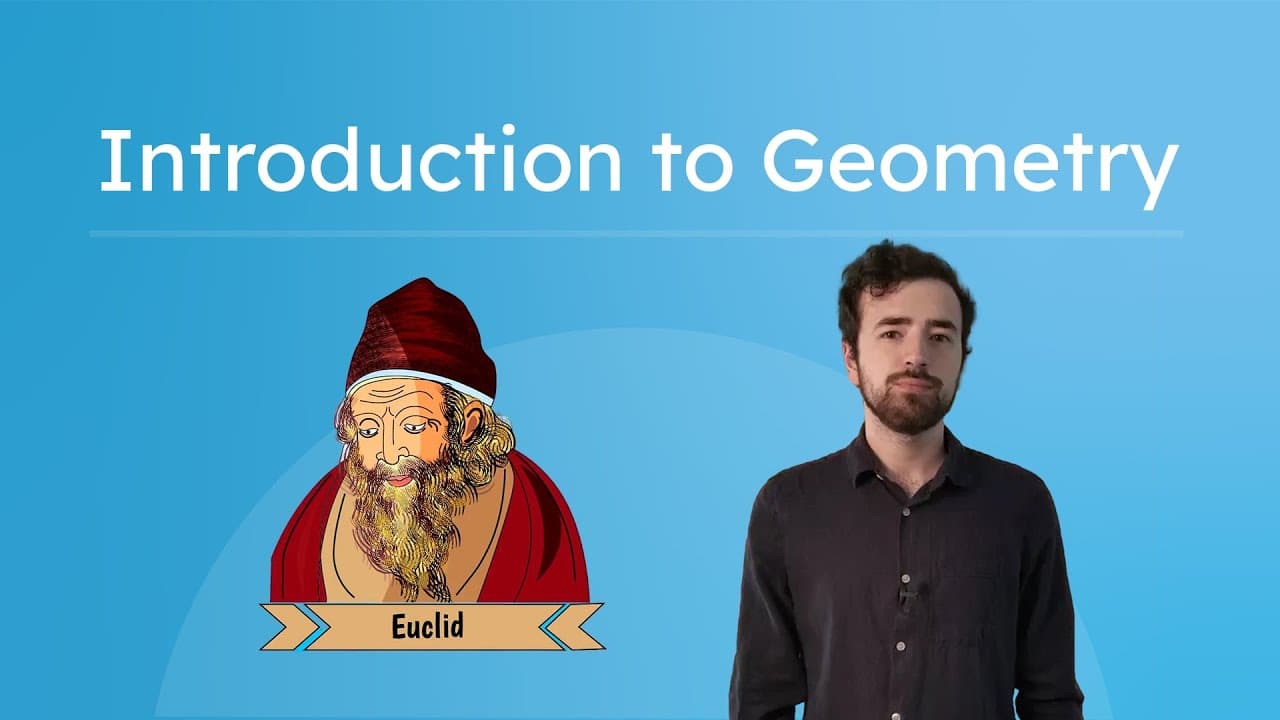
This video serves as a dual-purpose introduction: it first establishes the historical and conceptual foundations of Euclidean geometry, and then transitions into a guide on effective study habits for mathematics students. The video begins by introducing Euclid of Alexandria and his work in 300 BC, visually demonstrating how zero-dimensional points evolve into one-dimensional lines, two-dimensional shapes, and three-dimensional figures. It connects these abstract concepts to the measurement of area and volume, framing geometry as the study of the rules that govern space. The second half of the video functions as a course orientation, detailing the structure of learning units (lessons, wrap-ups, and projects) while emphasizing metacognitive strategies. The narrator provides specific advice on the importance of taking durable notes, using rubrics to understand expectations, and the necessity of reviewing material rather than rushing through it. It stresses that learning is about long-term retention rather than just passing an immediate assessment. For educators, this video is a valuable tool for the start of a geometry semester. It can be used to humanize the subject by introducing its ancient roots and to scaffold executive functioning skills. The segment on real-world applications—connecting geometry to computer screens, architecture, and molecular structures—helps answer the perennial student question, "When will I use this?" by framing geometry as the "laws of nature."

Miacademy & MiaPrep Learning ChannelMiacademy & MiaPrep Learning Channel

6mins 46s

Identifying Medians, Altitudes, and Bisectors in Triangles

Identifying Medians, Altitudes, and Bisectors in Triangles

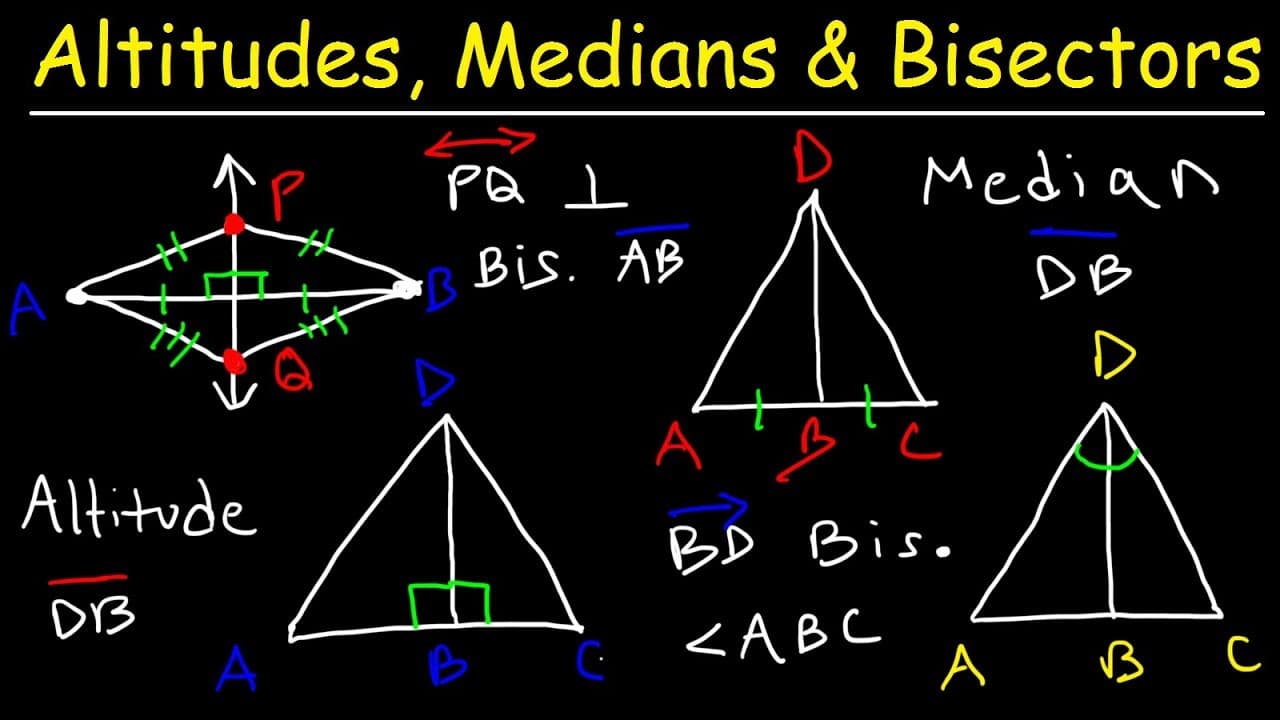
This comprehensive geometry tutorial breaks down the specific definitions and properties of four critical line segments associated with triangles: the median, altitude, perpendicular bisector, and angle bisector. Using clear, hand-drawn diagrams, the narrator explains the unique characteristics of each segment, such as how a median connects to a midpoint while an altitude forms a right angle. The video carefully distinguishes between often-confused terms by highlighting visual markers like tick marks for congruence and squares for right angles.

The Organic Chemistry TutorThe Organic Chemistry Tutor

10mins 18s

Understanding Rectangles: Properties and Problem Solving

Understanding Rectangles: Properties and Problem Solving

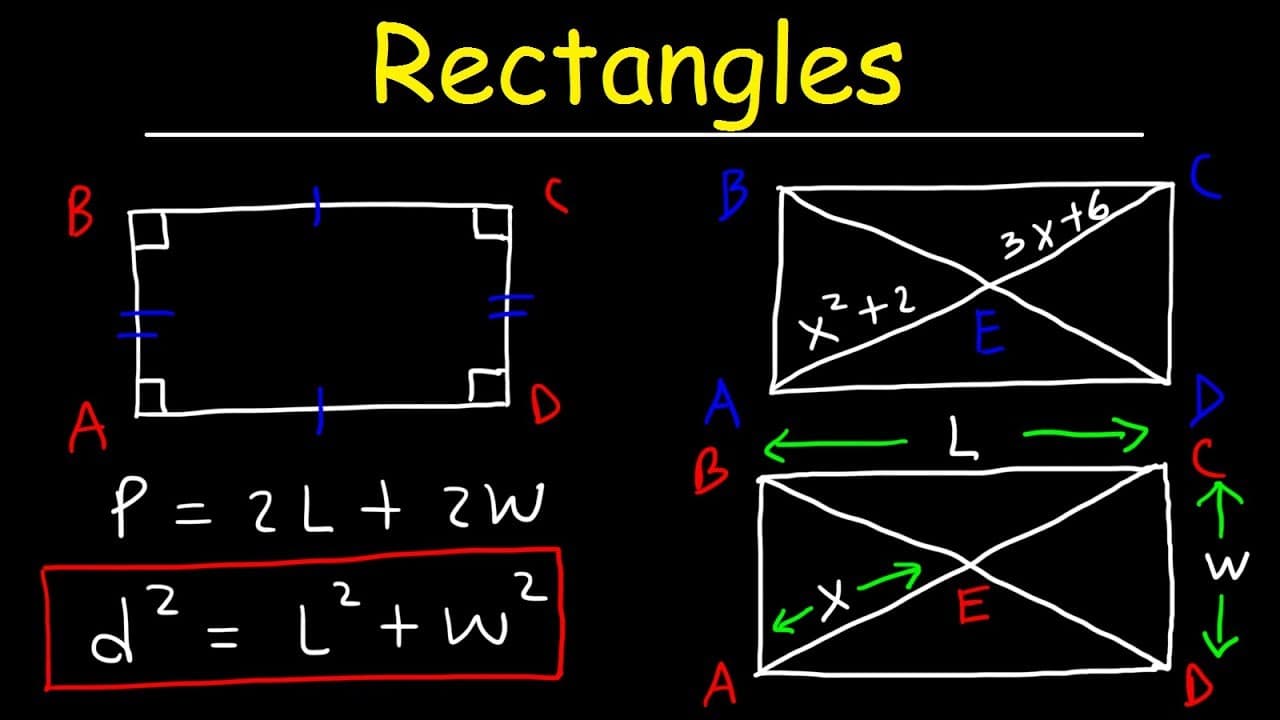
This educational video provides a comprehensive overview of rectangles, blending geometric theory with algebraic application. It begins by defining a rectangle as a specific type of quadrilateral and parallelogram, detailing essential properties such as parallel opposite sides, congruent opposite sides, and four right angles. The narrator explains the unique properties of diagonals in a rectangle, including congruency and bisection, before moving on to fundamental formulas for area, perimeter, and calculating diagonal length using the Pythagorean theorem. The video progresses from basic concepts to advanced problem-solving, demonstrating how to apply algebraic skills within a geometric context. Two complex example problems are worked through in real-time. The first involves setting up and solving a quadratic equation derived from diagonal properties to find segment lengths. The second presents a scenario where students must calculate a segment length given only the area and perimeter, requiring the creation and solution of a system of equations involving substitution and factoring. For educators, this video serves as an excellent bridge between geometry and algebra. It goes beyond simple shape identification, challenging students to use deductive reasoning and rigorous calculation. It is particularly useful for demonstrating how multiple mathematical concepts—such as systems of equations, factoring quadratics, and geometric theorems—converge in a single problem, making it a valuable resource for high school geometry or algebra curriculums.
The Organic Chemistry TutorThe Organic Chemistry Tutor

12mins 26s

How to Perform Rotations About the Origin

How to Perform Rotations About the Origin

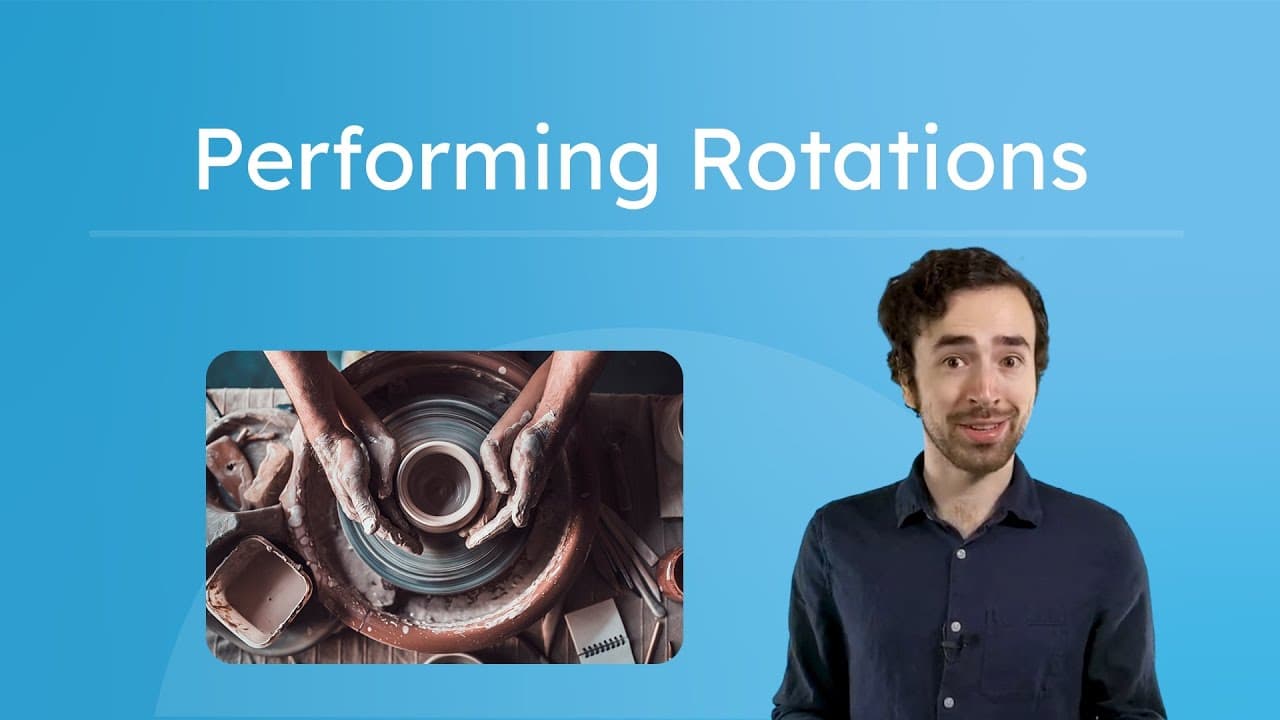
This video provides a comprehensive tutorial on performing geometric rotations of shapes on a coordinate plane. The instructor, Justin, guides viewers through the core concepts of rotation, specifically focusing on rotating figures 90, 180, and 270 degrees about the origin. The video utilizes a clever "paper turning" technique to help students visualize how coordinates change during rotation without needing to memorize complex algebraic rules immediately. The content covers essential vocabulary such as "center of rotation," "clockwise (CW)," "counterclockwise (CCW)," "preimage," "image," "isometry," and "invariant points." It clarifies standard mathematical conventions, such as the default direction of rotation being counterclockwise when not specified. Through three distinct examples, the video demonstrates the equivalence between different rotations (e.g., 90° CCW is the same as 270° CW) and explores special cases where points located on the center of rotation remain fixed. This resource is highly valuable for middle and high school geometry classrooms. It bridges the gap between physical manipulation and abstract coordinate geometry. Teachers can use this video to introduce the concept of transformations or as a remediation tool for students struggling to visualize rotations. The step-by-step guided practice format allows for active participation, making it ideal for a flipped classroom model or independent study station.

Miacademy & MiaPrep Learning ChannelMiacademy & MiaPrep Learning Channel

11mins 23s

Calculating Angles on a Clock Face

Calculating Angles on a Clock Face

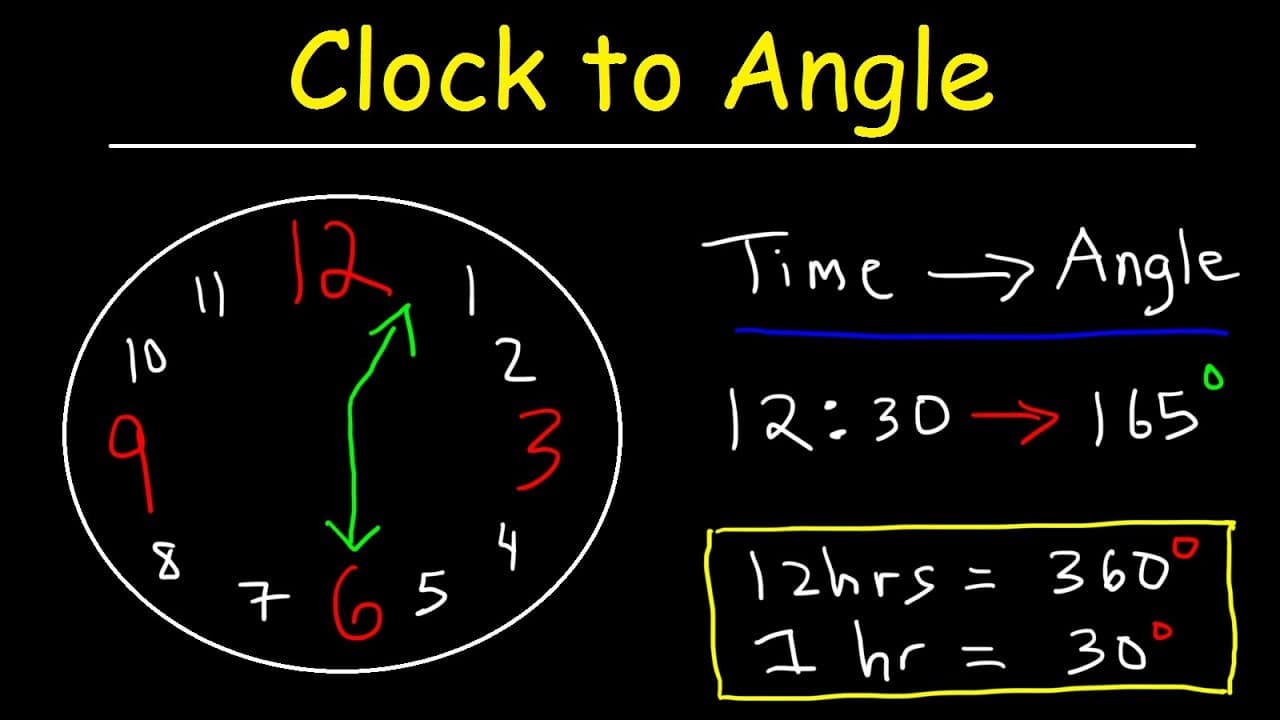
This math tutorial provides a step-by-step guide on how to calculate the precise angle between the hour and minute hands of an analog clock at specific times. The instructor uses clear visual diagrams and algebraic logic to demonstrate how to convert time into geometric degrees, breaking down the clock face into 30-degree sectors corresponding to each hour. The video covers four distinct examples—12:30, 1:20, 11:15, and 10:25—progressing from simpler half-hour calculations to more complex minute intervals involving fractions and decimals. Key themes include the geometry of circles (360 degrees), ratios and proportions (converting minutes to fractions of an hour), and critical thinking in determining determining angles based on relative positions. The video emphasizes that the hour hand is not static but moves proportionally as minutes pass, a common misconception that students often overlook when solving these types of problems. For educators, this video serves as an excellent resource for middle and high school geometry or algebra lessons. It bridges the gap between abstract concepts of degrees and fractions with a tangible, real-world object. Teachers can use the "Your Turn" segment to facilitate active learning and check for understanding before revealing the solution, making it a versatile tool for direct instruction, review, or enrichment activities.

The Organic Chemistry TutorThe Organic Chemistry Tutor

12mins 19s

Materials

Figurative Patterns Slides Orientation Fix

Figurative Patterns Slides Orientation Fix

Fixed Slide 6 where the visualization of two paired triangular numbers forming a rectangle was missing. Replaced the previous layout with explicit flex rows to ensure the dots render correctly and clearly show how $T_4$ and its twin create a $4 \times 5$ rectangle. Label positioning and container sizing were also refined for better clarity. Adjusted Slide 4 to fill vertical space more effectively.

BC

Brenda Coombs

Grid Shift Detective Worksheet

Grid Shift Detective Worksheet

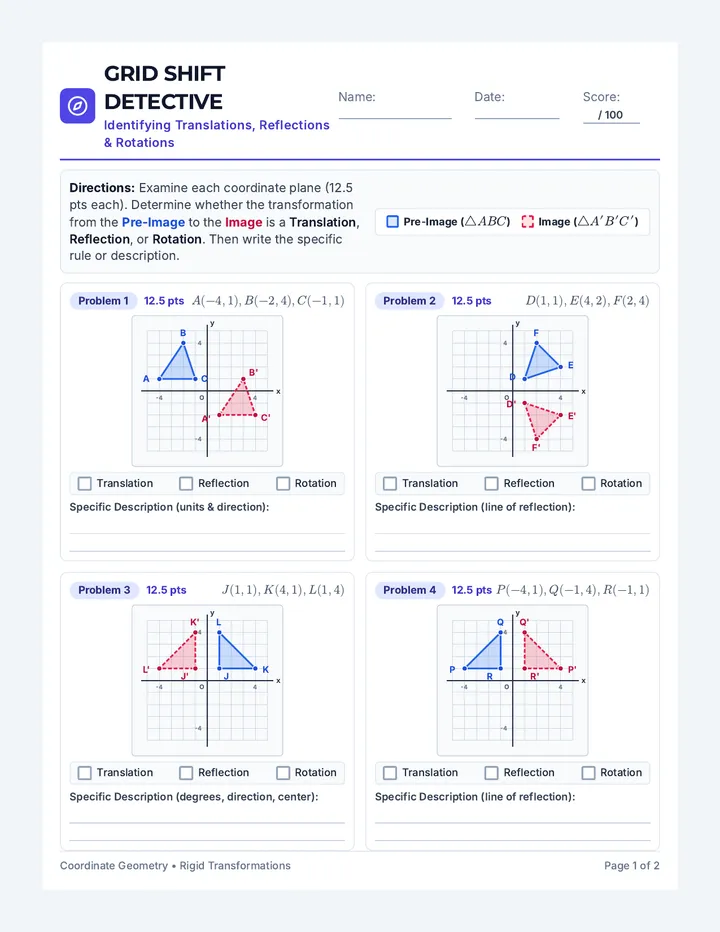
An 8-question printable geometry worksheet where students analyze coordinate planes to identify and describe translations, reflections, and rotations, featuring enlarged fonts, prominent vertex labels, and clean handwriting spaces.

L

Logan-Greene

Grid Shift Detective Worksheet

Grid Shift Detective Worksheet

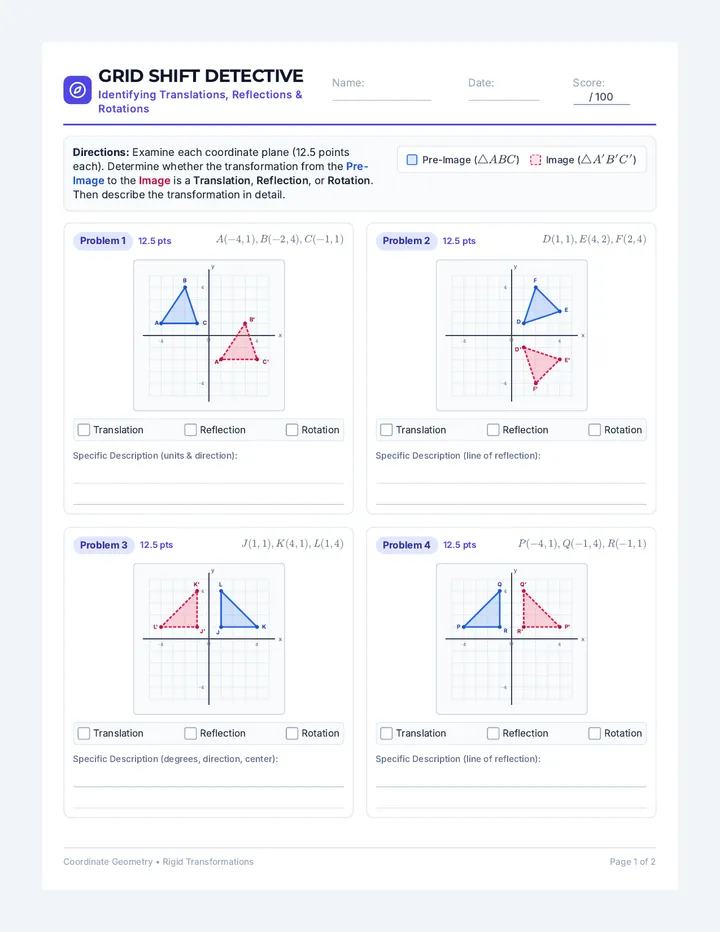
An 8-question printable geometry worksheet where students analyze coordinate planes to identify and describe translations, reflections, and rotations, scored out of 100 points.

RW

Rachel Walker

Geometry Blueprint Reference

Geometry Blueprint Reference

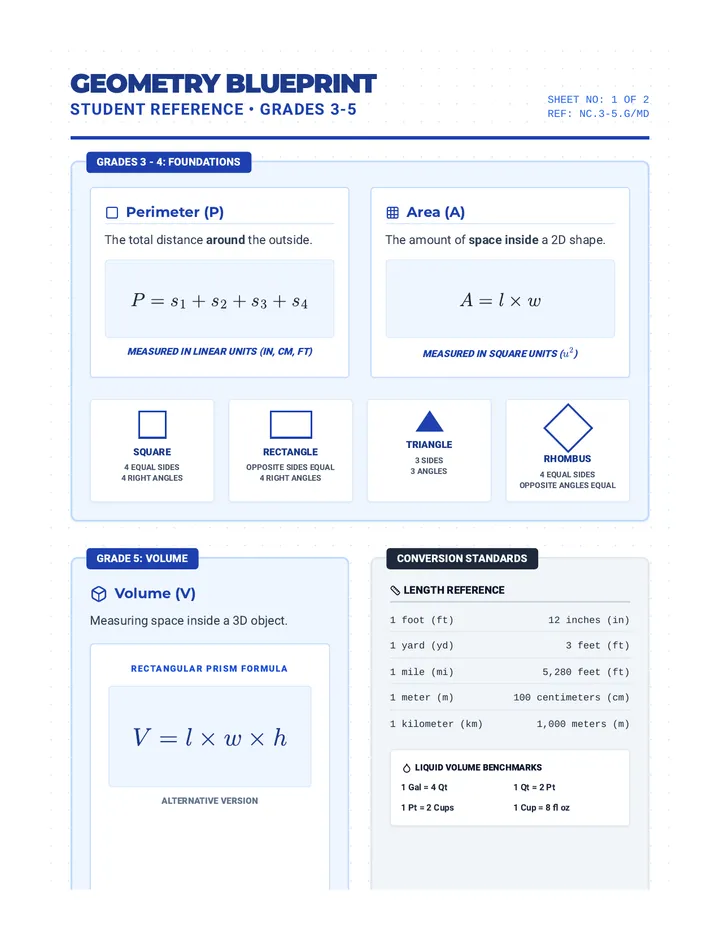
A comprehensive two-page printable geometry anchor chart for grades 3-8, themed as a technical blueprint. Features grade-banded formulas for perimeter, area, volume, surface area, and circles, including the Pythagorean theorem and common measurement conversions. Organized with MathJax for professional notation.

KB

Karen Brown

Angle & Geometry Flashcards

Angle & Geometry Flashcards

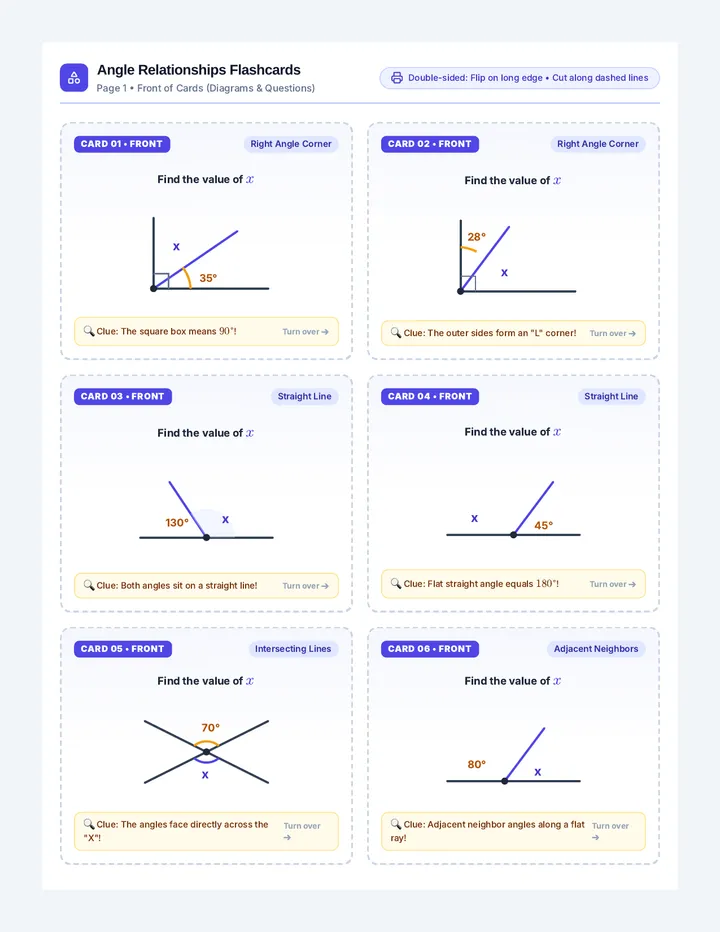
A 4-page double-sided printable flashcard set (16 cards total) for 8th-grade geometry review. Updates Card 6 Front so the 120° label is positioned to the right of the transversal in the top-right obtuse exterior angle, perfectly matching x in the alternate exterior pair.

L

Logan-Greene

Alphabet Coordinate Quest Worksheet

Alphabet Coordinate Quest Worksheet

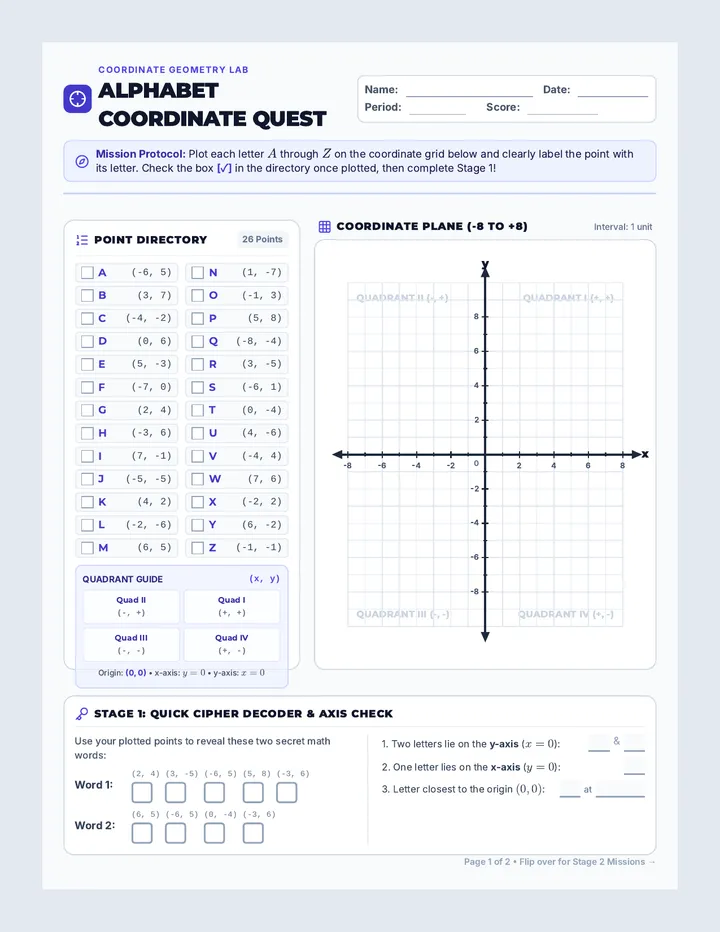
A comprehensive two-page coordinate graphing worksheet where students plot letters A through Z on a four-quadrant coordinate plane. Features an alphabetical coordinate directory with tracking checkboxes, an SVG coordinate grid, secret message ciphers, quadrant sorting, and geometric distance challenges.

J

jeffreychadwick.inspiretx

Sequences

Packet Master TOC document

Unit 6 Equal Groups and Multiplication

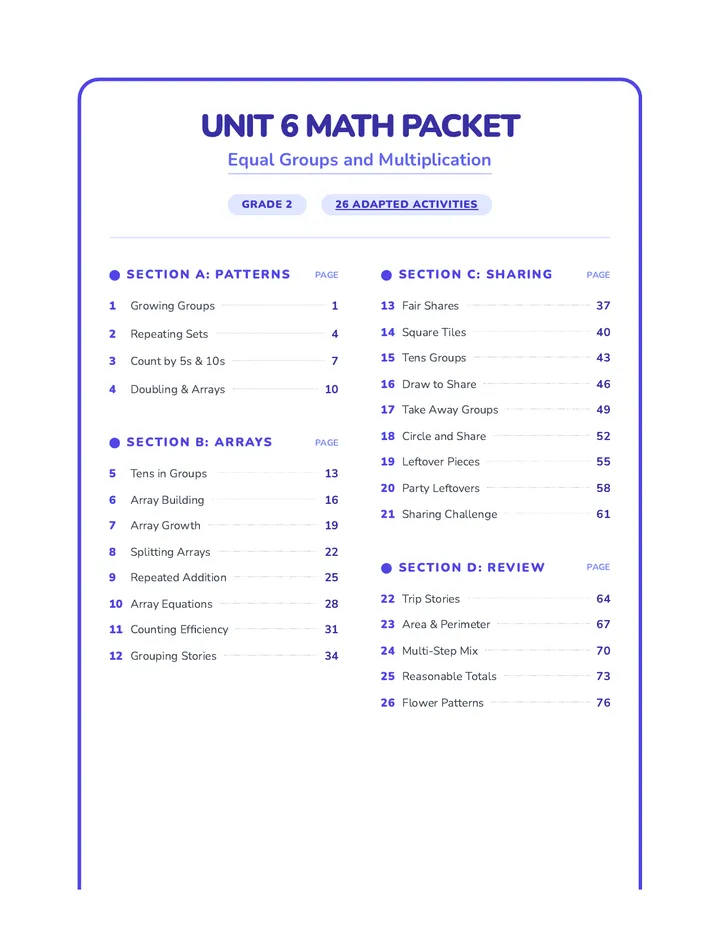
A comprehensive Grade 2 math packet focused on skip counting, repeated addition, arrays, and equal groups.

N

nmack

39
Equation Balancing Student Packet

Distance Detectives

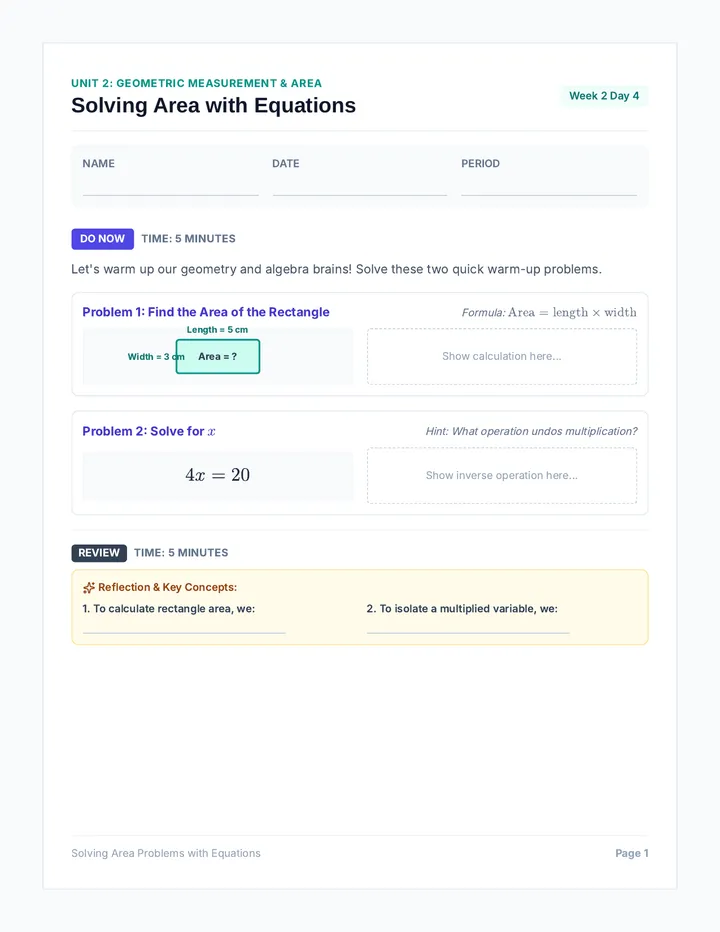
A highly visual geometry unit focused on applying algebraic formulas to coordinate planes. Students use coordinate grids, step-by-step graphic organizers, and tactile representations to solve real-world distance and segment length problems.

D

deeohnny.jackson

64
Blueprint Basics Slides

Foundational Math Builders

A foundational math sequence for special education students (grades 5-6) focusing on algebraic thinking and spatial reasoning through highly visual, themed units.

JS

Janette Sullivan

37
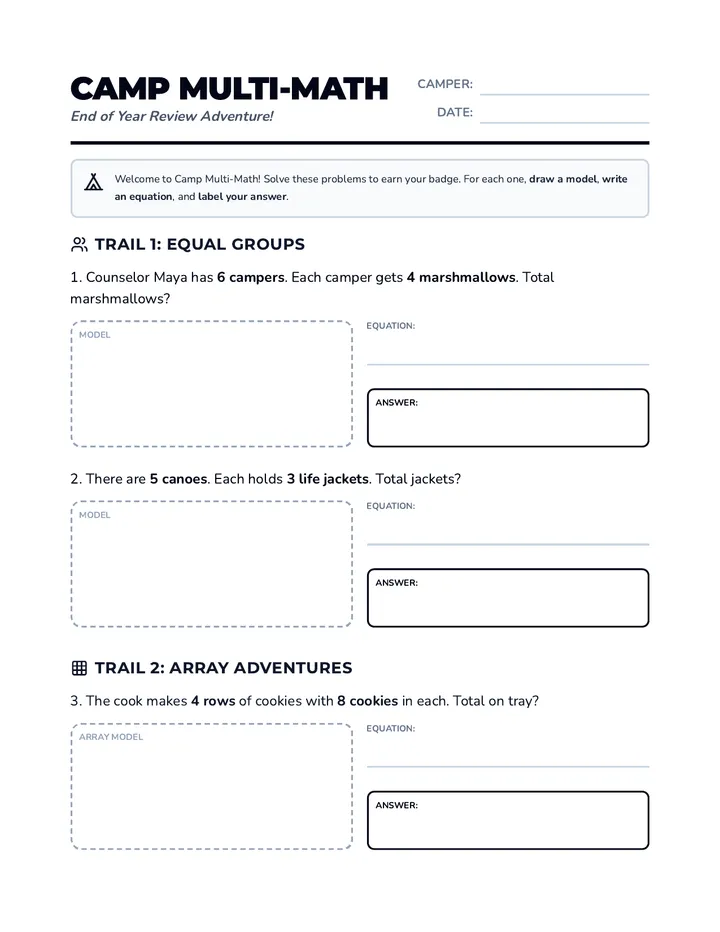
Camp Multi-Math Worksheet

Math Review Adventures

A collection of themed end-of-year math review adventures for different grade levels, focusing on spiraling key standards and problem-solving.

DB

Deborah Burton

21
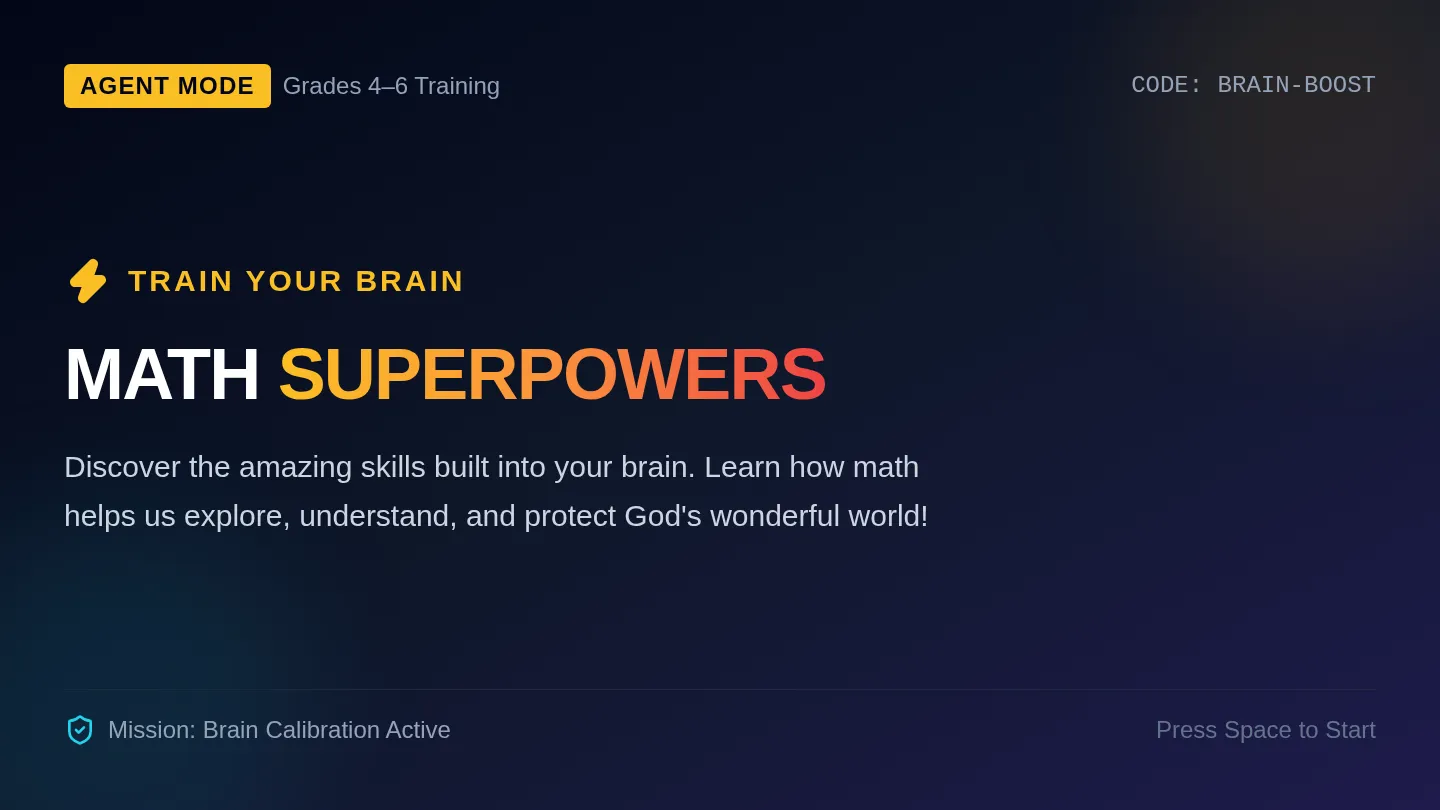
Superpower Academy Slides

Math Mindset and Identity

A transformative math unit focusing on math identity, mindset, and practical superpowers. Integrates a rich Biblical worldview to show how mathematics is woven into each student's past, present, and future purpose.

CH

Carlina Hui

14
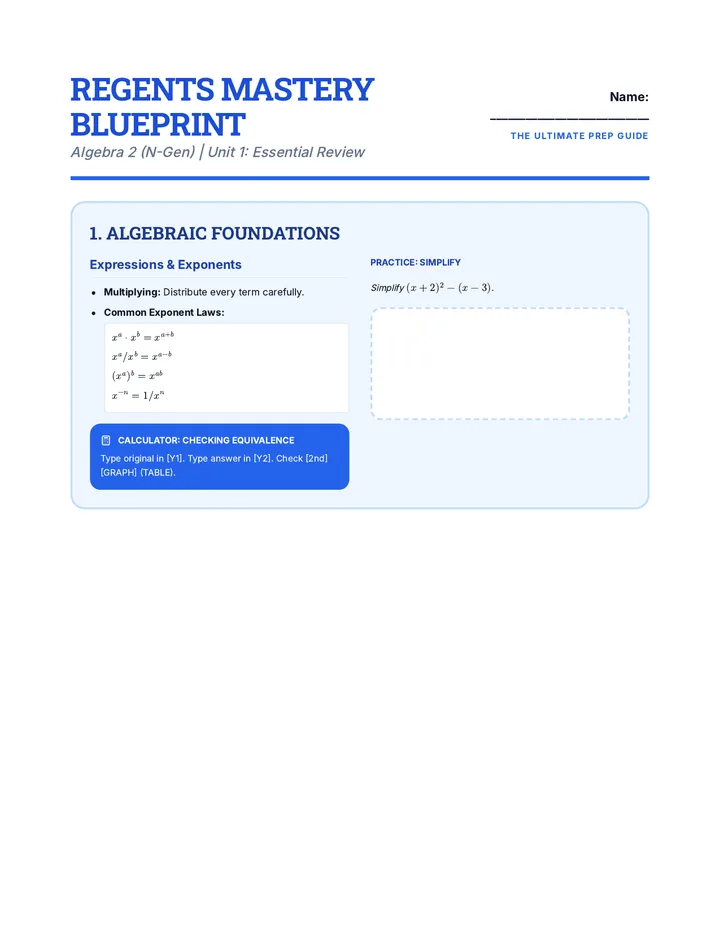
Regents Mastery Blueprint Study Guide

Regents Mastery Suite

A comprehensive review suite for the New York State Mathematics Regents exams, including Algebra 1, Geometry, and Algebra 2, featuring mastery blueprints, calculator strategies, and exam-taking tips.

KB

Kayla Borozny

15