Optimization, related rates, and curve sketching via first and second derivatives. Addresses real-world scenarios in physics and economics using the Mean Value Theorem and L'Hôpital's Rule.
This sequence bridges the gap between discrete mathematics and quantitative finance, focusing on the application of geometric series to asset valuation, loan amortization, and risk management. Graduate students will develop the mathematical foundations for pricing complex financial instruments and understanding market dynamics.
A comprehensive unit for 12th Grade Calculus students focusing on the derivation and application of derivatives in polar coordinates. Students transition from Cartesian slope to polar slope, analyze horizontal and vertical tangency, investigate behavior at the pole, and solve optimization problems involving polar curves.
This sequence explores the calculus of polar functions, focusing on differentiation techniques. Students will learn to calculate slopes of tangent lines, identify horizontal and vertical tangents, analyze behavior at the pole, and apply optimization to find maximum and minimum distances from the origin.
A graduate-level exploration of expected value applications in finance, covering utility theory, portfolio optimization, risk-neutral pricing, and tail risk metrics. Students transition from theoretical foundations to computational implementation using Monte Carlo methods.
A graduate-level exploration of the Calculus of Variations, focusing on optimizing functionals. Students derive the Euler-Lagrange equation and apply it to physics and geometry problems like the Brachistochrone and Isoperimetric challenges.
A graduate-level sequence on constrained optimization, covering Lagrange Multipliers, KKT conditions, and sensitivity analysis for economics and engineering applications.
A comprehensive graduate-level exploration of numerical optimization algorithms, moving from first-order gradient descent to second-order Newton methods and computationally efficient Quasi-Newton approaches. Students analyze convergence rates, stability, and strategies for navigating complex, non-convex landscapes.
This sequence establishes the rigorous mathematical underpinnings necessary for advanced optimization work, moving beyond procedural calculus to analysis-based proofs. Students explore the intersection of topology, set theory, and multivariate calculus to determine the existence and uniqueness of optimal solutions.
An inquiry-based exploration of calculus optimization, focusing on real-world efficiency in travel time, infrastructure cost, and business profit. Students progress from geometric shortest-paths to complex rate-based modeling.
A comprehensive workshop series on optimization in calculus. Students master the Extreme Value Theorem, learn to translate complex word problems into mathematical models, and apply differentiation to find optimal outcomes in number theory and geometric contexts.
A project-based calculus sequence where students use optimization to design efficient packaging. They transition from physical modeling to algebraic functions and derivative-based solutions to maximize volume and minimize material costs.
This sequence bridges the gap between theoretical calculus operations and applied problem-solving by focusing on optimization in real-world contexts. Students begin by mastering the 'modeling process'—translating verbal constraints into mathematical objective functions. Over five lessons, they progress from simple geometric maximization to complex economic minimization and physical efficiency problems. By the end, students will demonstrate proficiency in using the First and Second Derivative Tests to justify absolute extrema in manufacturing and design scenarios.
This lesson investigates why turning points are excluded from increasing and decreasing intervals. Students analyze the 'neutral zone' of zero slope at a vertex and debate strict monotonicity versus general definitions.
Students explore the application of derivatives in real-world contexts beyond physics, specifically focusing on instantaneous rates of change in biology, finance, and social media growth using the limit definition.
An 11th-grade honors lesson connecting the limit definition of the derivative to instantaneous velocity through rocket launch simulations. Students will analyze height functions to determine peak altitude and impact force.
This lesson introduces 11th-grade students to the distinction between average and instantaneous rates of change. Students analyze real-world COVID-19 data and explore a quadratic function by 'shrinking the interval' to discover the concept of a tangent line.
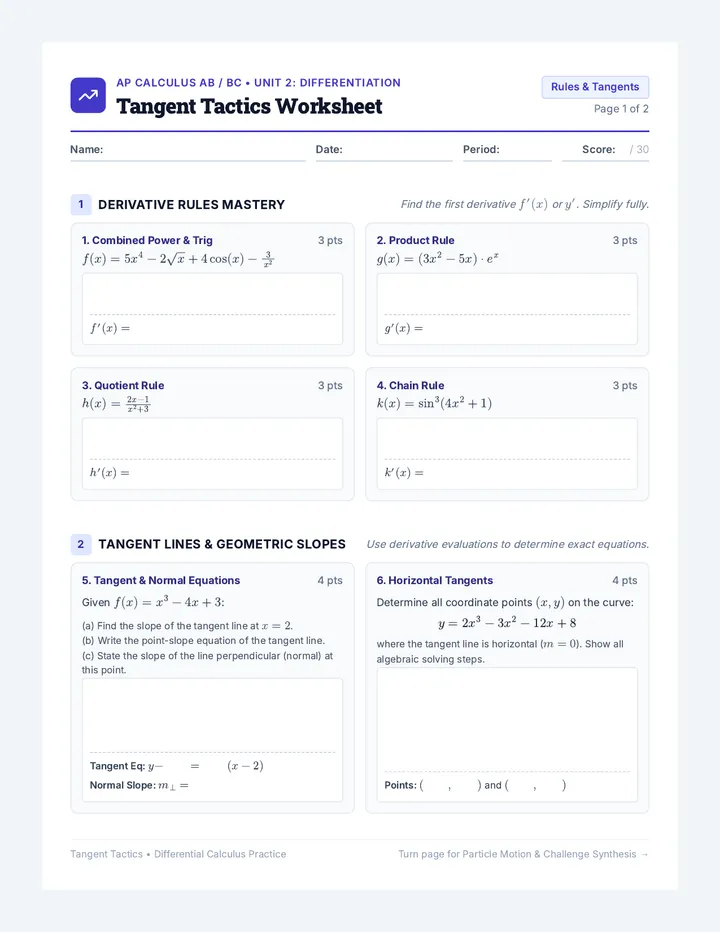
The sequence concludes with an introduction to stochastic sequences, simulating random walks to model stock price movements.
Students analyze bonds as series of cash flows, using differentiation to calculate Duration and assess interest rate risk.
This lesson explores the valuation of infinite horizons, applying geometric series convergence to price perpetuities and the Dividend Discount Model.
Learners model loan payments and savings plans using finite geometric series, deriving amortization formulas for mortgages and annuities.
Students derive the compound interest formulas as geometric sequences, exploring the impact of compounding frequency and the limit as it approaches infinity (continuous compounding).
A synthesis session where students tackle complex problems combining slope, tangency, and coordinate conversion, including peer review and error analysis.
Students apply derivatives to find maximum values of r (distance from origin) and y (height) to solve geometric optimization problems within polar contexts.
A focused lesson on finding tangent lines at the origin (the pole) by determining where r=0 and analyzing the behavior of rose curves and other polar functions.
An exit ticket designed as a 'forensics case file' where students provide a one-sentence justification for using open intervals at a vertex. Matches the Turning Point Slides theme.
A comprehensive presentation for 11th Grade Pre-Calculus focusing on the justification for excluding turning points from increasing and decreasing intervals. Features thematic 'Forensics' visual design, video integration, and conceptual deep-dives.
Detailed answer key for the 'Rocket Run' activity. Includes full algebraic derivations using the limit definition for multiple rocket height functions, along with peak altitude and impact velocity solutions.
A teacher guide for 'The Change Lab' lesson, featuring pacing instructions, discussion prompts, and a detailed answer key for all group scenarios.
A visual presentation deck for the 'Rocket Run' lesson. Includes warm-up questions, an embedded YouTube video segment, mathematical definitions of the derivative, and a clear overview of the simulation tasks.
A student worksheet for recording derivative calculations and interpretations during the 'Rate of Change Research' activity, with ample space for the limit definition process.
A handout containing four role-play scenarios (biology, finance, social media, and climate science) with specific functions and 'critical moments' for students to analyze using derivatives.
A student-facing activity sheet designed as a 'Flight Data Log'. Students use the limit definition of the derivative to find the velocity function of a assigned rocket, then calculate its peak height and impact velocity.
A visual presentation for 'The Change Lab' lesson, featuring a warm-up brainstorming session, a YouTube video summary on derivatives, group activity instructions, and a closure presentation format.
A comprehensive lesson plan for 11th-grade honors students covering the derivative as instantaneous velocity. Includes a warm-up discussion, video guide, and main simulation activity instructions for the teacher.
Teacher answer key for 'The Shrinking Gap' worksheet. Includes full calculations for the investigation table and sample responses for discussion questions.
Student worksheet for 'The Shrinking Gap' lesson. Includes a section for video notes on COVID-19 data and an investigation table for calculating average rates of change as the interval shrinks for the function y = x^2 + 2x.