Lenny.com
Explore
Create
ActivitiesNewMathEnglish Language ArtsScience & EngineeringSocial StudiesGlobal LanguagesHealth & Physical EducationSpecial EducationCounseling & Life SkillsArts & CreativityESL
Lenny.com
Lenny.com
Explore
Create
ActivitiesNewMathEnglish Language ArtsScience & EngineeringSocial StudiesGlobal LanguagesHealth & Physical EducationSpecial EducationCounseling & Life SkillsArts & CreativityESL
Lenny.com
MathNumbers & CountingCounting ObjectsNumber NamesComparing NumbersNumber OperationsCounting SequenceNumbers 0-10Place Value Understanding and SystemAdd and Subtract Within 20Addition and Subtraction ConceptsAddition and Subtraction EquationsAddition and Subtraction ProblemsFoundations for MultiplicationMultiplication and Division PropertiesMultiply and Divide Within 100Multiplication and Division ProblemsFactors and MultiplesProperties of OperationsPatterns and RelationshipsGenerate and Analyze PatternsMulti-Digit ArithmeticPlace Value OperationsMulti-Digit and Decimal OperationsNumerical ExpressionsFour Operations and PatternsFour Operations Problem SolvingMeasurement & DataMeasurable AttributesMeasuring LengthsMeasure and Estimate Lengths in Standard UnitsRelate Addition and Subtraction to LengthClassifying and Counting ObjectsTime and MoneyArea Concepts and MeasurementPerimeter and Area MeasuresAngle Concepts and MeasurementTime, Volume, and MassMeasurement Unit ConversionsGeometryIdentifying ShapesShapes and AttributesShape Attributes and ReasoningShapes and CompositionClassifying 2D FiguresGeometric Figures and RelationshipsLines, Angles, and ShapesAngle, Area, and VolumeGeometric MeasurementVolume of 3D ShapesCoordinate Plane ApplicationsTransformations in the PlaneCongruence and SimilarityUnderstand congruence in terms of rigid motionsSimilarity and TransformationsProve Theorems Involving SimilarityPythagorean TheoremTrigonometry for General TrianglesMake Geometric ConstructionsProve Geometric TheoremsTheorems About CirclesFind Arc Lengths And Areas of Sectors of CirclesVolume FormulasRelationships Between Two-Dimensional and Three-Dimensional ObjectsProve Simple Geometric Theorems AlgebraicallyTranslate Between Geometric Description and Equation for Conic SectionApply Geometric Concepts in Modeling SituationsFractions & DecimalsFractions as NumbersBuilding FractionsFraction Equivalence and OrderingAdding and Subtracting FractionsMultiplying and Dividing FractionsDividing FractionsDecimal FractionsMulti-Digit Computation and FactorsAdd, Subtract, Multiply, and Divide Rational NumbersRational Number SystemIrrational Numbers and ApproximationsRatiosRatios and ProportionsProportional RelationshipsUnit RateAlgebraAlgebraic ExpressionsGenerate Equivalent ExpressionsQuantitative RelationshipsProportional Relationships and Linear EquationsEquations and InequalitiesEquation Solving and ReasoningLinear Equations and SystemsGraph Equations and InequalitiesSystems of EquationsReal-World Algebraic ProblemsQuantitative Reasoning with UnitsExpression StructureEquivalent Expression FormsRadicals and Integer ExponentsRational ExponentsRational and Irrational NumbersPolynomial OperationsPolynomial IdentitiesPolynomial Zeros and FactorsRational ExpressionsComplex Number OperationsComplex Numbers in PolynomialsComplex Numbers on PlaneStatistics & ProbabilityRepresent and Interpret DataData DistributionsStatistical VariabilityProbability ModelsCompound Event ProbabilitiesStatistical SamplingInterpret Categorical and Quantitative DataBivariate Data PatternsInterpret Linear ModelsComparing Two PopulationsRandom Processes in StatisticsIndependence and Conditional ProbabilityExpected ValuesProbability-Based Decision MakingStatistical Inference and ConclusionsFunctionsFunction Concepts and NotationDefine and Compare FunctionsInterpret Functions in ContextAnalyze Function RepresentationsModel Relationships with FunctionsIdentify Linear vs Exponential GrowthDistinguish Between Function TypesCompare Growth RatesInterpret Function ExpressionsBuild Functions from RelationshipsConstruct and Model FunctionsTransform and Combine FunctionsModel Comparison and SelectionSolve Exponential EquationsTrigonometryTrigonometric Ratios Involving Right TrianglesTrigonometric Functions and Unit CircleModel with Trigonometric FunctionsTrigonometric IdentitiesVectors & MatricesIntroduction to Vectors and MatricesVector QuantitiesVector OperationsMatrix OperationsCalculusLimits and ContinuityDerivative Concepts and NotationDerivative Rules and TechniquesApplications of DerivativesOptimization ProblemsRelated RatesCurve Sketching and AnalysisIntegration Concepts and NotationAntiderivatives and Indefinite IntegralsDefinite Integrals and AreaFundamental Theorem of CalculusIntegration TechniquesApplications of IntegrationDifferential EquationsSequences and SeriesParametric and Polar FunctionsVector-Valued Functions

Rational Expressions

Simplification, arithmetic operations, and equation-solving involving polynomial fractions. Targets identification of domain restrictions and vertical asymptotes.

Lenny.com

Solutions

Lenny for EducatorsLenny for SchoolsLenny for Districts

Product

ExploreSign inCreateSupportAbout

Resources

Getting startedMTSS Acceleration Program

© 2026 Lenny Learning Inc.

TermsPrivacyAccessibility
LinkedInInstagramX
Lenny

Videos

Mastering Complex Rational Expressions

Mastering Complex Rational Expressions

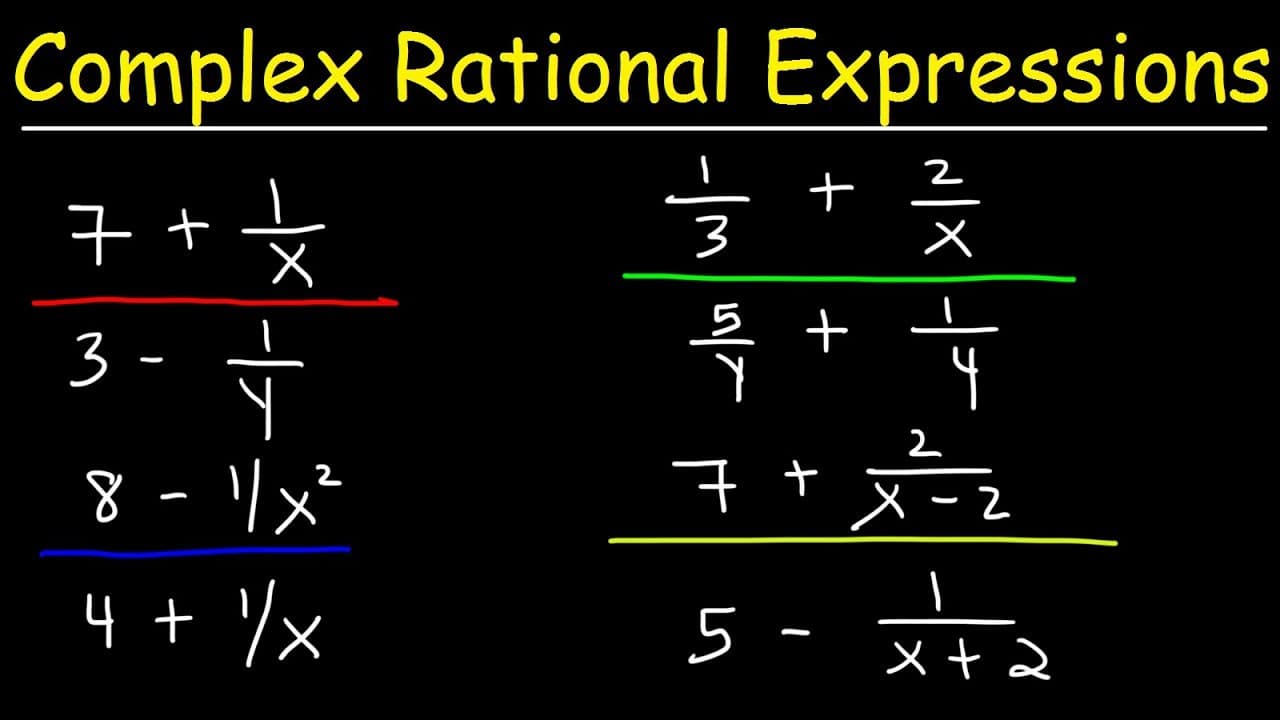
This comprehensive math tutorial guides students through the process of simplifying complex fractions and rational expressions. Starting with basic arithmetic complex fractions, the video progressively introduces variables, difference of squares, and quadratic trinomials. The primary method taught is multiplying the numerator and denominator by the Least Common Denominator (LCD) to eliminate internal fractions, a technique that streamlines the simplification process. The video covers key algebraic themes including finding common denominators for integers and variables, distributing terms, combining like terms, and factoring polynomials. It specifically demonstrates how to handle complex expressions where the denominators are binomials, requiring students to factor quadratics before finding the LCD. The tutorial concludes with a challenging problem that synthesizes all these skills, requiring the 'AC method' for factoring trinomials with leading coefficients greater than one. For educators, this video serves as an excellent resource for Algebra I, Algebra II, and Pre-Calculus units on rational expressions. It provides a scaffolded approach that helps students transition from concrete arithmetic concepts to abstract algebraic manipulation. The clear, step-by-step visual working of problems makes it useful for introducing the topic, reviewing before a test, or providing remediation for students struggling with multi-step algebraic procedures.
The Organic Chemistry TutorThe Organic Chemistry Tutor

12mins 46s

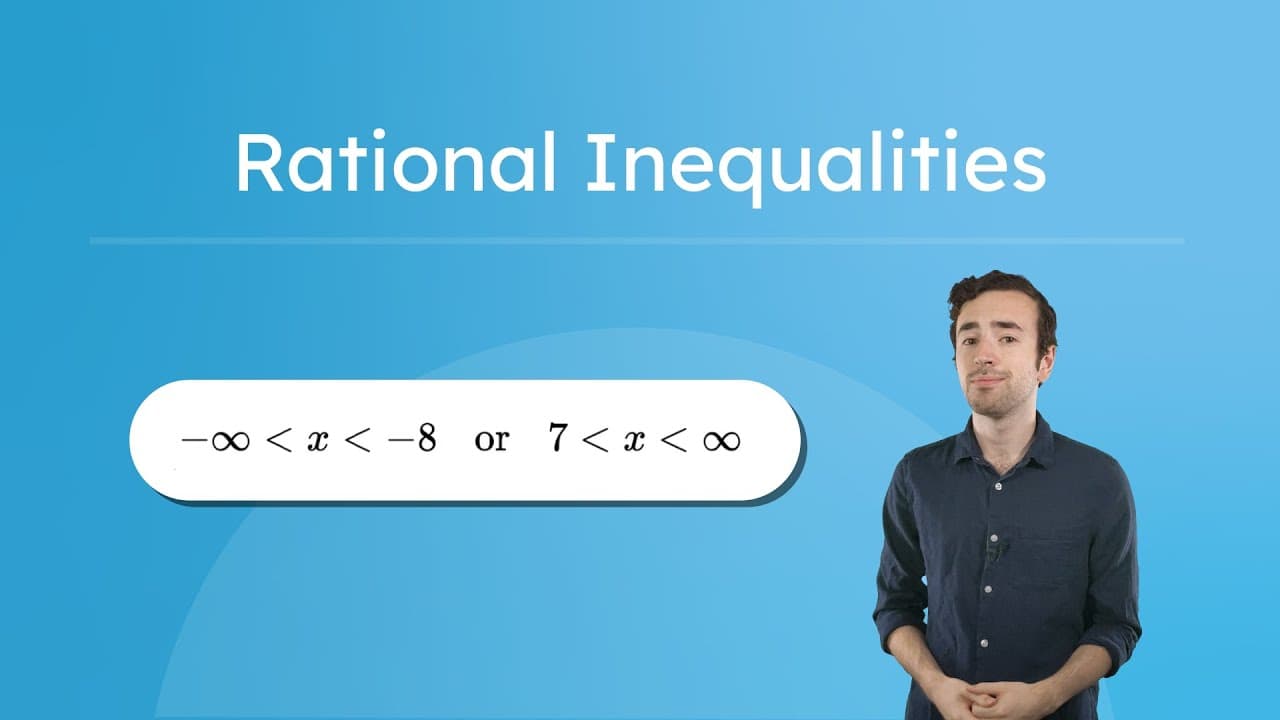
Mastering Rational Inequalities: Steps and Solutions

Mastering Rational Inequalities: Steps and Solutions

This instructional video provides a comprehensive guide to solving rational inequalities, a core topic in advanced algebra. The lesson begins by distinguishing between rational equations, which typically have a finite number of solutions, and rational inequalities, which possess infinite solutions within specific intervals. The narrator introduces a structured four-step process for solving these problems: altering the inequality to set one side to zero, factoring to identify boundary points, testing intervals on a number line, and writing the final solution set using inequality notation. The video walks through two detailed examples that cover different scenarios. The first example demonstrates how to handle an inequality that is already set to zero, focusing on factoring quadratics and determining whether boundary points are included (closed circles) or excluded (open circles). The second, more complex example shows how to manipulate an inequality with fractions on both sides by finding a common denominator and combining terms before solving. The narrator emphasizes the critical rule that values making the denominator zero are never included in the solution set. Teachers can use this video to introduce the algebraic method for solving rational inequalities or as a review tool for students struggling with sign analysis. The visual representation of the number line and the step-by-step testing of points helps demystify the abstract concept of solution intervals. The clear distinction between numerator roots (which can be included) and denominator roots (which are always excluded) addresses a common student misconception directly.

Miacademy & MiaPrep Learning ChannelMiacademy & MiaPrep Learning Channel

19mins 32s

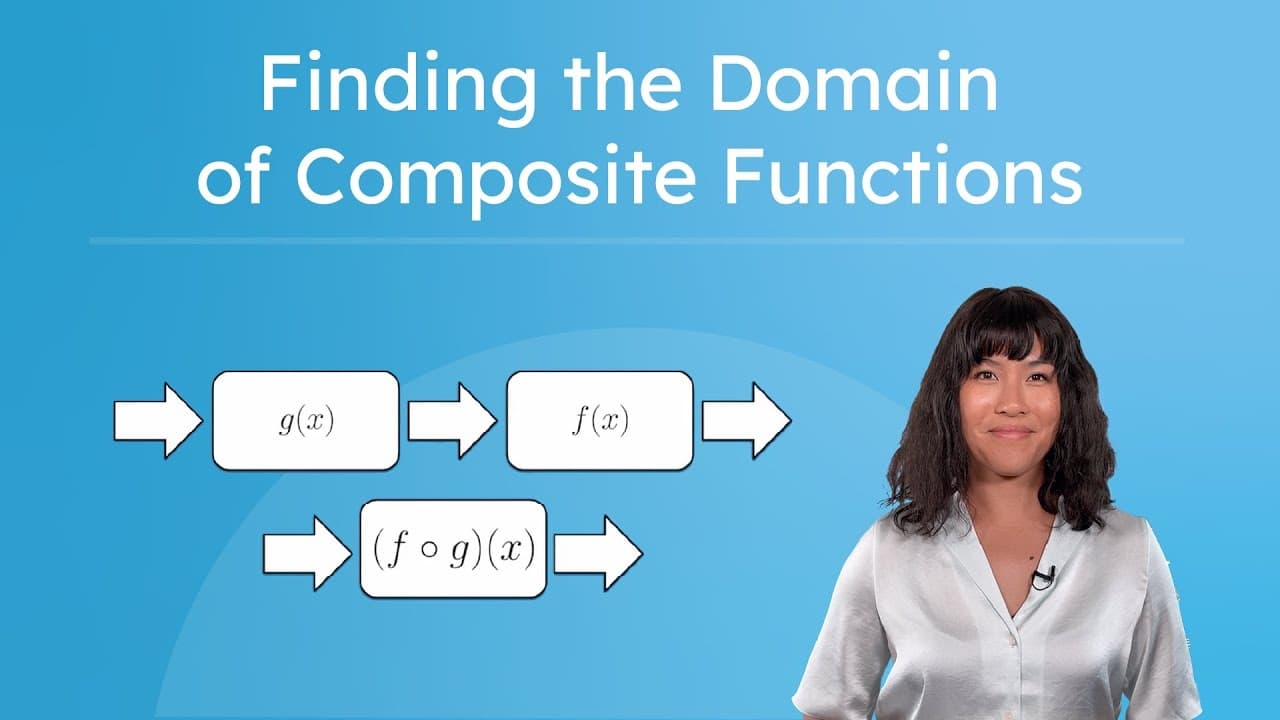
How to Find the Domain of Composite Functions

How to Find the Domain of Composite Functions

This educational video provides a clear, step-by-step guide on how to determine the domain of composite functions, a key concept in precalculus and algebra. Through the use of specific examples involving rational and radical functions, the narrator demonstrates that finding the domain isn't as simple as just looking at the final simplified equation. The video uses a logical "input-output" approach, comparing functions to a cooking process where inputs must be compatible with each stage of preparation. The content progresses from a numerical investigation using a table of values to an analytical algebraic method. It highlights the two main sources of domain restrictions: values excluded from the inner function, and values that cause the inner function to output a number that is undefined in the outer function. This dual-layer analysis is crucial for students who often miss the second type of restriction. Teachers can use this video to introduce or reinforce the complex topic of composite domains. It breaks down the process into four actionable steps: finding the inner domain, finding the outer domain, solving for x-values that violate the outer domain, and combining the results. The visual aids and pause points make it an excellent tool for interactive classroom learning or flipped classroom assignments.

Miacademy & MiaPrep Learning ChannelMiacademy & MiaPrep Learning Channel

8mins 44s

Solving Domain Restrictions for Algebra Functions

Solving Domain Restrictions for Algebra Functions

This educational video provides a comprehensive tutorial on calculating domain restrictions for various algebraic functions. The narrator, Justin, guides viewers through four distinct examples that increase in complexity, covering square root functions, rational functions (fractions), and composite functions involving both. The video emphasizes the two primary algebraic rules for domain restrictions: denominators cannot equal zero, and radicands (expressions under even roots) must be greater than or equal to zero. Key mathematical concepts explored include solving linear inequalities, understanding the behavior of variables in numerators versus denominators, and interpreting graphs of functions. A significant portion of the video is dedicated to visual verification, where the calculated algebraic domain is compared against the function's graph. The video specifically addresses the limitation of graphing calculators in displaying "holes" (removable discontinuities), reinforcing the importance of analytical calculation over reliance on technology. This resource is highly valuable for Algebra I and Algebra II classrooms. It serves as both a direct instructional tool for introducing domain constraints and a review for identifying discontinuities. Teachers can use the specific examples to demonstrate common pitfalls, such as forgetting to flip inequality signs when dividing by negatives or assuming variables in the numerator cause restrictions. The clear connection between algebraic manipulation and graphical representation helps students bridge the gap between abstract solving and visual understanding.

Miacademy & MiaPrep Learning ChannelMiacademy & MiaPrep Learning Channel

5mins 15s

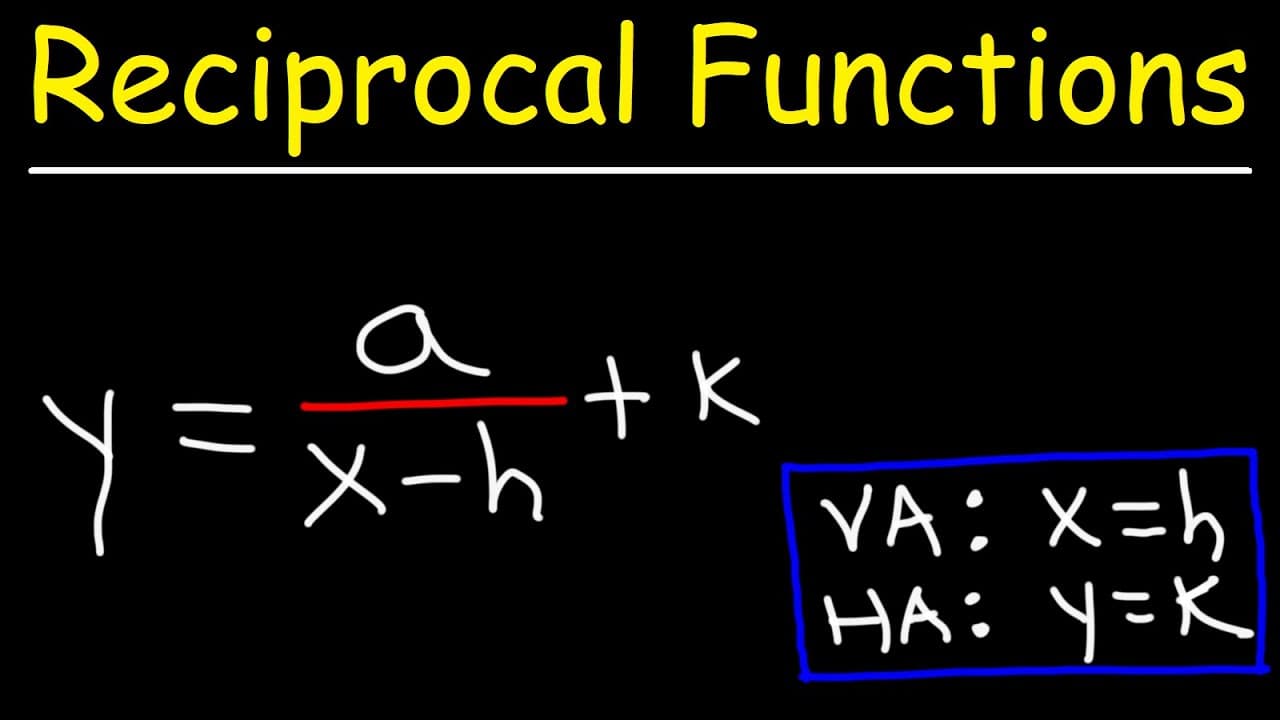
Graphing Reciprocal Functions Using Transformations and Asymptotes

Graphing Reciprocal Functions Using Transformations and Asymptotes

This video provides a detailed, step-by-step tutorial on how to graph reciprocal functions using the standard equation form y = a/(x-h) + k. The instructor explains the role of each variable in the equation, specifically focusing on how 'h' and 'k' determine the vertical and horizontal asymptotes, and how 'a' influences the vertical stretch, shrink, and orientation of the graph across the coordinate plane. The video explores key themes such as identifying asymptotes, understanding transformations (shifts and stretches), and the process of creating a table of values to plot accurate points. It contrasts positive and negative values of 'a', demonstrating how a negative sign reflects the graph across the horizontal asymptote, changing which quadrants the curves occupy relative to the asymptotes. For educators, this video serves as an excellent instructional tool for Algebra II or Pre-Calculus students moving beyond linear and quadratic functions. It offers a clear procedural method for graphing rational functions without a calculator, reinforcing concepts of domain, range, and asymptotic behavior. The step-by-step examples allow teachers to pause and let students practice predicting the graph's behavior before the solution is revealed.

The Organic Chemistry TutorThe Organic Chemistry Tutor

12mins 30s

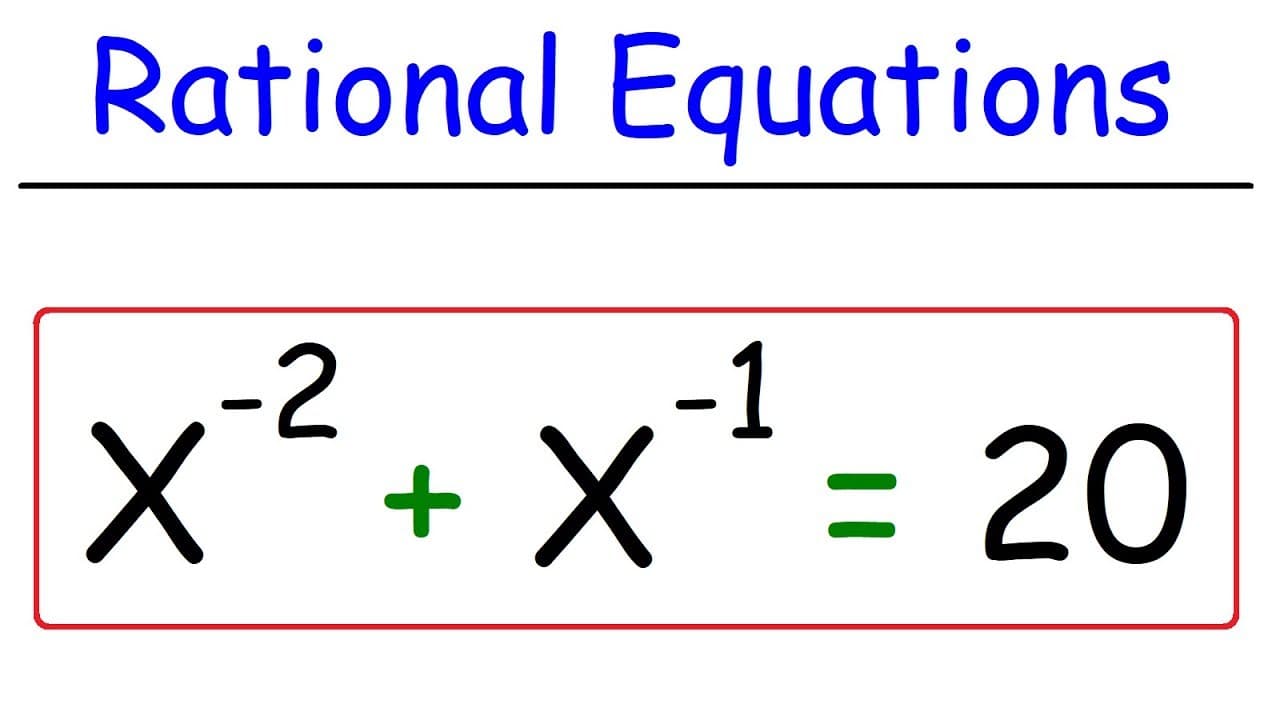
How to Solve Equations with Negative Exponents

How to Solve Equations with Negative Exponents

This video provides a step-by-step tutorial on solving an algebraic equation involving negative exponents ($x^{-2} + x^{-1} = 20$). The narrator begins by converting the negative exponents into rational expressions (fractions), transforming the problem into a rational equation. The solution process involves clearing the denominators to create a quadratic equation, rearranging it into standard form, and solving for $x$ using the factoring by grouping method. Key mathematical themes include the properties of exponents, specifically the rule $x^{-n} = 1/x^n$, solving rational equations by multiplying by the least common multiple, and factoring trinomials where the leading coefficient is not equal to one. The video also emphasizes the critical step of verifying solutions by substituting the answers back into the original equation to check for validity. For educators, this video serves as an excellent resource for Algebra 1 or Algebra 2 classes. It effectively bridges multiple concepts—exponent rules, rational expressions, and quadratic factoring—into a single problem. It can be used to demonstrate how algebraic structures can be disguised and how to manipulate equations into solvable forms. The clear, handwritten visual style makes it easy for students to follow the logical flow of the solution.

The Organic Chemistry TutorThe Organic Chemistry Tutor

10mins 6s

Materials

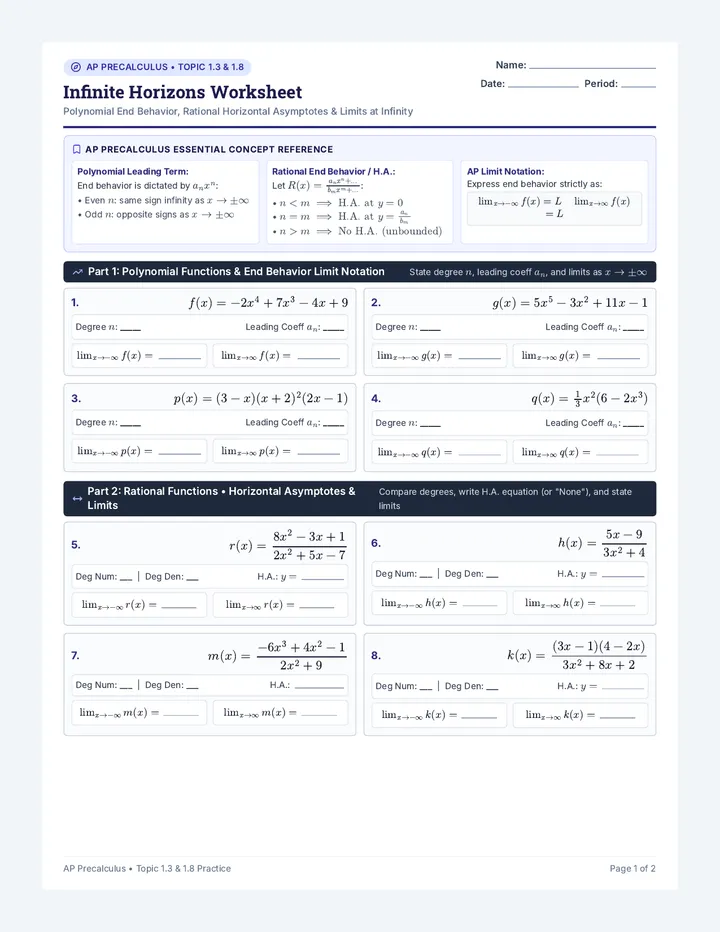
Infinite Horizons Worksheet

Infinite Horizons Worksheet

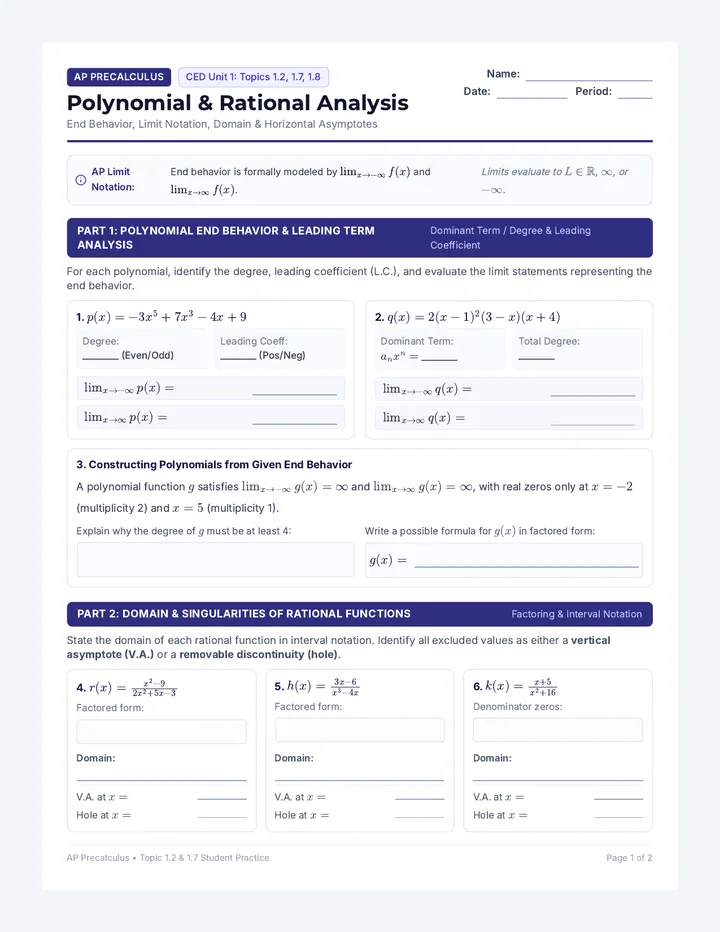
A rigorous 2-page AP Precalculus worksheet covering polynomial end behavior using AP limit notation, rational function end behavior and horizontal asymptotes, and finding domains of rational functions in interval notation without holes or vertical asymptotes.

R

Robinson

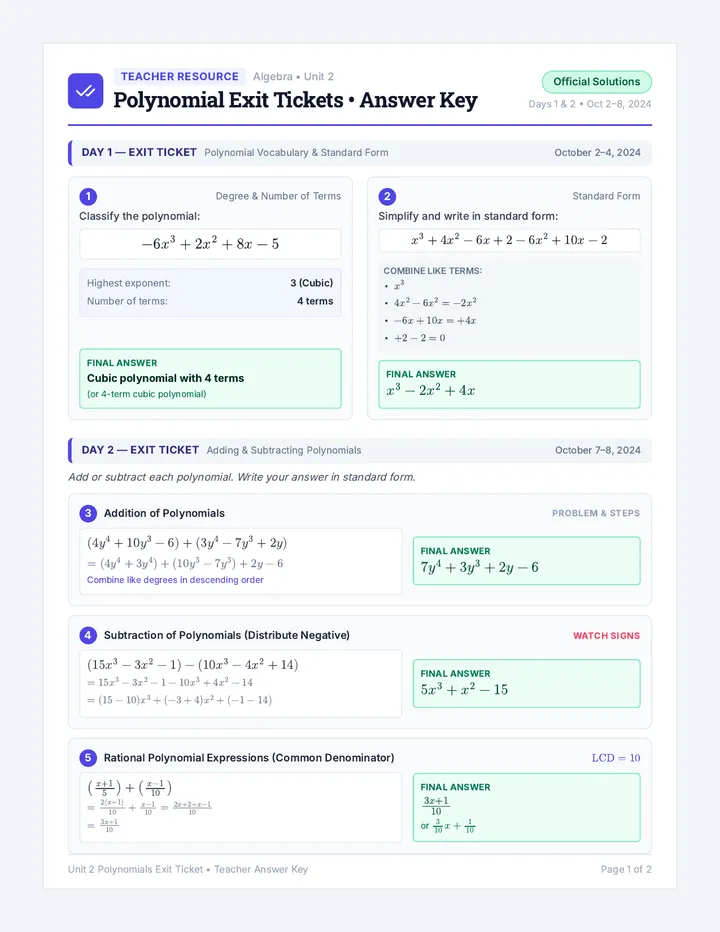
Polynomial Exit Ticket Answer Key

Polynomial Exit Ticket Answer Key

Complete 2-page teacher answer key and step-by-step solution guide for Unit 2 Polynomial Exit Tickets covering Days 1 through 4. Includes classification, simplifying, addition/subtraction, rational expressions, function operations with tables, and polynomial multiplication.

MR

Mahuya Roy Chowdhury

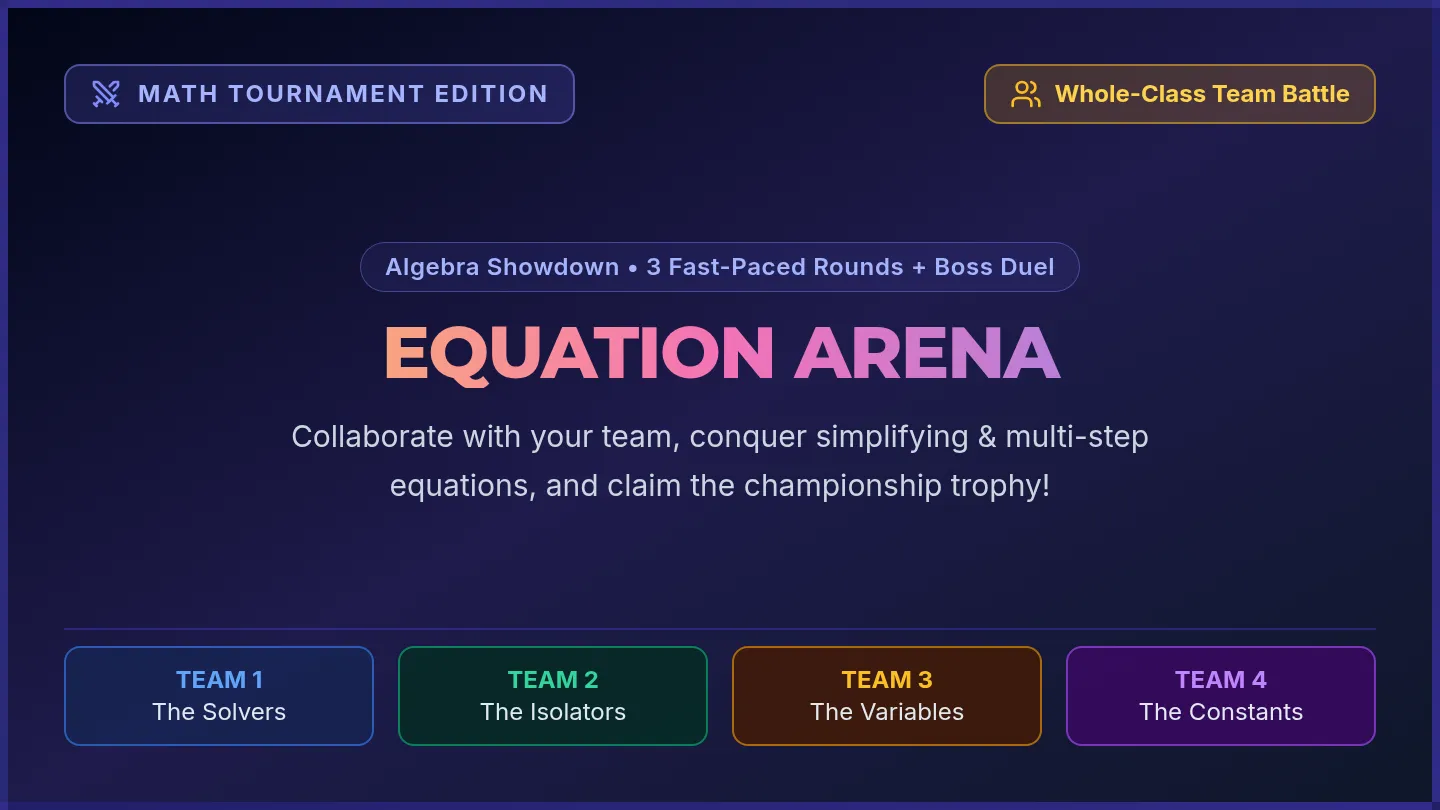
Equation Arena Game Slides

Equation Arena Game Slides

A comprehensive whole-class team game slide deck featuring three competitive rounds and a final boss challenge covering simplifying expressions, one-sided equations, and two-sided equations with fractions and decimals.

L

Lorie.Shiveley

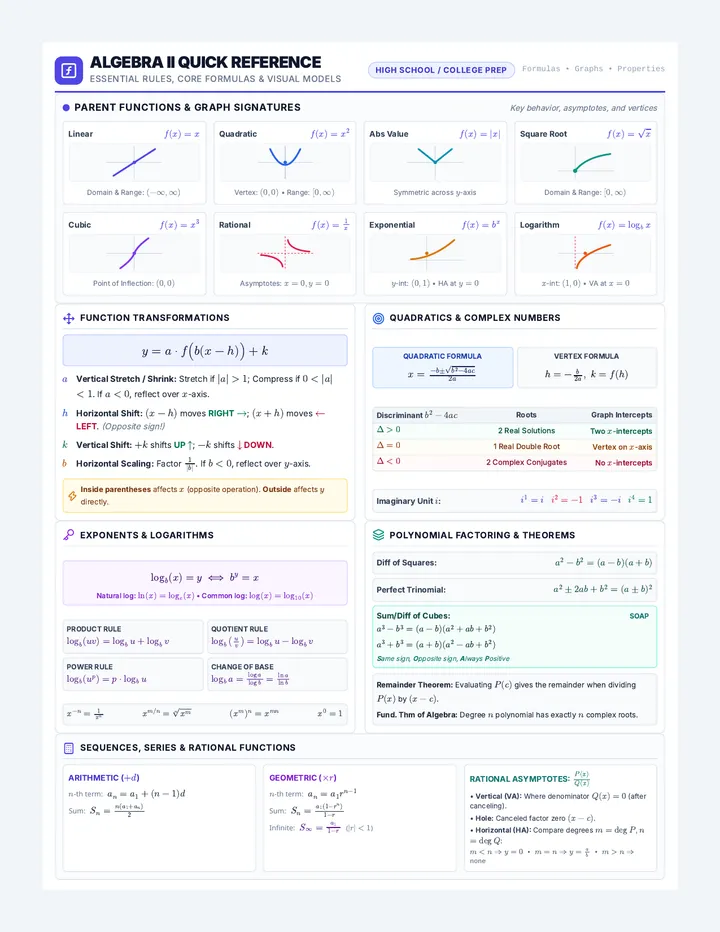
Algebra Engine Reference Sheet

Algebra Engine Reference Sheet

A comprehensive, one-page printable Algebra 2 reference sheet packed with visual parent function graphs, transformation guides, quadratic formulas, complex numbers, logarithmic rules, polynomial factoring shortcuts, and sequence formulas.

KL

Karen Lloyd

Interim Assessment Review Practice

Interim Assessment Review Practice

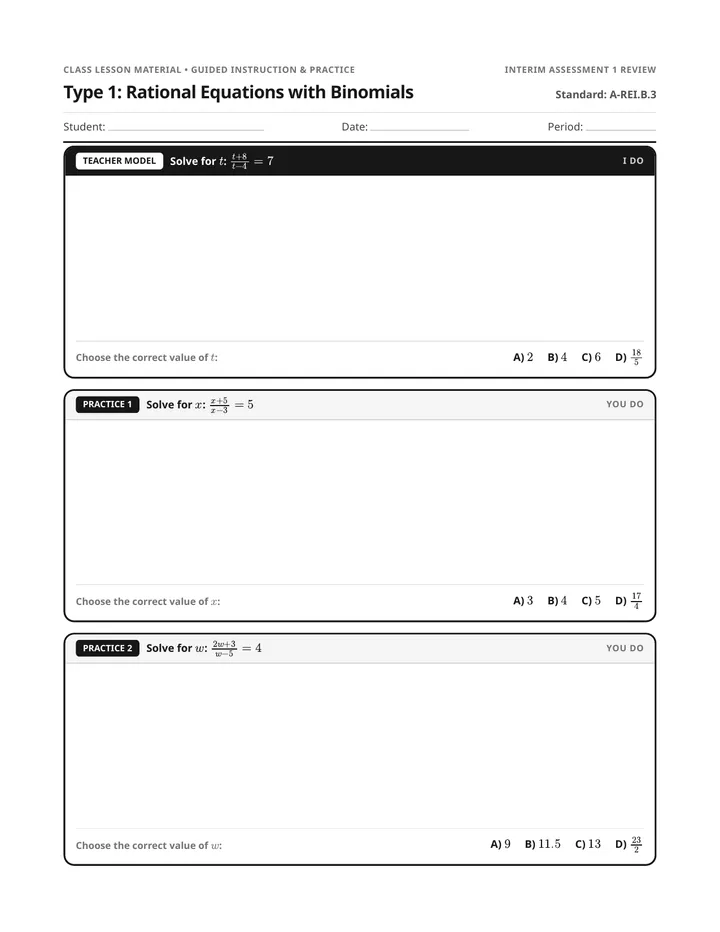
Fixed spacing and alignment issues across the 16-page review packet by removing auto-centering margins (mx-auto) and border offsets from all page sections, ensuring every page strictly anchors to the 720px by 960px viewport without horizontal shifting or clipping.

CE

Clifford Ernst

Asymptote & Limit Lab Worksheet

Asymptote & Limit Lab Worksheet

A comprehensive 2-page AP Precalculus worksheet covering polynomial end behavior using limit notation, rational function domains, and end behavior including horizontal asymptotes with AP-style analysis questions.

R

Robinson

Sequences

Regents Mastery Blueprint Study Guide

Regents Mastery Suite

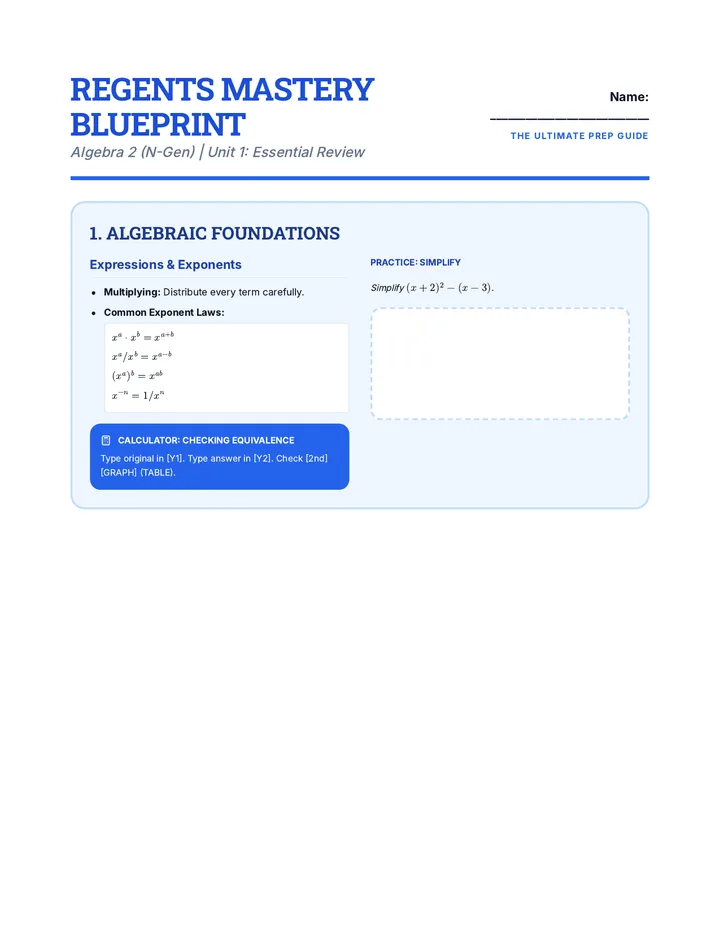
A comprehensive review suite for the New York State Mathematics Regents exams, including Algebra 1, Geometry, and Algebra 2, featuring mastery blueprints, calculator strategies, and exam-taking tips.

KB

Kayla Borozny

15
Parallel Path Packet Student

Linear Logic Blueprints

A series of algebra and geometry foundation lessons designed with a technical blueprint aesthetic, focusing on precision, organized computation, and visual clarity in mathematical steps.

D

david.marques

5
Power Play Worksheet

Algebra Architect Recovery

A comprehensive grade recovery packet for 9th Grade Algebra 1 students, covering exponent laws, exponential functions, polynomial operations, and factoring techniques.

DG

Dakota Griffith

8
Strategy Blueprint Slides

ACT Math Mastery

A comprehensive ACT Math preparation program focusing on essential strategies, high-yield Algebra and Geometry concepts, and realistic practice to boost scores.

AL

ava larumbe

26
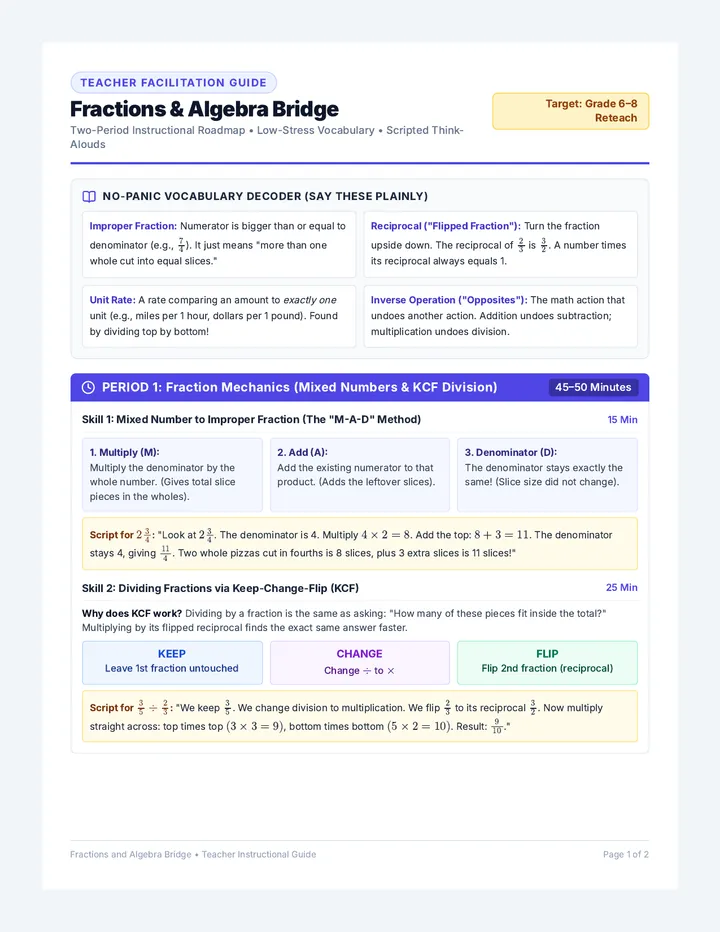
Fractions and Algebra Teacher Guide

Fraction Algebra Mastery

A comprehensive two-part unit connecting foundational fraction operations to algebraic one-step equations and real-world fractional rate word problems. Features scripted teacher guides, scaffolded visual frameworks, and rigorous step-by-step practice.

AP

Alexis Paolini

12
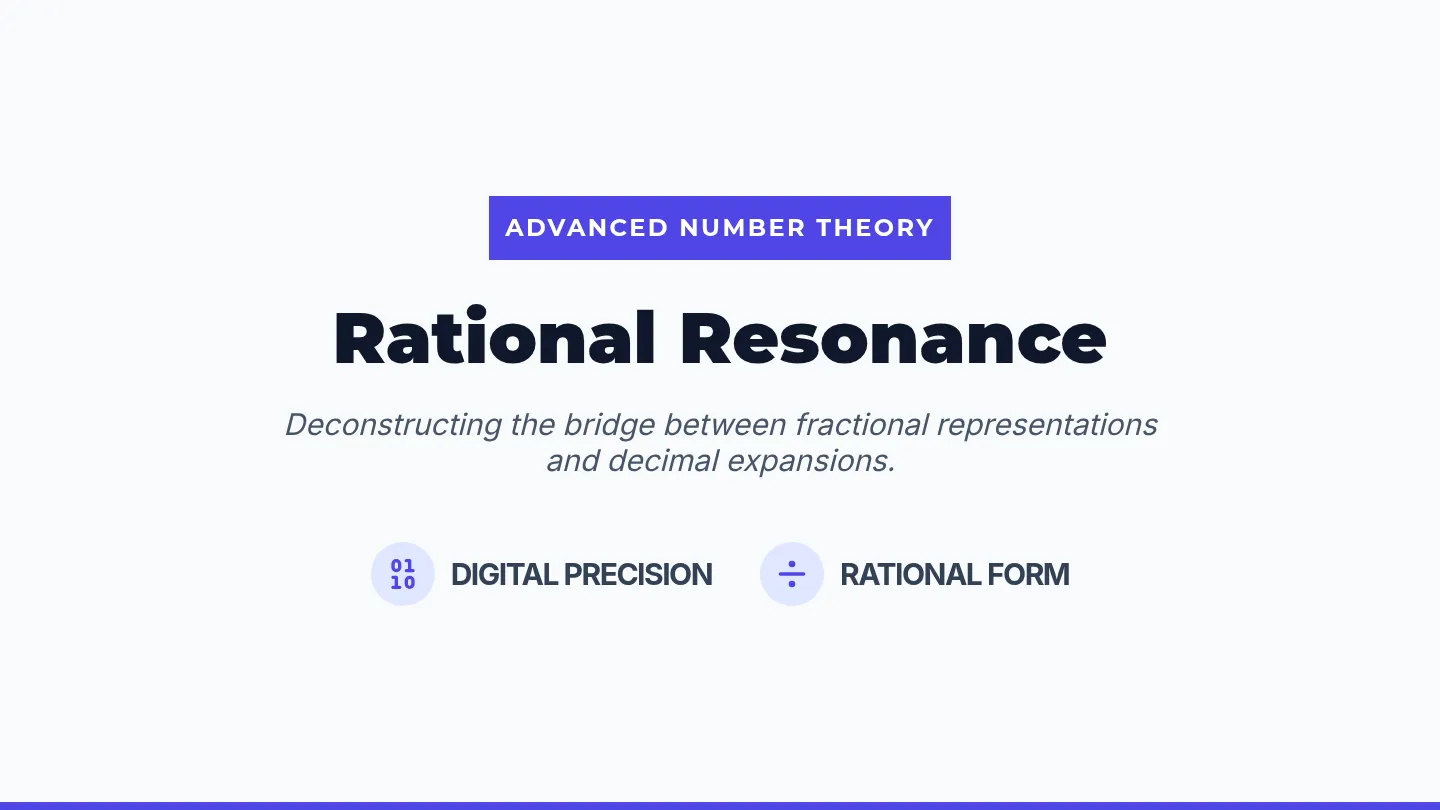
Rational Resonance Slides

Decimal Dimensions

A deep dive into the theoretical and practical relationship between fractions and decimals, designed for advanced learners to explore the structure of rational numbers and precision in calculation.

6

Lessons

Algebra II Final Exam Test

Algebra II Spring Final Exam

A comprehensive Algebra II final exam covering quadratics, function operations, inverses, exponent rules, and polynomial division.

BF

Ben Freitag

2
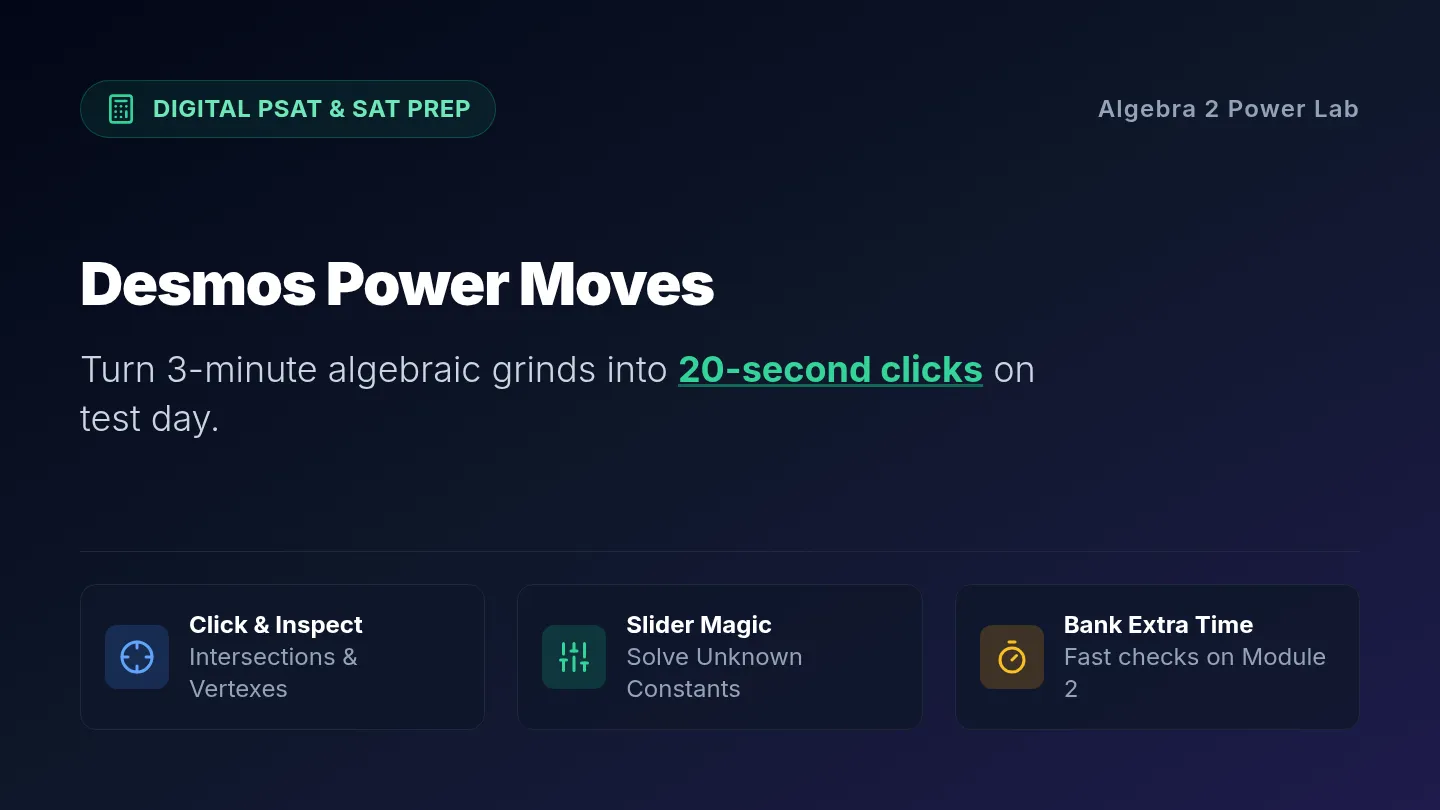
Desmos Power Moves Slides

Desmos SAT Launchpad

A high-impact 45-minute workshop introducing Algebra 2 students to essential Desmos Graphing Calculator strategies for the digital PSAT and SAT. Students discover key calculator moves through a brief interactive demo followed by an authentic partner sprint.

RB

Ronald Berg

3
TSIA2 Math Formula Reference Sheet

TSIA2 Math Mastery

A comprehensive practice suite designed to prepare students for the TSIA2 Mathematics placement test. Includes a realistic 20-question practice exam, a detailed step-by-step solutions guide, and a targeted formula reference sheet.

P

psreed75

3
Rational Roundup Worksheet

Rational Roundup

A review lesson focused on transformations, simplifying, adding, and modeling with rational expressions based on district assessment standards.

M

mastronardil

2
Curve Shifters Worksheet

Curve Shifters

A lesson focused on identifying and applying transformations to the rational parent function f(x) = 1/x. Students will master horizontal and vertical shifts, vertical stretches and compressions, and reflections.

MR

Mahuya Roy Chowdhury

2
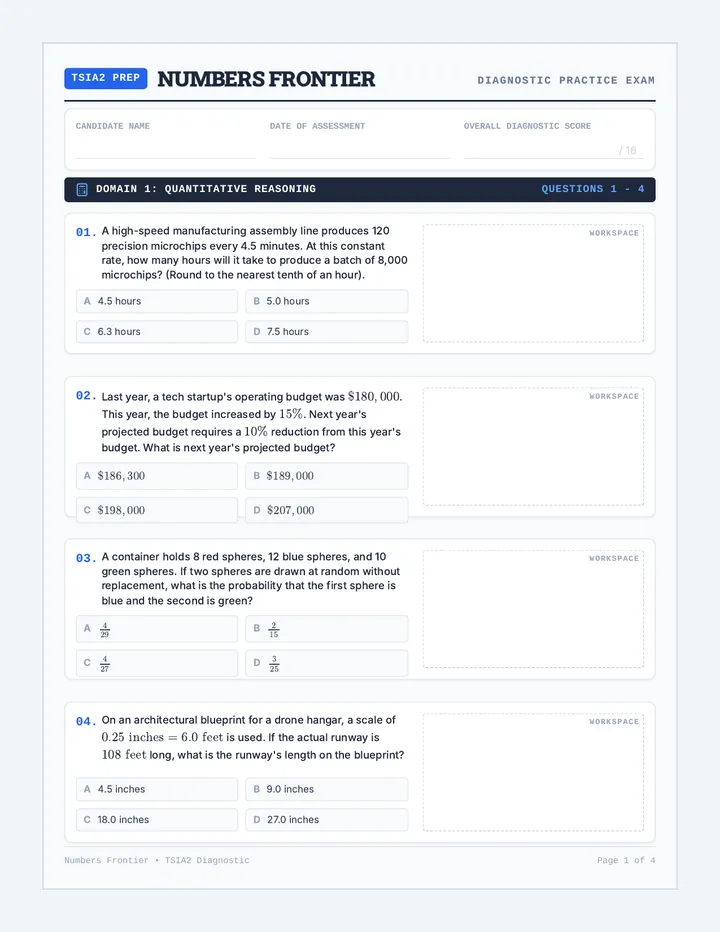
Numbers Frontier Practice Test

Numbers Frontier

A comprehensive diagnostic practice sequence designed to prepare students for the TSIA2 mathematics assessment, covering quantitative, algebraic, geometric, and statistical reasoning.

P

psreed75

2