Lenny.com
Explore
Create
ActivitiesNewMathEnglish Language ArtsScience & EngineeringSocial StudiesGlobal LanguagesHealth & Physical EducationSpecial EducationCounseling & Life SkillsArts & CreativityESL
Lenny.com
Lenny.com
Explore
Create
ActivitiesNewMathEnglish Language ArtsScience & EngineeringSocial StudiesGlobal LanguagesHealth & Physical EducationSpecial EducationCounseling & Life SkillsArts & CreativityESL
Lenny.com
Lenny.com

Solutions

Lenny for EducatorsLenny for SchoolsLenny for Districts

Product

ExploreSign inCreateSupportAbout

Resources

Getting startedMTSS Acceleration Program

© 2026 Lenny Learning Inc.

TermsPrivacyAccessibility
LinkedInInstagramX
Lenny
MathNumbers & CountingCounting ObjectsNumber NamesComparing NumbersNumber OperationsCounting SequenceNumbers 0-10Place Value Understanding and SystemAdd and Subtract Within 20Addition and Subtraction ConceptsAddition and Subtraction EquationsAddition and Subtraction ProblemsFoundations for MultiplicationMultiplication and Division PropertiesMultiply and Divide Within 100Multiplication and Division ProblemsFactors and MultiplesProperties of OperationsPatterns and RelationshipsGenerate and Analyze PatternsMulti-Digit ArithmeticPlace Value OperationsMulti-Digit and Decimal OperationsNumerical ExpressionsFour Operations and PatternsFour Operations Problem SolvingMeasurement & DataMeasurable AttributesMeasuring LengthsMeasure and Estimate Lengths in Standard UnitsRelate Addition and Subtraction to LengthClassifying and Counting ObjectsTime and MoneyArea Concepts and MeasurementPerimeter and Area MeasuresAngle Concepts and MeasurementTime, Volume, and MassMeasurement Unit ConversionsGeometryIdentifying ShapesShapes and AttributesShape Attributes and ReasoningShapes and CompositionClassifying 2D FiguresGeometric Figures and RelationshipsLines, Angles, and ShapesAngle, Area, and VolumeGeometric MeasurementVolume of 3D ShapesCoordinate Plane ApplicationsTransformations in the PlaneCongruence and SimilarityUnderstand congruence in terms of rigid motionsSimilarity and TransformationsProve Theorems Involving SimilarityPythagorean TheoremTrigonometry for General TrianglesMake Geometric ConstructionsProve Geometric TheoremsTheorems About CirclesFind Arc Lengths And Areas of Sectors of CirclesVolume FormulasRelationships Between Two-Dimensional and Three-Dimensional ObjectsProve Simple Geometric Theorems AlgebraicallyTranslate Between Geometric Description and Equation for Conic SectionApply Geometric Concepts in Modeling SituationsFractions & DecimalsFractions as NumbersBuilding FractionsFraction Equivalence and OrderingAdding and Subtracting FractionsMultiplying and Dividing FractionsDividing FractionsDecimal FractionsMulti-Digit Computation and FactorsAdd, Subtract, Multiply, and Divide Rational NumbersRational Number SystemIrrational Numbers and ApproximationsRatiosRatios and ProportionsProportional RelationshipsUnit RateAlgebraAlgebraic ExpressionsGenerate Equivalent ExpressionsQuantitative RelationshipsProportional Relationships and Linear EquationsEquations and InequalitiesEquation Solving and ReasoningLinear Equations and SystemsGraph Equations and InequalitiesSystems of EquationsReal-World Algebraic ProblemsQuantitative Reasoning with UnitsExpression StructureEquivalent Expression FormsRadicals and Integer ExponentsRational ExponentsRational and Irrational NumbersPolynomial OperationsPolynomial IdentitiesPolynomial Zeros and FactorsRational ExpressionsComplex Number OperationsComplex Numbers in PolynomialsComplex Numbers on PlaneStatistics & ProbabilityRepresent and Interpret DataData DistributionsStatistical VariabilityProbability ModelsCompound Event ProbabilitiesStatistical SamplingInterpret Categorical and Quantitative DataBivariate Data PatternsInterpret Linear ModelsComparing Two PopulationsRandom Processes in StatisticsIndependence and Conditional ProbabilityExpected ValuesProbability-Based Decision MakingStatistical Inference and ConclusionsFunctionsFunction Concepts and NotationDefine and Compare FunctionsInterpret Functions in ContextAnalyze Function RepresentationsModel Relationships with FunctionsIdentify Linear vs Exponential GrowthDistinguish Between Function TypesCompare Growth RatesInterpret Function ExpressionsBuild Functions from RelationshipsConstruct and Model FunctionsTransform and Combine FunctionsModel Comparison and SelectionSolve Exponential EquationsTrigonometryTrigonometric Ratios Involving Right TrianglesTrigonometric Functions and Unit CircleModel with Trigonometric FunctionsTrigonometric IdentitiesVectors & MatricesIntroduction to Vectors and MatricesVector QuantitiesVector OperationsMatrix OperationsCalculusLimits and ContinuityDerivative Concepts and NotationDerivative Rules and TechniquesApplications of DerivativesOptimization ProblemsRelated RatesCurve Sketching and AnalysisIntegration Concepts and NotationAntiderivatives and Indefinite IntegralsDefinite Integrals and AreaFundamental Theorem of CalculusIntegration TechniquesApplications of IntegrationDifferential EquationsSequences and SeriesParametric and Polar FunctionsVector-Valued Functions

ACT Math Mastery

A comprehensive ACT Math preparation program focusing on essential strategies, high-yield Algebra and Geometry concepts, and realistic practice to boost scores.

ALava larumbe
Strategic Blueprint

Master the structure of the ACT Math section and learn time-saving strategies like 'The 3-Pass Method' and 'Plugging In' while reviewing essential formulas.

Algebra Ascent

Deep dive into high-yield Algebra topics including linear functions, systems of equations, and quadratic properties frequently tested on the ACT.

Geometric Gains

Review critical Geometry and Trigonometry concepts, from SOH CAH TOA to circle properties and coordinate geometry.

Final Sprint

Apply strategies and knowledge in a timed practice environment with a representative ACT Math question set.

Advanced Apex

Master the most challenging topics on the ACT, including Pre-Calculus concepts (matrices, vectors, complex numbers) and high-difficulty Geometry (Law of Sines/Cosines, ellipses).

ACT Math Mastery

A comprehensive ACT Math preparation program focusing on essential strategies, high-yield Algebra and Geometry concepts, and realistic practice to boost scores.

ALava larumbe

Target: \( (3+2)^2 - 4 = 25 - 4 = 21 \)

A) \( x^2 \)     (9) NO

B) \( x^2 + 4x \)   (9 + 12 = 21) MATCH!

C) \( x^2 - 4 \)   (5) NO


Geometry Hacks

Trust (but Verify) the Eyes

Most ACT diagrams are roughly to scale. If an angle looks like 90°, and your answer says 15°, you're wrong.

Fill in the Blanks

As soon as you find a piece of information (an angle, a side), write it on the diagram. It will reveal the next step.

The "Eyeball" Ruler

Use the edge of your answer sheet or your pencil to compare lengths. If you know a side is 4, how many of those fit into the unknown side?

12 5 x = ?

Pythagorean Triple: 5-12-13


Calculator Confidence

Master Your Machine

  • Graph functions to find intersections/roots.
  • Use "ANS" button to keep precision.
  • Always use parentheses for negative numbers: (-3)^2 vs -3^2.
  • Don't use it for simple arithmetic (waste of time).

Speed Kills!

If you can solve it in your head or on paper in 5 seconds, don't pick up the calculator.

Math Essentials Reference

ACT MATH ESSENTIALS

High-Yield Formula & Concept Map

ACT MASTERY

3-Pass Method

1. Sprints (Now)
2. Work (Later)
3. Guess (Never leave blank)

P.I.T.A.

Plugging In The Answers. Start with C or H. Work backwards from answer to question.

P.I.N.

Plugging In Numbers. Replace abstract variables with easy numbers like 2, 5, or 10.

I. ALGEBRA & FUNCTIONS

Linear Equations

Slope Formula: \[ m = \frac{y_2 - y_1}{x_2 - x_1} \]

Slope-Intercept: \[ y = mx + b \]

Standard Form: \[ Ax + By = C \]

Parallel: Same Slopes

Perpendicular: Opposite Reciprocals

Quadratics & Roots

Quadratic Formula:

\[ x = \frac{-b \pm \sqrt{b^2 - 4ac}}{2a} \]

Vertex \(x\)-coord: \[ x = \frac{-b}{2a} \]

Discriminant: \[ b^2 - 4ac \]

Positive = 2 real roots; Zero = 1 root; Negative = 2 imaginary.

Exponents & Logarithms

  • \( x^a \cdot x^b = x^{a+b} \)

  • \( \frac{x^a}{x^b} = x^{a-b} \)

  • \( (x^a)^b = x^{ab} \)

  • \( x^{-a} = \frac{1}{x^a} \)

  • \( x^{a/b} = \sqrt[b]{x^a} \)

  • \( \log_b(x) = y \rightarrow b^y = x \)

Sequences

Arithmetic: \( a_n = a_1 + (n-1)d \)

Geometric: \( a_n = a_1 \cdot r^{n-1} \)

Average = Sum / # of terms. Sum = Average \(\times\) # of terms.

II. STATS & PROBABILITY

Basic Stats

  • Mean: Average of all numbers.
  • Median: Middle value (if list is ordered).
  • Mode: Most frequent value.
  • Range: Max \(-\) Min.

Probability

  • P(Event): \( \frac{\text{Wanted Outcomes}}{\text{Total Possible}} \)
  • "AND": Multiply probabilities.
  • "OR": Add probabilities.

ACT MATH ESSENTIALS

Page 2: Geometry & Trigonometry

III. GEOMETRY

Triangles

Area: \[ A = \frac{1}{2}bh \]

Pythagorean: \[ a^2 + b^2 = c^2 \]

Special Right Triangles:

  • 45-45-90: Ratio \( 1 : 1 : \sqrt{2} \)
  • 30-60-90: Ratio \( 1 : \sqrt{3} : 2 \)

Triangle Inequality: Sum of any 2 sides > 3rd side.

Circles

Area: \[ A = \pi r^2 \]

Circumference: \[ C = 2\pi r \text{ or } \pi d \]

Equation: \[ (x-h)^2 + (y-k)^2 = r^2 \]

Center: \((h, k)\). Radius: \(r\).

Coordinate Geometry

Midpoint: \[ \left( \frac{x_1+x_2}{2}, \frac{y_1+y_2}{2} \right) \]

Distance: \[ d = \sqrt{(x_2-x_1)^2 + (y_2-y_1)^2} \]

3D & Polygons

Rect. Box Vol: \( l \cdot w \cdot h \)

Cylinder Vol: \( \pi r^2 h \)

Interior Angles: \( 180(n-2) \)

Trapezoid Area: \( \frac{1}{2}(b_1+b_2)h \)

IV. TRIGONOMETRY

SOH CAH TOA

SIN

Opp/Hyp

COS

Adj/Hyp

TAN

Opp/Adj

\[ \sin^2\theta + \cos^2\theta = 1 \]

Graphs & Units

  • Radians: \( 180^\circ = \pi \) radians
  • Amplitude: \( y = \mathbf{A}\sin(Bx) \)
  • Period: \( \text{Period} = \frac{2\pi}{B} \)

PRO TIP: Don't Over-Calculate

The ACT Math section is designed to be finished without a calculator if you're efficient. If you find yourself doing massive, multi-step long division or complex square roots, stop and look for a simpler way or a geometric shortcut.
Math Essentials Reference Updated

ACT MATH ESSENTIALS

High-Yield Formula & Concept Map

ACT MASTERY

3-Pass Method

1. Sprints (Now)
2. Work (Later)
3. Guess (Never leave blank)

P.I.T.A.

Plugging In The Answers. Start with C or H. Work backwards from answer to question.

P.I.N.

Plugging In Numbers. Replace abstract variables with easy numbers like 2, 5, or 10.

I. ALGEBRA & FUNCTIONS

Linear Equations

Slope Formula: \[ m = \frac{y_2 - y_1}{x_2 - x_1} \]

Slope-Intercept: \[ y = mx + b \]

Standard Form: \[ Ax + By = C \]

Parallel: Same Slopes

Perpendicular: Opposite Reciprocals

Quadratics & Roots

Quadratic Formula:

\[ x = \frac{-b \pm \sqrt{b^2 - 4ac}}{2a} \]

Vertex \(x\)-coord: \[ x = \frac{-b}{2a} \]

Discriminant: \[ b^2 - 4ac \]

Positive = 2 real roots; Zero = 1 root; Negative = 2 imaginary.

Exponents & Logarithms

  • \( x^a \cdot x^b = x^{a+b} \)

  • \( \frac{x^a}{x^b} = x^{a-b} \)

  • \( (x^a)^b = x^{ab} \)

  • \( x^{-a} = \frac{1}{x^a} \)

  • \( x^{a/b} = \sqrt[b]{x^a} \)

  • \( \log_b(x) = y \rightarrow b^y = x \)

Complex Numbers

Definition: \( i^2 = -1, i = \sqrt{-1} \)

Conjugate: \( a+bi \rightarrow a-bi \)

Used to rationalize denominators (multiply by conjugate).

II. STATS & PROBABILITY

Basic Stats

  • Mean: Average of all numbers.
  • Median: Middle value (if list is ordered).
  • Mode: Most frequent value.
  • Range: Max \(-\) Min.

Probability

  • P(Event): \( \frac{\text{Wanted Outcomes}}{\text{Total Possible}} \)
  • "AND": Multiply probabilities.
  • "OR": Add probabilities.

ACT MATH ESSENTIALS

Page 2: Geometry & Trigonometry

III. GEOMETRY & CONICS

Triangles

Area: \[ A = \frac{1}{2}bh \]

Advanced Triangle Rules:

  • Law of Sines: \( \frac{a}{\sin A} = \frac{b}{\sin B} \)
  • Law of Cosines: \( c^2 = a^2 + b^2 - 2ab\cos C \)

Circles & Ellipses

Circle: \[ (x-h)^2 + (y-k)^2 = r^2 \]

Ellipse: \[ \frac{(x-h)^2}{a^2} + \frac{(y-k)^2}{b^2} = 1 \]

Center for both: \((h, k)\). Ellipse axis lengths: \(2a\) and \(2b\).

Coordinate Geometry

Midpoint: \[ \left( \frac{x_1+x_2}{2}, \frac{y_1+y_2}{2} \right) \]

Distance: \[ d = \sqrt{(x_2-x_1)^2 + (y_2-y_1)^2} \]

Vectors & Matrices

Dot Product: \( \langle x_1, y_1 \rangle \cdot \langle x_2, y_2 \rangle = x_1x_2 + y_1y_2 \)

Determinant: \( \text{det}\begin{bmatrix} a & b \\ c & d \end{bmatrix} = ad - bc \)

IV. TRIGONOMETRY

SOH CAH TOA

SIN

Opp/Hyp

COS

Adj/Hyp

TAN

Opp/Adj

\[ \sin^2\theta + \cos^2\theta = 1 \]

Graphs & Units

  • Radians: \( 180^\circ = \pi \) radians
  • Amplitude: \( y = \mathbf{A}\sin(Bx) \)
  • Period: \( \text{Period} = \frac{2\pi}{B} \)

PRO TIP: Don't Over-Calculate

The ACT Math section is designed to be finished without a calculator if you're efficient. If you find yourself doing massive, multi-step long division or complex square roots, stop and look for a simpler way or a geometric shortcut.
Strategy Sandbox Worksheet

Strategy Sandbox

PRACTICE: P.I.T.A. & P.I.N. TECHNIQUES

Name:

SECTION 1: P.I.T.A. (Plugging In The Answers)

Use PITA when: The question asks for a specific value and the answers are simple numbers.

1. A group of friends splits a $96 restaurant bill equally. If there had been 2 more friends in the group, each person would have paid $4 less. How many friends were in the original group?

A) 4

B) 6

C) 8

D) 10

E) 12

Strategy Tip: Start with Choice C (8). Is 96/8 minus 96/10 equal to 4?

2. If \( \frac{x+3}{2} + \frac{x-1}{3} = 7 \), what is the value of \( x \)?

F) 5

G) 7

H) 9

J) 11

K) 13

SECTION 2: P.I.N. (Plugging In Numbers)

Use PIN when: The question and the answers both contain variables (x, y, a, b).

3. For all non-zero values of \( a \) and \( b \), which of the following is equivalent to \( \frac{3a^2b + 6ab^2}{3ab} \)?

A) \( a + b \)

B) \( a + 2b \)

C) \( 3a + 2b \)

D) \( 2a + b \)

E) \( 3ab \)

Strategy Tip: Let a=2 and b=3. Find the "Target" value, then test the choices.

Subject Spotlight Activity

Subject Spotlight

QUICK REFRESHERS & TARGETED DRILLS

Topic-by-Topic Practice

ALGEBRA: Systems of Equations

The Refresher

To solve a system, use **Substitution** (if one var is isolated) or **Elimination** (to cancel a var). If the question asks for \(x+y\), look for a way to add/subtract the whole equations at once!

Ex: \( x+y=10 \); \( x-y=4 \)
Add 'em: \( 2x = 14 \rightarrow x=7 \)
Plug back: \( 7+y=10 \rightarrow y=3 \)

Try It:

If \( 2x + 3y = 15 \) and \( x - 3y = 3 \), what is the value of \( x \)?

A) 3B) 6C) 9D) 12

GEOMETRY: Angles & Parallel Lines

The Refresher

When a line (transversal) crosses parallel lines, all **acute** angles are equal and all **obtuse** angles are equal. Any acute + any obtuse = 180°.

a b

Try It:

Lines \(L_1\) and \(L_2\) are parallel. If angle \(A = 130^\circ\), what is the measure of its supplementary angle \(B\)?

F) 40°G) 50°H) 60°J) 130°

TRIGONOMETRY: SOH CAH TOA

The Refresher

Remember the ratios: \( \sin = \frac{O}{H} \), \( \cos = \frac{A}{H} \), \( \tan = \frac{O}{A} \). Use them to find missing sides OR angles.

SOH - CAH - TOA

Try It:

In a right triangle, the hypotenuse is 13 and the side adjacent to angle \(\theta\) is 5. What is \(\cos \theta\)?

A) 5/13B) 12/13C) 5/12D) 13/5

ADVANCED: Matrix Addition

The Refresher

To add or subtract matrices, they must be the same size. Just add/subtract the corresponding elements in each position.

\(\begin{bmatrix} a & b \\ c & d \end{bmatrix} + \begin{bmatrix} e & f \\ g & h \end{bmatrix} = \begin{bmatrix} a+e & b+f \\ c+g & d+h \end{bmatrix}\)

Try It:

What is \(\begin{bmatrix} 2 & 3 \end{bmatrix} + \begin{bmatrix} -1 & 5 \end{bmatrix}\)?

F) [1 8]G) [3 8]H) [1 -2]J) [215]

Understanding through Practice

Don't just read the formulas—solve the problems. The ACT tests **application**, not just memorization!

Strategy Sandbox Answer Key

Strategy Sandbox: Answer Key

STEP-BY-STEP STRATEGY BREAKDOWNS

Section 1: P.I.T.A. Solutions

Question 1: The Group Bill

Correct Answer: B (6 friends)

The Strategy: Instead of writing a complex equation, we test the answer choices.

Step 1: Start with Choice C (8). If there were 8 friends, each pays \( 96/8 = \$12 \). If there were 10 friends, each pays \( 96/10 = \$9.60 \). The difference is \( \$2.40 \). We need a difference of \( \$4 \). Since the difference is too small, we need each person to pay more originally, so we need a smaller group.

Step 2: Test Choice B (6). If there were 6 friends, each pays \( 96/6 = \$16 \). If there were 2 more (8 friends), each pays \( 96/8 = \$12 \). The difference is \( \$16 - \$12 = \$4 \). This matches the problem perfectly!

Question 2: The Fraction Equation

Correct Answer: G (7)

The Strategy: Solve by plugging the numbers into the equation instead of finding a common denominator.

Step 1: Test Choice G (7). \( \frac{7+3}{2} + \frac{7-1}{3} = \frac{10}{2} + \frac{6}{3} \).

Step 2: Calculate. \( 5 + 2 = 7 \). This matches the right side of the equation! We found it on the first try (starting near the middle helps).

Section 2: P.I.N. Solutions

Question 3: Variable Expression

Correct Answer: B (\( a + 2b \))

The Strategy: Pick easy numbers for variables to turn algebra into arithmetic.

Step 1: Pick numbers. Let \( a = 2 \) and \( b = 3 \).

Step 2: Find the "Target" value.
Numerator: \( 3(2^2)(3) + 6(2)(3^2) = 3(4)(3) + 6(2)(9) = 36 + 108 = 144 \).
Denominator: \( 3(2)(3) = 18 \).
Target: \( 144 / 18 = 8 \).

Step 3: Test the choices using \( a=2, b=3 \).
A) \( 2 + 3 = 5 \) (No)
B) \( 2 + 2(3) = 2 + 6 = 8 \) (Match!)
C) \( 3(2) + 2(3) = 6 + 6 = 12 \) (No)
D) \( 2(2) + 3 = 4 + 3 = 7 \) (No)

Mastering the Sandbox

The goal of these strategies isn't just to get the answer—it's to get the answer faster and with fewer mistakes than traditional algebra. Practice recognizing these "PITA/PIN friendly" questions on the real test!

Strategy Sandbox 2 Worksheet

Strategy Sandbox 2

EXTENDED PRACTICE: P.I.T.A. & P.I.N.

Name:

SECTION 1: P.I.T.A. (Plugging In The Answers)

Strategy Reminder: When a question asks for a specific number and the answers are ordered, start with Choice (C) or (H).

1. The sum of the squares of two consecutive positive integers is 145. What is the smaller of the two integers?

A) 7

B) 8

C) 9

E) 72

2. A rectangle has a perimeter of 40 centimeters. If the length is 4 centimeters longer than the width, what is the length, in centimeters, of the rectangle?

F) 8

G) 10

H) 12

J) 14

K) 18

SECTION 2: P.I.N. (Plugging In Numbers)

Strategy Reminder: Replace variables (x, y, n) with easy numbers like 2, 3, or 10. Avoid 0 and 1.

3. For all \( x \neq 3 \), which of the following is equivalent to \( \frac{x^2 - 9}{2x - 6} \)?

A) \( x+3 \)

B) \( \frac{x-3}{2} \)

C) \( \frac{x+3}{2} \)

D) \( 2x+6 \)

E) \( \frac{1}{2} \)

Recommended: Let x = 5.

4. If \( n \) is an odd integer, which of the following must be an even integer?

F) \( n + 2 \)

G) \( 2n + 1 \)

H) \( n^2 \)

J) \( n^2 + n \)

K) \( 3n \)

Recommended: Let n = 3.

Efficiency = Score

PITA and PIN are not just "backups." On the ACT, they are often the fastest way to solve questions 30-50. If you spend more than 20 seconds trying to set up an algebraic equation, switch to PITA or PIN immediately!

Strategy Sandbox 2 Answer Key

Strategy Sandbox 2: Answer Key

STEP-BY-STEP STRATEGY BREAKDOWNS

Section 1: P.I.T.A. Solutions

Question 1: Consecutive Integers

Correct Answer: B (8)

The Strategy: Test the choices as the "smaller integer." The next integer will be choice + 1.

Step 1: Test Choice C (9). Smaller = 9, Larger = 10. Squares: \( 9^2 + 10^2 = 81 + 100 = 181 \). This is too high (target is 145).

Step 2: Test Choice B (8). Smaller = 8, Larger = 9. Squares: \( 8^2 + 9^2 = 64 + 81 = 145 \). Match!

Question 2: Rectangle Perimeter

Correct Answer: H (12)

The Strategy: Test the choices as the "length." The width will be length - 4.

Step 1: Test Choice H (12). If length = 12, then width = 8. Perimeter = \( 2(12) + 2(8) = 24 + 16 = 40 \). Match!

Algebra check: \( 2(w+4) + 2w = 40 \rightarrow 4w + 8 = 40 \rightarrow 4w = 32 \rightarrow w=8, L=12 \). PITA is often faster and less prone to setup errors!

Section 2: P.I.N. Solutions

Question 3: Algebraic Fractions

Correct Answer: C (\( \frac{x+3}{2} \))

The Strategy: Pick a number for \( x \). Avoid 3 (denominator would be 0).

Step 1: Let \( x = 5 \).

Step 2: Find Target. \( \frac{5^2 - 9}{2(5) - 6} = \frac{25 - 9}{10 - 6} = \frac{16}{4} = 4 \).

Step 3: Test Choices.
A) \( 5+3 = 8 \) (No)
B) \( \frac{5-3}{2} = \frac{2}{2} = 1 \) (No)
C) \( \frac{5+3}{2} = \frac{8}{2} = 4 \) (Match!)

Question 4: Number Properties

Correct Answer: J (\( n^2 + n \))

The Strategy: Pick an odd integer for \( n \).

Step 1: Let \( n = 3 \).

Step 2: Test Choices.
F) \( 3 + 2 = 5 \) (Odd)
G) \( 2(3) + 1 = 7 \) (Odd)
H) \( 3^2 = 9 \) (Odd)
J) \( 3^2 + 3 = 9 + 3 = 12 \) (Even!)
K) \( 3(3) = 9 \) (Odd)

Desmos Mastery Slides

Desmos Mastery

Digital ACT Strategies


The Power of Graphing

01 // VISUAL SOLUTIONS

On the digital ACT, the **Desmos Graphing Calculator** is built right in. It turns abstract algebra into pictures.

Core Rule:

"If it has an \(x\) or a \(y\), you can probably graph it."

Find Intersections (Systems)

Find Roots (\(x\)-intercepts)

Find Vertex (Min/Max)


Solving Equations

The "Two Line" Method

To solve any equation like \( 2x + 5 = 3x - 2 \):

  1. 1 Type the left side as \( y = 2x + 5 \)
  2. 2 Type the right side as \( y = 3x - 2 \)
  3. 3 Click the intersection. The **\(x\)-value** is your answer.

(x, y)


Equivalence Hack

THE SLIDER TRICK

When a question asks "Which is equivalent to \( (x+3)^2 \)?", use **Sliders** to PIN instantly.

Step 1

x = 5.2

(Click "Add Slider")

Step 2

(x + 3)^2

Target value: 67.24

Step 3: Test Choices

  • Type choice A: \( x^2 + 9 \) (27.04)
  • Type choice B: \( x^2 + 6x + 9 \) (67.24)

The choice that yields the exact same number as your target is the winner!


Points & Tables

Find the Pattern

If you are given a table of values and asked for the equation, don't do the math—use the points!

  1. 1. Enter points into a **Desmos Table**.
  2. 2. Type your answer choices as equations.
  3. 3. The correct equation will pass **perfectly** through all points on the graph.
xy
03
15
27

The "Gray Dot" Feature

Desmos automatically highlights "Interesting Points" with little gray dots. Click them to see coordinates for:

  • The Vertex (Maximum or Minimum)
  • \(x\)-intercepts (Roots)
  • \(y\)-intercepts

Vertex

Just click and see!


Desmos Dangers

Time Trap

Don't use Desmos for \( 12 \times 5 \). Handheld or mental math is faster for basics.

Zoom Bloopers

If you can't see your graph, click the **Home** icon or check your scale. It might be at \( y=500 \)!

Type-O-Saurus

A single typo (like forgetting a negative sign) makes the whole graph wrong. Double check your typing!

Desmos Drill Worksheet

Desmos Drill

HACKING THE DIGITAL ACT MATH SECTION

Digital Ready

The Goal: Solve these problems using the Desmos Graphing Calculator as your primary tool. Don't use algebra unless you have to! Focus on the **Two-Line Method**, **Sliders**, and **Gray Dots**.

1

The Two-Line Method

1. What is the value of \( x \) that satisfies the equation \( \frac{2}{3}(x - 6) = 4x + 10 \)?

A) -4.2

B) -3.5

C) -2.8

D) 2.4

E) 6.0

Instructions: Type left side as y1, right side as y2. Find the x-coordinate of the intersection.

2. If \( 3x - 2y = 8 \) and \( 5x + 4y = 6 \), what is the value of \( y \)?

F) -1

G) 0

H) 2

J) 4

K) 6

Instructions: Type both equations exactly as they appear. Click the intersection.

2

The Slider Hack

3. For all \( a > 0 \), which of the following is equivalent to \( (2a + 3)^2 - 4a^2 \)?

A) 9

B) 12a + 9

C) 4a^2 + 9

D) 8a^2 + 12a + 9

E) 12a

Instructions: Set a = 5.2. Type the expression. Type each choice. Find the match.

3

Gray Dots (Min/Max)

4. A projectile's height \( h \), in feet, after \( t \) seconds is modeled by \( h(t) = -16t^2 + 64t + 10 \). What is the maximum height, in feet, reached by the projectile?

F) 10

G) 32

H) 64

J) 74

K) 80

Instructions: Use x instead of t. Graph it. Click the gray dot at the top of the curve.

Score Multiplier

The built-in Desmos calculator is a "legal cheat code" for about 30% of the ACT Math section. Students who master it often finish with 5-10 minutes of extra time to check their work.

Desmos Drill Answer Key

Desmos Drill: Answer Key

THE "HOW-TO" GUIDE FOR DIGITAL SUCCESS

Question 1: Equation Solving

Correct Answer: A (-4.2)

The Desmos Steps:

  1. Line 1: Type \( y = (2/3)(x - 6) \)
  2. Line 2: Type \( y = 4x + 10 \)
  3. Step 3: Click the point where the lines cross. The coordinates are \( (-4.2, -6.8) \).
  4. The Answer: The \(x\)-value is your solution: -4.2.

Question 2: Systems of Equations

Correct Answer: F (-1)

The Desmos Steps:

  1. Line 1: Type \( 3x - 2y = 8 \)
  2. Line 2: Type \( 5x + 4y = 6 \)
  3. Step 3: Click the intersection point: \( (2, -1) \).
  4. The Answer: The question asks for \(y\). The \(y\)-value is -1.

Question 3: Algebraic Equivalence (Sliders)

Correct Answer: B (12a + 9)

The Desmos Steps:

  1. Line 1: Type \( a = 5.2 \) (Click "add slider").
  2. Line 2: Type \( (2a + 3)^2 - 4a^2 \). Desmos outputs: 71.44 (The Target).
  3. Line 3: Type choice B: \( 12a + 9 \). Desmos outputs: 71.44.
  4. The Answer: Choice B matches the target value perfectly.

Question 4: Max/Min (Gray Dots)

Correct Answer: J (74)

The Desmos Steps:

  1. Line 1: Type \( y = -16x^2 + 64x + 10 \) (Always use \(x\) and \(y\) in Desmos!).
  2. Step 2: Zoom out or click the "Home" icon if you can't see the top.
  3. Step 3: Click the **gray dot** at the very top of the parabola (the vertex).
  4. Step 4: The dot shows \( (2, 74) \).
  5. The Answer: The maximum height is the \(y\)-value: 74.

Algebra Power Worksheet

Algebra Ascent

TARGETED SKILL BUILDING: FUNCTIONS & EQUATIONS

Name:

Date:

Practice these high-yield Algebra problems. Use the space provided to show your steps. Remember to look for opportunities to "Plug In Numbers" (PIN) if the algebra gets stuck.

1

Linear Relationships

1. Line \(L\) passes through the points \((2, 5)\) and \((-1, 14)\). What is the slope of line \(L\)?

A) -9

B) -3

C) 1/3

D) 3

E) 9

2. If \( 3x + 2y = 12 \) and \( x - y = 4 \), what is the value of \( x + y \)?

F) 2

G) 4

H) 6

J) 8

K) 10

2

Quadratics & Roots

3. For what value of \(c\) does the equation \( x^2 - 6x + c = 0 \) have exactly one real solution?

A) 0

B) 3

C) 6

D) 9

E) 36

3

Function Manipulation

4. If \( f(x) = x^2 - 4 \) and \( g(x) = 2x + 3 \), what is the value of \( f(g(1)) \)?

F) 1

G) 5

H) 21

J) 25

K) 29

Strategy Focus: PIN

5. For all \( a > 1 \), the expression \( \frac{a^2 - 1}{a-1} + \frac{a^2 + a}{a} \) is equivalent to:

A) \( a+1 \)

B) \( 2a \)

C) \( 2a+2 \)

D) \( a^2 + a \)

E) \( 2a^2 \)

6. If \( 2^{x+3} = 32 \), what is the value of \( x \)?

F) 2

G) 3

H) 5

J) 8

K) 29

Algebra Check!

Check for: Factoring, Distributing negatives, and exponent rules.

Algebra Power Answer Key

Algebra Ascent: Answer Key

SOLUTIONS & STRATEGY BREAKDOWNS

Section 1: Linear Relationships

1. Slope Formula

Correct Answer: B (-3)

Use the slope formula: \( m = \frac{y_2 - y_1}{x_2 - x_1} \).
Substitute the points \((2, 5)\) and \((-1, 14)\):
\( m = \frac{14 - 5}{-1 - 2} = \frac{9}{-3} = -3 \).

2. Systems of Equations

Correct Answer: G (4)

Equations: (1) \( 3x + 2y = 12 \), (2) \( x - y = 4 \).
Method: Elimination. Multiply Eq (2) by 2: \( 2x - 2y = 8 \).
Add to Eq (1): \( (3x + 2x) + (2y - 2y) = 12 + 8 \rightarrow 5x = 20 \rightarrow x = 4 \).
Plug \( x = 4 \) back into Eq (2): \( 4 - y = 4 \rightarrow y = 0 \).
Question asks for \( x + y \): \( 4 + 0 = 4 \).

Section 2: Quadratics

3. One Real Solution (Discriminant)

Correct Answer: D (9)

For a quadratic to have exactly one real solution, the discriminant \( (b^2 - 4ac) \) must equal 0.
For \( x^2 - 6x + c = 0 \): \( a = 1, b = -6 \).
\( (-6)^2 - 4(1)(c) = 0 \rightarrow 36 - 4c = 0 \rightarrow 4c = 36 \rightarrow c = 9 \).

Section 3: Functions & Exponents

4. Composition of Functions

Correct Answer: H (21)

Solve from the inside out: \( f(g(1)) \).
First, find \( g(1) \): \( 2(1) + 3 = 5 \).
Next, find \( f(5) \): \( 5^2 - 4 = 25 - 4 = 21 \).

5. Expression Equivalence (PIN Strategy)

Correct Answer: C (\( 2a + 2 \))

Algebraic Way: Factor the numerators.
\( \frac{(a-1)(a+1)}{a-1} + \frac{a(a+1)}{a} = (a+1) + (a+1) = 2a + 2 \).
PIN Way: Let \( a = 2 \).
Expression: \( \frac{4-1}{2-1} + \frac{4+2}{2} = \frac{3}{1} + \frac{6}{2} = 3 + 3 = 6 \).
Check choice (C): \( 2(2) + 2 = 6 \). Match!

6. Exponent Bases

Correct Answer: F (2)

Convert both sides to the same base: \( 32 = 2^5 \).
Equation: \( 2^{x+3} = 2^5 \).
Set exponents equal: \( x + 3 = 5 \rightarrow x = 2 \).

Algebra Pro-Tip

Algebra questions often hide simple arithmetic solutions through the PIN or PITA strategies. Always check if plugging in a simple number or the answer choices themselves would be faster than factoring or solving a complex equation!

Geometry Trig Worksheet

Geometric Gains

SKILL BUILDING: SHAPES, ANGLES & TRIG

Name:

Date:

1

Right Triangle Trigonometry

θ 8 6

1. In the right triangle shown above, what is the value of \(\sin \theta\)?

A) 3/4

B) 3/5

C) 4/5

D) 5/3

E) 4/3

2. A 10-foot ladder leans against a vertical wall such that the base of the ladder is 6 feet from the wall. How many feet up the wall does the ladder reach?

F) 4

G) 6

H) 8

J) 10

K) \(\sqrt{136}\)

2

Circle Properties

r=4 45°

3. What is the length of the arc (shown in red) for a circle with radius 4 and a central angle of 45°?

A) \(\pi/2\)

B) \(\pi\)

C) \(2\pi\)

D) \(4\pi\)

E) \(8\pi\)

3

Coordinate Geometry & Planes

4. What is the distance between the points \((3, -2)\) and \((-1, 1)\) in the standard \((x, y)\) coordinate plane?

F) 3

G) 4

H) 5

J) \(\sqrt{7}\)

K) 25

5. A circle in the standard \((x, y)\) coordinate plane is defined by the equation \( (x-3)^2 + (y+4)^2 = 25 \). Which of the following is the center of the circle?

A) (-3, 4)

B) (3, -4)

C) (3, 4)

D) (-3, -4)

E) (5, 5)

The Eyeball Test

If you find a distance or angle that looks completely impossible on the diagram (e.g., an angle that looks acute but your answer is 120°), re-read the question. Diagrams are usually drawn to scale unless stated otherwise!

Geometry Trig Answer Key

Geometric Gains: Answer Key

SOLUTIONS & GEOMETRIC STRATEGIES

Section 1: Triangles & Trig

1. Sine Ratio (\(\sin \theta\))

Correct Answer: B (3/5)

Step 1: Find the Hypotenuse. Using Pythagorean theorem: \( a^2 + b^2 = c^2 \).
\( 6^2 + 8^2 = c^2 \rightarrow 36 + 64 = 100 \rightarrow c = \sqrt{100} = 10 \).
Step 2: Apply SOH. \( \sin \theta = \frac{\text{Opposite}}{\text{Hypotenuse}} \).
Opposite side to \(\theta\) is 6. Hypotenuse is 10.
\( \sin \theta = \frac{6}{10} = \frac{3}{5} \).

2. Ladder Problem (Pythagorean Theorem)

Correct Answer: H (8)

The ladder (hypotenuse) is 10 ft. The base (one leg) is 6 ft. We need the height (other leg).
\( x^2 + 6^2 = 10^2 \rightarrow x^2 + 36 = 100 \rightarrow x^2 = 64 \rightarrow x = 8 \).
Pro-tip: Recognize the 6-8-10 triangle as a multiple of the 3-4-5 Pythagorean triple!

Section 2: Circle Properties

3. Arc Length

Correct Answer: B (\(\pi\))

Formula for Arc Length: \( s = \frac{\text{angle}}{360^\circ} \times 2\pi r \).
Given: \( r = 4 \) and angle \( = 45^\circ \).
\( s = \frac{45}{360} \times 2\pi(4) = \frac{1}{8} \times 8\pi = \pi \).

Section 3: Coordinate Geometry

4. Distance Formula

Correct Answer: H (5)

Points: \( (3, -2) \) and \( (-1, 1) \).
\( d = \sqrt{(x_2 - x_1)^2 + (y_2 - y_1)^2} \)
\( d = \sqrt{(-1 - 3)^2 + (1 - (-2))^2} = \sqrt{(-4)^2 + (3)^2} \)
\( d = \sqrt{16 + 9} = \sqrt{25} = 5 \).

5. Circle Equation Center

Correct Answer: B (3, -4)

Standard circle equation: \( (x - h)^2 + (y - k)^2 = r^2 \), where \( (h, k) \) is the center.
Our equation: \( (x - 3)^2 + (y + 4)^2 = 25 \).
Notice \( (y + 4) \) is the same as \( (y - (-4)) \).
Center \( = (3, -4) \).

Geometry Pro-Tip

Always draw a quick sketch for coordinate geometry and triangle problems. Visualizing the points or the shapes can help you catch common sign errors or recognize Pythagorean triples without doing the full calculation.

ACT Math Practice Test

ACT Math: Final Sprint

SIMULATED PRACTICE SECTION (PART 1)

Name:

Time Limit: 20 Mins

DIRECTIONS: Solve each problem, choose the correct answer, and then fill in the corresponding bubble. Do not linger over problems that take too much time. Solve as many as you can; then return to the others in the time you have left for this test. You ARE permitted to use a calculator.

The price of a certain shirt was reduced by 20% to a sale price of $24. What was the original price of the shirt?

A. $19.20 B. $28.80 C. $30.00 D. $36.00 E. $48.00

If \( 5x - 7 = 3x + 15 \), then \( x = ? \)

F. 4 G. 11 H. 15 J. 22 K. 44

A jar contains 5 red marbles, 8 blue marbles, and 7 green marbles. If one marble is drawn at random, what is the probability that it is NOT red?

A. 1/4 B. 3/10 C. 1/2 D. 3/4 E. 4/5

In the figure below, the area of the rectangle is 48 square units. If the width is 6 units, what is the length of the diagonal?

6

Area=48

F. 8 G. 10 H. 12 J. 14 K. 100

Which of the following is equivalent to \( \frac{\sin x}{\cos x} + \frac{\cos x}{\sin x} \) ?

A. \( \tan x + \cot x \) B. 1 C. \( \sin x + \cos x \) D. \( \frac{1}{\sin x \cos x} \) E. Both A and D

What is the least common multiple of 12, 15, and 20?

F. 60 G. 120 H. 180 J. 300 K. 3600

The expression \( (2x-3)^2 \) is equivalent to:

A. \( 4x^2 - 9 \) B. \( 4x^2 + 9 \) C. \( 4x^2 - 6x + 9 \) D. \( 4x^2 - 12x + 9 \) E. \( 4x^2 - 12x - 9 \)

For all \( x \), \( |x-4| \leq 3 \) is equivalent to which of the following inequalities?

F. \( x \leq 7 \) G. \( x \geq 1 \) H. \( 1 \leq x \leq 7 \) J. \( -7 \leq x \leq -1 \) K. \( x \leq 1 \) or \( x \geq 7 \)

In the standard \((x,y)\) coordinate plane, what is the midpoint of the segment with endpoints \((3, 7)\) and \((9, -1)\)?

A. (6, 3) B. (6, 4) C. (12, 6) D. (3, 4) E. (5, 3)

A circle has a circumference of \( 16\pi \). What is its area?

F. \( 8\pi \) G. \( 16\pi \) H. \( 32\pi \) J. \( 64\pi \) K. \( 256\pi \)

If \( \log_2 x = 5 \), what is the value of \( x \)?

A. 10 B. 25 C. 32 D. 64 E. 128

What is the slope of a line perpendicular to the line \( y = -\frac{2}{3}x + 5 \)?

F. -3/2 G. -2/3 H. 2/3 J. 3/2 K. 5

In a group of 40 students, 25 play soccer and 18 play basketball. If 10 students play both, how many play neither?

A. 3 B. 7 C. 15 D. 17 E. 33

A rectangular prism has a volume of 120 cubic units. If its length is doubled and its width is tripled while the height remains the same, what is the new volume?

F. 240 G. 360 H. 600 J. 720 K. 1,440

Which of the following describes the roots of the equation \( x^2 + 4x + 5 = 0 \)?

A. Two distinct real roots B. One real root C. Two imaginary roots D. One imaginary root E. No roots exist

End of Section 1

Check your work if time allows. Ensure every question has an answer—even if it's a guess. There is no penalty for guessing on the ACT!

Practice Test Answer Key

Answer Key & Explanations

FINAL SPRINT: ACT MATH PRACTICE

1. C ($30.00)

Strategy: PITA or Percent Formula. Sale Price = Original \(\times\) (1 - 0.20). \( 24 = 0.80x \rightarrow x = 24 / 0.8 = 30 \).

2. G (11)

Strategy: Basic Algebra. Subtract 3x from both sides: \( 2x - 7 = 15 \). Add 7: \( 2x = 22 \). Divide by 2: \( x = 11 \).

3. D (3/4)

Strategy: Probability. Total marbles = 20. Not red = Blue (8) + Green (7) = 15. \( P = 15/20 = 3/4 \).

4. G (10)

Strategy: Geometry. Area = \( l \times w \rightarrow 48 = l \times 6 \rightarrow l = 8 \). Diagonal \( = \sqrt{6^2 + 8^2} = \sqrt{36 + 64} = 10 \).

5. E (Both A and D)

Strategy: Trig Identities. \( \sin/ \cos = \tan \); \( \cos/\sin = \cot \). Also, common denominator: \( (\sin^2 + \cos^2)/(\sin\cos) = 1/(\sin\cos) \).

6. F (60)

Strategy: LCM. Multiples of 12: 12, 24, 36, 48, 60... 60 is divisible by 12, 15, and 20.

7. D (\( 4x^2 - 12x + 9 \))

Strategy: FOIL. \( (2x-3)(2x-3) = 4x^2 - 6x - 6x + 9 = 4x^2 - 12x + 9 \). Or use PIN: let x=2.

8. H (\( 1 \leq x \leq 7 \))

Strategy: Absolute Value. \( |x-4| \leq 3 \rightarrow -3 \leq x-4 \leq 3 \). Add 4: \( 1 \leq x \leq 7 \).

9. A (6, 3)

Strategy: Midpoint Formula. \( (\frac{3+9}{2}, \frac{7-1}{2}) = (12/2, 6/2) = (6, 3) \).

10. J (\( 64\pi \))

Strategy: Circle Formulas. \( C = 2\pi r \rightarrow 16\pi = 2\pi r \rightarrow r = 8 \). Area \( = \pi r^2 = \pi (8^2) = 64\pi \).

11. C (32)

Strategy: Logs. \( \log_b x = y \rightarrow b^y = x \). So \( 2^5 = 32 \).

12. J (3/2)

Strategy: Parallel/Perp. Perp slope is opposite reciprocal of -2/3, which is 3/2.

13. B (7)

Strategy: Venn Diagram. Soccer only = 15; B-ball only = 8; Both = 10. Total playing = 15+8+10 = 33. Neither = 40-33 = 7.

14. J (720)

Strategy: Volume Scaling. \( V = lwh \). New V \( = (2l)(3w)h = 6(lwh) = 6(120) = 720 \).

15. C (Two imaginary roots)

Strategy: Discriminant. \( b^2 - 4ac = 4^2 - 4(1)(5) = 16 - 20 = -4 \). Negative discriminant means imaginary roots.

Last Minute Math Manifesto

Math Manifesto

THE ULTIMATE LAST-MINUTE REVIEW GUIDE

T-Minus 24 Hours

60

Minutes

60

Questions

100%

Bubbled

The Strategy Matrix

If you see...Your move is...
"Which of the following is equivalent..."**P.I.N.** Pick x=2 or x=5. Use **Desmos Sliders** for instant verification.
"What is the value of x..." and answers are numbers.**P.I.T.A.** Start with Choice C/H. Use **Desmos Two-Line Method** to find intersection.
A complex geometry diagram with missing sides.**The Eyeball Test.** Most diagrams are to scale. If the answer is 12 and the side looks longer than 10, keep it. If it looks like 2, dump it.
A question that makes you say "I have no idea."**The 3-Pass Rule.** Mark it, circle it on the booklet, and move on. Come back in Pass 2 or 3.

Top 10 "Must-Knows"

1. Slope Formula: \( m = \frac{y_2-y_1}{x_2-x_1} \)

2. Circle Area: \( \pi r^2 \)

3. Quadratic Formula: \( \frac{-b \pm \sqrt{b^2-4ac}}{2a} \)

4. Prob (Event): \( \frac{\text{Want}}{\text{Total}} \)

5. SOH CAH TOA: Opp/Hyp, Adj/Hyp, Opp/Adj

6. Avg Speed: Total Distance / Total Time

7. Midpoint: \( (\frac{x_1+x_2}{2}, \frac{y_1+y_2}{2}) \)

8. Exponents: \( (x^a)^b = x^{ab} \); \( x^a \cdot x^b = x^{a+b} \)

9. Pythagorean: \( a^2 + b^2 = c^2 \) (Triples: 3-4-5, 5-12-13)

10. Log Rule: \( \log_b x = y \leftrightarrow b^y = x \)

Trap Alert!

The "Diameter" Trap

The ACT gives you the diameter but the formula needs the radius. Always check: **Did I halve the diameter?**

The "Negative" Trap

Distributing a negative is where 20% of errors happen. \( -(x-3) \) becomes \( -x+3 \). **Double check every minus sign.**

The "Calculator" Trap

Typing \( -3^2 \) into some calculators gives -9, but \( (-3)^2 \) is 9. **Use parentheses for negatives.**

The "Final Step" Trap

The question asks for \( 2x \), but choice A is \( x \). **Read the final sentence of the question TWICE.**

Morning-Of Game Plan

Pack 2 pencils, a manual sharpener, and your approved calculator.

Eat a high-protein breakfast. Brain fuel is real.

Commit to the **Letter of the Day**. If you're guessing, pick the same letter every time.

Decide to stay calm. If you hit a wall at #45, take 3 deep breaths and move to #46.

You've Put in the Work.

Strategy beats struggle. Confidence beats calculation. Trust your training.

Go Get That Score

Advanced Apex Worksheet

Advanced Apex

THE "HARD" 10%: PRE-CALC & COMPLEX GEOMETRY

Name:

DIFFICULTY: ELITE

The ACT does not test Calculus, but it tests the Pre-Calculus topics below. These usually appear in the final 15 questions (45-60). Take your time and use the reference notes if needed.

1

Advanced Algebra & Matrices

1. Given the matrix \( A = \begin{bmatrix} 4 & -2 \\ 3 & x \end{bmatrix} \), for what value of \( x \) is the determinant of matrix \( A \) equal to 22?

A) 1

B) 4

C) 7

D) 10

E) 16

2. Which of the following is equivalent to the complex expression \( \frac{2+i}{3-i} \)? (Note: \( i^2 = -1 \))

F) \( \frac{1}{2} + \frac{1}{2}i \)

G) \( \frac{5+5i}{10} \)

H) \( 5 + 5i \)

J) \( \frac{1}{2} - \frac{1}{2}i \)

K) \( 1 + i \)

2

Hard Geometry & Conics

3. An ellipse in the standard \((x,y)\) coordinate plane is defined by the equation \( \frac{(x-2)^2}{25} + \frac{(y+3)^2}{16} = 1 \). What is the length of the major axis of this ellipse?

A) 4

B) 5

C) 8

D) 10

E) 20

8 5 x 60°

4. In the triangle shown above, what is the length of side \( x \)? (Note: \( \cos 60^\circ = 0.5 \))

F) \(\sqrt{39}\)

G) 7

H) \(\sqrt{89}\)

J) 9

K) \(\sqrt{129}\)

5. Vectors \(\vec{u} = \langle 3, -1 \rangle\) and \(\vec{v} = \langle 2, 4 \rangle\) are defined in the standard coordinate plane. What is the dot product \( \vec{u} \cdot \vec{v} \)?

A) -2

B) 2

C) 6

D) 10

E) 14

The Apex Strategy

Most students skip these or guess. If you know even one or two formulas (like the Law of Cosines or how to find a Matrix Determinant), you can easily separate yourself from the pack. These are "shallow" advanced questions—they only require knowing the formula!

Advanced Apex Answer Key

Apex Answer Key

ADVANCED TOPIC SOLUTIONS

Matrix Determinant

1. B (4)

The determinant of a \( 2 \times 2 \) matrix \( \begin{bmatrix} a & b \\ c & d \end{bmatrix} \) is \( ad - bc \).
For matrix \( A \): \( 4(x) - (-2)(3) = 4x + 6 \).
Set equal to 22: \( 4x + 6 = 22 \rightarrow 4x = 16 \rightarrow x = 4 \).

Complex Numbers

2. F (\( \frac{1}{2} + \frac{1}{2}i \))

Multiply numerator and denominator by the conjugate of the denominator \( (3+i) \):
\( \frac{2+i}{3-i} \cdot \frac{3+i}{3+i} = \frac{6 + 2i + 3i + i^2}{9 - i^2} \).
Since \( i^2 = -1 \): \( \frac{6 + 5i - 1}{9 - (-1)} = \frac{5 + 5i}{10} = \frac{5}{10} + \frac{5i}{10} = \frac{1}{2} + \frac{1}{2}i \).

Ellipse Conics

3. D (10)

In the ellipse equation \( \frac{(x-h)^2}{a^2} + \frac{(y-k)^2}{b^2} = 1 \), the lengths of the semi-axes are \( a \) and \( b \).
Here, \( a^2 = 25 \rightarrow a = 5 \). The full major axis is \( 2a = 10 \).
(Note: \( b^2 = 16 \rightarrow b = 4 \). The minor axis is \( 2b = 8 \). Since 10 > 8, the major axis is 10.)

Law of Cosines

4. G (7)

Law of Cosines: \( c^2 = a^2 + b^2 - 2ab \cos C \).
\( x^2 = 5^2 + 8^2 - 2(5)(8) \cos 60^\circ \).
\( x^2 = 25 + 64 - 80(0.5) = 89 - 40 = 49 \).
\( x = \sqrt{49} = 7 \).

Vectors

5. B (2)

The dot product of \( \langle x_1, y_1 \rangle \) and \( \langle x_2, y_2 \rangle \) is \( x_1x_2 + y_1y_2 \).
\( \langle 3, -1 \rangle \cdot \langle 2, 4 \rangle = (3)(2) + (-1)(4) = 6 - 4 = 2 \).

Ellipse Explorer Activity

Ellipse Explorer

THE "SQUASHED CIRCLE" OF THE ACT

Advanced Geometry

What is an Ellipse?

Think of an ellipse as a **squashed circle**. Instead of having one constant radius like a circle, an ellipse has two different "radii": a long one and a short one.

The Standard Equation:

\[ \frac{(x-h)^2}{a^2} + \frac{(y-k)^2}{b^2} = 1 \]

  • Center: Just like a circle, the center is at \((h, k)\). Watch those signs!
  • Horizontal Stretch (\(a\)): The distance from the center to the edge in the \(x\) direction is \(a\).
  • Vertical Stretch (\(b\)): The distance from the center to the edge in the \(y\) direction is \(b\).

(h, k) a b

Major Axis = 2a

Minor Axis = 2b

Note: If b > a, then the ellipse is tall and 2b is the major axis!

Master the Equation

1. Identify the center and the lengths of the axes for the following ellipse:

\[ \frac{(x+5)^2}{9} + \frac{(y-1)^2}{49} = 1 \]

Center: ____________________

Horizontal Radius (\(a\)): ________

Vertical Radius (\(b\)): __________

Major Axis Length: __________

2. Writing the Equation:

An ellipse is centered at (2, 4). It has a horizontal width (full major axis) of 12 and a vertical height (full minor axis) of 10. Write its equation below.

Write equation here...

The ACT "Ellipse" Secret

The ACT almost always asks for the **center** or the **length of the major/minor axis**. Remember: the numbers in the denominators are \(a^2\) and \(b^2\). You **must take the square root** to find the radius!

Ellipse Explorer Answer Key

Ellipse Explorer Key

SOLUTIONS & EXPLANATIONS

Drill 1: Decoding the Equation

\[ \frac{(x+5)^2}{9} + \frac{(y-1)^2}{49} = 1 \]

Center: (-5, 1)

Remember: the signs are flipped! (x - h) and (y - k).

Horizontal Radius (a): 3

The denominator is \(a^2 = 9\), so \(a = \sqrt{9} = 3\).

Vertical Radius (b): 7

The denominator is \(b^2 = 49\), so \(b = \sqrt{49} = 7\).

Major Axis Length: 14

The major axis is the longer one. Since \(b=7\) is larger than \(a=3\), the major axis is vertical. Length = \(2b = 2(7) = 14\).

Drill 2: Building the Equation

Given: Center (2, 4), Major Axis (Horizontal) = 12, Minor Axis (Vertical) = 10.

  • Center: \(h = 2, k = 4\)
  • Horizontal Radius (a): Since the full horizontal axis is 12, \(a = 12/2 = 6\). So \(a^2 = 36\).
  • Vertical Radius (b): Since the full vertical axis is 10, \(b = 10/2 = 5\). So \(b^2 = 25\).

Correct Equation:

\[ \frac{(x-2)^2}{36} + \frac{(y-4)^2}{25} = 1 \]

Check the Major Axis

The "Major Axis" is ALWAYS the longer one. If the question asks for the major axis, find both \(a\) and \(b\), pick the bigger one, and double it. Don't let them trick you with the order!

Ellipse Mastery Drills Worksheet

Ellipse Mastery

ADVANCED GEOMETRY INTENSIVE DRILLS

Name:

Practice recognizing ellipse properties in different formats. Show your work clearly—the ACT often hides these in the last 10 questions.

1. For the ellipse defined by \( \frac{x^2}{64} + \frac{(y+2)^2}{100} = 1 \), which of the following is the length of the horizontal axis?

A) 8

B) 10

C) 16

D) 20

E) 64

2. What is the distance between the two vertices (endpoints) of the major axis of the ellipse defined by the equation \( \frac{(x-4)^2}{36} + \frac{y^2}{4} = 1 \)?

F) 2

G) 4

H) 6

J) 12

K) 36

3 5

3. Which of the following equations best represents the ellipse graphed to the left?

A) \( \frac{x^2}{3} + \frac{y^2}{5} = 1 \)

B) \( \frac{x^2}{9} + \frac{y^2}{25} = 1 \)

C) \( \frac{x^2}{25} + \frac{y^2}{9} = 1 \)

D) \( \frac{x^2}{6} + \frac{y^2}{10} = 1 \)

E) \( x^2 + y^2 = 25 \)

4. CHALLENGE: Area of an Ellipse

The area of a circle is \( \pi r^2 \). The area of an ellipse is \( \pi \cdot a \cdot b \). What is the area of the ellipse defined by \( 4x^2 + 25y^2 = 100 \)?

F) \( 10\pi \)

G) \( 20\pi \)

H) \( 29\pi \)

J) \( 100\pi \)

K) \( 400\pi \)

Strategy Hint: First, divide everything by 100 to get the equation equal to 1.

Ellipse Mastery Answer Key

Ellipse Mastery: Key

INTENSIVE DRILL SOLUTIONS

1. C (16)

The horizontal axis is determined by the denominator under \( x^2 \). \( a^2 = 64 \), so \( a = \sqrt{64} = 8 \). The full horizontal axis is \( 2a = 16 \). (Note: the vertical axis would be \( 2 \times \sqrt{100} = 20 \)).

2. J (12)

The "distance between vertices of the major axis" is simply the length of the major axis. Denominators: 36 and 4. Radii: \( \sqrt{36} = 6 \) and \( \sqrt{4} = 2 \). The major radius is 6. The full major axis length is \( 2 \times 6 = 12 \).

3. B (\( \frac{x^2}{9} + \frac{y^2}{25} = 1 \))

Looking at the graph: Horizontal radius (a) = 3. So \( a^2 = 9 \). Vertical radius (b) = 5. So \( b^2 = 25 \). Plug these into the denominators: \( \frac{x^2}{9} + \frac{y^2}{25} = 1 \).

4. F (\( 10\pi \))

Step 1: Get equation in standard form. Divide by 100: \( \frac{4x^2}{100} + \frac{25y^2}{100} = \frac{100}{100} \).
This simplifies to: \( \frac{x^2}{25} + \frac{y^2}{4} = 1 \).
Step 2: Find a and b. \( a = \sqrt{25} = 5 \) and \( b = \sqrt{4} = 2 \).
Step 3: Area Formula. \( \text{Area} = \pi \cdot a \cdot b = \pi \cdot 5 \cdot 2 = 10\pi \).

Confidence Check

Ellipse questions on the ACT aren't about complex math—they are about **vocabulary**. If you know that "major axis" means the long one and "center" uses opposite signs, you've already beaten 90% of students on these questions.

Ellipse Encore Drills Worksheet

Ellipse Encore

ADVANCED APPLICATIONS & COORDINATE CHALLENGES

Level 2 Drills

These questions go beyond the basics. You'll need to use your knowledge of coordinates, translations, and the relationship between the center and the axes.

1

Which of the following points is a vertex (endpoint) of the major axis for the ellipse defined by \( \frac{(x-3)^2}{16} + \frac{(y+1)^2}{4} = 1 \)?

A) (3, 1)

B) (7, -1)

C) (3, 3)

D) (-1, 3)

E) (3, -5)

Show your coordinate steps here...

2

An ellipse has its center at (0, 0). One endpoint of its major axis is at (0, 10) and one endpoint of its minor axis is at (6, 0). What is the equation of the ellipse?

F) \( \frac{x^2}{6} + \frac{y^2}{10} = 1 \)

G) \( \frac{x^2}{100} + \frac{y^2}{36} = 1 \)

H) \( \frac{x^2}{36} + \frac{y^2}{100} = 1 \)

J) \( x^2 + y^2 = 64 \)

3

The ellipse \( \frac{x^2}{4} + \frac{y^2}{9} = 1 \) is shifted 4 units to the right and 2 units down. What is the equation of the new ellipse?

A) \( \frac{(x+4)^2}{4} + \frac{(y-2)^2}{9} = 1 \)

B) \( \frac{(x-4)^2}{4} + \frac{(y+2)^2}{9} = 1 \)

C) \( \frac{(x-4)^2}{16} + \frac{(y+2)^2}{81} = 1 \)

D) \( \frac{(x-4)^2}{4} + \frac{(y-2)^2}{9} = 1 \)

4

The distance from the center to each focus of an ellipse is \( c \), where \( c^2 = |a^2 - b^2| \). What is the distance from the center to a focus of the ellipse \( \frac{x^2}{25} + \frac{y^2}{9} = 1 \)?

F) 2

G) 4

H) 5

J) 16

K) \(\sqrt{34}\)

Ellipse Encore Answer Key

Ellipse Encore: Key

ADVANCED DRILL SOLUTIONS

1. B (7, -1)

Center: (3, -1). Denominators are 16 (\(a^2\)) and 4 (\(b^2\)).

Horizontal radius \( a = 4 \). Vertical radius \( b = 2 \).

The major axis is horizontal since \( a > b \). The vertices are 4 units to the left and right of the center.

Right vertex: \( (3+4, -1) = (7, -1) \). Left vertex: \( (3-4, -1) = (-1, -1) \).

2. H (\( \frac{x^2}{36} + \frac{y^2}{100} = 1 \))

Center is (0,0). Endpoint (0, 10) is vertical, so the vertical radius \( b = 10 \). Thus \( b^2 = 100 \).

Endpoint (6, 0) is horizontal, so the horizontal radius \( a = 6 \). Thus \( a^2 = 36 \).

The equation must have 36 under \(x^2\) and 100 under \(y^2\).

3. B (\( \frac{(x-4)^2}{4} + \frac{(y+2)^2}{9} = 1 \))

Original center: (0, 0). New center: (4, -2).

In the equation, we use \( (x - h) \) and \( (y - k) \).

So \( (x - 4) \) and \( (y - (-2)) \), which is \( (y + 2) \).

The denominators \(a^2\) and \(b^2\) do not change when shifting!

4. G (4)

Given \( c^2 = |a^2 - b^2| \).

From the equation \( \frac{x^2}{25} + \frac{y^2}{9} = 1 \), we have \( a^2 = 25 \) and \( b^2 = 9 \).

\( c^2 = |25 - 9| = 16 \).

\( c = \sqrt{16} = 4 \).

Advanced Mastery

If you can solve these "Encore" questions, you are in the top 5% of ACT test-takers for geometry. The "c-squared" focus formula is the ultimate secret weapon for the hardest ellipse questions.

You might also like

Sign Flip Foundations Handout

Sign Flip Showdown

A comprehensive Regents-aligned Algebra 1 sequence guiding students from reading and graphing inequalities on number lines to mastering multi-step linear inequalities using the visual Boxes and Circles cross-cross method.

H

Harlston

5
Consecutive Quadratics Practice Guide

Consecutive Integer Quadratics

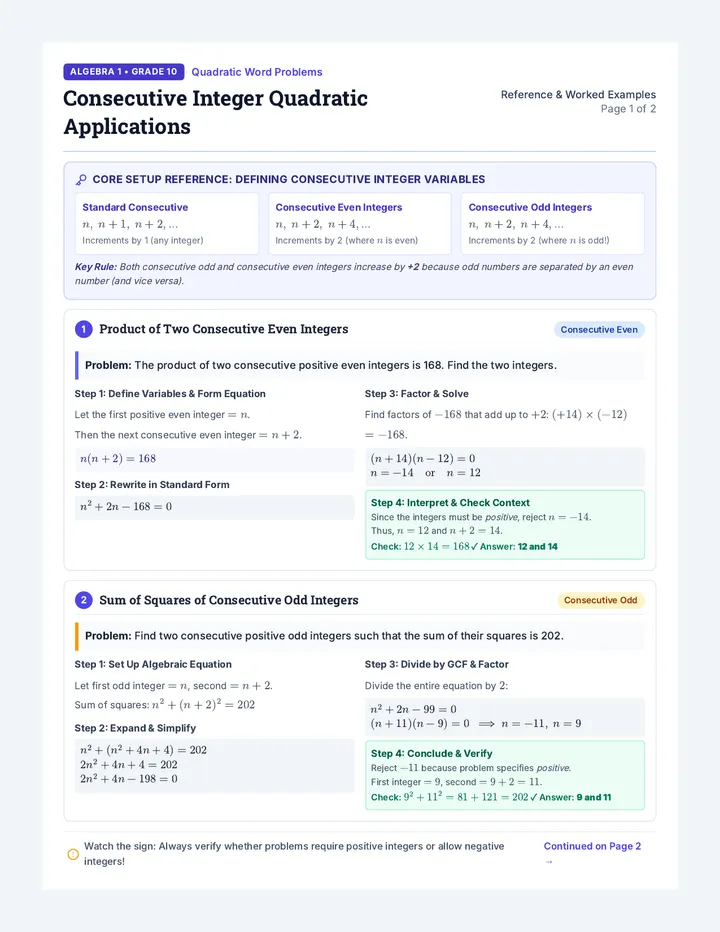
A focused 10th-grade algebra lesson on modeling real-world and algebraic relationships using quadratic equations with consecutive odd and even integers. Features structured reference materials and an in-depth teacher solutions key.

AR

Angie Rice

4
Consecutive Quadratics Teacher Guide

Consecutive Quadratics Teacher Guide

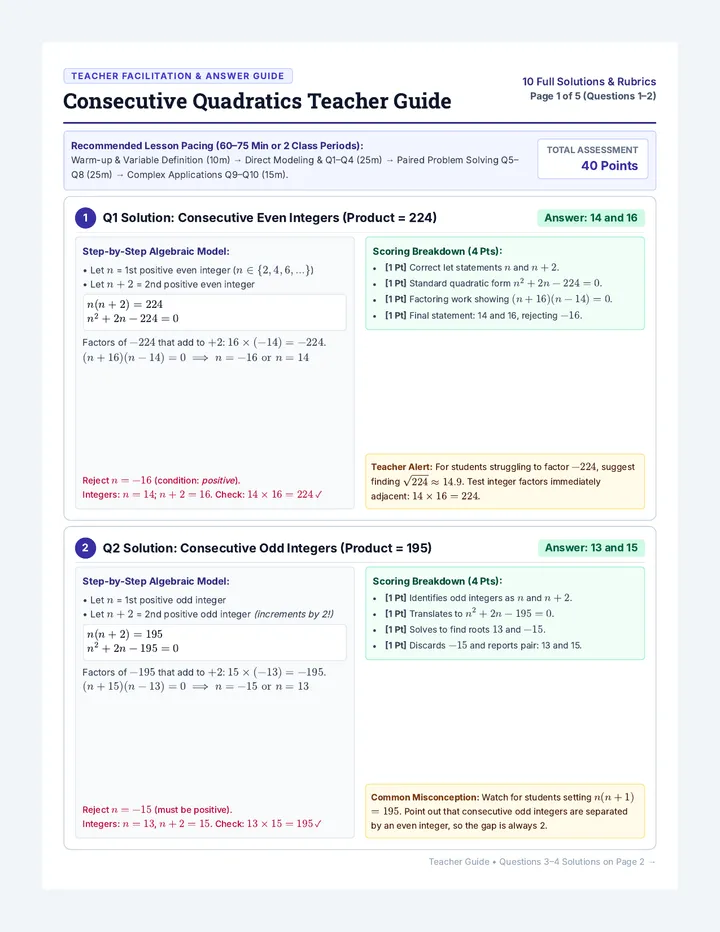
A five-page comprehensive teacher guide and solutions manual matching the ten-problem student worksheet. Provides detailed step-by-step algebraic solutions, 4-point grading rubrics for all 10 problems, pedagogical notes, error diagnostics, and differentiation strategies.

AR

Angie Rice

Linear Equations Practice Worksheet

Coordinate Geometry Mastery

A secondary mathematics curriculum sequence exploring linear functions and geometric transformations on the Cartesian coordinate plane, featuring print-ready guided practice and teacher keys.

FM

Fernando Mancini

4
Matrix Systems Review Worksheet

Matrix Mastery

A high school finite mathematics unit review introducing matrix anatomy, operations, matrix multiplication, linear systems solved by graphing and elimination, and augmented matrices with calculator-based RREF applications.

RB

Ronald Berg

2
Consecutive Quadratics Worksheet

Consecutive Quadratics Worksheet

A five-page student worksheet containing ten comprehensive quadratic application word problems involving consecutive odd and even integers. Features expanded, extra-large partitioned blank work areas for defining variables, setting up standard-form equations, factoring, and contextual checks.

AR

Angie Rice