Lenny.com
Explore
Create
ActivitiesNewMathEnglish Language ArtsScience & EngineeringSocial StudiesGlobal LanguagesHealth & Physical EducationSpecial EducationCounseling & Life SkillsArts & CreativityESL
Lenny.com
Lenny.com
Explore
Create
ActivitiesNewMathEnglish Language ArtsScience & EngineeringSocial StudiesGlobal LanguagesHealth & Physical EducationSpecial EducationCounseling & Life SkillsArts & CreativityESL
Lenny.com
Lenny.com

Solutions

Lenny for EducatorsLenny for SchoolsLenny for Districts

Product

ExploreSign inCreateSupportAbout

Resources

Getting startedMTSS Acceleration Program

© 2026 Lenny Learning Inc.

TermsPrivacyAccessibility
LinkedInInstagramX
Lenny

Number Names

Identification and spelling of number words from zero through millions. Connects numerical symbols to their written linguistic representations to strengthen mathematical literacy.

MathNumbers & CountingCounting ObjectsNumber NamesComparing NumbersNumber OperationsCounting SequenceNumbers 0-10Place Value Understanding and SystemAdd and Subtract Within 20Addition and Subtraction ConceptsAddition and Subtraction EquationsAddition and Subtraction ProblemsFoundations for MultiplicationMultiplication and Division PropertiesMultiply and Divide Within 100Multiplication and Division ProblemsFactors and MultiplesProperties of OperationsPatterns and RelationshipsGenerate and Analyze PatternsMulti-Digit ArithmeticPlace Value OperationsMulti-Digit and Decimal OperationsNumerical ExpressionsFour Operations and PatternsFour Operations Problem SolvingMeasurement & DataMeasurable AttributesMeasuring LengthsMeasure and Estimate Lengths in Standard UnitsRelate Addition and Subtraction to LengthClassifying and Counting ObjectsTime and MoneyArea Concepts and MeasurementPerimeter and Area MeasuresAngle Concepts and MeasurementTime, Volume, and MassMeasurement Unit ConversionsGeometryIdentifying ShapesShapes and AttributesShape Attributes and ReasoningShapes and CompositionClassifying 2D FiguresGeometric Figures and RelationshipsLines, Angles, and ShapesAngle, Area, and VolumeGeometric MeasurementVolume of 3D ShapesCoordinate Plane ApplicationsTransformations in the PlaneCongruence and SimilarityUnderstand congruence in terms of rigid motionsSimilarity and TransformationsProve Theorems Involving SimilarityPythagorean TheoremTrigonometry for General TrianglesMake Geometric ConstructionsProve Geometric TheoremsTheorems About CirclesFind Arc Lengths And Areas of Sectors of CirclesVolume FormulasRelationships Between Two-Dimensional and Three-Dimensional ObjectsProve Simple Geometric Theorems AlgebraicallyTranslate Between Geometric Description and Equation for Conic SectionApply Geometric Concepts in Modeling SituationsFractions & DecimalsFractions as NumbersBuilding FractionsFraction Equivalence and OrderingAdding and Subtracting FractionsMultiplying and Dividing FractionsDividing FractionsDecimal FractionsMulti-Digit Computation and FactorsAdd, Subtract, Multiply, and Divide Rational NumbersRational Number SystemIrrational Numbers and ApproximationsRatiosRatios and ProportionsProportional RelationshipsUnit RateAlgebraAlgebraic ExpressionsGenerate Equivalent ExpressionsQuantitative RelationshipsProportional Relationships and Linear EquationsEquations and InequalitiesEquation Solving and ReasoningLinear Equations and SystemsGraph Equations and InequalitiesSystems of EquationsReal-World Algebraic ProblemsQuantitative Reasoning with UnitsExpression StructureEquivalent Expression FormsRadicals and Integer ExponentsRational ExponentsRational and Irrational NumbersPolynomial OperationsPolynomial IdentitiesPolynomial Zeros and FactorsRational ExpressionsComplex Number OperationsComplex Numbers in PolynomialsComplex Numbers on PlaneStatistics & ProbabilityRepresent and Interpret DataData DistributionsStatistical VariabilityProbability ModelsCompound Event ProbabilitiesStatistical SamplingInterpret Categorical and Quantitative DataBivariate Data PatternsInterpret Linear ModelsComparing Two PopulationsRandom Processes in StatisticsIndependence and Conditional ProbabilityExpected ValuesProbability-Based Decision MakingStatistical Inference and ConclusionsFunctionsFunction Concepts and NotationDefine and Compare FunctionsInterpret Functions in ContextAnalyze Function RepresentationsModel Relationships with FunctionsIdentify Linear vs Exponential GrowthDistinguish Between Function TypesCompare Growth RatesInterpret Function ExpressionsBuild Functions from RelationshipsConstruct and Model FunctionsTransform and Combine FunctionsModel Comparison and SelectionSolve Exponential EquationsTrigonometryTrigonometric Ratios Involving Right TrianglesTrigonometric Functions and Unit CircleModel with Trigonometric FunctionsTrigonometric IdentitiesVectors & MatricesIntroduction to Vectors and MatricesVector QuantitiesVector OperationsMatrix OperationsCalculusLimits and ContinuityDerivative Concepts and NotationDerivative Rules and TechniquesApplications of DerivativesOptimization ProblemsRelated RatesCurve Sketching and AnalysisIntegration Concepts and NotationAntiderivatives and Indefinite IntegralsDefinite Integrals and AreaFundamental Theorem of CalculusIntegration TechniquesApplications of IntegrationDifferential EquationsSequences and SeriesParametric and Polar FunctionsVector-Valued Functions

Videos

Identifying the Coins of Singapore

Identifying the Coins of Singapore

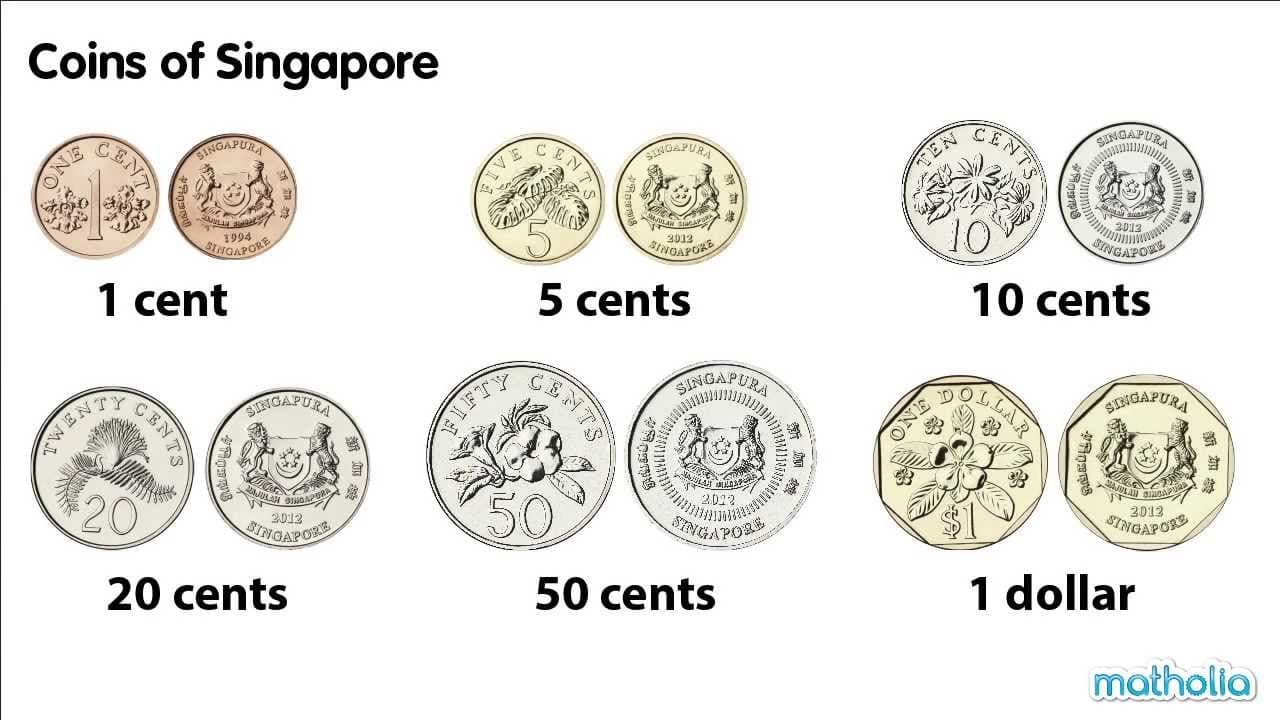
This educational video provides a clear and structured introduction to the currency of Singapore, specifically focusing on coin denominations. Through a simple visual presentation, the video introduces the one-cent, five-cent, ten-cent, twenty-cent, fifty-cent, and one-dollar coins. Each coin is displayed showing both the obverse (front) and reverse (back) sides, allowing students to see the distinct visual features, size differences, and colors associated with each value. The video utilizes a clean, distraction-free format where coins appear one by one against a white background. As each coin is introduced, the narrator clearly articulates its value, and the numerical value is written on screen in both word format (e.g., "1 cent") and symbol format (e.g., "1¢"). The video concludes with a summary screen displaying all the coins side-by-side in ascending order of value, providing a comparative view that reinforces the relative sizes and colors of the currency. For educators, this resource is an excellent tool for early numeracy and financial literacy lessons. It serves as a foundational text for teaching money recognition, sorting, and counting. The clear audio and slow pacing make it particularly suitable for young learners or students learning English as a second language. Teachers can use this video to introduce a unit on money, specifically for students in or learning about Singapore, to help them identify coins before moving on to practical activities like counting change or role-playing shopping scenarios.
MatholiaChannelMatholiaChannel

1min 58s

Counting to 1000 with Place Value Models

Counting to 1000 with Place Value Models

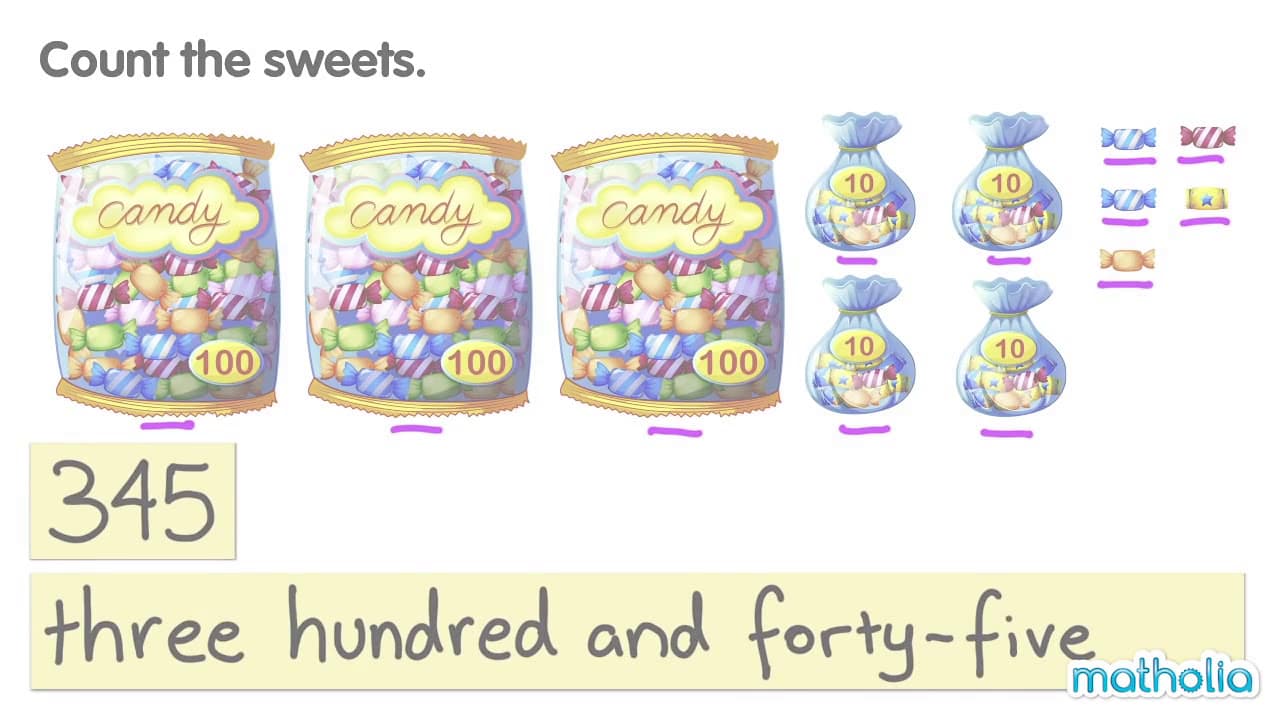
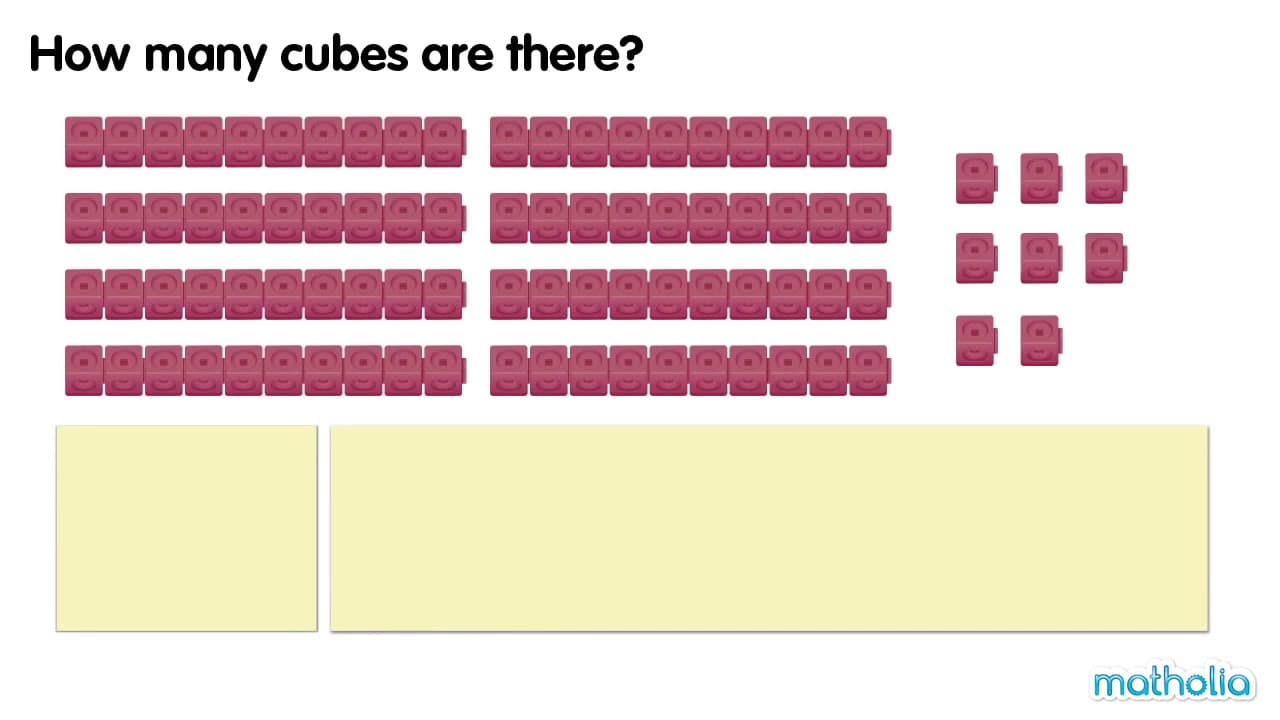
This educational video introduces students to counting numbers up to 1000 using visual place value models. It transitions from concrete objects (bags of candy) to standard mathematical manipulatives (Base-10 blocks), helping students visualize the magnitude of numbers in the hundreds. The narration guides viewers through a step-by-step counting process: first counting the hundreds, then adding the tens, and finally the ones, reinforcing the structure of our base-10 number system. The video covers key concepts including identifying hundreds, tens, and ones; understanding the value of digits based on their position; and dealing with zeros in the tens place (e.g., 604). It culminates in a demonstration of how ten hundreds combine to form one thousand, providing a clear visual representation of this milestone number. This resource is highly valuable for 2nd grade classrooms as it directly supports standards regarding three-digit numbers and place value. Teachers can use it to introduce the concept of larger numbers, model counting strategies, or as a visual aid to support students who struggle with abstract number concepts. The clear, paced counting allows for choral response and interactive participation during the lesson.

MatholiaChannelMatholiaChannel

5mins 16s

Rhythmic Counting to 10 With Neon Lights

Rhythmic Counting to 10 With Neon Lights

A high-energy, visually stimulating music video designed to teach early learners how to count from one to ten. The video features mesmerizing 3D animations of glowing neon tubes that ripple and wave in synchronization with an upbeat pop song. As the singer counts, the corresponding numerals (1-10) appear clearly on the screen, reinforcing number recognition alongside the auditory sequence. Key themes include number sequencing, digit recognition, and rhythmic patterns in math. The repetitive nature of the song structure—alternating between the chorus and the counting sequence—utilizes musical mnemonics to help children memorize the order of the first ten integers. The high-contrast visuals of bright neon against a black background are specifically designed to capture and hold the attention of young children. This video is an excellent classroom resource for transitions, warm-ups, or active breaks. Teachers can use it to practice choral counting, identifying numbers by sight, or associating distinct quantities with number names. Its catchy rhythm supports kinesthetic learning, allowing students to clap, stomp, or jump along with each number as it is sung.

Have Fun TeachingHave Fun Teaching

2mins 33s

Counting Objects to 100 by Grouping Tens and Ones

Counting Objects to 100 by Grouping Tens and Ones

This educational video provides a clear, step-by-step demonstration of how to count larger quantities of objects by grouping them into tens and ones. Using a repetitive and predictable structure, the video guides viewers through counting various items—such as eggs, cubes, pencils, and flowers—up to 100. For each example, the narrator counts groups of ten first (skip-counting), adds the remaining individual units, and then presents the final total in both numeral and written word forms. The content focuses on key early mathematics concepts including place value, skip-counting by tens, and the relationship between spoken numbers, numerals, and their written forms. It visually reinforces the base-ten number system by physically arranging objects into clear groups of ten, making abstract numerical concepts concrete for young learners. The video systematically increases the difficulty, moving from the 50s up to 100. For educators, this resource serves as an excellent tool for introducing or reinforcing place value and counting strategies in early elementary classrooms. It helps students transition from counting by ones (which is inefficient for large numbers) to the more efficient strategy of counting groups. The visual clarity makes it particularly useful for visual learners and can be easily replicated with physical manipulatives in the classroom for hands-on practice.

MatholiaChannelMatholiaChannel

3mins 31s

Spelling Numbers 1 to 10 with a Silly Salamander

Spelling Numbers 1 to 10 with a Silly Salamander

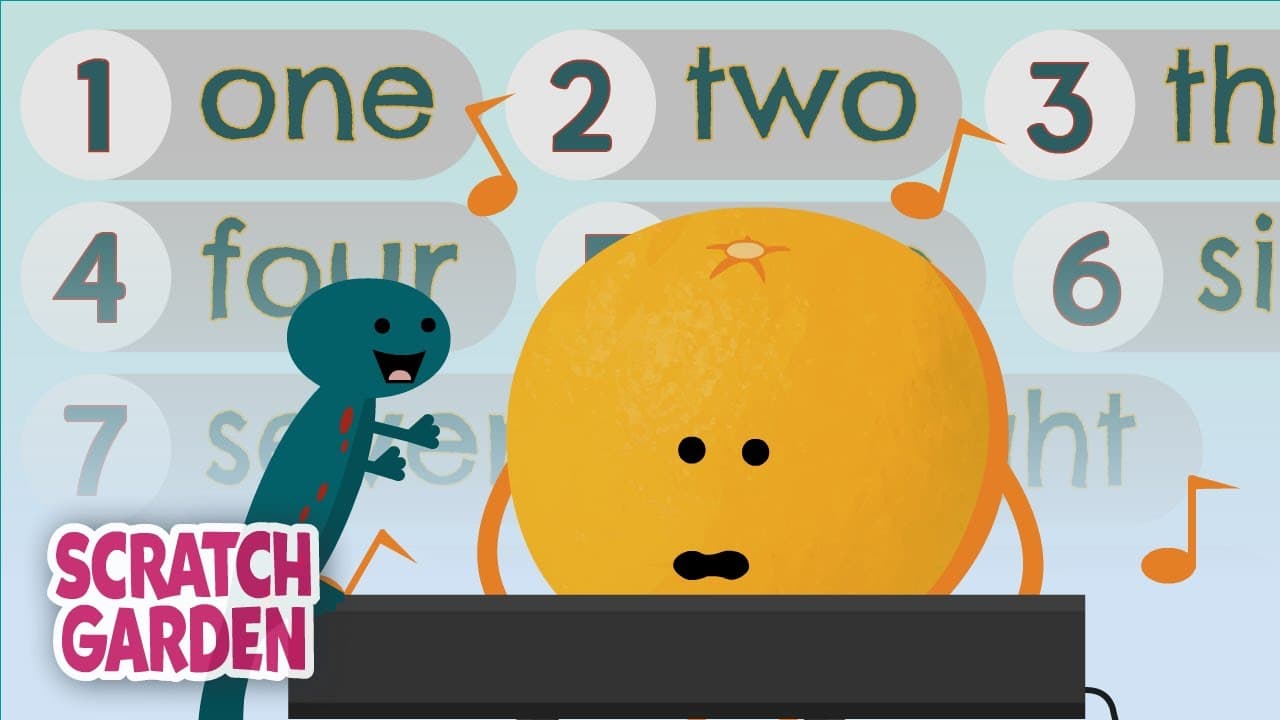
This animated music video combines early math and literacy skills by teaching viewers how to spell numbers from one to ten. Featuring a guitar-playing Apple and a keyboard-playing Orange, the characters use a call-and-response format where the Apple asks how to spell a number and the Orange sings the spelling. Visual cues clearly display the numeral, the letters as they are sung, and the final word.

Scratch GardenScratch Garden

3mins 8s

Skip Counting by Hundreds in Outer Space

Skip Counting by Hundreds in Outer Space

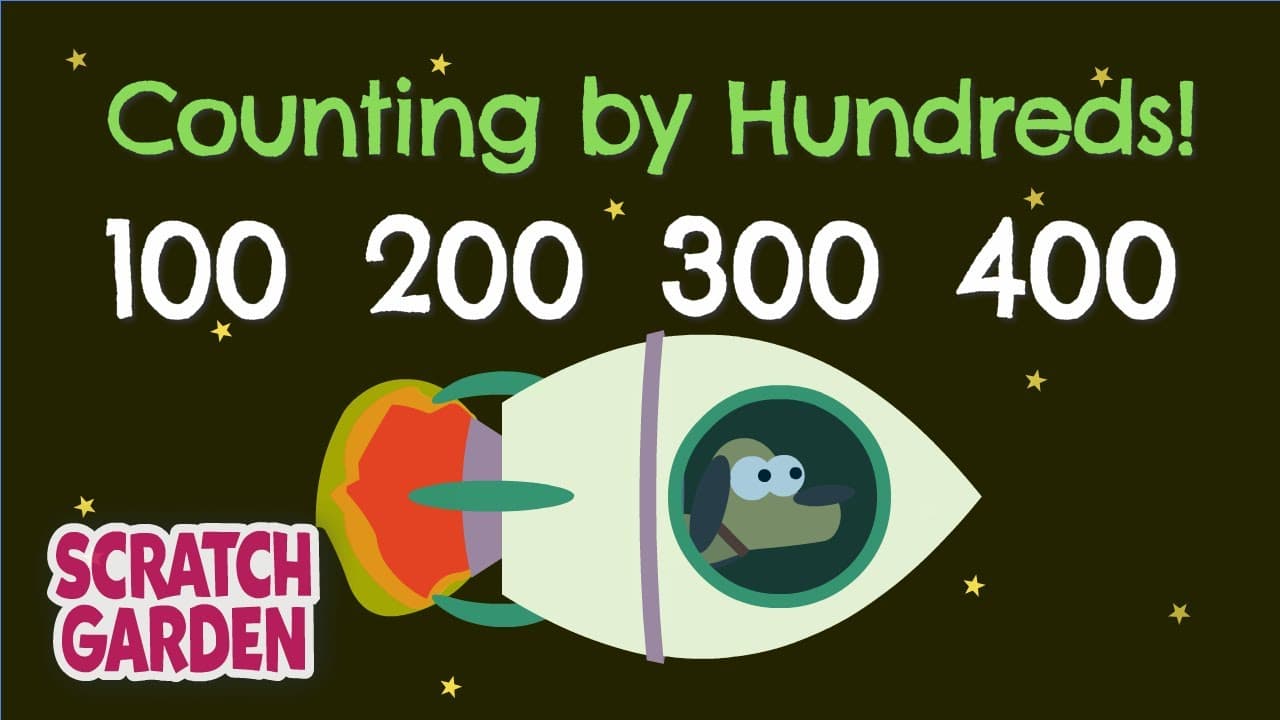
This engaging animated music video teaches students how to skip count by hundreds up to 2,000. Set in an 8-bit retro space environment, a rocket ship travels through the cosmos while a catchy song guides learners through the counting sequence. The video breaks down the pattern of counting by explaining that adding two zeros to single digits creates hundreds, providing a helpful mental math strategy for young learners. The content covers three distinct counting sequences: first from 100 to 1,000, then extending to 2,000 using standard place value terminology (e.g., "one thousand one hundred"), and finally revisiting the sequence to introduce alternative naming conventions (e.g., "eleven hundred"). Between counting segments, a humorous character floats through space kicking asteroids, providing an entertaining break that maintains student engagement. Ideally suited for 2nd and 3rd grade math classrooms, this video supports number sense and place value standards. It is an excellent tool for introducing skip counting, reinforcing the structure of large numbers, and clarifying the confusing dual-naming systems often used for four-digit numbers. The rhythmic nature of the song aids in memorization, making it perfect for whole-class participation or active learning breaks.

Scratch GardenScratch Garden

3mins

Materials

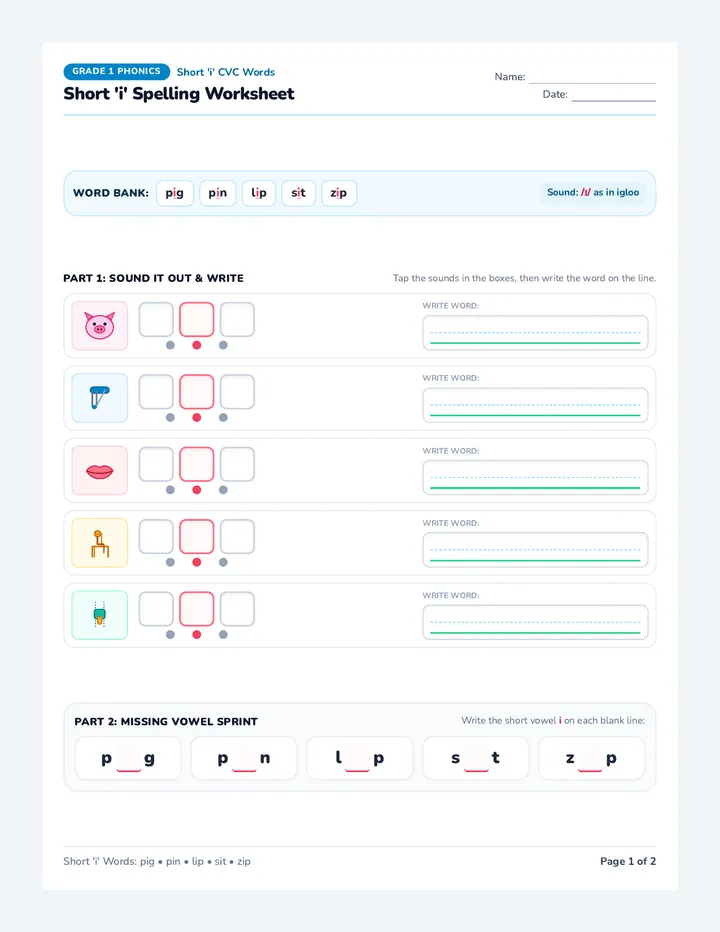
Short I Spelling Worksheet

Short I Spelling Worksheet

A two-page Grade 1 phonics and spelling worksheet focusing on 5 short I CVC words: pig, pin, lip, sit, and zip. Includes sound boxes, handwriting lines, word family sorting, cloze sentences, and a sentence writing challenge.

EA

Edith Asante

Empty Number Box Worksheet

Empty Number Box Worksheet

A clean 1-page print-ready number writing worksheet consisting entirely of large, empty handwriting boxes for student number practice.

EA

Edith Asante

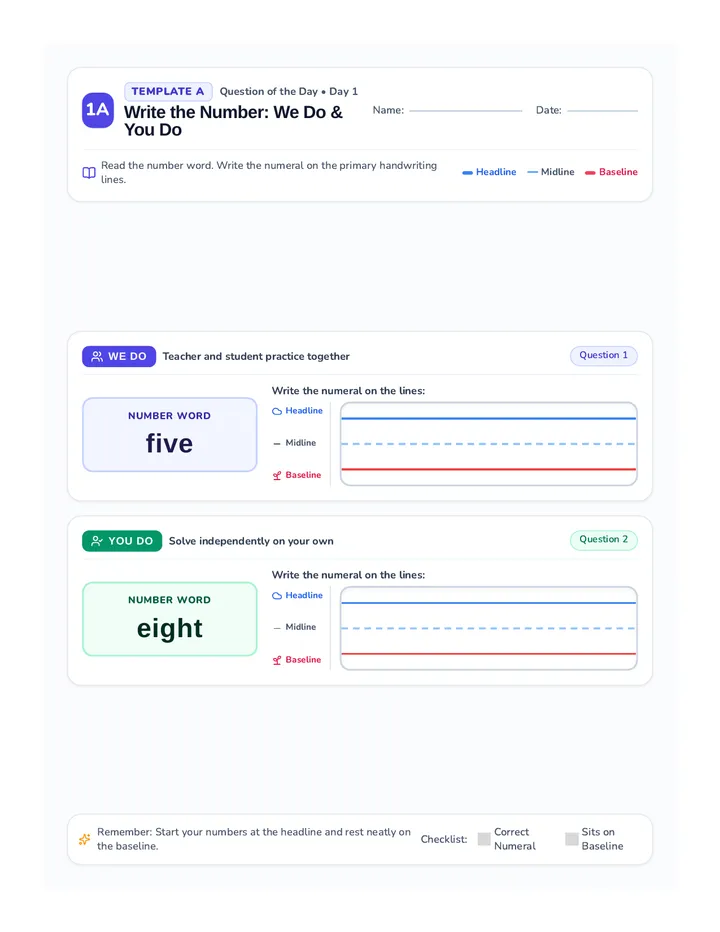
Number Writing Warmup Templates

Number Writing Warmup Templates

A 5-page Question of the Day math warmup collection with enlarged primary handwriting lines. Includes two Day 1 templates (guided 'We Do' and independent 'You Do'), Page 3 with a single writing line for 'six', Page 4 dedicated to the number 3 ('three') featuring exclusively the word form and handwriting lines, and Page 5 featuring the single-line format for 'ten'.

V

victoria.lesniak

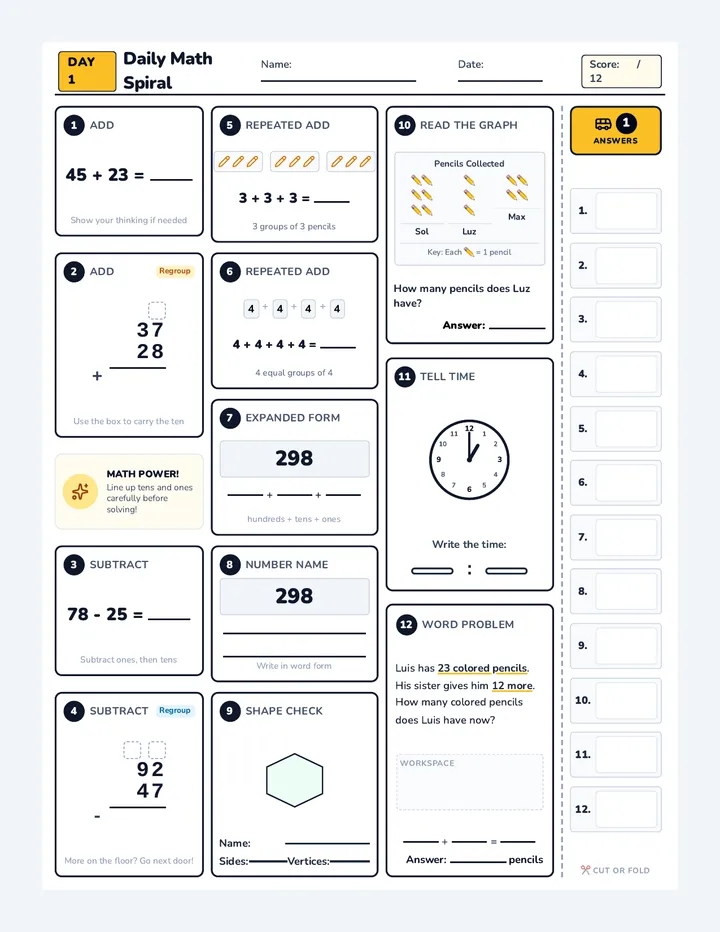
Weekly Math Spiral Packet

Weekly Math Spiral Packet

A 5-day printable weekly math spiral review packet (Monday to Friday) covering 2-digit addition and subtraction with regrouping, repeated addition, 3-digit expanded form, number names, 2D/3D geometry, graphs, analog time, and word problems, complete with a quick-grader answer strip.

DL

Damaris Lopez Valentin

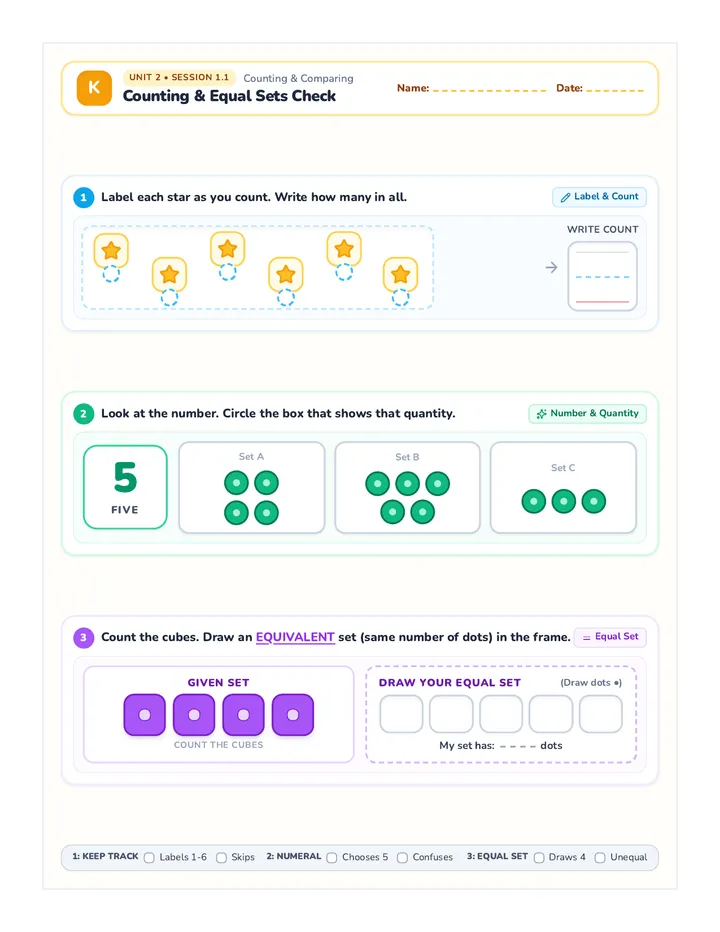
Counting Strategies Exit Ticket

Counting Strategies Exit Ticket

A Kindergarten exit ticket aligned to Investigations Unit 2 Session 1.1 assessing labeling strategies for keeping track of quantities, connecting numerals to quantities, and creating equivalent sets.

SB

Sondra Bell

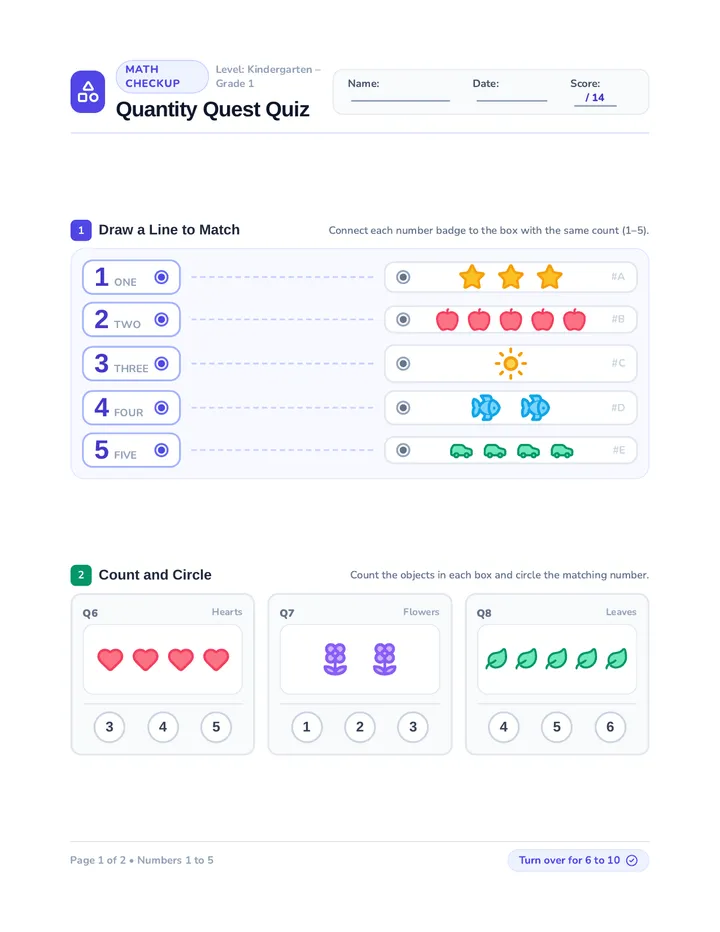
Quantity Quest Quiz

Quantity Quest Quiz

A two-page printable cut-and-paste math quiz assessing number-to-quantity matching for numbers 1 to 10. Page 1 serves as the student quiz board with designated pasting stations, and Page 2 provides large scrambled cut-out picture cards with scissor guides.

L

lueshen

Sequences

Number Gym Slides

Number Gym Circuit

A four-week intensive math intervention sequence for Tier 3 students. Each day features a 3-part drill targeting number identification, formation, and sequential counting. Weeks 1-2 focus on numbers 0-30; Weeks 3-4 expand to numbers 0-40.

NT

Nicole Thomson

22
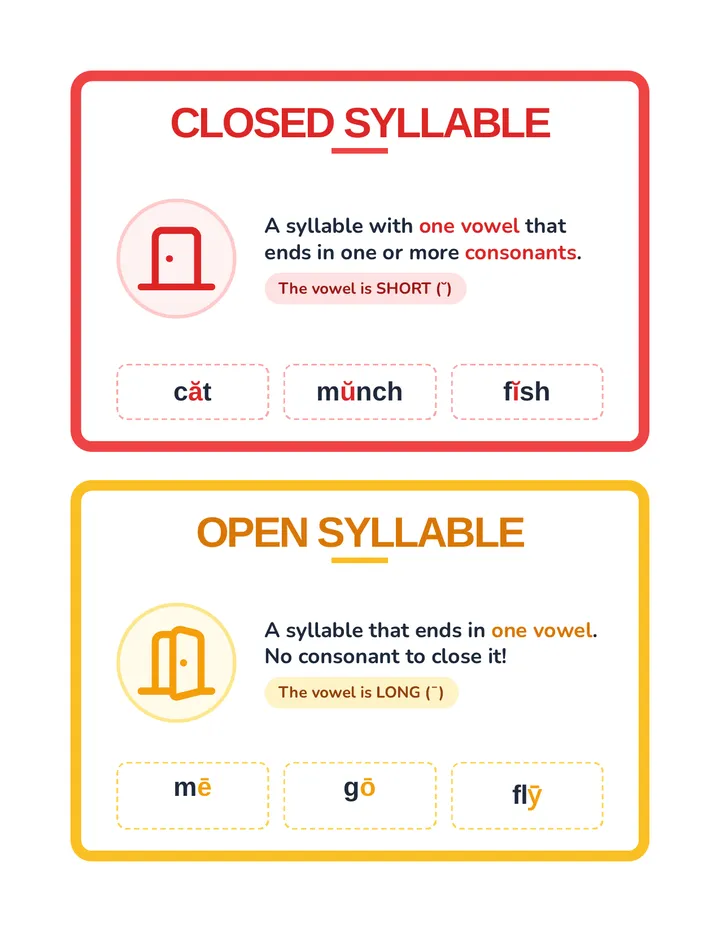
Syllable Type Anchor Charts

Foundational Skills Unit

A foundational skills unit covering literacy progress tracking and early numeracy strategies for decomposition and missing addends.

NT

Nicole Thomson

31
Downhill Differences Slides

Podium Power Subtraction Strategy Unit

A 20-lesson subtraction fluency unit for primary students, explicitly organized by mental math strategies: Counting Up, Number Lines, Making 10, Pretend 10, and Close to Doubles, all with Winter Olympic themes.

T

tmatthews

63
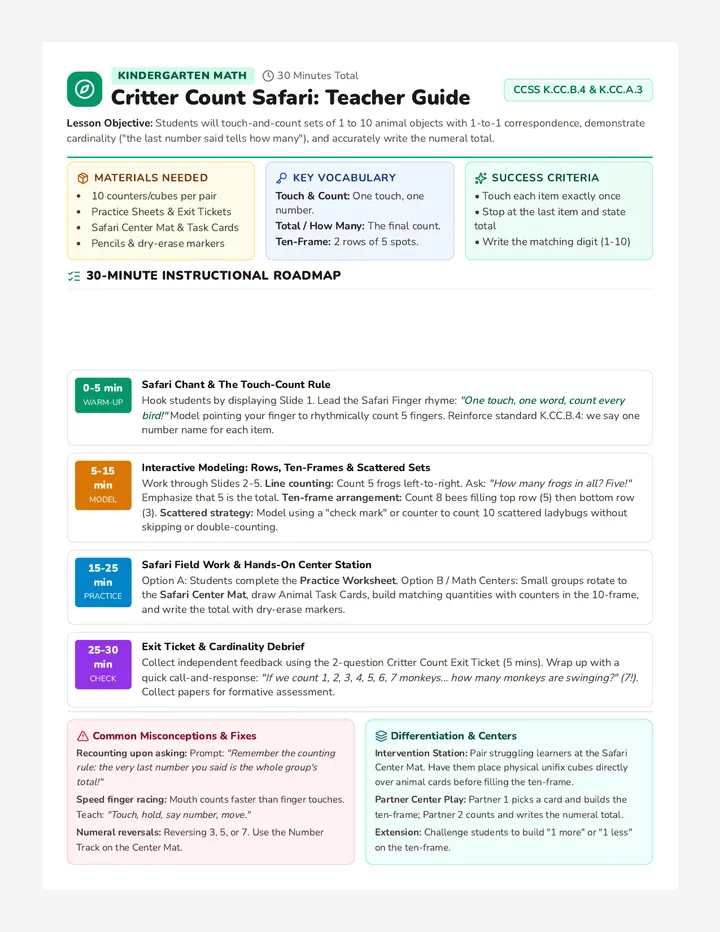
Critter Count Teacher Guide

Safari Math Explorers

A hands-on Kindergarten mathematics sequence covering one-to-one counting, cardinality, numeral handwriting 1 to 10, and representing quantities with concrete circle sets and ten-frames.

V

victoria.lesniak

21
Teacher Investigation Guide

Digit Detectives

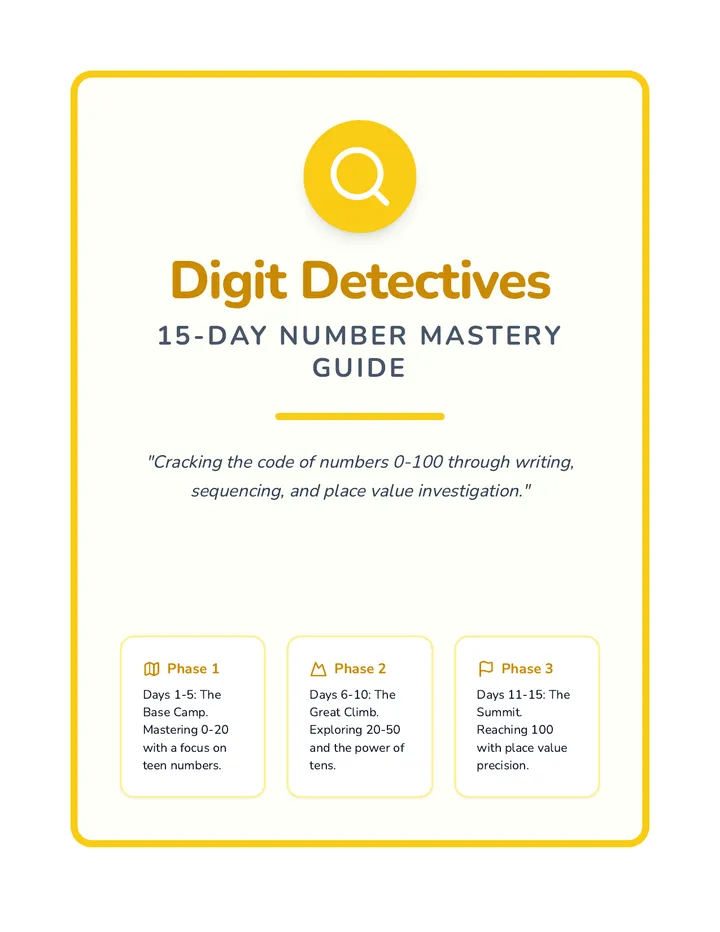
A comprehensive 15-day math sequence designed for early elementary students to master numbers 0-100. The curriculum covers writing, sequencing, and place value through three progressive phases: 0-20, 20-50, and 50-100.

W

wohlfordc

11
Numbers in Action Lesson Plan

Numbers in Action

A 12-session math intervention unit for Tier 3 students, focusing on place value up to the hundreds, addition and subtraction within 20, and single and two-step word problems.

K

kurtzm

19

Lessons

Math Radar Intake Slides

Math Skill Radar

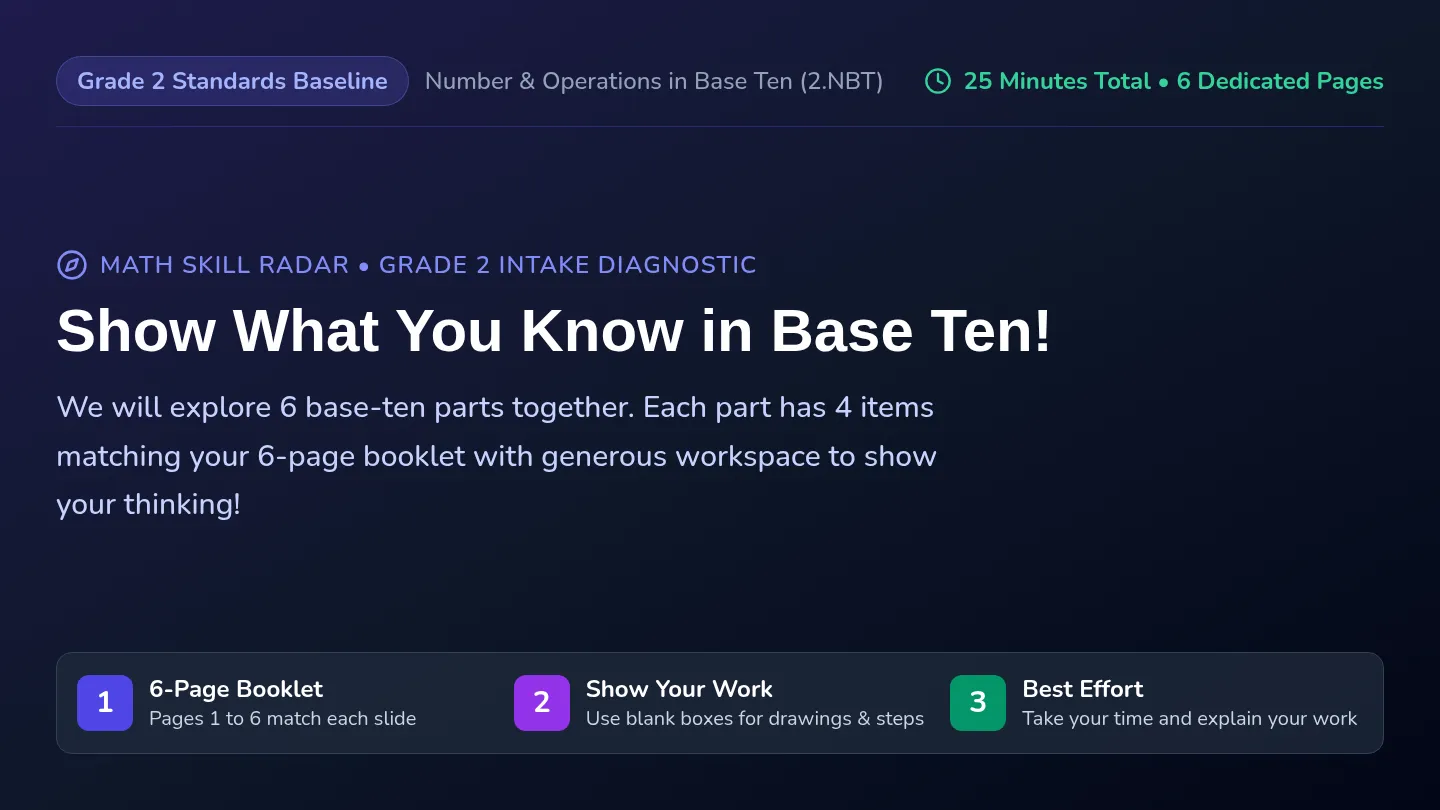
A comprehensive baseline math diagnostic and intervention suite for special education spanning early numeracy through Grade 4. Features complete tiered intake assessments, practice packets, manipulative work mats, and master scoring keys for both 1st Grade Base Ten (1.NBT) and 2nd Grade Base Ten (2.NBT), alongside K-1 early number sense tools.

S

Sara

20
Assessment 1 Worksheet

Number Base Camp

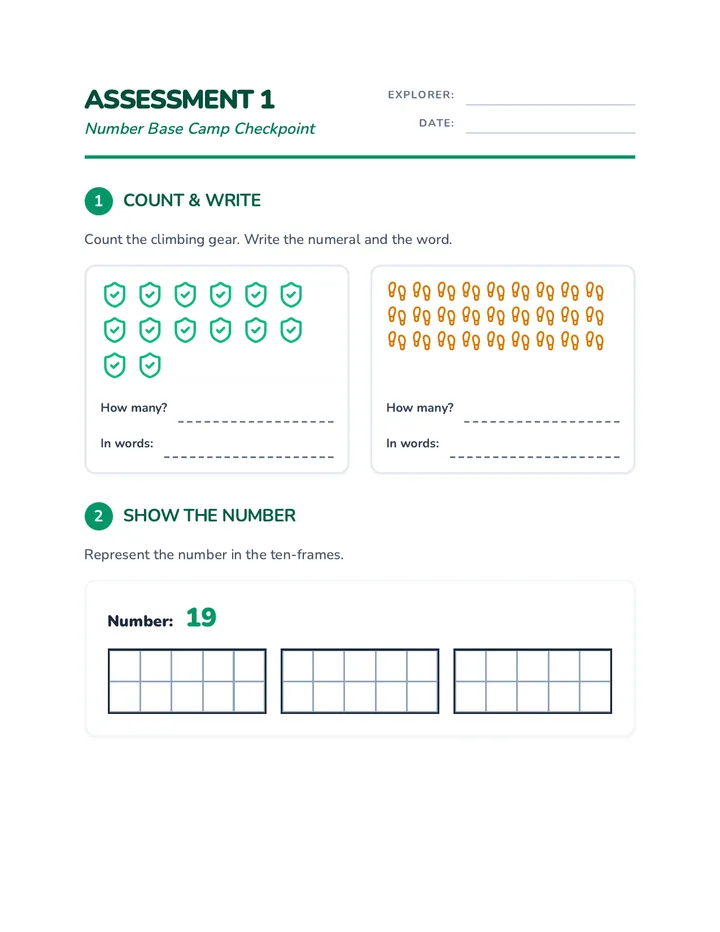
A comprehensive lesson focused on mastering numbers up to 30, covering counting, recognizing, representing, naming, and ordering quantities through hands-on practice and assessment.

CN

Coleman Newell

16
Blast Off Slides

Teen Trek

A foundational math lesson focused on identifying and sequencing numbers in the 'teens' (11-19) using a space exploration theme. Students will practice starting from a given teen number and counting forward to build numerical fluency.

V

victoria.lesniak

5
Numeral Formation Reference Sheet

Numeral Builders

A Grade 1 foundational toolkit for mastering numeral formation from 1 to 20 aligned with Eureka Math. Features minimal-ink printable reference sheets, student tracing booklets, model flashcards with filled 5-group ten-frames, and companion hands-on flashcards with blank ten-frames for student practice.

R

rnshaheen

4
Number Rangers Test Booklet

Number Rangers

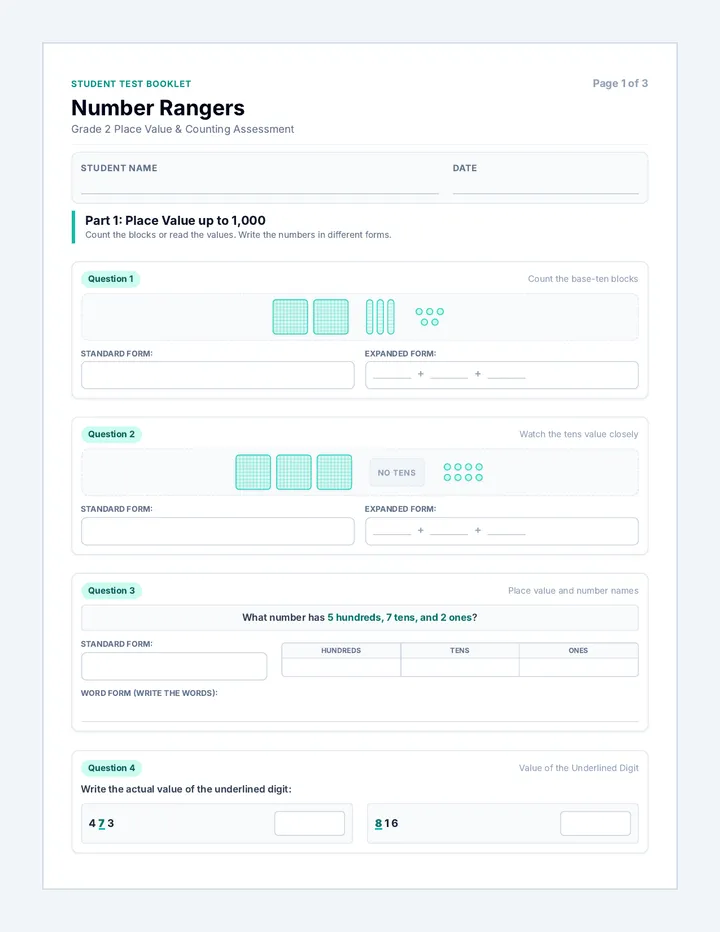
A comprehensive assessment package evaluating fundamental place value up to 1,000, skip counting by 5s, 10s, and 100s, and mental addition/subtraction of 10 and 100. Includes a highly scaffolded student test booklet, progress monitoring sheets, and a teacher scoring guide.

L

lwalker

4
Clock Workshop Activity

Time Tellers

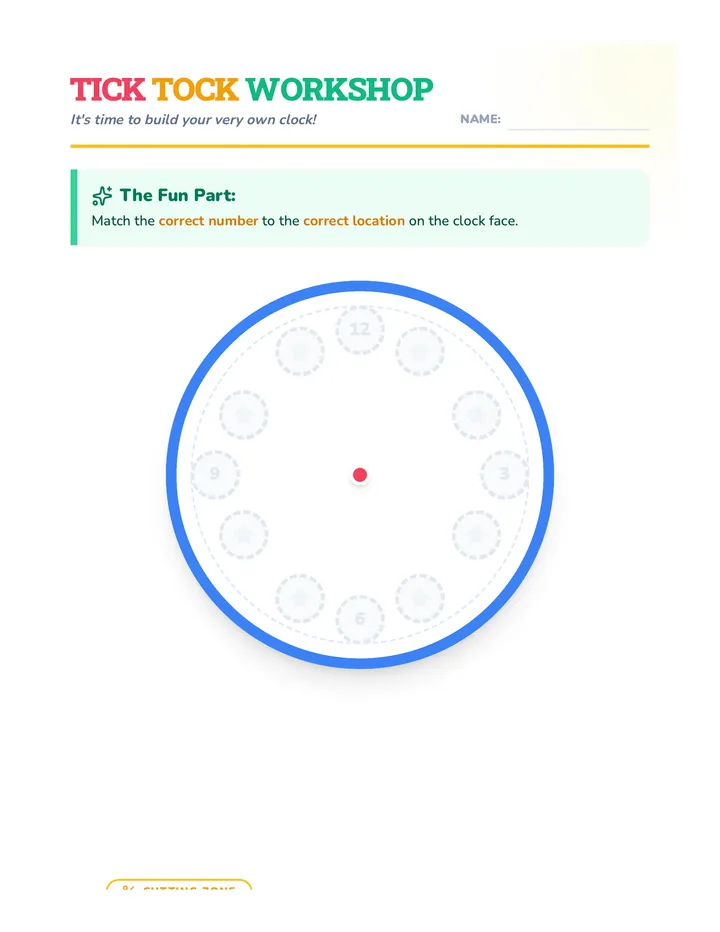
A hands-on introductory lesson where students build their own analog clock by cutting and pasting hour numbers. Students practice number sequencing and spatial awareness on a circular clock face.

TL

Tanya Larson

5