Lenny.com
Explore
Create
ActivitiesNewMathEnglish Language ArtsScience & EngineeringSocial StudiesGlobal LanguagesHealth & Physical EducationSpecial EducationCounseling & Life SkillsArts & CreativityESL
Lenny.com
Lenny.com
Explore
Create
ActivitiesNewMathEnglish Language ArtsScience & EngineeringSocial StudiesGlobal LanguagesHealth & Physical EducationSpecial EducationCounseling & Life SkillsArts & CreativityESL
Lenny.com
Lenny.com

Solutions

Lenny for EducatorsLenny for SchoolsLenny for Districts

Product

ExploreSign inCreateSupportAbout

Resources

Getting startedMTSS Acceleration Program

© 2026 Lenny Learning Inc.

TermsPrivacyAccessibility
LinkedInInstagramX
Lenny

Theorems About Circles

Relationships between chords, secants, tangents, and inscribed angles. Establishes proofs for arc measures, segment lengths, and angle properties within circular geometry.

MathNumbers & CountingCounting ObjectsNumber NamesComparing NumbersNumber OperationsCounting SequenceNumbers 0-10Place Value Understanding and SystemAdd and Subtract Within 20Addition and Subtraction ConceptsAddition and Subtraction EquationsAddition and Subtraction ProblemsFoundations for MultiplicationMultiplication and Division PropertiesMultiply and Divide Within 100Multiplication and Division ProblemsFactors and MultiplesProperties of OperationsPatterns and RelationshipsGenerate and Analyze PatternsMulti-Digit ArithmeticPlace Value OperationsMulti-Digit and Decimal OperationsNumerical ExpressionsFour Operations and PatternsFour Operations Problem SolvingMeasurement & DataMeasurable AttributesMeasuring LengthsMeasure and Estimate Lengths in Standard UnitsRelate Addition and Subtraction to LengthClassifying and Counting ObjectsTime and MoneyArea Concepts and MeasurementPerimeter and Area MeasuresAngle Concepts and MeasurementTime, Volume, and MassMeasurement Unit ConversionsGeometryIdentifying ShapesShapes and AttributesShape Attributes and ReasoningShapes and CompositionClassifying 2D FiguresGeometric Figures and RelationshipsLines, Angles, and ShapesAngle, Area, and VolumeGeometric MeasurementVolume of 3D ShapesCoordinate Plane ApplicationsTransformations in the PlaneCongruence and SimilarityUnderstand congruence in terms of rigid motionsSimilarity and TransformationsProve Theorems Involving SimilarityPythagorean TheoremTrigonometry for General TrianglesMake Geometric ConstructionsProve Geometric TheoremsTheorems About CirclesFind Arc Lengths And Areas of Sectors of CirclesVolume FormulasRelationships Between Two-Dimensional and Three-Dimensional ObjectsProve Simple Geometric Theorems AlgebraicallyTranslate Between Geometric Description and Equation for Conic SectionApply Geometric Concepts in Modeling SituationsFractions & DecimalsFractions as NumbersBuilding FractionsFraction Equivalence and OrderingAdding and Subtracting FractionsMultiplying and Dividing FractionsDividing FractionsDecimal FractionsMulti-Digit Computation and FactorsAdd, Subtract, Multiply, and Divide Rational NumbersRational Number SystemIrrational Numbers and ApproximationsRatiosRatios and ProportionsProportional RelationshipsUnit RateAlgebraAlgebraic ExpressionsGenerate Equivalent ExpressionsQuantitative RelationshipsProportional Relationships and Linear EquationsEquations and InequalitiesEquation Solving and ReasoningLinear Equations and SystemsGraph Equations and InequalitiesSystems of EquationsReal-World Algebraic ProblemsQuantitative Reasoning with UnitsExpression StructureEquivalent Expression FormsRadicals and Integer ExponentsRational ExponentsRational and Irrational NumbersPolynomial OperationsPolynomial IdentitiesPolynomial Zeros and FactorsRational ExpressionsComplex Number OperationsComplex Numbers in PolynomialsComplex Numbers on PlaneStatistics & ProbabilityRepresent and Interpret DataData DistributionsStatistical VariabilityProbability ModelsCompound Event ProbabilitiesStatistical SamplingInterpret Categorical and Quantitative DataBivariate Data PatternsInterpret Linear ModelsComparing Two PopulationsRandom Processes in StatisticsIndependence and Conditional ProbabilityExpected ValuesProbability-Based Decision MakingStatistical Inference and ConclusionsFunctionsFunction Concepts and NotationDefine and Compare FunctionsInterpret Functions in ContextAnalyze Function RepresentationsModel Relationships with FunctionsIdentify Linear vs Exponential GrowthDistinguish Between Function TypesCompare Growth RatesInterpret Function ExpressionsBuild Functions from RelationshipsConstruct and Model FunctionsTransform and Combine FunctionsModel Comparison and SelectionSolve Exponential EquationsTrigonometryTrigonometric Ratios Involving Right TrianglesTrigonometric Functions and Unit CircleModel with Trigonometric FunctionsTrigonometric IdentitiesVectors & MatricesIntroduction to Vectors and MatricesVector QuantitiesVector OperationsMatrix OperationsCalculusLimits and ContinuityDerivative Concepts and NotationDerivative Rules and TechniquesApplications of DerivativesOptimization ProblemsRelated RatesCurve Sketching and AnalysisIntegration Concepts and NotationAntiderivatives and Indefinite IntegralsDefinite Integrals and AreaFundamental Theorem of CalculusIntegration TechniquesApplications of IntegrationDifferential EquationsSequences and SeriesParametric and Polar FunctionsVector-Valued Functions

Videos

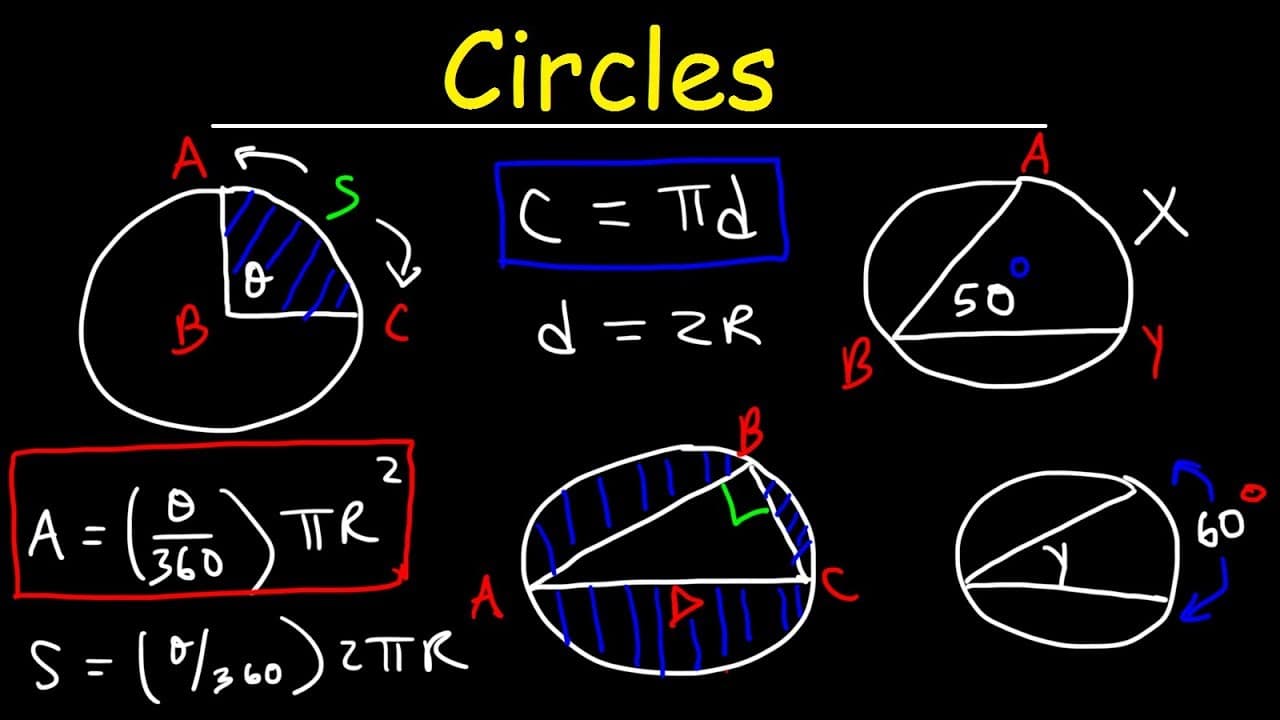
Understanding Circles: Area, Circumference, Arcs, and Angles

Understanding Circles: Area, Circumference, Arcs, and Angles

This comprehensive math tutorial provides an in-depth exploration of circle geometry, moving from basic definitions to complex problem-solving. The video begins by defining fundamental components such as the radius, diameter, circumference, and area, clearly establishing the relationship between these elements. It progresses to more advanced concepts including sectors, arc lengths, chords, and the theorems governing central and inscribed angles. The narration uses a blackboard style to visually demonstrate how formulas are derived and applied. Key themes include the distinction between central and inscribed angles, calculating the area of sectors and segments, and using the Pythagorean theorem within circle contexts. The video explicitly covers the Inscribed Angle Theorem—demonstrating that an inscribed angle is half the measure of its intercepted arc—and explores how to calculate arc lengths and sector areas using degrees. It concludes with multi-step word problems that require synthesizing multiple concepts, such as finding the area of a shaded region by subtracting a triangle's area from a circle's area. For educators, this video serves as an excellent instructional tool for high school geometry units. It can be used to introduce new vocabulary, demonstrate the application of formulas, or review for standardized tests. The step-by-step problem-solving sections allow teachers to pause and let students attempt calculations before seeing the solution, making it ideal for interactive classroom learning or independent study for students needing remediation on geometric concepts.

The Organic Chemistry TutorThe Organic Chemistry Tutor

18mins 7s

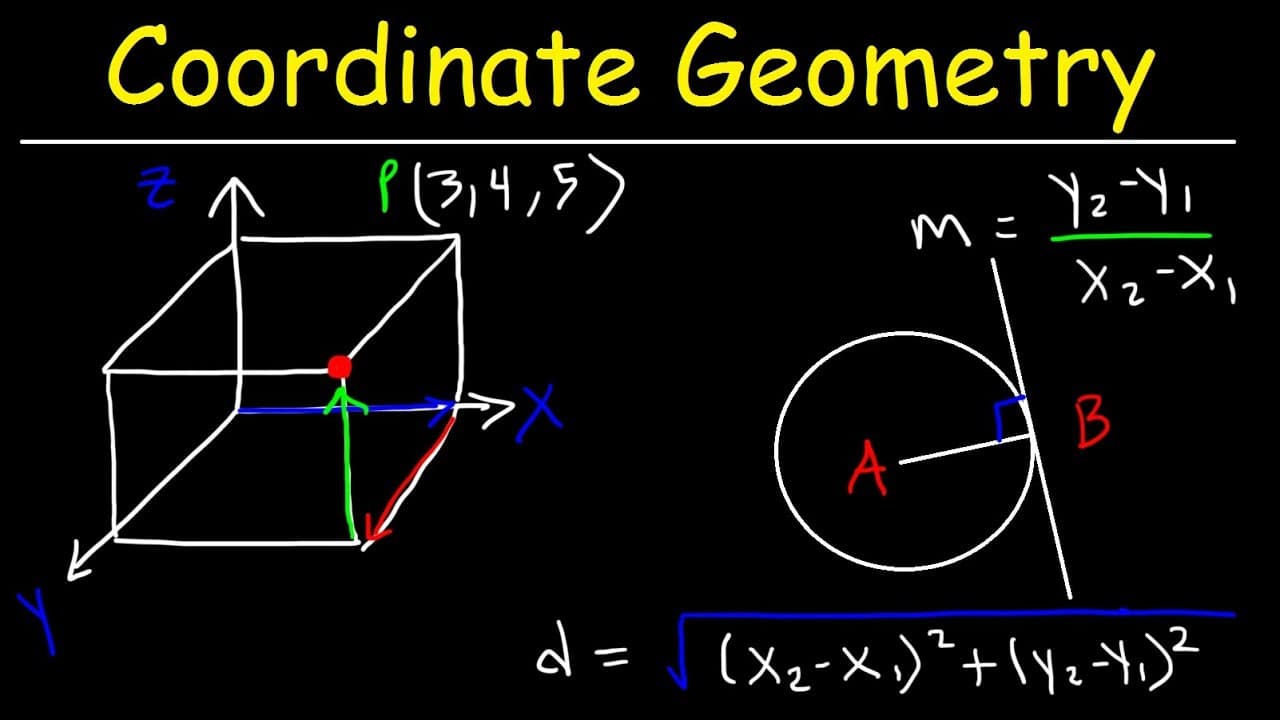
Mastering Coordinate Geometry: 9 Key Problem Types Solved

Mastering Coordinate Geometry: 9 Key Problem Types Solved

This comprehensive tutorial video guides students through nine distinct coordinate geometry problems, covering a wide range of high school math concepts. The video progresses from basic coordinate identification to more advanced topics like 3D coordinates and equations of lines within triangles. Each problem is presented clearly with a black background and colored diagrams, followed by a step-by-step walkthrough of the solution using algebraic and geometric principles. The video explores key themes including the distance and midpoint formulas, equations of circles and tangent lines, calculating areas of polygons defined by linear equations, and working with 3D coordinate systems. It also delves into advanced triangle properties, specifically teaching how to find the equations for medians, perpendicular bisectors, and altitudes. Specific formulas like the point-to-line distance formula and the area of an equilateral triangle are introduced and applied. For educators, this video serves as an excellent resource for scaffolding instruction or reviewing for a unit test. The segmented nature of the video allows teachers to assign specific problems that align with their current lesson—for example, using the circle segment when teaching conics, or the triangle segment when discussing centroids and orthocenters. The visual demonstrations help demystify abstract formulas by connecting them directly to graphical representations.

The Organic Chemistry TutorThe Organic Chemistry Tutor

33mins 2s

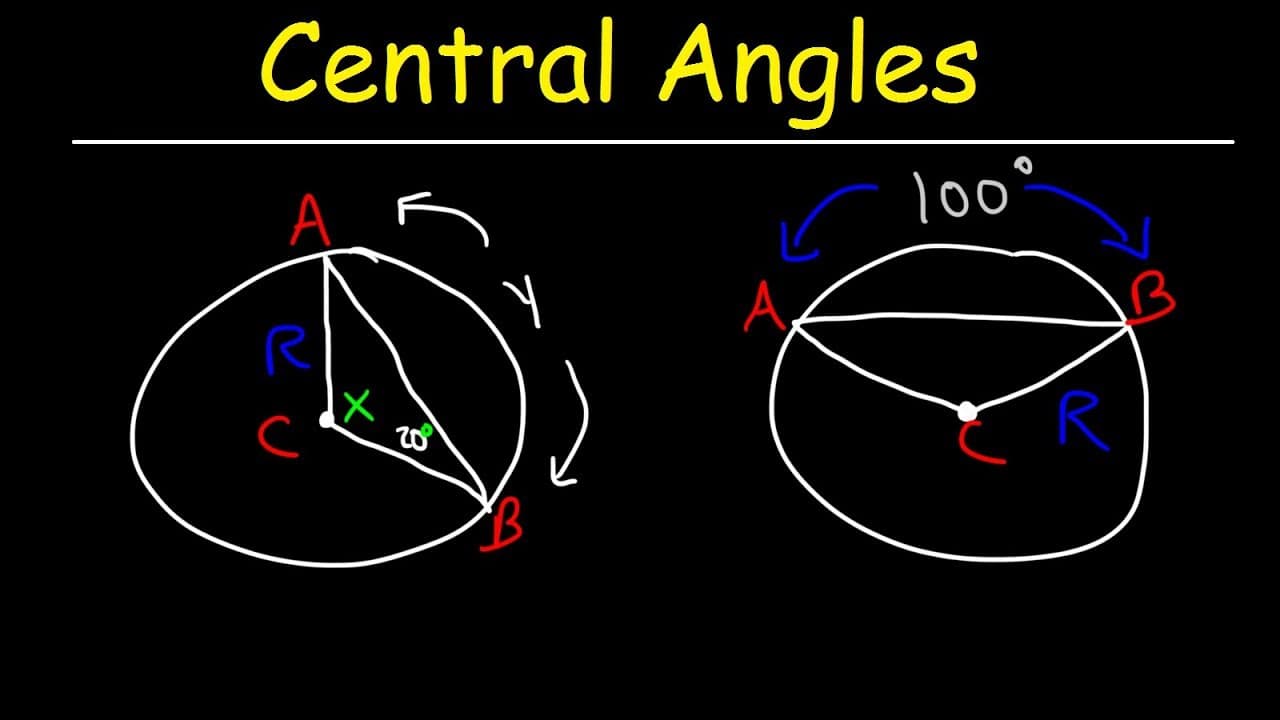
Mastering Central Angles, Arcs, and Chords in Circles

Mastering Central Angles, Arcs, and Chords in Circles

This comprehensive geometry tutorial breaks down the fundamental properties of circles, focusing on the relationships between central angles, arcs, and chords. The video begins by defining basic terminology, distinguishing between minor and major arcs, and explaining how to calculate arc measures based on central angles. It uses clear, high-contrast visual diagrams on a digital blackboard to illustrate how radii form isosceles triangles when connected by chords, a critical concept for solving circle geometry problems. The content progresses from basic definitions to complex problem-solving scenarios. Viewers learn how to identify semicircles, calculate major arc measures by subtracting minor arcs from 360 degrees, and use the properties of triangles to find missing angle measures. The final section introduces advanced applications involving special right triangles (30-60-90) to calculate chord lengths and the distance from the center to a chord, integrating trigonometry concepts with circle geometry. For educators, this video serves as an excellent instructional tool for High School Geometry units. It provides a scaffolded approach to teaching circle theorems, moving from vocabulary acquisition to multi-step application problems. The clear step-by-step narration allows teachers to pause for student practice, making it ideal for flipped classrooms, review sessions, or direct instruction on solving for missing lengths and angles within circles.

The Organic Chemistry TutorThe Organic Chemistry Tutor

13mins 45s

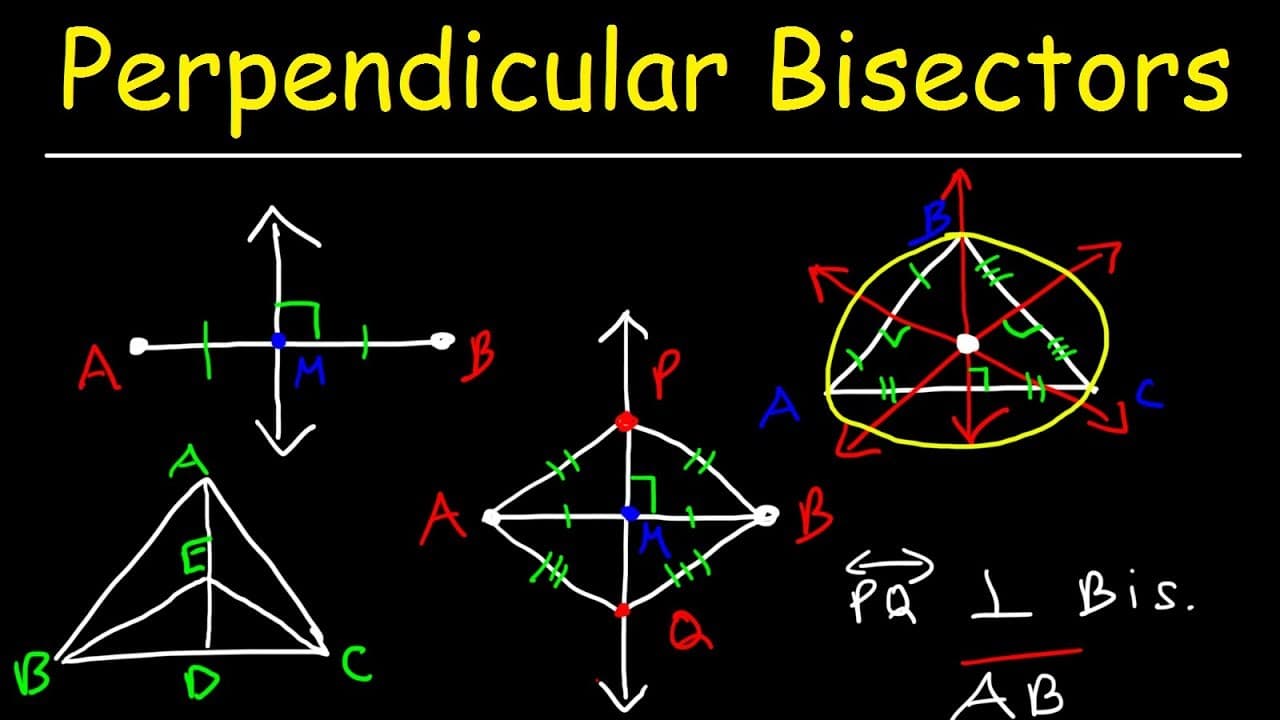
Understanding Perpendicular Bisectors and Circumcenters

Understanding Perpendicular Bisectors and Circumcenters

This video provides a comprehensive tutorial on perpendicular bisectors in geometry, moving from basic definitions to advanced proofs. It begins by defining a perpendicular bisector and illustrating the Perpendicular Bisector Theorem, which states that any point on the bisector is equidistant from the segment's endpoints. The video visually demonstrates this concept with clear diagrams and algebraic notation. The content progresses to explore the concept of a circumcenter—the point of concurrency where the perpendicular bisectors of a triangle meet. Through detailed construction examples, the video shows how the location of the circumcenter changes depending on whether the triangle is acute (inside), right (on the hypotenuse), or obtuse (outside). This section effectively visualizes how the circumcenter serves as the center for a circle that circumscribes the triangle. Finally, the video applies these concepts through rigorous two-column geometric proofs. It walks students through the logical steps of proving lines are perpendicular bisectors and proving triangle congruence using theorems like Side-Side-Side (SSS). This makes the video an excellent resource for high school geometry classes focusing on construction, logic, and formal proof writing.

The Organic Chemistry TutorThe Organic Chemistry Tutor

21mins 44s

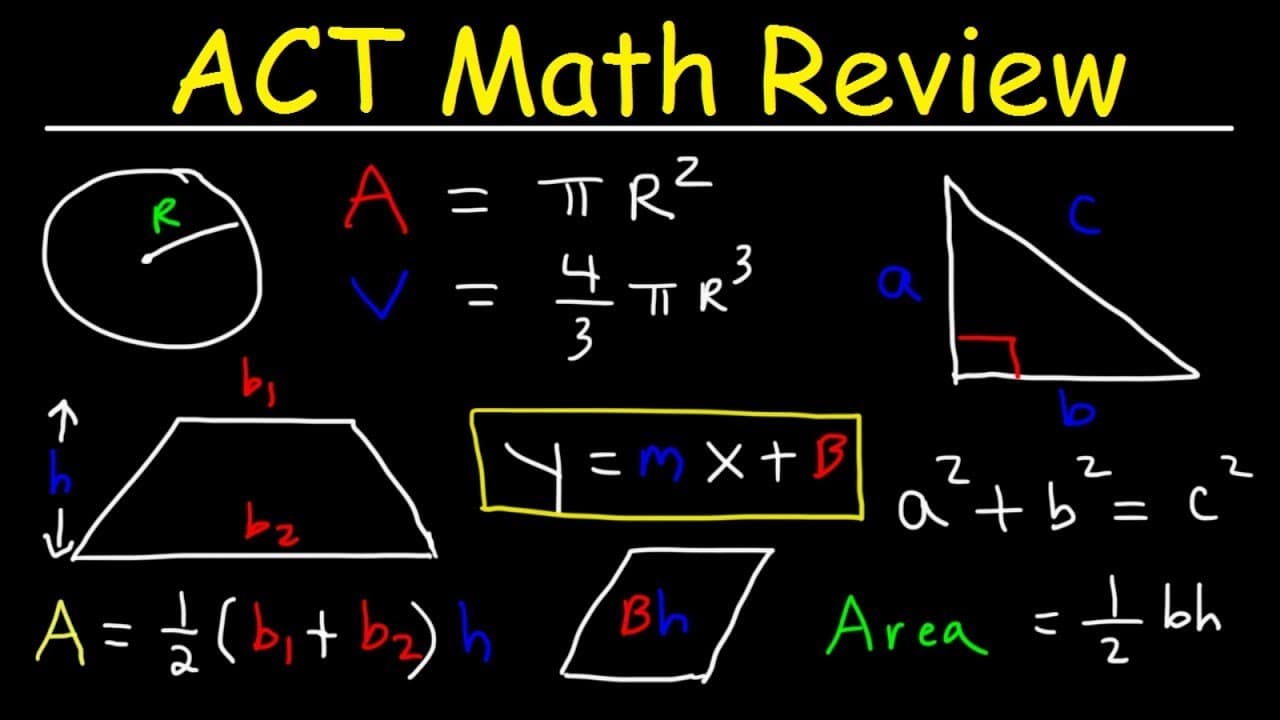
ACT Math Practice Test: Review of Algebra, Geometry, and Trig Concepts

ACT Math Practice Test: Review of Algebra, Geometry, and Trig Concepts

This comprehensive video tutorial serves as an intensive review for the ACT Math section, covering a wide array of topics crucial for high school students preparing for college entrance exams. The content is structured as a series of 31 practice problems that mimic the style and difficulty of actual ACT questions. It progresses through various mathematical domains including pre-algebra, elementary algebra, intermediate algebra, coordinate geometry, plane geometry, and trigonometry. The video adopts a pause-and-practice format, encouraging active participation where viewers attempt each problem before watching the detailed step-by-step solution. Key themes explored in this review include solving linear and quadratic equations, working with functions, understanding geometric properties of polygons and circles, applying trigonometric ratios (SOH CAH TOA) and identities, and analyzing statistical data. The video also places a strong emphasis on real-world application problems involving percentages, sales tax, discounts, and unit conversions. Particular attention is given to algebraic manipulation strategies, such as solving systems of equations and simplifying complex expressions, as well as test-taking tactics like identifying key information in word problems. For educators and students, this video is a valuable resource for standardized test preparation. It allows teachers to identify specific areas of weakness in student understanding by isolating problem types (e.g., if a student struggles with problem 10, they need more support with circle geometry). The step-by-step explanations model clear mathematical reasoning, demonstrating not just *how* to get the right answer, but *why* specific methods work. This makes it an excellent tool for flipped classrooms, homework support, or intensive boot-camp style review sessions prior to test dates.
The Organic Chemistry TutorThe Organic Chemistry Tutor

20mins 33s

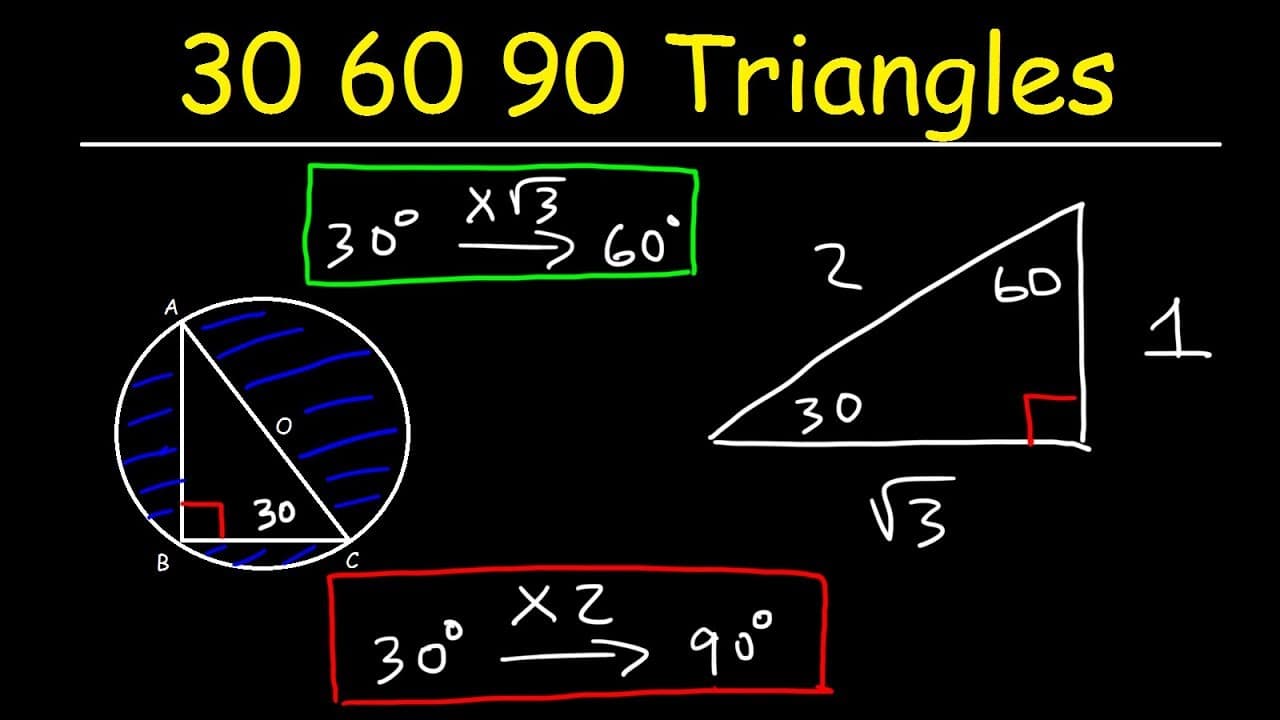
Solving 30-60-90 Special Right Triangles

Solving 30-60-90 Special Right Triangles

This instructional video provides a comprehensive tutorial on understanding and solving 30-60-90 special right triangles, a fundamental concept in high school geometry and trigonometry. The narrator utilizes a digital whiteboard to visually demonstrate the invariant ratios between the sides of these triangles: the side opposite 30° is x, the side opposite 60° is x√3, and the hypotenuse is 2x. The video breaks down the logic into a set of simple rules involving multiplication and division to transition between side lengths depending on which side is known. The content progresses from basic examples to more complex problems, covering various scenarios such as starting with the short leg, the long leg, or the hypotenuse. Crucially, it addresses algebraic skills often required in these problems, such as working with radicals and rationalizing the denominator. The video concludes with a challenging application problem typical of standardized tests like the SAT, integrating the 30-60-90 triangle rules with circle geometry to find the area of a shaded region. For educators, this video serves as an excellent resource for scaffolding lessons on special right triangles. It offers clear, step-by-step procedural fluency practice while also touching on conceptual understanding of geometric relationships. The final problem provides a perfect extension for advanced students, demonstrating how basic geometric theorems apply to composite shapes and area calculations, making it valuable for both core curriculum instruction and test preparation.

The Organic Chemistry TutorThe Organic Chemistry Tutor

11mins 12s

Materials

Circle Secrets Cheat Sheet

Circle Secrets Cheat Sheet

An expanded single-page reference sheet for circle geometry. Now includes boundary formulas (circumference, area, arc length) and a comprehensive section on angle relationships (central, inscribed, interior, and exterior angles) with visual aids. All fractional formulas have been updated to use division by 2 and the diagrams have been refined for clarity.

C

Courtney.Smiley

Circle Secrets Reference Sheet

Circle Secrets Reference Sheet

A circle geometry reference sheet with updated formula rendering and cleaner diagrams that remove redundant borders for a professional look. Diagrams are now clipped and footer text is expanded for clarity.

C

Courtney.Smiley

Circle Secrets Reference Sheet

Circle Secrets Reference Sheet

A highly condensed, single-page circle geometry reference sheet. It includes formulas for circumference, area, arc length, and angle relationships, featuring corrected inscribed polygon diagrams where vertices accurately touch the circle's edge. Layout and mathematical rendering are optimized for clarity and a strict single-page print format.

C

Courtney.Smiley

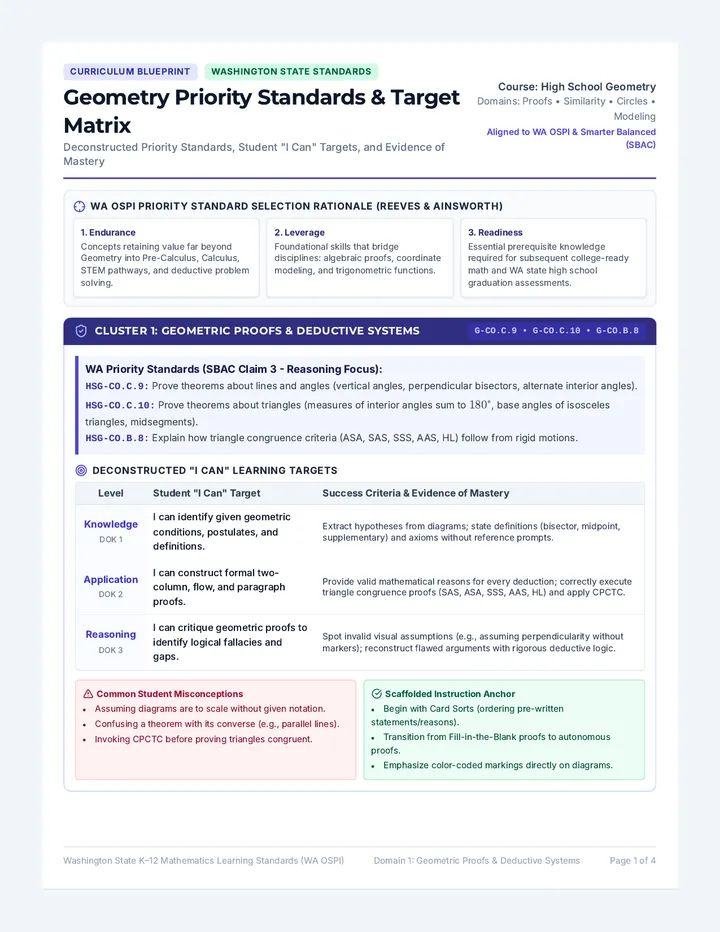
Geometry Targets Matrix Guide

Geometry Targets Matrix Guide

A comprehensive curriculum planning guide aligned to the Washington State K-12 Mathematics Learning Standards (OSPI / CCSS-M) that deconstructs high school geometry priority standards into rigorous, student-facing learning targets across proofs, similarity, circles, and geometric modeling. Features detailed success criteria, common student misconceptions, Smarter Balanced claim alignments, and instructional pacing recommendations.

Sequences

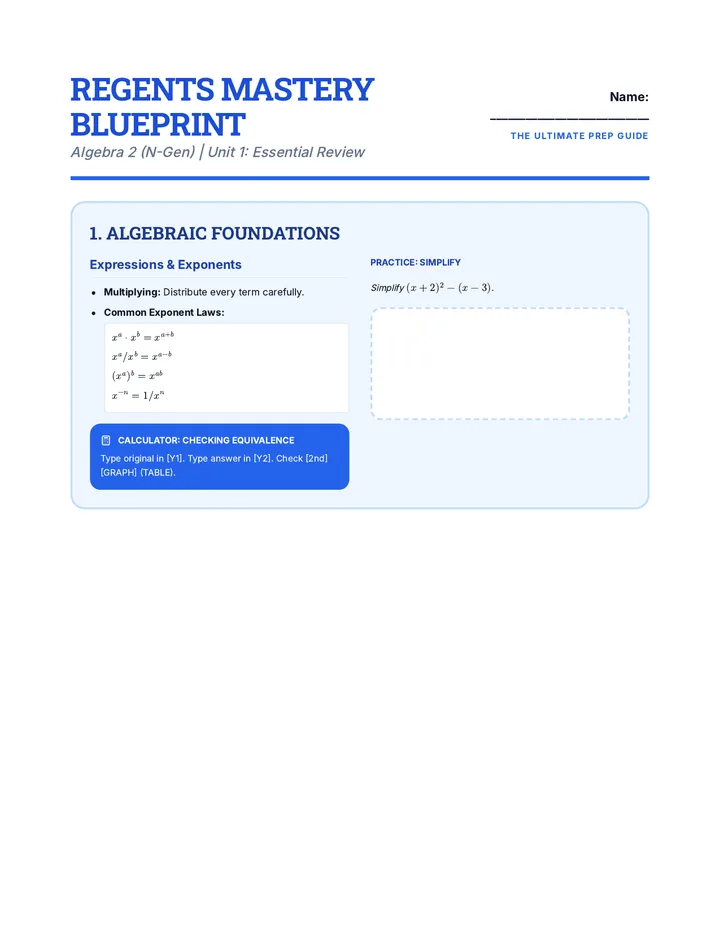
Regents Mastery Blueprint Study Guide

Regents Mastery Suite

A comprehensive review suite for the New York State Mathematics Regents exams, including Algebra 1, Geometry, and Algebra 2, featuring mastery blueprints, calculator strategies, and exam-taking tips.

KB

Kayla Borozny

15
Angle Investigations Slides

Circular Logic

A comprehensive two-lesson sequence covering the geometric properties of circles, including angle relationships and segment lengths. Students will explore inscribed angles, central angles, tangents, chords, and secants through guided discovery and practice.

EO

Edobor Omosigho

9
Strategy Blueprint Slides

ACT Math Mastery

A comprehensive ACT Math preparation program focusing on essential strategies, high-yield Algebra and Geometry concepts, and realistic practice to boost scores.

AL

ava larumbe

26
Elite Math Teacher Guide

Advanced ACT Mastery

A comprehensive prep sequence for the most challenging questions on the ACT Math and Science sections. It focuses on high-level conceptual blueprints for math topics like complex numbers and matrices, alongside speed-reading and data-interpretation strategies for the Science section.

AL

ava larumbe

29
Circle Secrets Presentation

Circle Connections

A targeted Tier 2 intervention for High School Geometry focusing on the derivation of the circle equation and completing the square. Includes scaffolded student worksheets and teacher facilitation guides designed for struggling learners.

5
Tangent Mastery Teacher Guide

Precision Points Construction Series

A targeted intervention sequence focused on geometric constructions, specifically tangent lines from external points to circles, designed for Tier 2 small group support with visual scaffolds and step-by-step mastery.

5

Lessons

Circle Secrets Slides

Circle Secrets

A comprehensive 60-minute exploration of circle anatomy, focusing on identifying all parts of a circle and applying theorems related to tangent lines. Students will engage with visual slides, a vocabulary matching activity, and a rigorous practice set.

EO

Edobor Omosigho

5
Circle Clues Slides

Circle Secrets

A guided exploration of circle angle relationships (central, inscribed, interior, and exterior) specifically designed with visual scaffolds and hints for students in a special education setting.

C

Courtney.Smiley

3
Circle Angle Notes Document

Circle Angle Relationships

A comprehensive lesson on circle angle relationships, covering central, inscribed, interior, and exterior angles with guided notes and visual examples.

C

Courtney.Smiley

7
Cercle des Mysteres Activite

Cercle des Savoirs Angles

Une séance coopérative pour découvrir les propriétés des angles inscrits et au centre dans un cercle, conçue pour les élèves de 3ème.

E

Enseignante

2
Math Codex Presentation

Objectif Brevet Maths

Une collection complète de fiches de révision et un diaporama dynamique pour maîtriser le programme de mathématiques de 3ème. Couvre l'arithmétique, l'algèbre, la géométrie et la trigonométrie avec des visuels clairs et modernes.

E

Enseignante

6
Circle Blueprint Reference Sheet

Circle Sleuths Assessment

A comprehensive assessment covering circle geometry, including angle relationships, arc measures, and circle components. Students will identify circle parts, calculate angle and arc measures using various theorems, and determine circumference and arc length.

C

Courtney.Smiley

3