Lenny.com
Explore
Create
ActivitiesNewMathEnglish Language ArtsScience & EngineeringSocial StudiesGlobal LanguagesHealth & Physical EducationSpecial EducationCounseling & Life SkillsArts & CreativityESL
Lenny.com
Lenny.com
Explore
Create
ActivitiesNewMathEnglish Language ArtsScience & EngineeringSocial StudiesGlobal LanguagesHealth & Physical EducationSpecial EducationCounseling & Life SkillsArts & CreativityESL
Lenny.com
Lenny.com

Solutions

Lenny for EducatorsLenny for SchoolsLenny for Districts

Product

ExploreSign inCreateSupportAbout

Resources

Getting startedMTSS Acceleration Program

© 2026 Lenny Learning Inc.

TermsPrivacyAccessibility
LinkedInInstagramX
Lenny

Add, Subtract, Multiply, and Divide Rational Numbers

Arithmetic operations including addition, subtraction, multiplication, and division of positive and negative fractions and decimals. Integrates strategies for common denominators, reciprocal multiplication, and precise decimal alignment.

MathNumbers & CountingCounting ObjectsNumber NamesComparing NumbersNumber OperationsCounting SequenceNumbers 0-10Place Value Understanding and SystemAdd and Subtract Within 20Addition and Subtraction ConceptsAddition and Subtraction EquationsAddition and Subtraction ProblemsFoundations for MultiplicationMultiplication and Division PropertiesMultiply and Divide Within 100Multiplication and Division ProblemsFactors and MultiplesProperties of OperationsPatterns and RelationshipsGenerate and Analyze PatternsMulti-Digit ArithmeticPlace Value OperationsMulti-Digit and Decimal OperationsNumerical ExpressionsFour Operations and PatternsFour Operations Problem SolvingMeasurement & DataMeasurable AttributesMeasuring LengthsMeasure and Estimate Lengths in Standard UnitsRelate Addition and Subtraction to LengthClassifying and Counting ObjectsTime and MoneyArea Concepts and MeasurementPerimeter and Area MeasuresAngle Concepts and MeasurementTime, Volume, and MassMeasurement Unit ConversionsGeometryIdentifying ShapesShapes and AttributesShape Attributes and ReasoningShapes and CompositionClassifying 2D FiguresGeometric Figures and RelationshipsLines, Angles, and ShapesAngle, Area, and VolumeGeometric MeasurementVolume of 3D ShapesCoordinate Plane ApplicationsTransformations in the PlaneCongruence and SimilarityUnderstand congruence in terms of rigid motionsSimilarity and TransformationsProve Theorems Involving SimilarityPythagorean TheoremTrigonometry for General TrianglesMake Geometric ConstructionsProve Geometric TheoremsTheorems About CirclesFind Arc Lengths And Areas of Sectors of CirclesVolume FormulasRelationships Between Two-Dimensional and Three-Dimensional ObjectsProve Simple Geometric Theorems AlgebraicallyTranslate Between Geometric Description and Equation for Conic SectionApply Geometric Concepts in Modeling SituationsFractions & DecimalsFractions as NumbersBuilding FractionsFraction Equivalence and OrderingAdding and Subtracting FractionsMultiplying and Dividing FractionsDividing FractionsDecimal FractionsMulti-Digit Computation and FactorsAdd, Subtract, Multiply, and Divide Rational NumbersRational Number SystemIrrational Numbers and ApproximationsRatiosRatios and ProportionsProportional RelationshipsUnit RateAlgebraAlgebraic ExpressionsGenerate Equivalent ExpressionsQuantitative RelationshipsProportional Relationships and Linear EquationsEquations and InequalitiesEquation Solving and ReasoningLinear Equations and SystemsGraph Equations and InequalitiesSystems of EquationsReal-World Algebraic ProblemsQuantitative Reasoning with UnitsExpression StructureEquivalent Expression FormsRadicals and Integer ExponentsRational ExponentsRational and Irrational NumbersPolynomial OperationsPolynomial IdentitiesPolynomial Zeros and FactorsRational ExpressionsComplex Number OperationsComplex Numbers in PolynomialsComplex Numbers on PlaneStatistics & ProbabilityRepresent and Interpret DataData DistributionsStatistical VariabilityProbability ModelsCompound Event ProbabilitiesStatistical SamplingInterpret Categorical and Quantitative DataBivariate Data PatternsInterpret Linear ModelsComparing Two PopulationsRandom Processes in StatisticsIndependence and Conditional ProbabilityExpected ValuesProbability-Based Decision MakingStatistical Inference and ConclusionsFunctionsFunction Concepts and NotationDefine and Compare FunctionsInterpret Functions in ContextAnalyze Function RepresentationsModel Relationships with FunctionsIdentify Linear vs Exponential GrowthDistinguish Between Function TypesCompare Growth RatesInterpret Function ExpressionsBuild Functions from RelationshipsConstruct and Model FunctionsTransform and Combine FunctionsModel Comparison and SelectionSolve Exponential EquationsTrigonometryTrigonometric Ratios Involving Right TrianglesTrigonometric Functions and Unit CircleModel with Trigonometric FunctionsTrigonometric IdentitiesVectors & MatricesIntroduction to Vectors and MatricesVector QuantitiesVector OperationsMatrix OperationsCalculusLimits and ContinuityDerivative Concepts and NotationDerivative Rules and TechniquesApplications of DerivativesOptimization ProblemsRelated RatesCurve Sketching and AnalysisIntegration Concepts and NotationAntiderivatives and Indefinite IntegralsDefinite Integrals and AreaFundamental Theorem of CalculusIntegration TechniquesApplications of IntegrationDifferential EquationsSequences and SeriesParametric and Polar FunctionsVector-Valued Functions

Videos

How to Write Equations for Parallel and Perpendicular Lines

How to Write Equations for Parallel and Perpendicular Lines

This instructional video provides a comprehensive tutorial on writing equations for lines that are either parallel or perpendicular to a given line and pass through a specific point. The narrator systematically walks through six distinct examples, increasing in complexity from simple integer slopes to fractional slopes. Two primary methods are demonstrated for finding these equations: using the slope-intercept form ($y = mx + b$) to solve for the y-intercept, and using the point-slope form ($y - y_1 = m(x - x_1)$) to write the equation directly before converting it.

The Organic Chemistry TutorThe Organic Chemistry Tutor

11mins 57s

Algebra 1 Final Exam Review: From Arithmetic to Logarithms

Algebra 1 Final Exam Review: From Arithmetic to Logarithms

This comprehensive video serves as a rapid-fire review of core algebra concepts, ranging from basic arithmetic operations to advanced equation solving. It begins by establishing a foundation with number systems, including real, rational, and imaginary numbers, before moving into fundamental operations with integers, fractions, and decimals. The instructor demonstrates various techniques for arithmetic, such as the number line for integers and the 'keep-change-flip' method for dividing fractions, ensuring viewers have the prerequisite skills for algebra. The content progresses into key algebraic topics including exponents, radicals, and polynomial factoring. Viewers are guided through the laws of exponents, simplifying complex radical expressions, and converting between exponential and radical forms. A significant portion of the video is dedicated to solving different types of equations: linear equations involving fractions, quadratic equations using both factoring and the quadratic formula, and exponential and logarithmic equations. The instructor emphasizes checking for extraneous solutions, particularly with logarithmic and rational equations. This video is an invaluable resource for students preparing for an Algebra 1 final exam or an Algebra 2 placement test. Its modular structure allows teachers to use specific segments for targeted review or as a complete overview of the curriculum. The step-by-step problem-solving approach models mathematical thinking, making it ideal for classroom observation, homework support, or 'flipped classroom' assignments where students review the theory at home and solve problems in class.

The Organic Chemistry TutorThe Organic Chemistry Tutor

12mins 10s

How to Calculate Percentage Increase Using Word Problems

How to Calculate Percentage Increase Using Word Problems

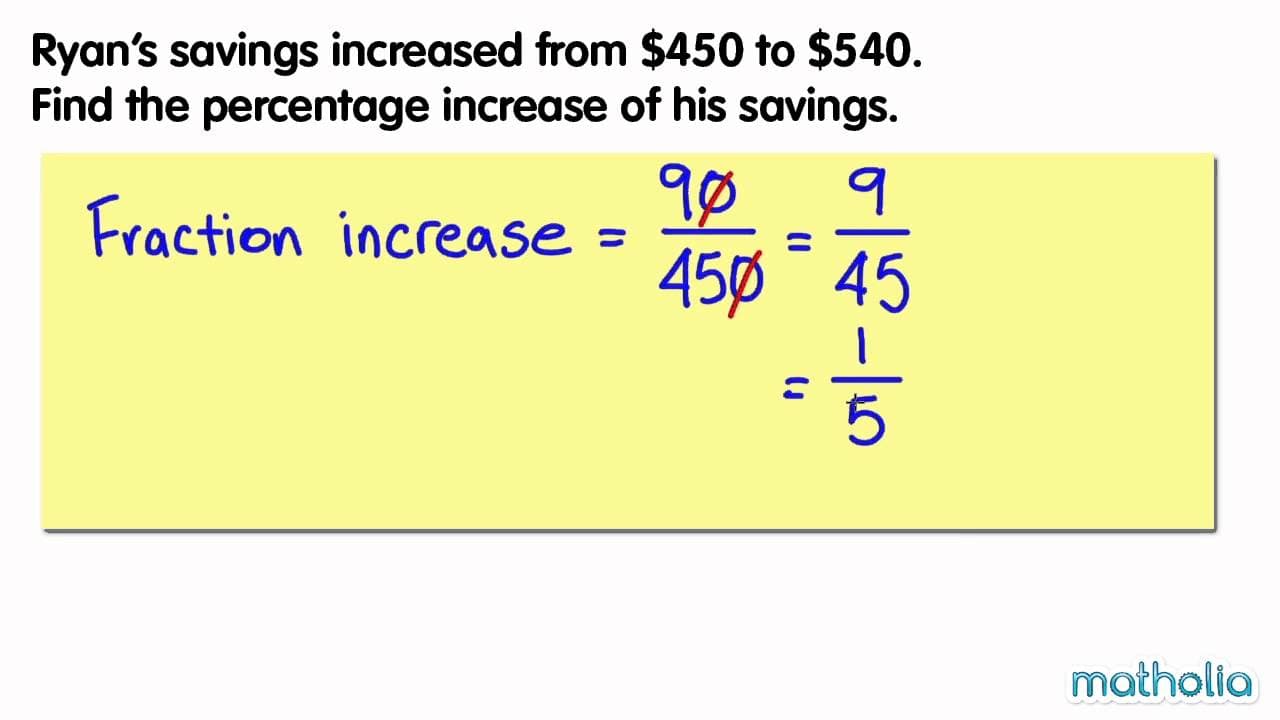
This educational video provides a clear, step-by-step tutorial on calculating percentage increase through three distinct word problems. It utilizes a consistent and pedagogical methodology: finding the numerical difference between the new and old values, expressing that difference as a fraction of the original value, and then converting that fraction into a percentage. The video employs visual bar models in the initial examples to help students conceptually understand the relationship between the original amount and the increase before moving into abstract numerical calculations. The key themes explored include interpreting word problems, subtraction to find differences, simplifying fractions, and converting fractions to percentages using equivalent fractions with a denominator of 100. The progression of examples—from a bakery scenario to personal savings and finally athletic performance—demonstrates the versatility of this mathematical concept across different real-world contexts. For the classroom, this video is an excellent resource for introducing or reinforcing the concept of percentage change. It models a specific strategy (finding a denominator of 100) that reinforces fraction fluency and number sense, rather than just teaching a formulaic algorithm like "multiply by 100." Teachers can use this to bridge the gap between fractions and percentages and to show students how to structure their working out for multi-step word problems.

MatholiaChannelMatholiaChannel

3mins 9s

Understanding Slope Using Rise Over Run and Roller Coasters

Understanding Slope Using Rise Over Run and Roller Coasters

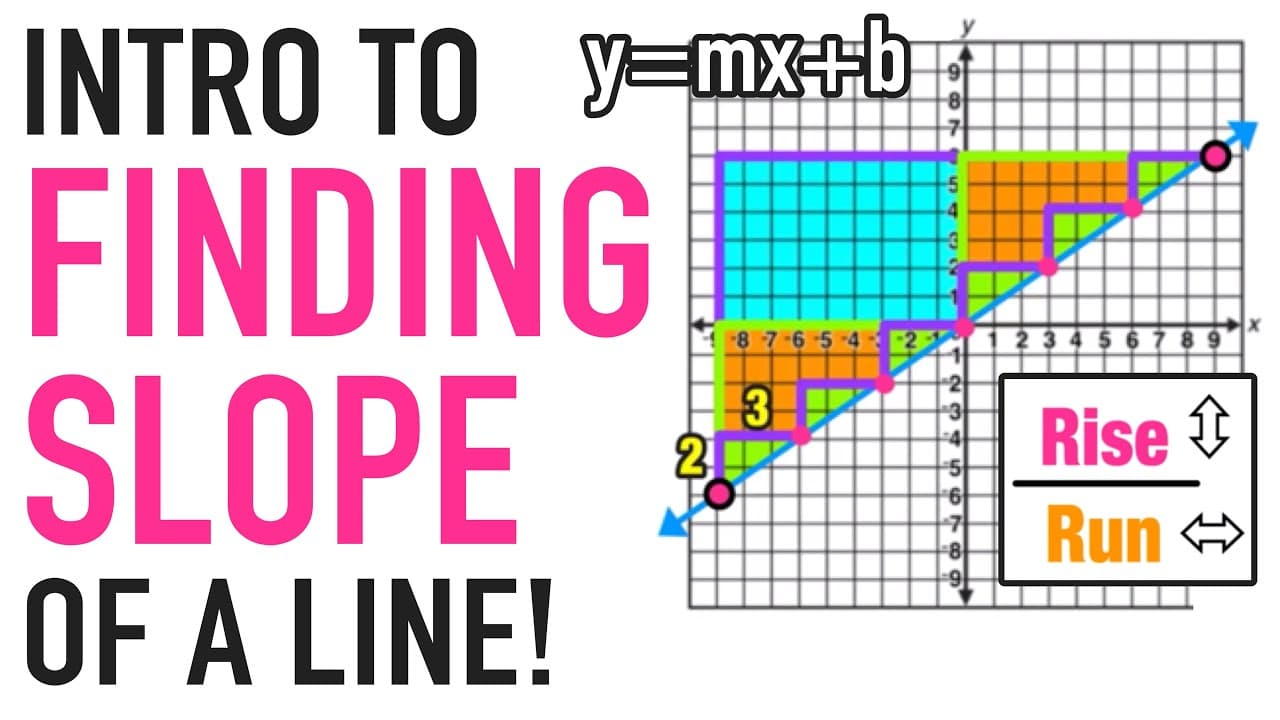
This engaging mathematics video introduces students to the concept of slope using a relatable roller coaster analogy before transitioning to the coordinate plane. It simplifies the abstract idea of slope by breaking it down into two understandable components: direction (positive or negative) and steepness (rate of change). The video effectively uses visual cues, such as POV roller coaster footage and animated diagrams, to help students visualize how lines rise or fall as they move from left to right. The content covers key topics essential for pre-algebra and algebra students, including distinguishing between positive and negative slopes, the formula "Rise over Run," and how to calculate slope from a graphed line. It places significant emphasis on the procedural steps of counting grid units to determine the rise and run between two points and demonstrates why simplifying the resulting fraction is crucial. The video provides clear examples of both positive integer slopes and negative fractional slopes. For educators, this video serves as an excellent hook for a unit on linear functions or as a reinforcement tool for struggling learners. It bridges the gap between real-world physical experiences and mathematical abstraction, making it easier for students to grasp why slope represents a rate of change. The step-by-step walkthroughs of practice problems on coordinate grids provide a model for students to follow when solving their own problems, making it a practical resource for direct instruction or flipped classroom settings.

Mashup MathMashup Math

6mins 50s

Mastering Linear Equations: From Two-Step to Complex Multi-Step Problems

Mastering Linear Equations: From Two-Step to Complex Multi-Step Problems

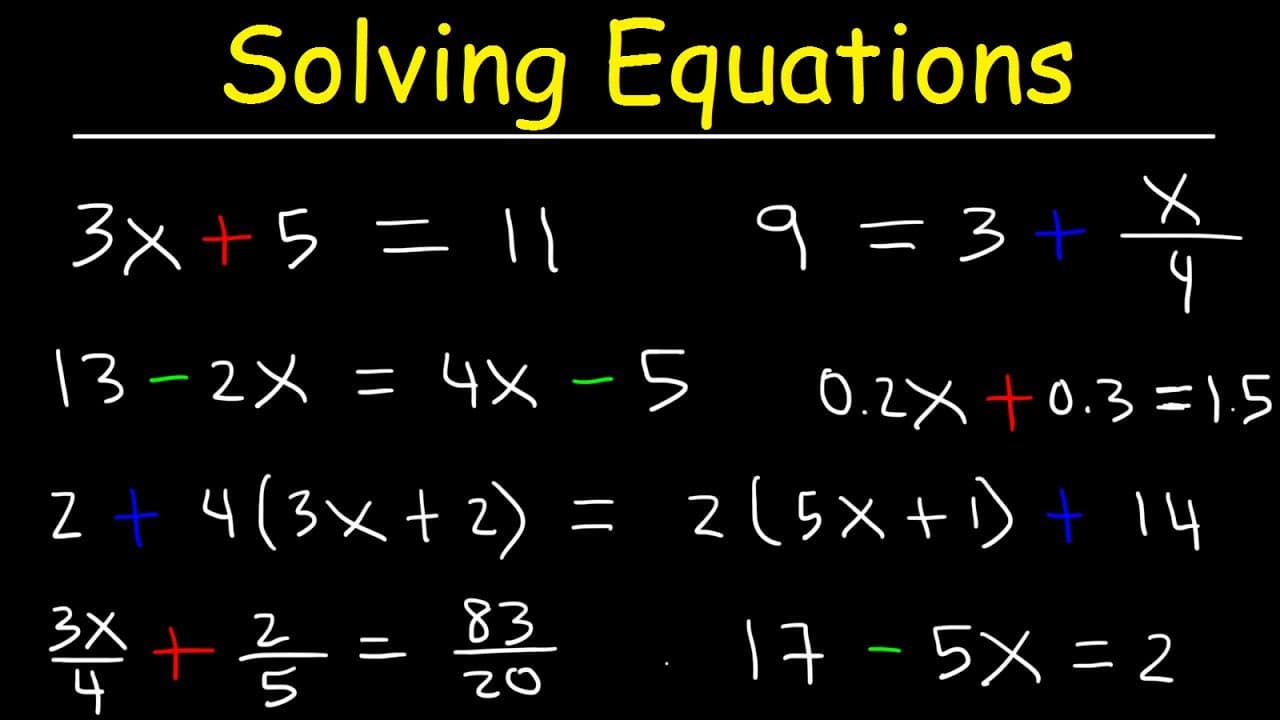
A comprehensive, step-by-step tutorial on solving linear equations, ranging from basic two-step equations to complex multi-step problems. The video adopts a "watch and try" approach, encouraging viewers to pause the video, attempt practice problems, and then watch the solution to verify their work. The instructor uses a clear digital blackboard format to demonstrate algebraic methods including inverse operations, combining like terms, and the distributive property. The content is structured progressively, beginning with isolating variables in simple equations like '3x + 5 = 17'. It advances to more challenging scenarios such as variables on both sides of the equal sign, equations requiring the distributive property with parentheses, and problems involving fractions and decimals. Special attention is given to strategies for clearing denominators and eliminating decimals to simplify calculations. This resource is highly valuable for algebra students and teachers as a tool for differentiation and independent practice. Teachers can use specific segments to reteach concepts (e.g., clearing fractions) or assign the video for flipped classroom learning. The abundance of worked examples allows students to see the repetition of logical steps required to solve equations, reinforcing procedural fluency.

The Organic Chemistry TutorThe Organic Chemistry Tutor

25mins 5s

How to Divide Decimals by Multiples of Ten

How to Divide Decimals by Multiples of Ten

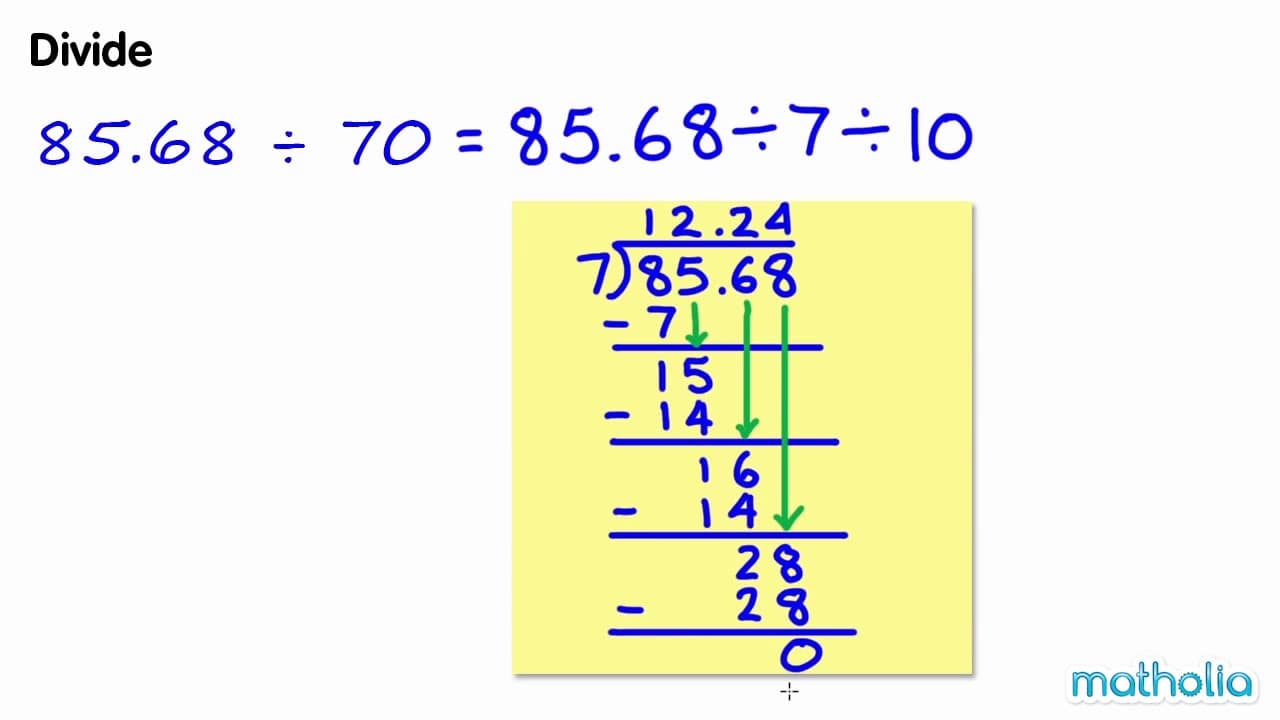
This math tutorial demonstrates a strategic method for dividing decimals by multiples of ten (e.g., 30, 70). The video breaks down the process into two manageable steps: first dividing by the single-digit factor (e.g., 3 or 7) using long division, and then dividing by 10 by shifting the decimal point. Two complete examples are worked through step-by-step, providing a clear visual model for students to follow. The video explores key themes of decomposing numbers, understanding place value, and using the properties of division to simplify complex problems. It reinforces the concept that dividing by a multiple of ten is equivalent to sequential division by its factors. The visual representation of long division on a 'sticky note' graphic helps isolate the calculation steps from the conceptual steps. For educators, this video serves as an excellent instructional tool for 5th and 6th-grade math classrooms. It offers an alternative strategy to standard long division with two-digit divisors, which can often be overwhelming for students. By decomposing the divisor, the method simplifies the mental load and reinforces the 'powers of ten' rules for decimal shifting, making it a valuable resource for building both procedural fluency and conceptual understanding.

MatholiaChannelMatholiaChannel

2mins 10s

Materials

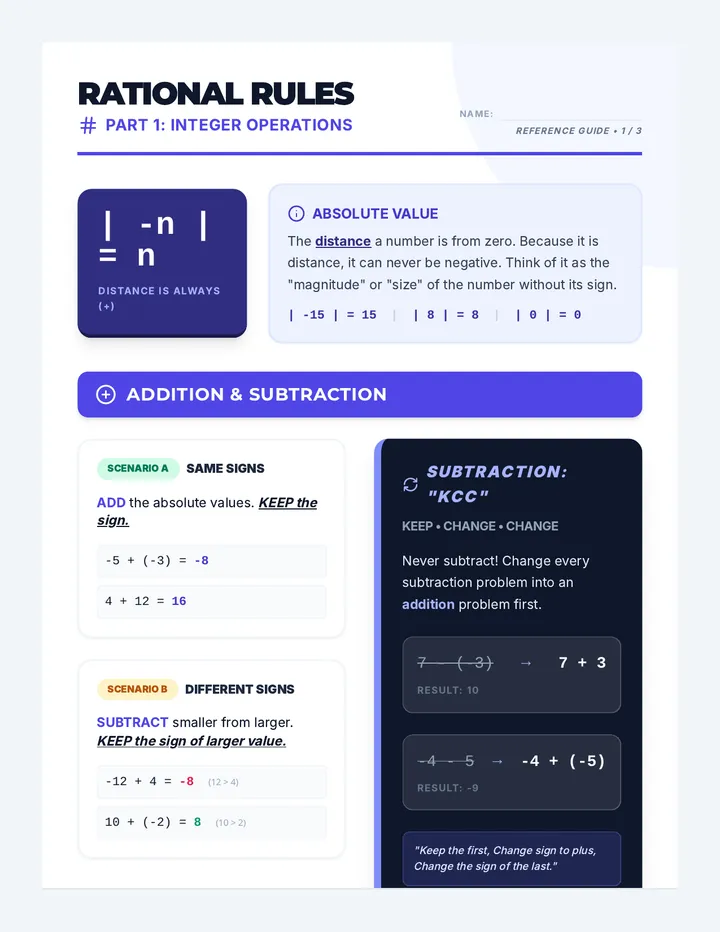
Rational Rules Reference Sheet

Rational Rules Reference Sheet

A redesigned three-page reference sheet for rational number operations. Page one focuses on integer rules with absolute value, addition, subtraction (KCC), and multiplication/division sign tricks. Page two covers decimals with detailed guides on lining up dots, counting places for multiplication, and the 'Top in the Box' method for division. Page three masters fractions with common denominators, the KCF method, mixed-to-improper conversion (MAD), and a table of common conversions, ending with a logical 'Reality Check' section.

WM

Will M

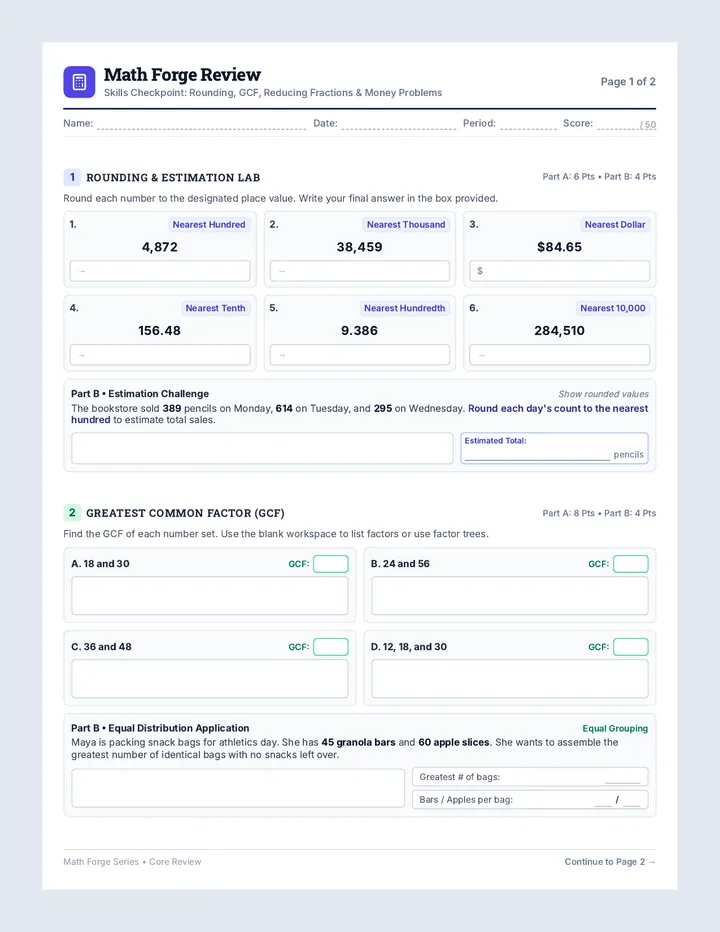
Math Forge Review Worksheet

Math Forge Review Worksheet

A comprehensive two-page printable review worksheet covering whole number and decimal rounding, greatest common factor computation and real-world grouping, simplifying fractions to lowest terms, and multi-step money word problems with generous dedicated workspaces.

S

stewart

Equation Matchup Cards

Equation Matchup Cards

A 16-set printable equation matching card deck with all equations and solution cards standardized to the variable x, requiring students to solve rather than match by variable letter.

M

Megan.Tanner

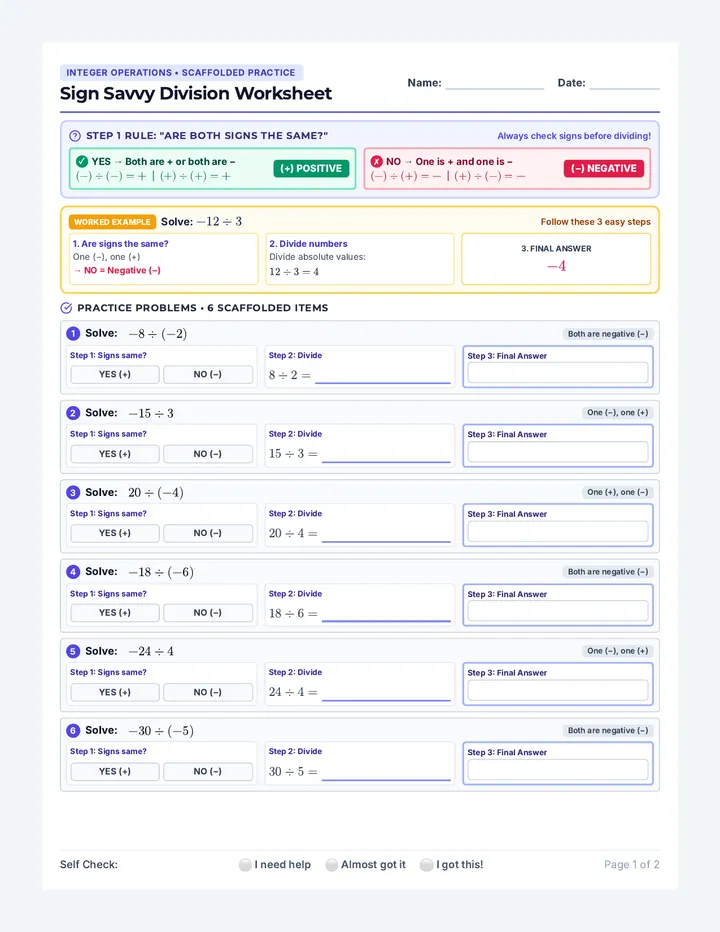
Sign Savvy Division Worksheet

Sign Savvy Division Worksheet

An expanded integer division worksheet for IEP students featuring 6 scaffolded problems, structured 3-step solution frames ('Are signs the same?', divide numbers, final answer), clear visual sign anchors, and a complete 6-problem answer key with teacher guidance.

CS

Courtney Scherer

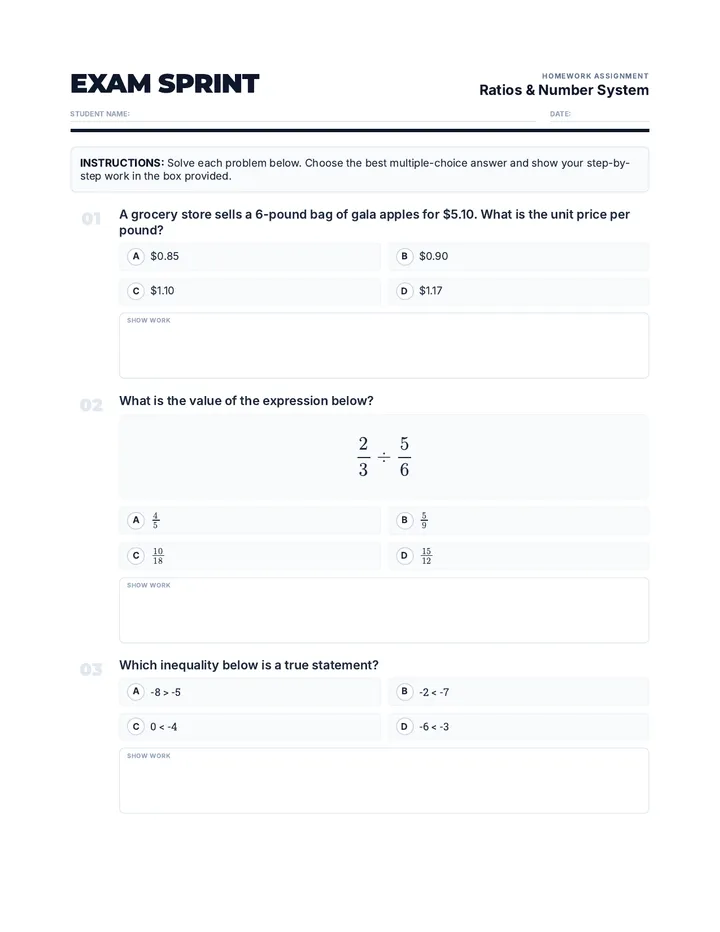
Exam Sprint Worksheet Reformatted

Exam Sprint Worksheet Reformatted

A reformatted, 2-page multiple-choice worksheet featuring 6th-grade math questions. This version uses optimized spacing to ensure exactly three questions fit per page, each with its own dedicated work area and a final scratch space.

FB

Faith Bain-Lucey

Integer Navigator Worksheet

Integer Navigator Worksheet

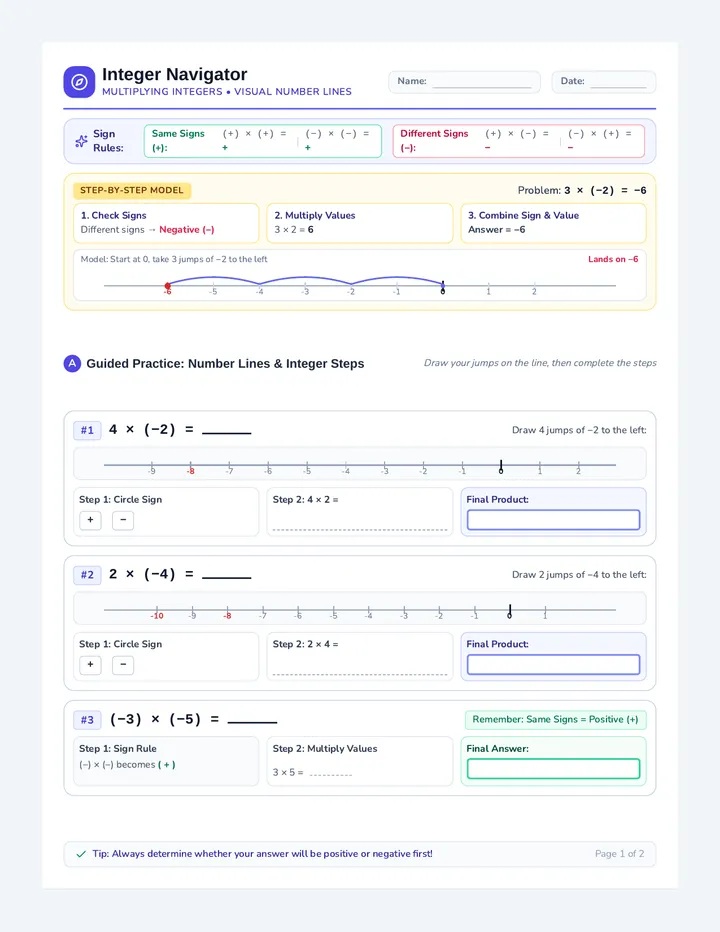
A scaffolded 7th-grade math worksheet designed for IEP support, featuring visual number lines, fraction models, and step-by-step algorithms to multiply positive and negative integers and rational numbers.

KD

Katelynn Dotson

Sequences

Math Blueprint Week 1 Booklet (Definitive)

Math Blueprint Spiral

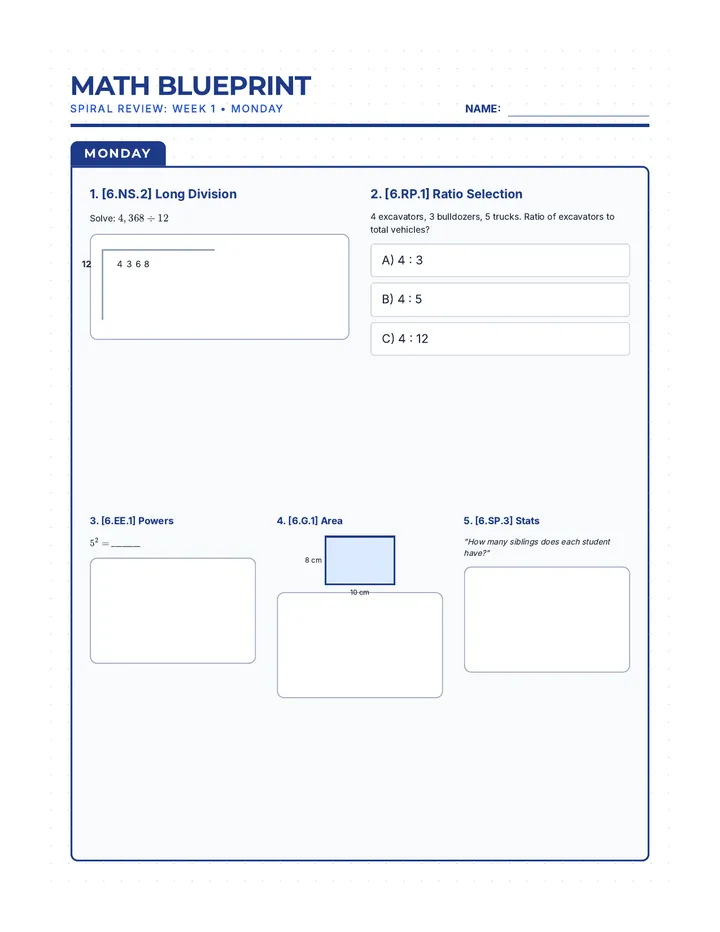
A 7-week comprehensive math review sequence designed to prepare 6th-grade students for North Carolina state testing, covering Number Systems, Ratios, Expressions, Geometry, and Statistics.

MK

Michell Kisler

27
Camp Multi-Math Worksheet

Math Review Adventures

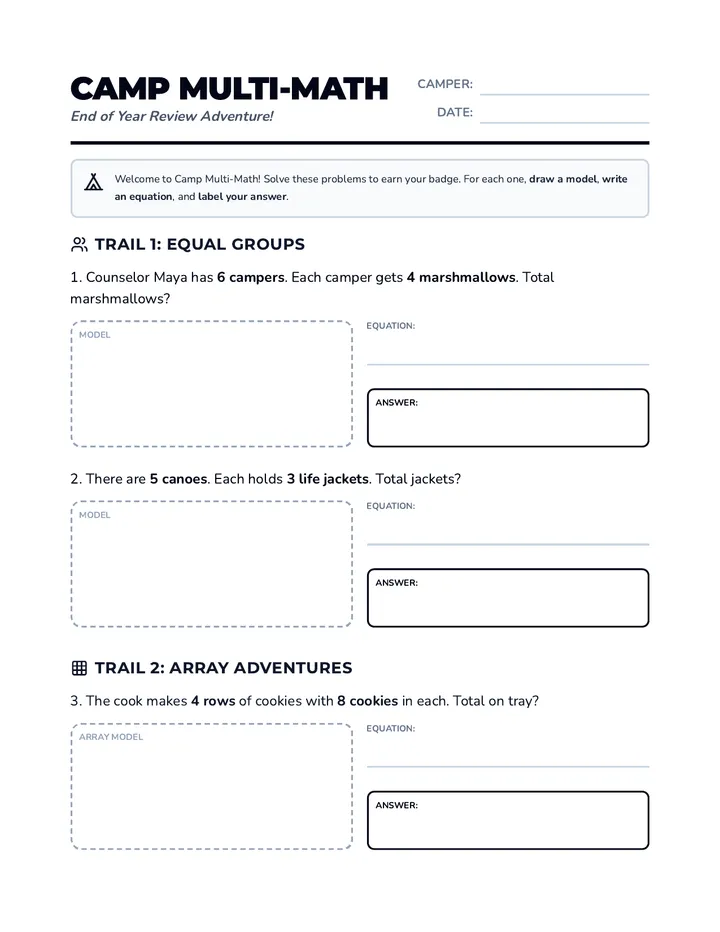
A collection of themed end-of-year math review adventures for different grade levels, focusing on spiraling key standards and problem-solving.

DB

Deborah Burton

21
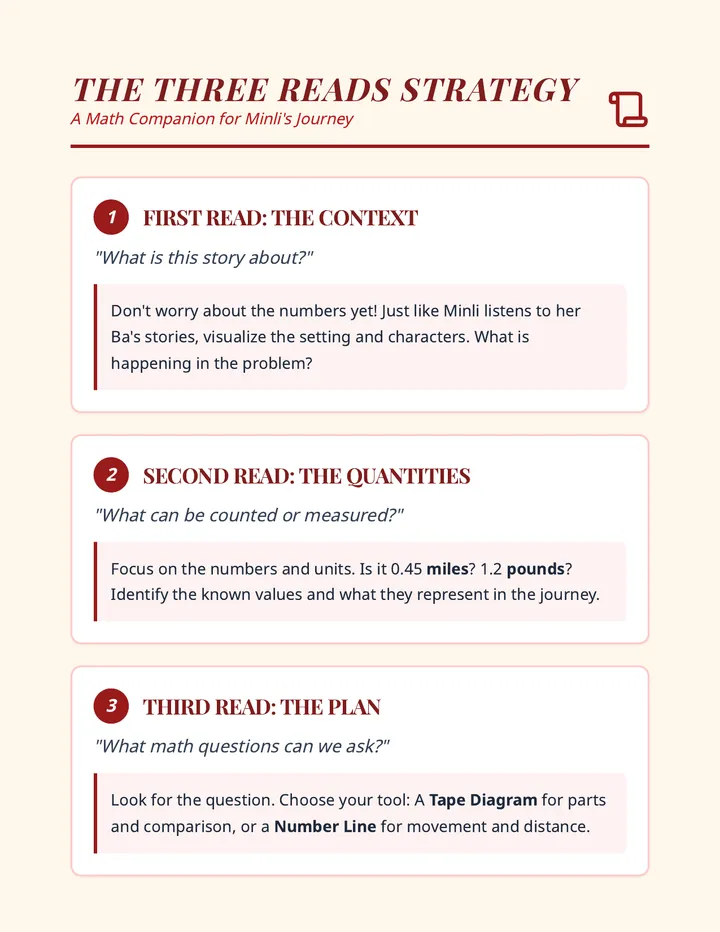
3 Reads Strategy Poster

Math Blueprints Grade 5

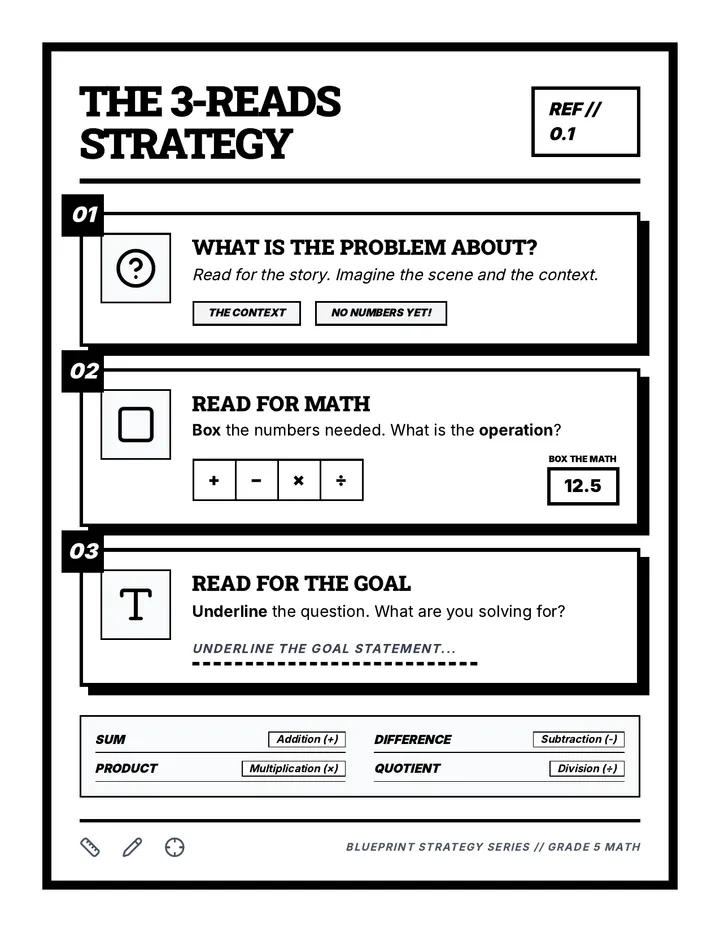
A comprehensive set of math supports for 5th-grade students in a co-taught environment. Each unit includes visual vocabulary, worked examples, cloze-style guided notes, and exit tickets featuring a 'Mistake of the Day' analysis.

HJ

Hope Joel

23
Three Reads Reference Sheet

Quest Mastery 4-Day Bridge

A 4-lesson intensive math intervention for 5th graders designed to bridge 4th-grade decimal foundations to 5th-grade mastery. Features the Three Reads strategy and mental math logic (Counting Up, Matching Units) themed around 'Where the Mountain Meets the Moon'.

K

kthompson

21
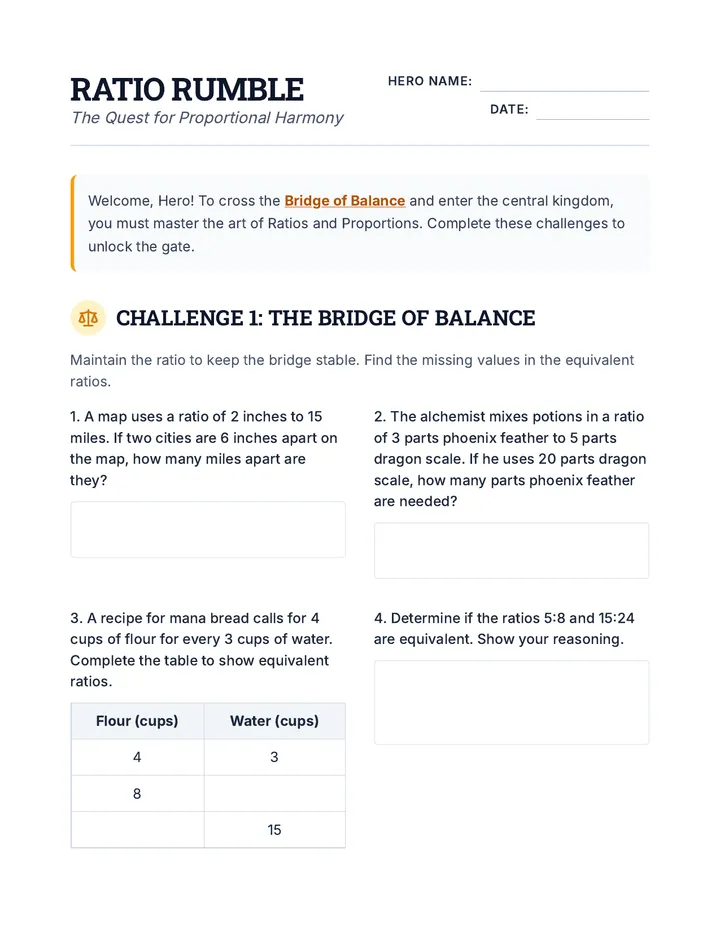
Ratio Rumble Worksheet

Math Quest Review

A week-long adventure-themed 6th-grade math review covering major clusters: Ratios & Proportions, Number System, Expressions & Equations, and Geometry. The sequence culminates in a mixed-review 'Quest Finale' to assess student mastery and readiness.

C

carlsond

15
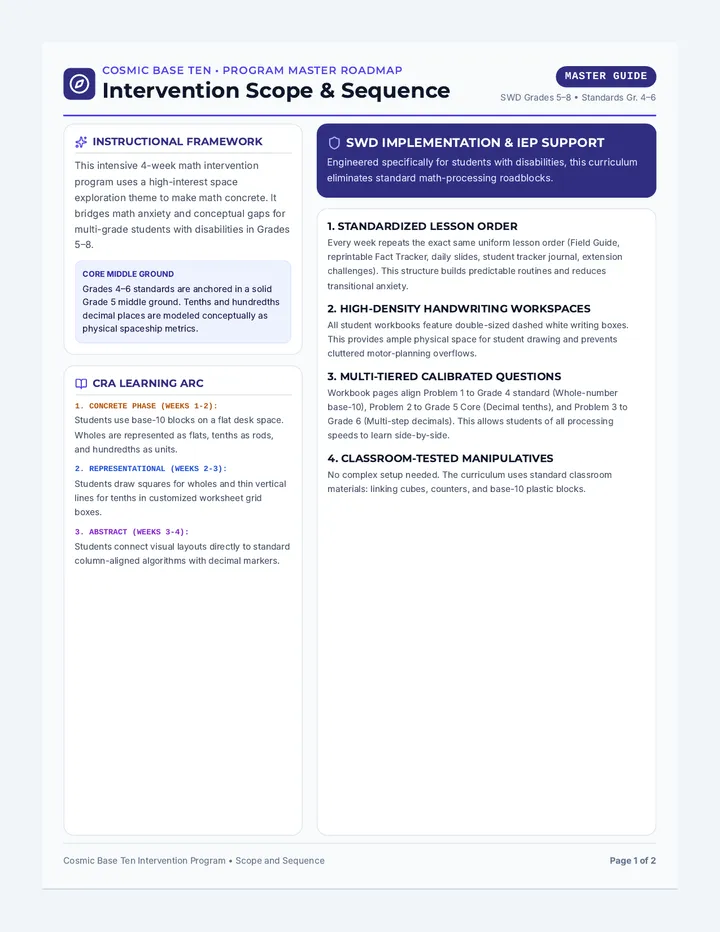
Cosmic Base Ten Scope Guide

Cosmic Base Ten

A 4-week intensive math intervention program set in a space exploration universe, designed for multi-grade students with disabilities in Grades 5–8. It covers additive thinking, place value, and decimal regrouping, anchored in Grades 4–6 standards with a Grade 5 core middle ground.

S

samantha.davis

37

Lessons

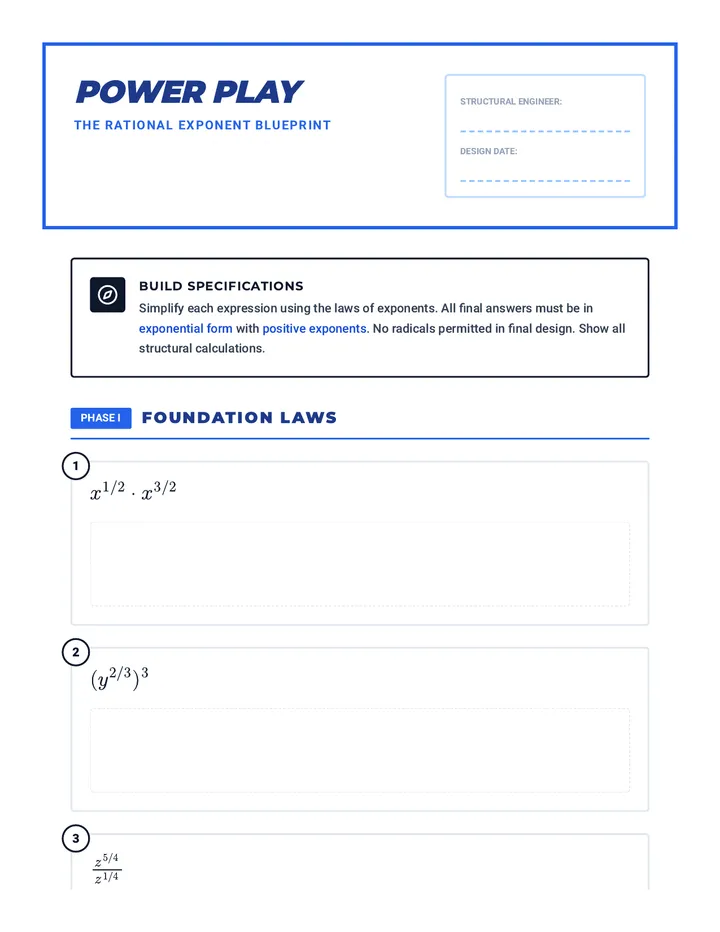
Power Play Worksheet

Power Play Masterclass

A lesson focused on mastering the laws of exponents with rational exponents, progressing from single-step applications to complex multi-step simplifications without using radical notation.

M

mastronardil

5
Percent Puzzle Lesson Plan

The Percent Puzzle Solving Percent Equations

A comprehensive 65-minute lesson for 9th-grade students on solving percent equations and proportions, using a "Percent Puzzle" theme to engage students in finding missing parts, wholes, and percentages.

KC

Kris Coyne

6
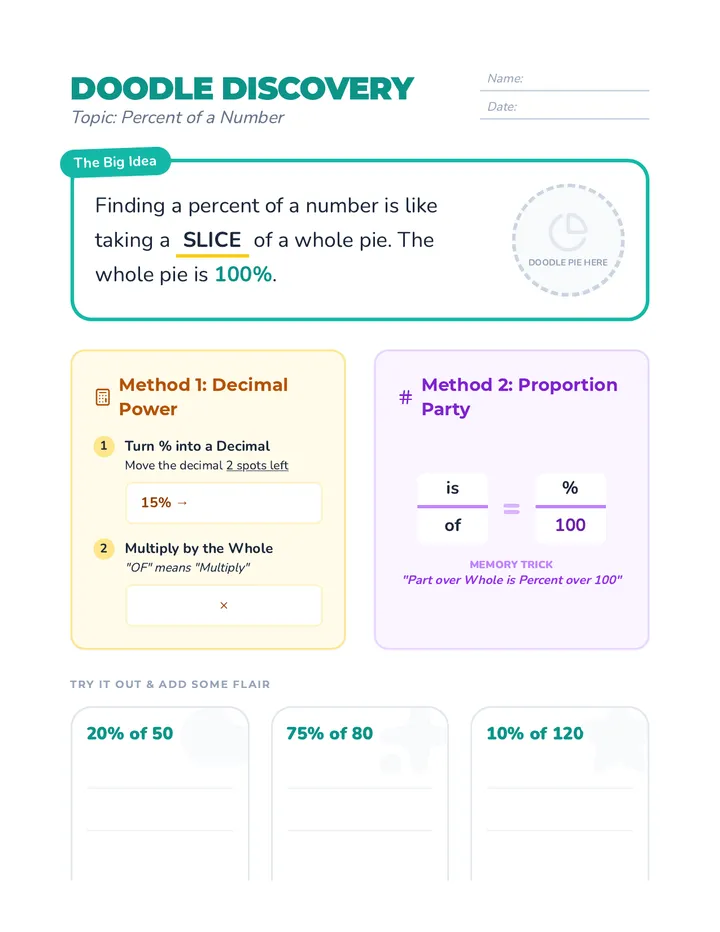
Percent Power Doodle Notes

Percent Power

A comprehensive set of visual, interactive doodle notes and practice activities designed to help students with ADHD master the concept of finding a percent of a number through single-concept focus and hands-on elements.

J

jedriend

5
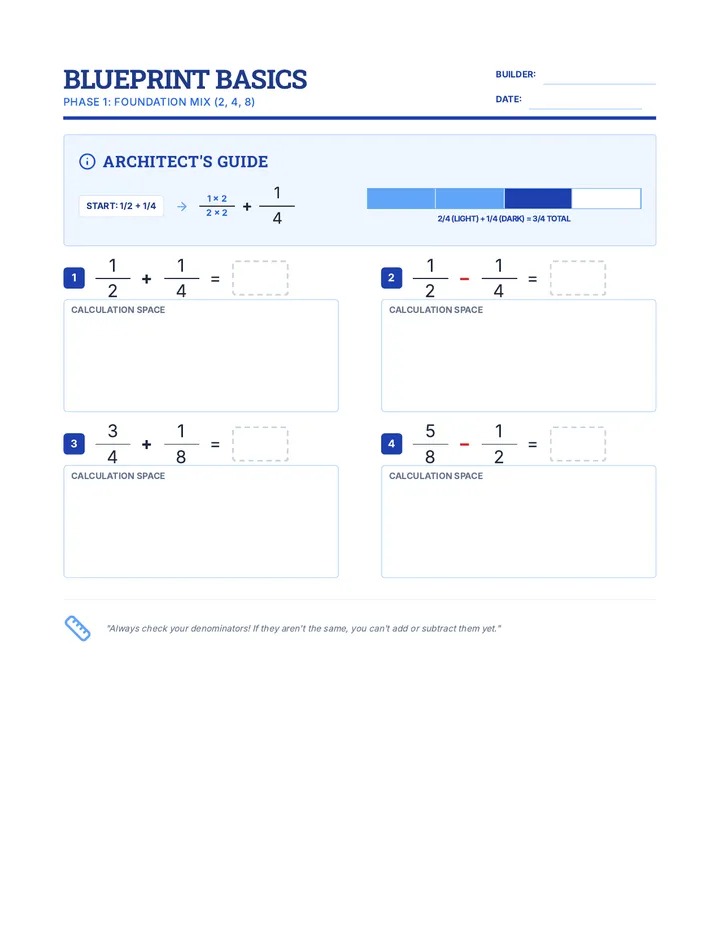
Blueprint Basics Worksheet

Fraction Blueprint Lesson

A series of 9 structured worksheets focusing on adding and subtracting fractions with simple denominators (2, 3, 4, 5, 6, 7, 8, 9, 10, 11) using a blueprint-inspired design. Includes step-by-step examples and visual scaffolds for students to master both like and unlike denominators.

TP

tiffany priest

13
Master Garden Scoreboard v2

Spring Fever Stakes

A vibrant, spring-themed 'Price is Right' game show featuring seasonal items, interactive rounds, and a high-stakes Showcase Showdown.

KB

Kelly Brown

5
Expression Duel Answer Key

Variable Victory

A high-energy review lesson where students evaluate algebraic expressions with whole numbers, decimals, and fractions through a secret agent themed mission.

MK

Michell Kisler

12