3 Reads Strategy Poster The 3-Reads Strategy
Ref // 0.1
01
What is the problem about?
Read for the story. Imagine the scene and the context.
The Context
No Numbers Yet!
02
Read for Math
Box the numbers needed. What is the operation ?
−
×
÷
Box the math
12.5
03
Read for the Goal
Underline the question. What are you solving for?
Underline the goal statement...
Sum Addition (+)
Difference Subtraction (-)
Product Multiplication (×)
Quotient Division (÷)
Blueprint Strategy Series // Grade 5 Math
Unit 1 Blueprint Guide Blueprint Guide: Unit 1
Multiplication & Volume
STAGE 01
Visual Vocabulary
Volume The total amount of 3D space an object occupies.
Base Area (B) The size of the bottom layer (L × W).
Factor Pair Two numbers multiplied to reach a product.
Cubic Unit A 1×1×1 cube used to measure volume.
Problem Solving Protocol: The 3-Reads
01. Story
Identify the context. Imagine the scene.
02. Math
Box the numbers and find the Operation .
03. Goal
Underline the question/goal.
Volume Formula
L = 10 W = 4 H = 5
V = L × W × H
Double & Half
5
10
×
14
7
=
70
Same product, easier mental math!
Mistake of the Day
Terry's Blueprint: To find the volume of a 10 × 4 × 5 prism, I'll just add the dimensions.
The Fix
Terry added dimensions! Volume requires multiplication : 10 × 4 × 5 = 200.
Unit 1 Blueprint Notes Blueprint Notes: Unit 1
Volume & Multi-Digit Logic
Name: ______________________
1. Volume Blueprint
Base (B) Height (H)
Volume is the total amount of ________________ inside a 3D shape.
V = BASE AREA × ________________
Practice Blueprint:
If a box has a Base Area of 12 and a Height of 5 , what is its volume?
Ans:
2. Double and Half Logic
Rule: When we double one factor and half the other, the PRODUCT stays exactly the same!
5 → 10
Double (×2)
×
14 → 7
Half (÷2)
=
70
Unit 1 Word Bank
Space Height Product Dimensions Base Area Cubic Unit
Unit 1 Blueprint Check Check Blueprint Check: Unit 1
Performance Assessment
Name: ______________________
TASK 01
Volume: Count the cubic units in this prism. Each layer has 8 cubes.
4 Layers
Number of layers (H):
Cubes per layer (B):
Total Volume: _________
TASK 02
Calculate the volume using the formula (V = L × W × H):
L = 12 W = 3 H = 4
Expression (Show Work):
Final Volume:
________________
Mistake of the Day
The Work: A student calculated the volume of a 5×4×2 box as:
Explain the Error:
The Correct Blueprint:
V = ________
Unit 1 Blueprint Check Blueprint Check: Unit 1
Performance Assessment
Name: ______________________
3-Reads Protocol:
1. Story Context
2. Box Math
3. Underline Goal
TASK 01
Volume Blueprint: Each layer has 12 cubes. Find the total volume.
5 layers
Expression (B × H):
12 × ____
Total Volume:
Ans: ________
TASK 02
Calculate the volume using the formula (V = L × W × H):
L = 8 W = 5 H = 3
Expression / Work:
Final Volume Answer:
Ans: ________
Mistake of the Day
The Work: To find the volume of a 5×4×2 box, a student wrote:
Explain the Error:
The Correct Blueprint:
V = ________
cubic units
Unit 2 Blueprint Guide Blueprint Guide: Unit 2
Fraction Foundations
Stage 02
Master Vocabulary List
Numerator The top number in a fraction. It tells you how many parts you are counting.
Denominator The bottom number. It defines the size of the whole or the number of parts.
Equivalent Fractions Fractions that represent the same value even if they look different (e.g., 1/2 = 2/4).
Simplest Form A fraction where the numerator and denominator share no common factors other than 1.
LCD Least Common Denominator. The smallest common multiple used to add unlike fractions.
GCF Greatest Common Factor. The largest number that divides both top and bottom.
Improper Fraction A fraction where the numerator is greater than or equal to the denominator.
Mixed Number A whole number and a proper fraction combined (e.g., 1 ½).
Model: Equivalent Parts
1/2
Original
=
2/4
Equivalent
Model: Common Denominator Logic
1/2 + 1/4
2/4 + 1/4 = 3/4
To add unlike parts, find the LCM of the denominators (2 and 4 is 4). Convert so sizes match. Add only the numerators!
Mistake of the Day
Terry's Math: "1/3 + 1/3 = 2/6. I added everything!"
The Fix:
Terry changed the size of the whole. The denominator must stay the same: 2/3.
Unit 2 Blueprint Notes Blueprint Notes: Unit 2
Fraction Logic & Models
Name: ______________________
1. Denominator Logic
The denominator represents the size of the pieces. We find a common denominator by looking for the ____________________.
"If denominators are 2 and 3, the common denominator is 6 !"
Rule: Once denominators match, we only add the ____________________.
2. Visual Equivalence
To create an equivalent fraction, multiply the top and bottom by the same number.
1/2
2/4
When a fraction has no common factors left, it is in ____________________.
Unit 2 Word Bank
Denominator Numerator Equivalent LCD GCF Simplest Form Improper Mixed Number
Unit 2 Blueprint Check Blueprint Check: Unit 2
Performance Assessment
Name: ______________________
TASK 01
Convert and solve: 1/3 + 2/5
Sketch Area // Models
Final Sum: ____________________
TASK 02
Find the product: 3 × 2/4
× 3 =
________ / ________
Mistake of the Day
The Problem: "Solve 3/4 - 1/2."Sam's Work: "3 - 1 = 2 and 4 - 2 = 2. The answer is 2/2 or 1."
Identify the Error:
Correct Blueprint Solution:
Ans: ________
Unit 3 Blueprint Guide Blueprint Guide: Unit 3
Decimal Place Value & Ops
Stage 03
Master Vocabulary List
Tenths The first place to the right of the decimal point. Represents 1/10 or 0.1.
Hundredths The second place to the right. Represents 1/100 or 0.01. Like pennies.
Thousandths The third place to the right. Represents 1/1000 or 0.001.
Decimal Point The symbol that separates whole numbers from fractional parts.
Equivalent Decimals Decimals that name the same amount (e.g., 0.4 = 0.40).
Rounding Replacing a number with a simpler value that is approximately the same.
Placeholder Zero A zero used to fill empty place values so columns align correctly.
Compare Using >, <, or = symbols to show which value is larger.
Model: Decimal Architecture
100s
10s
1s
.
1/10
1/100
1/1000
1
4
5
.
6
7
8
Strategy: Rounding Protocol
14.562
Check neighbor →
→
Since 6 ≥ 5...
14.6
Mistake of the Day
Jordan's Logic: "0.4 is smaller than 0.19 because 4 is smaller than 19."
The Correction:
False! 0.4 is 0.40 . 40 hundredths is bigger than 19 hundredths. Always align decimals before comparing!
Unit 3 Blueprint Notes Blueprint Notes: Unit 3
Decimal Fluency & Mapping
Name: ______________________
1. Place Value Structure
The decimal point separates the ________________ number part from the fractional part. Moving to the right makes the value 10 times ________________.
Ones.TenthsHund.Thous.
4 . 5 6 7
2. Aligning Decimals
When adding or subtracting, the Decimal Points must be ________________ vertically. This keeps the place values in the correct columns.
12.4
12.40
+ 3.56
"Fill empty spots with a Placeholder ________________ !"
Unit 3 Word Bank
Tenths Hundredths Aligned Zero Decimal Point Equivalent Rounding Compare
Unit 3 Blueprint Check Blueprint Check: Unit 3
Decimal Proficiency
Name: ______________________
TASK 01
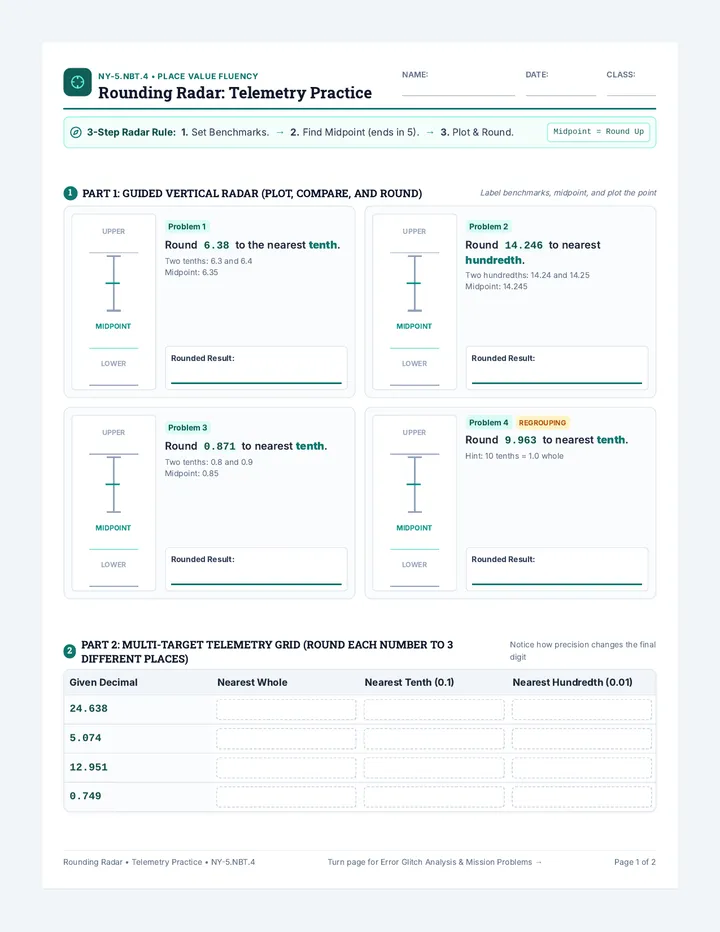
Round 14.562 to the nearest tenth:
14.5
14.6
Midpoint
Rounded Result: ________________
TASK 02
Solve using the alignment protocol: 15.8 - 4.25
Alignment Workspace (Stack Vertically)
Final Answer: ____________________
Mistake of the Day
The Scenario: Jordan says "0.19 is bigger than 0.4 because 19 is bigger than 4."
Find the Logic Error:
Correct the Blueprint:
0.4 ____ 0.19
Unit 4 Blueprint Guide Blueprint Guide: Unit 4
Standard Algorithms
Stage 04
Master Vocabulary List
Algorithm A step-by-step set of operations to be performed to solve a calculation.
Partial Product The intermediate steps in multi-digit multiplication before adding them together.
Placeholder Zero A zero used to shift a calculation to the correct place value (e.g., multiplying by tens).
Quotient The final result or answer to a division problem.
Dividend The number being divided into smaller parts.
Divisor The number you are dividing by. It tells you the size of the groups.
Ratio Table A table of equivalent ratios used to solve complex division or multiplication.
Multiple The product of a number and any whole number (e.g., multiples of 6: 6, 12, 18).
Model: The Area Connection
10 × 20
200
10 × 4
40
3 × 20
60
3 × 4
12
20
4
10
3
Stacking Partials:
24
× 13
72
+ 240
312
Mistake Analysis
Terry's Math: Terry says 32 × 20 is 64 because 32 × 2 is 64.
The Fix:
Terry forgot the Placeholder Zero ! 32 × 2 tens is 64 tens, or 640.
Unit 4 Blueprint Notes Blueprint Notes: Unit 4
Multiplication & Division
Name: ______________________
1. Multiplication Protocol
When multiplying by a 2-digit number, you calculate two Partial Products and add them together.
Step 1: Multiply Ones
Step 2: Add ____________________
Step 3: Multiply Tens
Why do we add the zero? Because we are multiplying by a value 10 times larger.
2. Long Division Blueprint
1. Divide
2. Multiply
3. Subtract
4. ____________________
Memory Key
D-M-S-B
Unit 4 Word Bank
Placeholder Quotient Dividend Algorithm Divisor Partial Product Bring Down Multiple
Unit 4 Blueprint Check Blueprint Check: Unit 4
Performance Assessment
Name: ______________________
TASK 01
Model and solve: 42 × 15
40
2
10
5
Standard Algorithm:
Work Area
TASK 02
Use a Ratio Table to find: 156 ÷ 6
Groups
1
10
20
_____
Total
6
60
120
_____
Quotient: ____________________
Mistake of the Day
The Problem: "Solve 32 × 24."Terry's Work: "32 × 4 = 128" and "32 × 2 = 64". Result: 128 + 64 = 192.
Identify the error:
Fix it here:
Correct Total: ________
Unit 5 Blueprint Guide Blueprint Guide: Unit 5
Advanced Fraction Ops
Stage 05
Master Vocabulary List
Reciprocal The "flip" of a fraction. When multiplied by the original, the product is 1 (e.g., 2/3 and 3/2).
Improper Fraction A fraction where the numerator is equal to or greater than the denominator.
Scaling Resizing a quantity by multiplying it by a fraction or whole number.
Keep-Change-Flip The algorithm for dividing fractions: Keep the first, change to multiply, flip the second.
Cross-Reduction Simplifying fractions diagonally before multiplying to make the numbers smaller.
Proper Fraction A fraction where the numerator is smaller than the denominator.
Product The answer when two or more numbers are multiplied together.
Unit Fraction A fraction with a numerator of 1 (e.g., 1/4, 1/10, 1/2).
Model: The K-C-F Strategy
1/2
Keep
÷
×
Change
3/1
1/3
Flip
= 1/6
Mistake Analysis
Terry's Logic: "5 × 2/3 must be larger than 5 because all multiplication results in a bigger number."
The Fix:
When the scale factor is less than 1 (like 2/3), the product is smaller than the original number.
Unit 5 Blueprint Notes Blueprint Notes: Unit 5
Advanced Fraction Ops
Name: ______________________
1. Multiplying Across
Multiplying fractions is a simple process. Unlike addition, you do not need to find a ________________ denominator. Just multiply across!
Numerator × Numerator
Denominator × ________________
2. Keep-Change-Flip (KCF)
To divide fractions, we actually turn the problem into multiplication using the ________________ .
KEEP
1st Fraction
CHANGE
÷ to ×
FLIP
2nd Fraction
Unit 5 Word Bank
Reciprocal Proper Improper Product Scaling Unit Fraction Denominator Common
Unit 5 Blueprint Check Blueprint Check: Unit 5
Performance Assessment
Name: ______________________
TASK 01
Model the multiplication: 3/4 × 2/5
Shade Blueprint
Calculation Protocol:
3 × 2 = ________
4 × 5 = ________
Final Answer: ____________
TASK 02
Model the division: 1/2 ÷ 3
Divide this 1/2 into 3 equal parts
Quotient
Mistake of the Day
The Problem: Terry was asked to solve 5 × 2/3.Terry's Logic: "It's multiplication, so the answer must be more than 5."
Find the Scaling Error:
If you take only a PART (2/3) of a number, will the result grow or shrink?
Correct the Logic:
Unit 6 Blueprint Guide Blueprint Guide: Unit 6
Geometry & Graphing
Stage 06
Master Vocabulary List
Polygon A closed 2D shape made of straight lines (e.g., triangles, quadrilaterals).
Hierarchy An organized system that ranks shapes by their shared properties.
Parallel (||) Lines that are always the same distance apart and never touch.
Right Angle An angle that measures exactly 90 degrees. A "square corner."
Coordinate Plane A 2D surface formed by two intersecting number lines (X and Y).
Ordered Pair Two numbers used to locate a point on a grid (X, Y).
Composite Shape A shape made of two or more simpler shapes (like two prisms combined).
Congruent Having the exact same size and same shape.
Shape Hierarchy
Quadrilaterals
Parallelogram
Trapezoid
Mapping Points
(X, Y)
Mistake Analysis
Terry's Claim: "All rectangles are squares because they both have 4 sides and 4 right angles."
The Correction:
False. A rectangle only needs equal angles. A square is a special rectangle that ALSO has 4 equal side lengths.
Unit 6 Blueprint Notes Blueprint Notes: Unit 6
Shape Properties & Logic
Name: ______________________
1. Classifying Triangles
By Side Lengths
An Isosceles triangle has at least ________ equal sides.
A Scalene triangle has ________ equal sides.
By Angle Measures
A Right triangle has exactly one 90° angle.
An Obtuse triangle has one angle larger than ________ degrees.
2. Hierarchy Logic
Geometry uses a ________________ to rank shapes. If a shape has 2 pairs of ________________ sides, it is a parallelogram.
True or False? A square is also a congruent rhombus. ________________
3. Coordinate Mapping
Ordered Pair: (X, Y)
1. Walk along the X-Axis (Right)
2. Fly up the Y-Axis (Up)
Unit 6 Word Bank
Hierarchy Parallel Polygon Ordered Pair Right Angle Composite X-Axis Y-Axis
Unit 6 Blueprint Check Blueprint Check : Unit 6
Geometry & Volume Performance
Name: ______________________
TASK 01
Classify this triangle based on its side lengths and internal angles:
10 in 8 in 8 in
Sides: ________________
Angles: ________________
TASK 02
Calculate the total Volume of this composite blueprint:
Prism B
Base Area = 15
Height = 10
Prism A
Base Area = 30
Height = 3
Vol A:
Vol B:
Total: ____________ units³
Mistake of the Day
Sam's Claim: "Every rhombus is a square because they both have four equal sides."
Sketch a non-square Rhombus:
Student Drawing Area
Correct Sam's Logic:
A rhombus only becomes a square if it also has __________________________.
Unit 7 Blueprint Guide Blueprint Guide: Unit 7
Decimal Multi/Div
Stage 07
Master Vocabulary List
Product The total value found by multiplying two numbers (factors).
Decimal Place The position of a digit to the right of the decimal point.
Divisor Shift Moving the decimal point to turn a decimal divisor into a whole number.
Estimation Rounding numbers before solving to predict if your answer is reasonable.
Place Value Shift Moving the decimal point by powers of 10 (e.g., ×10 shifts right).
Hundredths The result of multiplying tenths by tenths (0.1 × 0.1 = 0.01).
Compatible Numbers Numbers that are easy to divide or multiply mentally.
Algorithm The standard, step-by-step process used to solve multi-digit problems.
Decimal Product Model
Tenths × Tenths = Hundredths
The Shift Protocol
1.5 ÷ 0.5
15 ÷ 5
Mistake Analysis
Terry's Logic: "1.2 × 0.5 = 6.0 because 12 × 5 is 60 and I move the decimal 1 time."
The Fix:
Total decimal places must be counted! One place in each factor = 2 places in product. Ans: 0.60 .
Unit 7 Blueprint Notes Blueprint Notes: Unit 7
Decimal Operations
Name: ______________________
1. Multiplication Patterns
To multiply decimals, ignore the points first and multiply the whole numbers. Then, count the total number of ________________ places in both factors.
0.1 × 0.1 = ________________
Rule: Count from right to left!
When we multiply tenths by tenths, our answer is measured in ________________.
2. The Divisor Protocol
If the divisor has a decimal point, you must shift it to the right to make it a ________________ number .
4.8 ÷ 0.6 → shift → 48 ÷ 6
Final result = ________
Unit 7 Word Bank
Decimal Place Hundredths Divisor Shift Estimation Algorithm Whole Number Shift Product
Unit 7 Blueprint Check Blueprint Check : Unit 7
Decimal Operations
Name: ______________________
TASK 01
Model the product (Shade the grid): 0.4 × 0.5
Modeling Area
Blueprint Answer:
Result: ________
TASK 02
Use the Shift Protocol to find: 2.4 ÷ 0.08
________ ÷ ________ = ________
"Make the divisor a whole number first!"
Mistake of the Day
The Problem: Multiply 1.2 × 0.5.Terry's Logic: "12 × 5 = 60. Since there are two decimal places, the answer is 6.0."
Find the Shift Error:
How many total decimal places are in 1.2 and 0.5 combined? ________________
Correct Result:
________