Fundamental concepts of limits, derivatives, and integrals for modeling change and motion. Examines techniques for differentiation and integration alongside applications in optimization, area calculation, and differential equations.
A strategic masterclass for the ACT Science section, focusing on speed-reading data sets, identifying experimental variables, and decoding scientific logic. This lesson emphasizes the 'Straight to the Data' approach to maximize score in the 35-minute time limit.
An introductory exploration of calculus-adjacent concepts tested on the ACT, focusing on limits, instantaneous rates of change, and function optimization. Students will master the Limit Blueprint and apply rate-of-change logic to complex algebraic scenarios.
An intensive masterclass on advanced trigonometric identities, the unit circle, and non-right triangle laws. Students will master the Pythagorean identities, Law of Sines/Cosines, and the specific ACT-style unit circle coordinates required for top-tier scores.
A specialized deep dive into advanced geometry concepts including circle equations, 3D volume/surface area of complex shapes, and coordinate geometry involving perpendicularity and distance. Students will master completing the square for circles and visualizing 3D cross-sections.
A specialized deep dive into trigonometric functions, mastering the critical distinction between period and frequency. Students will apply the 2π/b blueprint to decode sine and cosine graphs and solve high-difficulty periodic motion problems.
A focused deep dive into imaginary and complex numbers. Students will master powers of i, arithmetic with complex conjugates, and solving quadratic equations with complex roots—all through the lens of ACT-style 'Final Ten' questions.
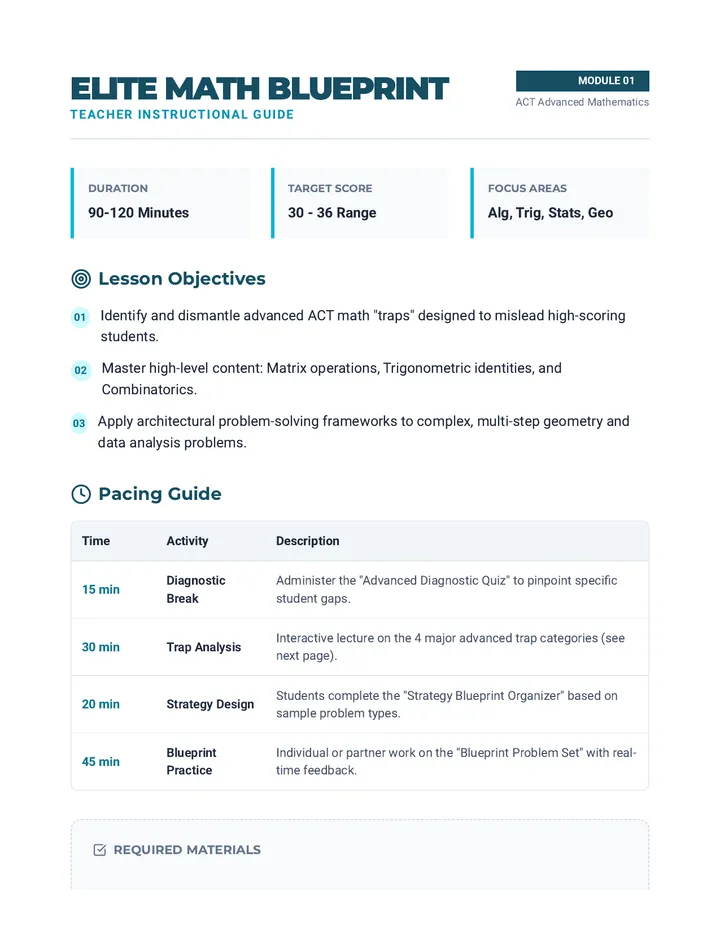
A comprehensive lesson focused on high-level ACT Math topics including matrices, complex functions, trigonometry, and advanced statistics. The lesson emphasizes identifying common 'traps' and applying architectural-style problem-solving strategies.
Students investigate how regular polygons with increasing numbers of sides eventually 'converge' into a circle, using the apothem formula to derive the area of a circle.
A Precalculus lesson focused on calculating overall limits from graphs and identifying conditions for non-existence through a courtroom-themed simulation.
A Precalculus lesson focusing on the informal definition of continuity through the 'pencil test' and identifying the four main types of discontinuities: removable, jump, infinite, and oscillating. Students engage in a hands-on card sort to classify functions based on their graphical behavior.
A comprehensive calculus lesson focused on the critical distinction between the value of a function at a point and the limit as it approaches that point, featuring video analysis and a 'True/False/Fix' activity.
Students investigate the behavior of functions with oscillating discontinuities, specifically focusing on the limit of \(\sin(1/x)\) as \(x \to 0\) compared to bounded oscillating functions like \(x \cdot \sin(1/x)\). The lesson uses a combination of video analysis and digital graphing tools to explore the formal definition of limit failure due to oscillation.
Une leçon interactive de niveau Première générale sur la notion de nombre dérivé, s'appuyant sur des visualisations graphiques du passage de la sécante à la tangente, la lecture et le tracé de coefficients directeurs, et le lien avec le sens de variation.
This AP Calculus review lesson bridges the gap between algebraic rational function rules and formal limit notation, using visual sketching as a framework for understanding asymptotic behavior and continuity. Students translate pre-calculus 'rules' into calculus 'logic' to prepare for the formal definition of limits.
Students will learn to identify and describe intervals of increase, decrease, and constant behavior in functions using interval notation through a roller coaster design challenge. The lesson emphasizes using x-values to define these intervals and distinguishing between location and value.
A 12th-grade Pre-Calculus lesson connecting the algebraic evaluation of infinite limits and limits at infinity to the visual behavior of vertical and horizontal asymptotes. Students analyze reciprocal functions from a video to bridge the gap between algebra and calculus.
A comprehensive lesson plan and student activity connecting algebraic graphing rules to rigorous calculus limit definitions, centered around a detailed rational functions tutorial.
This lesson investigates why turning points are excluded from increasing and decreasing intervals. Students analyze the 'neutral zone' of zero slope at a vertex and debate strict monotonicity versus general definitions.
A Precalculus lesson exploring the end behavior of rational functions through graphical analysis and algebraic intuition. Students use polynomial degrees to predict horizontal asymptotes and formalize their findings using limit notation.
This lesson guides undergraduate students through a review of 'Does Not Exist' limits, focusing on the visual and algebraic differences between removable discontinuities (holes) and infinite discontinuities (vertical asymptotes) using Khan Academy's quotient rule demonstration.
A Pre-Calculus lesson on determining the end behavior of polynomial functions using the Leading Coefficient Test, featuring a kinesthetic warm-up, video analysis, and a collaborative sorting activity.
A culminating project-based lesson where students apply discrete modeling tools to real-world scenarios such as drug kinetics, finance, or ecology.
Investigates period-doubling bifurcations and the transition to deterministic chaos in discrete systems as parameters vary.
Teaches visual and analytical methods for determining the stability of fixed points using cobweb plots and derivative-based stability criteria.
A comprehensive prep sequence for the most challenging questions on the ACT Math and Science sections. It focuses on high-level conceptual blueprints for math topics like complex numbers and matrices, alongside speed-reading and data-interpretation strategies for the Science section.
An advanced exploration of vector-valued functions and their applications in modeling 2D motion and force, preparing students for multivariable calculus.
A comprehensive unit for 12th Grade Calculus students focusing on the derivation and application of derivatives in polar coordinates. Students transition from Cartesian slope to polar slope, analyze horizontal and vertical tangency, investigate behavior at the pole, and solve optimization problems involving polar curves.
This sequence explores the calculus of polar functions, focusing on differentiation techniques. Students will learn to calculate slopes of tangent lines, identify horizontal and vertical tangents, analyze behavior at the pole, and apply optimization to find maximum and minimum distances from the origin.
A graduate-level exploration of expected value applications in finance, covering utility theory, portfolio optimization, risk-neutral pricing, and tail risk metrics. Students transition from theoretical foundations to computational implementation using Monte Carlo methods.
A graduate-level exploration of the Calculus of Variations, focusing on optimizing functionals. Students derive the Euler-Lagrange equation and apply it to physics and geometry problems like the Brachistochrone and Isoperimetric challenges.
A graduate-level sequence on constrained optimization, covering Lagrange Multipliers, KKT conditions, and sensitivity analysis for economics and engineering applications.
A comprehensive graduate-level exploration of numerical optimization algorithms, moving from first-order gradient descent to second-order Newton methods and computationally efficient Quasi-Newton approaches. Students analyze convergence rates, stability, and strategies for navigating complex, non-convex landscapes.
This sequence establishes the rigorous mathematical underpinnings necessary for advanced optimization work, moving beyond procedural calculus to analysis-based proofs. Students explore the intersection of topology, set theory, and multivariate calculus to determine the existence and uniqueness of optimal solutions.
An inquiry-based exploration of calculus optimization, focusing on real-world efficiency in travel time, infrastructure cost, and business profit. Students progress from geometric shortest-paths to complex rate-based modeling.
A comprehensive workshop series on optimization in calculus. Students master the Extreme Value Theorem, learn to translate complex word problems into mathematical models, and apply differentiation to find optimal outcomes in number theory and geometric contexts.
A project-based calculus sequence where students use optimization to design efficient packaging. They transition from physical modeling to algebraic functions and derivative-based solutions to maximize volume and minimize material costs.
Detailed answer key for the Trig Derivative Worksheet, featuring step-by-step logic, rule identification (product, quotient, chain), and notes on function continuity at specific points.
A playful and colorful alphabet tracing sheet for Kindergarten students, featuring uppercase letters with dotted guides, associated animal/object emojis for phonics, and ample practice space.
Visually engaging instructional slides for trigonometric derivatives, including mnemonic devices for the "co-functions", step-by-step chain rule examples, and interactive check-for-understanding questions.
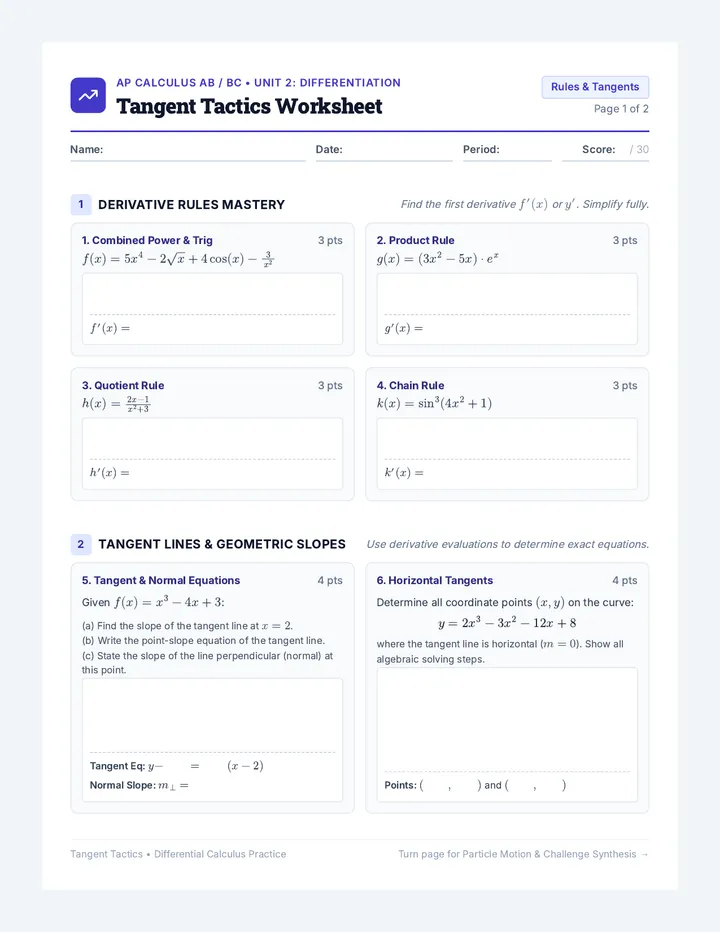
A structured practice worksheet for trigonometric derivatives, featuring basic differentiation, product/quotient rules, and complex chain rule applications. Includes space for detailed student work and a quick reference guide.
The detailed answer key for the Calculus Catalysts Workout, providing step-by-step solutions for limits, instantaneous rate of change, and basic function optimization problems.
A student practice worksheet for calculus-adjacent ACT concepts, featuring limits, instantaneous rate of change logic, and function optimization problems.
A visual slide deck explaining introductory calculus concepts for the ACT, including limits, instantaneous rate of change, and basic function optimization using standard blueprints. Revised for font size compliance (min 24px).
The detailed answer key for the Trig Titan Workout, including step-by-step solutions for identities, the unit circle, and non-right triangle problems.
A comprehensive practice worksheet for advanced ACT trigonometry, featuring sections on identities, the unit circle, Law of Sines/Cosines, and 'Final Ten' challenge problems.
A visual slide deck covering advanced ACT trigonometry: Pythagorean identities, the unit circle, Law of Sines/Cosines, and the ambiguous SSA case. Revised for font size compliance (min 24px).
The detailed answer key for the Geometric Grandeur Workout, providing step-by-step solutions for circle equations, 3D volume, and coordinate geometry problems.
A specialized geometry workout featuring problems on circle equations, 3D volume visualization, and coordinate geometry, including advanced 'Final Ten' style challenges like inscribed octagons and 3D coordinate spheres.
Students explore the application of derivatives in real-world contexts beyond physics, specifically focusing on instantaneous rates of change in biology, finance, and social media growth using the limit definition.
An 11th-grade honors lesson connecting the limit definition of the derivative to instantaneous velocity through rocket launch simulations. Students will analyze height functions to determine peak altitude and impact force.
This lesson introduces 11th-grade students to the distinction between average and instantaneous rates of change. Students analyze real-world COVID-19 data and explore a quadratic function by 'shrinking the interval' to discover the concept of a tangent line.
The sequence concludes with an introduction to stochastic sequences, simulating random walks to model stock price movements.
Students analyze bonds as series of cash flows, using differentiation to calculate Duration and assess interest rate risk.
This lesson explores the valuation of infinite horizons, applying geometric series convergence to price perpetuities and the Dividend Discount Model.
Learners model loan payments and savings plans using finite geometric series, deriving amortization formulas for mortgages and annuities.
Students derive the compound interest formulas as geometric sequences, exploring the impact of compounding frequency and the limit as it approaches infinity (continuous compounding).
A synthesis session where students tackle complex problems combining slope, tangency, and coordinate conversion, including peer review and error analysis.
Students apply derivatives to find maximum values of r (distance from origin) and y (height) to solve geometric optimization problems within polar contexts.
A focused lesson on finding tangent lines at the origin (the pole) by determining where r=0 and analyzing the behavior of rose curves and other polar functions.
A series of lessons designed to build fluency in mathematical notation and operations through visual and tactile learning.
This sequence explores numerical analysis through the lens of sequences, focusing on iterative methods to approximate solutions to complex equations. Students investigate fixed-point iteration, Newton's method, convergence rates, and the transition into chaotic behavior.
This graduate-level sequence explores the pedagogical content knowledge (PCK) needed to teach mathematical sequences and limits. It traces the historical development from Zeno's paradoxes to modern rigor, equipping educators to address common student misconceptions through inquiry-based instruction.
A graduate-level exploration of discrete dynamical systems, moving from linear growth models to the complex, chaotic behavior of the logistic map. Students apply recursive sequences to model biological and economic phenomena, emphasizing stability analysis and bifurcation theory.
A comprehensive unit on parametric equations and their applications in modeling motion. Students move from the basics of parametric curves to advanced calculus concepts like derivatives, concavity, vectors, and arc length.
A sequence for undergraduate students bridging pre-calculus and calculus by focusing on the analytical properties of functions with rational exponents. Students explore graphing, algebraic rewriting, rationalizing for limits, and growth comparison.
This advanced sequence bridges series to function approximation, introducing Power Series and Taylor Polynomials. Students discover how polynomials can mimic complex curves like sine and cosine, moving from simple tangent lines to higher-order polynomials while investigating convergence and approximation error.
Worksheet for practicing error analysis in related rates problems, featuring "Crime Scenes" where students must identify and correct common calculus mistakes.
Full solution guide for the "Calculus Gauntlet" seminar in Lesson 5, providing step-by-step mathematical breakdowns for all four challenge stages.
Comprehensive final exam for the Volume Flow Dynamics sequence. Includes problems on spherical balloons, cylindrical reservoirs, and a net-flow conical sieve problem.
Student workspace for the Lesson 5 "Calculus Gauntlet" seminar, designed for teams to record their solutions to the four challenge stages.
Visual presentation for Lesson 5 focusing on common errors like premature substitution, unit misalignment, and sign errors in related rates problems.
Final case study for Lesson 5. Students solve net flow problems involving a cylindrical reactor breach and a conical containment pit, culminating in an engineering recommendation.
Challenge cards for the "Calculus Gauntlet" seminar in Lesson 5, featuring complex, multi-stage related rates problems combining shadows, trigonometry, and geometry.
A final exit ticket to assess student understanding of Pythagorean related rates. Includes a computational problem involving a coordinate path and a conceptual comparison of rates.
Slide deck for Lesson 5 on Net Flow Dynamics. Covers the concept of dV/dt = In - Out, a cylindrical tank emergency scenario, and the added complexity of net flow in conical containers.
Answer key for Lesson 4's "The Shoreline Sweep" activity sheet, with detailed mathematical derivations for Part A, B, and C.
An advanced challenge set for the final lesson, featuring multi-object motion (baseball diamond), accelerating objects, and the classic lamppost shadow problem. Requires synthesis of geometry, calculus, and physics.
Synthesis worksheet for practicing the 4-step Related Rates protocol: Sketch, GFW List, Relate Equation, and Differentiate/Solve.
A collection of mathematical and physical problems ranging from early childhood addition to advanced network theory.
A comprehensive unit for 12th Grade Calculus students focusing on the integration of polar functions to find area, arc length, and surface area. Students transition from Cartesian thinking to radial accumulation, mastering the geometry of circular sectors and polar coordinate transformations.
A graduate-level exploration of expected value through the lens of measure theory, covering Lebesgue integration, fundamental inequalities, convergence theorems, and conditional expectation using Sigma-algebras.
An inquiry-based exploration of convergence tests for infinite series, focusing on visualization, logical justification, and strategic selection of testing methods. Students develop a comprehensive understanding of how to determine the behavior of unending sums.
A rigorous unit for 12th-grade Calculus students focusing on the Integral Test, p-series, and Comparison Tests (Direct and Limit) to determine the convergence of positive-term infinite series. Students will build a logical framework for selecting the most efficient convergence test for various mathematical structures.
A comprehensive advanced calculus unit exploring the use of vector-valued functions to model and analyze motion in 2D and 3D space. Students will master differentiation, integration, and arc length calculations within a kinematic context, culminating in complex projectile modeling.
This sequence explores the intrinsic geometry of curves in 3D space, focusing on arc length parameterization, the unit tangent vector, curvature, the principal normal vector, and torsion. Students will learn to quantify how paths bend and twist using the TNB (Tangent, Normal, Binormal) frame, providing a coordinate-independent description of movement.
A comprehensive unit connecting differentiation and integration through the Fundamental Theorem of Calculus. Students transition from visualizing accumulation to mastery of algebraic evaluation, applying these concepts to real-world net change and total area problems.
A technical skill-building sequence for 11th-grade students focusing on the algebraic processes of finding antiderivatives, from basic power rules to solving initial value problems.