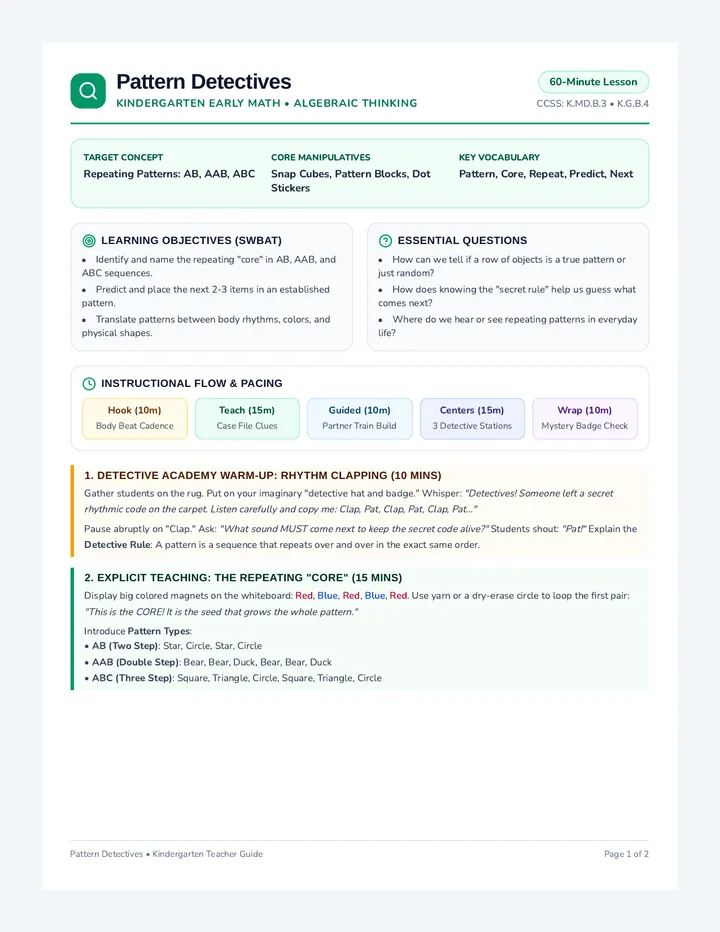
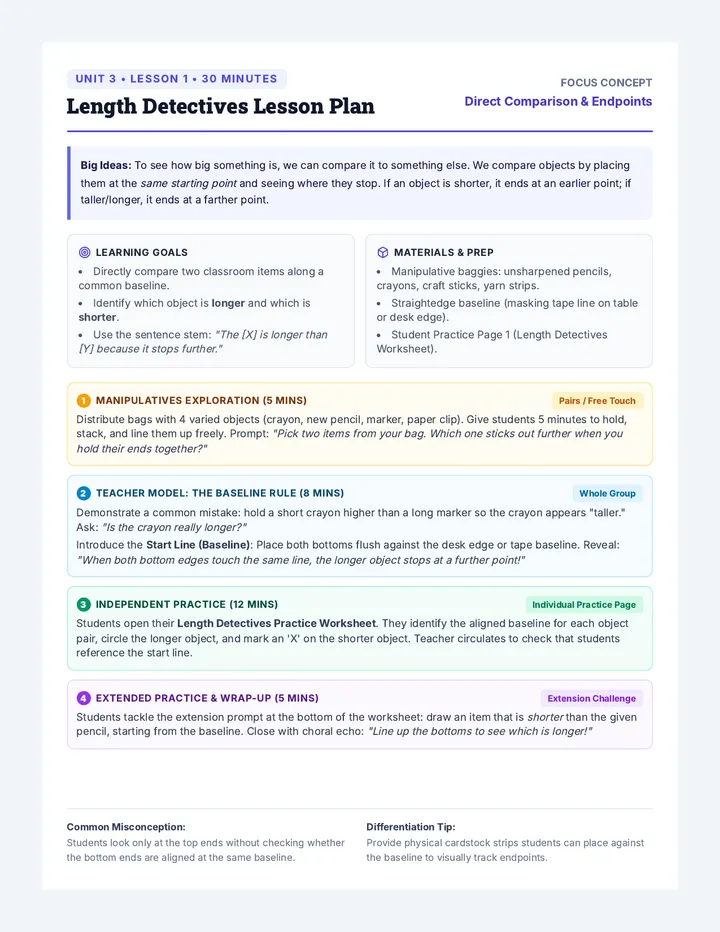
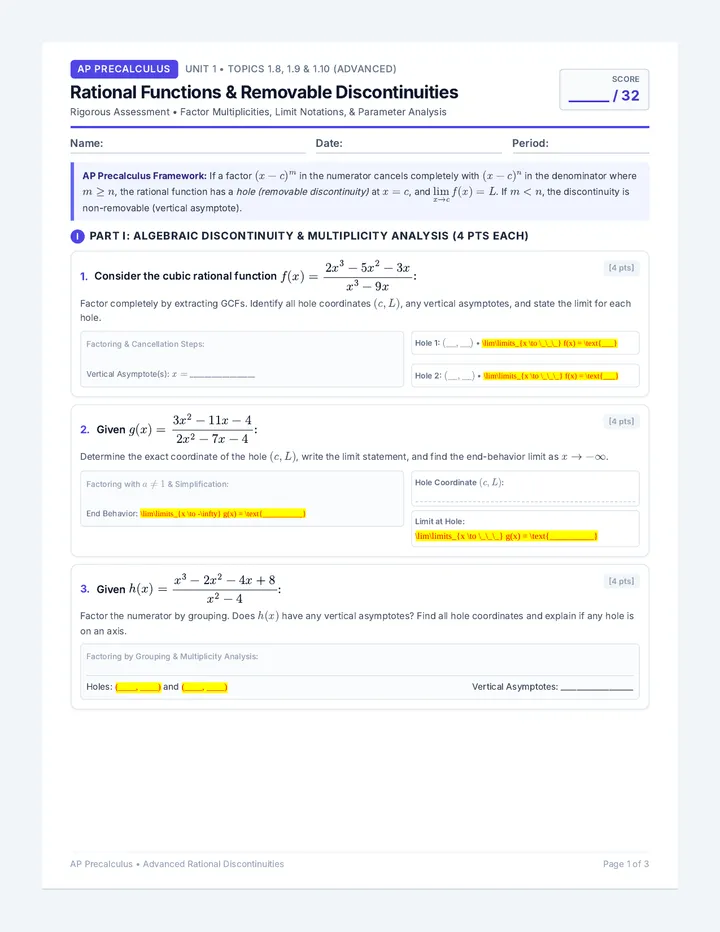
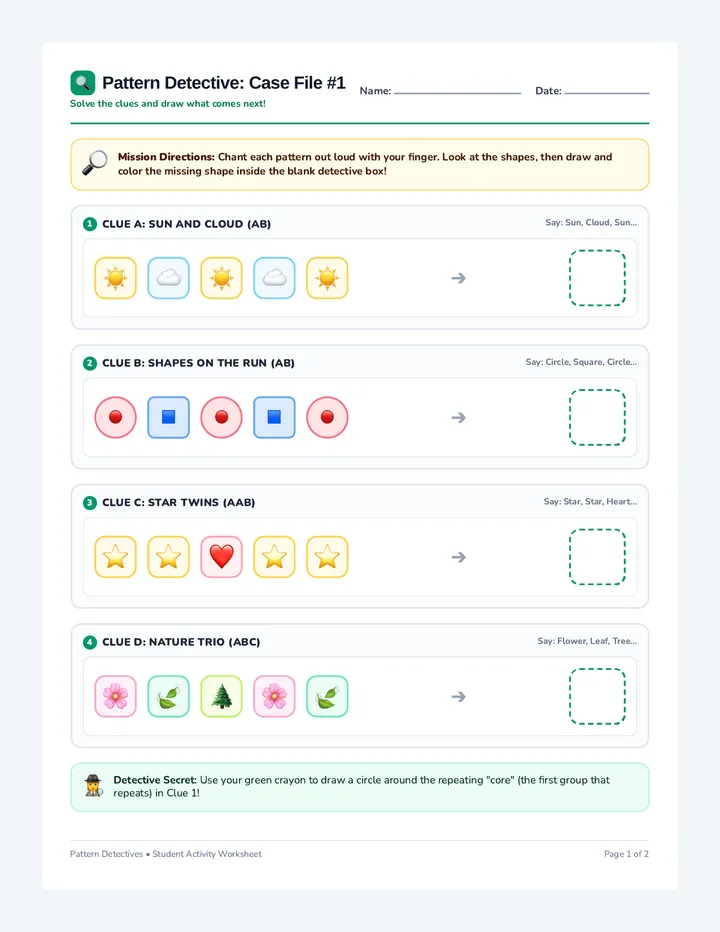
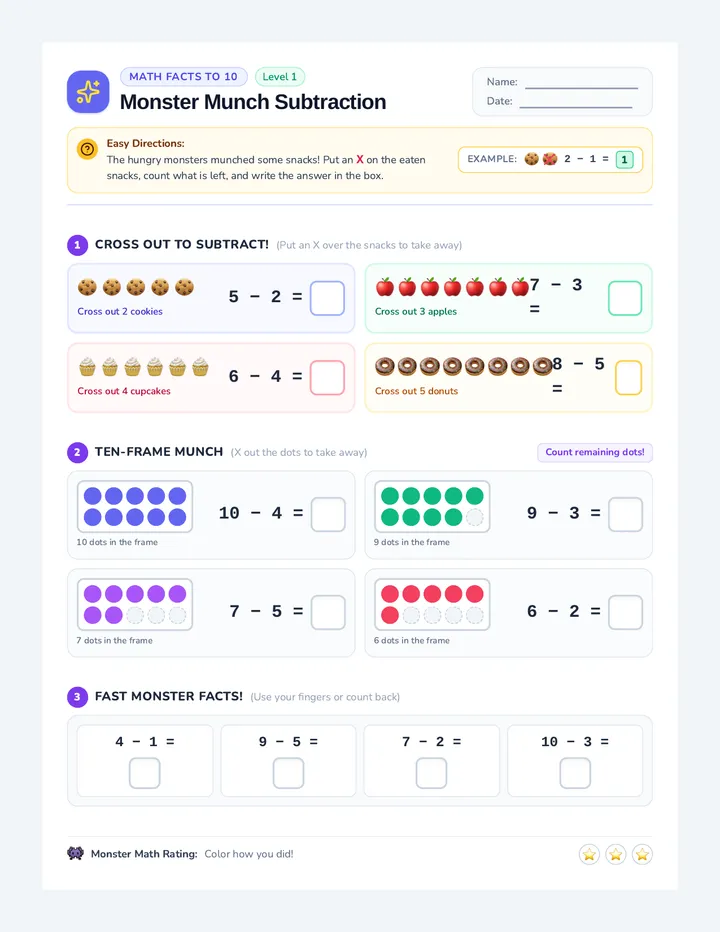
Dino Sums WorksheetDino Sums NAME: DATE: Roar! Can you help the dinosaurs count their eggs and friends? Write the answer in the box! 🦖 1 🦖 1 = 🥚 🥚 2 🥚 1 = 🌴 🌴 🌴 3 🌴 🌴 2 = 1 + 2 = 2 + 2 = 3 + 1 = 4 + 1 =
Dino Sums KeyDino Sums Answer Key Teacher Edition 🦖 1 🦖 1 = 2 🥚 🥚 2 🥚 1 = 3 🌴 🌴 🌴 3 🌴 🌴 2 = 5 1 + 2 = 3 2 + 2 = 4 3 + 1 = 4 4 + 1 = 5
Grid Logic SlidesInfinite Grids Calculating Equivalent Resistance in 2D Networks The Challenge Imagine an infinite square grid of identical resistors, each with resistance R. "What is the equivalent resistance between two adjacent nodes?" This isn't a simple series/parallel problem. Standard reduction rules fail when the network has no boundaries. Nodes A and B The Superposition Trick Step 1: Inject Current Inject current \( I \) into node A. By symmetry, the current flows out through 4 identical paths. Each path carries \( I/4 \). Step 2: Extract Current Extract current \( I \) from node B. By symmetry, current \( I/4 \) must flow into B from each of its 4 neighbors. Total Current in the Branch AB: \( I_{AB} = \frac{I}{4} + \frac{I}{4} = \frac{I}{2} \) Using Ohm's Law (\( V_{AB} = I_{AB} \cdot R \)): \( V_{AB} = \frac{I \cdot R}{2} \) The Conclusion For adjacent nodes in an infinite 2D grid: Req = \( \frac{R}{2} \) 1D (Line) \( \frac{R}{1} \) 2D (Square) \( \frac{R}{2} \) 3D (Cubic) \( \frac{R}{3} \)
Network Theory HandoutTECHNICAL SPECIFICATION // GRID-RES-INF-001 SHEET 01 OF 01 Infinite Network Analysis Subject: Equivalent Resistance in 2D Infinite Square Grids RESTRICTED DATA Rev: 2026.03 Class: Theoretical Physics Problem Statement Consider an infinite two-dimensional square lattice where every edge is a resistor of value R. The objective is to determine the equivalent resistance \( R_{eq} \) between two arbitrary nodes \( (0,0) \) and \( (m,n) \). Case 1: Adjacent Nodes The solution for nodes separated by a single resistor is elegantly found via the Superposition Principle. 1. Inject current \( I \) at Node A. Symmetry dictates \( I/4 \) flows through each neighbor. 2. Extract current \( I \) at Node B. Symmetry dictates \( I/4 \) enters from each neighbor. 3. Superpose: Current in branch AB = \( I/4 + I/4 = I/2 \). 4. Voltage drop \( V_{AB} = I_{branch} \cdot R = (I/2)R \). 5. Total Resistance \( R_{eq} = V_{AB} / I_{total} = (I \cdot R/2) / I = R/2 \). \( R_{adjacent} = \frac{R}{2} \) Case 2: The General Solution For non-adjacent nodes \( (m,n) \), we employ the lattice Green's function. The potential at site \( (m,n) \) relative to the origin when current \( I \) is injected at \( (0,0) \) is: \[ R(m,n) = \frac{R}{2\pi} \int_0^\pi \int_0^\pi \frac{1 - \cos(mx)\cos(ny)}{2 - \cos(x) - \cos(y)} dx dy \] Key Reference Values: Offset (m, n)Equivalent Resistance(1, 0) - Adjacent\( R/2 \)(1, 1) - Diagonal\( 2R/\pi \approx 0.637R \)(2, 0) - Skip One\( R(4/\pi - 1) \approx 0.273R \) Problem for Analysis Given a grid of \( 10\Omega \) resistors, calculate the equivalent resistance between nodes at \( (0,0) \) and \( (1,0) \). Then, qualitatively explain why the resistance between \( (0,0) \) and \( (2,2) \) must be greater than \( R/2 \). WORKSPACE: CALCULATIONS & DIAGRAMS
Grid Challenge SetGrid Challenge Set Infinite Lattice Resistance Assessment Candidate: Sector: 1 The Adjacent Case Consider an infinite 2D grid of \( 100\,\Omega \) resistors. Using the superposition principle, calculate the equivalent resistance between two adjacent nodes. 2 The Diagonal Bridge For a diagonal pair of nodes at coordinates \( (0,0) \) and \( (1,1) \), the theoretical resistance is known to be \( \frac{2R}{\pi} \). If each resistor is \( 50\,\Omega \), what is the numerical equivalent resistance? FORMULA FINAL ANSWER 3 Scaling Up Predict the equivalent resistance between adjacent nodes in an infinite 3D cubic lattice of resistors \( R \). Use symmetry and current injection logic to support your claim. 4 Infinite vs. Finite Why does the equivalent resistance decrease as you move from a 1D chain to a 2D grid to a 3D lattice? Explain in terms of available current paths. DATA-STREAM-CONNECTED // GRID-PHYSICS-V1
Grid Answer KeySolution Matrix Master Key // Grid Challenge Set TEACHER USE ONLY 1 Adjacent Case Solution Final Value: \( 50\,\Omega \) Using \( R_{eq} = R/2 \): \( R = 100\,\Omega \) \( R_{eq} = 100 / 2 = 50\,\Omega \) Reasoning: Superposition of \( I/4 \) in and \( I/4 \) out results in \( I/2 \) branch current. 2 Diagonal Bridge Solution Final Value: \( \approx 31.83\,\Omega \) Formula: \( \frac{2R}{\pi} \) Calculation: \( \frac{2 \cdot 50}{3.14159...} = \frac{100}{\pi} \approx 31.8309\,\Omega \) 3 3D Cubic Lattice Solution Final Value: \( R_{eq} = R/3 \) In a 3D cubic grid, each node has 6 neighbors. By superposition: Inject \( I \) at A: \( I/6 \) flows through branch AB. Extract \( I \) at B: \( I/6 \) flows through branch AB. Total \( I_{AB} = I/6 + I/6 = I/3 \). \( V_{AB} = (I/3)R \), so \( R_{eq} = V_{AB}/I = R/3 \). 4 Dimensional Analysis Theory As dimensionality increases, the number of parallel paths for current to travel through the "bulk" of the infinite grid increases. - In 1D, there are only 2 directions (total path limited). - In 2D, there are 4 directions (more degree of freedom). - In 3D, there are 6 directions. Greater connectivity results in a lower effective resistance between any two points. Correction Protocol Ensure students have accounted for symmetry in their initial current injection step. Common error: forgetting to add both injection and extraction currents.