Lenny.com
Explore
Create
ActivitiesNewMathEnglish Language ArtsScience & EngineeringSocial StudiesGlobal LanguagesHealth & Physical EducationSpecial EducationCounseling & Life SkillsArts & CreativityESL
Lenny.com
Lenny.com
Explore
Create
ActivitiesNewMathEnglish Language ArtsScience & EngineeringSocial StudiesGlobal LanguagesHealth & Physical EducationSpecial EducationCounseling & Life SkillsArts & CreativityESL
Lenny.com
Lenny.com

Solutions

Lenny for EducatorsLenny for SchoolsLenny for Districts

Product

ExploreSign inCreateSupportAbout

Resources

Getting startedMTSS Acceleration Program

© 2026 Lenny Learning Inc.

TermsPrivacyAccessibility
LinkedInInstagramX
Lenny

Polynomial Operations

Addition, subtraction, and multiplication of algebraic expressions using properties of exponents and distribution. Includes long and synthetic division techniques for simplifying higher-degree functions into standard form.

MathNumbers & CountingCounting ObjectsNumber NamesComparing NumbersNumber OperationsCounting SequenceNumbers 0-10Place Value Understanding and SystemAdd and Subtract Within 20Addition and Subtraction ConceptsAddition and Subtraction EquationsAddition and Subtraction ProblemsFoundations for MultiplicationMultiplication and Division PropertiesMultiply and Divide Within 100Multiplication and Division ProblemsFactors and MultiplesProperties of OperationsPatterns and RelationshipsGenerate and Analyze PatternsMulti-Digit ArithmeticPlace Value OperationsMulti-Digit and Decimal OperationsNumerical ExpressionsFour Operations and PatternsFour Operations Problem SolvingMeasurement & DataMeasurable AttributesMeasuring LengthsMeasure and Estimate Lengths in Standard UnitsRelate Addition and Subtraction to LengthClassifying and Counting ObjectsTime and MoneyArea Concepts and MeasurementPerimeter and Area MeasuresAngle Concepts and MeasurementTime, Volume, and MassMeasurement Unit ConversionsGeometryIdentifying ShapesShapes and AttributesShape Attributes and ReasoningShapes and CompositionClassifying 2D FiguresGeometric Figures and RelationshipsLines, Angles, and ShapesAngle, Area, and VolumeGeometric MeasurementVolume of 3D ShapesCoordinate Plane ApplicationsTransformations in the PlaneCongruence and SimilarityUnderstand congruence in terms of rigid motionsSimilarity and TransformationsProve Theorems Involving SimilarityPythagorean TheoremTrigonometry for General TrianglesMake Geometric ConstructionsProve Geometric TheoremsTheorems About CirclesFind Arc Lengths And Areas of Sectors of CirclesVolume FormulasRelationships Between Two-Dimensional and Three-Dimensional ObjectsProve Simple Geometric Theorems AlgebraicallyTranslate Between Geometric Description and Equation for Conic SectionApply Geometric Concepts in Modeling SituationsFractions & DecimalsFractions as NumbersBuilding FractionsFraction Equivalence and OrderingAdding and Subtracting FractionsMultiplying and Dividing FractionsDividing FractionsDecimal FractionsMulti-Digit Computation and FactorsAdd, Subtract, Multiply, and Divide Rational NumbersRational Number SystemIrrational Numbers and ApproximationsRatiosRatios and ProportionsProportional RelationshipsUnit RateAlgebraAlgebraic ExpressionsGenerate Equivalent ExpressionsQuantitative RelationshipsProportional Relationships and Linear EquationsEquations and InequalitiesEquation Solving and ReasoningLinear Equations and SystemsGraph Equations and InequalitiesSystems of EquationsReal-World Algebraic ProblemsQuantitative Reasoning with UnitsExpression StructureEquivalent Expression FormsRadicals and Integer ExponentsRational ExponentsRational and Irrational NumbersPolynomial OperationsPolynomial IdentitiesPolynomial Zeros and FactorsRational ExpressionsComplex Number OperationsComplex Numbers in PolynomialsComplex Numbers on PlaneStatistics & ProbabilityRepresent and Interpret DataData DistributionsStatistical VariabilityProbability ModelsCompound Event ProbabilitiesStatistical SamplingInterpret Categorical and Quantitative DataBivariate Data PatternsInterpret Linear ModelsComparing Two PopulationsRandom Processes in StatisticsIndependence and Conditional ProbabilityExpected ValuesProbability-Based Decision MakingStatistical Inference and ConclusionsFunctionsFunction Concepts and NotationDefine and Compare FunctionsInterpret Functions in ContextAnalyze Function RepresentationsModel Relationships with FunctionsIdentify Linear vs Exponential GrowthDistinguish Between Function TypesCompare Growth RatesInterpret Function ExpressionsBuild Functions from RelationshipsConstruct and Model FunctionsTransform and Combine FunctionsModel Comparison and SelectionSolve Exponential EquationsTrigonometryTrigonometric Ratios Involving Right TrianglesTrigonometric Functions and Unit CircleModel with Trigonometric FunctionsTrigonometric IdentitiesVectors & MatricesIntroduction to Vectors and MatricesVector QuantitiesVector OperationsMatrix OperationsCalculusLimits and ContinuityDerivative Concepts and NotationDerivative Rules and TechniquesApplications of DerivativesOptimization ProblemsRelated RatesCurve Sketching and AnalysisIntegration Concepts and NotationAntiderivatives and Indefinite IntegralsDefinite Integrals and AreaFundamental Theorem of CalculusIntegration TechniquesApplications of IntegrationDifferential EquationsSequences and SeriesParametric and Polar FunctionsVector-Valued Functions

Videos

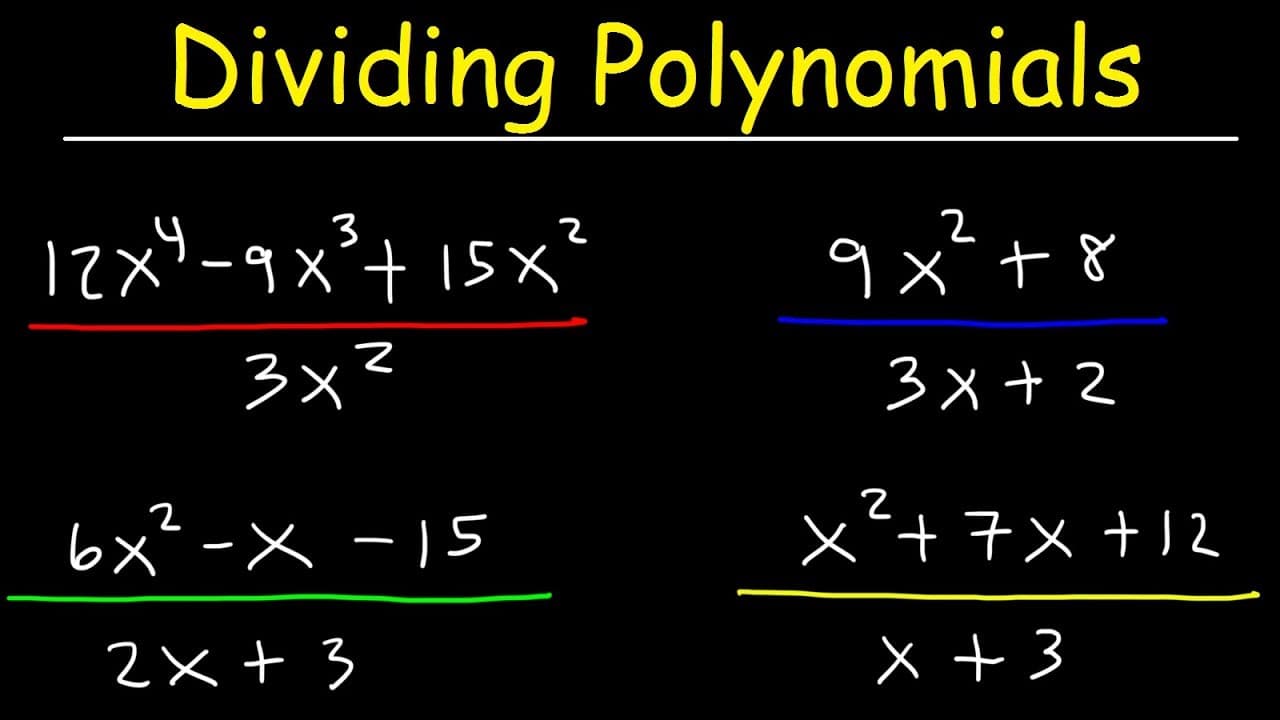
Mastering Polynomial Division: Monomials and Long Division

Mastering Polynomial Division: Monomials and Long Division

This instructional video provides a comprehensive tutorial on dividing polynomials, covering two distinct methods based on the divisor type. The video begins by demonstrating how to divide a polynomial by a monomial (a single term) by separating the expression into individual fractions and simplifying each term using exponent rules. This section builds a foundation for understanding term-wise division before moving to more complex scenarios. The second and larger portion of the video focuses on algebraic long division, used when dividing a polynomial by a binomial (two terms). The instructor walks through the standard algorithm step-by-step: divide, multiply, subtract, and bring down. Key themes include organizing polynomials in descending order, handling negative signs during subtraction, and checking answers by multiplying the quotient and divisor (FOIL method). This resource is highly valuable for high school algebra classrooms. It addresses common student stumbling blocks, such as what to do when a term is missing in the polynomial sequence (using placeholders like 0x) and how to properly format a final answer that includes a remainder. The clear, color-coded handwriting helps visual learners track the movement of numbers and variables throughout the complex multi-step processes.

The Organic Chemistry TutorThe Organic Chemistry Tutor

10mins 49s

Algebra 1 Final Exam Review: Part 1

Algebra 1 Final Exam Review: Part 1

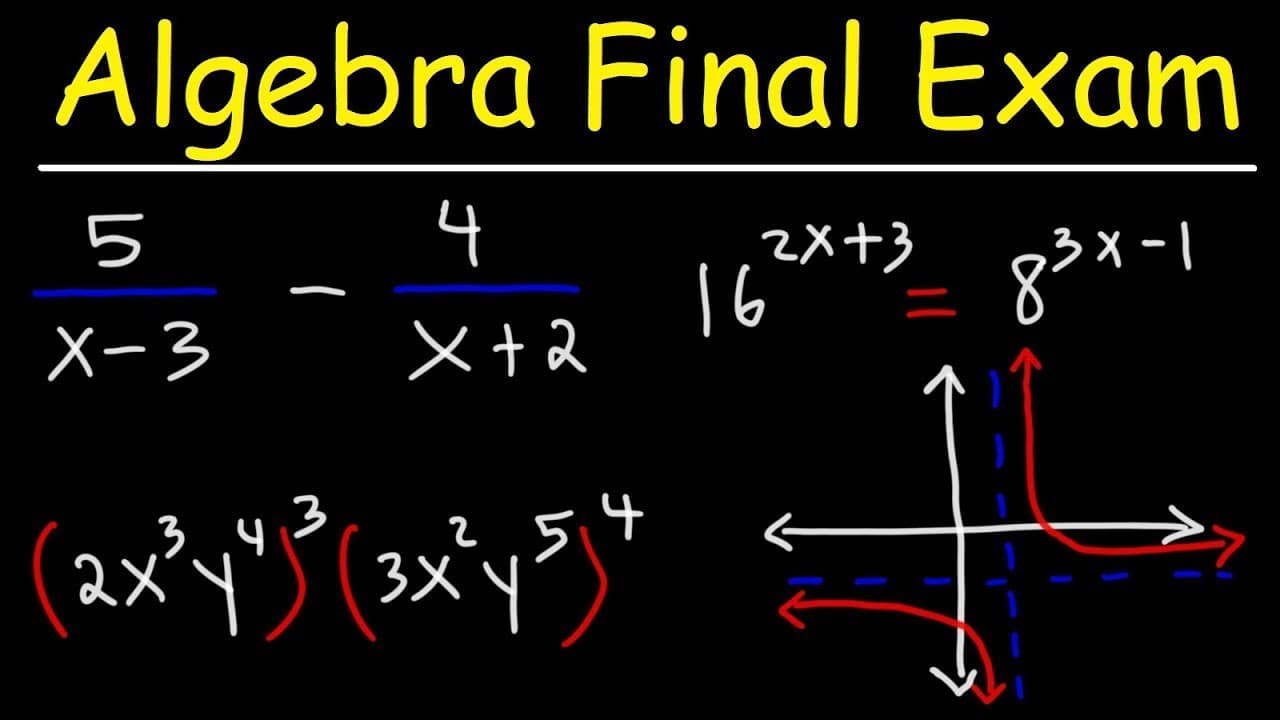
This comprehensive video serves as a targeted review for students preparing for an Algebra 1 final exam. It systematically walks through 15 distinct problem types commonly found on end-of-course assessments, covering a wide range of algebraic concepts. The video format functions as a digital tutor, presenting a problem, allowing the viewer to pause and attempt it, and then providing a detailed, step-by-step walkthrough of the solution. The instructor uses clear visual annotations on a blackboard style background to demonstrate the mechanics of each operation. Key algebraic themes explored include operations with polynomials (multiplying binomials, subtracting polynomials), linear functions (finding slope, graphing lines, matching equations to graphs), and factoring techniques (difference of squares, trinomials, difference of cubes). The video also covers solving various types of equations, including linear, quadratic, rational, and systems of equations. Additionally, it addresses exponent rules, the order of operations, and applying algebraic concepts to geometric word problems involving area and perimeter. For educators, this video is a valuable resource for review sessions, flipped classroom assignments, or differentiated instruction. It allows students to self-pace their review, focusing on areas where they need the most support. The clear explanations of multiple methods (e.g., solving quadratics by factoring vs. the quadratic formula) help reinforce conceptual understanding rather than just rote memorization. Teachers can use specific segments to reteach difficult concepts or assign the entire video as a comprehensive study guide before major assessments.
The Organic Chemistry TutorThe Organic Chemistry Tutor

55mins 8s

How to Subtract Polynomials by Distributing the Negative

How to Subtract Polynomials by Distributing the Negative

This instructional math video guides students through the process of subtracting polynomials. It begins with a brief real-world hook mentioning how medical researchers use polynomials to model bacterial colonies, providing a context for the abstract math to follow. The video then transitions into a clear, step-by-step tutorial using a digital whiteboard format.

Miacademy & MiaPrep Learning ChannelMiacademy & MiaPrep Learning Channel

5mins 53s

How to Calculate the Area of a Square from Sides, Perimeters, and Diagonals

How to Calculate the Area of a Square from Sides, Perimeters, and Diagonals

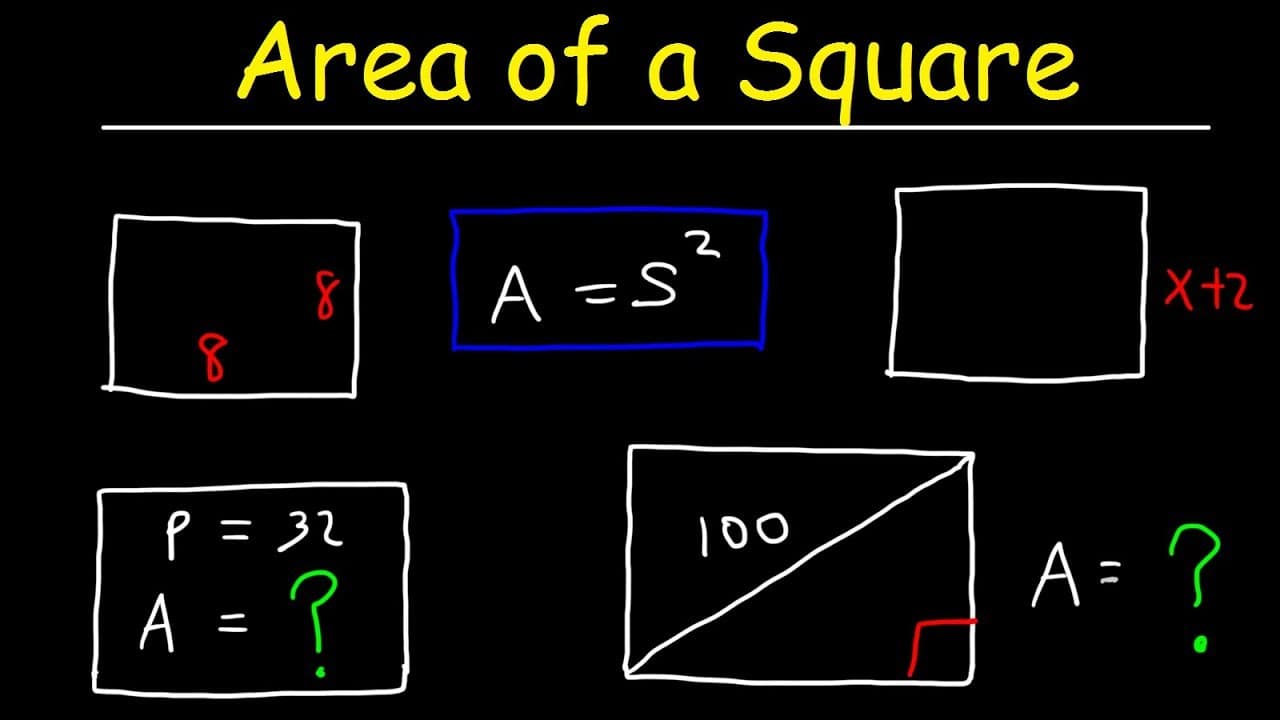
This instructional math video provides a comprehensive guide to calculating the area of a square using various given parameters. The narrator moves beyond basic side-length calculations to explore more complex scenarios that students encounter in algebra and geometry courses. The video demonstrates four specific problem types: finding area given a numerical side length, finding area given a binomial side length (requiring polynomial expansion), finding area given the perimeter, and finding area given the length of the diagonal. The content bridges the gap between arithmetic geometry and algebraic geometry. Key themes include the application of the standard area formula ($A = s^2$), expanding binomials using the FOIL method, solving for variables using linear equations ($P = 4s$), and applying the Pythagorean theorem ($a^2 + b^2 = c^2$) to derive side lengths from diagonals. The video emphasizes that area calculation often requires intermediate steps to determine the side length first. For educators, this video is an excellent resource for showing how geometry concepts connect with algebra. It is particularly useful for demonstrating why algebra skills are needed in geometric contexts. Teachers can use the specific segments to differentiate instruction—using the first segment for review, the second for connecting polynomials to geometry, and the final segment for advanced applications involving the Pythagorean theorem. The step-by-step narration allows for easy pausing and student prediction during class.

The Organic Chemistry TutorThe Organic Chemistry Tutor

5mins 39s

Calculating the Derivative at a Specific Point

Calculating the Derivative at a Specific Point

This educational video introduces the concept of the derivative at a specific point, bridging the gap between average rates of change and instantaneous rates of change. It begins by connecting the slope of a tangent line to the limit definition of a derivative, deriving the standard formula using 'h' to represent the distance between x-values. The narrator explains the notation $f'(a)$ and demonstrates how to calculate it algebraically through direct substitution and simplification limits. The video covers several key mathematical themes, including the definition of a derivative, evaluating limits, expanding binomials, and rationalizing numerators. It provides step-by-step worked examples ranging from polynomial functions to rational functions involving square roots. A significant portion of the video is dedicated to a real-world application problem involving projectile motion, where students learn to interpret the derivative as velocity (instantaneous rate of change) in the context of a rocket launch. For educators, this video serves as an excellent core lesson for Precalculus or Calculus I units on derivatives. It offers built-in pause points for student practice, addresses algebraic complexities like expanding powers and handling negative signs, and explicitly connects abstract mathematical calculations to physical interpretations like speed and direction. The visual graphs accompanying the algebraic work help students verify their calculations against geometric intuition.

Miacademy & MiaPrep Learning ChannelMiacademy & MiaPrep Learning Channel

12mins 45s

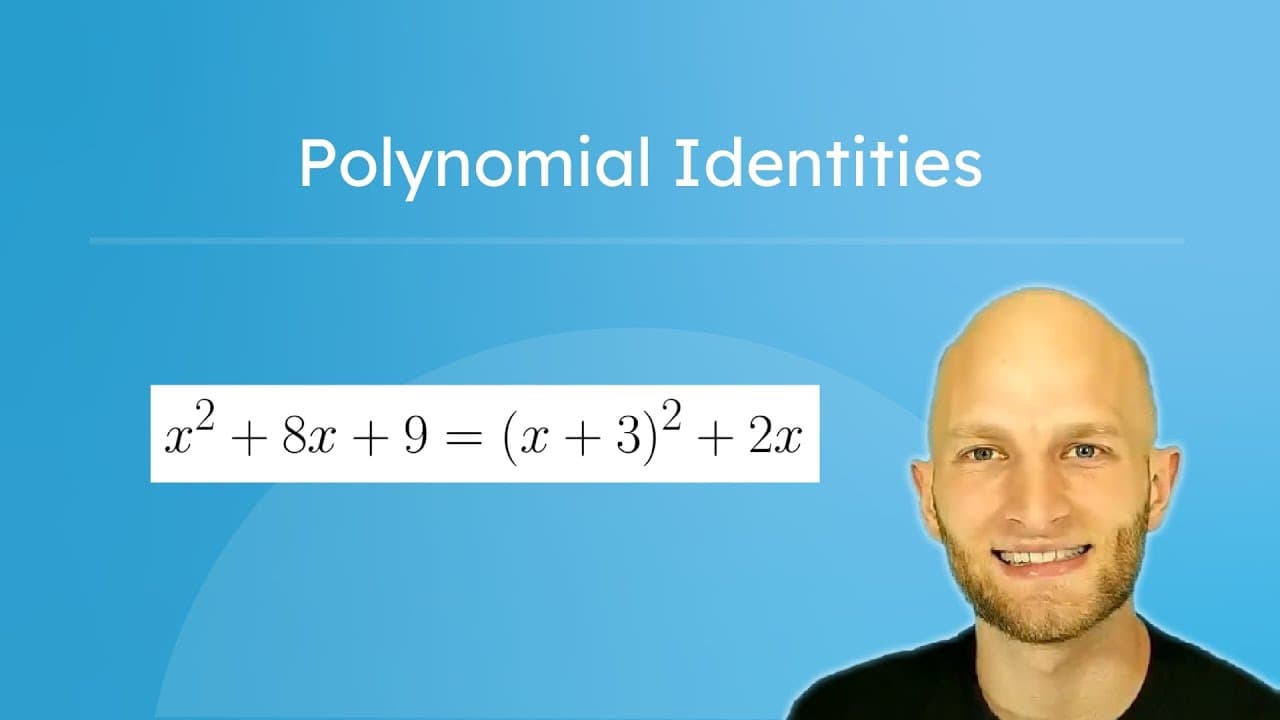
Completing Polynomial Identities by Factoring and Expansion

Completing Polynomial Identities by Factoring and Expansion

This instructional video guides students through the concept of polynomial identities and methods to verify them. The narrator, Randy, defines a polynomial identity as an equation that remains true for all values of the variable. The video demonstrates two primary strategies for completing identities: manipulating expressions through multiplication (expansion) and simplifying expressions through factorization. The video covers two distinct examples. The first example involves a quadratic expression where the strategy is to expand the multiple-choice options to see which one matches the original expression. The second example presents a higher-degree polynomial where the narrator uses Greatest Common Factor (GCF) extraction and trinomial factoring to simplify the expression and find the matching identity. For educators, this video serves as an excellent model for teaching algebraic equivalence. It reinforces core algebra skills including squaring binomials, distributing terms, combining like terms, finding GCFs, and factoring quadratic trinomials. It is particularly useful for Algebra I and II classrooms to demonstrate that algebraic manipulation allows us to write the same quantity in different forms.

Miacademy & MiaPrep Learning ChannelMiacademy & MiaPrep Learning Channel

7mins 3s

Materials

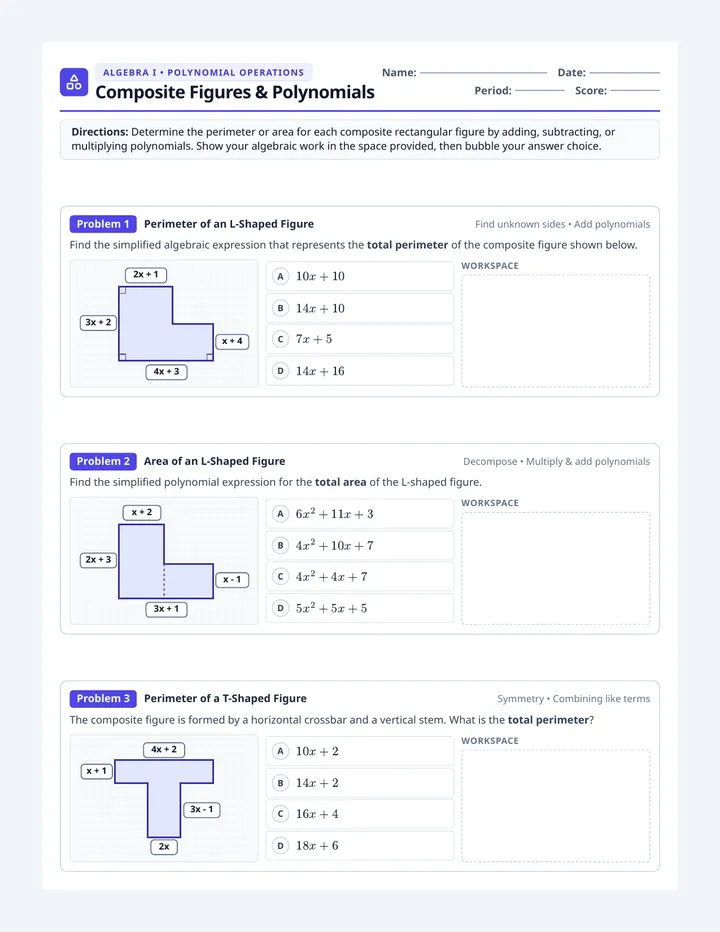
Composite Polynomials Worksheet

Composite Polynomials Worksheet

A two-page printable high school Algebra I worksheet containing 6 multiple-choice problems on finding the perimeter and area of composite rectangular figures using polynomial addition, subtraction, and multiplication, featuring crisp, bold SVG geometric diagrams with high-contrast dimension labels and student workspaces.

JW

Jessica Waters

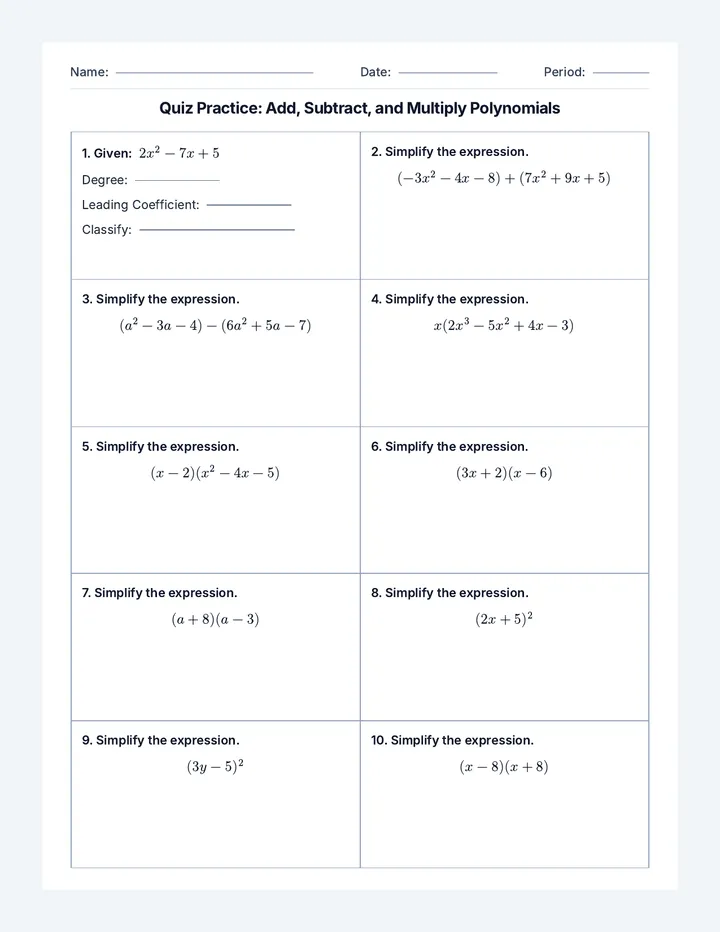
Polynomial Operations Practice Worksheet

Polynomial Operations Practice Worksheet

A clean, print-ready practice worksheet featuring 10 polynomial problems matching the exact structure and difficulty of the original quiz. It covers classifying polynomials, adding, subtracting, monomial multiplication, binomial by trinomial multiplication, FOIL binomial multiplication, and special products.

MR

Mahuya Roy Chowdhury

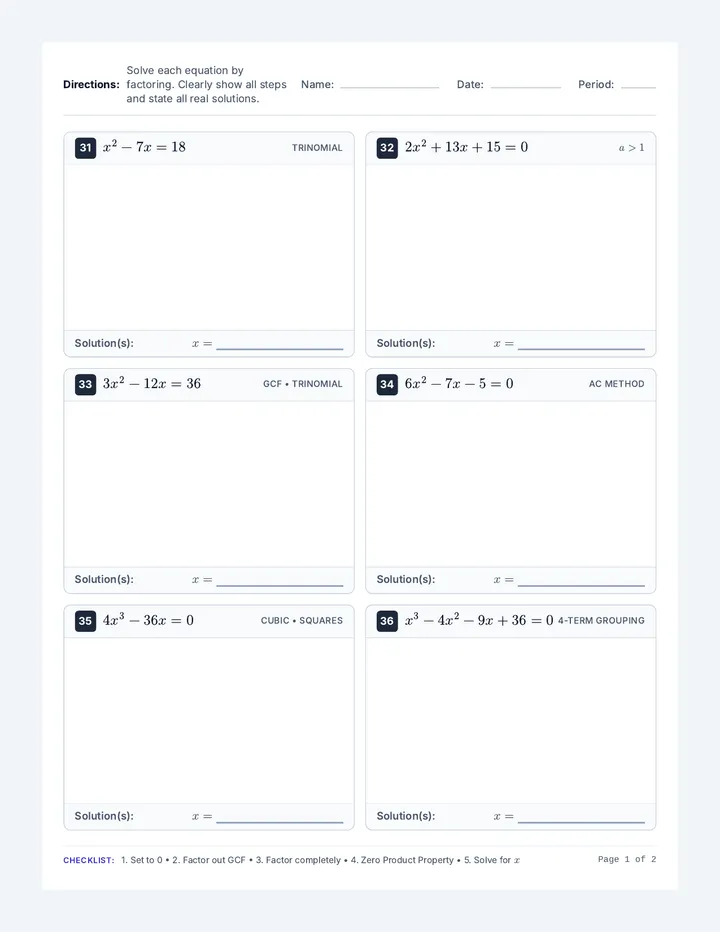
Factor Forge Worksheet

Factor Forge Worksheet

A streamlined 2-page Algebra II resource featuring problems #31–#36 with expanded student workspaces on page 1 and complete step-by-step solutions on page 2.

AR

Angie Rice

Polynomial Operations Answer Key

Polynomial Operations Answer Key

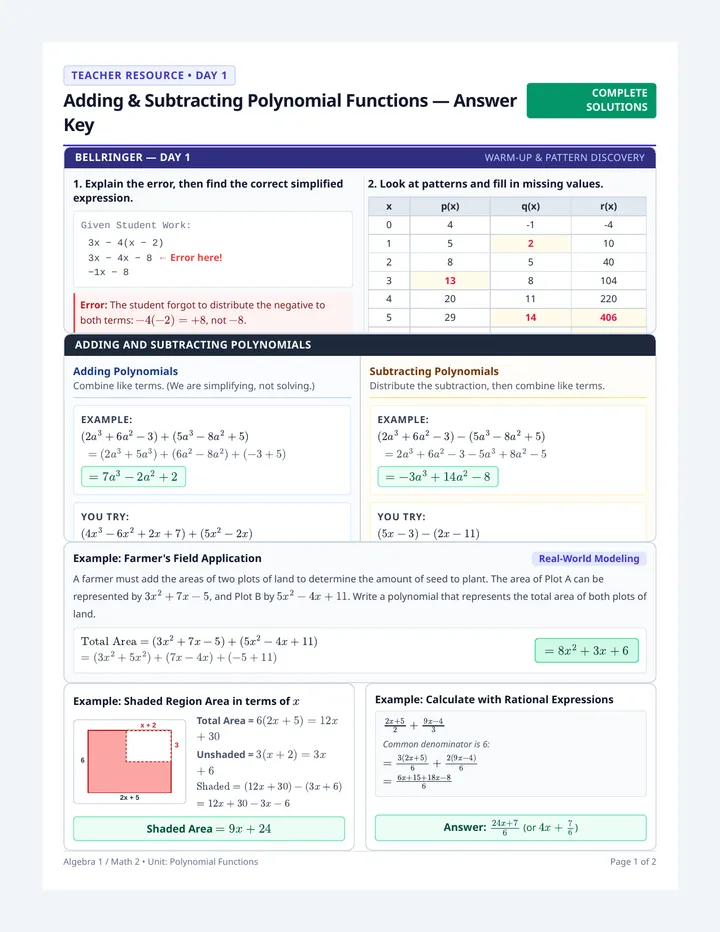
Complete teacher answer key for the two-day notes packet on adding and subtracting polynomial and linear functions. Includes fully worked-out step-by-step solutions, error analysis notes, completed input-output tables, geometric diagrams, and graphical representations.

MR

Mahuya Roy Chowdhury

Polynomial Exit Ticket Answer Key

Polynomial Exit Ticket Answer Key

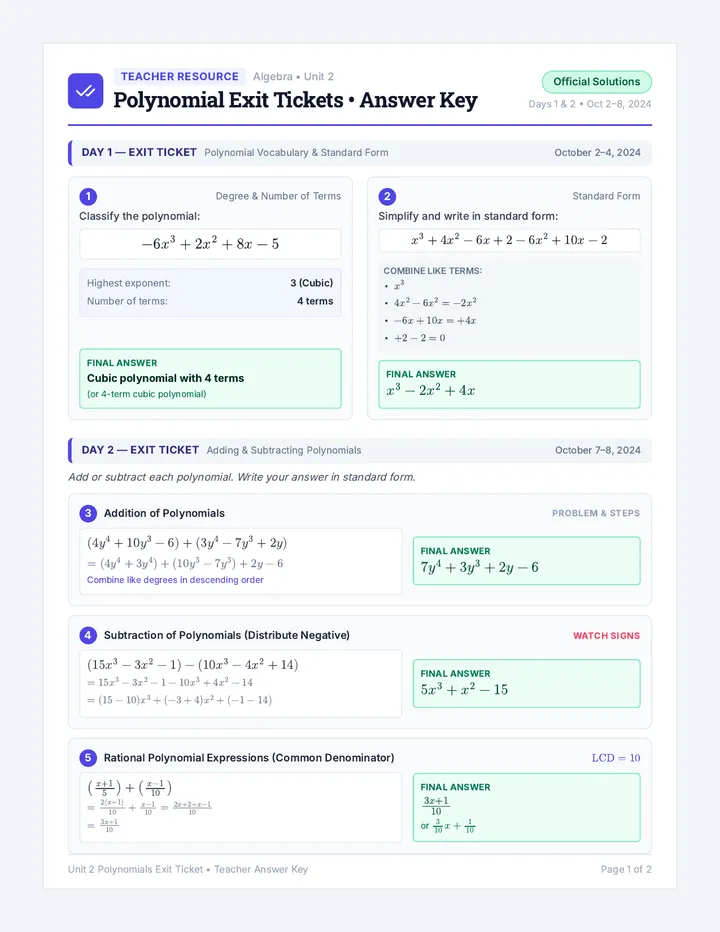
Complete 2-page teacher answer key and step-by-step solution guide for Unit 2 Polynomial Exit Tickets covering Days 1 through 4. Includes classification, simplifying, addition/subtraction, rational expressions, function operations with tables, and polynomial multiplication.

MR

Mahuya Roy Chowdhury

Intro to Polynomials Answer Key

Intro to Polynomials Answer Key

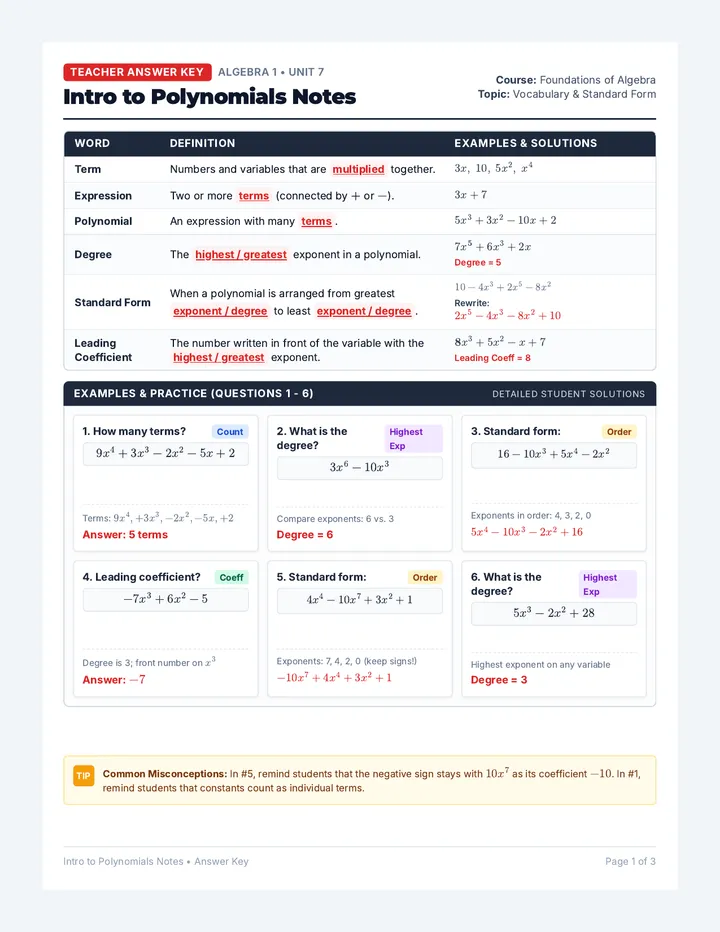
A comprehensive 3-page answer key and teacher facilitation guide for the Day 1 Intro to Polynomials student notes packet, featuring filled-in definitions, step-by-step worked solutions, standard form rewrites, and geometric applications.

MR

Mahuya Roy Chowdhury

Sequences

Foundation Missions Part 1 Final

Math in Motion: The 2-Hour Summit

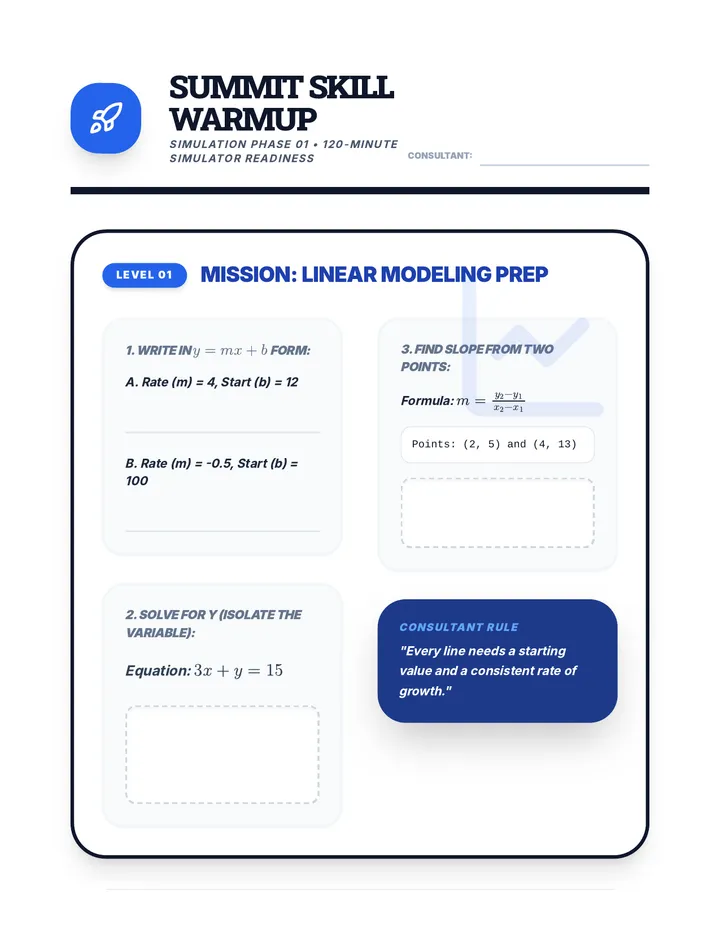
A high-intensity, 120-minute math simulation. Students act as lead consultants, completing a high-speed skill warmup before selecting a professional sector (Music, Urban Planning, Rocket Science, or Sports Analytics) to solve a series of complex work orders.

EL

Elsa LaLone

102
Project Mission Slides Final

Math in Motion: The 2-Hour Summit

A high-intensity, 120-minute math simulation. Students act as lead consultants, completing a high-speed skill warmup before selecting a professional sector (Music, Urban Planning, Rocket Science, or Sports Analytics) to solve a series of complex work orders.

EL

Elsa LaLone

102
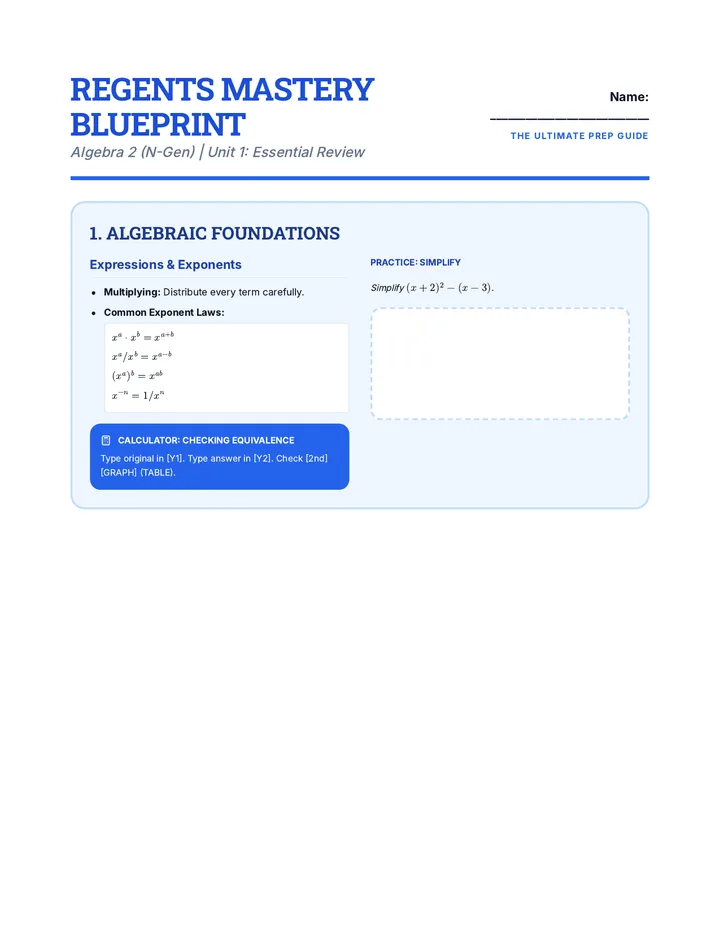
Regents Mastery Blueprint Study Guide

Regents Mastery Suite

A comprehensive review suite for the New York State Mathematics Regents exams, including Algebra 1, Geometry, and Algebra 2, featuring mastery blueprints, calculator strategies, and exam-taking tips.

KB

Kayla Borozny

15
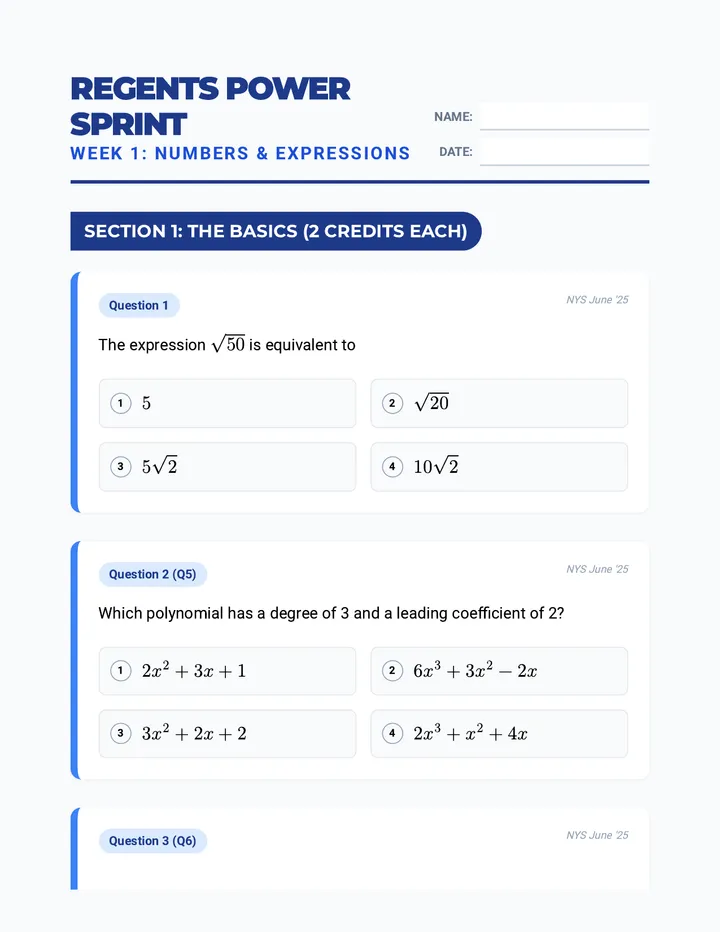
Week 1 Power Sprint Worksheet

Regents Road Map

A comprehensive 10-week preparation sequence designed to get students ready for the Algebra I Regents exam by May 15th, featuring bi-weekly 30-minute practice sessions and visual anchor charts.

L

laura.clar

31
Temple Craftsmen Slides

Middle School Math Block

A multi-subject middle school mathematics block for Week 1, covering 6th Grade Geometry (Temple Craftsmen: polygon decomposition, nets, surface area) and 7th/8th Grade Math (Faithful Stewards: proportional relationships, linear equations, inequalities, transversals) from a Christian perspective.

JR

Jamens Ray II

59
Round 1 Review Sheet

Algebra Regents Power Prep

A series of five high-stakes review rounds designed to prepare students for the Algebra I NYS Regents exam, focusing on expressions, equations, inequalities, and functions.

CW

Cheyenne Watkins

10

Lessons

Algebra II Final Exam Test

Algebra II Spring Final Exam

A comprehensive Algebra II final exam covering quadratics, function operations, inverses, exponent rules, and polynomial division.

BF

Ben Freitag

2
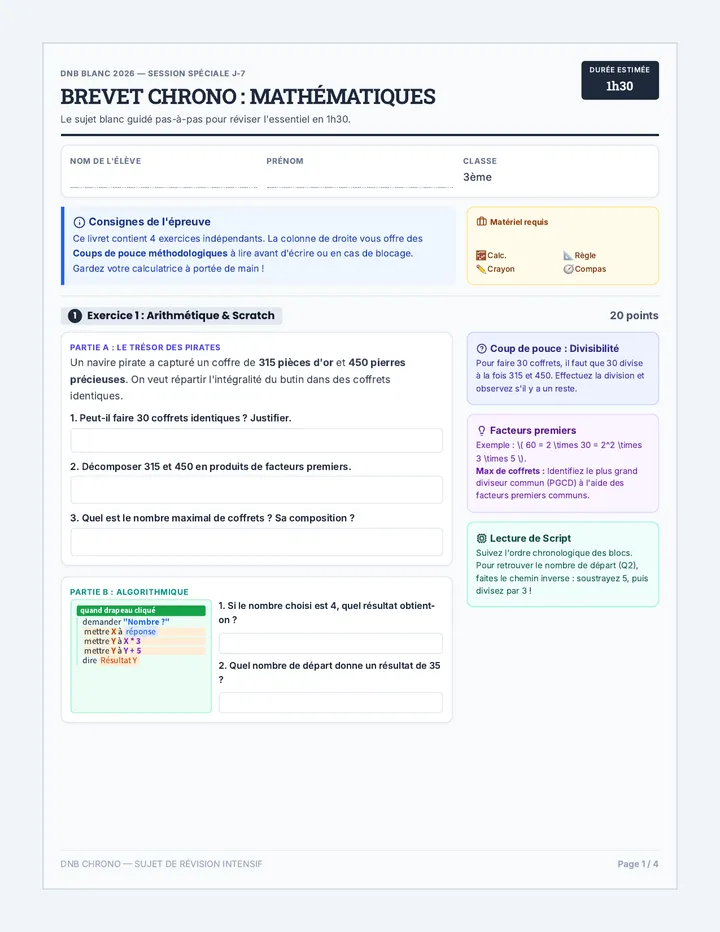
DNB Chrono Livret de Révision

Brevet Express

Un kit complet de révision de dernière minute pour le DNB de Mathématiques, comprenant un sujet blanc guidé pas-à-pas pour les élèves et un corrigé détaillé avec barème pour l'enseignant.

E

Enseignante

4
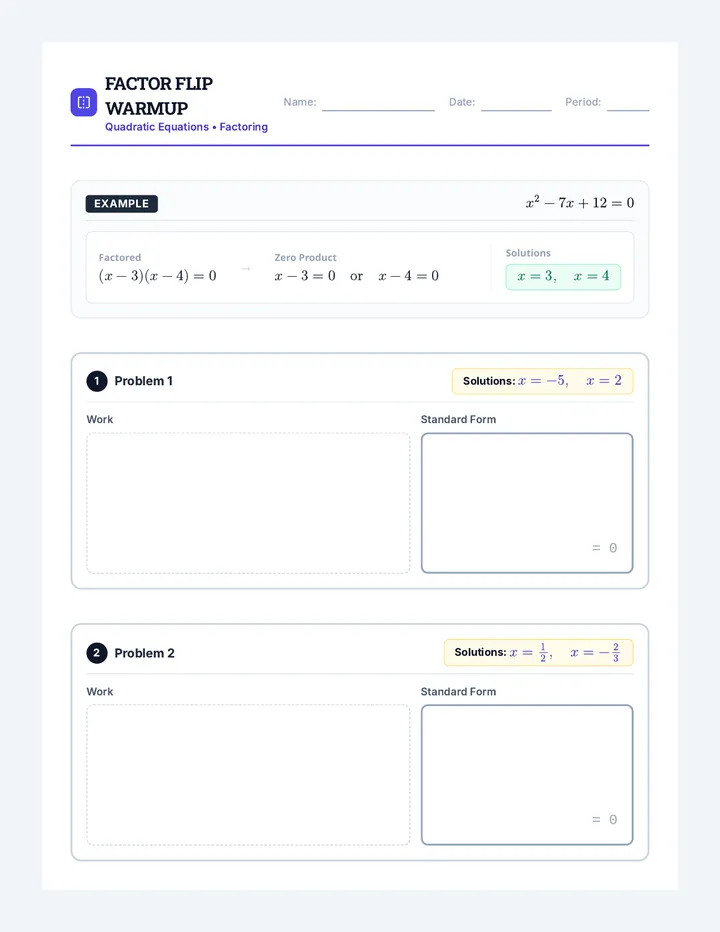
Factor Flip Warmup

Factor Flip

A targeted opening lesson focused on connecting quadratic factors with solutions and constructing standard-form equations from given roots.

AR

Angie Rice

6
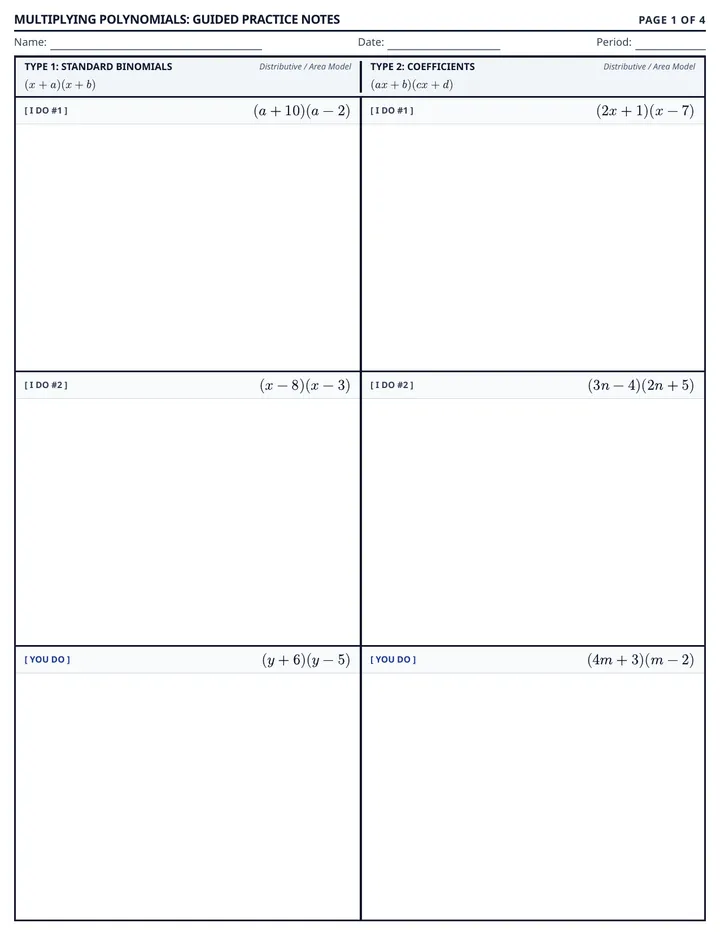
Polynomial Power Practice Notes

Polynomial Multiplication Mastery

A complete guided practice unit for multiplying polynomials covering standard binomials, leading coefficients, binomials with trinomials, and special product patterns.

MR

Mahuya Roy Chowdhury

2
Slam Dunk Slides

Slam Dunk Exponents

A basketball-themed lesson for 8th grade students covering the product, quotient, and power rules of exponents with both numbers and variables. The lesson includes instructional slides, guided notes, and differentiated practice.

JS

Jennifer Stevens

19
Algebra 1 Formula Sheet

Algebra 1 Assessment

A comprehensive final assessment for Algebra 1 covering linear equations, systems, exponents, polynomials, and quadratic functions. Includes free response and graphing sections to evaluate deep understanding.

JF

Jim Fusaro

3