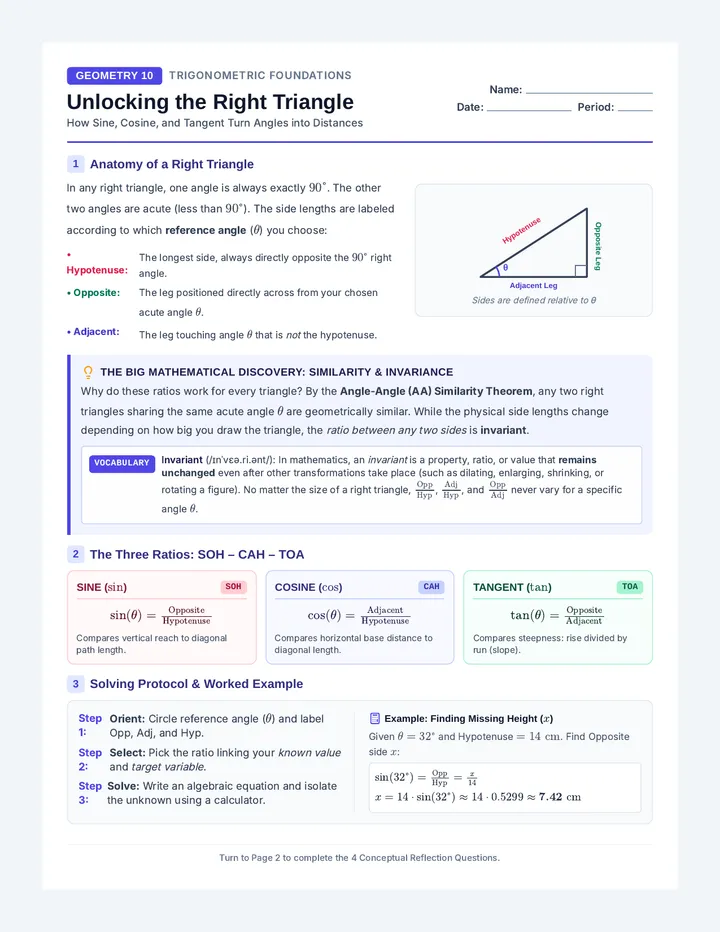
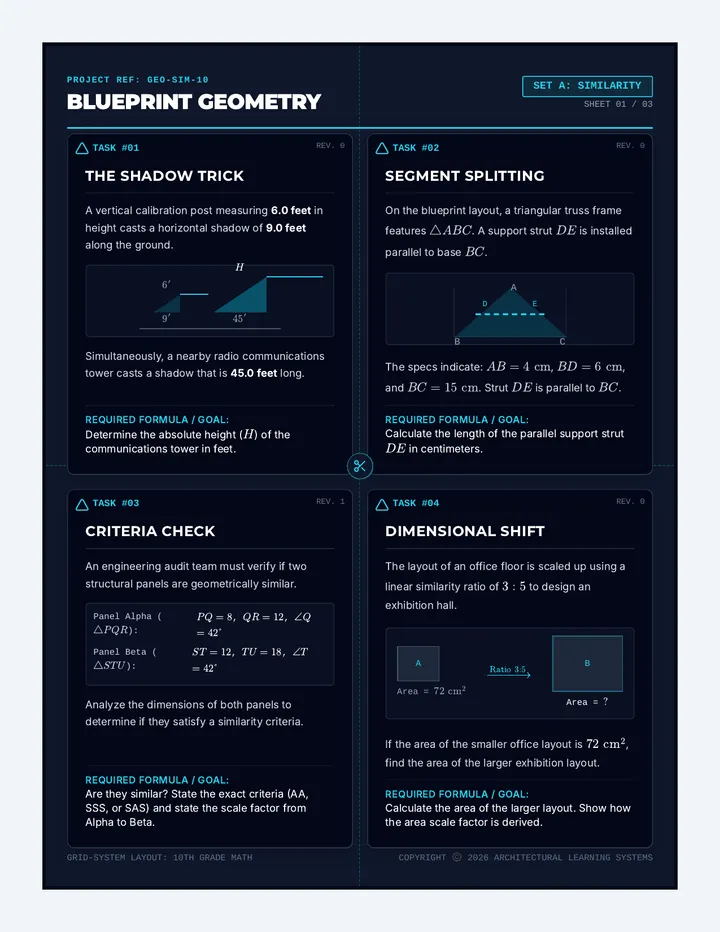
Geometric proofs using AA, SAS, and SSS criteria to establish triangle similarity. Applies proportional reasoning to solve for unknown side lengths and verify the Pythagorean theorem through similar sub-triangles.
A comprehensive review of the Geometry New York State Regents curriculum, focusing on proofs, transformations, similarity, trigonometry, and coordinate geometry.
A comprehensive review of the Algebra 1 New York State Next Generation Regents curriculum, focusing on linear, exponential, and quadratic functions, statistics, and algebraic procedures.
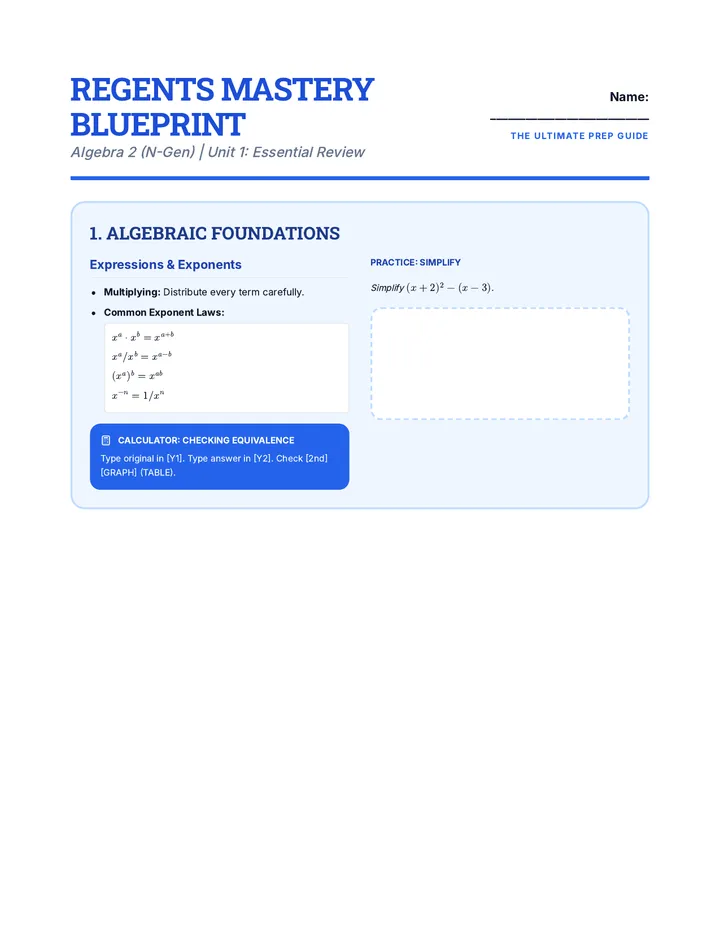
A comprehensive review of the Algebra 2 New York State Regents curriculum, focusing on key formulas, concepts, and calculator strategies.
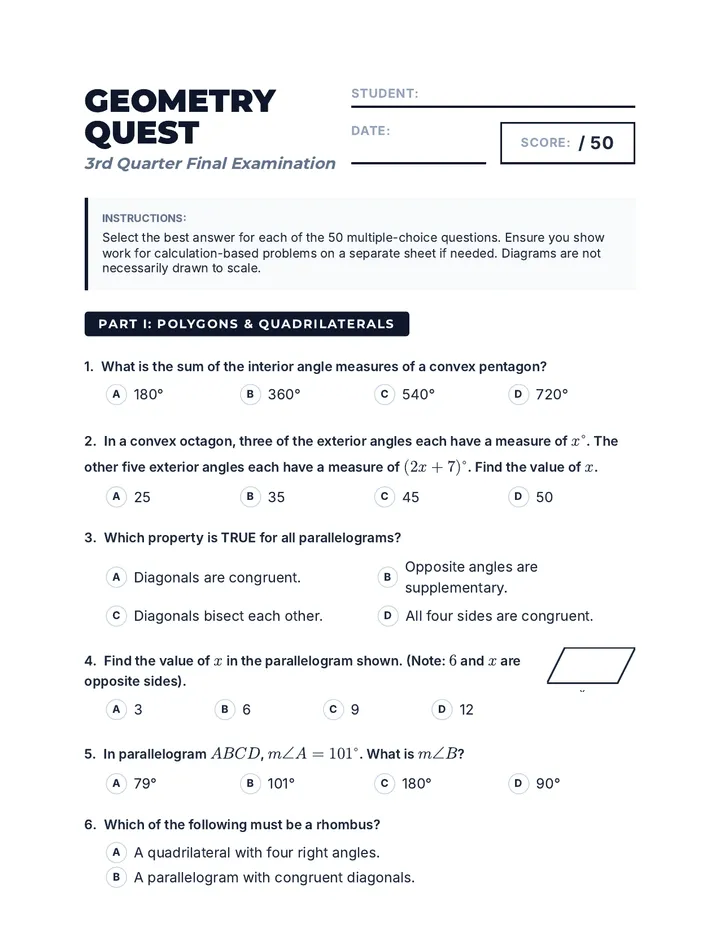
A comprehensive assessment covering right triangle properties, the Pythagorean Theorem, special right triangles, and introductory trigonometry based on standard geometry curriculum.
Une collection complète de fiches de révision et un diaporama dynamique pour maîtriser le programme de mathématiques de 3ème. Couvre l'arithmétique, l'algèbre, la géométrie et la trigonométrie avec des visuels clairs et modernes.
Students apply their indirect measurement skills to a real-world object, calculate scale factors, and construct a precision scale model of their chosen structure.
Students learn the mathematical principles of similarity and the shadow method for indirect measurement through guided practice and outdoor exploration.
A comprehensive geometry project where students explore similarity through scale modeling, outdoor shadow measurement, and artistic dilations. This lesson integrates hands-on construction with real-world mathematical applications.
Students explore geometric similarity through art and tessellations, applying ratios and proportional parts to create scaled masterpieces.
A hands-on geometry project where students apply similarity criteria (AA, SSS, SAS) to measure unreachable heights using shadow casting and mirror reflections. Students will perform outdoor measurements, calculate scale factors, and provide formal geometric proofs for their methods.
A project-based lesson where students design an infographic poster demonstrating their mastery of triangle similarity criteria and real-world proportional reasoning.
A hands-on geometry project where students apply the properties of similar triangles to calculate the height of tall, unmeasurable objects using their shadows.
A comprehensive review suite for the New York State Mathematics Regents exams, including Algebra 1, Geometry, and Algebra 2, featuring mastery blueprints, calculator strategies, and exam-taking tips.
A project-based unit where students use indirect measurement (shadow reckoning) to determine the height of tall objects and then build accurate scale models of those structures.
A geometric exploration of similar triangles, focusing on identification criteria and real-world applications of scale factors and proportions.
A targeted intervention sequence focused on helping students master triangle congruence and similarity criteria through scaffolded logic and collaborative problem-solving.
A targeted intervention sequence for 8th-grade students focusing on the geometric properties of angles in triangles and parallel lines. The lessons use informal arguments and visual proofs to build conceptual understanding of angle sums, exterior angles, and similarity.
This sequence teaches 10th-grade students with academic support needs how to translate complex geometric text descriptions into accurate, solvable visual representations. It covers geometric vocabulary, 2D blueprints from word problems, 3D nets/transformations, and similarity modeling, culminating in a synthesis project.
This sequence explores the metric relationships of circles, focusing on the Power of a Point theorems (chords, secants, and tangents) and their applications in engineering and geometry. Students will derive these relationships using similarity and apply them to solve complex algebraic problems, including common tangents in pulley systems.
A comprehensive undergraduate sequence on the metric properties of circles, focusing on the Power of a Point as a unifying concept. Students progress from basic segment products to advanced topics like radical axes, radical centers, and geometric inversion.
A comprehensive 10th-grade geometry unit exploring dilations as non-rigid transformations. Students investigate scale factors, coordinate rules, and the formal definition of similarity, culminating in complex problem-solving and forensic modeling applications.
A rigorous undergraduate exploration of similarity theory, proportionality, and their applications in proving the Pythagorean Theorem and circle properties. Students move from dynamic exploration to formal proofs.
This sequence explores the geometric foundations of similarity, connecting dilations on the coordinate plane to the Angle-Angle criterion. Students will prove the constancy of slope using similar right triangles and apply these theorems to solve real-world indirect measurement problems.
A 10th-grade geometry unit exploring similarity, proportionality, and dilations through transformations, proofs, and real-world indirect measurement. Students move from abstract coordinate plane dilations to physical field measurements of unreachable heights.
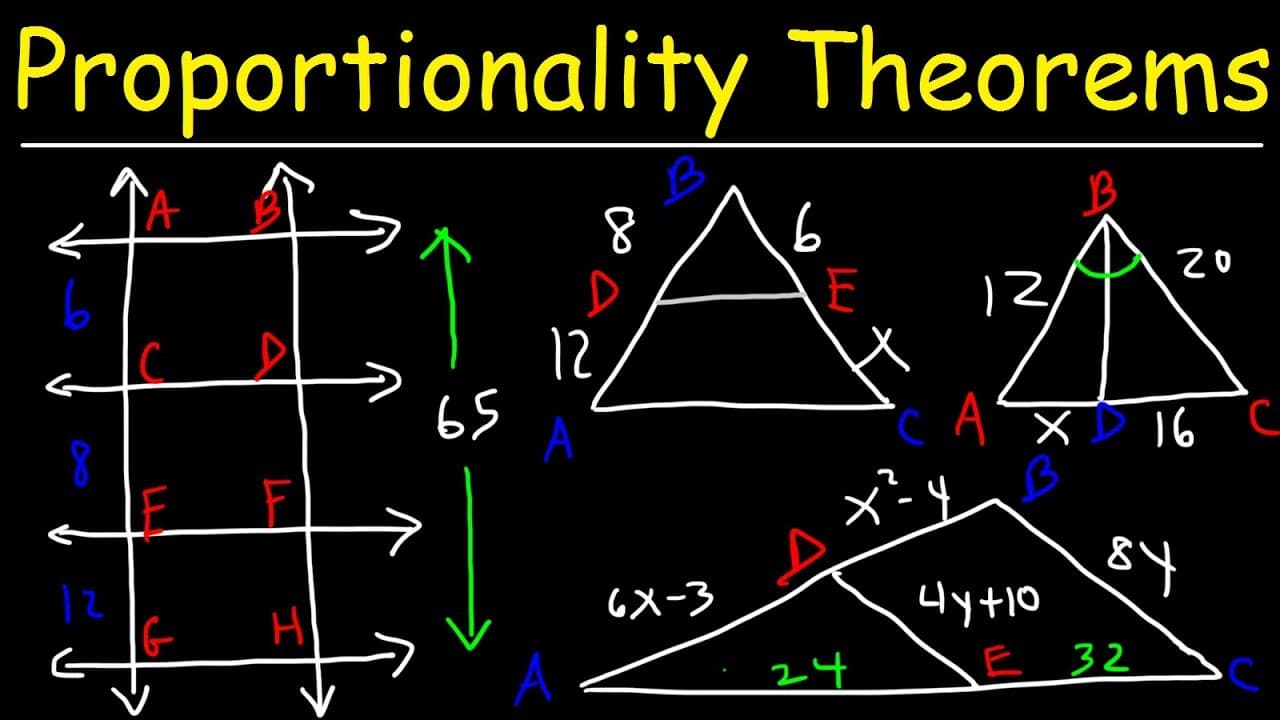
This comprehensive math tutorial guides students through the principles of proportionality in geometry, specifically focusing on the Side Splitter Theorem, Triangle Similarity, and the Angle Bisector Theorem. Through six distinct problem-solving examples, the video demonstrates how to set up and solve algebraic proportions based on geometric relationships. It clarifies the distinction between using the Side Splitter Theorem for side segments versus using Similar Triangles for parallel bases, a common point of confusion for students. The content covers key topics including identifying similar triangles, writing ratios for corresponding sides, solving linear and quadratic equations derived from geometric figures, and applying theorems regarding parallel lines cut by transversals. The narrator uses a step-by-step approach, encouraging viewers to pause and try problems themselves, making it an interactive learning experience that reinforces algebraic skills within a geometric context. For educators, this video serves as an excellent resource for teaching High School Geometry standards related to similarity and proportions. It provides clear visual models and verbal explanations for why certain ratios work, offering multiple methods to solve the same problem (e.g., Side Splitter vs. Similarity). The inclusion of a problem resulting in a quadratic equation also allows for cross-disciplinary reinforcement of Algebra 1 skills, making it suitable for advanced students or review sessions.
23mins 54s
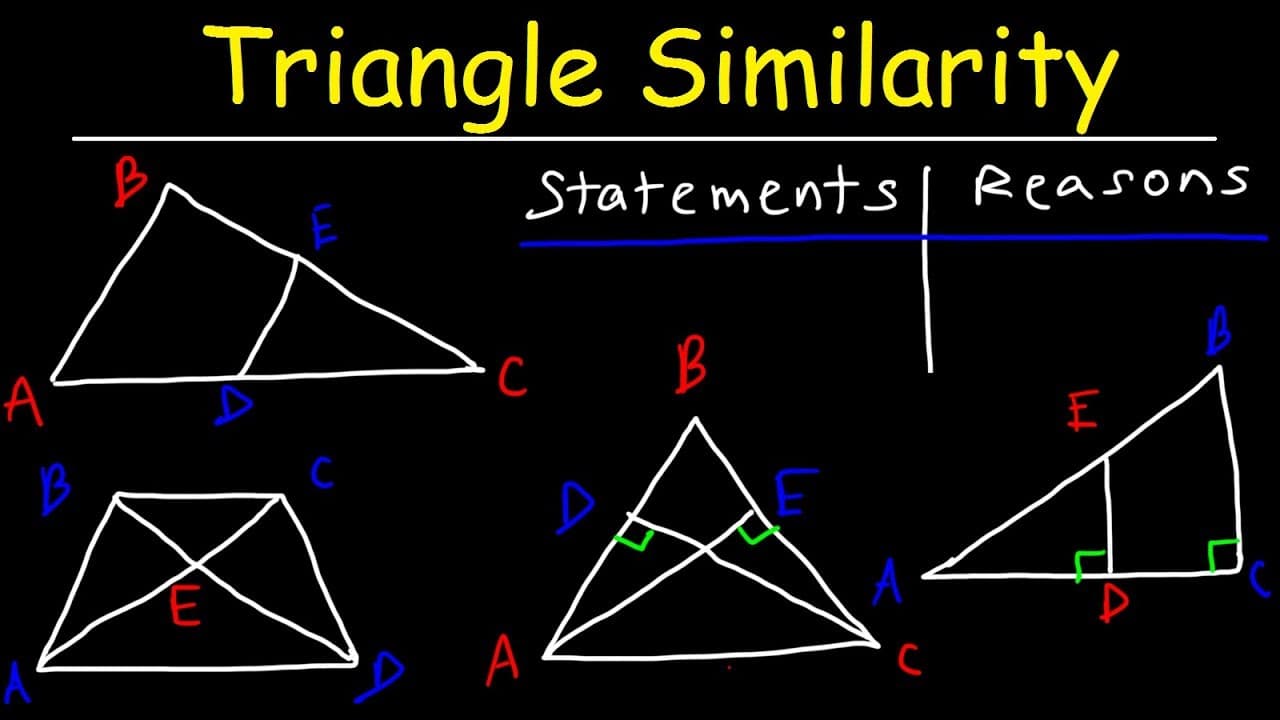
This comprehensive geometry tutorial provides a deep dive into proving triangle similarity, a fundamental concept in high school mathematics. The video begins by systematically explaining the four main methods for proving similarity: Angle-Angle-Angle (AAA), Angle-Angle (AA), Side-Side-Side (SSS), and Side-Angle-Side (SAS). It clearly distinguishes between these postulates and demonstrates how to identify them visually, explaining that while AAA exists, AA is the more commonly used and efficient method. The content transitions from theoretical definitions to practical application through numerical examples. Students are guided through problems where they must calculate ratios of corresponding sides to determine if triangles are similar using SSS and SAS. The video then advances to rigorous two-column geometric proofs. It walks viewers through complex scenarios involving isosceles trapezoids, parallel lines, alternate interior angles, and the reflexive property, modeling the logical step-by-step thinking required for formal geometric proofs. This resource is highly valuable for the classroom as it bridges the gap between basic computation and formal logic. It specifically addresses the challenging "Means-Extremes Product Theorem" (cross-multiplication in proofs), showing students how to work backwards from a product of segments to a similarity statement. The clear, slow-paced narration and visual markup of diagrams make it an excellent tool for introducing proofs or for remediation with struggling students.
29mins 23s
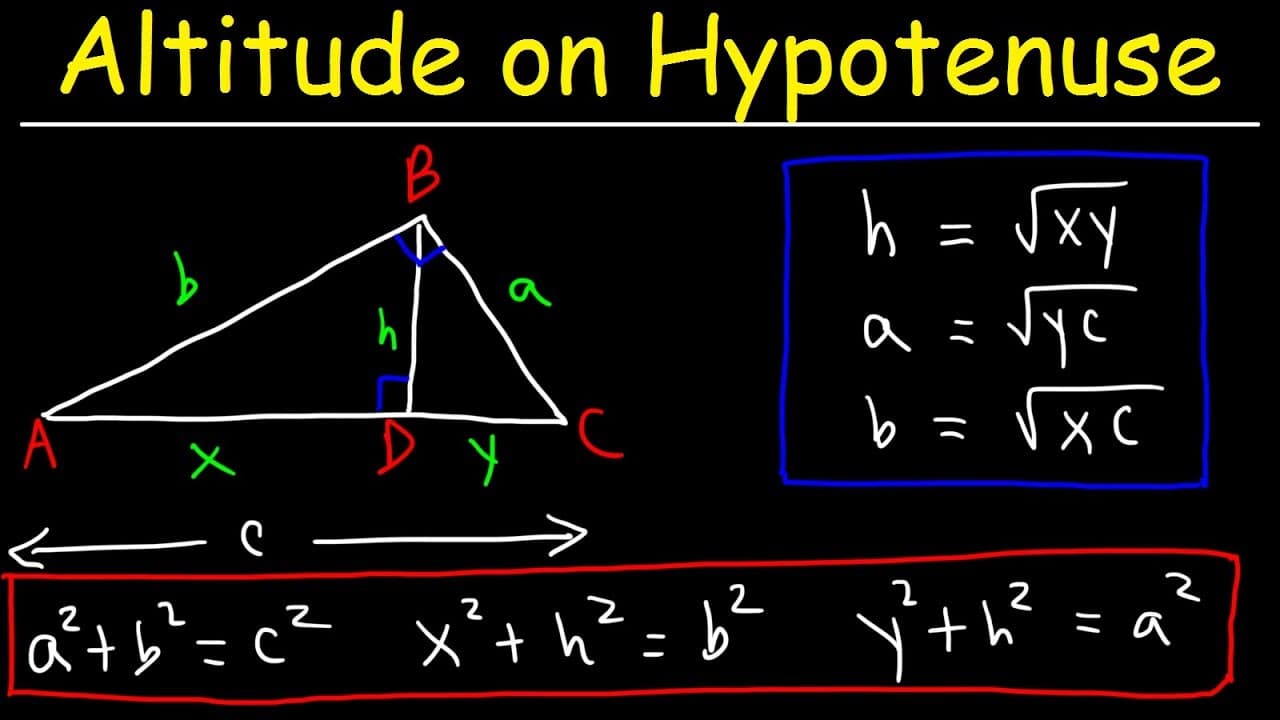
This educational mathematics video provides a comprehensive tutorial on solving geometry problems involving the Altitude on Hypotenuse Theorem (also known as the Geometric Mean Theorem). Through five distinct examples, the video demonstrates how to calculate missing side lengths in right triangles where an altitude is drawn from the right angle to the hypotenuse. The instructor breaks down the complex relationships between the segments of the hypotenuse, the altitude, and the legs of the triangle into clear, manageable formulas involving geometric means. The video explores key mathematical themes including similar triangles, radical simplification, quadratic equations, and the Pythagorean theorem. It progressively increases in difficulty, starting with basic arithmetic applications and advancing to problems that require solving quadratic equations by factoring. The content seamlessly integrates algebra into geometry, reinforcing the connection between these two mathematical disciplines. For educators, this video serves as an excellent instructional tool for high school geometry classes. It models methodical problem-solving strategies, explicitly defining variables and selecting the appropriate formulas for each scenario. The step-by-step walkthroughs of simplifying radicals (e.g., square root of 50) and checking for extraneous solutions in quadratic equations provide valuable reinforcement of prerequisite algebra skills within a geometric context.
24mins 50s
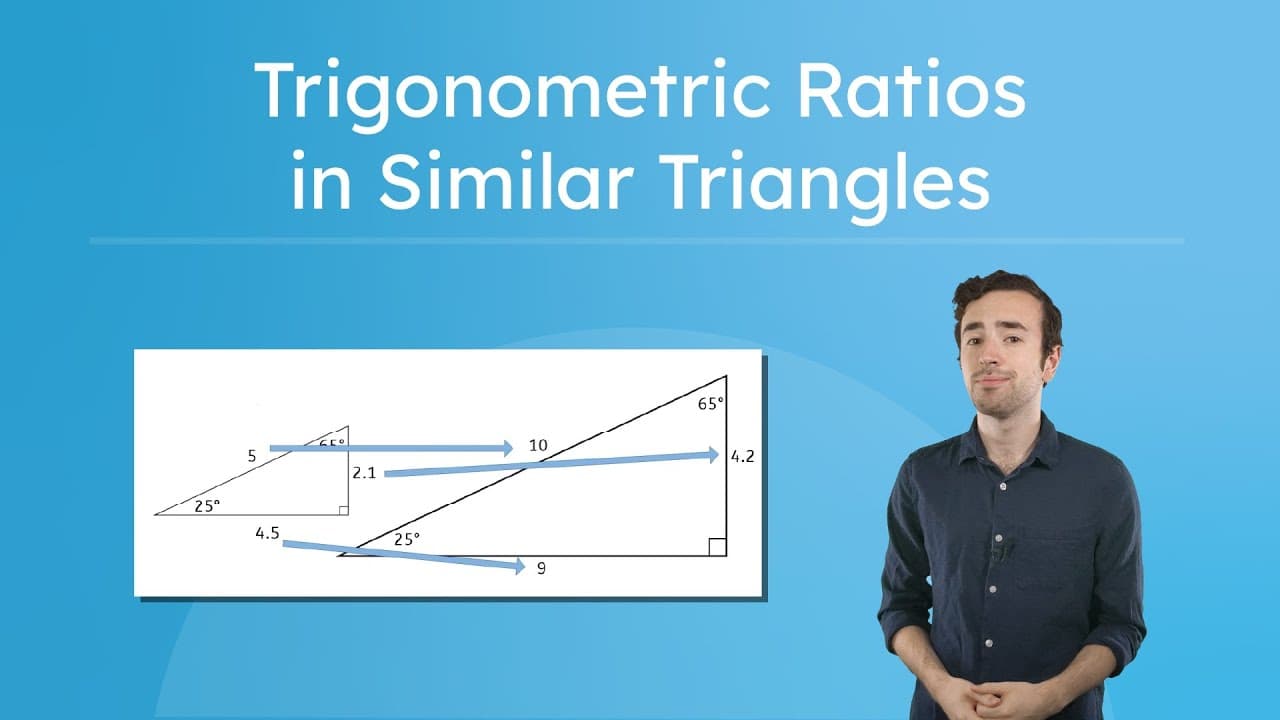
This video provides a clear and structured introduction to using trigonometric ratios within the context of similar triangles. It bridges the gap between the geometric concept of similarity—where corresponding sides are proportional—and the trigonometric definitions of sine and cosine. The lesson demonstrates that trigonometric ratios for a specific angle measure remain constant regardless of the triangle's size, providing a foundational understanding of why trigonometry works. Key themes include the properties of similar triangles, the calculation of sine and cosine ratios, and the practical skills needed to solve for missing side lengths. The video specifically focuses on the sine of 30 degrees and the cosine of approximately 36.9 degrees to illustrate these concepts. It also dedicates a significant section to proper calculator usage, highlighting common pitfalls like mode settings (degrees vs. radians) and input syntax. For educators, this resource serves as an excellent instructional tool for high school Geometry or Trigonometry units. It visualizes the abstract concept of constant ratios effectively, moving from concrete comparisons of similar shapes to algebraic solving using calculators. The inclusion of specific calculator tips makes it particularly useful for preventing common student errors during independent practice.
5mins 34s
An updated 3-page printable student-facing handout highlighting the foundational shifts, rigid grading pitfalls, and concrete mock questions (Statistical Simulations, Sinusoidal Wave Modeling, Geometric Series, and Remainder Theorem) in highly polished rich-HTML typography on a clean white background.
The Teacher Answer Key for the Algebra 2 Regents Mastery Blueprint, containing complete step-by-step solutions, coordinate graph mockups, calculator validation tricks, and official NYS partial credit grading insights for all 13 review units.
The Ultimate 3-Page Formula Cheat Sheet for the NYS Algebra 2 Regents. Fully loaded with all essential math relationships: Conics, Compound interest, Continuous PERT growth, Log loops, Trig waves, Remainder Theorem, Sum/Difference of Cubes, Discriminant, Powers of i, Log expansion, Average Rate of Change, Even/Odd functions, Rational exponents, Geometric Series, Pythagorean identities, and TI-84 normalcdf guides.
A strategic guide for the NYS Geometry Regents, featuring scoring breakdowns, time management tips, and specific advice on proofs and constructions.
A one-page reference sheet containing TI-84 calculator procedures, trig mode reminders, and precision tips for Geometry Regents students.
The Geometry Mastery Blueprint: A comprehensive 7-page study guide for the NYS Geometry Regents, covering transformations, congruence, similarity, trig, circles, volume, and exam strategies.
A strategic guide for the NYS Next Generation Algebra 1 Regents, featuring scoring breakdowns, time management tips, and specific advice on avoiding common point-loss penalties.
A one-page reference sheet containing Algebra 1 Next Generation Regents calculator shortcuts, procedures, and test-taking tricks for the TI-84.
The Algebra 1 Mastery Blueprint: A comprehensive 8-page study guide for the NYS Next Generation Algebra 1 Regents, covering all major units with practice areas and exam strategies.
A two-page strategy guide for the Algebra 2 Regents exam, covering scoring breakdowns, time management, partial credit rules, and common pitfalls.
A two-page reference sheet containing TI-84 calculator shortcuts, procedures, and worked examples for Algebra 2 Regents students.
The Ultimate Blueprint: A comprehensive 14-page Algebra 2 Regents study guide providing in-depth coverage of all 13 units from the N-Gen Math Algebra II curriculum, including detailed properties, formulas, white-background practice walkthroughs, and a final strategic game plan.