Linear Landscapes Slides Linear Landscapes
Slope, Intercepts, and the Math of Change
Learning Blueprint
01
Identify Rate of Change
Calculate slope (\(m\)) from graphs, tables, and algebraic equations.
02
Build Linear Equations
Understand the power of \(y = mx + b\) and how it models the real world.
03
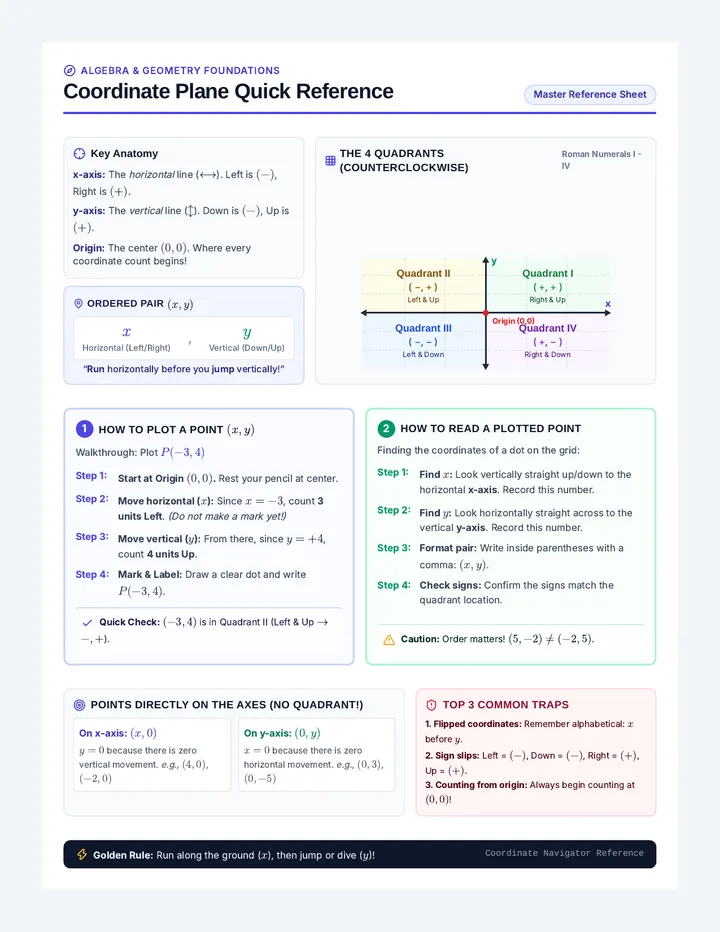
Master the Coordinate Plane
Graph linear equations with precision and interpret their characteristics.
What is Slope?
Slope (\(m\)) measures the steepness and direction of a line.
\[ m = \frac{\text{Rise}}{\text{Run}} = \frac{\Delta y}{\Delta x} \]
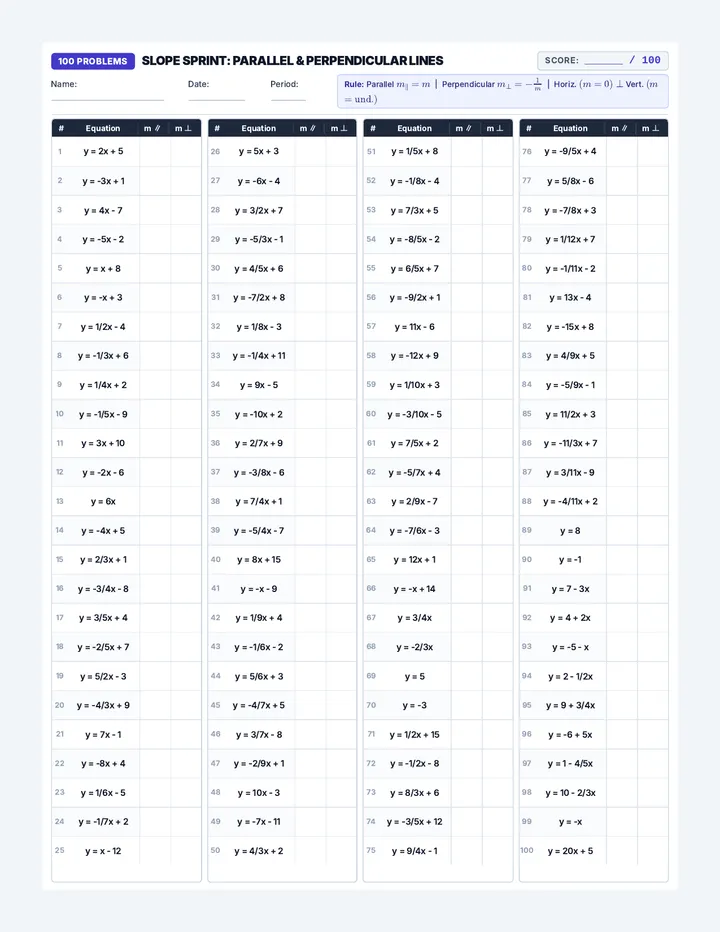
Positive: Going up from left to right
Negative: Going down from left to right
Zero: Flat horizontal line
RUN RISE
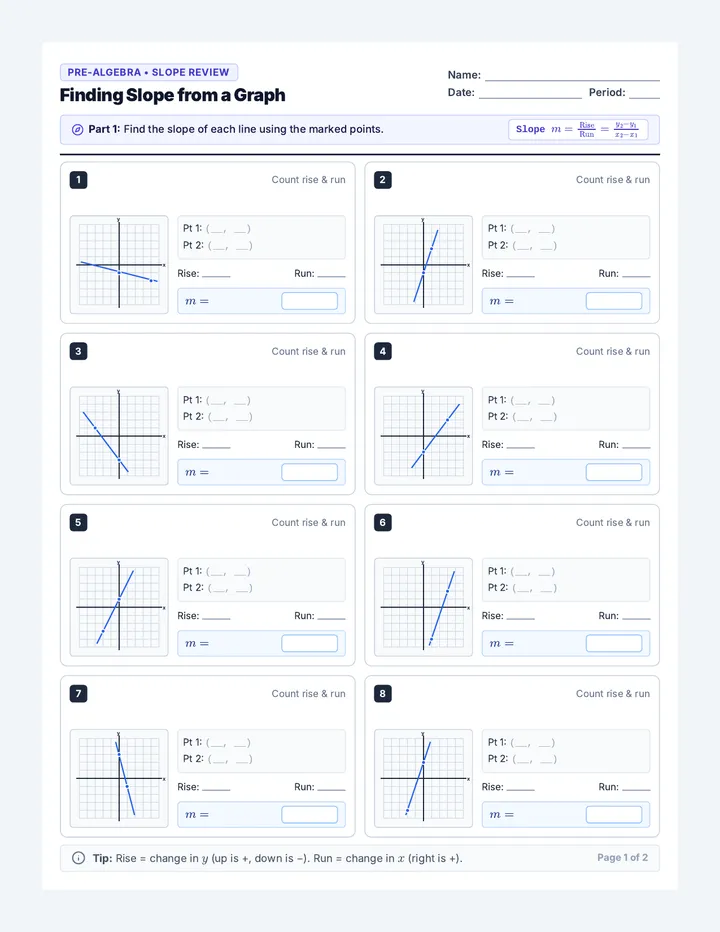
Finding Slope: Graphs
The 3-Step Method:
1 Pick two "perfect" points on the line.
2 Count vertical change (Rise).
3 Count horizontal change (Run).
"If you go down, the rise is negative! If you go left, the run is negative!"
[Interactive Graph Visualization Placeholder]
Example: Line passing through (0,0) and (2,4)
\(m = \frac{4-0}{2-0} = 2\)
Finding Slope: Tables
Slope is the Constant Rate of Change between any two pairs of values.
Change in Y (\(\Delta y\))
\(6 - 2 = 4\)
Change in X (\(\Delta x\))
\(2 - 0 = 2\)
\(m = \frac{4}{2} = 2\)
Proportional vs. Non-Proportional
Direct Variation
Proportional
\(y = mx\)
Passes through origin (0,0)
No "Starting Fee" or Constant
Constant ratio \(y/x = m\)
Linear Function
Non-Proportional
\(y = mx + b\)
Does NOT pass through (0,0)
Has a y-intercept \((b \neq 0)\)
Models "Initial Value + Rate"
The y-intercept (\(b\))
The "Starting Block" of your line.
Definition
The y-intercept is where the line crosses the y-axis.
Coordinates: \((0, b)\)
Real World Meaning
Initial Fee: Flat service charge.
Starting Height: Balloon off the ground.
Base Pay: Salary before commission.
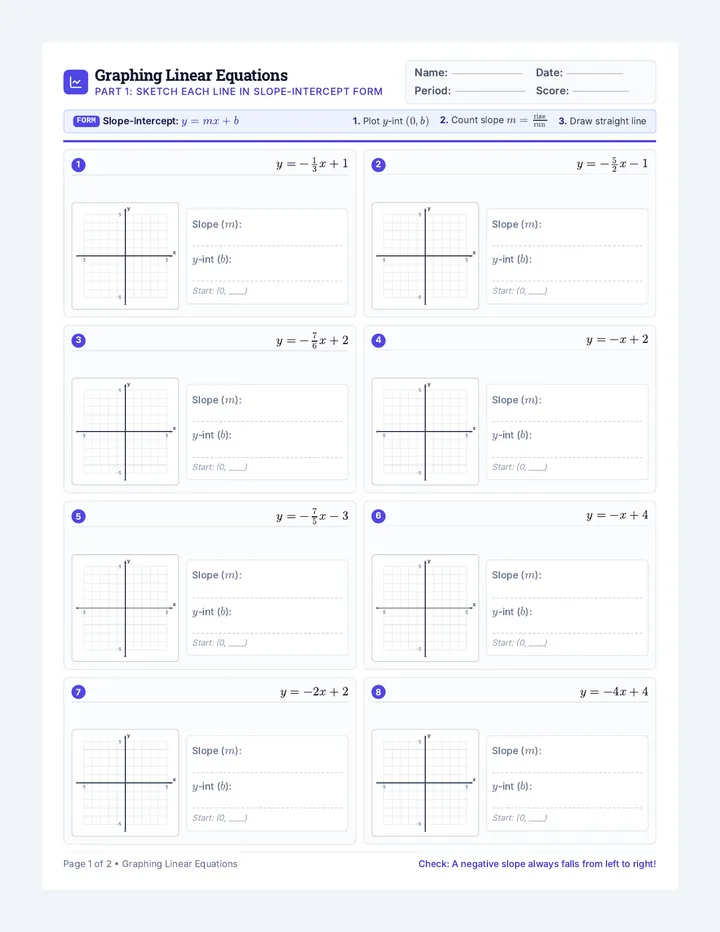
Graphing Linear Equations
01
Begin at \(b\)
Plot the y-intercept on the y-axis. This is your starting point!
02
Move with \(m\)
Use the slope (Rise/Run) to find the next point from your intercept.
03
Draw the line
Connect the dots using a straight edge and add arrows at the ends.
Graph: \(y = \frac{1}{2}x - 3\)
The Power of Geometry
Why is the slope the same everywhere on a line?
We can use Similar Triangles to prove it!
Ratios of corresponding sides are equal.
The ratio of vertical to horizontal change is constant.
This constant ratio is the Slope .
Ratio A Ratio B Ratio A = Ratio B
Landscape Mastered!
Slope Check
Can you find \(m\) from a graph, table, or points?
Intercept Check
Can you identify \(b\) as the y-intercept or initial value?
Graphing Check
Can you plot points starting at \(b\) and moving by \(m\)?
Proportion Check
Can you tell if a line starts at (0,0) or elsewhere?
Now, let's get building!
Slope Walk Activity Sheet Slope Walk Activity
Linear Landscapes Scenario Exploration
Name:
Date:
The Mission
Linear relationships aren't just lines on a paper—they are stories of change! For each scenario below, you will analyze the "walk," identify the rate of change (slope), and determine if the path is proportional.
1
The Steady Pacer
"You start at the beginning of the trail (0 meters) and walk at a steady pace of 2 meters every second."
Data Log
Time (s) Distance (m) 0 0 1 2 2 4 3 6
What is the Slope (\(m\))?
What is the \(y\)-intercept (\(b\))?
Proportional? (Yes/No)
Write the Equation
2
The Head Start
"You are already 5 meters ahead of the start line. You then walk at a rate of 1.5 meters per second."
Sketch a small graph representing this walk here.
What is the Slope (\(m\))?
What is the \(y\)-intercept (\(b\))?
Proportional? (Yes/No)
Write the Equation
3
The Return Trip
"You start 20 meters away and walk BACK toward the start at a speed of 4 meters per second."
Thinking Question:
Will your slope be positive or negative? Why?
What is the Slope (\(m\))?
What is the \(y\)-intercept (\(b\))?
Equation
Value of \(y\) when \(x = 5\)
Linear Landscapes Series
8.EE.5 • 8.F.3
Landscape Blueprint Practice Landscape Blueprint
Linear Equations Practice
Name:
Part 1: Finding the Rate of Change
1. Find the slope (\(m\)) between points (2, 5) and (4, 13).
Slope \(m\) = ________
2. Find the slope (\(m\)) from the table:
Slope \(m\) = ________
3. What is the slope of the line \(y = -3x + 10\)?
Slope \(m\) = ________
4. Find the slope of a line that passes through (0, 0) and (5, 20).
Is this proportional? ________
Part 2: Identifying Intercepts
"A membership to a gym costs $30 to join plus $15 per month."
5. Identify the slope and y-intercept for this scenario.
Slope: ________
Intercept: ________
Equation: \(y = 4x - 5\)
6. Is this relationship proportional? Explain why or why not.
Part 3: Sketching the Landscape
7. Graph the equation: \(y = \frac{1}{2}x + 2\)
Start at (0, 2). Rise 1, Run 2.
8. Graph the equation: \(y = -2x - 1\)
Start at (0, -1). Rise -2 (Down 2), Run 1.
8.EE.5 • 8.EE.6 • 8.F.3 Linear Landscapes Practice
Landscape EOG Check Assessment Landscape EOG Check
Standards-Based Assessment
Name:
The graph of a linear relationship passes through the points \((0, 4)\) and \((2, 10)\). What is the slope of the line?
A 2
B 3
C 4
D 6
Company A charges a flat fee of $10 plus $5 per hour for tool rentals. Company B charges $8 per hour with no flat fee. Which statement is true?
A Both companies represent proportional relationships.
B Only Company A represents a proportional relationship.
C Only Company B represents a proportional relationship.
D Neither company represents a proportional relationship.
Which equation represents a line with a slope of \(\frac{2}{3}\) and a \(y\)-intercept of \(-4\)?
A \(y = -4x + \frac{2}{3}\)
B \(y = \frac{2}{3}x - 4\)
C \(y = \frac{2}{3}x + 4\)
D \(y = -\frac{2}{3}x - 4\)
Two points on a line are \(P(1, 2)\) and \(Q(3, 5)\). Another two points on the same line are \(R(5, 8)\) and \(S(9, 14)\). Why is the slope between \(P\) and \(Q\) the same as the slope between \(R\) and \(S\)?
A Because the line passes through the origin.
B Because the vertical and horizontal changes create similar triangles.
C Because the slope of any vertical line is undefined.
D Because the y-intercept is a constant value.
A line has the equation \(y = 3x\). Which point lies on this line?
A \((3, 1)\)
B \((1, 0)\)
C \((2, 6)\)
D \((0, 3)\)
Which table represents a relationship with the greatest rate of change?
TABLE A
\(y = 2x + 1\)
TABLE B
\(y = 4x - 2\)
TABLE C
\(y = 0.5x + 10\)
TABLE D
\(y = 3x + 5\)
A
B
C
D
North Carolina Grade 8 Math EOG Prep • 8.EE.5, 8.EE.6, 8.F.3
Linear Landscapes Teacher Guide Teacher Guide
Linear Landscapes Lesson Facilitation
Subject
8th Grade Math
NCSCOS Standards
8.EE.5: Graph proportional relationships and compare.8.EE.6: Use similar triangles to explain slope.8.F.3: Interpret \(y = mx + b\) as linear.
Pacing (90 min)
Direct Instruction: 25 mins (Slides)Scenario Activity: 20 mins (Slope Walk)Guided Practice: 25 mins (Blueprint)Assessment: 20 mins (EOG Check)
Lesson Execution
1
Introduction (Slides)
Use the Linear Landscapes Slides to define slope as a constant rate of change. Emphasize the visual representation of "Rise over Run" and the geometric proof using similar triangles.
2
The "Walk" (Activity)
Hand out the Slope Walk Activity Sheet . Have students work in pairs to translate the verbal descriptions into math. Check for: Students correctly identifying that walking "back" creates a negative slope.
3
Skill Building (Practice)
Distribute Landscape Blueprint Practice . Circulate to assist with graphing. Ensure students are starting at the y-intercept (\(b\)) before applying the slope (\(m\)).
Master Answer Key
Slope Walk Activity
1. Steady Pacer: \(m=2\), \(b=0\), Prop: Yes, \(y=2x\)2. Head Start: \(m=1.5\), \(b=5\), Prop: No, \(y=1.5x+5\)3. Return Trip: \(m=-4\), \(b=20\), \(y=-4x+20\), \(y(5)=0\)
EOG Check Assessment
1. B (slope is 3)
2. C (only Co. B)
3. B (\(y = \frac{2}{3}x - 4\))
4. B (similar triangles)
5. C (\(2 \times 3 = 6\))
6. B (slope of 4)
Landscape Blueprint
1. \(m = 4\)
2. \(m = 2\)
3. \(m = -3\)
4. \(m = 4\) (Yes, proportional)
5. \(m = 15\), \(b = 30\)
6. Non-proportional (\(b = -5\))
Common Misconceptions
Students often swap rise and run (\(\Delta x / \Delta y\)). Use the mnemonic "Y to the sky, X is the side" or remind them that you must "Rise" before you can "Run" out the door.