Lenny.com
Explore
Create
ActivitiesNewMathEnglish Language ArtsScience & EngineeringSocial StudiesGlobal LanguagesHealth & Physical EducationSpecial EducationCounseling & Life SkillsArts & CreativityESL
Lenny.com
Lenny.com
Explore
Create
ActivitiesNewMathEnglish Language ArtsScience & EngineeringSocial StudiesGlobal LanguagesHealth & Physical EducationSpecial EducationCounseling & Life SkillsArts & CreativityESL
Lenny.com
Lenny.com

Solutions

Lenny for EducatorsLenny for SchoolsLenny for Districts

Product

ExploreSign inCreateSupportAbout

Resources

Getting startedMTSS Acceleration Program

© 2026 Lenny Learning Inc.

TermsPrivacyAccessibility
LinkedInInstagramX
Lenny

Four Operations Problem Solving

Addition, subtraction, multiplication, and division applications within complex word problems. Strengthens the ability to translate scenarios into mathematical equations and execute multi-step solutions.

MathNumbers & CountingCounting ObjectsNumber NamesComparing NumbersNumber OperationsCounting SequenceNumbers 0-10Place Value Understanding and SystemAdd and Subtract Within 20Addition and Subtraction ConceptsAddition and Subtraction EquationsAddition and Subtraction ProblemsFoundations for MultiplicationMultiplication and Division PropertiesMultiply and Divide Within 100Multiplication and Division ProblemsFactors and MultiplesProperties of OperationsPatterns and RelationshipsGenerate and Analyze PatternsMulti-Digit ArithmeticPlace Value OperationsMulti-Digit and Decimal OperationsNumerical ExpressionsFour Operations and PatternsFour Operations Problem SolvingMeasurement & DataMeasurable AttributesMeasuring LengthsMeasure and Estimate Lengths in Standard UnitsRelate Addition and Subtraction to LengthClassifying and Counting ObjectsTime and MoneyArea Concepts and MeasurementPerimeter and Area MeasuresAngle Concepts and MeasurementTime, Volume, and MassMeasurement Unit ConversionsGeometryIdentifying ShapesShapes and AttributesShape Attributes and ReasoningShapes and CompositionClassifying 2D FiguresGeometric Figures and RelationshipsLines, Angles, and ShapesAngle, Area, and VolumeGeometric MeasurementVolume of 3D ShapesCoordinate Plane ApplicationsTransformations in the PlaneCongruence and SimilarityUnderstand congruence in terms of rigid motionsSimilarity and TransformationsProve Theorems Involving SimilarityPythagorean TheoremTrigonometry for General TrianglesMake Geometric ConstructionsProve Geometric TheoremsTheorems About CirclesFind Arc Lengths And Areas of Sectors of CirclesVolume FormulasRelationships Between Two-Dimensional and Three-Dimensional ObjectsProve Simple Geometric Theorems AlgebraicallyTranslate Between Geometric Description and Equation for Conic SectionApply Geometric Concepts in Modeling SituationsFractions & DecimalsFractions as NumbersBuilding FractionsFraction Equivalence and OrderingAdding and Subtracting FractionsMultiplying and Dividing FractionsDividing FractionsDecimal FractionsMulti-Digit Computation and FactorsAdd, Subtract, Multiply, and Divide Rational NumbersRational Number SystemIrrational Numbers and ApproximationsRatiosRatios and ProportionsProportional RelationshipsUnit RateAlgebraAlgebraic ExpressionsGenerate Equivalent ExpressionsQuantitative RelationshipsProportional Relationships and Linear EquationsEquations and InequalitiesEquation Solving and ReasoningLinear Equations and SystemsGraph Equations and InequalitiesSystems of EquationsReal-World Algebraic ProblemsQuantitative Reasoning with UnitsExpression StructureEquivalent Expression FormsRadicals and Integer ExponentsRational ExponentsRational and Irrational NumbersPolynomial OperationsPolynomial IdentitiesPolynomial Zeros and FactorsRational ExpressionsComplex Number OperationsComplex Numbers in PolynomialsComplex Numbers on PlaneStatistics & ProbabilityRepresent and Interpret DataData DistributionsStatistical VariabilityProbability ModelsCompound Event ProbabilitiesStatistical SamplingInterpret Categorical and Quantitative DataBivariate Data PatternsInterpret Linear ModelsComparing Two PopulationsRandom Processes in StatisticsIndependence and Conditional ProbabilityExpected ValuesProbability-Based Decision MakingStatistical Inference and ConclusionsFunctionsFunction Concepts and NotationDefine and Compare FunctionsInterpret Functions in ContextAnalyze Function RepresentationsModel Relationships with FunctionsIdentify Linear vs Exponential GrowthDistinguish Between Function TypesCompare Growth RatesInterpret Function ExpressionsBuild Functions from RelationshipsConstruct and Model FunctionsTransform and Combine FunctionsModel Comparison and SelectionSolve Exponential EquationsTrigonometryTrigonometric Ratios Involving Right TrianglesTrigonometric Functions and Unit CircleModel with Trigonometric FunctionsTrigonometric IdentitiesVectors & MatricesIntroduction to Vectors and MatricesVector QuantitiesVector OperationsMatrix OperationsCalculusLimits and ContinuityDerivative Concepts and NotationDerivative Rules and TechniquesApplications of DerivativesOptimization ProblemsRelated RatesCurve Sketching and AnalysisIntegration Concepts and NotationAntiderivatives and Indefinite IntegralsDefinite Integrals and AreaFundamental Theorem of CalculusIntegration TechniquesApplications of IntegrationDifferential EquationsSequences and SeriesParametric and Polar FunctionsVector-Valued Functions

Videos

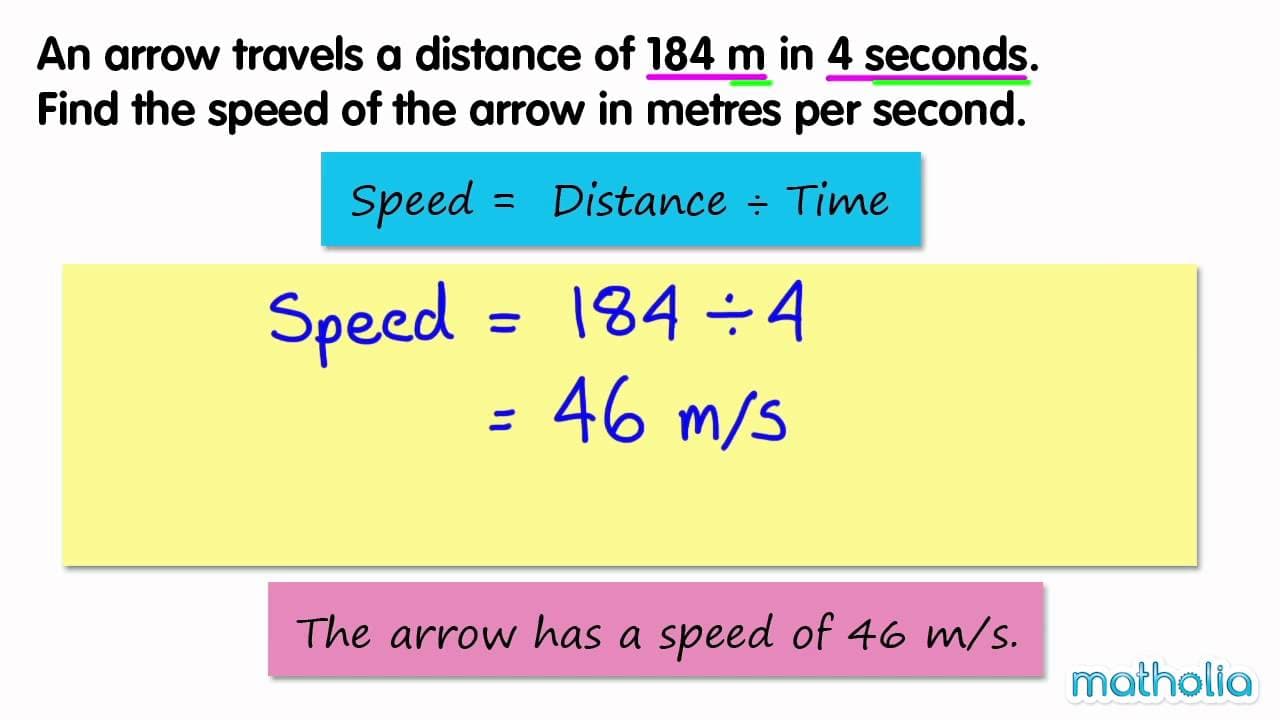
How to Calculate Speed: Distance Divided by Time

How to Calculate Speed: Distance Divided by Time

This educational math video provides a clear, step-by-step tutorial on how to calculate speed using the formula Speed = Distance ÷ Time. Through three distinct word problems, the narrator demonstrates how to identify the relevant information (distance and time), apply the formula, and perform the necessary division to find the solution. The video covers different units of measurement, including meters per second (m/s) and kilometers per hour (km/h), and addresses a variety of scenarios such as the flight of an arrow, a person walking, and a cyclist riding. The key themes explored include the mathematical relationship between speed, distance, and time, as well as the practical application of division skills in real-world contexts. The video specifically tackles the concept of rates and unit rates. A notable mathematical moment occurs in the second example, where the video explains the specific rule for dividing by fractions (dividing by one-half is the same as multiplying by two), reinforcing arithmetic rules alongside the physics concept. For educators, this video serves as an excellent modeling tool for upper elementary and middle school math classes. It visualizes the problem-solving process by highlighting key numbers in the text and writing out the equation clearly on a virtual whiteboard. It can be used to introduce the concept of speed, review long division in a practical context, or help students understand the importance of including correct units in their final answers.
MatholiaChannelMatholiaChannel

1min 53s

How to Calculate Discounts and Sale Prices

How to Calculate Discounts and Sale Prices

This instructional math video guides students through the process of calculating discounts and final sale prices using percentages. The video features a clear, step-by-step demonstration on a digital chalkboard, breaking down the mathematical procedure into two distinct parts: first calculating the discount amount by multiplying the original price by the discount rate, and then subtracting that amount from the original price to find the final cost. The narrator uses a friendly, paced approach suitable for middle school students learning consumer math.

Math with Mr. JMath with Mr. J

7mins 4s

Solving Word Problems by Subtracting Fractions

Solving Word Problems by Subtracting Fractions

This instructional video features Mr. J guiding students through two distinct word problems that require subtracting fractions with unlike denominators. The video provides a step-by-step walkthrough of the entire problem-solving process, from identifying key information in the text to finding common denominators and calculating the final difference. The visual presentation utilizes a digital chalkboard format where the teacher writes out the equations in real-time while explaining his thought process. The content focuses on key mathematical themes including identifying operation keywords in word problems (e.g., "how much left," "how much longer"), finding the least common multiple to create common denominators, and generating equivalent fractions. It explicitly reinforces the rule that denominators must be the same before subtracting and demonstrates how to rename fractions to achieve this. For educators, this video serves as an excellent modeling tool for 5th and 6th-grade math classrooms. It bridges the gap between abstract calculation skills and real-world application. Teachers can use it to introduce the concept of subtraction word problems, as a remediation tool for students struggling with unlike denominators, or as a reference for students to watch while solving similar problems independently.

Math with Mr. JMath with Mr. J

4mins 43s

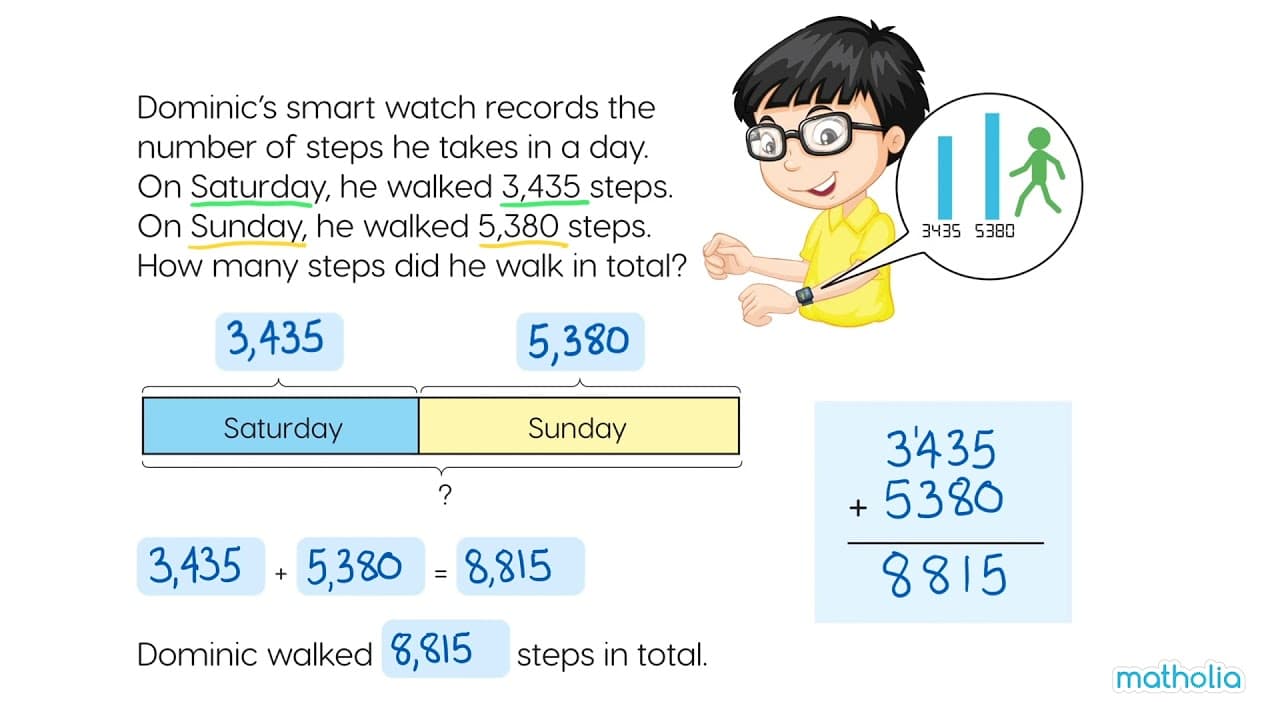
Solving 4-Digit Addition Word Problems Using Bar Models

Solving 4-Digit Addition Word Problems Using Bar Models

This educational video demonstrates a step-by-step approach to solving addition word problems using bar models and the column method. It presents two distinct scenarios: tracking daily steps on a smartwatch and calculating total points scored in a video game. For each problem, the narration guides viewers through identifying key information in the text, visualizing the quantities with a bar model, and setting up a vertical addition equation. The content focuses on bridging the gap between reading comprehension and mathematical calculation. Key themes include identifying relevant data within a narrative, using visual models to represent parts and wholes, and executing 4-digit addition with regrouping (carrying). The video explicitly models how to translate the question "how many in total?" into an addition operation. For teachers, this video is an excellent tool for modeling the problem-solving process. It supports the "Read-Draw-Write" strategy by showing students how to organize information visually before rushing to calculate. It effectively addresses common stumbling blocks like aligning place values and carrying digits during addition, making it a valuable resource for introducing or reviewing multi-digit addition in a meaningful context.

MatholiaChannelMatholiaChannel

2mins 47s

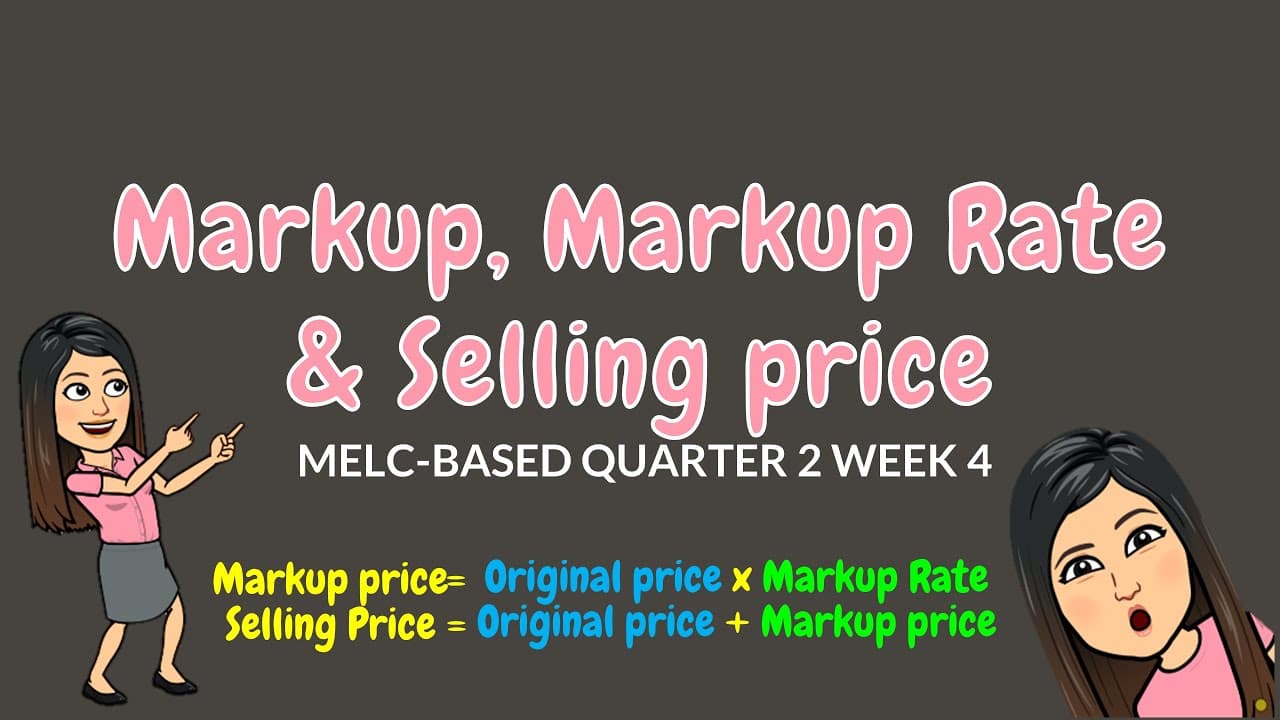
Calculating Markup, Rate, and Selling Price

Calculating Markup, Rate, and Selling Price

This educational mathematics video provides a step-by-step tutorial on solving percent problems related to retail and business contexts. Specifically, it covers three core concepts: calculating Markup Price, determining Selling Price, and finding the Markup Rate. The video uses an animated teacher avatar and clear on-screen text to guide students through the formulas and arithmetic required for each type of problem.

Sheena DoriaSheena Doria

7mins 1s

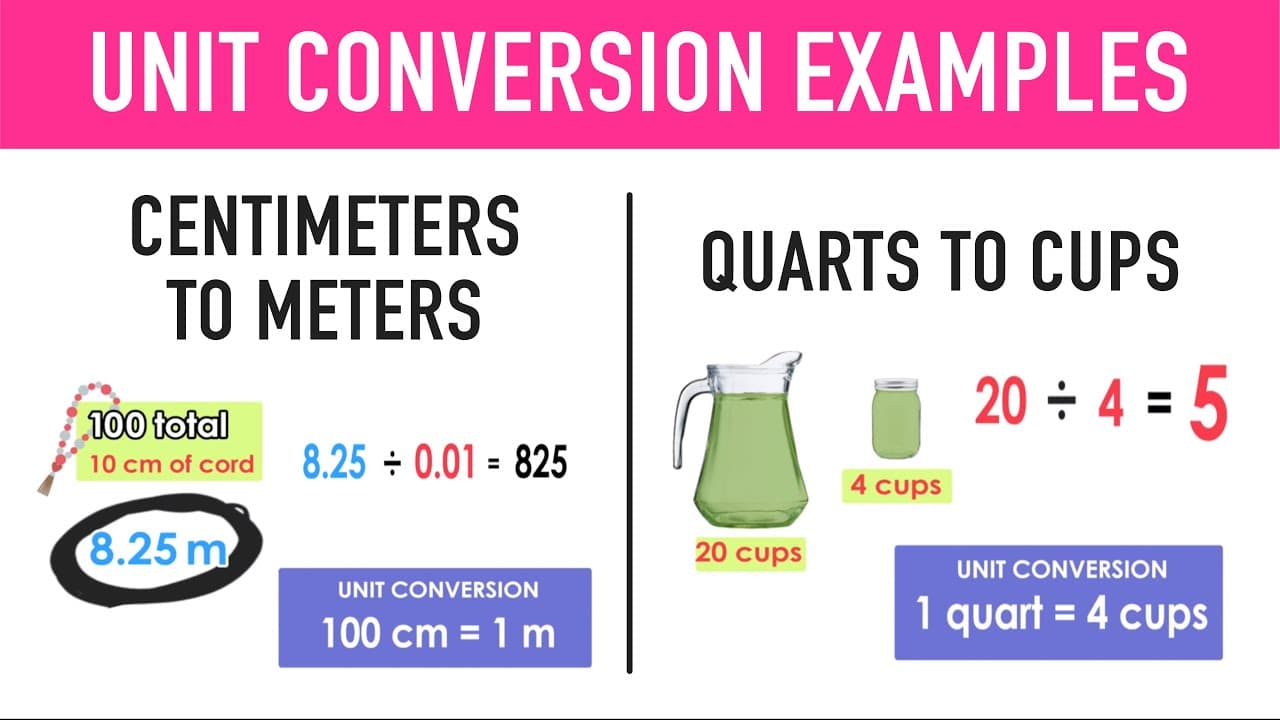
Solving Word Problems with Unit Conversions

Solving Word Problems with Unit Conversions

This video provides a clear, step-by-step visual guide to solving real-world math word problems involving measurement conversions. It presents two distinct scenarios: one involving length (converting meters to centimeters to determine materials needed for bracelets) and one involving capacity (converting cups to quarts to fill jars). The video utilizes animated text and graphics to break down the problem-solving process without voiceover narration, making it an excellent resource for visual learners or for teachers to narrate over. The key themes explored are metric conversions (specifically centimeters and meters), customary capacity conversions (cups and quarts), and multi-step problem solving. The video demonstrates how to identify the necessary information in a word problem, perform the initial calculations to find totals, and then use unit conversion rates to derive the final answer. It explicitly shows the math operations—multiplication for determining totals and division for converting units. For the classroom, this video serves as a perfect model for "think-aloud" activities where students or teachers articulate the steps being shown. It is highly valuable for bridging the gap between abstract calculation and practical application. Teachers can use this to introduce unit conversion, reinforce decimal multiplication, or practice identifying operation keywords in word problems. The lack of voiceover allows educators to pause and ask students to predict the next step or explain the logic before the video reveals it.

Mashup MathMashup Math

3mins 52s

Materials

Scale Word Problems Scaffolded Worksheet

Scale Word Problems Scaffolded Worksheet

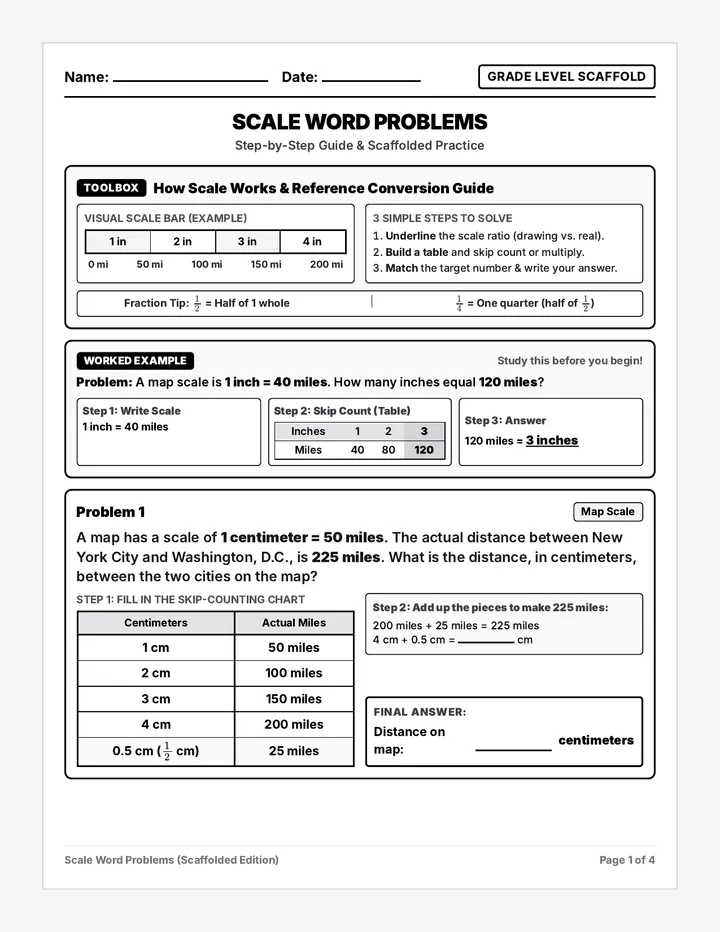
A 4-page black and white scaffolded worksheet of the 8 scale word problems designed for learners reading and computing at 2nd-3rd grade instructional levels. Features large print, a visual reference conversion scale, step-by-step ratio tables, benchmark skip-counting ladders, and spacious white handwriting areas.

MJ

Meg Jones

Math Forge Review Worksheet

Math Forge Review Worksheet

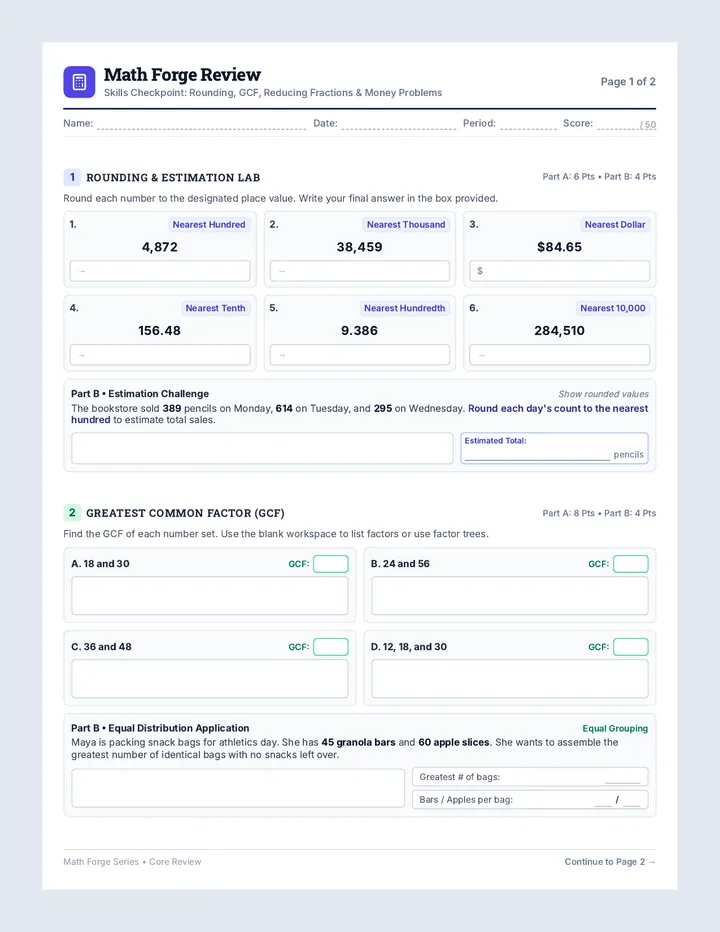
A comprehensive two-page printable review worksheet covering whole number and decimal rounding, greatest common factor computation and real-world grouping, simplifying fractions to lowest terms, and multi-step money word problems with generous dedicated workspaces.

S

stewart

Pit Stop Budget Worksheet

Pit Stop Budget Worksheet

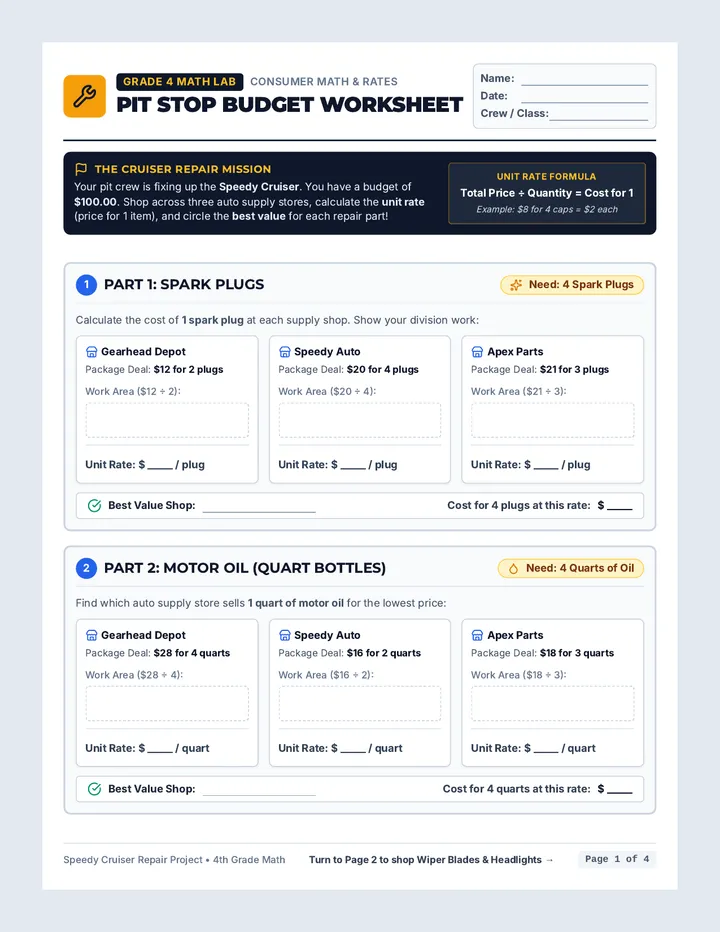
A 4-page print-ready car parts budgeting and consumer math packet for 4th-grade students, featuring unit rate calculations across supply shops, budget tracking, deal comparisons, a garage receipt audit, and applied profit challenges.

AR

Alexander Rhea

Grade 4 Math Priority Pacing Guide

Grade 4 Math Priority Pacing Guide

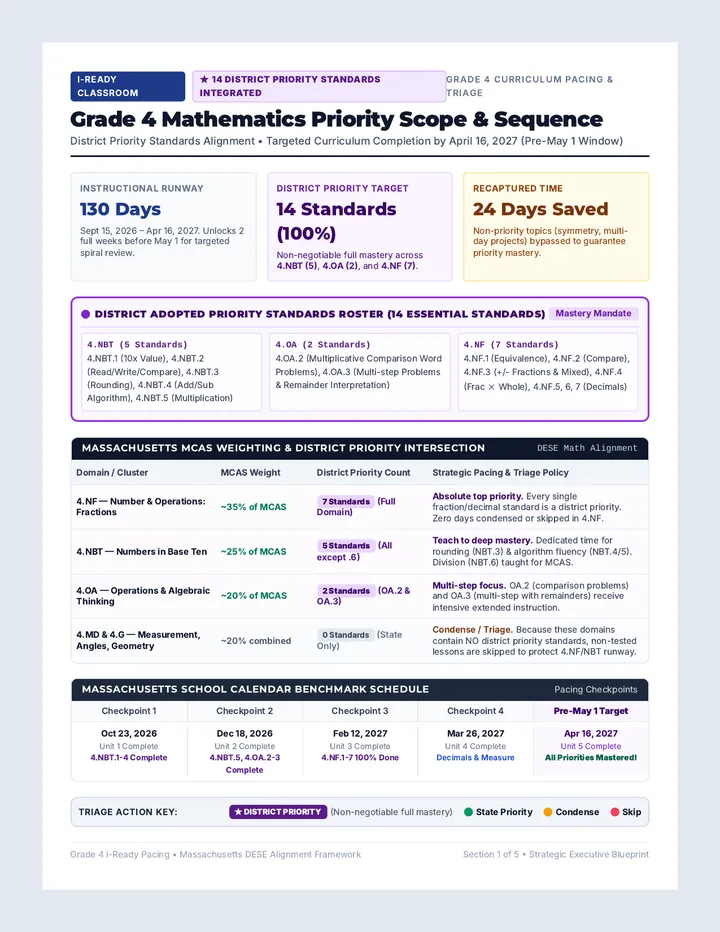
A comprehensive 5-page standards-aligned Grade 4 Mathematics curriculum pacing guide for i-Ready Classroom Mathematics, specifically incorporating the 14 designated District Priority Standards across 4.OA, 4.NBT, and 4.NF. Calibrated to the Massachusetts Curriculum Frameworks to guarantee 100% completion of all district priority standards before May 1, featuring explicit district priority badging, unit-by-unit pacing dates, strategic triage rationales for non-priority topics, and a Tier 2 prerequisite intervention bridge.

AS

Ashley Santiago

Operation Odyssey Assessment

Operation Odyssey Assessment

A comprehensive 10-problem math assessment covering 1-step and 2-step word problems with 2-to-3-digit numbers across all four operations. Includes generous student workspaces, a problem-solving completion checklist, and an end-of-test self-reflection tracker.

WS

Wendy Soberanis

Math Readiness Screener Worksheet

Math Readiness Screener Worksheet

A clean, structured two-page math readiness screener for incoming 6th-grade Resource Room students, updated with single-digit fact fluency across all four operations, whole number comparisons, multi-digit operations, place value, fractions, and word problems.

L

laura.clar

Sequences

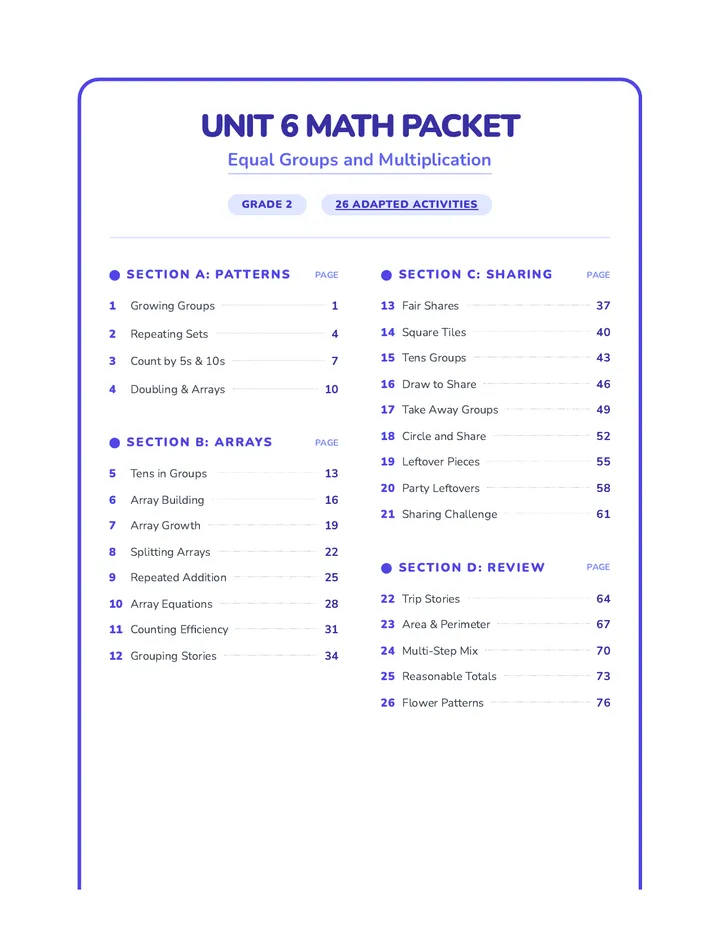
Packet Master TOC document

Unit 6 Equal Groups and Multiplication

A comprehensive Grade 2 math packet focused on skip counting, repeated addition, arrays, and equal groups.

N

nmack

39
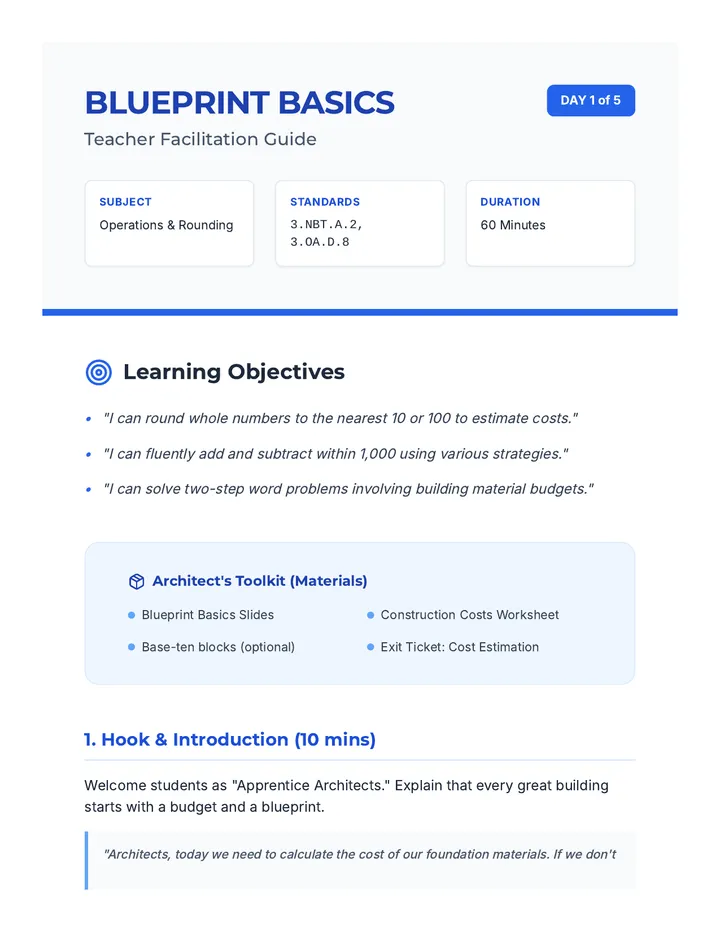
Blueprint Basics Teacher Guide

Master Builders Math Lab

A 5-day intensive math sequence for 3rd grade covering multiplication, division, multi-digit operations, fractions, area, and rounding through a "Master Builder" architectural theme. Students act as apprentice architects solving construction-themed math challenges.

TD

Taylor Doucet

25
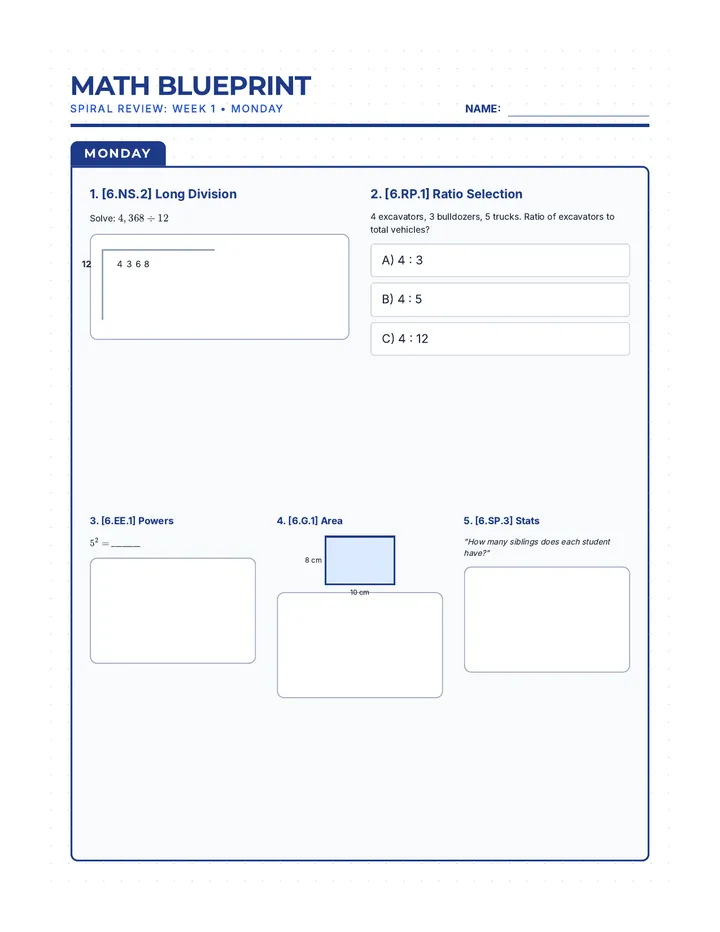
Math Blueprint Week 1 Booklet (Definitive)

Math Blueprint Spiral

A 7-week comprehensive math review sequence designed to prepare 6th-grade students for North Carolina state testing, covering Number Systems, Ratios, Expressions, Geometry, and Statistics.

MK

Michell Kisler

27
Blueprint Basics Slides

Foundational Math Builders

A foundational math sequence for special education students (grades 5-6) focusing on algebraic thinking and spatial reasoning through highly visual, themed units.

JS

Janette Sullivan

37
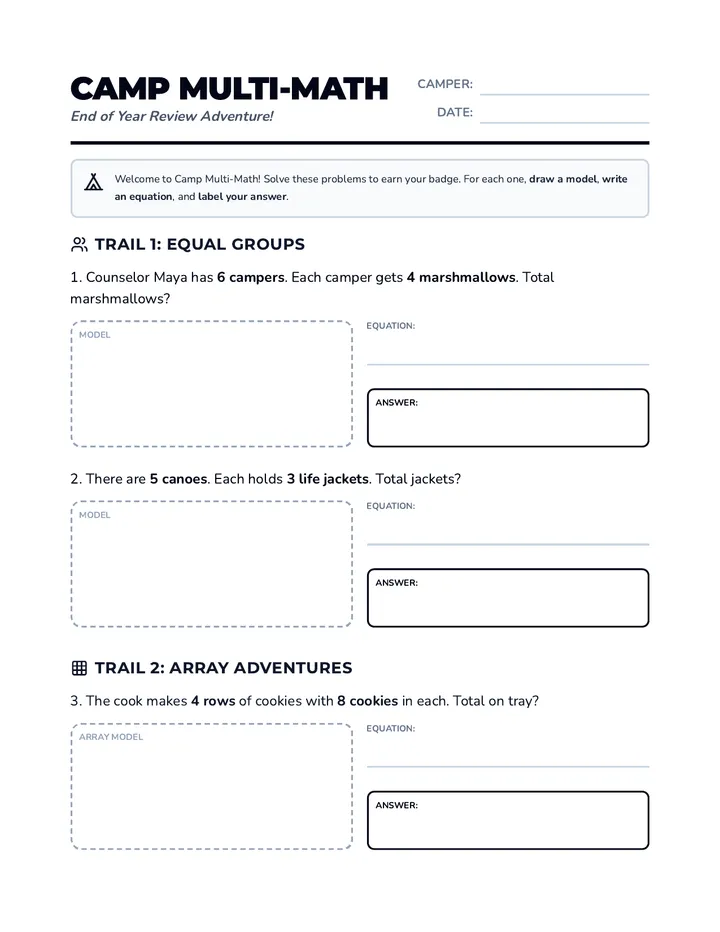
Camp Multi-Math Worksheet

Math Review Adventures

A collection of themed end-of-year math review adventures for different grade levels, focusing on spiraling key standards and problem-solving.

DB

Deborah Burton

21
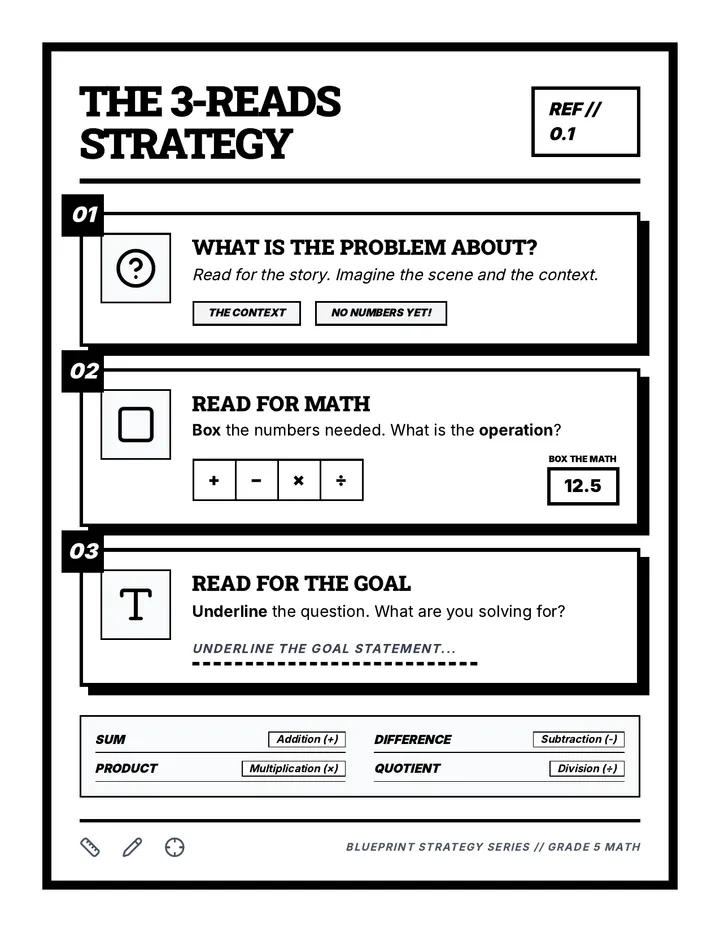
3 Reads Strategy Poster

Math Blueprints Grade 5

A comprehensive set of math supports for 5th-grade students in a co-taught environment. Each unit includes visual vocabulary, worked examples, cloze-style guided notes, and exit tickets featuring a 'Mistake of the Day' analysis.

HJ

Hope Joel

23

Lessons

Muffin Madness Worksheet

Bakery Batch Division

A comprehensive series of fifteen bakery-themed math worksheets focusing on multi-digit multiplication using area models (both 2-digit by 2-digit and 3-digit by 2-digit) and multi-digit long division (up to 5-digits by 1-digit), complete with a consolidated answer key. Worksheets 10-15 feature advanced word problems with extraneous numerical information to build critical thinking, offered in both scaffolded and independent practice formats.

N

nmack

19
Cash Calculators Slides

Cash Calculators

A comprehensive lesson on mastering currency, from basic coin identification and skip counting to calculating mixed bills and making change in real-world market scenarios. Includes visual slides, scaffolded worksheets, and an interactive matching game.

DP

Deana Padgett

4
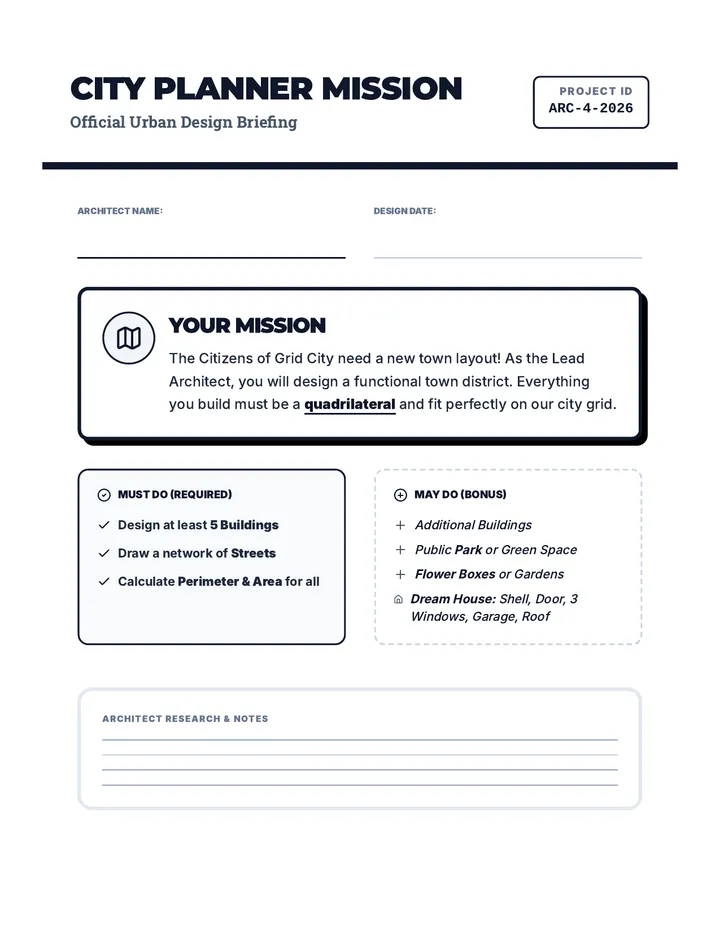
City Planner Mission Guide

Grid City Architects

Students act as urban architects to design a town using quadrilaterals on a grid, calculating perimeter and area for their structures.

TC

Tracey Craft

5
Work Sample 2 Fruit Circle Graph

Data Detective Lab

A collection of 10 distinct data analysis work samples featuring bar and circle graphs, designed for MCAS Alt portfolio evidence. Each sample focuses on identifying key information, making comparisons, and calculating totals.

EE

Erin Esswein

10
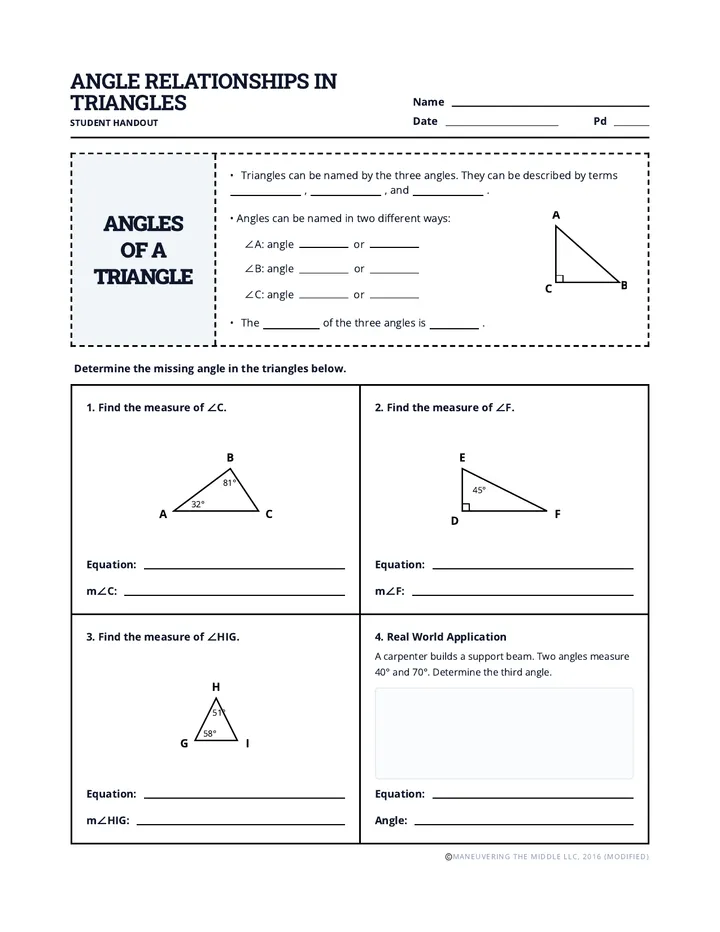
Triangle Sum Secrets Handout

Triangle Sum Secrets

A simplified lesson on the Triangle Sum Rule, focusing on 3-letter angle naming and solving for missing angles using one-step equations with whole numbers.

HF

Hannah Fernandes

6
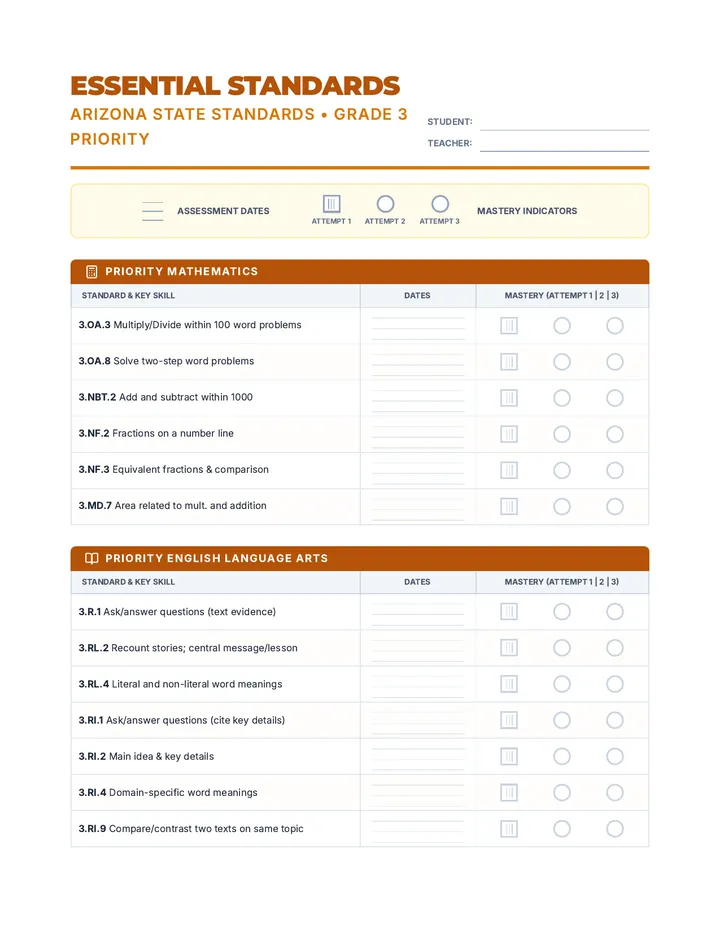
Essential Standards Tracker Document

Arizona Mastery Trackers

A collection of standards mastery tracking cards for Grade 3 Arizona students, covering Math and ELA with a consistent multi-attempt tracking system.

KB

Krista Bodkin

3