Lenny.com
Explore
Create
ActivitiesNewMathEnglish Language ArtsScience & EngineeringSocial StudiesGlobal LanguagesHealth & Physical EducationSpecial EducationCounseling & Life SkillsArts & CreativityESL
Lenny.com
Lenny.com
Explore
Create
ActivitiesNewMathEnglish Language ArtsScience & EngineeringSocial StudiesGlobal LanguagesHealth & Physical EducationSpecial EducationCounseling & Life SkillsArts & CreativityESL
Lenny.com
Lenny.com

Solutions

Lenny for EducatorsLenny for SchoolsLenny for Districts

Product

ExploreSign inCreateSupportAbout

Resources

Getting startedMTSS Acceleration Program

© 2026 Lenny Learning Inc.

TermsPrivacyAccessibility
LinkedInInstagramX
Lenny

Rational Number System

Classification and representation of integers, fractions, and terminating or repeating decimals on the number line. Examines the relationships between subsets of real numbers and techniques for comparing and ordering rational values.

MathNumbers & CountingCounting ObjectsNumber NamesComparing NumbersNumber OperationsCounting SequenceNumbers 0-10Place Value Understanding and SystemAdd and Subtract Within 20Addition and Subtraction ConceptsAddition and Subtraction EquationsAddition and Subtraction ProblemsFoundations for MultiplicationMultiplication and Division PropertiesMultiply and Divide Within 100Multiplication and Division ProblemsFactors and MultiplesProperties of OperationsPatterns and RelationshipsGenerate and Analyze PatternsMulti-Digit ArithmeticPlace Value OperationsMulti-Digit and Decimal OperationsNumerical ExpressionsFour Operations and PatternsFour Operations Problem SolvingMeasurement & DataMeasurable AttributesMeasuring LengthsMeasure and Estimate Lengths in Standard UnitsRelate Addition and Subtraction to LengthClassifying and Counting ObjectsTime and MoneyArea Concepts and MeasurementPerimeter and Area MeasuresAngle Concepts and MeasurementTime, Volume, and MassMeasurement Unit ConversionsGeometryIdentifying ShapesShapes and AttributesShape Attributes and ReasoningShapes and CompositionClassifying 2D FiguresGeometric Figures and RelationshipsLines, Angles, and ShapesAngle, Area, and VolumeGeometric MeasurementVolume of 3D ShapesCoordinate Plane ApplicationsTransformations in the PlaneCongruence and SimilarityUnderstand congruence in terms of rigid motionsSimilarity and TransformationsProve Theorems Involving SimilarityPythagorean TheoremTrigonometry for General TrianglesMake Geometric ConstructionsProve Geometric TheoremsTheorems About CirclesFind Arc Lengths And Areas of Sectors of CirclesVolume FormulasRelationships Between Two-Dimensional and Three-Dimensional ObjectsProve Simple Geometric Theorems AlgebraicallyTranslate Between Geometric Description and Equation for Conic SectionApply Geometric Concepts in Modeling SituationsFractions & DecimalsFractions as NumbersBuilding FractionsFraction Equivalence and OrderingAdding and Subtracting FractionsMultiplying and Dividing FractionsDividing FractionsDecimal FractionsMulti-Digit Computation and FactorsAdd, Subtract, Multiply, and Divide Rational NumbersRational Number SystemIrrational Numbers and ApproximationsRatiosRatios and ProportionsProportional RelationshipsUnit RateAlgebraAlgebraic ExpressionsGenerate Equivalent ExpressionsQuantitative RelationshipsProportional Relationships and Linear EquationsEquations and InequalitiesEquation Solving and ReasoningLinear Equations and SystemsGraph Equations and InequalitiesSystems of EquationsReal-World Algebraic ProblemsQuantitative Reasoning with UnitsExpression StructureEquivalent Expression FormsRadicals and Integer ExponentsRational ExponentsRational and Irrational NumbersPolynomial OperationsPolynomial IdentitiesPolynomial Zeros and FactorsRational ExpressionsComplex Number OperationsComplex Numbers in PolynomialsComplex Numbers on PlaneStatistics & ProbabilityRepresent and Interpret DataData DistributionsStatistical VariabilityProbability ModelsCompound Event ProbabilitiesStatistical SamplingInterpret Categorical and Quantitative DataBivariate Data PatternsInterpret Linear ModelsComparing Two PopulationsRandom Processes in StatisticsIndependence and Conditional ProbabilityExpected ValuesProbability-Based Decision MakingStatistical Inference and ConclusionsFunctionsFunction Concepts and NotationDefine and Compare FunctionsInterpret Functions in ContextAnalyze Function RepresentationsModel Relationships with FunctionsIdentify Linear vs Exponential GrowthDistinguish Between Function TypesCompare Growth RatesInterpret Function ExpressionsBuild Functions from RelationshipsConstruct and Model FunctionsTransform and Combine FunctionsModel Comparison and SelectionSolve Exponential EquationsTrigonometryTrigonometric Ratios Involving Right TrianglesTrigonometric Functions and Unit CircleModel with Trigonometric FunctionsTrigonometric IdentitiesVectors & MatricesIntroduction to Vectors and MatricesVector QuantitiesVector OperationsMatrix OperationsCalculusLimits and ContinuityDerivative Concepts and NotationDerivative Rules and TechniquesApplications of DerivativesOptimization ProblemsRelated RatesCurve Sketching and AnalysisIntegration Concepts and NotationAntiderivatives and Indefinite IntegralsDefinite Integrals and AreaFundamental Theorem of CalculusIntegration TechniquesApplications of IntegrationDifferential EquationsSequences and SeriesParametric and Polar FunctionsVector-Valued Functions

Videos

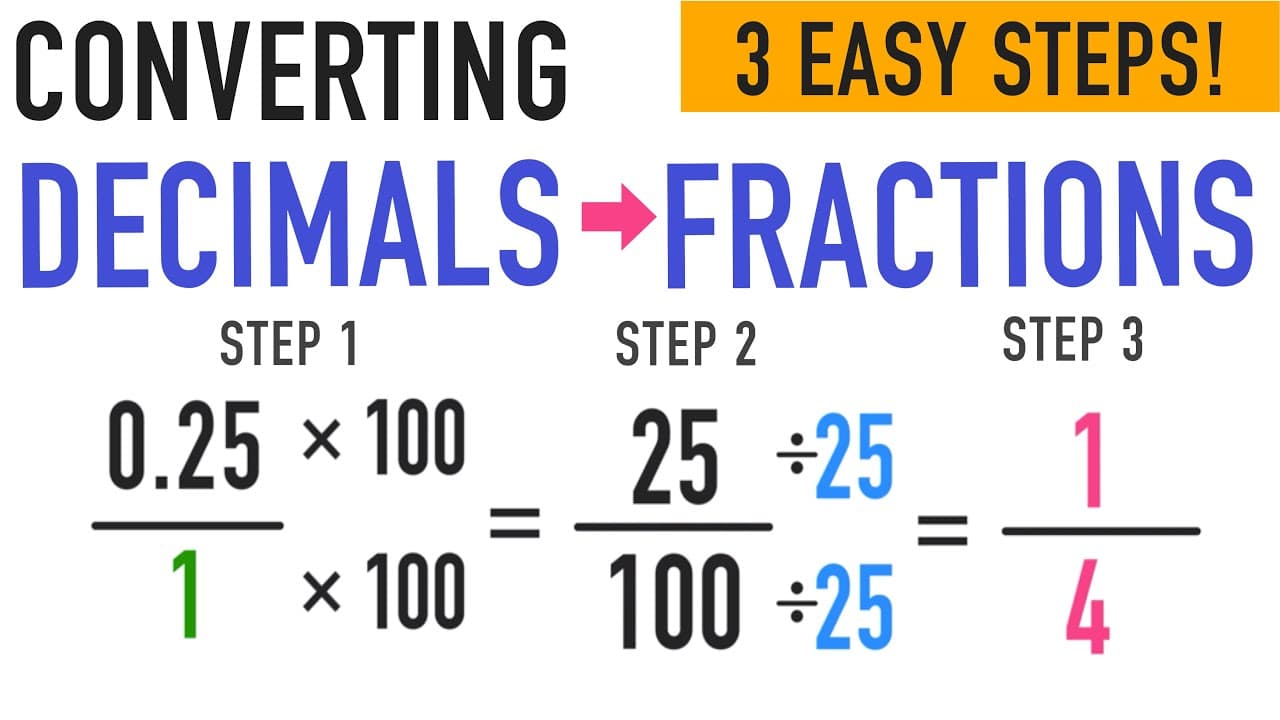
How to Convert Decimals to Fractions Using a 3-Step Method

How to Convert Decimals to Fractions Using a 3-Step Method

This instructional video provides a clear, step-by-step guide on how to convert terminating decimals into fractions. Using a systematic 3-step process, the video demonstrates the mathematical procedure of rewriting the decimal with a denominator of 1, multiplying by powers of 10 to remove the decimal point, and finally simplifying the resulting fraction to its lowest terms. The content is presented visually with on-screen text and animations, making it suitable for visual learners. The video explores key mathematical themes including rational numbers, place value, and fraction simplification. It specifically focuses on the relationship between the number of decimal places and the power of 10 required for conversion (e.g., two decimal places requires multiplying by 100). Two complete examples are worked through in detail: converting 0.25 into 1/4 and converting 0.375 into 3/8. For educators, this video serves as an excellent direct instruction tool or review resource for upper elementary and middle school math students. It breaks down a multi-step algorithmic process into manageable chunks, making it ideal for students who struggle with the mechanics of conversion. The clear visual distinction between steps helps scaffold learning, allowing teachers to pause and check for understanding before moving to the simplification phase.

Mashup MathMashup Math

4mins 17s

How to Compare and Order Decimals to the Thousandths

How to Compare and Order Decimals to the Thousandths

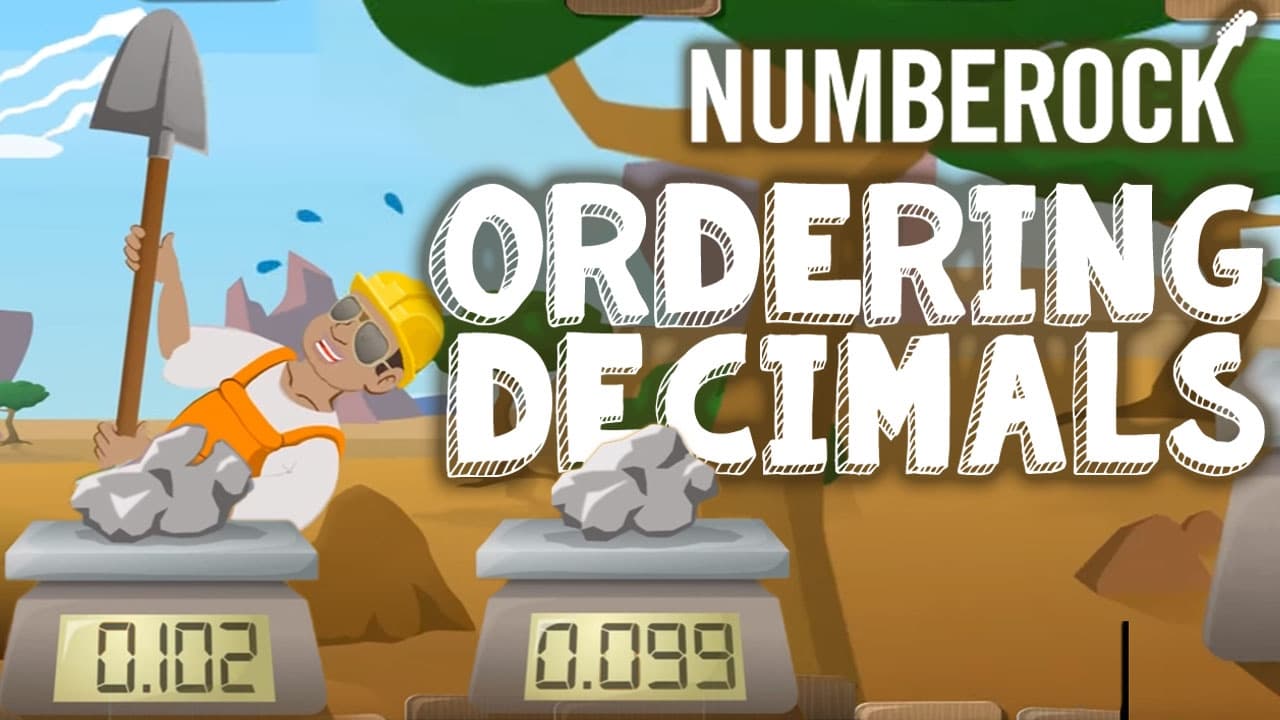
This engaging animated music video teaches students how to compare and order decimals through catchy lyrics and clear visual demonstrations. Using narratives about weighing gold coins and silver pieces, the song guides viewers through the step-by-step process of lining up decimal points vertically and comparing digits from left to right to determine value. The video breaks down complex comparisons involving tenths, hundredths, and thousandths in a way that is accessible and memorable.

Math Songs by NUMBEROCKMath Songs by NUMBEROCK

2mins 23s

Algebra 1 Final Exam Review: From Arithmetic to Logarithms

Algebra 1 Final Exam Review: From Arithmetic to Logarithms

This comprehensive video serves as a rapid-fire review of core algebra concepts, ranging from basic arithmetic operations to advanced equation solving. It begins by establishing a foundation with number systems, including real, rational, and imaginary numbers, before moving into fundamental operations with integers, fractions, and decimals. The instructor demonstrates various techniques for arithmetic, such as the number line for integers and the 'keep-change-flip' method for dividing fractions, ensuring viewers have the prerequisite skills for algebra. The content progresses into key algebraic topics including exponents, radicals, and polynomial factoring. Viewers are guided through the laws of exponents, simplifying complex radical expressions, and converting between exponential and radical forms. A significant portion of the video is dedicated to solving different types of equations: linear equations involving fractions, quadratic equations using both factoring and the quadratic formula, and exponential and logarithmic equations. The instructor emphasizes checking for extraneous solutions, particularly with logarithmic and rational equations. This video is an invaluable resource for students preparing for an Algebra 1 final exam or an Algebra 2 placement test. Its modular structure allows teachers to use specific segments for targeted review or as a complete overview of the curriculum. The step-by-step problem-solving approach models mathematical thinking, making it ideal for classroom observation, homework support, or 'flipped classroom' assignments where students review the theory at home and solve problems in class.
The Organic Chemistry TutorThe Organic Chemistry Tutor

12mins 10s

Solving Rational Equations Using the LCM Method

Solving Rational Equations Using the LCM Method

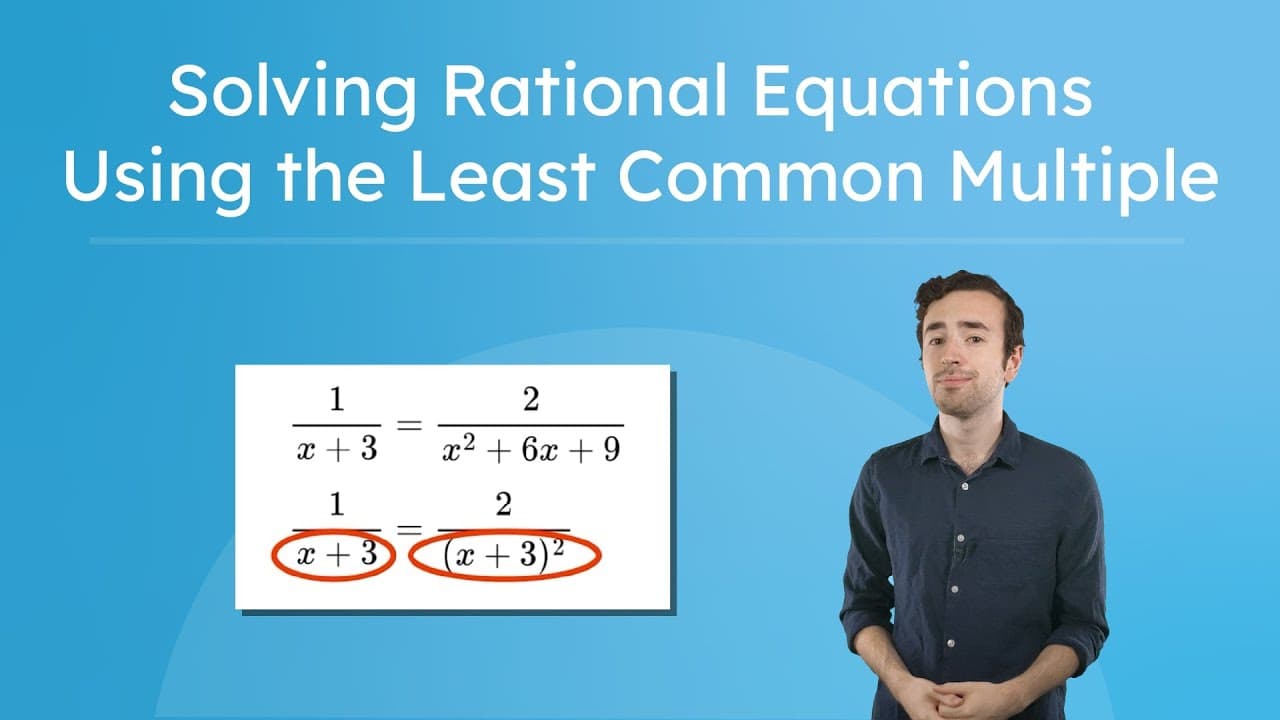
This video provides a comprehensive tutorial on solving rational equations using the Least Common Multiple (LCM) method. It begins by contrasting this approach with the cross-product method, helping students identify exactly when the LCM method is more efficient—specifically when equations involve multiple fractions on one side or share common factors in the denominators. The presenter, Justin, guides viewers through four distinct examples that increase in complexity, demonstrating how to factor denominators, determine the LCM, clear fractions by multiplying, and solve the resulting linear or quadratic equations. The content emphasizes procedural fluency and the critical step of checking for extraneous solutions. By revisiting a problem from a previous lesson, the video highlights how choosing the correct method can simplify the solving process. It covers key algebraic skills including factoring quadratics, distributing terms, combining like terms, and identifying domain restrictions that result in extraneous solutions (division by zero). For educators, this resource serves as an excellent direct instruction tool for Algebra I or Algebra II classes. It models mathematical thinking by asking "which method is best?" before solving. The clear visual breakdown of cancelling factors helps demystify why multiplying by the LCM works. The video is particularly useful for addressing the common student struggle of dealing with complex rational expressions and reinforces the importance of verifying answers in the context of the original equation.

Miacademy & MiaPrep Learning ChannelMiacademy & MiaPrep Learning Channel

13mins 39s

Comparing Decimals Using a Place Value Chart

Comparing Decimals Using a Place Value Chart

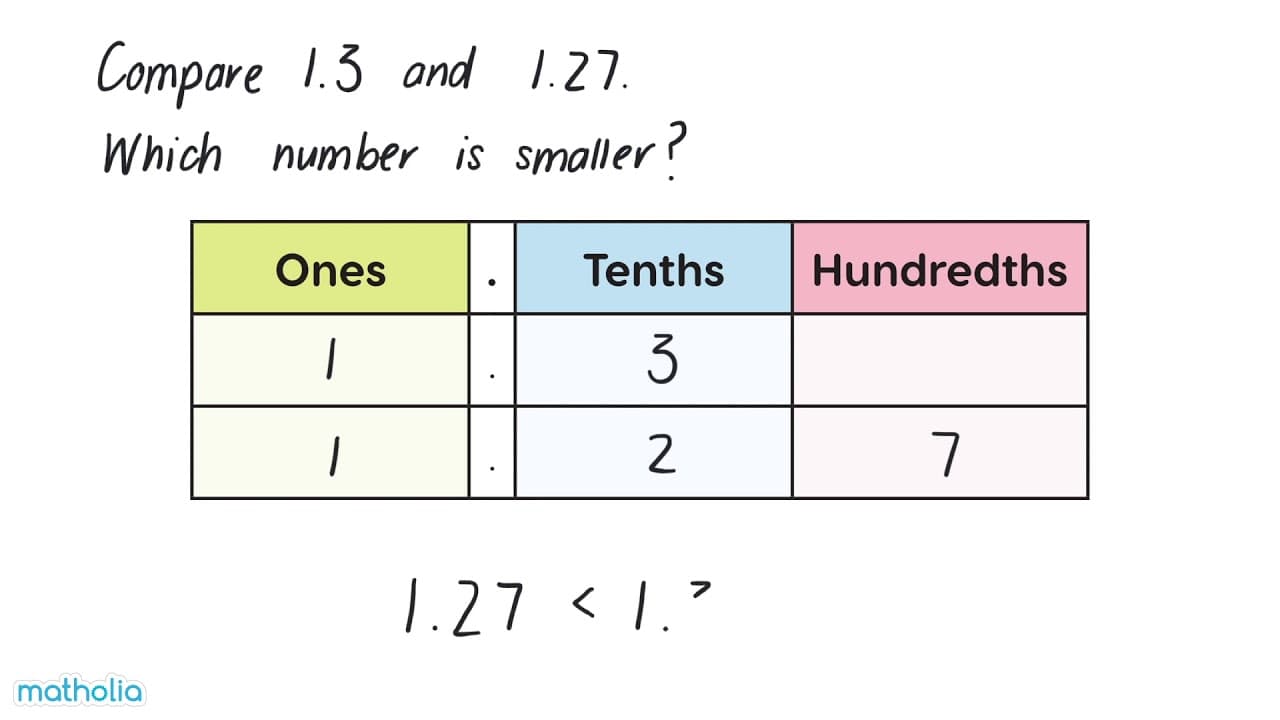
This educational video provides a clear, step-by-step demonstration of how to compare decimal numbers using a place value chart. It guides viewers through two distinct examples: identifying the smaller number between 1.3 and 1.27, and determining the greater number between 8.36 and 8.31. The narration emphasizes the systematic approach of comparing digits from left to right, starting with the highest place value, to determine which value is larger or smaller. Key themes include number sense, place value understanding (ones, tenths, and hundredths), and logical problem-solving strategies. The video specifically reinforces the concept that the value of a decimal is determined by the position of its digits relative to the decimal point, rather than the total number of digits, which is a fundamental concept in upper elementary mathematics. For educators, this video is an excellent tool for introducing or remediating decimal comparison skills. It directly addresses the common student misconception that longer decimal numbers are automatically larger (e.g., thinking 1.27 is greater than 1.3). By visually aligning numbers in a grid, it offers a concrete strategy that students can replicate on paper to avoid errors, making it valuable for direct instruction or independent review stations.

MatholiaChannelMatholiaChannel

1min 30s

Converting Percentages to Simplified Fractions

Converting Percentages to Simplified Fractions

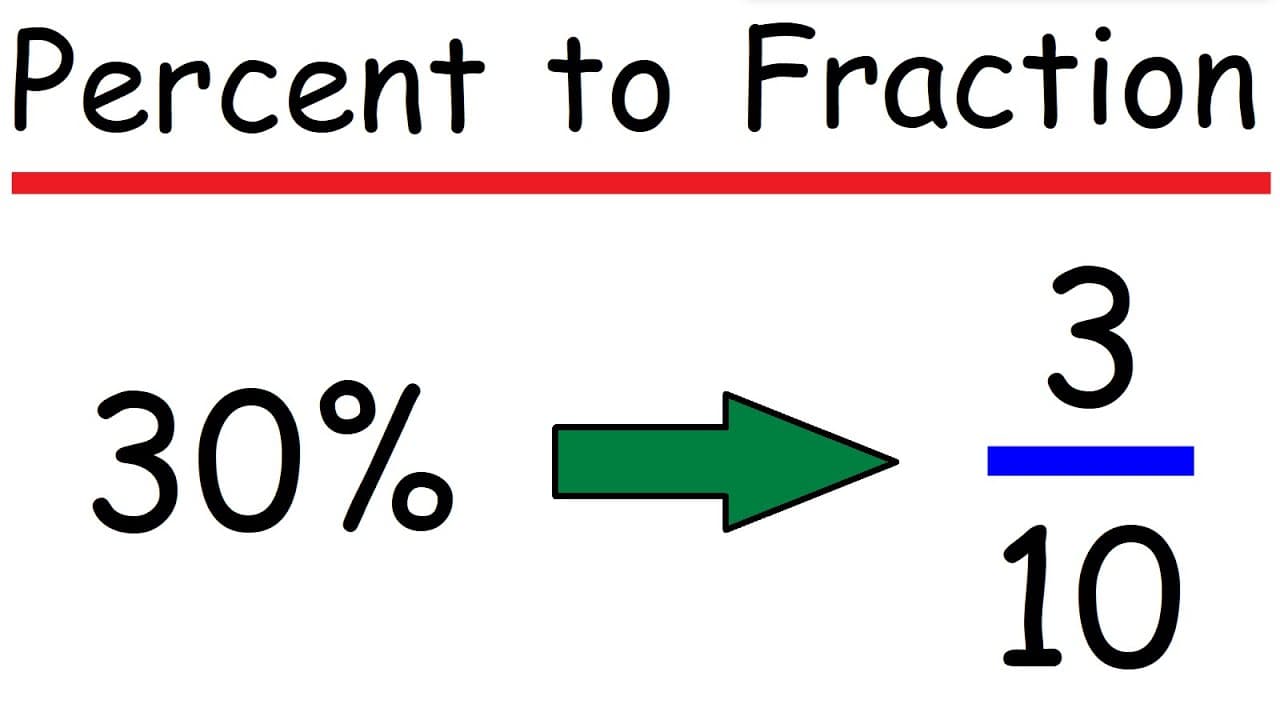
This instructional video provides a step-by-step tutorial on converting percentages into simplified fractions. The narrator breaks down the process into three clear stages: first converting the percentage to a decimal by dividing by 100, then transforming that decimal into a fraction, and finally simplifying the fraction to its lowest terms. The video progresses from simple integer percentages to more complex examples involving decimals within the percentage itself. The content explores key mathematical themes such as decimal-to-fraction conversion, the concept of dividing by 100 as a representation of 'percent', and the rules of divisibility used for simplifying fractions. It specifically demonstrates how to handle decimal movements (moving the decimal point two places to the left) and how to eliminate decimals from a numerator by multiplying by powers of 10. For educators, this video serves as an excellent resource for reinforcing arithmetic skills in middle school math. It can be used to introduce the concept of conversions, as a review tool for struggling students, or as a visual guide for understanding the algorithmic process of simplification. The clear, handwritten visual style allows students to follow the mechanical steps of the math problems in real-time, making abstract rules concrete.

The Organic Chemistry TutorThe Organic Chemistry Tutor

4mins 3s

Materials

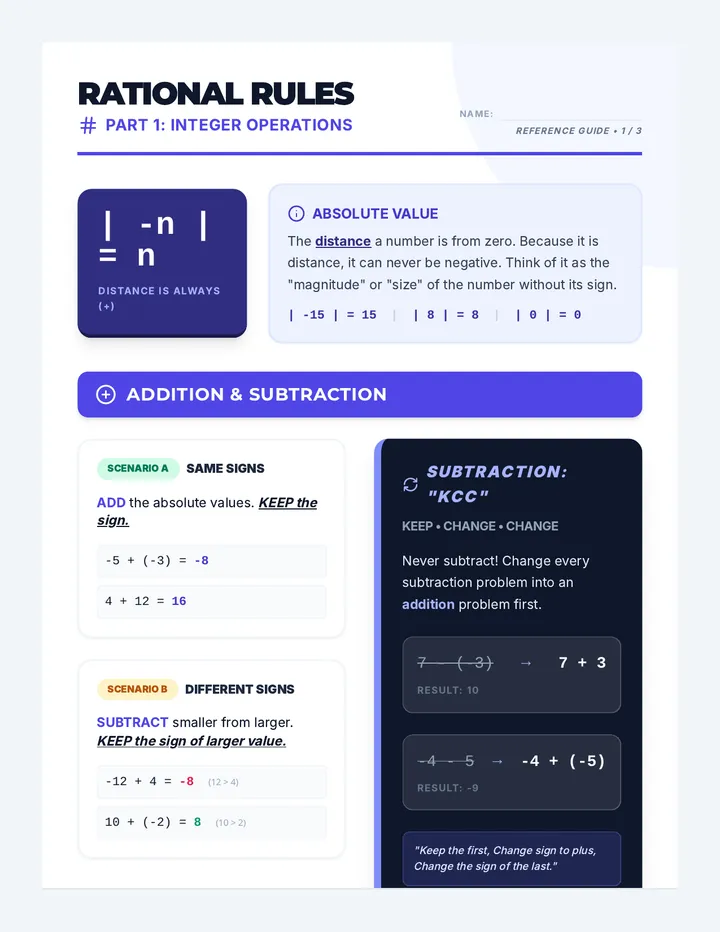
Rational Rules Reference Sheet

Rational Rules Reference Sheet

A redesigned three-page reference sheet for rational number operations. Page one focuses on integer rules with absolute value, addition, subtraction (KCC), and multiplication/division sign tricks. Page two covers decimals with detailed guides on lining up dots, counting places for multiplication, and the 'Top in the Box' method for division. Page three masters fractions with common denominators, the KCF method, mixed-to-improper conversion (MAD), and a table of common conversions, ending with a logical 'Reality Check' section.

WM

Will M

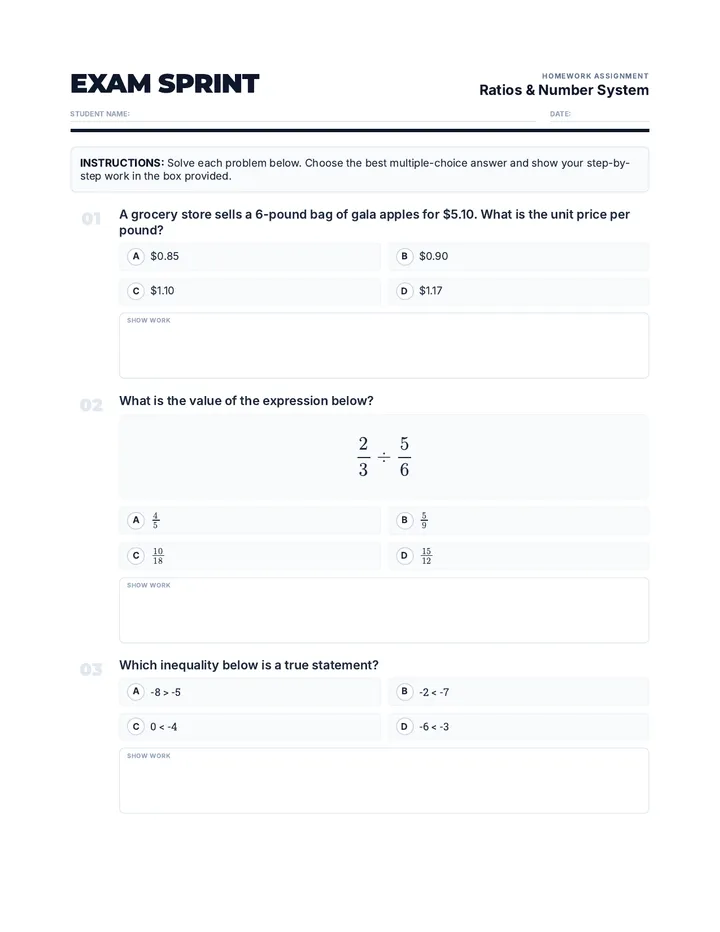
Exam Sprint Worksheet Reformatted

Exam Sprint Worksheet Reformatted

A reformatted, 2-page multiple-choice worksheet featuring 6th-grade math questions. This version uses optimized spacing to ensure exactly three questions fit per page, each with its own dedicated work area and a final scratch space.

FB

Faith Bain-Lucey

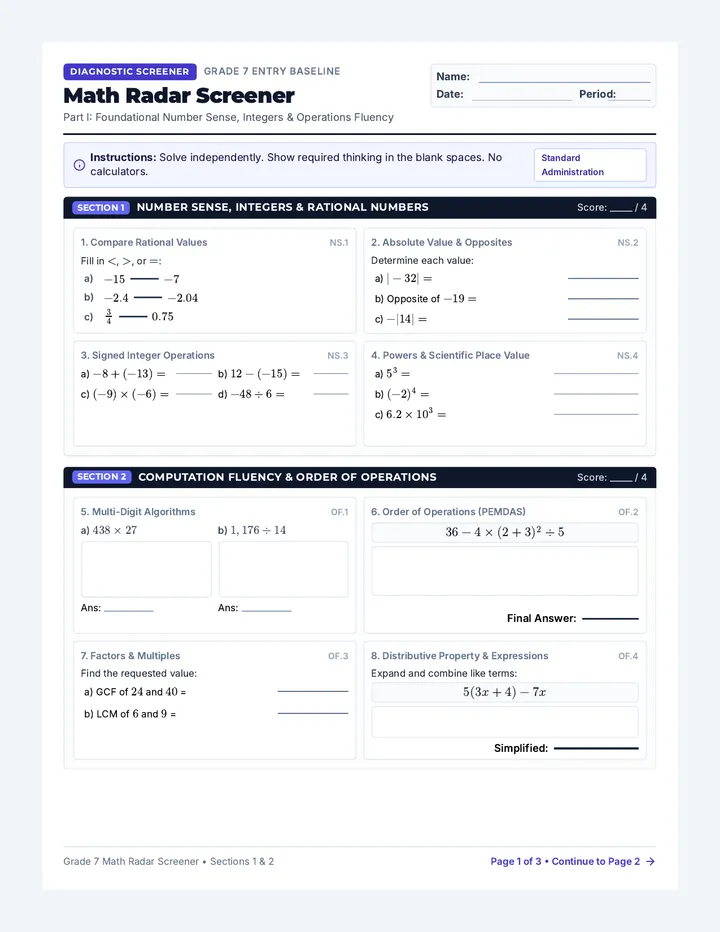
Math Radar Screener

Math Radar Screener

A comprehensive 3-page diagnostic math screener for entering 7th graders covering number sense, operations fluency, fractions, decimals, percents, and multi-step word problems. Includes a built-in teacher diagnostic rubric and tier intervention matrix.

BH

Beth Hellman

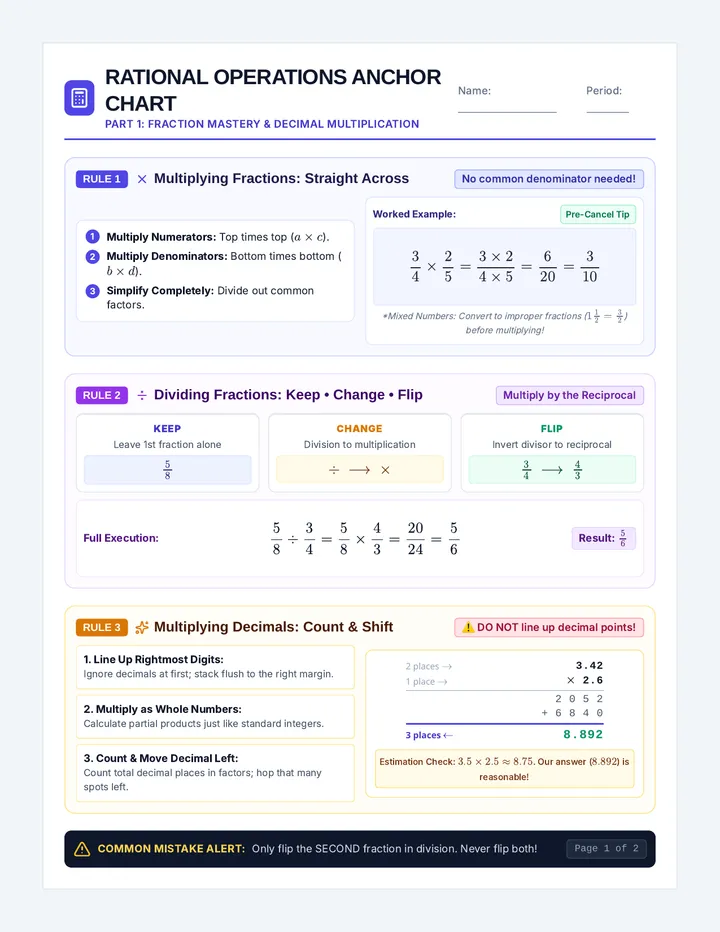
Rational Operations Anchor Chart

Rational Operations Anchor Chart

A two-page printable student anchor chart and desk reference guide detailing multiplication and division algorithms for fractions and decimals, the power-of-10 shortcut, decimal long division, and terminating versus repeating decimals.

R

rgood

Bistro Startup Project Guide

Bistro Startup Project Guide

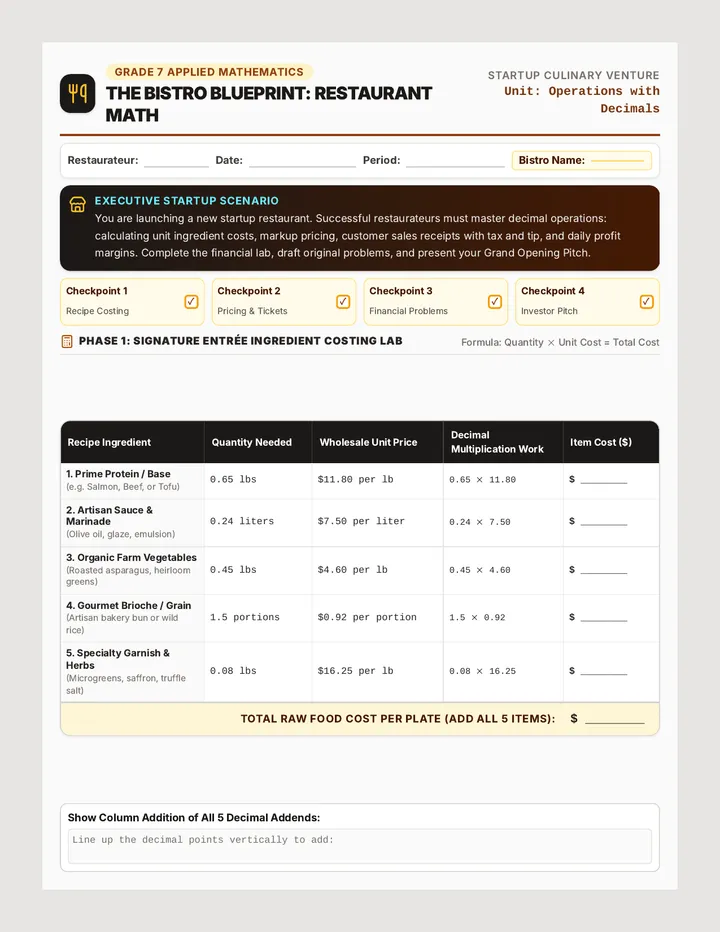
A comprehensive Grade 7 mathematics project guide exploring decimal operations through the real-world lens of launching a startup restaurant. Students calculate ingredient food costs, menu markups, customer dining receipts with tax and tip, author three original multi-step decimal word problems, and assemble a final business pitch portfolio evaluated by a 16-point analytical rubric.

EE

Ezz Eldeen Ahmed

Decimal Expedition Worksheet

Decimal Expedition Worksheet

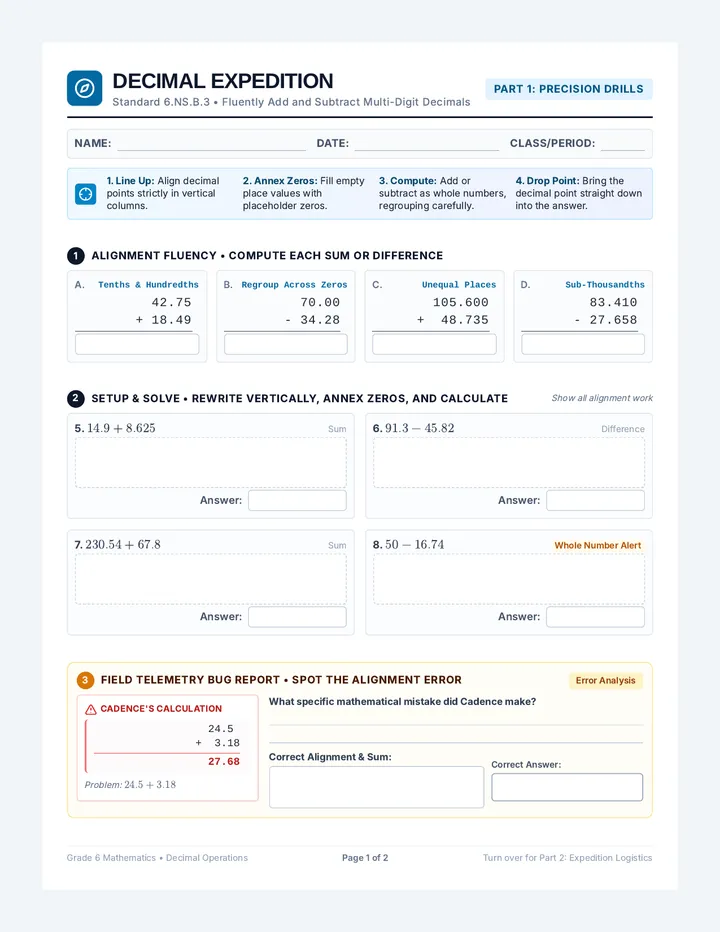
A two-page 6th grade math worksheet focused on adding and subtracting multi-digit decimals through expedition logistics. Features place-value alignment drills, whole-number regrouping, error analysis, and multi-step real-world problem solving.

KD

Katelynn Dotson

Sequences

Project Mission Slides Final

Math in Motion: The 2-Hour Summit

A high-intensity, 120-minute math simulation. Students act as lead consultants, completing a high-speed skill warmup before selecting a professional sector (Music, Urban Planning, Rocket Science, or Sports Analytics) to solve a series of complex work orders.

EL

Elsa LaLone

102
Math Blueprint Week 1 Booklet (Definitive)

Math Blueprint Spiral

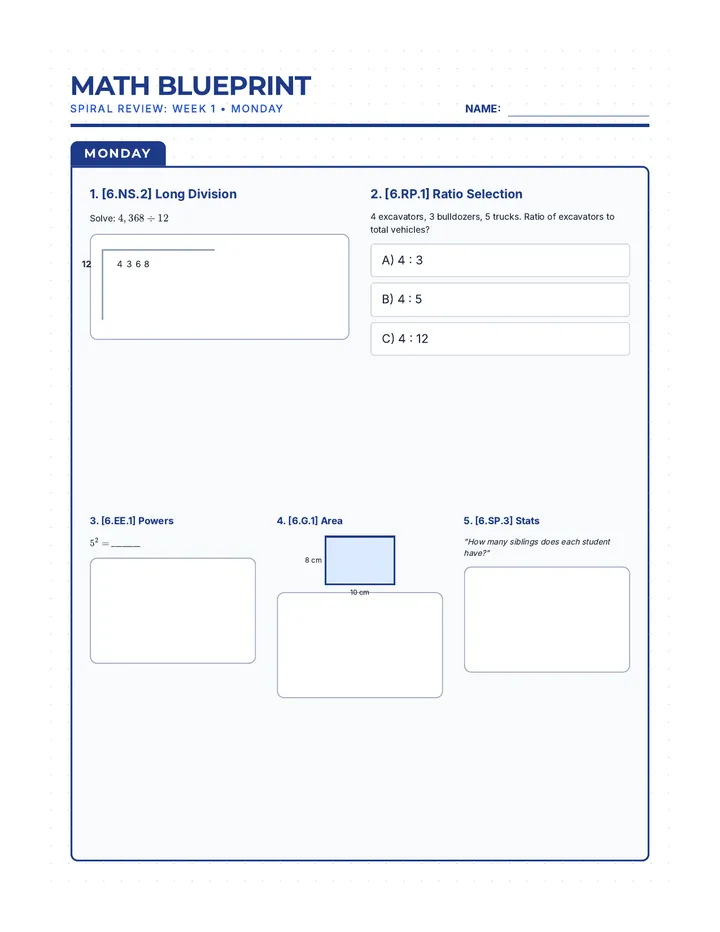
A 7-week comprehensive math review sequence designed to prepare 6th-grade students for North Carolina state testing, covering Number Systems, Ratios, Expressions, Geometry, and Statistics.

MK

Michell Kisler

27
Camp Multi-Math Worksheet

Math Review Adventures

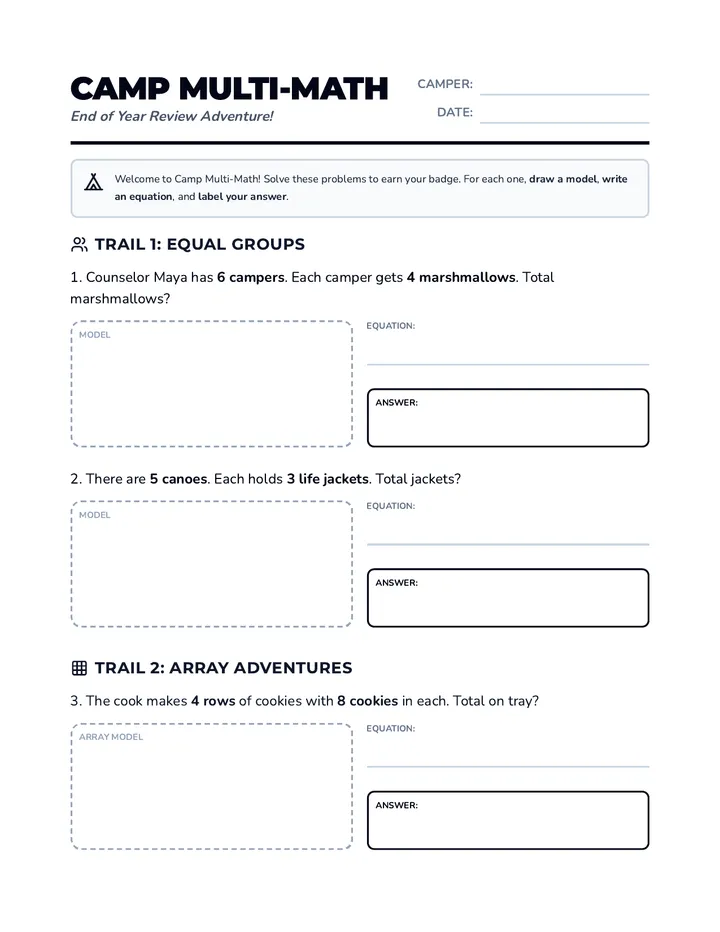
A collection of themed end-of-year math review adventures for different grade levels, focusing on spiraling key standards and problem-solving.

DB

Deborah Burton

21
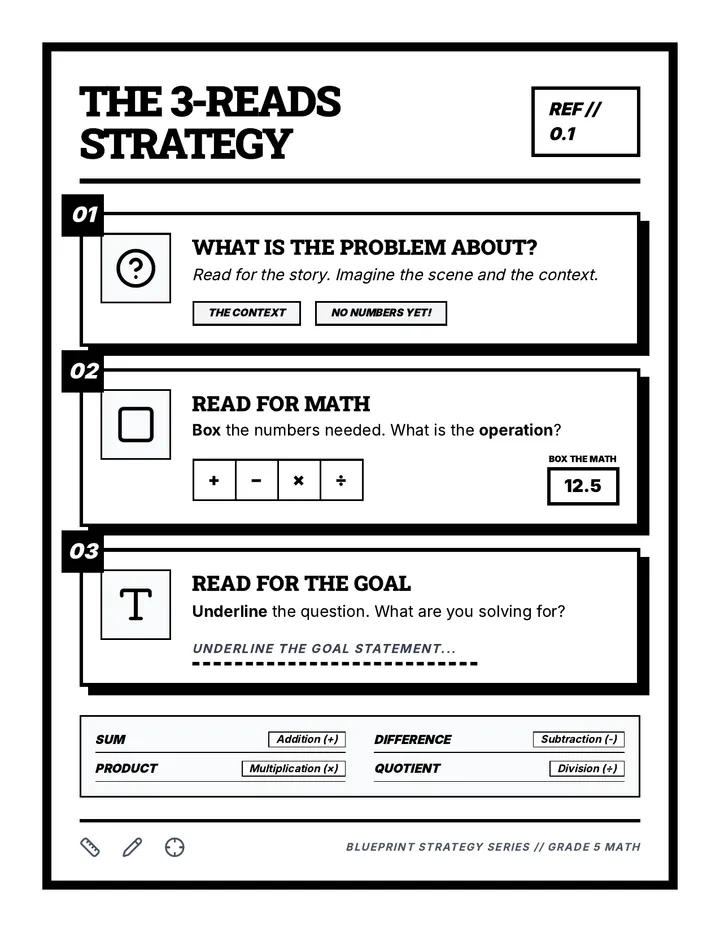
3 Reads Strategy Poster

Math Blueprints Grade 5

A comprehensive set of math supports for 5th-grade students in a co-taught environment. Each unit includes visual vocabulary, worked examples, cloze-style guided notes, and exit tickets featuring a 'Mistake of the Day' analysis.

HJ

Hope Joel

23
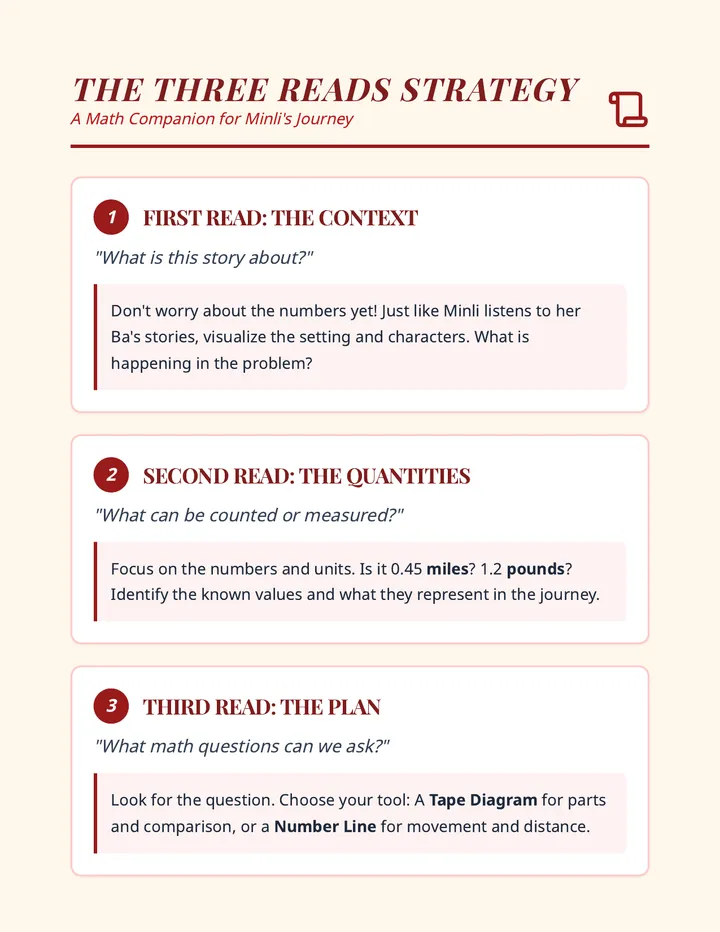
Three Reads Reference Sheet

Quest Mastery 4-Day Bridge

A 4-lesson intensive math intervention for 5th graders designed to bridge 4th-grade decimal foundations to 5th-grade mastery. Features the Three Reads strategy and mental math logic (Counting Up, Matching Units) themed around 'Where the Mountain Meets the Moon'.

K

kthompson

21
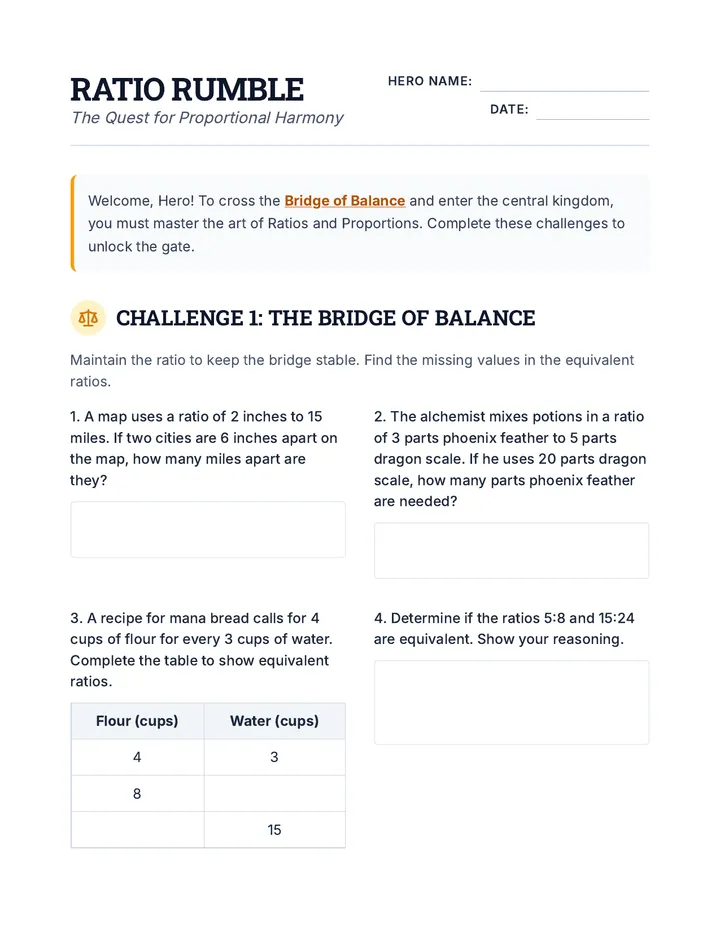
Ratio Rumble Worksheet

Math Quest Review

A week-long adventure-themed 6th-grade math review covering major clusters: Ratios & Proportions, Number System, Expressions & Equations, and Geometry. The sequence culminates in a mixed-review 'Quest Finale' to assess student mastery and readiness.

C

carlsond

15

Lessons

Percent Puzzle Lesson Plan

The Percent Puzzle Solving Percent Equations

A comprehensive 65-minute lesson for 9th-grade students on solving percent equations and proportions, using a "Percent Puzzle" theme to engage students in finding missing parts, wholes, and percentages.

KC

Kris Coyne

6
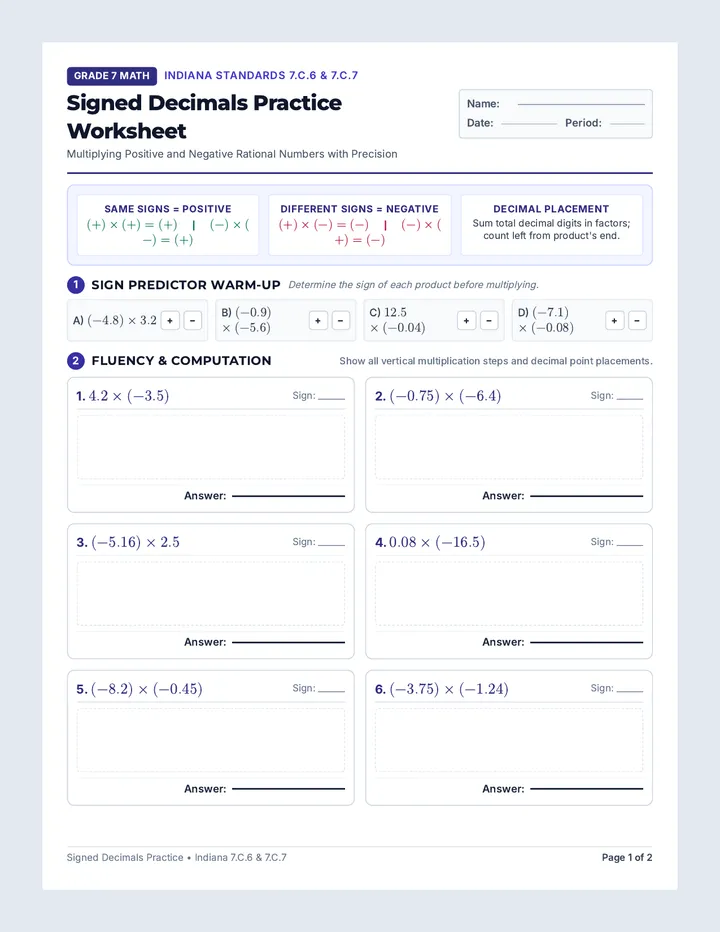
Signed Decimals Practice Worksheet

Signed Decimal Showdown

A comprehensive 7th-grade math lesson focused on multiplying positive and negative decimals, mastering integer sign rules with rational numbers, and solving multi-step real-world problems aligned to Indiana standards 7.C.6 and 7.C.7.

R

Rebecca.Heimann

5
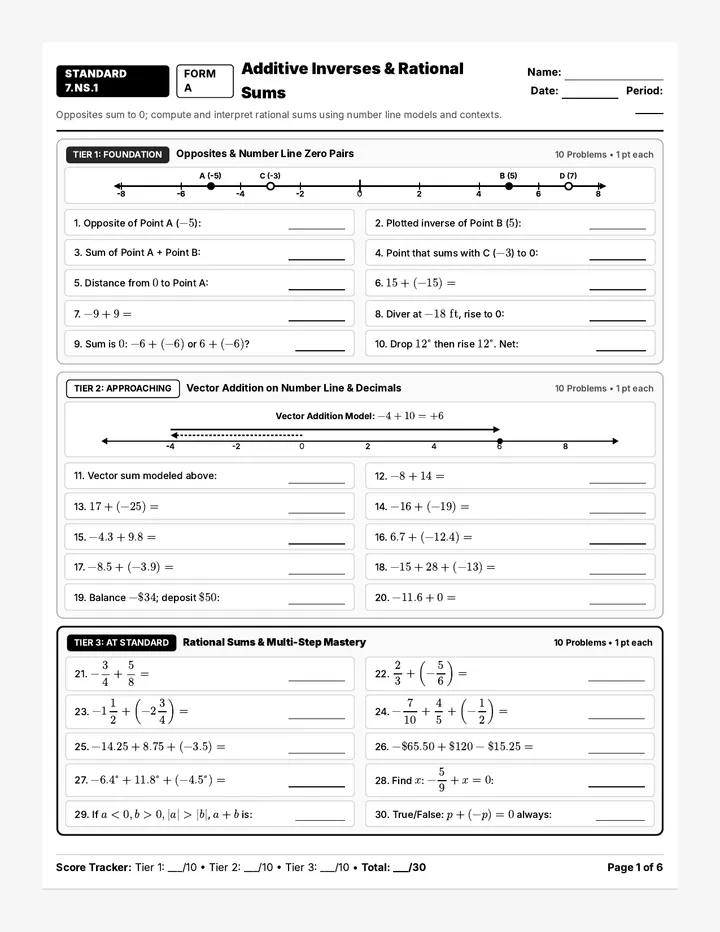
Number Sense Form A Workbook

Number Sense Progression

Grade 7 number sense progression series covering standards 7.NS.1 through 7.NS.6. Features four parallel assessment workbooks (Forms A, B, C, and the 4-tier Form D with Above Standard challenge), a master answer key, teacher facilitation guide, and tier quick notes.

CS

Chynna Smith

7
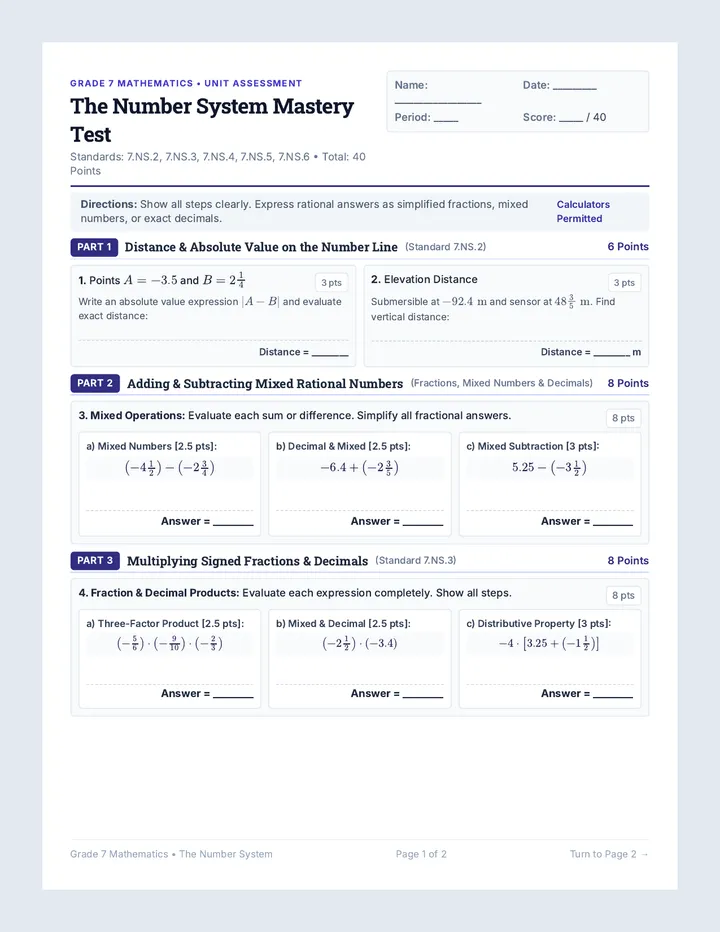
Rational Numbers Test

Rational Numbers Mastery

A complete 7th-grade rational numbers learning and assessment package, featuring a spacious 3-page test with maximum vertical workspace, a compact 2-page teacher answer key with step-by-step point distribution (35 points total), a guided Study Guide, and two independent practice packets (Forms A & B).

CS

Chynna Smith

5
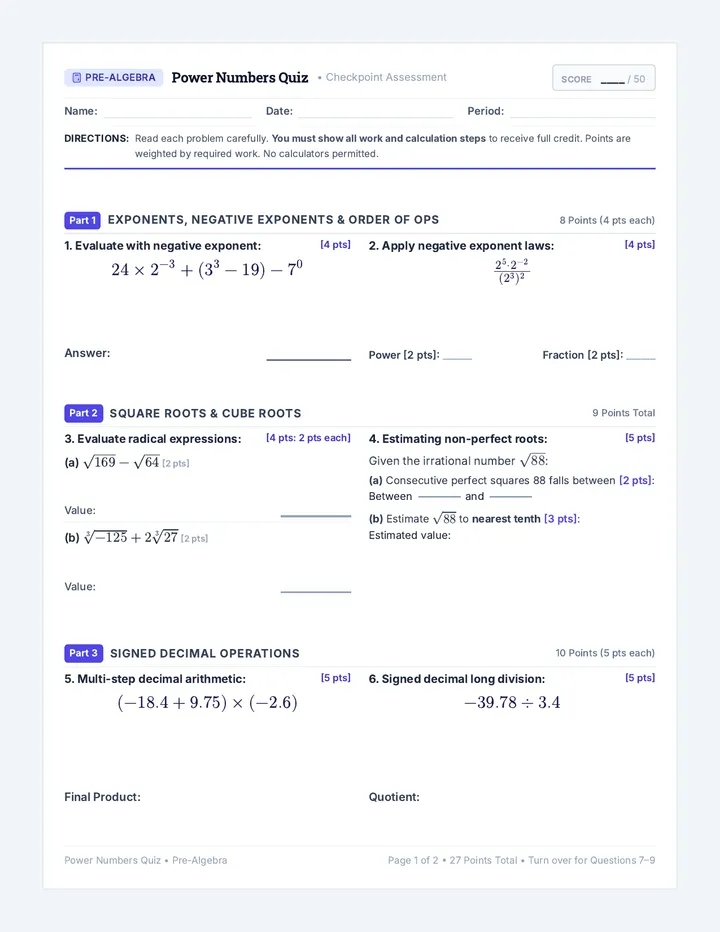
Power Numbers Quiz

Power Numbers Checkpoint

A pre-algebra checkpoint assessing exponents, square and cube roots, prime factorization, decimal arithmetic, and scientific notation with number ordering.

CS

Chynna Smith

4
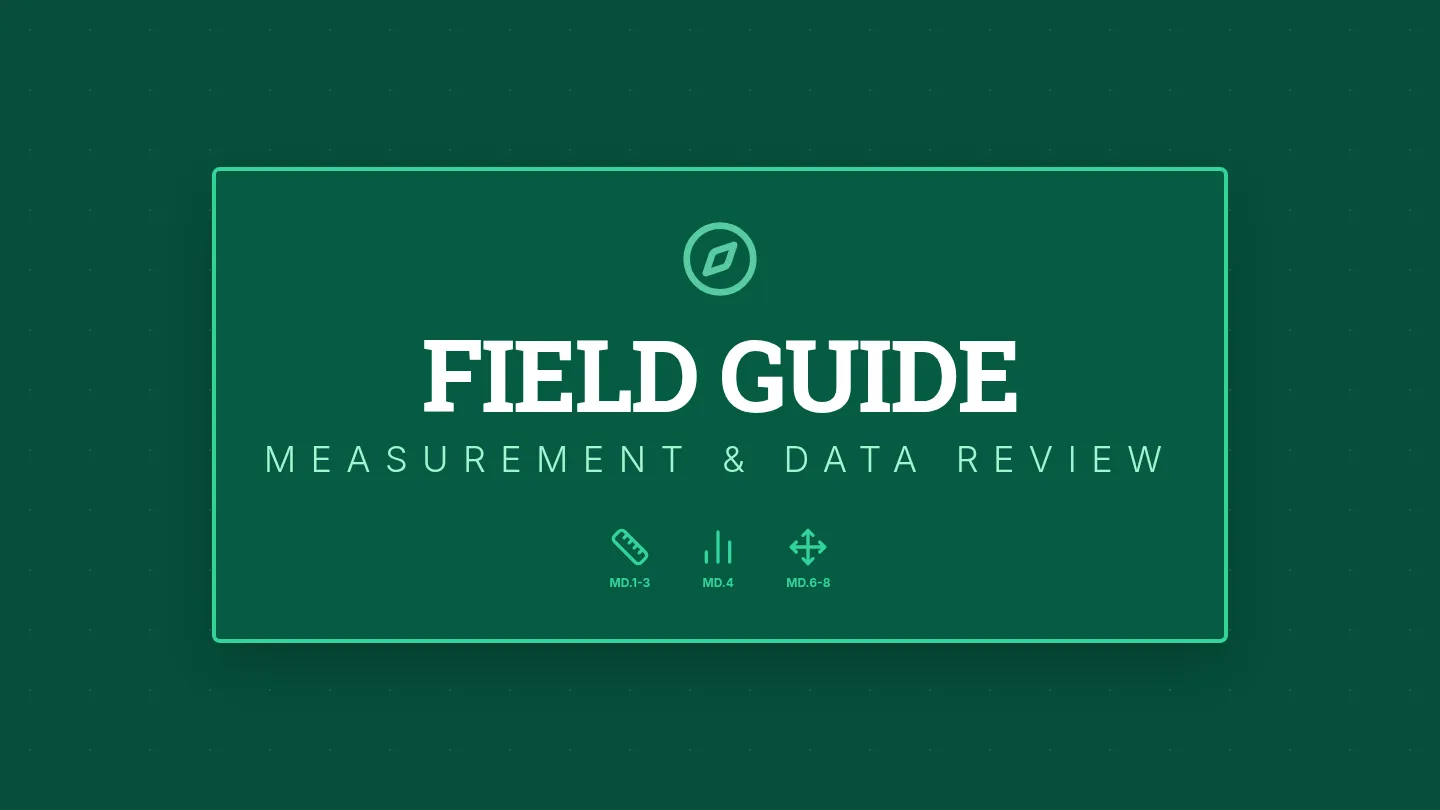
Measurement Field Guide Slides

Drafting Board Measurement & Data Review

A precision-focused drafting-themed review of 4th grade Measurement and Data (MD) standards. Covers units and conversions (MD.1), measurement word problems (MD.2), area and perimeter (MD.3), line plots (MD.4), and angle measurement and addition (MD.6-7). Division has been removed from the curriculum.

DG

Debra Golden

18