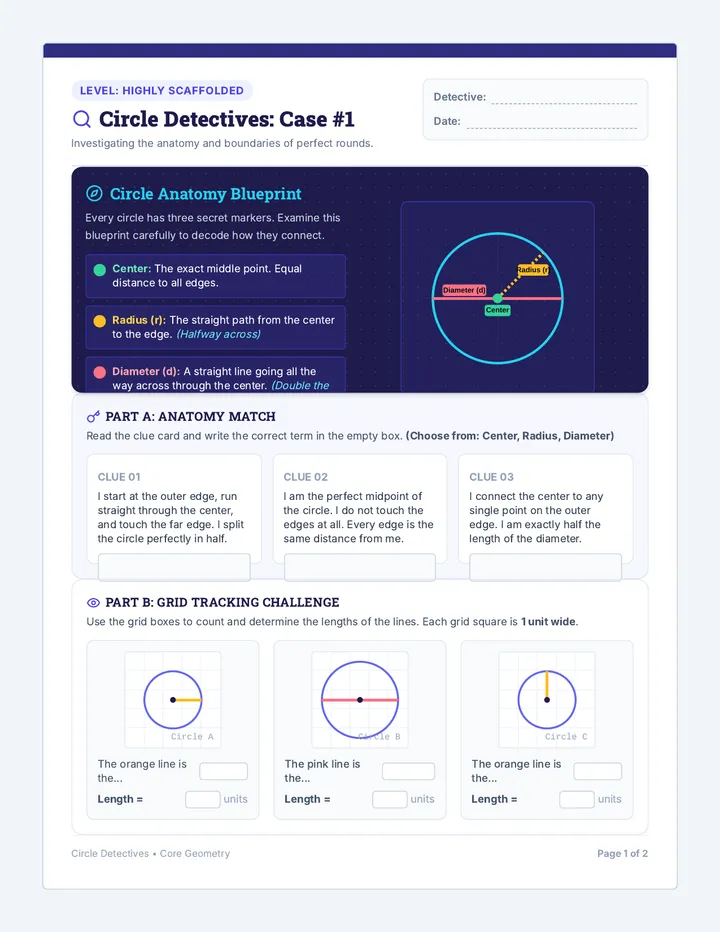
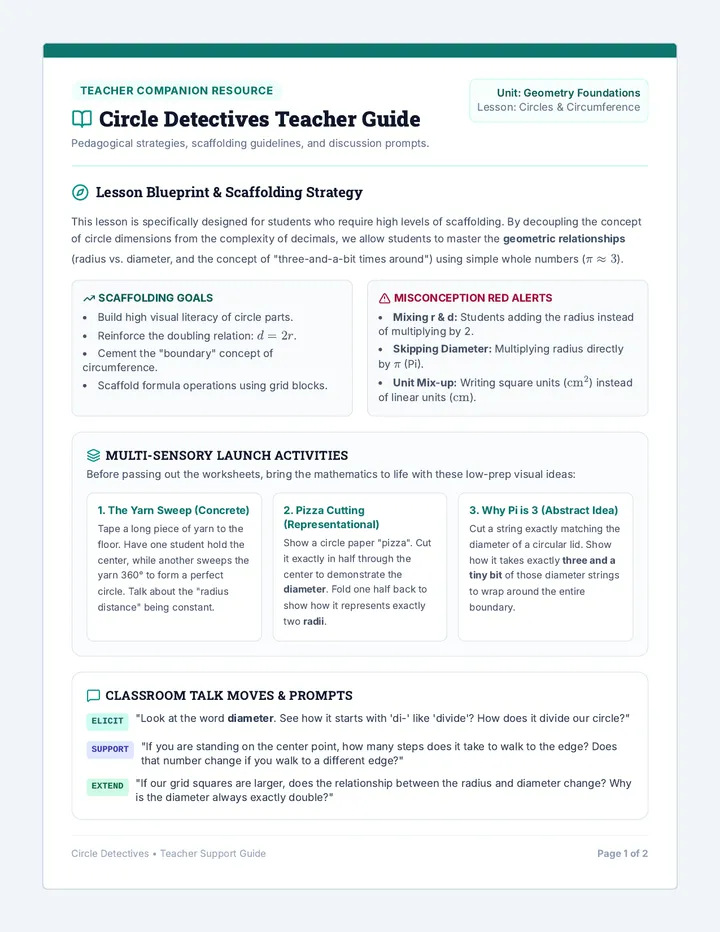
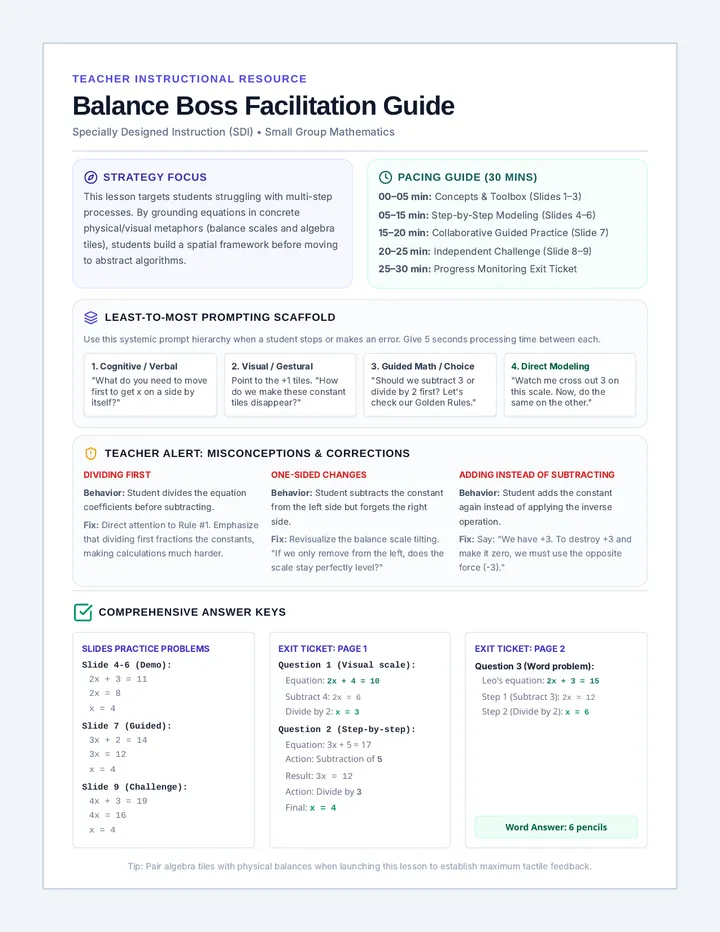
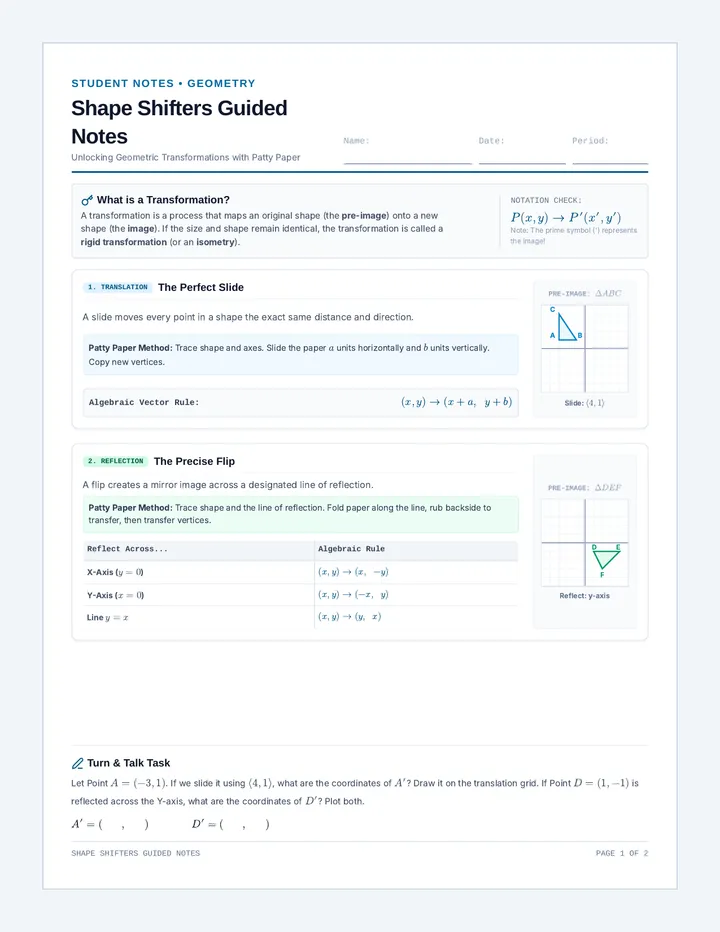
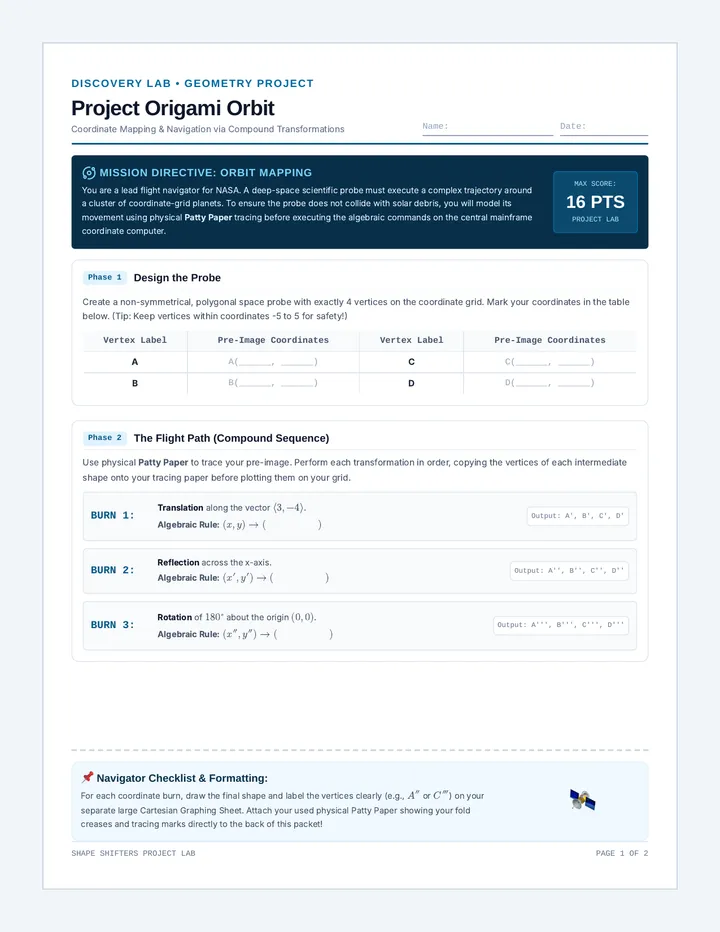
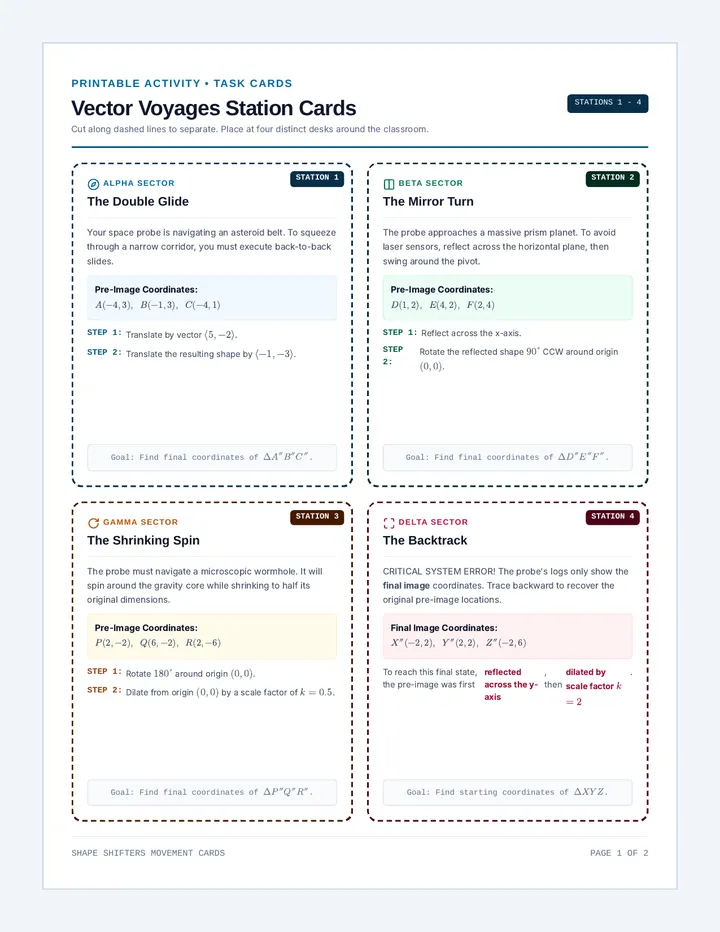
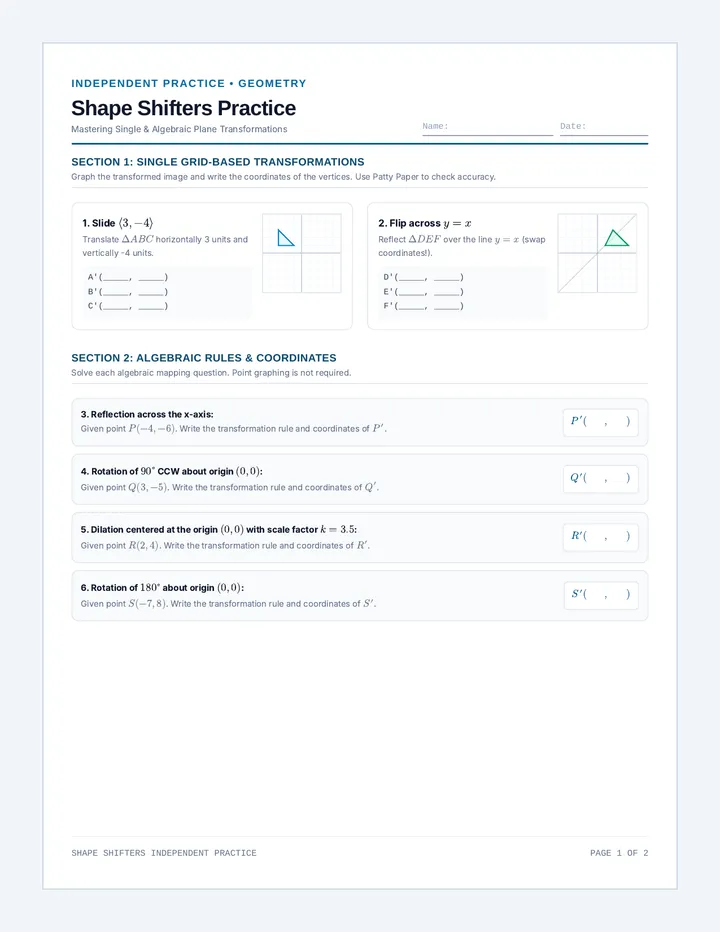
Scale Factor Secrets Slides Scale Factor Secrets
Lesson 1: Dilations and Similarity
The Shadow Hook
Imagine holding a flashlight 12 inches from a wall. You place a puppet in front of it.
What happens to the shadow if you move the puppet closer to the light?
What happens if you move it further away?
"Does the shadow change shape, or just size?"
What is a Dilation?
Enlargement
The figure gets bigger. The scale factor \(k > 1\).
Reduction
The figure gets smaller. The scale factor \(0 < k < 1\).
Scale Factor
The ratio of the lengths of two corresponding sides.
Key Formula: \(k = \frac{\text{Image Length}}{\text{Pre-image Length}}\)
Dilation on the Grid
At the Origin
To dilate a point \((x, y)\) by a scale factor of \(k\) about the origin:
\((x, y) \rightarrow (kx, ky)\)
Example:
Point \(A(2, 4)\) with \(k = 3\)
\(A'(2 \cdot 3, 4 \cdot 3) = A'(6, 12)\)
Pre-image
Image (\(k = 2.5\))
Similarity
Two figures are similar if one can be obtained from the other by a sequence of:
Rigid Motions
(Translations, Reflections, Rotations)
Dilation
(Changing size)
Result: Same shape, different size.
Angles stay the same! Side lengths change proportionally.
Scale Factor Secrets Teacher Guide Scale Factor Secrets
Lesson 1 Facilitation Guide
Unit: Similarity & Slope
Grade 8 Geometry
Learning Objectives
Identify the effect of dilations on the coordinates of a figure.
Calculate scale factor given a pre-image and its dilated image.
Define similarity as a sequence of rigid motions and dilations.
Materials Needed
• Flashlight (or phone light)
• Cardboard cutouts (shapes)
• "Scale Up" Activity Sheet
• Rulers & Colored Pencils
The Hook (10 mins)
Shadow Play
Turn off the classroom lights. Use a flashlight to project a shadow of a small triangle cutout onto a screen or wall. Ask students:
"I want to make this shadow exactly twice as big. Should I move the triangle toward the light or toward the wall? Does the triangle actually change shape, or is it just the size that shifts?"
Key Concept: This is a 3D dilation. The flashlight is the "Center of Dilation."
Instruction (15 mins)
The Rule of Origin
Direct students to Slide 4. Explain that in 8th grade, we primarily dilate figures relative to the Origin (0,0).
1
Show how multiplying every coordinate by \(k\) "pushes" or "pulls" the points away from the center.
2
Demonstrate the difference between \(k=2\) (Enlargement) and \(k=0.5\) (Reduction).
Misconception Alert
Students often try to add the scale factor to coordinates instead of multiplying . Remind them that dilation is about ratio and scale, which requires multiplication.
Questioning Strategy
Ask: "If the scale factor is 1, what happens to the shape?" (It stays the same size; it's congruent). "What happens if \(k\) is negative?" (It flips across the origin).
Differentiation Support
Student Needs Strategy Struggling with Decimals Use fraction scale factors (e.g., \(1/2\) instead of \(0.5\)) to help them see the relationship to division. Advanced Learners Challenge them to perform a dilation about a center point other than the origin (e.g., dilate about point (1,2)).
Scale Factor Secrets Activity Scale Factor Secrets
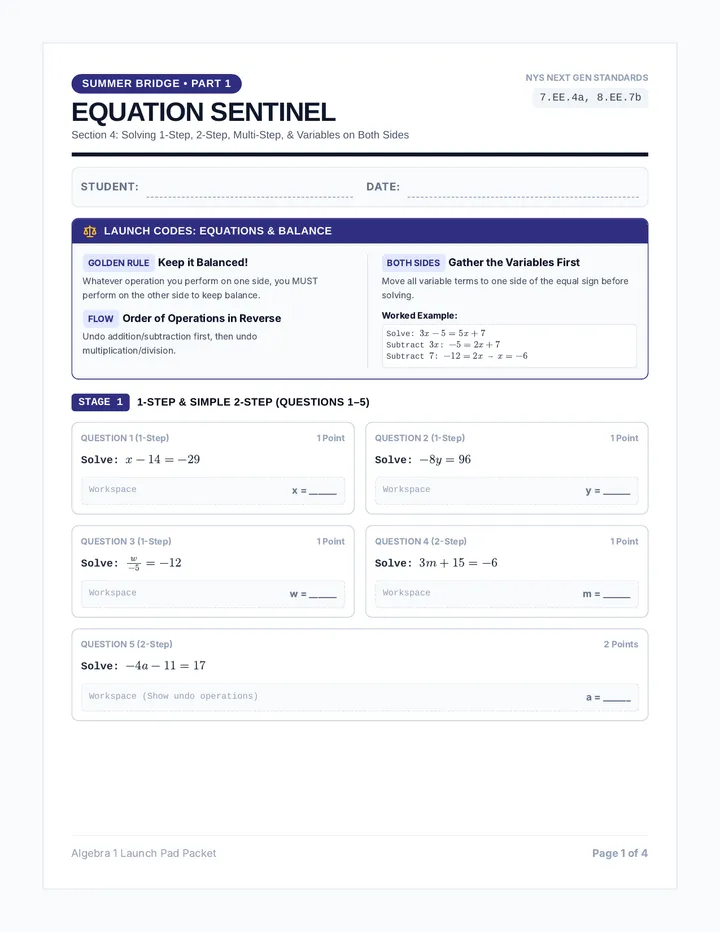
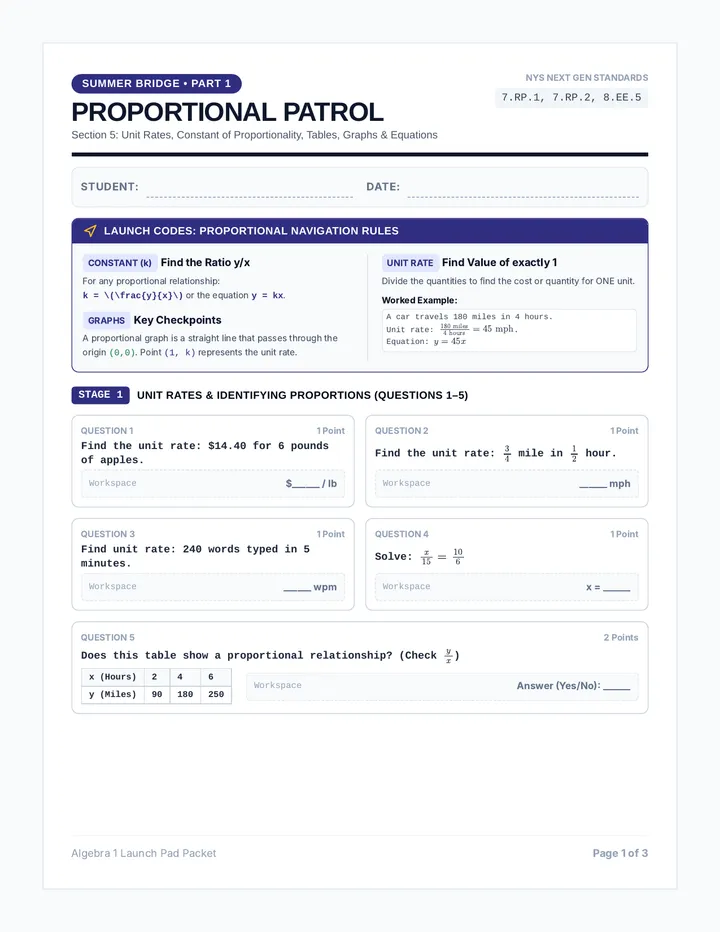
NAME: ___________________________________
DATE: __________________
Lab Sheet 1.1
1
The Blueprint Expand
Triangle \(ABC\) has vertices at \(A(1, 1)\), \(B(3, 1)\), and \(C(1, 4)\) . Perform a dilation about the origin with a scale factor of \(k = 2\) .
Pre-image Calculation \((kx, ky)\) Image (New Point) \(A(1, 1)\) \((1 \cdot 2, 1 \cdot 2)\) \(A'(\text{____}, \text{____})\) \(B(3, 1)\) \(B'(\text{____}, \text{____})\) \(C(1, 4)\) \(C'(\text{____}, \text{____})\)
Check Your Work:
Compare the side lengths of \(AC\) and \(A'C'\). How many times longer is the image side?
Plot both triangles here.
2
Identifying the Scale
The point \(P(8, 12)\) was dilated from the origin to create \(P'(2, 3)\). What was the scale factor \(k\)?
Show Your Calculation
Final Scale Factor
\(k = \) ________
3
Similarity Statement
Below are two rectangles. Rectangle A has dimensions \(4 \times 10\). Rectangle B has dimensions \(6 \times 15\). Are these rectangles similar? Prove it by calculating the scale factor for the width and the length.
"If the ratios are the same, they are similar!"
Similarity Rule: Corresponding angles are congruent; corresponding sides are proportional.
Angle Angle Alliance Slides Angle Angle Alliance
Lesson 2: The Shortcut to Similarity
A
A
The Similarity Debate
Two triangles exist:
Triangle 1: Angles 30°, 60°, 90° (Tiny)
Triangle 2: Angles 30°, 60°, 90° (Giant)
"Are they similar? Is matching the angles enough to prove it?"
Scale Up
The AA Theorem
Finding the minimum information needed.
Scientific Fact:
If two angles of one triangle are congruent to two angles of another triangle, then the triangles are similar .
AA ~
Wait, what about the third angle? If two match, the third must match too (Sum of 180°)!
AA in Action
Evidence Search
Triangle X:
Angles: 45°, 75°
Triangle Y:
Angles: 75°, 60°
ARE THEY SIMILAR?
Tip: Find the missing 3rd angle for each!
Calculation Area
\(180 - (45 + 75) = 60\)
Matches Triangle Y!
AA Summary
If triangles share the same angles , they share the same shape .
Rule 1
Shape stays constant
Rule 2
Sides scale proportionally
Rule 3
Minimal proof needed
Angle Angle Alliance Teacher Guide Angle Angle Alliance
Facilitator's Investigation Log
SESSION 2.1
AA CRITERION
The Inquiry Path
The goal of this lesson is for students to discover that they don't need all six pieces of information (3 sides, 3 angles) to prove similarity. Angles are the "blueprint" of a shape.
Step 1: The Tiny vs. Giant Debate
Use Slide 2 to spark a debate. Half the class should argue "No, they are different sizes," and the other half "Yes, they are the same shape." Guide them toward the definition of similarity (same shape, different size).
Step 2: The Mystery of the 3rd Angle
Ask: "If I tell you two triangles both have 40° and 60° angles, what must the third angle be for both?" (80°). "Can they ever have different third angles?" (No, because triangles always sum to 180°).
Key Question
"If a photocopier enlarges a photo by 200%, do the angles in the photo change?"
(Goal: Understand angles are invariant under dilation)
Scaffolding
Provide protractors for tactile learners.
Use color-coding for corresponding angles.
Remind students: Congruent angles = Same measure.
Common Misconceptions
The Error The Intervention Confusing AA with AAA Explain that AAA is also true, but AA is the minimum . Once you have two, the third is a given. Confusing Similarity with Congruence Show two equilateral triangles of different sizes. They have matching angles (AA) but are not congruent (different side lengths).
Closing Reflection
"If you only know two angles of a triangle, do you know its exact size? Do you know its exact shape?"
Angle Angle Alliance Activity AA Investigation
Lab Report 2.1
SUBJECT: TRIANGLE DNA
NAME: __________________________
DATE: __________________________
Objective: Prove that two triangles are similar by finding at least two pairs of congruent angles (AA Similarity Criterion).
1
The Missing Link
Calculate the missing third angle for each triangle below. Then, determine if they are similar using the AA Criterion .
Case Study A
Triangle 1
Angles: 40°, 80°, ____°
Triangle 2
Angles: 80°, 60°, ____°
Are they similar?
Yes No
Case Study B
Triangle 3
Angles: 90°, 25°, ____°
Triangle 4
Angles: 90°, 65°, ____°
Are they similar?
Yes No
2
The Shared Angle
In the diagram to the right, line segment \(DE\) is parallel to \(BC\). Explain why \(\triangle ADE\) is similar to \(\triangle ABC\).
Write your proof here
Hint: Look for a shared angle at the top and corresponding angles created by the parallel lines.
A D E B C
Diagram Not to Scale
3
Scientific Conclusion
Is it possible for a right triangle and an obtuse triangle to be similar? Explain your reasoning using the AA criterion.
Internal Research Document • Grade 8 Geometry • Unit 2.1
Slope Triangle Proofs Slides Slope Triangle Proofs
Lesson 3: The Geometry of Constant Steepness
The Ramp Mystery
Think about a wheelchair ramp or a mountain road.
"If the ramp is a straight line, is it steeper at the bottom than it is at the top?"
Algebra says slope is constant. Today, we use triangles to prove why.
Linear Integrity
Building the Evidence
1
Pick Two Points
Pick any two points on a line. Draw a right triangle between them.
2
Analyze Angles
Because lines are parallel (horizontal/vertical axes), matching angles appear!
3
AA Similarity
The triangles are similar. Their sides must be proportional.
The Proof
Rise over Run
If \(\triangle \text{Small} \sim \triangle \text{Large}\), then:
\[ \frac{\text{Rise}_1}{\text{Run}_1} = \frac{\text{Rise}_2}{\text{Run}_2} \]
Slope is Constant!
Same Steepness
Same Ratio
Proven by Similarity
Mission Accomplished
Geometry isn't just about shapes. It's the reason Algebra works.
Constant Rate of Change = Similarity
Slope Triangle Proofs Teacher Guide Slope Triangle Proofs
Project Manager Facilitation Guide
PROJECT ID: 3.1.SIM
SLOPE PROOF
The Learning Blueprint
Students often accept "rise over run" as a rule without understanding its geometric necessity. This lesson bridges the gap between Similarity (Geometry) and Rate of Change (Algebra) .
Objective 1
Draw multiple slope triangles along a single line on a coordinate plane.
Objective 2
Use AA Criterion to prove all slope triangles on a line are similar.
Facilitation Steps
1
The Hook: Constant Steepness
Ask students if they've ever noticed how a slide or a ladder has the same steepness everywhere. Ask: "If you measured the steepness using a 1-inch ruler versus a 1-foot ruler, would the number change?"
2
Visual Proof: Parallel Property
Explain that because the horizontal legs are parallel to the x-axis and vertical legs are parallel to the y-axis, the corresponding angles are congruent. This satisfies the AA Criterion.
3
The Ratio Connection
Demonstrate that since the triangles are similar, the ratio of \(\frac{\text{Vertical Leg}}{\text{Horizontal Leg}}\) must be equal for all triangles on the line.
Pro-Tip
Watch for students who flip the ratio to \(\frac{\text{run}}{\text{rise}}\). Remind them that slope is the change in height over the change in distance .
Discussion Starters
"Why can't we use slope triangles on a curved line?"
"If a line is steeper, what happens to the vertical leg of the triangle relative to the horizontal leg?"
The "Parallel" Trap
Students often forget that the similarity proof relies on the parallel lines property of the coordinate axes. Make sure to explicitly point out that the horizontal legs of all slope triangles are parallel to each other, creating congruent corresponding angles with the line.
"Geometry provides the proof; Algebra provides the language."
Slope Triangle Proofs Activity Slope Proof Analysis
Field Data Sheet 3.1
ENGINEER: _________________________
DATE: _____________________________
1
The Linear Grid
Below is the equation for a construction ramp: \(y = \frac{2}{3}x + 1\) .
Task List:
Plot at least 4 points that satisfy the equation.
Draw a small slope triangle between any two adjacent points.
Draw a large slope triangle between two far-apart points.
Use the grid to the right to complete these tasks. Label your triangles "Triangle A" and "Triangle B".
Coordinate Plane [10x10]
2
Geometric Proof
Why are Triangle A and Triangle B similar? Provide evidence using the AA Criterion.
Evidence 1 (Angles)
Evidence 2 (Angles)
3
Ratio Verification
Triangle Rise (Vertical) Run (Horizontal) Ratio (Rise/Run) Triangle A _______ units _______ units Triangle B _______ units _______ units
Conclusion:
Based on your ratios above, why is the slope of a line constant?
Structural Integrity Document • Linear Analysis Division • Geometry Standard G.8.C
Proportion Power Play Slides Proportion Power Play
Lesson 4: Solving for Scale
The Nesting Mystery
Imagine a set of Russian Nesting Dolls.
The largest doll is 12 inches tall and 6 inches wide.
The smallest doll is only 2 inches wide.
"How tall is the smallest doll?"
12"
?
The Golden Setup
To solve for a missing side, we match corresponding parts:
\[ \frac{\text{Left}_1}{\text{Left}_2} = \frac{\text{Bottom}_1}{\text{Bottom}_2} \]
Crucial Rule:
Consistency is king! If you put the "Large" figure on top for the first fraction, you MUST put the "Large" figure on top for the second.
Common Error Search:
Mix-and-match sizing
Wrong side matching
Cross-multiplication!
Overlapping Triangles
Strategy: Separate
When triangles are "nested," the hardest part is identifying the lengths of the larger triangle.
"Total Length = Piece 1 + Piece 2"
Don't just use the bottom segment; use the whole side .
Ready for the Power Play?
Proportions are the secret language of architects, engineers, and doll-makers. Master the ratio, and you can solve for any distance—no matter how small.
Find your Match. Solve for \(X\).
Proportion Power Play Teacher Guide Proportion Power Play
Lesson 4 Facilitator Guide
Ratio & Proportion
Modular Skills
The Scaling Objective
In this mastery-based lesson, students move from the conceptual (Dilations/AA) to the calculative . They will master the setup of algebraic proportions to solve for unknown side lengths in similar figures.
Standard 8.G.4: Understand that a two-dimensional figure is similar to another if the second can be obtained from the first by a sequence of transformations.
Skill: Solving proportions using cross-multiplication or scale factor multiplication.
The "Nesting" Strategy
"Tell students that overlapping triangles are like Russian Nesting Dolls. You can't see the inner doll's dimensions clearly until you pull them apart."
Facilitation Keyword: SEPARATE
Instructional Flow
1
Modeling Proportions
Show Slide 3. Emphasize that there are multiple correct ways to set up a proportion (e.g., Small/Large = Small/Large OR Large/Small = Large/Small). The only wrong way is to be inconsistent (e.g., Small/Large = Large/Small).
2
The "Sum" Mistake
In overlapping triangles (Slide 4), students often use just the bottom piece of a side (e.g., the segment \(BC\)) instead of the whole side (\(AC\)). Model drawing the two triangles separately to avoid this.
3
Scale Factor vs. Cross-Mult
Encourage students to look for the "easy path." If the scale factor is a whole number (e.g., \(\times 3\)), use multiplication. If it's a decimal, use cross-multiplication.
Differentiation Support
FOR SCAFFOLDING:
Provide pre-separated diagrams for overlapping triangles so students can focus on the arithmetic before the visualization.
FOR EXTENSION:
Challenge students to solve for a missing side when the side length is an algebraic expression (e.g., side length = \(2x + 1\)).
Proportion Power Play Activity Proportion Power Play
Mastery Worksheet 4.1
NAME: __________________________
DATE: __________________________
1
The Simple Nest
Rectangle A is \(4 \times 10\). Rectangle B is similar to Rectangle A and has a width of 6. What is the length (\(x\)) of Rectangle B?
Setup Proportion
\[ \frac{\text{____}}{\text{____}} = \frac{\text{____}}{\text{____}} \]
Solve for \(x\)
Two triangles are similar. Triangle 1 has sides of 3, 4, and 5. The shortest side of Triangle 2 is 12. Find the missing sides.
Side 1
Side 2
2
Overlapping Depths
In the diagram to the right, find the value of \(x\) . Tip: Redraw the two triangles separately before setting up your ratio!
Redraw Triangle 1
Redraw Triangle 2
Final Answer
\(x = \) __________
A D E B C
Diagram ID: 4.1.A
DIMENSIONS:
• \(AD = 5\) cm
• \(AB = 15\) cm
• \(DE = 4\) cm
• \(BC = x\) cm
3
The Power Play
"If the scale factor between two similar triangles is 3.5 , and the area of the smaller triangle is 10 square units, can you use a proportion to find the area of the larger triangle?"
*Challenge: Remember what happens to area when you scale side lengths!
Similarity Axiom: Corresponding sides are proportional; \( \frac{a_1}{a_2} = \frac{b_1}{b_2} = k \)
Shadow Math Mission Slides Shadow Math Mission
Lesson 5: Indirect Measurement
The Flagpole Challenge
"Your mission, should you choose to accept it..."
You need to measure the height of the school's flagpole.
Problem: Your ladder is only 6 feet tall.
"How can you find the height without leaving the ground?"
Shadow Casting Method
The Shadow Method
Triangulation
At any given time, the sun's rays hit the ground at the same angle .
Why it works:
Both objects form a 90° angle with the ground.
The sun's rays form matching angles.
AA Similarity!
The Calculation:
\[ \frac{\text{Height}_1}{\text{Shadow}_1} = \frac{\text{Height}_2}{\text{Shadow}_2} \]
"Height 1" is usually you. "Height 2" is the mystery object.
The Mirror Method
No Sun Required
Place a mirror on the ground. Back up until you can see the top of the object in the mirror.
Law of Reflection:
"The angle of incidence equals the angle of reflection."
Bingo. Matching angles = AA Similarity.
Eye Object Top
Similarity in the Wild
Geometry is not just a subject in a book. It is the tool we use to measure the world around us.
Start the Mission
Shadow Math Mission Teacher Guide Shadow Math Mission
Expedition Leader's Guide
CASE STUDY 5.1
FIELD LOG
Mission Objectives
The culmination of this sequence is the Indirect Measurement Mission . Students transition from solving textbook problems to modeling real-world physical constraints using the geometric principles of similarity.
Geometric Proof
Explain why the triangles formed by shadows or mirrors must be similar (AA Criterion).
Applied Calculation
Measure lengths accurately and use proportions to solve for inaccessible heights.
Deployment Options
Option A: Field Work
Take the class outside to the flagpole. Split into teams of 3. Tools: Measuring tape, student "shadow markers."
Option B: Lab Work
Use the classroom mirror method. Tape a target high on the wall. Students use a handheld mirror to find the height.
Option C: Simulation
Use the "Shadow Math Case Study" worksheet provided for an in-class individual analysis.
Field Tips
Shadow method only works on sunny days!
For mirror method, eye height must be measured accurately.
Measure in the same units (all inches or all feet).
The "Why"
Geometric Integrity
"Without the AA Similarity criterion, our measurements would be guesses. Because we know the triangles are similar, our math is as reliable as a tape measure."
The Mirror Placement
Students often measure the distance from the base of the object to the edge of the mirror. Remind them to measure to the center of the mirror (the point of reflection) to ensure the triangles meet at the same vertex.
"Measure twice, calculate once."
Shadow Math Mission Activity Mission Field Report
Indirect Measurement Lab 5.1
AGENT: _________________________
DATE: ___________________________
LOCATION: _______________________
Mission Objective
Use the principles of AA Similarity to calculate the height of a tall object that cannot be measured directly.
1
Expedition Setup
Select Method:
Shadow Method Mirror Method
Target Object:
Sketch Your Triangles
Include the height of the person/stick, length of shadows, and distance to the mirror.
Label all known and unknown values.
2
Field Evidence
Measured Dimensions:
<table class="w-full border-collapse"><tbody><tr><td class="p-4 border border-slate-200 bg-slate-50 font-bold text-sm">Your Height (Eyes)</td><td class="p-4 border border-slate-200">___________</td></tr><tr><td class="p-4 border border-slate-200 bg-slate-50 font-bold text-sm">Your Shadow/Distance</td><td class="p-4 border border-slate-200">___________</td></tr><tr><td class="p-4 border border-slate-200 bg-slate-50 font-bold text-sm">Object's Shadow/Dist</td><td class="p-4 border border-slate-200">___________</td></tr></tbody></table>
Setup Proportion
=
3
Mission Result
Show All Math Steps
Calculated Height of Object
__________ units
Confidential Field Data • Expedition Unit 5.1 • End of Sequence