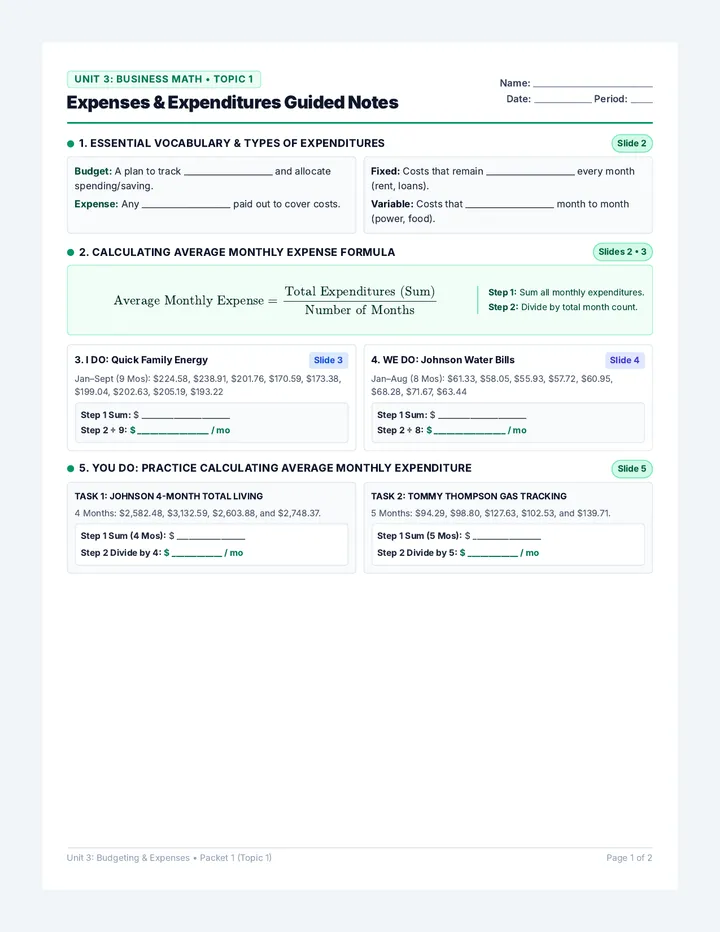
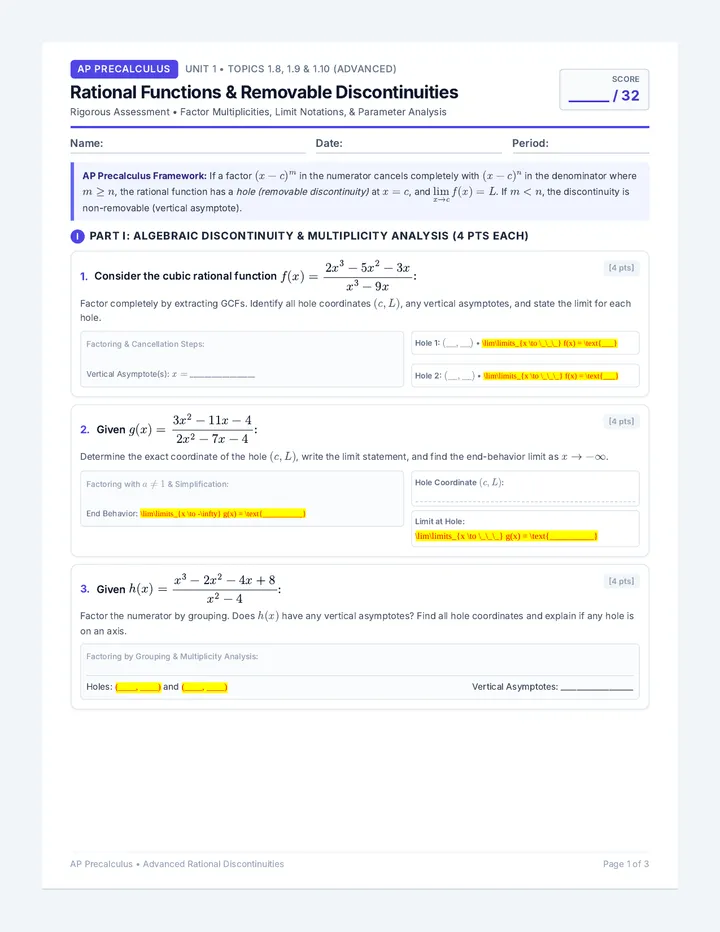
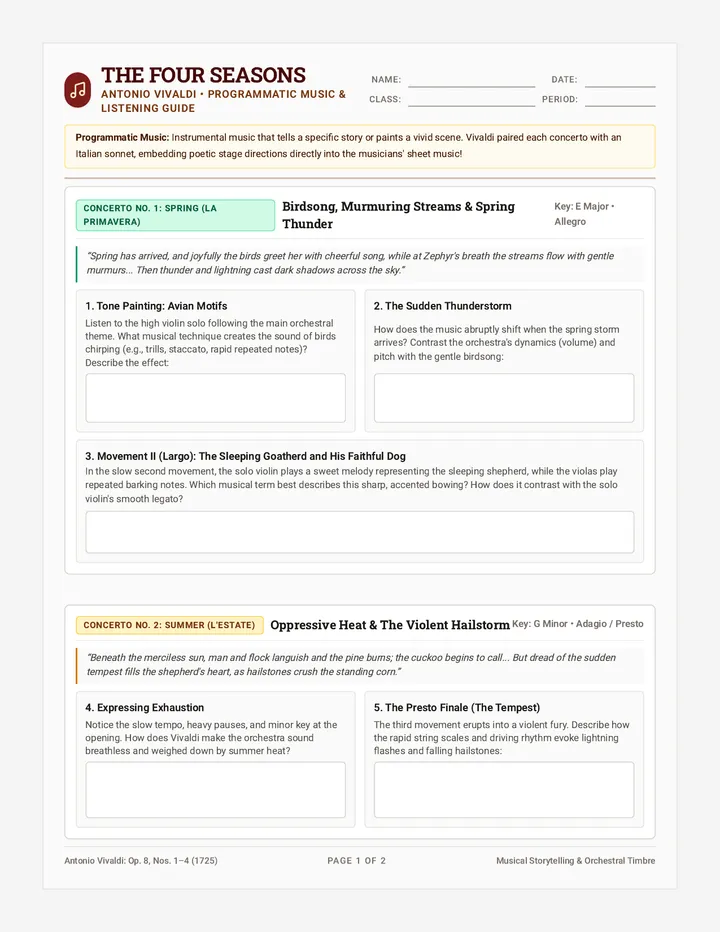
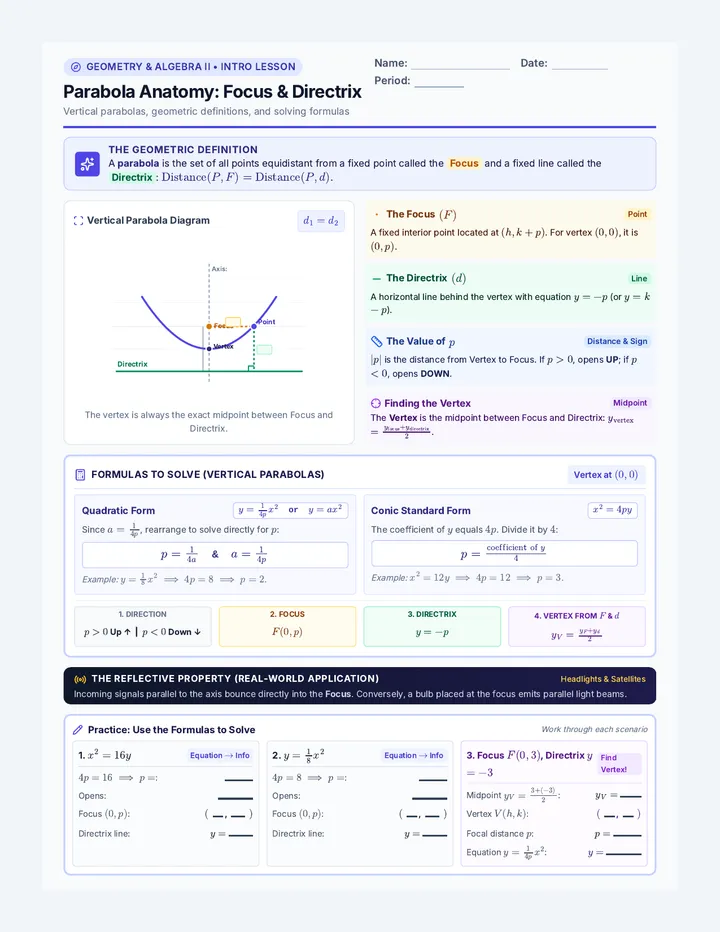
Mapping Motion Slides Mapping Motion
Defining & Graphing Vector-Valued Functions
What is This Shape?
Imagine a particle whose position at time \(t\) is given by:
\[ \mathbf{r}(t) = \langle \cos(t), \sin(t), t \rangle \]
As \(t\) increases from 0 to \(4\pi\), what path does the particle take through space?
The Helix: A 3D Journey
Vector-Valued Functions
The Definition:
A function of the form:
\[ \mathbf{r}(t) = f(t)\mathbf{i} + g(t)\mathbf{j} + h(t)\mathbf{k} \]
or \(\langle f(t), g(t), h(t) \rangle\)
It maps a real number \(t\) (often time) to a vector in 2D or 3D space.
Domain Rules
1 The domain of \(\mathbf{r}(t)\) is the intersection of the domains of its component functions.
2 Watch for roots of negative numbers.
3 Watch for division by zero.
4 Watch for logarithmic constraints.
Graphing the Curve \(C\)
Eliminating the Parameter
To find the Cartesian equation (like \(y = f(x)\) or \(x^2 + y^2 = r^2\)), solve for \(t\) in one equation and substitute it into the other.
Defining Orientation
The path has a specific direction as \(t\) increases. We mark this on the graph using arrows. This is the "orientation" of the curve.
Pro-Tip: If components involve trig, use identities like \(\sin^2(t) + \cos^2(t) = 1\) to eliminate the parameter.
Blueprint Check: Sample Problem
Sketch the curve and state the domain:
\[ \mathbf{r}(t) = \langle \sqrt{t}, 4-t \rangle \]
Step 1: Domain
\(t \ge 0\)
Step 2: Eliminate \(t\)
\(x = \sqrt{t} \implies t = x^2\)
\(y = 4 - x^2 \text{ (where } x \ge 0)\)
Path Analysis Worksheet Path Analysis: Vector-Valued Functions
Calculus III / Physics Analysis | Lesson 1
Student Name:
Date:
1
Domain Determination
Determine the domain of the following vector-valued functions. Provide your answers in interval notation.
A) \(\mathbf{r}(t) = \left\langle \ln(t+1), \sqrt{4-t}, \frac{1}{t} \right\rangle\)
B) \(\mathbf{r}(t) = \cos(t)\mathbf{i} + \tan(t)\mathbf{j} + e^t\mathbf{k}\)
2
Curve Visualization
Eliminate the parameter \(t\) to find the Cartesian equation of the curve. Sketch the curve and use arrows to indicate the orientation (direction of increasing \(t\)).
\[ \mathbf{r}(t) = \langle 2+3t, 1-t \rangle \]
\[ \mathbf{r}(t) = \langle 3\cos(t), 3\sin(t) \rangle \]
3
3D Path Description
Describe the path of the particle given by the 3D function below. What surface does this curve lie on?
\[ \mathbf{r}(t) = \langle \sin(t), \cos(t), \sin(2t) \rangle \]
Vector Dynamics Slides Vector Dynamics
Velocity, Acceleration, and Speed
Simulation: The Peak
A coaster car follows the path \(\mathbf{r}(t)\). At the very top of a loop:
Where is the Velocity Vector pointing?
Where is the Acceleration Vector pointing?
Is the car's Speed increasing or decreasing?
Physics Interaction Zone
Differentiation
The Derivative
\[ \mathbf{r}'(t) = \langle f'(t), g'(t), h'(t) \rangle \]
We differentiate component by component.
Geometric Interpretation
\(\mathbf{r}'(t)\) is a vector tangent to the curve at the point corresponding to \(t\).
It points in the direction of motion.
Differentiation Rules
\(\frac{d}{dt}[\mathbf{u}(t) \pm \mathbf{v}(t)] = \mathbf{u}' \pm \mathbf{v}'\)
\(\frac{d}{dt}[c\mathbf{u}(t)] = c\mathbf{u}'(t)\)
\(\frac{d}{dt}[f(t)\mathbf{u}(t)] = f'(t)\mathbf{u}(t) + f(t)\mathbf{u}'(t)\)
Yes, there are Dot and Cross product rules too!
The Physics Link
Velocity
\[ \mathbf{v}(t) = \mathbf{r}'(t) \]
The rate of change of position. It is a vector.
Speed
\[ s(t) = \|\mathbf{v}(t)\| \]
The magnitude of velocity. It is a scalar .
Acceleration
\[ \mathbf{a}(t) = \mathbf{v}'(t) = \mathbf{r}''(t) \]
The rate of change of velocity. It is a vector.
Analysis Lab: Circular Motion
Consider a particle moving along: \(\mathbf{r}(t) = \langle \cos(2t), \sin(2t) \rangle\)
Quick Calc:
\(\mathbf{v}(t) = \langle -2\sin(2t), 2\cos(2t) \rangle\)
\(\text{Speed} = \sqrt{4\sin^2(2t) + 4\cos^2(2t)} = 2\)
Critical Thinking
The speed is constant (\(2\)), yet the velocity is changing .
How can we have acceleration if the speed is constant?
Kinematic Lab Worksheet Kinematic Lab: Motion Vectors
Vector Differentiation and Tangent Analysis | Lesson 2
Technician ID:
TOP SECRET // DATA ANALYSIS
Sector A
Vector Calculus Operations
1. Given \(\mathbf{r}(t) = \langle t^3 - 3t, \sqrt{t^2+1}, e^{2t} \rangle\), calculate the following at \(t = 0\):
A) Velocity Vector \(\mathbf{v}(0)\)
B) Acceleration Vector \(\mathbf{a}(0)\)
C) Speed \(s(0)\)
2. Find the unit tangent vector \(\mathbf{T}(t)\) for \(\mathbf{r}(t) = \langle \cos(t), \sin(t), t \rangle\) at \(t = \pi/4\).
Sector B
Geometric Synthesis
A particle moves along the curve \(y = x^2\) in the direction of increasing \(x\). At the point \((2, 4)\), its speed is 10 units per second.
Find the velocity vector \(\mathbf{v}\) at this specific instant.
Roller Coaster Simulation
Consider the coaster at the apex of a vertical loop. The path is roughly \(\mathbf{r}(t) = \langle 10\cos(t), 10\sin(t) + 10 \rangle\). At \(t = \pi/2\) (the top):
Sketch \(\mathbf{v}(\pi/2)\) and \(\mathbf{a}(\pi/2)\) qualitatively.
Explain the physical meaning of the acceleration vector's direction.
Sector C
Theoretical Inquiry
Orthogonality Proof Challenge:
Prove that if \(\|\mathbf{r}(t)\| = c\) (a constant), then the position vector \(\mathbf{r}(t)\) and the velocity vector \(\mathbf{r}'(t)\) are always orthogonal .
Hint: Use the property that \(\mathbf{r}(t) \cdot \mathbf{r}(t) = \|\mathbf{r}(t)\|^2 = c^2\).
Path Reconstruction Slides Path Reconstruction
Integration and Initial Value Problems
Forensic Challenge: The Drone Crash
We found a crashed drone at coordinates \((100, 50, 0)\).
Retrieved Data Log:
Velocity \(\mathbf{v}(t) = \langle 10t, 5\cos(t), 20 - 9.8t \rangle\)
Crash Time \(t = 5\) seconds
Question: Where was the operator located at \(t=0\)?
Vector Integration
The Indefinite Integral:
\[ \int \mathbf{r}(t) dt = \left\langle \int f(t)dt, \int g(t)dt, \int h(t)dt \right\rangle \]
Crucial Note:
Do not forget the constant vector \(\mathbf{C}\) ! Each component has its own \(+C\), which we combine into a single vector \(\langle C_1, C_2, C_3 \rangle\).
Component-Wise Rule
Integration is a linear operator. You integrate each part of the vector independently using standard power, trig, and exponential rules.
\[ \int (3t^2 \mathbf{i} + 2t \mathbf{j}) dt = (t^3 + C_1) \mathbf{i} + (t^2 + C_2) \mathbf{j} \] \[ = \mathbf{R}(t) + \mathbf{C} \]
Definite Integration
Net Displacement
The definite integral of the velocity vector from \(a\) to \(b\) gives the net change in position (displacement).
\[ \int_a^b \mathbf{v}(t) dt = \mathbf{r}(b) - \mathbf{r}(a) \]
Watch Out!
Displacement is a vector . It only tells you the straight-line change from start to end.
Example:
If you travel in a perfect circle and return to the start, your displacement is \(\mathbf{0}\).
Solving Initial Value Problems (IVPs)
1
Integrate
Integrate \(\mathbf{a}(t)\) or \(\mathbf{v}(t)\) and include \(\mathbf{C}\).
2
Substitute
Plug in the given time \(t_0\) and initial vector \(\mathbf{r}_0\).
3
Solve
Solve for \(\mathbf{C}\) and write the final function.
Forensic Path Reconstruction Lab Case File: Drone 842-X Forensic Analysis
Kinematic Reconstruction Unit | Initial Value Problems
Lead Investigator:
CONFIDENTIAL RECONSTRUCTION
Evidence Overview
On July 14, a commercial drone was recovered at coordinates (250, 140, 0). Internal flight sensors recorded the drone's acceleration profile from takeoff until the moment of impact. Analysts must reconstruct the flight path to determine the launch point and peak altitude.
1
Velocity Reconstruction
The drone's acceleration vector was constant: \[ \mathbf{a}(t) = \langle 0, 0, -9.8 \rangle \]
Sensor data indicates that at t = 2 seconds, the velocity was \(\mathbf{v}(2) = \langle 12, 5, 4.4 \rangle\).
Find the general velocity function \(\mathbf{v}(t)\):
2
Launch Point Identification
Using your velocity function from Part 1, find the position function \(\mathbf{r}(t)\). Use the crash site data: at t = 10 (impact), the drone was at (250, 140, 0).
Determine the starting position \(\mathbf{r}(0)\):
RECONSTRUCTED ORIGIN:
3
Operational Data
A) Peak Altitude
Determine the maximum z-value achieved during flight.
B) Total Displacement
Calculate the net change in position vector \(\Delta \mathbf{r}\) from \(t=0\) to \(t=10\).
LOG_RECON_VER: 4.02 // KINEMATIC_CALCULUS_CORE // [END OF DOCUMENT]
Arc Length Slides Curved Lengths
Arc Length and Total Distance Traveled
The Engineering Challenge
You are building a solenoid coil. The wire forms a helix:
\[ \mathbf{r}(t) = \langle \cos(t), \sin(t), 2t \rangle \]
The coil spans from \(t=0\) to \(t=10\pi\).
How much copper wire do you need to order?
Model: Helix_3D_Coil
Arc Length Derivation
Think of a tiny segment of the curve \(ds\). By Pythagoras in 3D:
\[ ds = \sqrt{(dx)^2 + (dy)^2 + (dz)^2} \] \[ \frac{ds}{dt} = \sqrt{\left(\frac{dx}{dt}\right)^2 + \left(\frac{dy}{dt}\right)^2 + \left(\frac{dz}{dt}\right)^2} \]
Notice anything?
This is just the magnitude of the velocity vector: \(\|\mathbf{v}(t)\|\)!
The Arc Length Formula
The distance \(L\) along a curve from \(a\) to \(b\):
\[ L = \int_a^b \|\mathbf{r}'(t)\| dt \]
"The integral of speed over time gives the total distance traveled."
Distance vs. Displacement
Displacement
\[ \Delta \mathbf{r} = \int_a^b \mathbf{v}(t) dt \]
• It's a vector .
• Net change in position.
• Ignores the path taken.
Distance
\[ s = \int_a^b \|\mathbf{v}(t)\| dt \]
• It's a scalar .
• Total length of the path.
• Always \(\ge\) magnitude of displacement.
Solution: Helix Length
Calculate the wire needed for: \(\mathbf{r}(t) = \langle \cos(t), \sin(t), 2t \rangle\) from \(0 \le t \le 10\pi\).
1. Find Speed
\[ \|\mathbf{v}(t)\| = \sqrt{(-\sin t)^2 + (\cos t)^2 + (2)^2} \]
\[ = \sqrt{1 + 4} = \sqrt{5} \]
2. Integrate
\[ L = \int_0^{10\pi} \sqrt{5} dt \]
\[ L = 10\pi\sqrt{5} \approx 70.2 \text{ units} \]
Distance and Length Worksheet Technical Spec: Curved Lengths
Distance vs. Displacement Analysis | Lesson 4
Technician:
REF_ID: ARC_LEN_004
Module 1
The Divergence Test
A particle oscillates along a 2D path given by:
\[ \mathbf{r}(t) = \langle 2\sin(t), 2\cos(t) \rangle \text{ for } 0 \le t \le 2\pi \]
A) Net Displacement
Calculate \(\int_0^{2\pi} \mathbf{v}(t) dt\)
B) Total Distance Traveled
Calculate \(\int_0^{2\pi} \|\mathbf{v}(t)\| dt\)
Analysis Prompt:
Briefly explain why these two values differ. In what specific geometric scenario would the magnitude of displacement equal the total distance traveled?
Module 2
Suspension Engineering
A suspension bridge cable follows a parabolic path. For a specific design, the position vector from the center of the bridge is:
\[ \mathbf{r}(t) = \langle t, 0.05t^2 \rangle \text{ for } -50 \le t \le 50 \]
Calculate the total length of the cable needed. (Hint: You may need to use an integral table or a calculator for the final evaluation, but set up the integral completely).
Diagram: Cable_Section_A
Module 3
3D Path Length
Find the arc length of the curve \(\mathbf{r}(t) = \langle t^2, \frac{2}{3}t^3, t \rangle\) from t = 0 to t = 1.
Trajectory Synthesis Slides Mission: Orbit
3D Projectile Trajectories and Synthesis
The Challenge: Clear the Debris
You are launching a satellite payload from \((0, 0, 0)\).
A cloud of space debris is drifting at coordinates \((500, 200, 150)\). You must choose an initial velocity vector \(\mathbf{v}_0\) that:
Ensures the path goes above the debris.
Accounting for 3D gravity: \(\mathbf{g} = \langle 0, 0, -9.8 \rangle\).
Trajectory Calculation Mode
INIT_VECTOR: [REQUIRED]
The Vector Model
1. Start with Acceleration
\[ \mathbf{a}(t) = \langle 0, 0, -g \rangle \]
2. Integrate for Velocity
\[ \mathbf{v}(t) = \mathbf{v}_0 + \langle 0, 0, -gt \rangle \]
3. Integrate for Position
\[ \mathbf{r}(t) = \mathbf{r}_0 + \mathbf{v}_0 t - \langle 0, 0, \frac{1}{2}gt^2 \rangle \]
3D Separation
In a vector model, the \(x\) and \(y\) components represent range and drift , while the \(z\) component handles altitude and gravity .
"Motion in orthogonal directions is independent."
Performance Metrics
Time of Flight
Set the \(z\)-component of \(\mathbf{r}(t)\) to zero and solve for \(t > 0\).
\[ z(t) = 0 \]
Max Height
Find when vertical velocity is zero, then plug that \(t\) into \(z(t)\).
\[ v_z(t) = 0 \]
Total Range
Find the magnitude of the displacement at the time of impact.
\[ \|\langle x(t), y(t) \rangle\| \]
Summary of Vector Kinematics
01 Differentiate for rates.
02 Integrate for paths.
03 Magnitude for speed/length.
Final Question
"If a wind vector \(\mathbf{w} = \langle 5, -2, 0 \rangle\) is added to the acceleration, how does the integration change?"
Mission Launch Project Guide Capstone: Mission Alpha Launch
3D Projectile Modeling Project | Lesson 5
Mission Control Status:
LIVE LAUNCH WINDOW
Mission Briefing
A research satellite must be launched from a mobile platform located at the origin (0, 0, 0). At time t=0, the satellite is launched with an initial velocity vector: \[ \mathbf{v}_0 = \langle 60, 80, 200 \rangle \text{ m/s} \] Assume acceleration due to gravity is \(\mathbf{a} = \langle 0, 0, -10 \rangle \text{ m/s}^2\) (approximated for mission simplicity).
1
Path Modeling
Develop the position function \(\mathbf{r}(t)\) for the satellite's flight.
2
Flight Telemetry
A) Time of Flight
How long will it take the satellite to return to ground level (z=0)?
B) Range and Drift
Determine the x and y coordinates of the impact point.
C) Max Altitude
What is the highest point reached by the satellite?
D) Peak Velocity
Calculate the speed of the satellite at its max altitude.
3
Obstacle Avoidance
Critical Scenario:
Intelligence reports a communications tower at coordinates (1200, 1600, h). The tower's height h is 1,500 meters. Based on your trajectory from Phase 1, will the satellite clear the tower? Show your mathematical evidence.
CLEARANCE CONFIRMED
IMPACT LIKELY
CALC_SATELLITE_CORE_v2.0 CHECKSUM: 0x88AF32