Interval Extremes Worksheet Interval Extremes Worksheet
Optimization Foundations: Finding Absolute Extrema on Closed Intervals
Name:
Date:
The Goal
To find the absolute maximum and minimum values of a continuous function \(f(x)\) on a closed interval \([a, b]\), you must compare the function values at the critical points and the endpoints .
Part 1: The Procedure
List the four steps required to find the absolute extrema of a continuous function \(f\) on \([a, b]\):
1
2
3
4
Part 2: Calculations
1. Find the absolute extrema of \(f(x) = x^3 - 3x^2 + 1\) on the interval \([-1, 3]\).
Find Critical Points
Evaluate Points & Endpoints
Final Results:
Absolute Max: ______________ at \(x\) = ______________
Absolute Min: ______________ at \(x\) = ______________
2. Find the absolute extrema of \(g(x) = 2x^3 - 6x\) on the interval \([0, 2]\).
Find Critical Points
Evaluate Points & Endpoints
Final Results:
Absolute Max: ______________ at \(x\) = ______________
Absolute Min: ______________ at \(x\) = ______________
3. Find the absolute extrema of \(h(x) = \frac{x}{x^2+1}\) on the interval \([-2, 2]\).
Find Critical Points
Evaluate Points & Endpoints
Final Results:
Absolute Max: ______________ at \(x\) = ______________
Absolute Min: ______________ at \(x\) = ______________
Interval Extremes Slides Extreme Frontiers
Finding Absolute Extrema on Closed Intervals
Lesson 01 // Optimal Solutions
The Peak Problem
Imagine a rollercoaster track starting at a height of 10m and ending at 5m.
"Is the highest point of the ride always at the top of a hill (critical point)?"
Or could the start or end points be the highest or lowest points of the experience?
The Extreme Value Theorem (EVT)
If a function f is continuous on a closed interval [a, b], then f MUST attain an absolute maximum and an absolute minimum on that interval.
Continuity is a non-negotiable requirement.
The interval must be closed (includes endpoints).
Candidate Search: Critical Points
Candidates for local extrema occur when:
\(f'(x) = 0\)
The tangent line is horizontal.
\(f'(x)\) DNE
The function has a cusp or discontinuity.
// Critical Point Checklist
Differentiate f
Set f' = 0
Solve for x
Verify x is in [a, b]
The Optimization Algorithm
01
Derive
Find the derivative \(f'(x)\) of your function.
02
Points
Identify all critical points within the interval \((a, b)\).
03
Evaluate
Plug critical points AND endpoints into the original function.
04
Compare
The largest value is the absolute max; the smallest is the absolute min.
Walkthrough #1
Live Practice
// Problem
Find the absolute extrema of:
f(x) = x^3 - 3x^2 + 1
on [-1, 3]
Step 1 & 2
\(f'(x) = 3x^2 - 6x\)
\(0 = 3x(x - 2)\)
Critical: x = 0, x = 2
Step 3 & 4
Endpoints:
\(f(-1) = -3\)
\(f(3) = 1\)
Critical Points:
\(f(0) = 1\)
\(f(2) = -3\)
Interval Extremes Answer Key Answer Key
Material ID: interval-extremes-worksheet
Teacher Resource
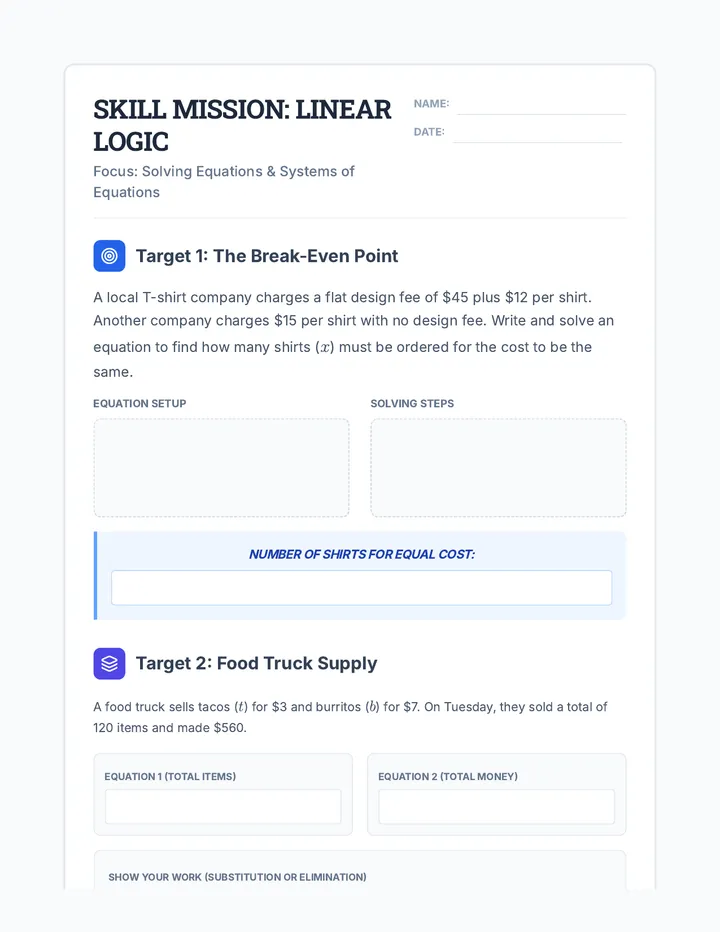
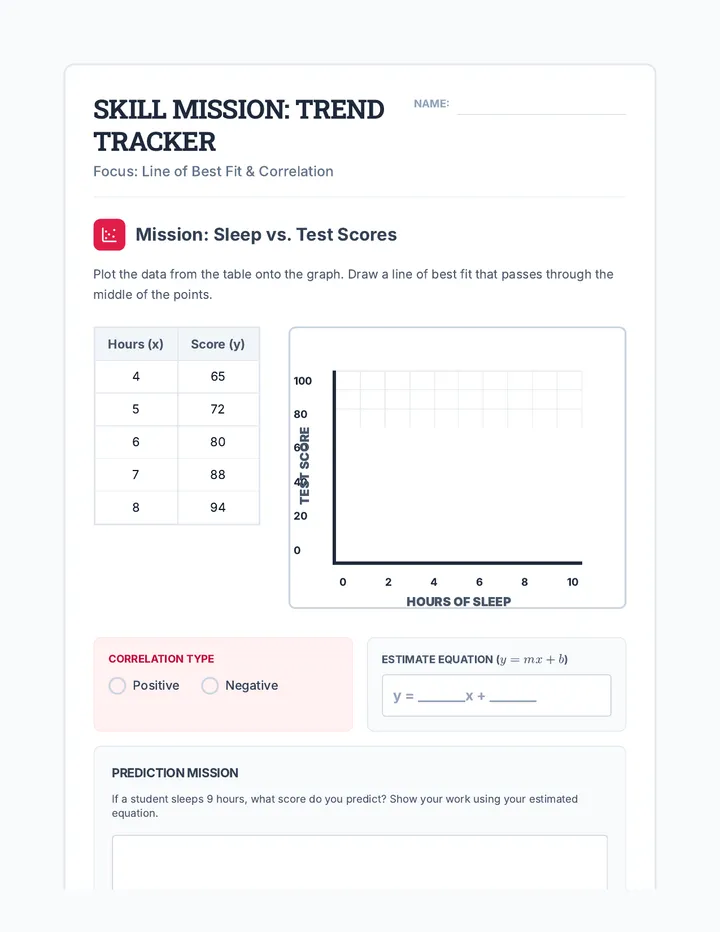
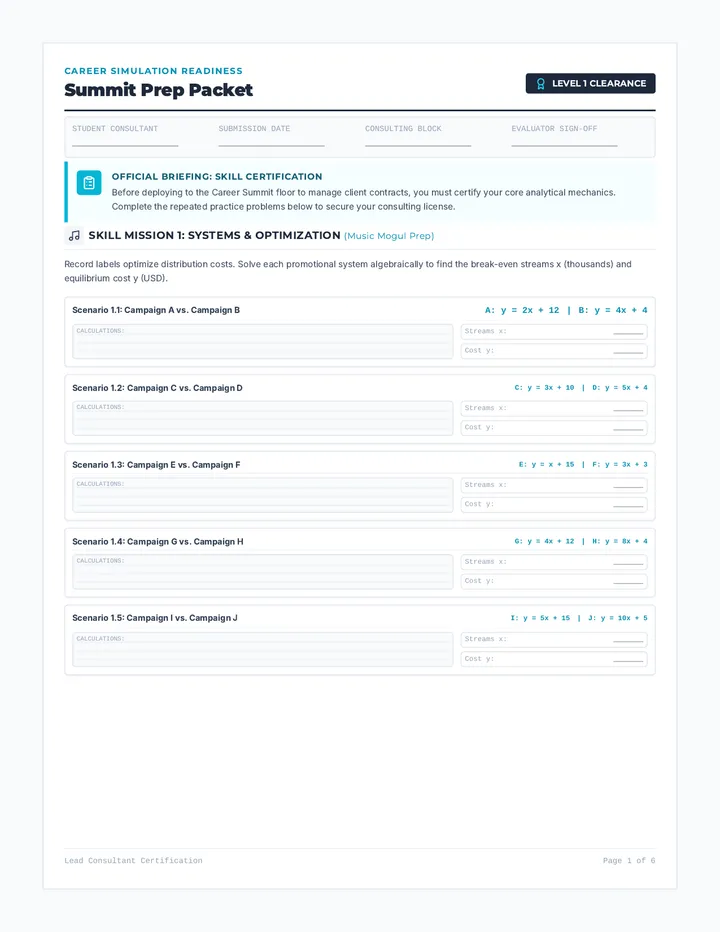
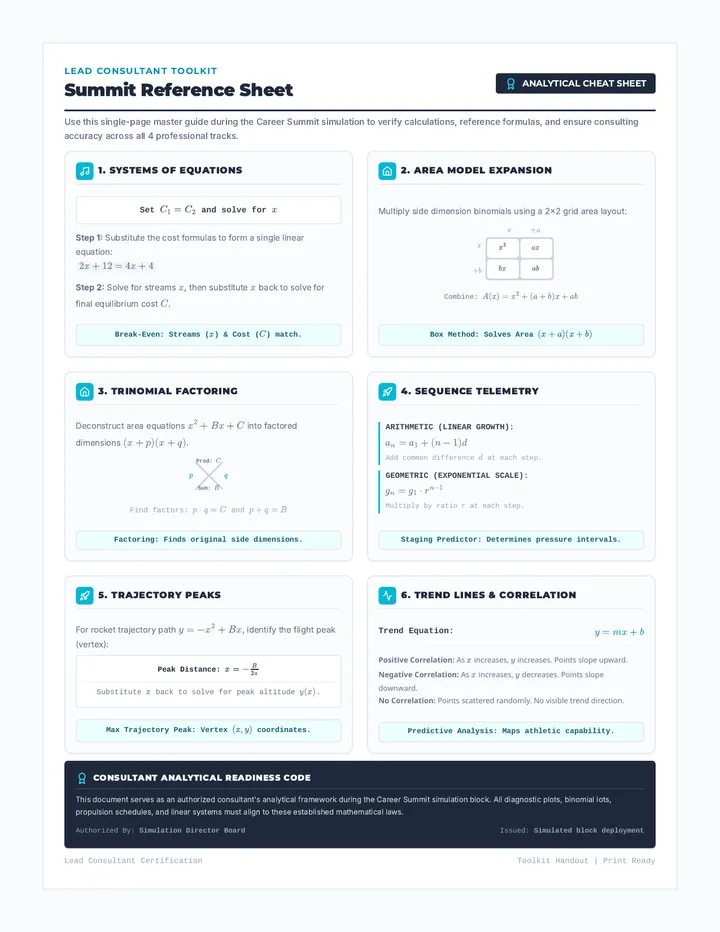
Part 1: The Procedure
1
Find the derivative \(f'(x)\).
2
Find all critical points (where \(f'(x) = 0\) or \(f'(x)\) DNE) that are within the interval \((a, b)\).
3
Evaluate the original function \(f(x)\) at each critical point and at the endpoints \(a\) and \(b\).
4
Compare values: the largest is the absolute maximum, and the smallest is the absolute minimum.
Part 2: Calculations
1. \(f(x) = x^3 - 3x^2 + 1\) on \([-1, 3]\)
Critical Points
\(f'(x) = 3x^2 - 6x = 3x(x - 2)\)
Critical points: \(x = 0, x = 2\)
Evaluation Table
\(x\) \(f(x)\) -1 (EP) \(-3\) 0 (CP) \(1\) 2 (CP) \(-3\) 3 (EP) \(1\)
Max: 1 (at \(x=0, 3\)) | Min: -3 (at \(x=-1, 2\))
2. \(g(x) = 2x^3 - 6x\) on \([0, 2]\)
Critical Points
\(g'(x) = 6x^2 - 6 = 6(x^2 - 1) = 6(x - 1)(x + 1)\)
Critical point in interval: \(x = 1\) (\(x = -1\) is outside)
Evaluation Table
\(x\) \(g(x)\) 0 (EP) \(0\) 1 (CP) \(-4\) 2 (EP) \(4\)
Max: 4 (at \(x=2\)) | Min: -4 (at \(x=1\))
3. \(h(x) = \frac{x}{x^2+1}\) on \([-2, 2]\)
Critical Points
\(h'(x) = \frac{(1)(x^2+1) - (x)(2x)}{(x^2+1)^2} = \frac{1-x^2}{(x^2+1)^2}\)
Critical points: \(x = 1, x = -1\)
Evaluation Table
\(x\) \(h(x)\) -2 (EP) \(-0.4\) -1 (CP) \(-0.5\) 1 (CP) \(0.5\) 2 (EP) \(0.4\)
Max: 0.5 (at \(x=1\)) | Min: -0.5 (at \(x=-1\))
Translation Slides Setting the Stage
Translating Verbal Constraints into Calculus Models
Lesson 02 // Optimal Solutions
The Language Barrier
The hardest part of optimization isn't the calculus... it's the translation.
"How do we turn a paragraph of messy real-world text into a clean mathematical equation?"
// Problem Statement
"A farmer wants to fence in a rectangular area..."
// Mathematical Model
\(A = x \cdot y\) subject to \(2x + y = 100\)
Identify the Protagonists
The Objective
The quantity you want to maximize or minimize (Area, Volume, Profit, Distance).
Keywords: "Largest", "Least", "Smallest", "Maximum"
The Constraint
The limitation or fixed value given in the problem (Total fencing, Fixed sum, Set volume).
Keywords: "Sum of", "Is limited to", "Fixed at", "Using exactly"
Anatomy of a Setup
Blueprint View
"Find two positive numbers whose sum is 20 and whose product is a maximum."
1
Identify Objective
P = x \cdot y
We want to maximize the PRODUCT.
2
Identify Constraint
x + y = 20
The numbers MUST sum to 20.
The End Game: Single Variable
In Calculus I, we only differentiate ONE variable.
Use the Constraint to rewrite the Objective .
P = x \cdot y
P = x(20 - x)
Now it's ready for differentiation!
Blueprint Setup Sheet Blueprint Setup Sheet
PHASE: MODELING & TRANSLATION
Name:
Date:
Mission Briefing
For each problem below, do NOT solve for the final answer. Your goal is to construct the mathematical model: define your variables, write the objective function, and state the constraint equation. Finally, rewrite the objective function in terms of a single variable.
1
"Find two positive numbers whose sum is 50 and whose product is as large as possible."
Objective Function
Constraint Equation
Objective in Single Variable
2
"A rectangular garden is to be fenced in against a straight stone wall (the wall acts as one side). If 120 feet of fencing is available, find the dimensions that maximize the area."
Objective Function
Constraint Equation
Objective in Single Variable
3
"Find two numbers such that their difference is 100 and their product is a minimum."
Objective Function
Constraint Equation
Objective in Single Variable
Number Hunt Slides The Number Crunch
Optimizing Pure Relationships
Lesson 03 // Pure Optimization
Stripped Down Calculus
Before we tackle complex shapes and fences, we master the pure algorithm.
No geometry needed
Clean algebraic substitutions
// The Sandbox Problem
"Find two positive numbers whose sum is 20 and whose product is as large as possible."
The Optimization Execution
STEP 1
Define
Declare your variables (x, y).
STEP 2
Model
Write Objective & Constraint eq's.
STEP 3
Reduce
Substitute to get ONE variable.
STEP 4
Derive
Find f'(x) and set to zero.
STEP 5
Verify
Check the interval or 2nd Deriv.
Case 01
"Find two numbers whose sum is 10 and whose product is maximized."
1. Constraint x + y = 10 → y = 10 - x
2. Objective P = x \cdot y
3. Combine P = x(10 - x) = 10x - x^2
4. Derive P' = 10 - 2x
5. Solution x = 5, y = 5
Number Crunch Worksheet Number Crunch Worksheet
Optimization Level 1: Number Theory & Variable Reduction
NAME: ___________________________
DATE: ___________________________
1. Define Variables 2. Set Equations 3. Substitute 4. Differentiate 5. Solve & Verify
Problem 01
"Find two positive numbers whose sum is 100 and whose product is a maximum."
Modeling (Steps 1-3)
Calculus (Steps 4-5)
Final Result
\(x =\) _________ \(y =\) _________
Problem 02
"The product of two positive numbers is 192. The sum of the first plus three times the second is a minimum. Find the numbers."
Modeling (Steps 1-3)
Calculus (Steps 4-5)
Final Result
\(x =\) _________ \(y =\) _________
Problem 03
"Find two positive numbers whose sum is 30 such that the sum of their squares is a minimum."
Modeling (Steps 1-3)
Calculus (Steps 4-5)
Final Result
\(x =\) _________ \(y =\) _________
Number Crunch Answer Key Answer Key
Material ID: number-crunch-worksheet
Teacher Guide
1. Sum is 100, Maximize Product
MODELING
Variables: \(x, y\)
Constraint: \(x + y = 100 \rightarrow y = 100 - x\)
Objective: \(P = x \cdot y\)
Reduce: \(P(x) = x(100 - x) = 100x - x^2\)
CALCULUS
Derive: \(P'(x) = 100 - 2x\)
Critical Point: \(100 - 2x = 0 \rightarrow x = 50\)
Solve for \(y\): \(y = 100 - 50 = 50\)
Final: x = 50, y = 50
2. Product is 192, Minimize \(x + 3y\)
MODELING
Constraint: \(xy = 192 \rightarrow y = \frac{192}{x}\)
Objective: \(S = x + 3y\)
Reduce: \(S(x) = x + 3(\frac{192}{x}) = x + \frac{576}{x}\)
CALCULUS
Derive: \(S'(x) = 1 - \frac{576}{x^2}\)
Critical: \(1 = \frac{576}{x^2} \rightarrow x^2 = 576 \rightarrow x = 24\)
Solve for \(y\): \(y = \frac{192}{24} = 8\)
Final: x = 24, y = 8
3. Sum is 30, Minimize sum of squares
MODELING
Constraint: \(x + y = 30 \rightarrow y = 30 - x\)
Objective: \(S = x^2 + y^2\)
Reduce: \(S(x) = x^2 + (30 - x)^2\)
CALCULUS
Derive: \(S'(x) = 2x + 2(30 - x)(-1) = 2x - 60 + 2x = 4x - 60\)
Critical: \(4x - 60 = 0 \rightarrow x = 15\)
Solve for \(y\): \(y = 30 - 15 = 15\)
Final: x = 15, y = 15
Fenced In Slides Fenced In
Optimizing Area & Perimeter in the Field
Lesson 04 // Geometric Optimization
The Efficiency Question
"If you have 500 feet of fencing, what shape enclosure gives your cattle the most grass?"
Rectangle
Square
Key Insight
Without extra constraints, the "most balanced" shape (a square) is usually the optimal one for area.
The River Constraint
Natural Boundary (No Fence Needed)
x y x
Constraint (Perimeter)
2x + y = FenceLength
Objective (Area)
A = x \cdot y
"Adding a natural boundary changes the 'perfect square' into a 'perfect rectangle' where one side is double the other."
Advanced Enclosures
Divided Pens
What if the pen is split into two equal sections?
P = 3x + 2y
Different Costs
The side along the road costs \$10/ft, other sides \$5/ft.
C = 10x + 5(x + 2y)
Pro Tip
"Always sketch the enclosure and label every segment of fencing before writing your equations."
Enclosure Challenge Worksheet Enclosure Challenge
UNIT 04: GEOMETRIC OPTIMIZATION
NAME:
DATE:
Mission 01
"A farmer has 1,200 meters of fencing and wants to enclose a rectangular field. What dimensions will maximize the area of the field?"
Sketch & Variables
Equations & Substitution
Calculus Execution (f' = 0)
Width: _________ m Length: _________ m
Mission 02
"A rectangle is to be fenced in along a straight river (no fence is needed along the river). If 800 feet of fencing is available, what are the dimensions of the largest possible area?"
Sketch & Variables
Equations & Substitution
Calculus Execution (f' = 0)
Width: _________ ft Length: _________ ft
Mission 03
"A rancher wants to enclose a rectangular area and then divide it into two equal pens with a fence parallel to one of the sides. If the total length of fencing available is 300 yards, find the dimensions that maximize the total area."
Sketch & Variables
Equations & Substitution
Calculus Execution (f' = 0)
Side 1 (x): _________ yd Side 2 (y): _________ yd
Verification Slides The Final Check
Mastering the Second Derivative Test
Lesson 05 // Verification Mastery
Trust, but Verify
When you find a critical point \(x = c\), how do you PROVE it's a maximum and not a minimum?
Method A: The First Derivative Test (Sign Chart)
Method B: The Second Derivative Test
The Search for Certainty
Concavity as Proof
Local MAX
If \(f'(c) = 0\) AND the function is concave down (\(f''(c) < 0\)), the point must be a peak.
f''(c) < 0
Local MIN
If \(f'(c) = 0\) AND the function is concave up (\(f''(c) > 0\)), the point must be a valley.
f''(c) > 0
Strategy Selection
Efficiency
The 2nd Derivative Test is often faster when finding the second derivative is simple (like polynomials).
The Catch
If \(f''(c) = 0\), the test is inconclusive . You must go back to the First Derivative Test.
Intervals
For closed intervals, always compare to endpoints! The 2nd Deriv Test only confirms local nature.
The Complete Workflow
1 Setup Model
2 Find f'(x) = 0
3 Find f''(x)
4 Verify Max/Min
Optimization Mastery Worksheet Optimization Mastery
Full Algorithm & Verification Practice
NAME: ___________________________
DATE: ___________________________
Requirement:
For every problem, you must verify that your result is a maximum or minimum using the Second Derivative Test . Show your \(f''(x)\) calculation clearly.
1
"Find two numbers whose sum is 36 such that the product of one number and the square of the other is a maximum."
Calculus Setup (f' = 0)
Verification (f'' Test)
2
"A rectangular pen is to be fenced. The fencing for the front costs \$10 per foot, while the other three sides cost \$5 per foot. If the total area must be 400 square feet, find the dimensions that minimize the cost."
Calculus Setup (f' = 0)
Verification (f'' Test)
3
"An open-top box is to be made by cutting congruent squares from the corners of a 24-inch by 24-inch sheet of tin and folding up the sides. Find the side length of the square that maximizes the volume."
Calculus Setup (f' = 0)
Verification (f'' Test)
Optimal Solutions Quiz Unit Assessment: Optimal Solutions
CALCULUS // OPTIMIZATION & EXTREMA
Name: ___________________________ Date: ___________________________ Score: ________ / 30
Q1: The Closed Interval (10 pts)
EVT ANALYSIS
Find the absolute maximum and minimum values of the function \(f(x) = x^3 - 6x^2 + 9x + 2\) on the interval \([0, 4]\). State the \(x\)-coordinates where these values occur.
Critical Point Analysis
Endpoint Evaluation
Abs Max: __________ at \(x = \) __________
Abs Min: __________ at \(x = \) __________
Q2: The Triple Pen (10 pts)
GEOMETRIC MODELING
A rectangular area is to be enclosed and divided into three equal pens by two fences parallel to one of the sides. If 600 meters of fencing are available, find the dimensions that maximize the total area.
Sketch & Equations
Derivation & Solution
Width: _________ m Length: _________ m
Q3: Verification (10 pts)
2nd DERIVATIVE TEST
Find two non-negative numbers whose sum is 48 such that the sum of their squares is minimized. Use the Second Derivative Test to verify your result.
Solution Steps
2nd Derivative Verification