Function Faceoff Graphic Organizer
Algebra 1 • Functions Unit
Function Faceoff: Linear vs. Quadratic
Compare & contrast structural, graphical, and algebraic characteristics
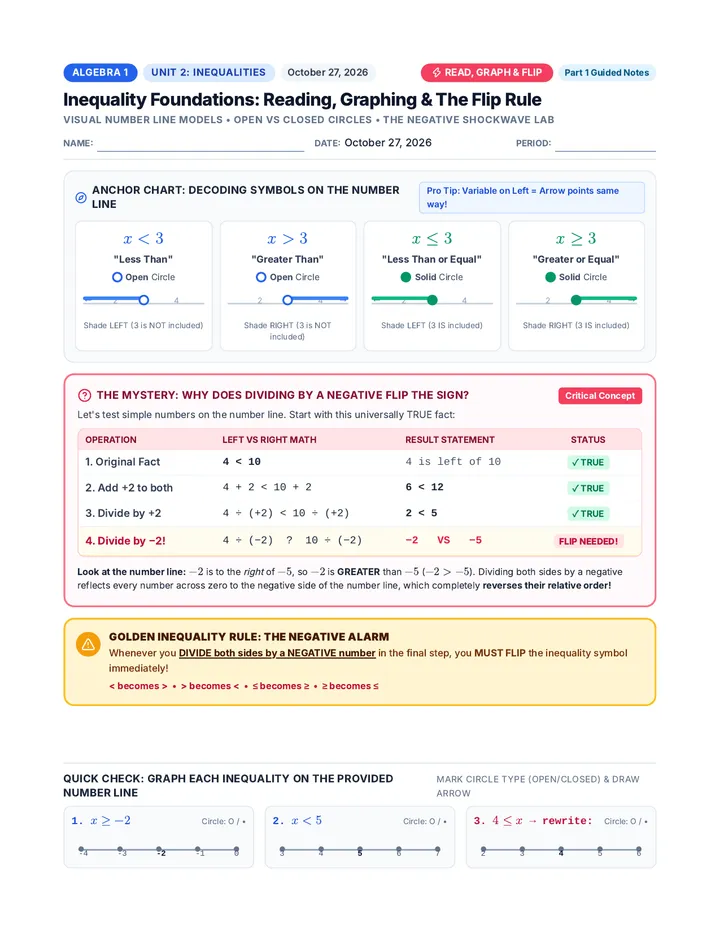
Name:
Date:
Period:
Function A Degree:
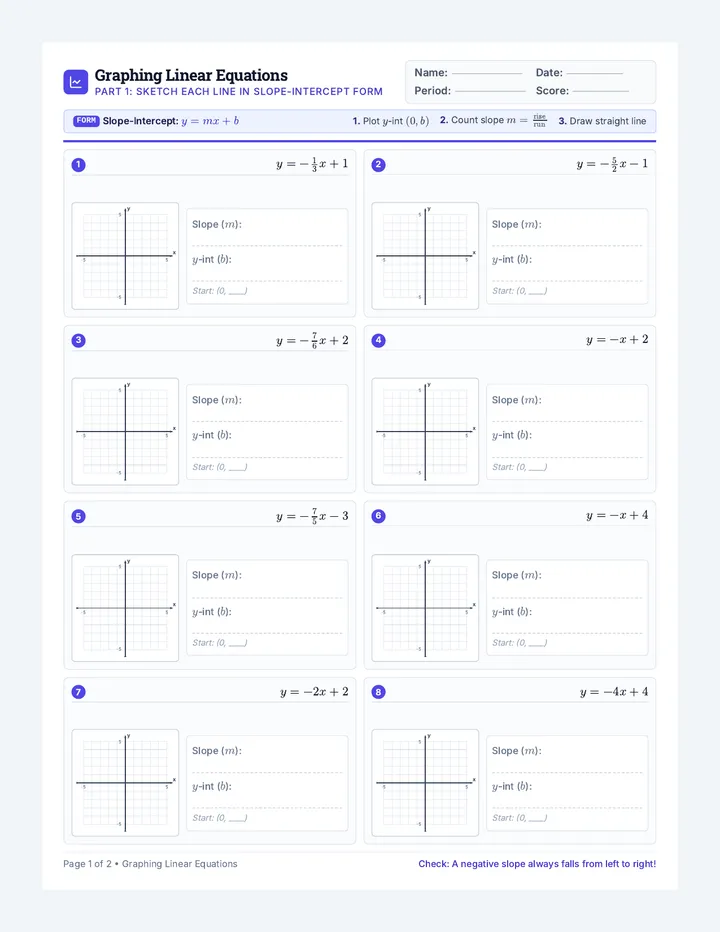
\(y = -\frac{2}{3}x + 3\)
1 2 3 4 -1 y 1 2 3 4 6 -2 x
Family: Linear Parent: \(y = x\)
Function B Degree:
\(y = x^2 - 1\)
1 3 5 7 10 -1 y 1 2 3 -1 -2 x
Family: Quadratic Parent: \(y = x^2\)
Key Feature Comparison Matrix Complete each cell using the graphs and equations above
| Characteristic | Function A: \(y = -\frac{2}{3}x + 3\) | Function B: \(y = x^2 - 1\) |
|---|
| Graph Shape & Symmetry | | |
| Shape: | | |
Axis of Symmetry:
|
Shape:
Axis of Symmetry:
|
| Intercepts |
\(y\)-intercept: ( 0, _____ )
\(x\)-intercept(s): ( _____, 0 )
|
\(y\)-intercept: ( 0, _____ )
\(x\)-intercept(s): ( _____, 0 ) and ( _____, 0 )
|
| Rate of Change |
Type: [ Constant / Variable ]
Slope (\(m\)):
|
Type: [ Constant / Variable ]
Decreasing on: | Inc on:
|
| Domain & Range |
Domain:
Range:
|
Domain:
Range:
|
| Extrema / Vertex |
Vertex: [ None / ( __, __ ) ]
Extrema:
|
Vertex: ( _____, _____ )
Minimum Value: \(y = \)
|
Overlap Organizer: Contrasts & Similarities
Write 2 distinct properties in each section
Unique to Function A (Linear)
e.g. constant slope, straight line
Shared by Both Functions
e.g. relation type, domain
Unique to Function B (Quadratic)
e.g. vertex, changing rate
Part II • Numerical & Analytical Patterns
Tables of Values, Differences & Systems
Verify relationships through finite differences and algebraic reasoning
Student Name:
Numerical Rate of Change: 1st vs. 2nd Differences
Calculate \(\Delta y\) and \(\Delta^2 y\) between consecutive rows
Function A: \(y = -\frac{2}{3}x + 3\)
| \(x\) | \(y = -\frac{2}{3}x + 3\) | 1st Diff (\(\Delta y\)) |
|---|
| -3 | 5 | — |
| 0 | 3 | |
| 3 | 1 | |
| 6 | -1 | |
| 9 | | |
Function B: \(y = x^2 - 1\)
| \(x\) | \(y = x^2 - 1\) | 1st Diff (\(\Delta y\)) | 2nd Diff (\(\Delta^2 y\)) |
|---|
| -2 | 3 | — | — |
| -1 | 0 | | — |
| 0 | -1 | | |
| 1 | 0 | | |
| 2 | 3 | | |
Finite Differences Rule: A relation is linear if the _______________ differences are constant. A relation is quadratic if the _______________ differences are constant.
System Intersection: When Line Meets Parabola
Algebraic setup & geometric interpretation
Intersection Possibilities:
How many points of intersection can exist between a line and a parabola?
[ 0 ] [ 1 ] [ 2 ]
Circle all possible solutions for any linear-quadratic system.
Setting the Equations Equal: \(x^2 - 1 = -\frac{2}{3}x + 3\)
Rearrange into standard quadratic form \(ax^2 + bx + c = 0\) and show your setup below:
Synthesis & Conceptual Reflection
Respond in complete mathematical sentences
1 Multi-Representation Test: How can you immediately distinguish a linear function from a quadratic function given only: (a) its algebraic equation, (b) its graph, and (c) a table of values?
2 Growth Rate & End Behavior: As \(x \to \infty\), describe the long-term behavior of \(y = -\frac{2}{3}x + 3\) versus \(y = x^2 - 1\). Which function will eventually dominate, and why?