Classify each scenario as Continuous (C) or Discrete (D):
A. Height of a sunflower as it grows over 60 days [ C | D ]
B. Number of movie tickets sold for Friday night [ C | D ]
C. Temperature of an oven cooling down over 45 minutes [ C | D ]
Jordan boxed a continuous graph starting at \(x = -2\) (solid dot) and ending at \(x = 5\) (solid dot), writing Domain as (-2, 5).
What was Jordan's error?
Key Takeaway Reflection
Why does interval notation use square brackets \([\;\;]\) for solid endpoints, but parentheses \((\;\;)\) for open circles?
4. Swapping Domain (\(x\)) and Range (\(y\)):
Students see vertical lines and think vertical axis (\(y\)).
Fix: Remind them that vertical lines slice across the horizontal \(x\)-axis, measuring left-to-right span.
Differentiation Strategies Interval Notation Scaffolds
Support / Scaffolding: Have students draw the rectangle in pencil and write “Left”, “Right”, “Bottom”, “Top” on the box walls before writing the interval.
Extension / Challenge: Ask students to draw their own continuous curve that begins and ends and has a specified domain of \([-5, 2)\) and range of \([-1, 4]\).
Answer Key • Interval Notation
Teacher Reference
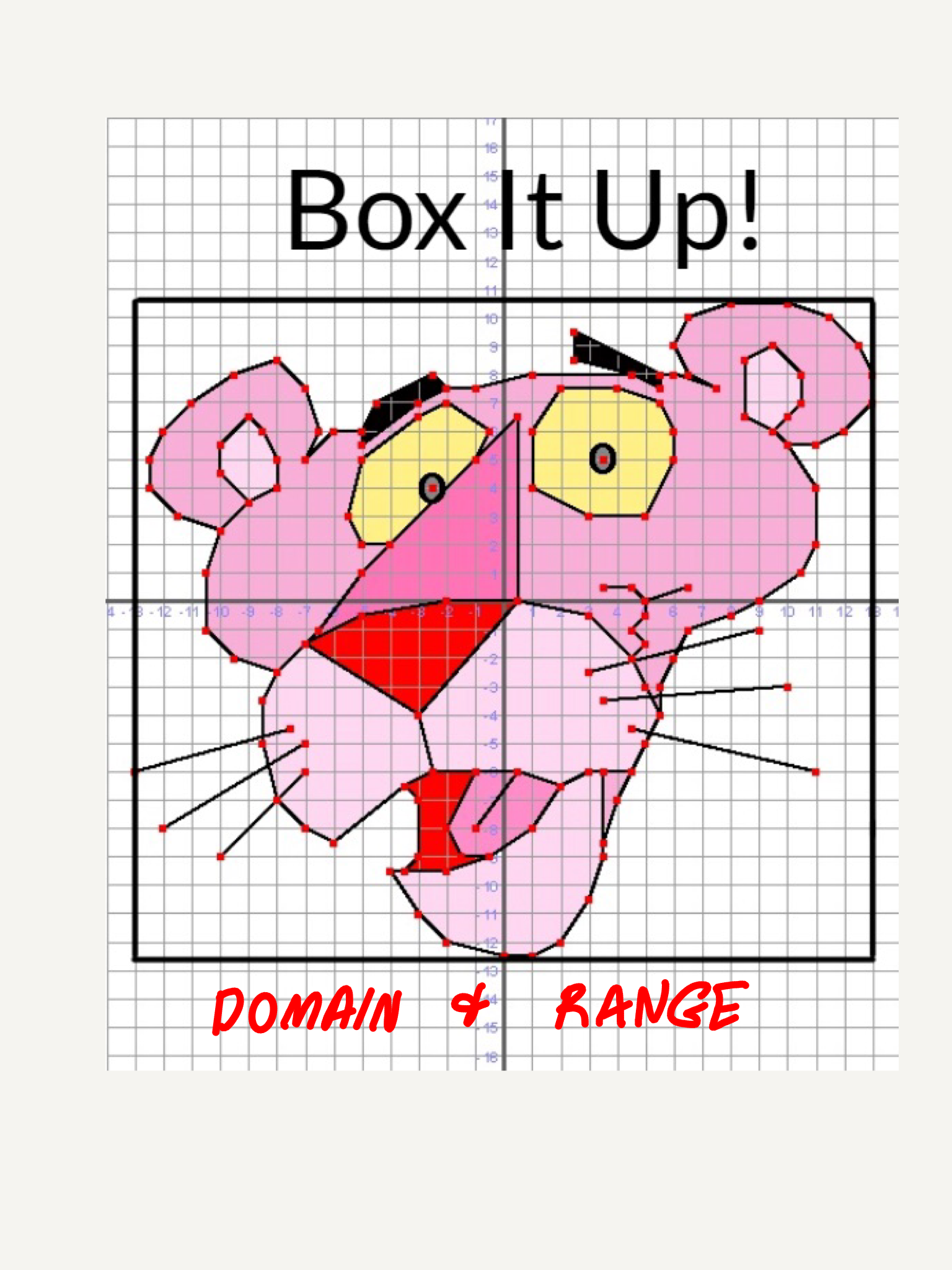
Part 1: The Pink Panther Warm-Up Interval Notation Key
Left Vertical Wall: \(x = -14\)
Right Vertical Wall: \(x = 13\)
Domain: [-14, 13]
Bottom Wall (Floor): \(y = -13\)
Top Wall (Ceiling): \(y = 11\)
Range: [-13, 11]
Problem 1: Linear Segment
Box boundaries: Left \(x = -4\) (solid), Right \(x = 3\) (open), Bottom \(y = -2\) (solid), Top \(y = 4\) (open).
Domain: [-4, 3)
Range: [-2, 4)
Problem 2: Quadratic U-Curve
Box boundaries: Left \(x = -3\) (solid), Right \(x = 3\) (solid), Floor \(y = -3\) (vertex min), Ceiling \(y = 3\) (endpoints).
Domain: [-3, 3]
Range: [-3, 3]
Problem 3: Continuous S-Curve
Domain: [-4, 4]
Range: [-3, 4]
Both endpoints are solid dots, so brackets are used throughout.
Problem 4: Inverted V-Graph
Domain: (-3, 4]
Range: (-3, 4]
Left/bottom endpoint is open; peak vertex at \(y=4\) is solid.
Problem 5: Bounded Arc (No Arrows)
Domain: [-4, 3)
Range: [-2, 3)
Begins at \((-4, -2)\) [solid], ends at \((3, 3)\) [open].
Problem 6: Closed Loop (Ellipse)
Domain: [-3, 3]
Range: [-2, 2]
Continuous smooth curve bounded by \(x = \pm 3\) and \(y = \pm 2\).
Real-World Scenario Answers
Jordan's Interval Error Solution
Error: Jordan used parentheses (-2, 5) instead of square brackets [-2, 5]. Because both endpoints are solid dots, the values \(-2\) and \(5\) are included in the domain. Parentheses are strictly reserved for open circles (excluded values).
Exit Ticket Exemplar Response
"In interval notation, a square bracket \([\;\;]\) means the boundary value is included (filled-in solid dot or continuous line). A round parenthesis \((\;\;)\) means the boundary value is excluded (open hole), meaning the graph gets infinitely close to that number but does not actually include it."
Domain: \([-3, 3]\) • \(-3 \le x \le 3\)
Range: \([-3, 3]\) • \(-3 \le y \le 3\)
All 4 sides end at definite numbers.
AFTER: Two 90° Corner Arrows! Goes Forever
Floor ends at \(y = -3\). Top corners have arrows that go forever!
Domain: \((-\infty, \infty)\) • All Reals \(\mathbb{R}\)
Range: \([-3, \infty)\) • \(y \ge -3\)
• 90° arrows point left & right forever → Domain is All Real Numbers!
Floor actually ends at vertex; top corners have arrows going forever! Slide 4 of 6
Notation Translator
Symbol Guide
Left wall ends at \(a\) \(x \ge a\) • \([a, \infty)\)
Right wall ends at \(b\) \(x \le b\) • \((-\infty, b]\)
Floor ends at \(c\) \(y \ge c\) • \([c, \infty)\)
Points right forever \(x \rightarrow +\infty\)
Points left forever \(x \rightarrow -\infty\)
Arrows on both sides All Reals (\(\mathbb{R}\))
Where the box ends = write the number • Where the arrow points = goes to \(\infty\) Slide 5 of 6
Action Plan
Ready for Practice!
1
Draw a bounding box around the visible curve.
Draw Box
2
Does each side actually end, or is there an arrow?
Ask the Question
3
If there is an arrow, draw 90° corner arrows on the box.
Mark Infinity
4
Solid wall = number • Corner arrow = \(\pm\infty\).
Write Notation
Now open your Beyond the Box Worksheet and ask the question on every graph! Slide 6 of 6
4. Inverted Parabola Vertex Peak at \((1, 4)\)
x y 1 4
Does top end? YES at vertex \(y=4\). Do sides/bottom end? NO → 90° arrows!
Domain:
Ineq: ________ Int: ________
Range:
Ineq: ________ Int: ________
5. Absolute Value V-Graph Vertex at \((-1, -2)\)
x y -1 -2
Does floor end? YES at vertex \(y=-2\). Do sides/top end? NO → 90° arrows!
Domain:
Ineq: ________ Int: ________
Range:
Ineq: ________ Int: ________
6. Continuous Curve (1 Arrow) Starts at \((-3, -2)\)
x y -3 -2
Does left end? YES (\(x=-3\)). Floor? YES (\(y=-2\)). Top-right? NO (Arrow)!
Domain:
Ineq: ________ Int: ________
Range:
Ineq: ________ Int: ________
1. If a side ends at a dot or peak → Write that fixed number (e.g., \(x \ge -3\)).
2. If a corner has an arrow → Put a 90° corner arrow indicating \(+\infty\) or \(-\infty\).
3. If arrows extend in both directions → Write All Real Numbers (\(\mathbb{R}\)).
Alex analyzed an upward parabola with vertex at \((2, -4)\) and wrote the range as -4 ≤ y ≤ ∞.
Why is this incorrect? What should it be?
Exit Ticket Reflection
After boxing a graph, why is it essential to ask: “Does the box actually end here or does it have an arrow?”
4. Misidentifying Left vs. Right Arrows:
Students struggle with negative infinity.
Fix: “Arrows pointing left or down always lead to \(-\infty\). Arrows pointing right or up lead to \(+\infty\).”
Differentiation Strategies Questioning Scaffolds
Support / Scaffolding: Have students tap each of the 4 walls and verbally answer: “Ends at [number]” or “Goes forever with arrow.”
Extension / Challenge: Ask students to draw a function whose box has corner arrows on 3 corners (e.g., cubic curve with restricted left domain).
Answer Key • Lesson 2
Teacher Reference
Part 1: Transformation Investigation Solutions Decision Check Solutions
Graph 1B (Arrow added to Top-Right):
Does it end? Left ends at \(-4\); floor ends at \(-2\). Top-right goes forever!
Domain: [-4, ∞) • x ≥ -4
Range: [-2, ∞) • y ≥ -2
Graph 2B (Two Arrows added to Parabola):
Does it end? Floor ends at vertex \(-3\). Sides and top go forever!
Domain: (-∞, ∞) • All Real Numbers (ℜ)
Range: [-3, ∞) • y ≥ -3
Problem 3: Downward Ray
Decision Check: Left ends at \(-2\); ceiling ends at \(3\). Bottom-right goes forever.
Domain: x ≥ -2 • [-2, ∞)
Range: y ≤ 3 • (-∞, 3]
Problem 4: Inverted Parabola
Decision Check: Top ends at vertex \(y=4\). Both bottom corners go forever.
Domain: All Reals (ℜ) • (-∞, ∞)
Range: y ≤ 4 • (-∞, 4]
Problem 5: Absolute Value V-Graph
Decision Check: Floor ends at vertex \(y=-2\). Both top corners go forever.
Domain: All Reals (ℜ) • (-∞, ∞)
Range: y ≥ -2 • [-2, ∞)
Problem 6: Continuous Curve (1 Arrow)
Decision Check: Left ends at \(-3\); floor ends at \(-2\). Top-right goes forever.
Domain: x ≥ -3 • [-3, ∞)
Range: y ≥ -2 • [-2, ∞)
Decision Rule Summary
Alex's Error Analysis Solution
Error: Alex wrote -4 ≤ y ≤ ∞. Infinity is not a stopping number. By asking “Does the top end?”, Alex would realize the top does NOT end, so there is no ceiling to bound the inequality. The correct range is y ≥ -4 (or [-4, ∞)).
Exit Ticket Exemplar Response
“Asking 'Does the box actually end here or does it have an arrow?' is essential because it stops students from assuming every box has fixed boundaries. If a side ends at a dot or peak, that side provides a fixed coordinate number. If it has an arrow that goes on forever, that side breaks open into a 90° corner arrow representing infinity, showing that only a single inequality is needed.”